Showing posts with label cultural misogyny. Show all posts

Wednesday, June 17, 2026

MUÑECA, sapphic gothic tale in 1960s Oakland


MUÑECA
CYNTHIA GÓMEZ

G.P. Putnam's Sons (non-affiliate Bookshop.org link)
$14.99 ebook, available now

Rating: 4* of five

The Publisher Says: A vivid, surreal Gothic about a queer, Latine, working class witch who sets out to rescue a bespelled heiress and loses control of her powers and her heart in the process.

It is 1968 Oakland, and Natalia Fuentes has been hearing rumors about the beautiful Violeta Miramontes. The young heiress to Spanish colonial wealth has been left paralyzed by a mysterious illness. But Nati knows a thing or two about witchcraft, and she is certain that this is the work of dark magic.

Armed with a plan to break the spell and earn a handsome reward, Nati works her way into the house as Violeta’s caretaker, and immediately discovers her suspicions are true. But who cursed Violeta? And why?

As feelings between the two women bloom into romance, Nati grows more and more reckless, and is forced to face her own ghosts—ones she hoped would stay gone forever.

Riveting and richly layered, Muñeca explores how far one will go to save the person they love—even if that means damning themselves. Cynthia Gómez fills her debut novel with moments that chill your bones and warm your heart, a razor-sharp examination of deep-rooted issues that will haunt readers long after the last page is turned.

I RECEIVED A DRC FROM THE PUBLISHER VIA NETGALLEY. THANK YOU.

My Review
: Oakland, California, gets very little love in the literary world. From Gertrude Stein's famous "there is no there there" quip to this very day, Oakland is mostly just the place that's across the bay from San Francisco. This novella/short novel (under 200pp) is set there in 1968, a fraught time before Stonewall ignited the gay-rights movement but after the Black Panther Party was founded there. Oakland was bubbling and seething with the energy of change that so spectacularly fizzled out in the malaise of the 1970s.

Nati is the perfect PoV for a supernatural suspense novel set in 1968 Oakland: she's a closeted lesbian with a hidden extraordinary ability, heir to a line of women who work outside the norms of their society...their white society, the Overculture whose very definition creates or at least delineates repressive, controlling, often authoritarian conformity. Nati does not live within the Overculture's rules though she largely disappears into its strictures by hiding in plain sight. She takes her revenge on those who keep her down because she's a brown-skinned woman by nibbling at the edges, by not accepting what she must obey, by taking a bit here and there. Her chance to exact serious revenge on her late mother's former employers is her cue to grab more for herself.

Only that more proves to be the love and the essence of the family, Violeta. A trapped woman subject to a greedy man's whims, an heiress and a pawn, Violeta is the path for Nati's revenge to manifest itself in the world. Gothic hero stuff ensues as Violeta is the gothic heroine all helpless and needing rescue from a lingering death. Nati does everything she can to break Violeta out of her helplessness, using her not-ordinary familial talents and learning in a 1968 that dismisses suchlike goins-on.

The novellaness of the story shows to disadvantage here. In the rush to resolve Violeta's disability, Nati is kept very busy indeed. She's actively working her magic, she's taking responsibilities in Violeta's life, she's even willing to do the dark work of self-healing. It means I felt knackered by the end of the read, there was so much happening in a tight window of time.

It's a four-star read because I was too tired to press the button for a fifth star. I was delighted by Nati, by her craft and her craftiness. I really wanted to spend more time with her, maybe just hang out while learning about her childhood in and around the Miramontes clan when her mama worked for them, learning about her earlier life with the class divide rigidly in place.

Still and finally a solidly fun sapphic gothic tale of revenge and vengeance and avenging wrongs all happening at once.

Sunday, December 7, 2025

SOME STRANGE MUSIC DRAWS ME IN: A Novel, trans awakening story


SOME STRANGE MUSIC DRAWS ME IN: A Novel
GRIFFIN HANSBURY

W. W. Norton & Company (non-affiliate Bookshop.org link)
$16.99 ebook, available now

Rating: 4* of five

The Publisher Says: From an award-winning author, this provocative novel tells an emotionally gripping story about friendship, family, and transgender awakening in a working-class American town.

It’s the summer of 1984 in Swaffham, Massachusetts, when Mel (short for Melanie) meets Sylvia, a tough-as-nails trans woman whose shameless swagger inspires Mel’s dawning self-awareness. But Sylvia’s presence sparks fury among her neighbors and throws Mel into conflict with her mother and best friend. Decades later, in 2019, Max (formerly Mel) is on probation from his teaching job for, ironically, defying speech codes around trans identity. Back in Swaffham, he must navigate life as part of a fractured family and face his own role in the disasters of the past.

Populated by a cast of unforgettable characters, Some Strange Music Draws Me In is a propulsive page turner about multiple electrifying relationships—between a working-class mother and her queer child, between a trans man and his right-wing sister, and between a teenager and her troubled best friend. Griffin Hansbury, in elegant, arresting, and fearless prose, dares to explore taboos around gender and class as he offers a deeply moving portrait of friendship, family, and a girlhood lived sideways. A timely and captivating narrative of self-realization amid the everyday violence of small-town intolerance, Some Strange Music Draws Me In builds to an explosive conclusion, illuminating the unexpected ways that difference can provide a ticket to liberation.

I RECEIVED A DRC FROM THE PUBLISHER VIA EDELWEISS+. THANK YOU.

My Review
: There is always a class divide in capitalist societies. There are reinforced, heteronormative binaries; there are intense pressures to conform. In 1984, these things were unquestioned, and enforced by laws prohibiting "crossdressing" and enabling parents to abuse and harm their children physically and psychically to "straighten them out."

There was a lot more, but that's plenty for now, if you weren't there you should be glad you missed the AIDS deaths, the hoo-rah for Reagan shit, the pillaging of Social Security...oh dear, starting to sound familiar? Oh, I forgot: the war on workers, the plant closures, the pension-fund thefts....

None of that shit is foregrounded but it very much makes the attitude (transfem) Sylvia carries, downright truculent, make more sense than it already does. Melanie...Mel...is attracted to Sylvia for her serious edge, her survivor's black humor, her wealth of knowledge Mel wants and needs. Mel wants to become Max. Mel has no way to verbalize that, has no framework to put a new mind into, is reeling from the very existence of someone...someone she knows...holding a slightly skewed mirror to her thus showing that she is real, there are others.

Of course, capitalist patriarchy is not about to let Mel go.

I'm queer but not trans; I've known it since 1966 without knowing what it was or meant, just that it was me. As a male, my path was hugely easier than Mel's or even Sylvia's. I got threatened and bullied in school. No one ever followed through because I'm also large and tall. It was entirely bad enough; these characters would've given anything to be in my so-easy place. I hurt for them now, in this miraculously better world we've wrestled into being that can never be left to just run the right way because "They"...the god squad, the macho pindicks, the scumbag transphobes...will not allow it. Our lives, our happiness, our progress, all threaten "Them" in some inexplicable way.

I still don't get that. I have the one "christian" sister who said to my face (okay, my ear, it was by phone) that gay marriage threatened her church because "what if "They" make us perform a wedding?! It will diminish my marriage!"

I was more patient then and did not simply hang up and never speak to her again. We had a discussion, but I was so sick with rage that I remember little of it except telling her that if someone sued their church to force them to marry a couple queers I'd contribute heavily to their legal defense fund.

Again, this is mild compared to what the characters face in this story.

It's never been easy to be Other. It leads to the emotional and physical violence of being Othered. As the story moves from 1984 to 2019, I felt a lot of the emotional rawness, the highs and the lows, leaching out; the author wanted, like me, to make some points, and in the context of a novel that drains dramatic tension below optimal levels. It doesn't ever recover, though. We get a satisfactory ending where from the jump I was primed by the intensity of the story for a satisfying one. It's not bad, it's not poorly thought out; it just didn't go to the next level. Things like Mel becoming Max don't resonate like the woofers at a concert because we never delve, or even dabble, in the dysphoria inherent in transness pre-transition; we don't get, let's say, the bathroom-usage nightmares that make the pervasiveness of transphobia and its implicit capacity for potential lethality immediate.

So I land on four stars and strongly recommend you give this (after some probing questions, though) to someone trans you know and love. I think they'll really mean the thank you they offer.

Monday, September 1, 2025

HASSOUNA MOSBAHI'S PAGE: WE NEVER SWIM IN THE SAME RIVER TWICE, both a truism and an Eternal Verity; and SOLITAIRE: A Novel, a title very fitting


WE NEVER SWIM IN THE SAME RIVER TWICE
HASSOUNA MOSBAHI
(tr. William Maynard Hutchins)
Syracuse University Press
$32.95 trade paper, available now

Rating: 3.75* of five

The Publisher Says: Originally published in 2020, Hassouna Mosbahi’s riveting novel explores the human psyche amidst the turbulent aftermath of the Arab Spring in Tunisia. Through the experiences of three friends, Mosbahi narrates the profound impact of violence and cultural change in Tunisian society and the ways in which those shifts are reflected in their personal lives.

We meet Saleem, on the brink of turning fifty, whose once blissful marriage teeters on the edge as his mental health deteriorates. Aziz, a retired postal clerk with an unassuming appearance, finds solace in literature and international cinema. And Omran, a well-traveled writer and public intellectual, navigates a complex relationship with a young Franco-Tunisian woman who lives in Paris. As these men forge an unlikely friendship over drinks at a coastal bar in Bizerte, and through long walks along the beach, they grapple with the increasing political extremism that surrounds them. Repelled by the Jihadist rhetoric and the brand of masculinity it represents, the three friends question their relationship to their country, which is both their home and a place they feel alienated from.

We Never Swim in the Same River Twice offers an alternative narrative of the Arab Spring, one that challenges Western media’s depiction of a “blessed revolution,” and gives readers an intimate and elegiac portrait of Tunisian history.

I RECEIVED A DRC FROM THE PUBLISHER VIA EDELWEISS+. THANK YOU.

My Review
: William Maynard Hutchins, who translated this story, is soeone whose work I admire and seek out. He came to my attention thirty-plus years ago when I first read, and loved, Naguib Mahfouz's Cairo Trilogy. In the hands of a less skiled translator that somewhat sudsy family saga could've become cloyingly moralistic...a fate that befell the later translation of Midaq Alley in my opinion.

I've been at a loss; this book did not irresistibly draw me in, but it's much better than most books I read. It's not to my taste. Its message very much is. Then I read World Literature Today's review of it, by M.D. Allen, of whom I've never heard before: (link: https://worldliteraturetoday.org/2025/july/we-never-swim-same-river-twice-hassouna-mosbahi)
...{visiting} a newly independent Algeria makes {the author's stand-in} consider that the Islamist establishment there also now misrepresents the protracted and bloody war that has just ended as having been fought not against colonial rule but in favor of “fatwas advocating violence, [and] a culture of hatred and loathing.”

Mosbahi’s high reputation as a novelist will not be hurt by this very readable work, which gives a vivid if not especially pleasant picture of post–Arab Spring Tunisia; nor will anyone but the most intransigent of his political opponents deny his moral courage.
This is a message I can not help but support, said however, aimed wherever, in whichever language of culture. Moral courage IN PUBLIC is more important now than it has ever been in my lifetime, though I stipulate that it is not and has never been unimportant.

+++++++++++++++++++++++++++++++++++++++++++++++++++++++++++++++


SOLITAIRE: A Novel
HASSOUNA MOSBAHI

Syracuse University Press (non-affiliate Bookshop.org link)
$24.95 all editions, available now

Rating: 3.5* of five

The Publisher Says: In Hassouna Mosbahi’s engrossing and keenly observed novel, he takes readers deep into one day in the life of Yunus, a Tunisian intellectual.

A professor of French language and Flaubert specialist, Yunus is recently retired and separated from his wife, as he leaves the city to settle in the Tunisian coastal city of Nabeul.

Searching for solitude, he hopes to spend the remainder of his life among the books he loves.

On the day of his sixtieth birthday, Yunus plunges into a delayed midlife crisis as he reflects on the major moments in his life, from taking up writing as a young man to his career as a university professor to his failed marriage.

Yunus’s identity crisis mirrors that of his Tunisian homeland with its tumultuous history of political and cultural upheaval.

He meditates on the lives of his friends, drawing from his memory a colorful cast of characters whose experiences reflect the outsized influence of religion and tradition in their lives.

Through the eyes of Yunus, Mosbahi’s elegiac, literary novel explores life and death, love and writing, and the relationship between puritanism and extremism in the Arab world today.

I RECEIVED A DRC FROM THE PUBLISHER VIA EDELWEISS+. THANK YOU.

My Review
: Quiet ruminations of a man younger than me that I'd've hated at forty, been scared by at fifty, and...uncomfortably...relate to at *mumble*ty-five.
I seemed to be a dead man granted a chance to observe the joy of life from the darkness of the tomb. The glass escaped from my hand, and shards of its glass flew across the kitchen floor. I did not hear the laughter overflowing with love that a smashing glass had inspired in a poet—it may have been Apollinaire, Eluard, or someone else. What I heard was my spirit splintering like the dry bough of a green tree. I left the kitchen and went to the bedroom to curl up in bed. I closed my eyes, wishing to flee from my black soul to another world. At some moment, a different vision of my country dawned on me—not the vague, gloomy one I had grown accustomed to harboring as an expatriate. It came to me with the radiant light of a Mediterranean morning on the beach at Les Grottes in Bizerte, green and fragrant like the vineyards and the orchards of figs and almonds in the spring at Raf Raf, dreamy like sunset in the oases of el-Djerid, and white and blue like the houses in Sidi Bou Said. I leapt out of bed happily, like someone who had long misplaced something and found it again after despairing that he ever would find it. So, I returned to my fatherland.
It's nice, and it's resonant...I felt the same way returning to New York after exile in Texas...but y'all, do not overlook that "fatherland" ending this passage. This is not a western country but a westernized one, and it really shows. There are assumptions inside this narrative invisible to a Tunisian man of a certain age, women exist in relation to me being the most toxic one.

It's not unusual, honestly, in literature from anywhere to see men taking women for granted. It bothers me more now than ever because the world is at the intersection of multiple crises and can not remotely afford to turn away minds and hands needed to figure out then apply solutions to the problems we face.

A shame it's not so stone-cold simple, and obvious, to the old white men desperately clinging to power.

As I was saying...Author Mosbahi has some assumptions that jangle warning bells in my 21st-century-woke mind. The narrator, still less the author, demonstrate the remotest awareness of their cultural blinders, which the best, the most successful critically anyway, US writers are at long last coming to do. We've all got miles to go before we sleep.

Wednesday, April 2, 2025

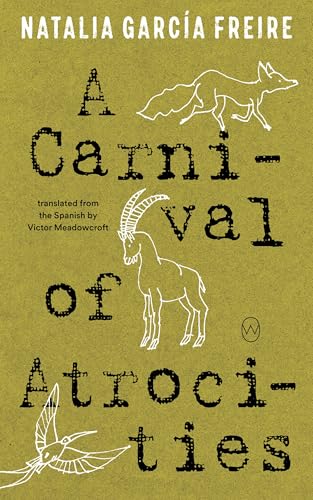
A CARNIVAL OF ATROCITIES, things going wrong? blame a woman!


A CARNIVAL OF ATROCITIES
NATALIA CARCÍA FREIRE
(tr. Victor Meadowcroft)
World Editions (non-affiliate Amazon link)
$14.99 ebook, available now

Rating: 5* of five

The Publisher Says: The residents of a desolate town nestled in the Ecuadorian Andes are forced to reckon with the legend of Mildred, a girl wronged by the town years ago

Cocuán, a desolate town nestled between the hot jungle and the frigid Andes, is about to slip away from memory. This is where Mildred was born, and where everything she had—her animals, her home, her lands—was taken from her after her mother’s death. Years later, a series of strange events, disappearances, and outbursts of collective delirium will force its residents to reckon with the legend of old Mildred. Once again, they will feel the shadow of death that has hung over the town ever since she was wronged. The voices of nine characters—Mildred, Ezequiel, Agustina, Manzi, Carmen, Víctor, Baltasar, Hermosina, and Filatelio—tell us of the past and present of that doomed place and Mildred's fate.

Natalia García Freire’s vivid language blurs the lines between dreams and reality and transports the reader to the hypnotic Andean universe of Ecuador.

I RECEIVED A DRC FROM THE PUBLISHER VIA EDELWEISS+. THANK YOU.

My Review
: Nine PoVs in under 160pp. Why is my rating even a speck over 3 stars?

Mildred.

How perfect that her memory is, not celebrated exactly, but very much incorporated into the life of the town she was Othered, abused, and abandoned by in life. She never once left the midrange of the townsfolk's memories. Funny about that, since all she ever got was a grudging corner in life. Now Cocuán, never a place that loomed large on the world's stage (or even Ecuador's), is slowly and steadily vanishing. It's an unnerving process to read about. The place is, under the pressure of shared guilt, Brigadooning itself as monsters (real? psychic?) claim all of Cocuán.

Told in the kind of prose that I'm reluctant to call "dreamlike" because that means all y'all will click away in search of meatier fare, it's akin to a folktale. A kind of Silver John the Balladeer reading experience. The nine (9) PoVs all expand, like in the Appalachian folktales I've referenced, the reach of Mildred's...presence? ghost? transitional object-iveness?...serves to illuminate the magic in magical realism. She (please attend to pronoun) is killing the place that killed her by causing (how?) the trauma they inflicted on her to make itself manifest in themselves. Revenge? Whose, and on whom?

It is as easy to see Mildred as Silver John the Balladeer's rejected suitor Evadare, pining unto death for what she is denied in life, as it is to see her as John the competent and potent restorer of ma'at to the town. It's a role that folktales love, the bringer of justice and balance who is not quite of this world, but was, and still cares about it.

As easily as that more esoteric take I can defend this story as a restoration of justice for a victim of cultural misogyny, whose maltreatment and displacement by the town was so deeply unjust that it haunts each perpetrator or passive unsavior unto death. The town's vanishing because their collective responsibility to a woman seeking only to exercise the rights they all demand to life and liberty signally failed. They project onto the space called Mildred all the consequences of their failings as women have always endured. Every bad thing is someone else's fault, never one's own. Othering and blaming Mildred for the forces shutting down their town gives Cocuán double psychic relief: exoneration for how they treated her, and an explanation for the advancing death rattles of Cocuán.

Plus it's got cool monstrous doins!

Real or fantasy, Mildred and Cocuán and their wildly entangled realities, as the author and the translator have thrown into relief with words of the most precisely calculated illumination, get all five stars from me.

Tuesday, February 11, 2025

LIVING IN YOUR LIGHT, sad acknowledgment of power denied, flouted, repressed


LIVING IN YOUR LIGHT
ABDELLAH TAÏA
(tr. Emma Ramadan)
Seven Stories Press (non-affiliate Amazon link)
$12.99 ebook edition, available for pre-order

Rating: 4.75* of five

One of LitHub's 100 Notable Small Press Books for 2025!

The Publisher Says: A story in in praise of a woman, a fighter, a survivor from the award-winning French-Moroccan novelist known for humanizing North Africa’s otherwise marginalized characters—prostitutes and thieves, trans and gay people in a world where being LGBTQ+ can be a dangerous act.

Shortlisted for the prestigious Prix Goncourt in 2022.


Three moments in the life of Malika, a Moroccan countrywoman is her voice we hear in Abdellah Taïa’s stunning new novel, translated by Emma Ramadan, who won the PEN Translation Prize for her translation of Taïa’s last novel, A Country for Dying.

Malika’s first husband was sent by the French to fight in Indochina, the novel takes place from 1954 to 1999—from French colonization to the death of King Hassan II. In the 1960s, in Rabat, she does everything possible to prevent her daughter Khadija from becoming a maid in a rich French woman’s villa. The day before the death of Hassan II, a young homosexual thief, Jaâfar, enters her home and wants to kill her. Malika recounts with rage her strategies to escape the injustices of history. To survive and to have a little space of her own.

Malika is Taïa’s M'Barka Allali Taïa (1930-2010). This book is dedicated to her.

I RECEIVED A DRC FROM THE PUBLISHER VIA EDELWEISS+. THANK YOU.

My Review
: I read Taïa's novels to feel the world as I experience it from a the experience of a true stranger...étranger, foreigner, other, Other, the French don't parse things down near as fine-tipped as Anglophones do...who, like me, believes queer desire runs the world.

Save it, apologists for the inversion of nature that is hetero identity, it's just unnatural or we wouldn't have so many bloody-minded religious and civil laws shoring it up. One doesn't prohibit what people don't like.

As I was saying before that irritated tangent: Taïa’s stories center queer desire, feature queer people, are about things we understand a little differently than hetero people do. It's like a warm blanket in a freezing, windy steppe that isn't for you, doesn't give a shit about your happiness or satisfaction unless it somehow comes up and gives "them" a frisson of what you're expected to endure your entire life in which case shut up and stop bothering "them". This is Taïa’s reality, and thus where his fiction lives. It's a whole lot worse in god-ridden spaces than it currently is in the US.

So how does this relate to a story about Malika, an aging mother of eight whose life is ending, but whose track record is not close to what she ever wanted it to be? Her tragic inflection points are all around collisions with Authority, a thing every QUILTBAGger is deeply, existentially familiar with. She fails to keep her first husband home from the war that kills him, despite it being fought for the same people who have colonized their country. She fails to convince her money-motivated daughter to eschew the colonialist inducement of cash for submission and become a mail in a wealthy French family's service. Lastly, her gay son chooses his identity over her idea of duty to their country after he is raped by men in their neighborhood who claim to hate homosexuals...yet exert their sexual rights as straight men by fucking him...Rape is a crime of power, an abuse of autonomy and self-ownership, not sex itself, of course. That's pretty well established as fact. But someone needs to explain to me, slowly and in simple words, how the sex act they're engaging in makes any sense in this framework, given male penetration requires a physiological state of excitement to a sexual object.

I don't get it. But I'm back on a tangent.

Malika wants her powerful will to be obeyed because she is Right. The problem is she's correct a lot of the time, but that's not enough for her...she must be Right, and that is uniformly fatal to successful imposition of one's will. In a long life of mixed emotional results, that central truth does not come clear for her. It's the human condition to live life backwards, learning more and more as the need for applicable knowledge diminishes. It's the reason to have elders in the family system, expandable to encompass every level of social organization...a thing Malika would've reveled in, but did herself out of by insisting she be seen as Right. The world needs us oldsters to give up our addiction to the powerful substance of Rightness, and accept they're doing it differently now so offer advice without judgment.


As if.

So we read stories. It helps us all make sense of each other, helps us see the humanity in people deeply and fundamentally not-U, in Mitford's 1955 formulation. I'd offer all five stars with a big smile if the story was longer, developing the parts I was most curious about...Malika's time under colonialism would be so fascinating to learn about!...but this récit isn't designed to do that, and as it is written, is a beautiful evovation of a complex woman's life as a second-class partially empowered participant in a wildly passionately tumultuous world.

Her contributions to that world's growth earn my four and three-quarters star rating for their telling here.

Sunday, December 1, 2024

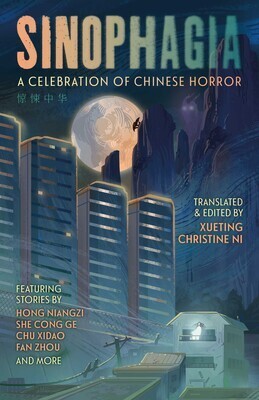
SINOPHAGIA: A Celebration of Chinese Horror, fourteen unsettling tales chosen and translated by Xueting Christine Ni


SINOPHAGIA: A Celebration of Chinese Horror
XUETING CHRISTINE NI
, editor and translator
Solaris Books
$16.99 trade paper, available now

Rating: 4.75* of five

The Publisher Says: An anthology of unsettling tales from contemporary China, translated into English for the very first time.

Fourteen dazzling horror stories delve deep into the psyche of modern China in this new anthology curated by acclaimed writer and essayist Xueting C. Ni, editor and translator of the British Fantasy Award-winning Sinopticon.

From the menacing vision of a red umbrella, to the ominous atmosphere of the Laughing Mountain; from the waking dream of virtual working to the sinister games of the locked room… this is a fascinating insight into the spine-chilling voices working within China today—a long way from the traditional expectations of hopping vampires and hanging ghosts.

I RECEIVED A DRC FROM THE AUTHOR. THANK YOU.

My Review
: These fourteen tales of eerie events, unnerving occurrences, and dreadful doings all work as a unit to dispel the expectations of Western readers that there is one Chinese way to "do" horror. We're accustomed to thinking of China in monolithic terms, as a single unitary entity with a single (incomprehensible) culture and language.

So here comes Xueting Christine Ni, one-person wrecking crew, to show us in the monolithic, culturally incurious West, what we're slowly coming to realize: There's a lot of great storytelling in the rest of the world, and it's hella fun to discover what creeps other folks out...and how often it creeps us out too. Which leads me to one of the oddest modern phenomena ever to make me snort: The content warning. These are horror stories. If you are not triggered by them all, at some level, they are not doing their collective job! I am not including them because, well, horror. The translator/editor is kinder than I am and includes a story-by-story list of them.

As is the custom of this country here (aka my blog), we'll go story-by-story with a note and rating, then a summation, or the Bryce Method as it's better known around here.

The Girl in the Rain by Hong Niangzi has the most eerie vibe...anything that smacks of perception manipulation gives me serious shuddering horrors.

As a way to start the collection, it's got a serious punch. It gets 4.5*.

The Waking Dream by Fan Zhou moves the perception manipulation up a notch, and uses it to fuel the more-expected among Western readers bodily pains and restraints. Is any of this real? Or is there a deep disturbance in the psyche? Is the disturbance in the psyche causing victimhood, or perpetration?

A combination I wasn't expecting, and that didn't really land in either direction, so 4*

Immortal Beauty by Chu Xidao is remorselessly, grindingly physical...abuse is horrifying, though not horror in my personal taste. I felt this was more a report of awful events than a story.

Least successful to me. 3*

Those Who Walk at Night, Walk With Ghosts by She Cong Ge adds bugs to the psychoterror, and does so in a way I was genuinely dreading. The disability angle caused my horripilation to become visible from across the room.

Affecting, upsetting, dark, and just plain nasty. 4*

The Yin Yang Pot by Chuan Ge was more or less a take on "The Girl in the Rain"'s themes...I was still very, very unsettled by the physical restraint aspect, as I always will be, but the perception manipulation in this story was what Did. Me. In.

I want to rate it "zero stars, do not recommend", so that means it did a 4.5* job of creeping me out.

The Shanxiao by Goodnight, Xiaoqing gets my CW because animals are abused. Do what you want to adults, but never harm an animal.

Two stars, because there's some very memorable, lurid non-animal-harm imagery.

Have You Heard of Ancient Glory? by Zhou Dedong did its level best to make my axniety circuits fry. Adding to perception manipulation the scourges of addiction, deliberate and intentional triggering of CPTSD, and mental illness issues galore, gave me a jolt that caused me to put the book down for a week. But I could not stop thinking about it during that week. Read the story again, and *click* on came the light: I am in this same headspace—but I can leave it!

That is a giant success. It's the story I'd call the most successful at what horror fiction does. 5*

Records of Xiang Xi by Nanpai Sanshu was unpleasant on every axis: Animal abuse, use of slurs and a kind of contemptuous belittling attitude, a sense of horrifyingly real entitlement, that repulsed me without the cathartic benefit of other stories. A grudging 2*

The Ghost Wedding by Yimei Tangguo did all of that, and more...but did not project the nauseating sense of entitlement, of an absolute right to inflict these horrors, which in my mind made this story (while unpleasant to me) less inexcusable and intolerable.

Evil exists. We must look at it to poultice away some of its toxic power and its appalling fascination. 3* because it was absolutely no fun at all to read, but does something I value.

Night Climb by Chi Hui felt like a Crimean vacation after a Moscow blizzard! Atmospheric and eerie, dread in place of horror, and a slammin' command of imagery.

Never so glad to give something I finished in shivers 4* in my life.

Forbidden Rooms by Zhou Haohui places too much of its harms on children. It doesn't do so gratuitously, and this isn't The Focus like in earlier stories, but...well...ew. I was interested, not repelled, by the slurs used in this story...honestly, human inventiveness is marvelous even when used for scumbaggery. Because this story's ending is what it is, I felt able to get to 4*

Tian'nang by Su Min trads the territories above, and really stomps the floorboards with it...felt like a tale meant to push you outside its narrative to compel you to look, really look, at what you're reading as an entertainment, not merely a story.

I could totally be projecting with this and it has no bearing whatever to the author's intent. But that's how I found it, and it worked well on that level. 3.5*

Huangcun by Cai Jun leans into the slur-use...for my taste, this is just plain ol' abuse meant to disgust. This, plus a hafty dose of graphic violence, could've led to a poor rating. The trick, when selling horror stories to an ambivalent consumer like me, is to bring the goods...this does...but to offer a level of reflection on, or assessment of, the goods in a differently slanted frame.

It's down to the prose in this story. In less adept hands, this would've sent me on my way for good. As it is, 4*

The Death of Nala by Gu Shi is the last story, and would've been no matter what because the animal harm was just too much for me. 3*

All in all the seasoned horror-reader will get the desired chills and thrills from these stories, and from some unexpected directions. I'm always sure that my horror reading is bog-standard until I get a horror title to read! I'm a complete wuss...animals and kids should be left alone. You can talk hauntings and demons all nigh, won't bother me a whit because I don't care, but hurt a creature that can't fight back and I am very angry.

So why did I rate this collection so highly? Because I learned a lot about what scares the Sinophone world. Because I am, like most in that world, stirred into fear and rage by the same sorts of things.

Because Xueting Ni has annotated this collection, you can go learn a lot if you like. If you don't care to do that, you can get your scary-story needs (whatever they may be) met here unbothered. I think it's a fine emotional investment.

Thursday, July 31, 2014

SAVING THE HOOKER, a lot funnier than the films it satirizes!


SAVING THE HOOKER
MICHAEL ADELBERG

The Permanent Press
$28.00 hardcover, available now

Rating: 3.5* of five

The Publisher Says: Matthew Hristahalois (Hrist-a-hal-E-os) is a not so scholarly scholar. He's obsessed with the "Hooker with a Heart of Gold" character that keeps turning up in movies like Pretty Woman and The Hangover—the beautiful and kind fallen woman who can only be saved by Prince Charming. Matthew wins a post-doc to see if real fallen women can be saved by a good man. He casts himself as Prince Charming and sets out to study and rehabilitate real New York City prostitutes, at least until he meets a fiery auburn-haired prostitute who calls herself Julia Roberts.

Saving the Hooker is a fast-paced assault on male hubris and the recycled fairy tales at the core of so many of our favorite books and movies. It is also a bawdy tour of lower Manhattan's escort service prostitution scene, a poke in the eye of academic orthodoxy, and a not-so-subtle send up of cable television talk-news. Centered on the combustible relationship between Matthew and Julia, Saving the Hooker makes comic hash out of modern America's show horse institutions and sacred cow issues: academia, high and low media, political correctness, misogyny, and sexual assault.

I RECEIVED AN ARC FROM THE PUBLISHER. THANK YOU.

My Review
: I don't at all enjoy the way women are portrayed in major-budget films. They're scheming scum, out to hurt every man they meet, or they're saintly supporters, human jock straps meant to keep Their Man's balls in the air no matter how hard gravity pulls on 'em. Thus there are mothers and wives, there are sex workers and assistants; there are not rivals and partners.

This sends the message that women exist for men, and have no valid existence aside from their relations with men. That being arrant nonsense, I long ago stopped enjoying any film that doesn't pass the Bechdel Test, and there are precious few of them. As the years pass, and as I grow to realize how few women actually think about men all that much, I realize that someone like Michael Adelberg is on to something. He's also almost alone in talking about it. I hope he's not as alone in thinking about it.

Sadly I suspect that he is.
I lied to my father about having a real girlfriend: I conned my old friends into thinking I was a dude with fun friends; and I pulled this off by financing sexual favors, including the loss of my own virginity, with the center’s research funds.

What makes the story of Matthew's search for the roots of the "Hooker with a Heart of Gold" tale as funny as it is, is the pace the author sustains. Humor needs speed. Slow, ponderous things aren't usually funny, or at least not intentionally. Here we're careening all around Manhattan as Matthew bounces off the pachinko bumpers of misogyny (presented humorously but not played for laughs) and its stablemate political correctness...condescending mealy-mouthed nonsense with a genuinely important impetus, to stop cruel and belittling stereotyping...thus ramming at speed into clueless men and resigned, angrily despairing women.
For four nights, I imagined introducing myself to Ms. Caliente and telling her that I was a researcher. I imagined buying her a cup of coffee and talking with her about Mexico and how she fell into hooking. I imagined her telling me that I was the first truly nice man she’d ever known.

Matthew's Pilgrim's Progress is speeded up by the connections his academic focus makes a variety of stake-holders take an interest in his purpose. The "Wolf News Channel" episode made me laugh very scornfully, I admit. But the problem, as any grown-up knows, is that this lifestyle is expensive and deep pockets aren't common in academia...or not for very long, anyway. And worst of all, when he snags a perfect research subject he discovers that he's what he always was: A means to someone else's end.

This is a funny, bitter, cynical read that has big ambitions and only just falls short of realizing them fully. While Matthew's research is on the right track, he's still just a guy without a clue when it comes to women. He doesn't see, and doesn't see that he doesn't see, the hard truth that he comes across as the kid who fell off the pickle truck as it made a hard left onto Tenth Avenue. When life makes it too obvious for him to ignore, he responds in the stereotypical man way.

I trust all my readers will remember why The Pilgrim's Progress came to be. Now apply that here. And there you have the missing stars! Not everyone will feel as I do, so by all means adventure a bit and pick one up.

I got so much of what I wanted that I'm really annoyed I didn't get it all.