Pages
- Home
- Mystery Series
- Bizarro, Fantasy & SF
- QUILTBAG...all genres
- Kindle Originals...all genres
- Politics & Social Issues
- Thrillers & True Crime
- Young Adult Books
- Poetry, Classics, Essays, Non-Fiction
- Science, Dinosaurs & Environmental Issues
- Literary Fiction & Short Story Collections
- Sookie Stackhouse/Southern Vampire Books & True Blood
- Books About Books, Authors & Biblioholism
Showing posts with label colonial legacy. Show all posts
Thursday, February 12, 2026
THE LAST OF EARTH, Tibetan national survival has been under threat forever
THE LAST OF EARTH
DEEPA ANAPPARA
Random House (non-affiliate Bookshop.org link)
$13.99 ebook, available now
Rating: 4* of five
The Publisher Says: From the award-winning author of Djinn Patrol on the Purple Line comes a stunning historical novel set in nineteenth-century Tibet that follows two outsiders—an Indian schoolteacher spying for the British Empire and an English “lady” explorer—as they venture into a forbidden kingdom.
1869. Tibet is closed to Europeans, an infuriating obstruction for the rap¬idly expanding British Empire. In response, Britain begins training Indians—permitted to cross borders that white men may not—to undertake illicit, dangerous surveying expeditions into Tibet.
Balram is one such surveyor-spy, an Indian schoolteacher who, for several years, has worked for the British, often alongside his dearest friend, Gyan. But Gyan went missing on his last expedition and is rumored to be imprisoned within Tibet. Desperate to rescue his friend, Balram agrees to guide an English captain on a foolhardy mission: After years of paying others to do the exploring, the captain, disguised as a monk, wants to personally chart a river that runs through southern Tibet. Their path will cross fatefully with that of another Westerner in disguise, fifty-year-old Katherine. Denied a fellowship in the all-male Royal Geographical Society in London, she intends to be the first European woman to reach Lhasa.
As Balram and Katherine make their way into Tibet, they will face storms and bandits, snow leopards and soldiers, fevers and frostbite. What’s more, they will have to battle their own doubts, ambitions, grief, and pasts in order to survive the treacherous landscape.
A polyphonic novel about the various ways humans try to leave a mark on the world—from the enduring nature of family and friendship to the egomania and obsessions of the colonial enterprise—The Last of Earth confirms Deepa Anappara as one of our greatest and most ambitious storytellers.
I RECEIVED A DRC FROM THE PUBLISHER VIA NETGALLEY. THANK YOU.
My Review: Tibet closed itself off from the Western powers playing "the Great Game," as it was dismissively described from 1840 onwards, because they saw its awful effects on India, Nepal, Burma, and China. The British took this as a challenge, like Katherine in this story...a mixed-race woman thwarted in desire to join the Royal Geographical Society despite her surveying achievements. They set about circumventing the Tibetans' desire to be left in peace (Katherine by disguising herself to become the first European woman to enter Lhasa) by training Indians like Balram in this story to survey the land for them. These men and one pretender disguise their purpose by the faking the trading of goods into and out of the country, pretending to be religious pilgrims visiting the holy places, and other subterfuges. (When your country covers the headwaters of the main waterways serving multiple billions of people, isolation is an untenable fantasy.)
The novel begins in 1869, a time when Tibet was also fighting the Qing Dynasty for territorial integrity. Its diplomatice relations with Nepal were strained by this series of wars. It is, then, a story of people doing things that are reprehensible and selfish at a time of upheaval engineered by reprehensible and selfish colonial powers. The different PoVs are each checked in with in alternating sections. It's a technique with many advantages, like avoiding awkward and forced joinings of forces, as well as perils, like leaving one PoV at a critical juncture for long enough to vitiate the plot's momentum. Both happen here. It is not as though there is a shortage of story; it's action that takes the hit.
Duty, freedom, self-willed assertions of independence, are all present in micro- and macro-scale facets of the plot. It never gets terribly deep into the whys and wherefores on the personal or the political scales. Like the prose itself, it limns the surfaces and reflects the highlights but leaves off before any deep diving takes place. I was utterly rapt at the descriptive language used for the landscapes, the customs, and the cultures around the characters. I felt distant from them, though, like they were cameras and I was viewing their footage played back after editing into a narrative.
Distanced as I was, I was quite clearly inspired to go poking around into the faxtual history of the time and place. Author Anappara has done this to me before: taken a truly epic story with ramifications reverberant well beyond the slice she chooses for her focus. It's clearly working on me at one level. I am once againg stopping short of a full five-star rating because I'm in too many places, too much is touched on but not explored, for the read to merit that accolade.
It's not like it was a failure of a read. I thoroughly enjoyed it. I was ready to pick it back up, but I was also ready to put it down to look up the details I wanted to know more about.
Monday, April 7, 2025
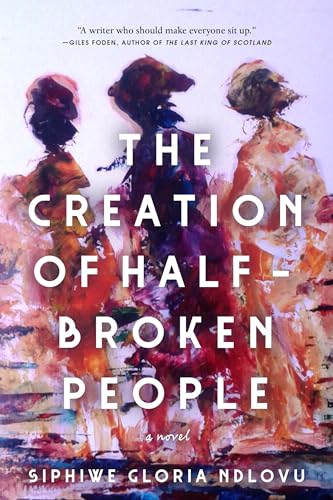
THE CREATION OF HALF-BROKEN PEOPLE, new African Gothic novel from Windham-Campbell Prize winner SIPHIWE GLORIA NDLOVU
THE CREATION OF HALF-BROKEN PEOPLE
SIPHIWE GLORIA NDLOVU
House of Anansi Press (non-affiliate Amazon link)
$16.99 ebook, available tomorrow
LONGLISTED for the 2026 Dublin Literary Award...the shortlist of six will be announced on 7 April 2026, the winner(s) in May's festival.
Rating: 4.25* of five
The Publisher Says: Stupendous African Gothic, by the winner of Yale University’s Windham–Campbell Prize
A modern Gothic story set on the African continent, The Creation of Half-Broken People tells the tale of a nameless woman plagued by visions. She works for the Good Foundation and its museum, a place filled with artifacts from the family’s exploits in Africa, the Good family members all being descendants of Captain John Good, of King Solomon’s Mines fame.
Our heroine is happy with her association with the Good family, until one day she comes across a group of people protesting outside the museum. Instigating the protesters is an ancient woman, who our heroine knows is not real. The nameless woman knows too that the secrets of her past have returned. After this encounter, she finds herself living first in an attic and then in a haunted castle, her life anything but normal as her own intangible inheritance unfolds through the women who inhabit her visions.
With a knowing nod to classics of the Gothic genre, Siphiwe Gloria Ndlovu weaves the threads of a complex colonial history into the present as she examines the collusion of colonialism, patriarchy, and capitalism in creating and normalizing a certain kind of womanhood.
I RECEIVED A DRC FROM THE PUBLISHER VIA EDELWEISS+. THANK YOU.
My Review: What I loved about this read started from the first line: "There was a time before this. I did not always live in the attic."
I defy anyone who reads my reviews not to want to know what happens next.
One thing that happens is our narrator (nameless here, and like the second Mrs. de Winter, seamlessly unobservedly nameless throughout) meets and becomes entangled with the ominously named "John B. Good IX"—did your arm hairs just prickle with anticipatory dread or is it just me?—at the scary age of twenty-one. Legally responsible, emotionally clueless. Truly a moment in one's life when The Worst can happen without any way to avoid it.
*gleeful hand-rubbing*
So the story unfolds as a heartfelt homage to the centuries of gothic novels and tales that have come before it. The events, the relationships, the emotional devastations that come to each living one of us, all occur in a logical order as demanded by the arc of acceptance in emotional maturation. The struggles, the demands we place on Life for it to conform to our momentary desires, the sudden storms of others' emotional demands blowing our lifeships ever farther from safe harbors...all present and accounted for. As an experienced purveyor of stories...she's a filmmaker, several earlier novels to her credit, graduate of Stanford's film studies program...Author Ndlovu doesn't slow her roll for anything unnecessary, or lard in the always tempting useless "grace note" that reduces the reader's momentum.
Lush descriptive language will always get praise from me, I enjoy it for its own sake, and this is replete with it. It's a plus that I, old white US man, am taken into a sensory world not already familiar to me. I'm also fully on board with the not-subtle anti-colonial and anti-patriarchal messaging of the entire enterprise. What, then, explains my chary star rating? Surely my delighted warbling comes in a full-five review!
Nothing's perfect. I kept feeling the ghost of gothics past brushing by me, trope by trope. It's not a *bad* thing in and of itself, the story told here is remixed from the very best of its forerunners. It is, however, still a remix. I do not have a way to tell a gothic story that breaks new ground, not being a supergenius or time-traveling visitor from the storytelling future. Yet as I kept reading (and I never stopped from giddy-up to whoa) I got these flashes of "that's from this story!" I do not know if they were precisely the ones Author Ndlovu had as inspirations. I do feel, when that sensation comes very frequently in a story, a small sense of disconnection from my full-on engagement with the narrative flow.
I doubt this would present anyone but the most seasoned readers any kind of problem. It did not reduce my enjoyment of this story's merits by much at all. I recommend it to all y'all who want to read a deeply emotionally resonant story.
Tuesday, February 11, 2025
LIVING IN YOUR LIGHT, sad acknowledgment of power denied, flouted, repressed
LIVING IN YOUR LIGHT
ABDELLAH TAÏA (tr. Emma Ramadan)
Seven Stories Press (non-affiliate Amazon link)
$12.99 ebook edition, available for pre-order
Rating: 4.75* of five
One of LitHub's 100 Notable Small Press Books for 2025!
The Publisher Says: A story in in praise of a woman, a fighter, a survivor from the award-winning French-Moroccan novelist known for humanizing North Africa’s otherwise marginalized characters—prostitutes and thieves, trans and gay people in a world where being LGBTQ+ can be a dangerous act.
Shortlisted for the prestigious Prix Goncourt in 2022.
Three moments in the life of Malika, a Moroccan countrywoman is her voice we hear in Abdellah Taïa’s stunning new novel, translated by Emma Ramadan, who won the PEN Translation Prize for her translation of Taïa’s last novel, A Country for Dying.
Malika’s first husband was sent by the French to fight in Indochina, the novel takes place from 1954 to 1999—from French colonization to the death of King Hassan II. In the 1960s, in Rabat, she does everything possible to prevent her daughter Khadija from becoming a maid in a rich French woman’s villa. The day before the death of Hassan II, a young homosexual thief, Jaâfar, enters her home and wants to kill her. Malika recounts with rage her strategies to escape the injustices of history. To survive and to have a little space of her own.
Malika is Taïa’s M'Barka Allali Taïa (1930-2010). This book is dedicated to her.
I RECEIVED A DRC FROM THE PUBLISHER VIA EDELWEISS+. THANK YOU.
My Review: I read Taïa's novels to feel the world as I experience it from a the experience of a true stranger...étranger, foreigner, other, Other, the French don't parse things down near as fine-tipped as Anglophones do...who, like me, believes queer desire runs the world.
Save it, apologists for the inversion of nature that is hetero identity, it's just unnatural or we wouldn't have so many bloody-minded religious and civil laws shoring it up. One doesn't prohibit what people don't like.
As I was saying before that irritated tangent: Taïa’s stories center queer desire, feature queer people, are about things we understand a little differently than hetero people do. It's like a warm blanket in a freezing, windy steppe that isn't for you, doesn't give a shit about your happiness or satisfaction unless it somehow comes up and gives "them" a frisson of what you're expected to endure your entire life in which case shut up and stop bothering "them". This is Taïa’s reality, and thus where his fiction lives. It's a whole lot worse in god-ridden spaces than it currently is in the US.
So how does this relate to a story about Malika, an aging mother of eight whose life is ending, but whose track record is not close to what she ever wanted it to be? Her tragic inflection points are all around collisions with Authority, a thing every QUILTBAGger is deeply, existentially familiar with. She fails to keep her first husband home from the war that kills him, despite it being fought for the same people who have colonized their country. She fails to convince her money-motivated daughter to eschew the colonialist inducement of cash for submission and become a mail in a wealthy French family's service. Lastly, her gay son chooses his identity over her idea of duty to their country after he is raped by men in their neighborhood who claim to hate homosexuals...yet exert their sexual rights as straight men by fucking him...Rape is a crime of power, an abuse of autonomy and self-ownership, not sex itself, of course. That's pretty well established as fact. But someone needs to explain to me, slowly and in simple words, how the sex act they're engaging in makes any sense in this framework, given male penetration requires a physiological state of excitement to a sexual object.
I don't get it. But I'm back on a tangent.
Malika wants her powerful will to be obeyed because she is Right. The problem is she's correct a lot of the time, but that's not enough for her...she must be Right, and that is uniformly fatal to successful imposition of one's will. In a long life of mixed emotional results, that central truth does not come clear for her. It's the human condition to live life backwards, learning more and more as the need for applicable knowledge diminishes. It's the reason to have elders in the family system, expandable to encompass every level of social organization...a thing Malika would've reveled in, but did herself out of by insisting she be seen as Right. The world needs us oldsters to give up our addiction to the powerful substance of Rightness, and accept they're doing it differently now so offer advice without judgment.
As if.
So we read stories. It helps us all make sense of each other, helps us see the humanity in people deeply and fundamentally not-U, in Mitford's 1955 formulation. I'd offer all five stars with a big smile if the story was longer, developing the parts I was most curious about...Malika's time under colonialism would be so fascinating to learn about!...but this récit isn't designed to do that, and as it is written, is a beautiful evovation of a complex woman's life as a second-class partially empowered participant in a wildly passionately tumultuous world.
Her contributions to that world's growth earn my four and three-quarters star rating for their telling here.
Monday, March 6, 2017
FOLLOW THE RABBIT-PROOF FENCE, Aboriginal Australian girl-children with more grit than most adults
FOLLOW THE RABBIT-PROOF FENCE
DORIS PILKINGTON aka Nugi Garimara
University of Queensland Press
$9.99 Kindle edition, available now
Rating: 3.5* of five
The Publisher Says: This extraordinary story of courage and faith is based on the actual experiences of three girls who fled from the repressive life of Moore River Native Settlement, following along the rabbit-proof fence back to their homelands. Assimilationist policy dictated that these girls be taken from their kin and their homes in order to be made white. Settlement life was unbearable with its chains and padlocks, barred windows, hard cold beds, and horrible food. Solitary confinement was doled out as regular punishment. The girls were not even allowed to speak their language. Of all the journeys made since white people set foot on Australian soil, the journey made by these girls born of Aboriginal mothers and white fathers speaks something to everyone.
My Review: Doris Pilkington's grandfather was a cowardly white man who failed to protect his three half-Aboriginal daughters from the colonial mentality espousing their forced removal from their parents. Their mother left the cad, good on her, and was still powerless to act against the white government to get her daughters out of their "residential school" where they were maltreated. The aim of their removal from Aboriginal society was to prevent them from passing on the values of their society, instead becoming darker-skinned white people. Oh, and not just that, but inferior servant-class white people.
Can't imagine where the Aussies got such a horrible idea. Nope. Just can't. Nor where the South Africans got the idea for apartheid. Nuh-uh. Imponderable. No relation to the American policies on Native peoples or former slaves. Dear me, no.
That sarcasm out of the way, I will remark that the story is presented as a novel despite the fact that Pilkington aka Garimara (1937-2014) was writing about her very own mother's story. It freed her to write about the details of the girls' experiences, ones she must have heard from her mother's own lips, without the burden of fact-checking or documenting things that were never written down or part of any official record in the first event.
The prose isn't stellar. In fact it's pretty clunky. I enjoyed the Aboriginal words used without explanation, since there was a handy-dandy glossary in the back of the book; I didn't want the author to lead me by my lily-white hand to the Promised Land of Otherness. I expect that my rating would've been a lot lower had she done that. I was simply dropped into the otherness, as Molly and her sisters were. It's a good technique, effectively putting the reader into the shoes of scared children.
In the end, the experience of reading the book was better than the book itself. What a weird sentence that is; I know I must sound like a raving loonie. But what I mean by that is that this is a truly important and continually relevant (depressingly) tale of oppression and victimization based on ethnic difference. It just isn't a particularly well-written one. And still it makes a strong impression on the reader, one that means something inside shifts a bit, hopefully in a positive direction. I'd suggest reading it to anyone who thinks the segregation of an ethnic minority is in any way a good idea.
The 2002 film, Rabbit-Proof Fence, is only $2.99 to rent at Amazon. It's got some areas where it's a bit better than the book, and some lovely cinematography. The book and the film are best enjoyed together. How unusual is that!
Monday, April 18, 2016
Time Commences in Xibalbá, a fantastical tale of sex, identity, violence, and time
TIME COMMENCES IN XIBALBÁ
LUIS DE LIÓN (tr. Nathan C. Henne)
University of Arizona Press
$22.95 trade paper, available now
Rating: 3.8* of five
The Publisher Says: Time Commences in Xibalbá tells the story of a violent village crisis in Guatemala sparked by the return of a prodigal son, Pascual. He had been raised tough by a poor, single mother in the village before going off with the military. When Pascual comes back, he is changed—both scarred and “enlightened” by his experiences. To his eyes, the village has remained frozen in time. After experiencing alternative cultures in the wider world, he finds that he is both comforted and disgusted by the village’s lingering “indigenous” characteristics.
De Lión manages to tell this volatile story by blending several modes, moods, and voices so that the novel never falls into the expected narrative line. It wrenches the reader’s sense of time and identity by refusing the conventions of voice and character to depict a new, multi-layered periphery. This novel demands that we leave preconceptions about indigenous culture at the front cover and be ready to come out the other side not only with a completely different understanding of indigeneity in Latin America, but also with a much wider understanding of how supposedly peripheral peoples actually impact the modern world.
The first translation into English of this thought-provoking novel includes a concluding essay by the translator suggesting that a helpful approach for the reader might be to see the work as enacting the never-quite-there poetics of translation underlying Guatemala’s indigenous heart. An afterword by Arturo Arias, the leading thinker on Indigenous modernities in Guatemala, offers important approaches to interpreting this challenging novel by showing how Guatemala’s colonial legacy cannot escape its racial overtones and sexual undertones as the nation-state struggles to find a suitable place in the modern world.
My Review: Eighty-two pages of story; fifteen pages of Translator's Introduction; twenty-five pages of academic essay placing the story and the author into context for the American student.
If you're still reading at this point, you're one tough bugger. The essays are fine, if you're in the mood for academic prose and a discussion of the merits of psychosexual colonial identity theft. I think that's what it's about. The essay, that is.
I don't pretend to know what the story itself is about. Pascual, the main character, is a proper shit of a person, the village that grounds the novel is made up of silly gits, mean girls, a few sluts, one gay guy who lusts after Pascual and is called Hen, not Juan, when the two are alone.
It makes sense in context, I promise.
The village, the real purpose for the story of Pascual, is enchanted and enchanting in the traditional Latin American magical realist way. There's a wind at the beginning of the book...the description can't be excerpted, I'm not up for that much typing...and there are any number of sun-rising-in-the-west moments that make the story itself feel more like a retold folk tale than a novella. (Which this is, despite the insistence of the academics that it's a novel.)
It's a short, interesting moment in Guatemalan cultural studies. It's got some lovely imagery, and it's got copious annotations explaining the concepts that periodic Spanish words connote. It's lyrical in measure, it's beautifully proofread (and isn't it sad as all hell that I mention that in a review?), and I can't quite give it four stars because I don't feel one bit moved to learn more of these characters. I'm incurious. And a big part of that is the brevity wrought by the author's choice of length. More, please. This iteration of the tale is worthy and is even pleasurable in spots. But it just never quite reaches the empyrean blue that's clearly within the author's native grasp.
Read it, by all means, you of Hispanic-colonial descent, to learn how the Maya survived...for you of leftward-leaning politics, it's an endorsement of your smug dismissal of post-colonial guilt-shedding so in vogue. The majority of the readerly public isn't likely to clasp the book to their collective bosom.
Subscribe to:
Posts (Atom)