Showing posts with label death. Show all posts

Sunday, July 12, 2026

EVERYTHING WAS BEAUTIFUL AND NOTHING HURT, how I would know I was dead is just that


EVERYTHING WAS BEAUTIFUL AND NOTHING HURT
BEN REEVES

Avid Reader Press (non-affiliate Bookshop.org link)
$14.99 ebook, available now

Rating: 4.5* of five

The Publisher Says: Travis is Death in the modern world. He wears jeans and a T-shirt and lives in a small, grey town. His job is to offer people comfort in their final hours of life. He’s stoic, gentle, and a little naive, despite everything he knows. He’s young and handsome, despite who he is. Each death he witnesses is meaningful to him; he listens, never judges, and most importantly, never tries to change anyone’s fate. He knows that every life must eventually end to maintain the balance of the universe and he respects the cycle.

Then he meets Dalia, a midwife, and her boisterous eight-year-old daughter Layla, who live across the hall. As Dalia and Layla come to embrace Travis, it becomes more difficult to maintain the detachment that’s allowed him to function for so long. Their time together teaches him what’s truly important in life—and what might be irrevocably lost in death.

Written with radiant warmth, wisdom, and compassion, Everything Was Beautiful and Nothing Hurt is a timeless story about appreciating life, accepting its end, and finding our place in the universe—especially when it feels most impossible—that will resonate with anyone who has ever loved and lost or worried at time’s passing.

I RECEIVED A DRC FROM THE PUBLISHER VIA NETGALLEY. THANK YOU.

My Review
: Remember Meet Joe Black? Or, if you're a reader my age, Salley Vickers' novel Mr. Golightly's Holiday? We're all interested in divine personifications of absolute power...god and death being in Western cosmology the two supreme beings...and we need to tell stories as much as we need to breathe, so it's inevitable that there will always be new and interesting ways to personify them. (And funny ones, if you're irreverent like Sir Terry Pratchett. Author Ben Reeves is staking out a bit of that territory in this story.

Travis is an ordinary guy who also happens to be Death. Literal Death. The Grim Reaper wears jeans and t-shirts. Sure, why not. Travis comforts and guides people into death, so you already know it's not going to be a Pratchetty jollification of a story. Seeing the personification of death as more or less a death doula is, on its face, reductive because Death is permanent, absolute, fundamental, and utterly unknowable like Life is. Reducing a terrifying cosmic power to a guy in jeans and a t-shirt who helps you, guides you with kindness and sympathy, through the emotional landscape of The End, feels like lèse-majesté to me. Like euphemising "he died" into "he has passed away," if feels like emotional dishonesty to me, like a pointless attempt to pre-feel the horrible twisting agony that is grief. (It doesn't work, any more than not saying "Voldemort" did. Any time one uses the passive voice, dishonesty is stinking up the sentence.)
Enough abstraction. The action in this story is heavy, the emotions surrounding death are never otherwise though sadness is not necessarily always foregrounded. Author Reeves chose, rightly in my view, to give Travis a first-person narrative voice in stream of consciousness style. It is how we experience life, so why wouldn't Life's intimate partner use it? It's also effective in conveying the immediacy of Death's role in one's life by distancing our mere mortal PoVs into third-person limited narratives.

I think that won't sit well with some readers, but it very much worked for me. It made the stakes so clear: at the end of life, Death is the main character. He (in this case) looms large, his thoughts and his emotional investment in us are all mortals have in that transition. It was a very interesting take, one I don't recall seeing in a novel before. (A dim, distant tocsin sounds about a short story set during a pogrom in Ukraine—anyone else hear it?)

What made this creative and intelligent Death-centered story so interesting to me was the clear intent to elicit powerful responses in the reader was never shortchanged by pulled punches. I find the central conceit just a bit dimmed down for softening sharp edges; but within that mild criticism of intentional diminishment of robustness, the action isn't kinetic to make the story external. It's a story of the interiority of death, as experienced and related to us by Death.

It's a superior read, told by a talented storyteller, in a creative way that enhances its message of coping with emotion at te end of life.

Monday, December 26, 2022

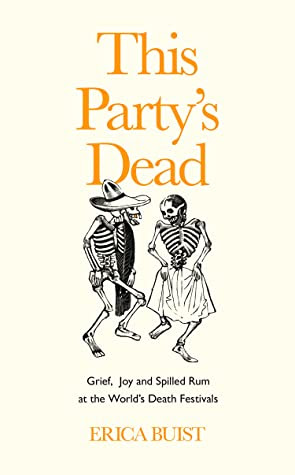
THE DEATH PAGE: ALL THE LIVING AND THE DEAD: from Embalmers to Executioners, an Exploration of the People Who Have Made Death Their Life's Work & THIS PARTY'S DEAD: Grief, Joy and Spilled Rum at the World’s Death Festivals


THIS PARTY'S DEAD: Grief, Joy and Spilled Rum at the World’s Death Festivals
ERICA BUIST

Unbound Books
$25.00 hardcover, available now

Rating: 4.5* of five

The Publisher Says: What if we responded to death... by throwing a party?

By the time Erica Buist’s father-in-law Chris was discovered, upstairs in his bed, his book resting on his chest, he had been dead for over a week. She searched for answers (the artery-clogging cheeses in his fridge?) and tried to reason with herself (does daughter-in-law even feature in the grief hierarchy?) and eventually landed on an inevitable, uncomfortable truth: everybody dies.

With Mexico’s Day of the Dead festivities as a starting point, Erica decided to confront death head-on by visiting seven death festivals around the world—one for every day they didn’t find Chris. From Mexico to Nepal, Sicily, Thailand, Madagascar, Japan and finally Indonesia—with a stopover in New Orleans, where the dead outnumber the living ten to one—Erica searched for the answers to both fundamental and unexpected questions around death anxiety.

This Party’s Dead is the account of her journey to understand how other cultures deal with mortal terror, how they move past the knowledge that they’re going to die in order to live happily day-to-day, how they celebrate rather than shy away from the topic of death – and how when this openness and acceptance are passed down through the generations, death suddenly doesn’t seem so scary after all.

I RECEIVED A DRC FROM THE PUBLISHER VIA EDELWEISS+. THANK YOU.

My Review
: I grew up in the Southwest. It's part of my mental furniture to know what calaveras are and to appreciate that marigolds are the right floral tributes on Día de los Muertos. Skeletons, and skulls, are endlessly fascinating. An old artist-friend of mine created one of my most treasured possessions, sadly destroyed in a move, of a drawing she entitled "Martinis on My Horizon" with stylish skeletons quaffing the elixir of the goddesses, the gin martini.

I am, in other words, the exact reader Author Buist aimed at. She shot; she scored.

I found her grief for the death of her friend Chris, father of her future husband, entirely ordinary. He sounds to me like someone it would very much hurt to lose. And, since humankind can't physiologically stay in protracted peak states like grieving, what better way to cope with the pain than toss a party? The author's dedicatory "Love is not a reward, and death is not a punishment. If you thought they were, this book is for you," made me legs twitch with the fight-or-flight response. It's that true, it's that deep.

What made me glad that I got the book from the publisher via Edelweiss+ is the timelessness of grief and grieving. Every generation of humans feels it, which is why we have so many grave goods for archaeologists to plunder and ponder; many of our animal cohabitants seem to as well, eg elephants and crows; life being, then not being, inside someone we know and love is just flat weird. My old friend D'Anne died just before Christmas. I'd known her for fifty-three years. All the things that meant something to her in relation to me are now only in my mind. It's...strange.

And I hope her current husband is planning a bash! She'd've loved that. It's a great way to remember someone. As witness some of the author's rowdier experiences of parties where the guest of honor isn't breathing anymore. Offering the dead many of life's little luxuries has an old and distinguished history. The Japanese and Chinese, in today's cultural landscape, are the masters of the offerings with many things like paper iPhones burnt for the departed's use in the afterlife. Mexico's Day of the Dead isn't quite that au courant but it's got the best material culture, the calaveras de azúcar offered to the ancestors:
...and the modern innovation of the Día de los Muertos parade that the James Bond film Spectre made popular before COVID killed it, too.
So as I said, the author found her dream reader here. Why, then, didn't I rate the read more highly? I enjoyed it. I was educated by it, as painlessly as I think is possible. But the very thing that made it a painless read, a lovely glass of juice with a hefty glug of 151 rum in it (as the author discovers in New Orleans, visiting the Museum of Death and quaffing a Hurricane at Pat O'Brien's for afters), makes it feel more like it's about Author Buist on a weird kind of very amusing dark tourism trip. (I myownself vote that we start normalizing "thanatourism" for this; it's not necessarily dark!), is the thing that wore thin: It's about her. Her grief, her loss. Learning about other cultures was her way of coping, of giving her husband support in his own grieving process.

I know that's what it said on the tin. I know that's the explicit purpose for the book's existence. I support the author's quest and am glad I made her acquaintance, happy that her journey was rewarded as richly as it was in ways familiar and unfamiliar as her friends and her bosses and her husband made room for it all.

But I can't help my feeling of slight "I'm done now"ness. Her job, ably performed, merits the full four stars. Her amusing and emotionally resonant narrative voice merit the other half-star. But the tone, in the end, brought my personal enjoyment down from all the stars to almost all of them.

Still very much a book I'd urge you to make room for on your shelf.

++++++++++++++++++++++++++++++++++++++++++++++++++++++++++++++++


ALL THE LIVING AND THE DEAD: from Embalmers to Executioners, an Exploration of the People Who Have Made Death Their Life's Work
HAYLEY CAMPBELL

St. Martin's Press
$29.99 hardcover, available now

Rating: 4.5* of five

The Publisher Says: A deeply compelling exploration of the death industry and the people—morticians, detectives, crime scene cleaners, embalmers, executioners—who work in it and what led them there.

We are surrounded by death. It is in our news, our nursery rhymes, our true-crime podcasts. Yet from a young age, we are told that death is something to be feared. How are we supposed to know what we’re so afraid of, when we are never given the chance to look?

Fueled by a childhood fascination with death, journalist Hayley Campbell searches for answers in the people who make a living by working with the dead. Along the way, she encounters mass fatality investigators, embalmers, and a former executioner who is responsible for ending sixty-two lives. She meets gravediggers who have already dug their own graves, visits a cryonics facility in Michigan, goes for late-night Chinese with a homicide detective, and questions a man whose job it is to make crime scenes disappear.

Through Campbell’s incisive and candid interviews with these people who see death every day, she asks: Why would someone choose this kind of life? Does it change you as a person? And are we missing something vital by letting death remain hidden? A dazzling work of cultural criticism, All the Living and the Dead weaves together reportage with memoir, history, and philosophy, to offer readers a fascinating look into the psychology of Western death.

I RECEIVED A DRC FROM THE PUBLISHER VIA NETGALLEY. THANK YOU.

My Review
: A book with a truly tragic genesis, the author losing a baby at birth; but it led her to look for her grief to be assuaged in discovering the connective tissue in our society's death industry. She made a terrible tragedy into a very interesting study and came away with the kind of book that many of us read with squeamishness as we're utterly disconnected from death.

No one doesn't think about death, and dying; and, as we've professionalized and medicalized every part of the process, we're going to the bookshelf for our answers. Luckily there are those among us who like learning things and then explaining them. (As long as they're not men, they're lauded for it.) Author Hayley Campbell did a major research project in this book's genesis. It comes across more in the endnotes...they're extensive. I realize I'm very much in the minority here, but I prefer endnotes with spiffy little superscript numbers that, in ebooks, function as hyperlinks; I'm perfectly willing to navigate away from the page when I want to know something's source. But la, the wishes and the wants of one not the author, or the editor, are mere wing-flappings of the tiniest of midges. (I'm waxing lyrical. Send help!) Encountering, for example, the saline hydrocremation process was something I wanted to know more about right then and there...but you can bet your sweet bippy I've bookmarked the UK WIRED Magazine story for future discovery.

A less delightful thing that somewhat tarnished my reading experience, and is the source of the missing half-star on the rating about, was the lived experience of her tragic loss of a baby. It was very, very present in the text. It is a loss second to none in the world for painful permanence. As such it felt, to be honest, overused as a rhetorical device. This is a subjective measure, and I freely acknowledge that a recently bereaved parent might find this inclusion unobtrusive, or positively helpful. I did not.

The other side of that coin, however, was my discovery that there are certain souls, who if there is a god deserve a total and complete remission from their sins, who specialize in bereavement midwifery. How very, very beautiful a soul those people must possess. How vast their reserves of kindness and empathy must be. And how deeply glad I am that they do this job.

Executioners, on the utterly other hand, aren't people I think should be employed. I have this wacky idea that killing people is wrong. Killing them as a profession is not one iota different in my own eyes to being a serial killer. And that, mes vieux, is that. (The executioner interview was interesting, I will admit, but changed my opinion not one jot.)

While I'm sure others might feel triggered at a frank discussion of the process of one's body's cessation of function, it fascinated me. It is a sad truth that most people in today's Western, privileged society have little or nothing to do with their dying fellow beings. They're the ones most in need of this book's honesty. I fear they won't pick it up and I truly advise you, should you be so unfortunate as to face your own mortality in an imminent way, to read and gift this fascinating story of what dealing with death truly entails.

I will always advocate for the "it's better to know than to wonder and fear" end of the information-reading spectrum. Author Hayley makes the process of educating yourself about the aftermath of dying as painless and as compelling as is, for example, one of the mysteries or thrillers that so many of us devour.

Wednesday, May 15, 2019

THE ART OF DYING and WHAT ABOUT THIS, two collections by two poets you need to know about

Happy Hump Day, everyone! I'm reading poetry books, plural (hence the double review below), on this positively sun-struck breezy day.

Pick y'all's selves up off the floor at your leisure. Meanwhile let me explain.

THE ART OF DYING
SARAH TOLMIE

McGill-Queen's University Press
$16.95 trade paper, available now Amazon link for US purchasers

Rating: 5 stars...yep, all five!...of five

The Art of Dying was one helluva wallop. Y'all might remember that I fell in love with its cover, enough that I used A Dear Canadian Friend's gift to me to procure a copy after an article about the AUP Book, Jacket, and Journal Design show showed it to me.

So I was reading the short, super-concentrated poems. "Self," I said to myself, "this is the Sh...tuff. This is why all those pretentious pit-sniffers whose only love is self-love (in all its meanings) write their vapid maunderings with silly line breaks."
Most books of poems are far too short.
It's hard to get your money's worth.
How does it make sense in the marketplace

To pay twelve quid for sixty pages?
Or fifteen euros, or twenty bucks?
So poets are shit out of luck.
first two stanzas of poem 22
I know, right?!

Memento mori...and does Doctor Sarah Tolmie, academic, medievalist, un-sniffing poet extraordinaire, ever put memory through its paces. I was, and am, compelled to think deeply about five-line, ten-line, multi-page word paintings. That's not the commonest impulse for me. "You too will die" is my preferred translation from the Latin (pace Latinists with exact translations) of the phrase and that thought is ever with me. I think a lot of people shy away from the idea of Death when what they actually fear is the process of dying. We're divorced from its realities by the medicalization of illness (an issue Tolmie deals with in multiple facets). The process is part of Life, not of Death...and that's a Tolmie thought that I think makes the whole fear industry tremble.
Hate to tell you, but you're going to die.
Quite soon. Me, too.

Shuck off the wisdom while it's warm.
Death does no harm
To wisdom.
It's the very first poem, in its entirety; it sets a tone for this collection that the remaining artistry very much delivers on.

You're not afraid of Death. I can almost promise you that you haven't thought about Death much at all. The pain and enfeeblement of illness are the things that inspire most people to flee screaming from the mere mention of Death. Its reality is possibly more terrifying: The Great Unknown, the place we're all going but no one has ever come back from to tell us about. (I am not religious and I don't believe y'all's bedtime story is in any way factual.)
It continues to be fashionable to mourn the death of ritual.
We miss the Neolithic ochre, smoking censers, silly hats
Cthulhu and Harryhausen prayers, all the mystic flap.
first stanza of poem 10
A Facebook chat with Gemma Files, an author of horror novels, that I participated in very recently made me think again about why horror has no fear for me. The silliness of the rituals surrounding Death has always struck my funny bone. I save my sadness and longing for the living. They can make use of it, they can feel my empathy and my lovingkindness and my appreciation. The dead? I suspect they survive in some form. I doubt very much its a form we'd recognize. But the body horror and supernatural horror of the storytelling world, the world that Author Files (and to an extent Poet Tolmie, though she with an ironically raised brow) and many like her inhabit, have little actual potency and their imaginative powers exert force on our imaginations in proportion to our fear of Death (which, I said above, I believe to be a fear of the process of dying).
Death looks a lot like success.
As in, "I killed that test"
"She slays me" and the rest—

Though it's the act and not the state
Whose power we appropriate,
All us murderous wannabes
In our casual hyperboles.
Poem 42 in its entirety
The attentive will note my approbation of a rhyming-couplets poem.

Pick y'all's selves up off the floor at your leisure.
The New York Times photo
WHAT ABOUT THIS: Collected Poems of Frank Stanford
Michael Wiegers, ed.

Copper Canyon Press
$40.00 hardcover, available now

Rating: 5* of five

So then, after that delight to my literary sensibilities arose from the quantum foam, I read this article from The Millions and was reminded of Frank Stanford, whose 1978 collection Crib Death I found on my then-boyfriend the much older alcoholic abuser's shelf.

The Neighbor's Wife
Four a.m. and she's still gone
But I'm not going to call.
It's not so bad, until just before morning,
When I see a truck driver
Take a smoke out of his lips
And throw it out the window
And I watch it go to pieces
All over the road.
I read that as a teen and was shocked to my still-forming core that someone out there Got Me. The obsessive need for someone's presence. The intense internal fire that only comes to the surface when mundane reality offers a single, fleeting, unremarkable image of one's inner state and thus crystallizes reality in the same stunning, unexpected way that a chemistry demonstration creates shocking clouds of sharpness from water.

I don't mean to give y'all the impression that I can just *poof* summon up a poem from 40-year-old memories. I got the text from my memory of the older book's and the specific poem's title, then checked this book out of the library. This kitten-squisher of a volume...750 pages!...collects a thorough and informed sampling of his magic mountain of work both published and unpublished. I got re-interested in Stanford after reading in the above-referenced article that Stanford had committed suicide at 29.

Twenty-nine.

Imagine the life unlived, the art unmade; the world's loss is incalculable when Death takes some unhappy or unwilling soul away from whatever Reality finally turns out to be. Assuming we ever find out, that is.

So the book...elephantine tome!...slogged home in my shoulder tote on a cold and rainy day. I sat right down to look for this deeply meaningful memory, but being a bookish sort, was unable not to read both the Introduction (by one Dean Young, previously unknown to me) and the Editor's Note by Copper Canyon Press publisher Michael Wiegers. I discovered this unlikely-to-be-memed aperçu in Young's Introduction:
Many of these poems seem as if they were written with a burnt stick. With blood, in river mud. There is something thankfully unexamined in their execution. I say "thankfully" because we have been through a long century of self-consciousness and irony, and while their brand of rigor and suspicion have brought intelligence to American poetry they have also brought rigor mortis, they have deadened the nerves and made poets fear the irrational.
What is more irrational than Death? Dying is rational, can be subjected to analysis and quantification, is possible to construct a schema to slot into one's syllogistic understanding of Life.

Death is the Great Unknown. Frank Stanford got that, and wrote with its reality up front and up close and personal:
Putting Up Fence
I believe the moon wades a creek
Like an albino with a blade
Fixed to a stick.

It rises, red as a place
Where a chigger's been.

Voyeur in the loft, leaving your gum
Stuck to a fork in the barn,
Like a porter paid to listen
With his head in a portal
Of a ship returning before it's due.

Then I come down the road with ice.
An unpolished scream of a betrayed husband, a howl of the pain of being unwanted and still alive, a rage-filled hate-fuelled moment in time that Stanford lived and left uncollected on his paper alp. He's dead, he's dying in front of our horrified eyes always and forever.

Or is he the moon.

Or the chigger.

The reddener of millions of feet, ankles bending to bring them within frantic scratching distance of fingers long ago rotted away. The annoying, irritating, sometimes sickening (in all its senses) reminder that we're alive and Life is a Death sentence. Irrationally clawing at the reddened surface of our living corpses, we read poems by artists like Frank Stanford who just couldn't endure the long way home.

These poets spoke to my unpoetic Poetry-hatin' heart because they practice poetry without the dead, deadening blanket of Poetics across their faces. Their mouths, unmuffled, speak and can be heard by this Death-addled dying man. Since y'all're dying too, I want you to know we can listen to what the souls of our compatriots feel without unnecessary intellectualizing complications.