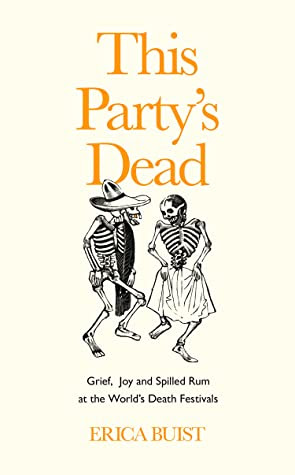
THIS PARTY'S DEAD: Grief, Joy and Spilled Rum at the World’s Death Festivals
ERICA BUIST
Unbound Books
$25.00 hardcover, available now
Rating: 4.5* of five
The Publisher Says: What if we responded to death... by throwing a party?
By the time Erica Buist’s father-in-law Chris was discovered, upstairs in his bed, his book resting on his chest, he had been dead for over a week. She searched for answers (the artery-clogging cheeses in his fridge?) and tried to reason with herself (does daughter-in-law even feature in the grief hierarchy?) and eventually landed on an inevitable, uncomfortable truth:
everybody dies.
With Mexico’s Day of the Dead festivities as a starting point, Erica decided to confront death head-on by visiting seven death festivals around the world—one for every day they didn’t find Chris. From Mexico to Nepal, Sicily, Thailand, Madagascar, Japan and finally Indonesia—with a stopover in New Orleans, where the dead outnumber the living ten to one—Erica searched for the answers to both fundamental and unexpected questions around death anxiety.
This Party’s Dead is the account of her journey to understand how other cultures deal with mortal terror, how they move past the knowledge that they’re going to die in order to live happily day-to-day, how they celebrate rather than shy away from the topic of death – and how when this openness and acceptance are passed down through the generations, death suddenly doesn’t seem so scary after all.
I RECEIVED A DRC FROM THE PUBLISHER VIA EDELWEISS+. THANK YOU.
My Review: I grew up in the Southwest. It's part of my mental furniture to know what
calaveras are and to appreciate that marigolds are the right floral tributes on
Día de los Muertos. Skeletons, and skulls, are endlessly fascinating. An old artist-friend of mine created one of my most treasured possessions, sadly destroyed in a move, of a drawing she entitled "Martinis on My Horizon" with stylish skeletons quaffing the elixir of the goddesses, the gin martini.
I am, in other words, the exact reader Author Buist aimed at. She shot; she scored.
I found her grief for the death of her friend Chris, father of her future husband, entirely ordinary. He sounds to me like someone it would very much hurt to lose. And, since humankind can't physiologically stay in protracted peak states like grieving, what better way to cope with the pain than toss a party? The author's dedicatory
"Love is not a reward, and death is not a punishment. If you thought they were, this book is for you," made me legs twitch with the fight-or-flight response. It's that true, it's that deep.
What made me glad that I got the book from the publisher via Edelweiss+ is the timelessness of grief and grieving. Every generation of humans feels it, which is why we have so many grave goods for archaeologists to plunder and ponder; many of our animal cohabitants seem to as well, eg elephants and crows; life being, then not being, inside someone we know and love is just flat weird. My old friend D'Anne died just before Christmas. I'd known her for fifty-three years. All the things that meant something to her in relation to me are now only in my mind. It's...strange.
And I hope her current husband is planning a bash! She'd've loved that. It's a great way to remember someone. As witness some of the author's rowdier experiences of parties where the guest of honor isn't breathing anymore. Offering the dead many of life's little luxuries has an old and distinguished history. The Japanese and Chinese, in today's cultural landscape, are the masters of the offerings with many things like paper iPhones burnt for the departed's use in the afterlife. Mexico's Day of the Dead isn't quite that au courant but it's got the best material culture, the
calaveras de azúcar offered to the ancestors:
...and the modern innovation of the
Día de los Muertos parade that the James Bond film
Spectre made popular before COVID killed it, too.
So as I said, the author found her dream reader here. Why, then, didn't I rate the read more highly? I enjoyed it. I was educated by it, as painlessly as I think is possible. But the very thing that made it a painless read, a lovely glass of juice with a hefty glug of 151 rum in it (as the author discovers in New Orleans, visiting the Museum of Death and quaffing a Hurricane at Pat O'Brien's for afters), makes it feel more like it's about Author Buist on a weird kind of very amusing
dark tourism trip. (I myownself vote that we start normalizing "thanatourism" for this; it's not necessarily dark!), is the thing that wore thin: It's about her. Her grief, her loss. Learning about other cultures was her way of coping, of giving her husband support in his own grieving process.
I know that's what it said on the tin. I know that's the
explicit purpose for the book's existence. I support the author's quest and am glad I made her acquaintance, happy that her journey was rewarded as richly as it was in ways familiar and unfamiliar as her friends and her bosses and her husband made room for it all.
But I can't help my feeling of slight "I'm done now"ness. Her job, ably performed, merits the full four stars. Her amusing and emotionally resonant narrative voice merit the other half-star. But the tone, in the end, brought my personal enjoyment down from all the stars to almost all of them.
Still very much a book I'd urge you to make room for on your shelf.
++++++++++++++++++++++++++++++++++++++++++++++++++++++++++++++++
ALL THE LIVING AND THE DEAD: from Embalmers to Executioners, an Exploration of the People Who Have Made Death Their Life's Work
HAYLEY CAMPBELL
St. Martin's Press
$29.99 hardcover, available now
Rating: 4.5* of five
The Publisher Says: A deeply compelling exploration of the death industry and the people—morticians, detectives, crime scene cleaners, embalmers, executioners—who work in it and what led them there.
We are surrounded by death. It is in our news, our nursery rhymes, our true-crime podcasts. Yet from a young age, we are told that death is something to be feared. How are we supposed to know what we’re so afraid of, when we are never given the chance to look?
Fueled by a childhood fascination with death, journalist Hayley Campbell searches for answers in the people who make a living by working with the dead. Along the way, she encounters mass fatality investigators, embalmers, and a former executioner who is responsible for ending sixty-two lives. She meets gravediggers who have already dug their own graves, visits a cryonics facility in Michigan, goes for late-night Chinese with a homicide detective, and questions a man whose job it is to make crime scenes disappear.
Through Campbell’s incisive and candid interviews with these people who see death every day, she asks: Why would someone choose this kind of life? Does it change you as a person? And are we missing something vital by letting death remain hidden? A dazzling work of cultural criticism,
All the Living and the Dead weaves together reportage with memoir, history, and philosophy, to offer readers a fascinating look into the psychology of Western death.
I RECEIVED A DRC FROM THE PUBLISHER VIA NETGALLEY. THANK YOU.
My Review: A book with a truly tragic genesis, the author losing a baby at birth; but it led her to look for her grief to be assuaged in discovering the connective tissue in our society's death industry. She made a terrible tragedy into a very interesting study and came away with the kind of book that many of us read with squeamishness as we're utterly disconnected from death.
No one doesn't think about death, and dying; and, as we've professionalized and medicalized every part of the process, we're going to the bookshelf for our answers. Luckily there are those among us who like learning things and then explaining them. (As long as they're not men, they're lauded for it.) Author Hayley Campbell did a major research project in this book's genesis. It comes across more in the endnotes...they're extensive. I realize I'm very much in the minority here, but I prefer endnotes with spiffy little superscript numbers that, in ebooks, function as hyperlinks; I'm perfectly willing to navigate away from the page when I want to know something's source. But la, the wishes and the wants of one not the author, or the editor, are mere wing-flappings of the tiniest of midges. (I'm waxing lyrical. Send help!) Encountering, for example, the saline hydrocremation process was something I wanted to know more about right then and there...but you can bet your sweet bippy I've bookmarked the UK
WIRED Magazine story for future discovery.
A less delightful thing that somewhat tarnished my reading experience, and is the source of the missing half-star on the rating about, was the lived experience of her tragic loss of a baby. It was very, very present in the text. It is a loss second to none in the world for painful permanence. As such it felt, to be honest, overused as a rhetorical device. This is a subjective measure, and I freely acknowledge that a recently bereaved parent might find this inclusion unobtrusive, or positively helpful. I did not.
The other side of that coin, however, was my discovery that there are certain souls, who if there is a god deserve a total and complete remission from their sins, who specialize in bereavement midwifery. How very, very beautiful a soul those people must possess. How vast their reserves of kindness and empathy must be. And how deeply glad I am that they do this job.
Executioners, on the utterly other hand, aren't people I think should be employed. I have this wacky idea that killing people is wrong. Killing them as a profession is not one iota different in my own eyes to being a serial killer. And that, mes vieux, is that. (The executioner interview was interesting, I will admit, but changed my opinion not one jot.)
While I'm sure others might feel triggered at a frank discussion of the process of one's body's cessation of function, it fascinated me. It is a sad truth that most people in today's Western, privileged society have little or nothing to do with their dying fellow beings. They're the ones most in need of this book's honesty. I fear they won't pick it up and I truly advise you, should you be so unfortunate as to face your own mortality in an imminent way, to read and gift this fascinating story of what dealing with death truly entails.
I will always advocate for the "it's better to know than to wonder and fear" end of the information-reading spectrum. Author Hayley makes the process of educating yourself about the aftermath of dying as painless and as compelling as is, for example, one of the mysteries or thrillers that so many of us devour.