Showing posts with label William Morrow. Show all posts

Wednesday, May 20, 2026

VILLAIN (Hench #2) is Author NATALIE ZINA WALSCHOTS long-awaited and worth the wait sequel


VILLAIN (Hench #2)
NATALIE ZINA WALSCHOTS

Watch the inimitable Nancy Pearl interview Author Walschots here!
William Morrow (non-affiliate Bookshop.org link)
$14.99 ebook, available now

Rating: 4.75* of five

The Publisher Says: The Boys meets Starter Villain and Assistant to the Villain in Natalie Zina Walschots’s electrifying, sharp, violent, and hilarious sequel to the highly acclaimed novel, Hench, in which the Auditor must confront the near-impossible in order to right the many wrongs in the superhuman industry…or cause more of them. She’s not picky.

Anna, better known to superheroes as the Auditor, has carved out a name for herself. Any hero unlucky enough to cross her path knows her potential and powers. Surely, success should taste she has an incredible job with lots of perks, and her boss will literally annihilate anyone who crosses her, and her greatest enemy, the former hero Supercollider, has been utterly defeated and literally ground to a pulp.

But Anna still has her sights set on a greater destroying the Draft, the organization that makes, trains, and manages the world’s most powerful superheroes. These “heroes” have shown time and time again that they do more harm than good, and now is the time to stop the damage at its source.

Yet all is not well for the Auditor and her fellow evildoers. Her employer, Leviathan—the world’s most feared supervillain—is not coping well with Supercollider’s defeat at someone else’s hands. Moreover, her unlikely ally and unexpected friend, Quantum Entanglement, has vanished without a trace, leaving Anna to examine all the ways they deceived each other. Tension and uncertainty fill the air, and fear that this moment of triumph is about to crumble looms over all of them.

Anna soon finds herself facing down an opponent unlike any she’s taken on before—not another superhero, but someone like her…someone much more the Draft’s Chief Marketing Officer. This isn’t a test of physical prowess, but ideas, and as the fight spirals deeper and deeper, with new foes popping up every day—she’ll need more than just her superpower—data research—to keep ascending through the supervillain ranks.

It’s guerrilla ad warfare, and the Auditor might have finally met her match.

I RECEIVED A DRC FROM THE PUBLISHER VIA NETGALLEY. THANK YOU.

My Review
: It took five years, but the sequel I've quietly pined for has arrived. I downloaded the DRC in February, started reading it in late March, and finished a final pre-review skim last night. I treated this read as a reward, an experience to be savored, because Hench was such a completely fresh experience that it made me rethink the messaging of superhero crap, made me consider how subversion can in fact look like participation or even celebration. I liked The Boys because it's taken that idea to its logical end-point; but it came after Hench had prepared me psychologically for its storytelling mode.

The Department of Superheroic Affairs, aka "the Draft," is the organization that's responsible for everything involving superheroes. They do the recruiting, training, and funding...who ever stops to think about the accounting and expenditures that enable superheroes to blow apart entire city blocks? can you even imagine the insurance bills?!...and they create the most compelling backstories for them that they can. It means only certain tropes survive time-testing as superheroes wreak havoc in order to "save" people from supervillains.

Who also have an organizational structure centered around Leviathan, for whom our dear Anna...formerly Electric Eel's hench, now known as the supervillain "The Auditor" (if that yclepture doesn't provoke horripilation you've never filled out an accounting reimbursement justification)...serves as right-hand person. Leviathan, after the end of Hench sees the biggest rival he has (Supercollider) fall to richly deserved intimate betrayal orchestrated by Anna/The Auditor, is too depressed by the newly unchallenging world he lives in to be effective in supervillainy. Anna/The Auditor needs to snap him out of it but, in a truly tropey twist, The Draft hires a new marketing manager. One who is Anna/The Auditor's equal or possibly superior in data analytics and statistical modeling...the secret superpowers that brought Supercollider down. Now Supercollider is permanently damaged, and dies as the Draft's medics are trying to "untangle him from himself," and the Draft's new marketer finds enough dirt to plausibly, if inaccurately, pin responsibility for his death on Leviathan.

Hijinks ensue.

To look into this only-slightly-distorted mirror world is to see 2026 explained without didactic shouting, blaming, and finger-pointing. It's all here, all the guilty parties are lined up for our scorn and contumely to be unloaded on them, and exactly like real life they are everywhere not just on one side. False dichotomies like hero-v-villain aren't allowed to stand; the acts perpetrated are equally awful, are not discernably different in their results. They're not different in their motivations, either; each "side" is only out to do down the other side and then justify the carnage for everyone else later.

It is here that I come fully into my love of Author Natalie's storytelling. The battling sides are not contesting opposing ideas, arguing through competing society-wide organizational plans, they're solely and entirely focused on hurting each other in increasingly horrifying ways. What that means for non-combatants is (yet again) not part of the calculus except insofar as the optics can be used against the other side.

As Leviathan re-awakens to his supervillainous purpose, Anna/The Auditor and her scoobygroup are stretched on practical and emotional levels to achieve Leviathan's purpose and counteract the Draft's new, high-powered team that uses Anna/The Auditor's innovative techniques against them. As in Hench, the emotional costs of violence, loss, betrayal, and fanaticism are personalized while the impersonal systems grind on propelled by the suffering people behind the major players.

I think Author Natalie took her time...I understand she re-wrote this book four times...to very good effect. I got invested again immediately despite the long interval between reads. I was deftly reminded of things necessary to remember instead of infodumped on; I was also shown how time has passed in the storyverse and the changes that has wrought on significant relationships. It's a fine achievement in storytelling craft. The ending is not A Conclusion. There is openness in its action to either another sequel (yes please!) or simply room for you-the-reader to headcanon something you'd like for the characters. It works for soap operas and comic book series, why not for a supervillain's difficult choices and incomplete emotional development?

I recommend the read; it's not utterly necessary to read Hench first, but why wouldn't you want to? It's a series with a lot to say about the world we live in, and what it says I agree with, so I'm recommending it to all y'all, even the superhero/comic book averse.

After all, that described me before this series came my way.

Monday, January 19, 2026

GEORGE FALLS THROUGH TIME, a modern Canterbury Tale


GEORGE FALLS THROUGH TIME
RYAN COLLETT

William Morrow (non-affiliate Bookshop.org link)
$14.99 ebook, preorder now for delivery 20 January 2026

Rating: 4.25* of five

The Publisher Says: Less meets the year 1300 in this exhilarating and thoughtfully genre-defying literary novel about a man transported through time in a moment of extreme stress, whose modern anxieties are replaced by medieval brutalities

Newly laid off George’s internet bill is in his ex-boyfriend’s name. He’s got a spider-infested apartment, and two of the six dogs he’s walking in London have just escaped. It’s pure undiluted stress that sends him into a spiral, all the way to the year 1300.

When he comes to, George recognizes the same rolling hills of Greenwich Park. But the luxuries and phone service of modernity are nowhere. In their place are locals with a bizarre, slanted speech in awe of his foreign clothes, who swiftly toss him in a dungeon. Despite the barbarity of a medieval world, a servant named Simon helps George acclimate to a simpler, easier existence—until a summons from the King threatens to send his life up in flames.

George Falls Through Time is as much an inward journey as an outward one: an immersive exploration of identity and dislocation that pits present-day sensibilities against a raw and alien backdrop, a strangely perfect canvas for the absurd anxieties of our modern lives. It's a profound meditation on the nature of desire perfect for fans of Madeline Miller and The Ministry of Time.

I RECEIVED A DRC FROM THE PUBLISHER VIA NETGALLEY. THANK YOU.

My Review
: No one I've ever known is not in need of challenges to become their best self. Of course, like all other circumstances in this life, the challenge can be met, or lost, failed, or left with mixed results. I think the strength of this book is its calling-forth of George's inner winner.

What works less well for me is Simon, the medieval version of George's modern self-abnegating submissive self. At least in George Simon is serving a worthy master, a thing George never found in modern times. Simon doesn't have a PoV so we can't learn why he chooses to be this person to George, this being stream of consciousness, and George is quite understandably overwhelmed by the brain-bending reality he's in the reign of Edward I. George is, howsomever, a *major* whiner, which is a big part of what he works through in the story. What does Simon see in him? I never knew. To the story's credit neither does George, and he's explicitly amazed and humbled by it.

Of course with all time-travel narratives there are practical hurdles to overcome that Author Collett largely sidesteps (a good choice in my opinion) by using the stream-of-consciousness narrative technique. It takes a good third of the book for George to think about the *way* he was transported to 1300 instead of the *why* of it. The "how" really makes all the difference. If you don't know how you got somewhere how do you ever figure out how to leave?

And about George...his historical ignorance lands him at a point he knows literally not one thing about, which fact freaks him out. As does the language the locals speak. It's a clever resolution to that giant, existentially threatening fact that earns the book its half-star bump. I'm not quite fully on board with the dragon being what it was, nor with the resolution this provided. That's the missing three-quarters of the fifth star. Both of those opinions are the remaining cavils I have to this funny, often rib-ticklingly so, story of a fish so far out of water he might as well be an octopus on Everest.

George's many mistreatments in modern times, most of which seemed to me to stem from his utter inability to see what people were quite plainly after from him, snap into focus when he's chucked into a medieval dungeon. How his life changes from there is a ride through a decade of the most torturous kind of therapy (pun very much intended) in a short time, with the steadying hand of Simon to hold. Why Simon does not get a PoV is...well, I missed it, so I'll leave it at that. The publisher compares this to Less, a book I deeply disliked; it's an apt comparison. George has a little more reason to feel whinging moaning self-pity, being trapped (?) 700 years in the past at a time he knows nothing about. It's the best thing that's ever happened to him. He needs to be shook. What could shake you more than being gay, alone, ad then finding a partner and a purpose and a core after being moved through time and meeting a dragon? He's the safest time traveler ever because he's too ignorant to cause any paradoxes. He's marginal in his life and marginal in the past; it's not like anyone would much miss him, but here in 1300 he's been through horrors yet found purpose and a shot at lasting, imperfect cobbled-together(!) happiness.

What I wanted but lacked in The Ministry of Time I wanted here too, but there was enough fun sex between George and Simon that I'm more forgiving. Oh yeah...sex...eww-ick homophobes should not even consider this story. At all.

It's a journey of self-discovery in a way I didn't expect, wasn't fully on board with, yet related to and resonated with. A bit like the Franklin's Tale from the other end of the fourteenth century, it's a bit overwrought; a bit overinterested in sex for its plot; but, overall, the message of self-discovery and giving one's self permission to live with purpose, well worth reading.

Saturday, November 15, 2025

WHO KNOWS YOU BY HEART, layered storytelling...in the Satanic second person


WHO KNOWS YOU BY HEART
C.J. FARLEY

William Morrow (non-affiliate Bookshop.org link)
$14.99 ebook, available now

Rating: 3.75* of five

The Publisher Says: Part social thriller, part modern love story, Who Knows You by Heart is a sly, witty, and endlessly discussable tale of Big Tech, new money, relationships, race, and discovering what’s real in an age of artificial intelligence.

Octavia Crenshaw, a Jamaican-American coder living in Manhattan, is broke, burned out, and haunted by her parents’ deaths. Desperate to pay off some debts, she ditches her nonprofit job for a high-paying gig at Eustachian Inc., a Big Tech company that specializes in audio entertainment. Language, communication, human connection—these are the markets Eustachian wants to revolutionize...and dominate.

Octavia finds herself swept up in the world of the Tech Titans, with its lure of instant riches and its seemingly limitless future. But as one of Eustachian’s very few Black employees, Octavia is uncomfortably aware of things that seem to escape her unexplained tech glitches, cryptic remarks, a mysterious secret floor in the corporation’s gleaming headquarters.

But she sets her suspicions aside when she’s recruited by another Black coder—the infuriating but attractive Walcott—to collaborate on a secret project code-named Zion. Zion is a new kind of AI-powered storytelling, one that’s programmed to be free from the racist and sexist biases that plague other AI products. Zion could launch Eustachian into a bold new future and make its developers super rich while righting all kinds of injustices. Octavia and Walcott’s excitement over their creation sets off romantic sparks between the two of them, until they discover a toxic secret about their employer—something that they can’t unlearn, or overlook, but must overcome.

I RECEIVED A DRC FROM THE PUBLISHER VIA NETGALLEY. THANK YOU.

My Review
: Told in second person, so no possibility for anything above four of five stars exists. A Columbia educated (as we're reminded often) Black woman succumbs to the lure of tech money in this romance-tinged technothriller. It's very much a game of two halves, as the beginning sets up the circumstances of Octavia's decision to accept cold capitalist reality and take a high-paying, not likely to be fulfilling job in order to buy her way out of debt...much of which was inherited from her mother, thus involving Octavia in debt peonage.Fortunately for her a megacompany, Eustachian, Inc.'s, testing algorithm taps her as A Talent.

As witty, obsevant Octavia spends time in Eustachian, Inc., we get the deeply uneasy sense of "offness" that a thriller needs to make it exciting. The author chooses to make this a very extended part of the book, not igniting the thriller part until Walcott, the love interest/cospirator with excellent aims, appears far too near the halfway point. This is also when the language shifts registers as technobabble (for all of me, anyway) predominates from here on out. I perked up, though, because the stated aim of these two Black folks in a lily-white tech company staffed by tech bros is to subvert the systemic racism and misogyny from within using coding skills.

As this is exactly what I think keeps Aynholes awake at night and causes them to refuse DEI anything with all their might, I was so down with this! Especially since I was being tenderized by the (for white people) immersion into Black culture, use of Black contributions to the world, and centering of a Black woman in a plot about confronting and subverting racism and misogyny.

You'll have noticed the incomplete fourth star. I was a bit surprised by Author Farley's complete absence of Asian characters in a novel centering race-based prejudice. Historical reckoning with racism and combating is perpetuation is very much incomplete without more inclusion. Still, It's not fatal as flaws go, nowhere near as guaranteed to put me off as Satanic second-person narration.

I would've relegated this novel to a short review until I got to the final chapter. A summation of the extreme dangers inherent in AI's development *at*all* left me slightly winded from the emotional ooof as the gut-punch landed.

For that alone I hope you'll read the book. (I won't forgive the second-personning waterboard torture, though.)

Friday, June 13, 2025

THE PHOENIX PENCIL COMPANY, debut magical-realism Chinese culture novel...very worthy Reese's Book Club pick for #PrideMonth


THE PHOENIX PENCIL COMPANY
ALLISON KING

William Morrow (non-affiliate Bookshop.org link)
$14.99 ebook, available now

Rating: 4.75* of five

The Publisher Says: A REESE'S BOOK CLUB PICK!

In this dazzling debut novel, a hidden and nearly forgotten magic—of Reforging pencils, bringing the memories they contain back to life—holds the power to transform a young woman’s relationship with her grandmother, and to mend long-lost connections across time and space.


Monica Tsai spends most days on her computer, journaling the details of her ordinary life and coding for a program that seeks to connect strangers online. A self-proclaimed recluse, she's always struggled to make friends and, as a college freshman, finds herself escaping into a digital world, counting the days until she can return home to her beloved grandparents. They are now in their nineties, and Monica worries about them constantly—especially her grandmother, Yun, who survived two wars in China before coming to the States, and whose memory has begun to fade.

Though Yun rarely speaks of her past, Monica is determined to find the long-lost cousin she was separated from years ago. One day, the very program Monica is helping to build connects her to a young woman, whose gift of a single pencil holds a surprising clue. Monica’s discovery of a hidden family history is exquisitely braided with Yun’s own memories as she writes of her years in Shanghai, working at the Phoenix Pencil Company. As WWII rages outside their door, Yun and her cousin, Meng, learn of a special power the women in their family possess: the ability to Reforge a pencil’s words. But when the government uncovers their secret, they are forced into a life of espionage, betraying other people’s stories to survive.

Combining the cross-generational family saga and epistolary form of A Tale for the Time Being with the uplifting, emotional magic of The Midnight Library, Allison King’s stunning debut novel asks: who owns and inherits our stories? The answers and secrets that surface on the page may have the unerasable power to reconnect a family and restore a legacy.

I RECEIVED A DRC FROM THE PUBLISHER VIA NETGALLEY. THANK YOU.

My Review
: I so very badly want Meng's superpower of Reforging that, once I encountered it, I was unable...okay, unwilling but really, really unwilling...to stop reading the story. Injecting an author's actual words directly into my veins?

Magical pencil me, Yun! (Or Monica, if you're now possessed of the power.)

So there you have it, laddies and gentlewomen. My officially enthroned favorite fantasy trope that utterly bypasses my usual Chosen-One Hidden Powers flush button. There really is a way around every prejudice. What didn't really ring for me was Monica's modern-day iteration of these magically delicious pencils made by Yun and her cousin Meng in 1937 Shanghai (all you Iris Chang readers know what the implications of that are already; if you haven't read Chang, go do so.) EMBR, Monica's boss's startup, seems to be a not-evil iteration of Facebook, in my own crude and unnuanced terms, and that's a concept so toxified by that fuck Zuck and his henchrats that I was preemptively squicked out by it.

It's a cool idea for a story, and one that feels like Author King has really gone into to develop her world's natural development. I think the decision not to go into how and what Meng and Yun have as a power paradoxically let me just accept it...use one of the pencils they created and in a future that's never defined by length or relationship, someone hip to the trick can utterly exist within the words you've created. Trying to build out a system around this would not have made it easier to believe.

As to *why* these pencils exist, this brings me to the almost-all-five starrèdness of the read: The entire book is suffused with a deep and highly loving sadness as memory, its utter unreliability, its undeniable centrality to one's identity and selfhood, are examined. Monica, Yun, all their ties and all the facts of their family's life, swept away in the fires of war; recoverable with this one astonishing instrument, writing itself entire in a new head. Monica's journey to understanding this...power, gift, supernatural geas...is tied back to Grandmother Yun and forward to new lover Louise. I've said elsewhere that reading is the act of thinking with another head.

Writing, creating stories, are under direct and explicit threat in a time of rampant and overly successful suppression of books, ideas, and fields of study. NASA's proposed budget eliminates entirely astrophysical research, funding for space-sciences fellowships, all Earth sciences research. Libraries suffer huge challenges to remove particularly queer books and media...all orchestrated and funded by certain religious groups. This is something I'm morally certain Author King is indirectly, and all the more effectively for it, commenting on with Yun and Monica's interconnectedness via the magic of stories to pass forward the truth and the facts of a violent past.

If you wonder how this can happen in the modern world, look at what's under attack...learning, information-gathering, all the weapons against ignorance and chaos. Resisting this, refusing to simply accept it, why this is a thing to be worked toward and desired, you should trust Shakespeare:
Not marble, nor the gilded monuments
Of princes, shall outlive this powerful rhyme;
But you shall shine more bright in these contents
Than unswept stone, besmeared with sluttish time.

When wasteful war shall statues overturn
And broils root out the work of masonry,
Nor Mars his sword, nor war’s quick fire, shall burn
The living record of your memory:

’Gainst death, and all oblivious enmity,
Shall you pace forth; your praise shall still find room
Even in the eyes of all posterity
That wear this world out to the ending doom.

So, till the judgement that yourself arise,
You live in this, and dwell in lovers’ eyes.

It is impious to speak after Divinity has spoken.

Saturday, December 21, 2024

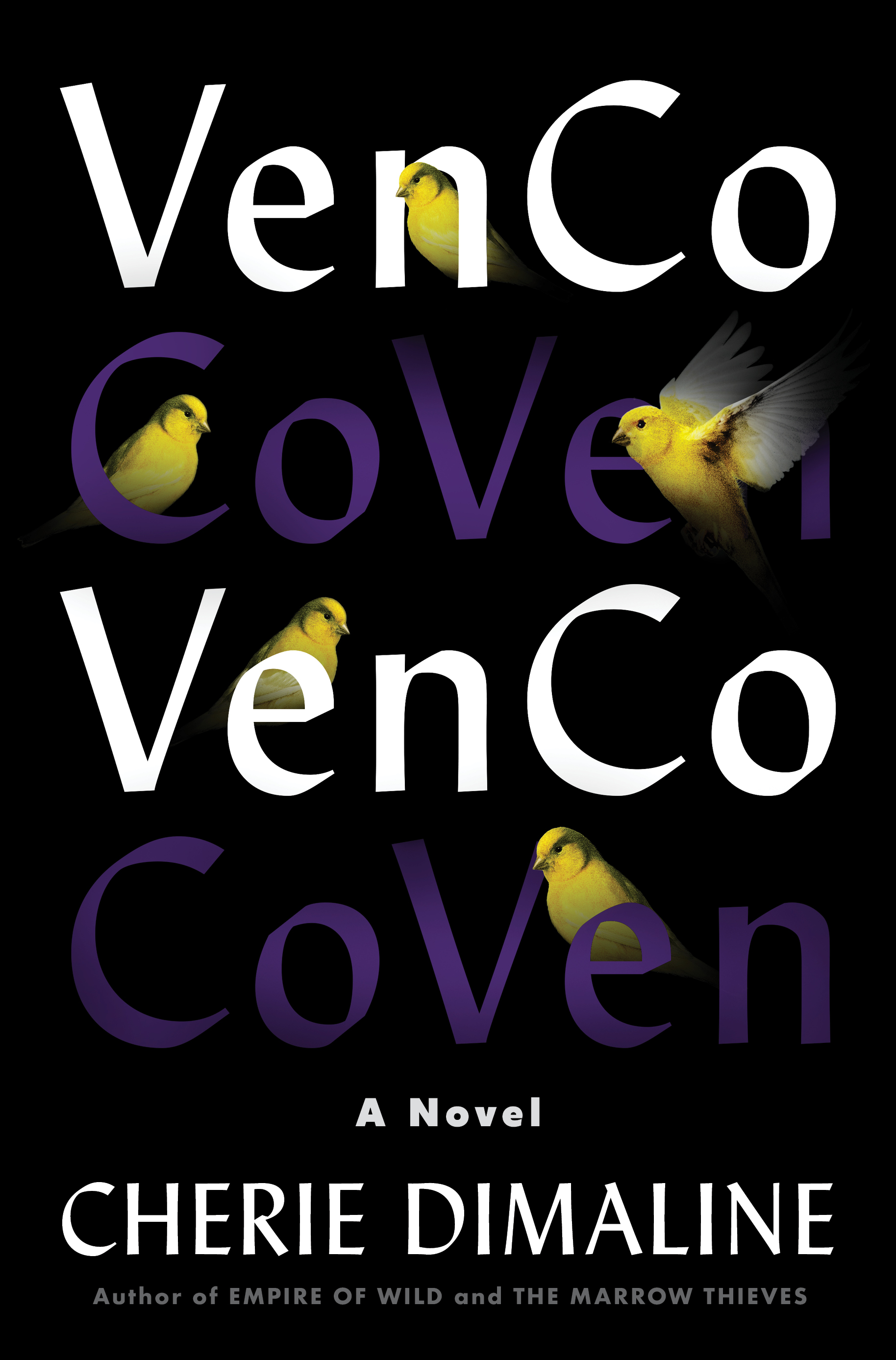
VEN.CO, sapphic Indigenous fantasy drenched in gynergy to keep you sane this Yule


VEN.CO
CHERIE DIMALINE

William Morrow (non-affiliate Amazon link)
$12.99 Kindle edition, available now

Rating: 4* of five

The Publisher Says: Lucky St. James, a Métis millennial living with her cantankerous but loving grandmother Stella, is barely hanging on when she discovers she will be evicted from their tiny Toronto apartment. Then, one night, something strange and irresistible calls out to Lucky. Burrowing through a wall, she finds a silver spoon etched with a crooked-nosed witch and the word SALEM, humming with otherworldly energy.

Hundreds of miles away in Salem, Myrna Good has been looking for Lucky. Myrna works for VenCo, a front company fueled by vast resources of dark money.

Lucky is familiar with the magic of her indigenous ancestors, but she has no idea that the spoon links her to VenCo’s network of witches throughout North America. Generations of witches have been waiting for centuries for the seven spoons to come together, igniting a new era, and restoring women to their rightful power.

But as reckoning approaches, a very powerful adversary is stalking their every move. He’s Jay Christos, a roguish and deadly witch-hunter as old as witchcraft itself.

To find the last spoon, Lucky and Stella embark on a rollicking and dangerous road trip to the darkly magical city of New Orleans, where the final showdown will determine whether VenCo will usher in a new beginning…or remain underground forever.

I RECEIVED A DRC FROM THE PUBLISHER VIA NETGALLEY. THANK YOU.

My Review
: VenCo, a front corporation for a CoVen (get it?) is a really fun gynergetic fantasy of what it would take to overwhelm the patriarchy and restore women to power.

Do you need something else to get one for this hijacked-by-jesus (who has a sly off-kilter cameo) sacred solstice holiday?

How about this: Lucky, our PoV character, is at a low ebb when we meet her...she's been struggling along, caring for her dementia-ridden paternal grandmother, scraping the money to survive, and now...the capitalist axe comes down, they're losing their home. Relatable, if in a grim way, to most all of us in or after middle age. Plot twist: It's now that Lucky discovers she's a witch, and the coven that's forming needs her...but not in Toronto, in New Orleans. The coven is forming to bring the world that Lucky's been angry with for most of her life, patriarchal racist exploitive horror that it is, to an end. She's got to assist the assembled women...including transfem Freya, explicitly accepted as a woman...in locating and assembling the spoons that'll generate the power they need to accomplish the task.

There are lots of names that don't always have solid characters attached, there is a notable holeyness to the plot, there is a powerful aura of wish fulfillment here. There is also an even-handed treatment of adversarial relationships. There is a demonization of Patriarchy, it's true, but not (to my surprise) of men.

The reason I gave it four stars is that this story was just plain fun to read. I wish it had been a wee tiny tidge tighter of plot. I'm not going to hold it up as a best of my reading year book. But I loved feeling so at home with Lucky, her deeply stressful life, and her middlescent discovery of her powers and her purpose. I thoroughly agree, in 2024, with the need to smash the Patriarchy and all its boosters and adherents. I was deeply gruntled by the transfem Freya simply...being...unremarkably one of the coven.

If you're going to be among the unenlightened, even the benighted, this coming Yule, bring this on your Kindle. You'll have an escape into a much nicer version of the world at hand, and a little spirit boost as the impending events of 2025 loom ever larger.

Tuesday, June 1, 2021

SWIMMING IN THE DARK, a lovely first-love tragedy where no one dies


SWIMMING IN THE DARK
TOMASZ JEDROWSKI

William Morrow Paperback Originals
$16.99 trade paper, available now


Rating: 4.75* of five

The Publisher Says: Set in early 1980s Poland against the violent decline of communism, a tender and passionate story of first love between two young men who eventually find themselves on opposite sides of the political divide—a stunningly poetic and heartrending literary debut for fans of Andre Aciman, Garth Greenwell, and Alan Hollinghurst.

When university student Ludwik meets Janusz at a summer agricultural camp, he is fascinated yet wary of this handsome, carefree stranger. But a chance meeting by the river soon becomes an intense, exhilarating, and all-consuming affair. After their camp duties are fulfilled, the pair spend a dreamlike few weeks camping in the countryside, bonding over an illicit copy of James Baldwin’s Giovanni’s Room. Inhabiting a beautiful natural world removed from society and its constraints, Ludwik and Janusz fall deeply in love. But in their repressive communist and Catholic society, the passion they share is utterly unthinkable.

Once they return to Warsaw, the charismatic Janusz quickly rises in the political ranks of the party and is rewarded with a highly-coveted position in the ministry. Ludwik is drawn toward impulsive acts of protest, unable to ignore rising food prices and the stark economic disparity around them. Their secret love and personal and political differences slowly begin to tear them apart as both men struggle to survive in a regime on the brink of collapse.

Shifting from the intoxication of first love to the quiet melancholy of growing up and growing apart, Swimming in the Dark is a potent blend of romance, post-war politics, intrigue, and history. Lyrical and sensual, immersive and intense, Tomasz Jedrowski has crafted an indelible and thought-provoking literary debut that explores freedom and love in all its incarnations.

I CHECKED THIS BOOK OUT OF MY LOCAL LIBRARY. USE YOUR LIBRARY, FOLKS! THEY NEED US.

My Review
: Happy Pride Month, US QUILTBAGgers! Let's celebrate what our fellows in Poland can't: A safe, sane Pride Month of more freedoms than were even conceivable even in my own youth of this lifetime.

Ludwik is a normal child: he knows he knows nothing, is interested in the things the people around him tell him to ignore, and most of all is just discovering, like all kids, that he's Weird. Trouble is his weird isn't going to be so easy to live with in Communist Poland: he's fallen in love, at nine years old, with Beniek. A boy. But also a Jewish boy. In the 1960s, World War II was very much alive and deeply scarringly real to Poles. Somehow the Jews, despite their vanishing into German ovens, are to blame for everything...and here's little faggot Ludwik falling for a Jewboy. Oh boy.

Then one day, Ludwik stops seeing Beniek around the way he always has been. Nothing...absence...awful heartbreak to a child whose loves are so fierce because they are so new. There is nothing like a disaster to make one aware of the freight we bring from our pasts, all the way out to our death.
I was transported into a vision of my life that made me so dizzy my head began to spin. Shame, heavy and alive, had materialized, built from buried fears and desires.

He's fallen; the only one who could catch him is now in Israel. (The Six-Day War happened, the Jews were expelled from Poland yet again.) Poor little guy, dropped into an ugly reality that connects to nothing, not any thing, in his loving heart. What the world will do to him....

Among the first things it does to him is grow him up: mother and grandmother lock themselves into her bedroom, doing something deeply mysterious together. He pesters and nags, and finally Granny tells his mother it's time to come clean: they bring their Ludzio into her bedroom and listen to Radio Free Europe. For the first time, they allow him to be One of Them. Sadly.
I thought of Mother, of her pointless life, her passivity. Of the years she’d spent listening to the radio, explaining her truths to me, and all of it for what? She’d died a submissive employee at the Electricity Office and had never dared to speak up or live out any of her ideas.

The sadness of a dead parent, a father whose entire life was spent far away from them by his choice, never spoken of still less to, results in an unmoored adolescent. Luckily for him, he is at least aware that he is gay...that he can not be like the boys he tres to emulate for mother and for grandmother to see, walking with a girl hand in hand along their street. One post-loss night, an older man in a park where THEY go takes his innocence. (As a side note, if not for one of those same older men I'd've never experienced a positive sexual encounter possibly at all, so no tutting about ephebeophiles or the like.) It is, from that moment on, a necessity that his bitter angry self, unable to fake an identity he despises the same way he despises the lying system he's entrapped by, leave Wroclaw and get to university in Warsaw.
Yay. That happens, there he is in his glory, but all courses end. At the end of his schooling, he is required to spend a summer harvesting beets, and there...
...my eyes fell on you. I had never seen you before—not consciously, anyway. Yet my mind felt strangely relieved, as if it had recognized someone.
–and–
“Pleased to meet you,” you said. “I’m Janusz.”

Janusz. Two syllables that rise and fall and follow each other logically, almost inevitably, and whose sound together is so familiar, so natural, that the meaning of its parts remained hidden to me until years later: Ja, meaning “I” in our language, and nusz, sounding just like our word for “knife.”
–and–
You smiled, dissolving the tension, your teeth flashing in the light of the fire. We sat there for a while, in our private silence, worlds shifting in me.

The dawning of first love! "Worlds shifting in me"...how utterly perfect and how very poignant to one so far from it as I am.

It seems bizarre to me, that I'm the same age as Ludwik. I look into this mirror, lightly distorted, and think...yes, that was it, these thoughts are familiar though I was doing this before Ludzio in age. But yes. I'm right there, I'm fully immersed, this is the way it felt, that's almost exactly what I thought.

It's unsurprising, then, that the rest of the course of first love is pretty particularly followed. Fear of rejection, fear of acceptance! Fear of the future. Wild, surging riptides of Jealousy! Swimming fearless and free in a moonlit pool, filling the darkness with your love for him, his for you, while every beat of the world's heart pushes pushes pushes...before you know its direction.
I don’t know how many days we stayed at the lake, because each one was like a whole world, every moment new and unrepeatable.
–and–
You listened, really listened, gentle eyes taking me in without judgment, making me feel more heard than I knew I could be.

So universal, the course of that first true love. There are minor variations, specific things to a time or a place. The course, however, is steady and unvarying: delight, disillusionment, dénouement. Then, if one is amazingly lucky, a new relationship grows into place over the old one.

The time of Solidarność, "Solidarity" in English, was the beginning of the end of Soviet Communism. Ludzio feels it in his bones, it causes him to rear back and resist and to refuse the whole idea of collaboration that his Janusz is making into a future...sadly we know how that will turn out for him.
The queues for the shops swelled like bloody lips—deliveries had become so few and far between that the only way to get anything was to wait. The lines had started to occupy whole streets.

And now Ludzio's frustrations are personal, his belovèd landlady/substitute grandmother, is very very ill and the system simply...doesn't care.
“There must be something else you can do.” I felt the moment slipping through my fingers. “Please, can’t you make an exception?”

She raised her eyes toward me again, this time without a trace of empathy. “I told you what to do. Now stop blocking the line for your fellow citizens.”


Why I did not give this book its seemingly merited perfect score is simple: Threads are raised but not snipped or woven, merely left dangling. The doctorate Ludzio spends so much time and effort on doesn't go anywhere...there is simply no mention of it ever again. Similarly the absolutely divine Pani Kolecka, his Warsaw grandma-quivalent and landlady...from dying to recovering to vanished. Um...not really acceptable. How he gets to New York instead of Chicago, where he applied for a passport to go, is never discussed. What does he do in New York, in Midtown no less? What business would need him? Has he gone to work for the UN as a translator? The Polish Government would have some stern words to say about that.... Yes, it's a book told in second person (blech) addressing a man the narrator's left behind forever and will never see again, but some sense of how that came to be *possible* was missing and missed.

In the end, though: It is exquisite pain to let go, to release the weight of the truth into a pool—deep, dark, and desalinated of all hints, innuendos, just lies—and save yourself, your future, your actual physical body without harming anyone else's life at all.
“I adored this book more than you knew,” it read there in your stocky, right-leaning script. “I wanted to keep it . . . but it’s yours. Bring it back one day if you can. I’ll be here. J.”


Fuck honesty. The price is too high, the interest Life charges is usurious, the carnage of Being Truthful lasts generations. Bravo Ludzio.

Friday, May 7, 2021

HENCH, or let's take "What the HELL Happened Here?!" to the next level

HENCH
NATALIE ZINA WALSCHOTS

Watch the inimitable Nancy Pearl interview Author Walschots here!
William Morrow
$27.99 hardcover, available now

Rating: 4.5* of five

The Publisher Says: A smart, imaginative, and evocative novel of love, betrayal, revenge, and redemption, told with razor-sharp wit and affection, in which a young woman discovers the greatest superpower—for good or ill—is a properly executed spreadsheet.

Anna does boring things for terrible people because even criminals need office help and she needs a job. Working for a monster lurking beneath the surface of the world isn’t glamorous. But is it really worse than working for an oil conglomerate or an insurance company? In this economy?

As a temp, she’s just a cog in the machine. But when she finally gets a promising assignment, everything goes very wrong, and an encounter with the so-called “hero” leaves her badly injured. And, to her horror, compared to the other bodies strewn about, she’s the lucky one.

So, of course, then she gets laid off.

With no money and no mobility, with only her anger and internet research acumen, she discovers her suffering at the hands of a hero is far from unique. When people start listening to the story that her data tells, she realizes she might not be as powerless as she thinks.

Because the key to everything is data: knowing how to collate it, how to manipulate it, and how to weaponize it. By tallying up the human cost these caped forces of nature wreak upon the world, she discovers that the line between good and evil is mostly marketing. And with social media and viral videos, she can control that appearance.

It’s not too long before she’s employed once more, this time by one of the worst villains on earth. As she becomes an increasingly valuable lieutenant, she might just save the world.

A sharp, witty, modern debut, Hench explores the individual cost of justice through a fascinating mix of Millennial office politics, heroism measured through data science, body horror, and a profound misunderstanding of quantum mechanics.

I CHECKED THIS BOOK OUT OF MY LOCAL LIBRARY. SUPPORT YOUR LIBRARY, FOLKS! USE THEM OFTEN!

My Review
: Several book ideas later, Author Walschots realized they all fit into one if she used a different frame...

I will make no bones about or apologies for my complete disdain for superhero crap. It's a bad social message. It's worse storytelling. The violence it does to physics and reality is incalculable.

Hey wait! I found *another* level of this book!

That this is a first novel is astonishing. That it is an assured and deft flensing of Western fascism and capitalism is a joy. That I am finding it now, nine months after William Morrow unleashed it on the US, is shocking. This should've flown at me, beating my head with its hard covers, demanding that it enter my consciousness long before now. Alas, the library wait-list was deep. I'm both glad and irked, because that means a lot more people have read it than might otherwise have been able to.

So, two reads in two weeks, and what I take away from it is: Love sucks.

Superhero stories are about loving someone who doesn't, can't, love you back. Part of the joke in Hench is that they cause such horrendous collateral damage because they're unmoored by love, unable to imagine the reality of other people that love demands of us. Superheros, by anyone's definition, are psychopaths. Supervillains, on the other hand, are sociopaths. The definitions aren't hard to grasp, and the conclusions are inescapable. Here we are in the world, the gig economy, that supports the supervillains...the henches, not the Meat, the bastards whose bodies are ripped and torn in the myriad of comic pages, bits flung here and there as X battles Y:
Our own tactical team members, Leviathan’s grade-A Meat (they tended to refer to themselves as Filet Mignon)...

Amusing, no? The Meat willingly serves the purpose, offers their flesh to the mills of the gods. Make jokes about how they're a better grade of Meat.

But think about that. Really, for once, think about that: this is what it costs to be alive but average, or less, in this world. To have unlucky parentage. To be lower than the lowest edge of the 1%:
I was beginning to nurse a feeble hope that maybe, just maybe, that gratitude he was feeling might blossom into a full-time position. Maybe one day I would be able to visit a dentist again.
–and–
Every day, the cost added up. Every day I couldn’t work, or move; every day that passed in a haze of pain and obsessive misery-making added to the total.
–and–
Maybe a lot of those years wouldn’t have been terribly good, and would have involved a lot of busting heads and driving recklessly and working for villains. But they were our shitty years, and they’d been taken from us by an asshole in a cape playing judge and executioner.

This is the thing I've always known but never articulated: The reason I loathe comic books and superhero movies is that I am bitterly opposed to the presumptious and wrongheaded notion that one asshole in a stupid outfit knows better than centuries of legal checks and balances. Yes, indeed, the Law fails; "The law often allows what honor forbids" said Bernard-Joseph Saurin, and his Ancien Régime ass knew what he was talkin' about. But someone needs to explain to me why vigilantism is in any way superior to letting the law do its slow, imperfect, maddeningly unjust work.

Apologizing to corpses is pointless.

But I digress. Hench gave me many moments such as this, the ones that led me down well-worn mental paths of outrage and indignation at the Way Things Are because it's manifestly rigged against ordinary people. The Henches and the Kicks (superheroes's sidekicks) aren't ever going to come out whole and will never entirely accept that they are not part of any future the supers concoct.

Women reading this screed: Yes, I know this is the lived experience of almost all of you.
“You know what’s more criminal than anything I have ever done? That you’ve been overshadowed by that lantern-jawed cock-wit when you’re obviously better than him in every imaginable way.”

Pain crossed her face. “Well. No one is willing to make some bitch the head of the greatest superhero team in the world.”
–and–
Her face was extraordinary. She was Grendel’s mother; she was vengeance incarnate. If she’d had any doubt about what she was doing haunting the edges of her actions, all of that was burned up now.

And there it is. The simplest reduction of male privilege there can be. She's better, smarter, more capable? Get her on the team and make sure she knows she's a girl, a second-class version of a Man. I have always known women were stronger than men; birth proves it. Watch a woman in labor for twelve, fourteen endless, hard-working, rest-less hours. Then tell me she's weak. Watch a woman whose body is hemorrhaging do her job anyway, despite the painful contractions and loss of blood. Roll your eyes, puny man, accuse her of being lesser; but you damn sure couldn't do what she does.

So that said, Hench's women are all about moving around the obstacles that Male Ego presents them; and doing it with purpose, and focus, and dogged determination. (Make a woman hate you at your peril.) The battles are quite revoltingly realistic in their description. There is very significant body horror. There is a lot of screaming, from all concerned, and there is a deeply felt accusation underpinning it all:
Supercollider had a great deal in common with a diamond: aesthetically tacky; value artificially ascribed by corporate greed; cultural significance vastly overinflated; and incredibly hard to damage. I’d theorized that the only thing really capable of hurting him would be himself, the way that diamond was used to cut diamond.

A bit on-the-nose, but valid. The Superheroes are diamonds, tacky brummagem things, capable of being synthesized in labs by the gross but sold to the hoi polloi as the Greatest! Thing!! EVER!!! and they accept it.

We accept it.

It isn't in us to refuse. The System has wound itself tightly about our every single neuron:
Not only were heroes responsible for all of the damage and injury they caused, they were even responsible for creating the villains they fought.

Fighting free involves losing one's sense of purpose, as The Auditor (our PoV character, Anna) discovers:
I wondered if I was jealous. I wished suddenly that I could see my own feelings with as much clarity as I now saw the ultraviolet spectrum.
–and–
"...My husband didn’t give a damn whether the work I was doing was noble as long as it appeared to be. When I killed someone then—something I did a lot more than I do now—it was for the greater good. It was such bullshit. So the second the pretense was gone, so was he. I didn’t need that.”
–and–
“He didn’t try and hide it.” He closed his eyes when he spoke this line, grabbed the podium for support.

“He didn’t care enough.”

This was the clip they played, over and over, the force of his misery making him sway.

The problem this fucked-up system we all acquiesce to is best at producing in bulk is just this, a misery so porfound that it's actually soul-destroying. This sense that we are all being cheated, denied, made fools of by the things we're told to value and given no way to engage with from a place of wholeness.

There was a lovely call-out to Mae West's famous line about diamonds that made me laugh out loud; there was a very sly reference to the MCU in all its acronymic glory; and there was, at the end of the read, a sense in this particularly old reader that there is indeed a reason to hope the future will not happen without witnesses to its glorious excesses.

I'll now take a brief personal moment to screech in revulsion about the two w-bombs dropped by Author Walschots at 9% and 50%. Only cost her half a star, though, because so much else was so delicious.

Friday, November 11, 2016

THE LEISURE SEEKER, soon to be a major (indie) motion picture! Helen Mirren! Donald Sutherland!


THE LEISURE SEEKER
MICHAEL ZADOORIAN

William Morrow
$15.99 trade paper, available now

NOW $1.99 ON KINDLE! (non-affiliate Amazon link)

Rating: 4.25* of five

***UPDATE! AVAILABLE ON STARZ & AMAZON PRIME!


***UPDATE 10/3/2017 Here's a clip that makes me really hopeful for the film's fidelity to the source material. And here's an Hollywood Reporter interview with Helen Mirren and Donald Sutherland! Dream casting!***


**UPDATE 11/10/2016 A feature film starring Helen Mirren and Donald Sutherland will debut in the US during 2017. Talk about dream casting for your novel's movie! I hope Michael Zadoorian is as well served by the screenwriters and producers as he stands to be by his characters' faces.**

The Publisher Says: A sort of Easy Rider meets The Notebook, Michael Zadoorian’s poignant, funny, vibrant, and unforgettable novel, The Leisure Seeker, is a story of two seniors who escape from their retirement home and embark upon a hilarious and touching end-of-life road trip. Here is a story that will appeal to a wide range of readers: from retiring Baby Boomers to fans of Mitch Albom, Tom Perotta, David Sedaris, Nick Hornby, and Nicholas Sparks. In fact, the Detroit Free Press says, “I would recommend Michael Zadoorian’s The Leisure Seeker to almost anyone.”

My Review: The Robinas got old one day. They couldn't tell you which day, exactly...he has Alzheimer's, she's just old and frankly after a certain point who can tell the days apart anyway?...but it happened, and now, well, The End isn't on the horizon anymore, it's on the to-do list.

Three quotes will tell you all that you need to know about this book. If they fail to appeal, so will this wry, loving, unsparing look at the parade's end:

“We pass a church with a massive blue neon cross, and I am spiritually lifted by feelings of great religiosity. No, I’m not, for crying out loud. Don’t be ridiculous. But what I do love about this road is how the gaudy becomes grand, how tastelessness is a way of everyday life.”(p37)

“I think about the people in the slides, most of them gone now, heart attacks and cancers, betrayed by the foods we ate, by our La-Z-Boys, by our postwar contentment, everyone getting larger and larger in every year’s photographs, our prosperity gone wide.” (p57)


“We pass on the Will Rogers Memorial in Claremore. I never much cared for the man. A big phony, I believe. Anyone who never met a man he didn’t like just isn’t trying hard enough.” (p79)
Seriously...tell me that's not pitch-perfect coming from a thirtysomething writer's imagination. The Robinas are delightful company on their last trip.

Thursday, January 21, 2016

MONGRELS: A Novel by Stephen Graham Jones...one helluva fine YA tale


MONGRELS: A Novel
STEPHEN GRAHAM JONES

William Morrow (non-affiliate Amazon link)
$13.49 Kindle edition, available now

Rating: 4* of five

The Publisher Says: A spellbinding and darkly humorous coming-of-age story about an unusual boy, whose family lives on the fringe of society and struggles to survive in a hostile world that shuns and fears them.

He was born an outsider, like the rest of his family. Poor yet resilient, he lives in the shadows with his aunt Libby and uncle Darren, folk who stubbornly make their way in a society that does not understand or want them. They are mongrels, mixed blood, neither this nor that. The boy at the center of Mongrels must decide if he belongs on the road with his aunt and uncle, or if he fits with the people on the other side of the tracks.

For ten years, he and his family have lived a life of late-night exits and narrow escapes—always on the move across the South to stay one step ahead of the law. But the time is drawing near when Darren and Libby will finally know if their nephew is like them or not. And the close calls they've been running from for so long are catching up fast now. Everything is about to change.

A compelling and fascinating journey, Mongrels alternates between past and present to create an unforgettable portrait of a boy trying to understand his family and his place in a complex and unforgiving world. A smart and innovative story—funny, bloody, raw, and real—told in a rhythmic voice full of heart, Mongrels is a deeply moving, sometimes grisly, novel that illuminates the challenges and tender joys of a life beyond the ordinary in a bold and imaginative new way.

I RECEIVED AN ARC FROM THE PUBLISHER. THANK YOU.

My Review
: This novel was born from a short story that Author Stephen collected in After the People Lights Have Gone Off (q.v.). It is a take on the werewolf legend that is, not to beat around the bush, completely and utterly his own and therefore exciting, involving, and deeply relatable. Like his fiction is in general.

What makes this so deeply and deliciously devourable is the way it takes us into the misery of being Othered in our modern Murruhkuh. There's the level of supernatural Otherness, of course; but as a result of this inborn, intrinsic Othering, the people who have it in them are forced to the lowest and least desirable options for survival: Migrant workers are the base of the modern food chain and are treated accordingly. That is, as the slaves they are in all but name. And, if our country doesn't pull its head out of its collective ass, things are about to get a whole lot worse for the Othered.

Different post...sorry. The blizzard coming has me edgy.

What Mongrels does that other werewolf fiction does not do is to make the quotidian decisions of life, of adolescence in particular...what it takes to have a significant other, for example:
Just when I thought I’d figured out what made a girlfriend happy, what would make one stay, I would do something wrong again and that would be that.

“Something wrong, like, I don’t know, like eating their pet goat?” Libby said, without looking over from the game show glowing all our faces light blue.

into the fictional universe's center. That will indeed make a lass's heart colder and her mouth set harder towards one, indeed...and while I'm here, let me note that Author Stephen's choice to use our PoV character without a name (or without one we know) but a shifting series of labels, eg "the reporter", makes his adolescence all the more touchingly obvious and honest. He's himself, he doesn't need a name inside his head; but he's trying on new identites, seeing which ones might fit. Yet everyone else has names, just like our own internal monologues give them. It's another technique to give the adolescent within the reader a strong and lasting handhold into the shifting (!) and unstable reality of not belonging. Of Being Other, being Othered, and knowing in your very deepest parts that you are, in fact, Other.

Not allowing others' Othering of you to take, to resist it internally, to make your Other from a label into an Identity, is one of the central struggles of adolescence. I know because I was Othered by gayness. I know because I watched my entire peer group choose up sides in the culture wars of the 1970s and 1980s, and I was never in the majority. And thus it is that, at *ahem*ty-plus years of age, that I can find myself in this story of a werewolf whose membership in even his birth community is not assured...he hasn't fully made it. He is just...hangin' there.

If blood and gore are hard-pass material for you, by no means should you try this read...or any other Stephen Graham Jones read. If you're thinking this story will scare you and keep you awake, I don't think you need to worry. The atmosphere of dread is situational. It's a spice used to make this a rare and precious dish not another Wednesday-night stew. I think the most important question to ask yourself before picking it up is, "how much longer do I want to ignore how many wonderful stories there are that I think I won't care about?" Break your cycle here. Learn about the reality of Othering and its huge personal and societal costs without being smacked around by Facts. Let the Truth work her mystical wiles on you instead.