Showing posts with label first love. Show all posts

Thursday, May 15, 2025

FRIDA KAHLO'S LOVE LETTERS, passionate Love for others in her own words


FRIDA KAHLO'S LOVE LETTERS
SUZANNE BARBEZAT

Frances Lincoln Ltd (non-affiliate Amazon link)
$24.00 ebook, available now

Rating: 4.75* of five

The Publisher Says: ‘I don’t know how to write love letters. But I wanted to tell you that my whole being opened for you. Since I fell in love with you everything is transformed and is full of beauty . . . love is like an aroma, like a current, like rain’

Frida Kahlo lived a passionate life and the letters shared between her and those she loved are an intimate insight into her life. Letters were sent to her first love, Alejandro Gomez Arias, and to her husband Diego Rivera. But she wrote declarations of love to many others, including Leon Trotsky, Nickolas Muray and Jose Bartoli.

I RECEIVED A DRC FROM THE PUBLISHER VIA EDELWEISS+. THANK YOU.

My Review
: Is somebody, other than the spy agencies, archiving people's emails? I doubt a book like this will be possible to collect in thirty years. That makes me sad.

It's lovely to have this peek into Frida's life of love.
who we're talkin' about
I deliberately said it that way because "love life" carries an entirely different meaning in English. I think no one exemplifies a "life of love" better than wounded, damaged Kahlo. Her many surgeries, her intense pain after the accident that mangled her, the earliness of her death...she was FORTY-SEVEN! I mean, I knew she was too young to die, but that's barely middle age!...all conspired to keep her isolated. It was inevitable. No wonder her artwork is a riot of color, is so intensely involved in portraying volumes in space...it had to be, or she'd go mad. Madder.
Frida in 1926, pre-accident
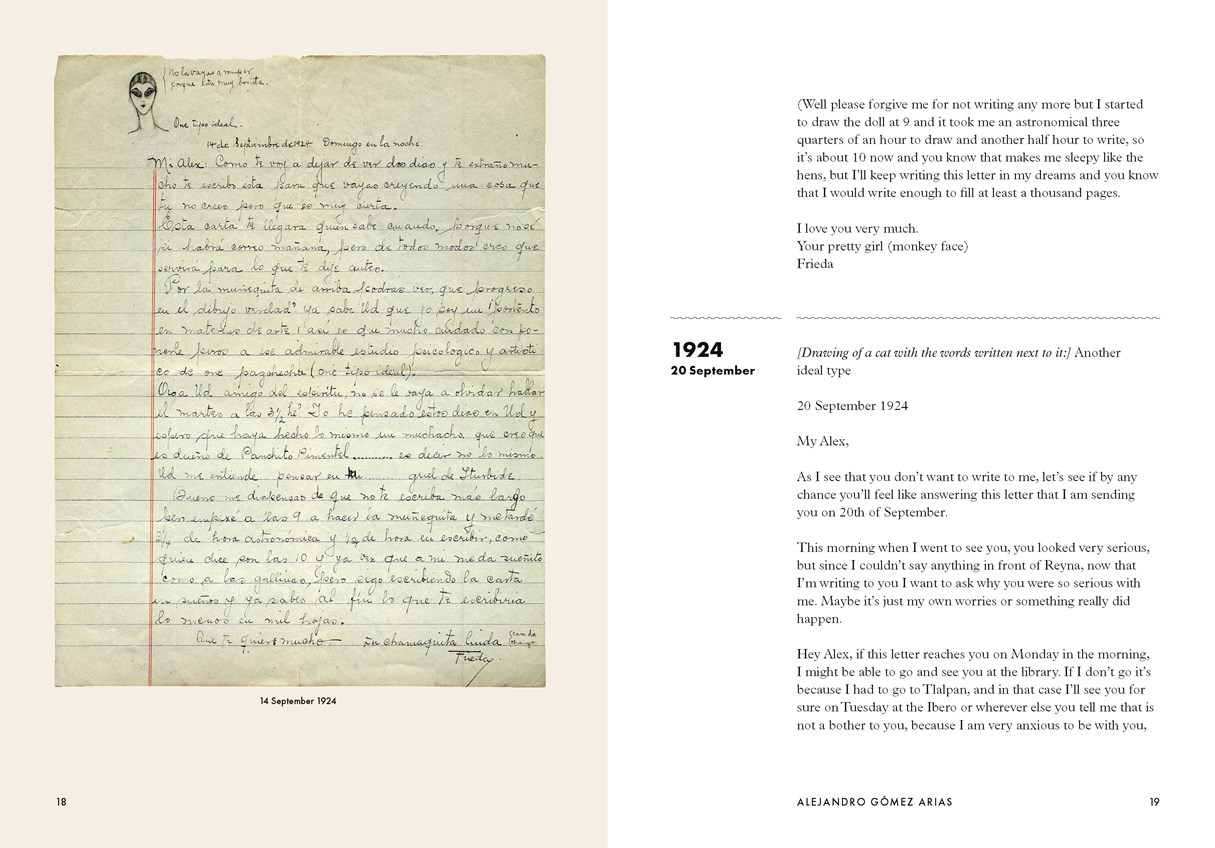
How I wish she'd lived in the time of the internet. How grateful I am that she didn't. It's like wishing her accident never happened, or she was not so severely broken by it...she wouldn't have been herself, then. Would we know of her as the monadnock of art she is had she not been made famous for overcoming her physical disadvantages? 17 September 1925 ruined one life, opened another. From the life before, her love letters to Alejandro Gómez Arias show a callow, intense crush on this handsome guy:
hubba hubba! me likee!
...who, to be honest, is very crushwortthy on value of face. The letters are, well, those of a young, very young, woman finding out about this amazing thing called Love:
It's the sort of thing that causes some people to insist their papers be burned after their death. I'm not sure that's wrong of them. After all, outpourings of Love are utterly cringe if you're not also in love; sometimes even if you are, but in a good way then.

I thoroughly enjoyed this collection of Frida's letters as an object, and as per usual give Frances Lincoln Ltd's designers big ups for their presentation. I understand this is a gift object. I would give it five of five stars if it had included some of the responses the recipients returned. I'm not al all sure that would've been the same book, of course, so that's why I got as close to the full five as I did. I'm quite sure I'd gift this to my lesbian pal (she's still iconic among us, despite the careful heteronormativity of this selection), or my Frida freak cousin, or just pretend I'll give it to someone and end up keeping it on my coffee table for people to flip through.

It's two hours well-spent learning about the close relationship between a gifted artist's openness to Love, and her creative intensity. This was a spirit not to be trapped, not to be bound, not to be trammelled; this was a woman who Loved where she would, who she would.

Tuesday, September 26, 2023

THE WORDS THAT REMAIN, and mold and carve and stain


THE WORDS THAT REMAIN
STÊNIO GARDEL
(tr. Bruna Dantas Lobato)
New Vessel Press
$16.95 trade paper, available now

Rating: 5* SIX of five for 2023! Far and away the best of my 2023 reads. Gorgeously translated, beautifully wrought, so piercinlgly sad and not the least bit maudlin with it. Superb.

WINNER of the 2023 National Book Award in Translated Literature

The Publisher Says: A letter has beckoned to Raimundo since he received it decades ago from his youthful passion, handsome Cícero. But having grown up in an impoverished area of Brazil where the demands of manual labor thwarted his becoming literate, Raimundo has long been unable to read.

As young men, he and Cícero fell in love, only to have Raimundo's father brutally beat his son when he discovered their affair. Even after Raimundo succeeds in making a life for himself in the big city, he continues to be haunted by this secret missive full of longing from the distant past.

Now, as an elderly man, he at last acquires a true education and the ability to access the letter. Exploring Brazil's little-known hinterland as well its urban haunts, this is a sweeping novel of repression, violence, and shame, along with their flip side: survival, endurance, and the ultimate triumph of an unforgettable figure on society's margins. The Words That Remain explores the universal power of the written word and language, and how they affect all our relationships.

I RECEIVED A DRC FROM THE PUBLISHER VIA EDELWEISS+. THANK YOU.

My Review
: When I was very young, all of thirteen, I fell in love with a football player. To my amazement, he gave every sign of returning my interest. It was all kind-of innocent, not like a giant orgiastic sexual discovery. And how beautiful I felt when he'd just...look at me. That had never happened to me before.

I did what a kid does...I wrote him notes. He wrote me notes. I kept one.

My appalling, homophobic, faux-religious mother discovered that note where I'd hidden it inside my favorite nautilus-shaped tchotchke box.

I had, not long before this, put a stop to her physical abuse of me by belting her in the belly. She retaliated by using this lovey-dovey note to cause all sorts of ugly trouble. The echoes of that awful passage in my life will likely never die down, since they haven't in the ensuing fifty years. This novel, then, was quite clearly aimed right at me, targeted on my sensitive spot for the cost of queer first love, the power of words written by someone you love to become talismans that organize your life. I organized mine by never, ever again letting anyone who could harm me have information about the man I was in love with...to this day it's a struggle for me even to speak of my Young Gentleman Caller to an individual person, even one who doesn't and won't ever know him. Luckily (or unluckily) his own family's awful behavior towards him has left him with a similar issue and we exist in a bubble of our own.

Like Raimundo's abandonment of a home that didn't want him, I left Texas for New York; like him, I made a life for myself, one where (like him) I never had the full decoding ring to really thrive in. Like Raimundo, I never knew the end of that first-love story. Like Raimundo, my Cícero disappeared along with my ability to believe people were good.

So when I read this under-150-page blaring klaxon, my Issues were summoned from their therapy-induced comas to bring me nightmares. To evoke my life-long sadness of not ever allowing myself a Home. Because then, if I did, some vengeful demoness would come, screeching bible verses and shouting about how god hates Sin but will welcome you "home" if you'e just willing to be fake, and miserable, and change into who and what you aren't.

That therapy worked because the Issues were clubbed into unconsciousness. They gave me the clear awareness, though, that Art was happening here, that honest truth was being told to me in beautiful sentences, that one old man's early pain is a lot like another's...that Fiction is doing her blessèd work of bringing the people who read it into a closer communion than any church could ever pretend to offer.

National Translation Month is a cornucopia of excellent work, any amount of which might give you the limpidly clear and bracingly cool sense of being seen, heard, and understood. If you buy one book from the thousands that arrive on our Anglophone shelves from all points, let 2023's be this one.

Wednesday, July 20, 2022

TOMORROW, AND TOMORROW, AND TOMORROW...taking Shakespeare literally is good strategy


TOMORROW, AND TOMORROW, AND TOMORROW: A Novel
GABRIELLE ZEVIN

Alfred A. Knopf
$28.00 hardcover, available now

TRADE PAPER EDITION ON 25 JUNE 2024 It will cost $19.00 and pre-orders are accepted now.

Rating: 4* of five

The Publisher Says: In this exhilarating novel by the best-selling author of The Storied Life of A. J. Fikry two friends—often in love, but never lovers—come together as creative partners in the world of video game design, where success brings them fame, joy, tragedy, duplicity, and, ultimately, a kind of immortality.

On a bitter-cold day, in the December of his junior year at Harvard, Sam Masur exits a subway car and sees, amid the hordes of people waiting on the platform, Sadie Green. He calls her name. For a moment, she pretends she hasn't heard him, but then, she turns, and a game begins: a legendary collaboration that will launch them to stardom. These friends, intimates since childhood, borrow money, beg favors, and, before even graduating college, they have created their first blockbuster, Ichigo. Overnight, the world is theirs. Not even twenty-five years old, Sam and Sadie are brilliant, successful, and rich, but these qualities won't protect them from their own creative ambitions or the betrayals of their hearts.

Spanning thirty years, from Cambridge, Massachusetts, to Venice Beach, California, and lands in between and far beyond, Gabrielle Zevin's Tomorrow, and Tomorrow, and Tomorrow is a dazzling and intricately imagined novel that examines the multifarious nature of identity, disability, failure, the redemptive possibilities in play, and above all, our need to connect: to be loved and to love. Yes, it is a love story, but it is not one you have read before.

I RECEIVED A DRC FROM THE PUBLISHER VIA NETGALLEY. THANK YOU.

My Review
: When you're old, like me, you don't expect to follow middle-aged peoples' passions because you raised them so you know there's just stuff not shared between generations. One of those things is gaming. I've watched people get really passionate about the games they're playing and, frankly, wanted to yawn in their face. I do not see the appeal. But, knowing this was going to be the spine of the story, I was ready for that and factored my indifference out of the story's appeal.
Sadie had often reflected that sex and video games had a great deal in common. There were certain objectives that needed to be met. There were certain rules that shouldn't be broken. There was a correct combination of movements—button mashes, joystick pivots, keystrokes, commands—that made the whole thing work or not work. There was a pleasure to knowing you had played the game correctly and a release that came when you reached the next level. To be good at sex was to be good at the game of sex.

What we're left with is the childhood friend, I think most of us have had one, whose idea of a good time marches well with our own and whose ability to connect with our quiet places makes them invaluable and necessary companions. This is not to say they're romantic-partner material, and in some odd way I think that romantic facet, if present, actually works against this sort of long-term companionship. The relationship that Sam and Sadie take with them through their lives is that companionably silent, creatively clicking connection. It's a wonderful thing to find and, mirabile dictu, Author Zevin makes the force of it real, present, and never overplays her hand with it. A tremendously admirable and no doubt difficult achievement.
Why was it so hard for him to say he loved her even when she said it to him? He knew he loved her. People who felt far less for each other said "love" all the time, and it didn't mean a thing. And maybe that was the point. He more than loved Sadie Green. There needed to be another word for it.

–and–

To allow yourself to play with another person is no small risk. It means allowing yourself to be open, to be exposed, to be hurt. It is the human equivalent of the dog rolling on its back—I know you won't hurt me, even though you can. It is the dog putting its mouth around your hand and never biting down. To play requires trust and love.

The hardest thing to admit to yourself is that you're the Bad Guy in someone else's fairy tale of life and love. Someone out there thinks of you with acute hurt and badly wounded feelings. Sam and Sadie are that to each other, as well as companionable besties. It's complicated, and it wouldn't do to spend time spoilering it, but suffice to say that the ability to betray, then to forgive yourself and seek forgiveness from the betrayed, is another very difficult thing to present in any believable way in fiction. Author Zevin does that, too.
"We work through our pain. That's what we do. We put the pain into the work, and the work becomes better. But you have to participate. You have to talk to me. You can't ignore me and our company and everything that came before."

It's a story about the depths of devotion to an idea, an ideal, and a cause in service of one's burning passion to make and be more than one is. It's a story about Love being, in the end, enough to make even failure less important. It's a story about Sam and Sadie making a life with each other: even though not spouses, they're necessary in each others' world because...well, because.
“I thought you were worried I was going to die," Sam said.

"No. You'll never die. And if you ever died, I'd just start the game again," Sadie said.

"Sam's dead. Put another quarter in the machine."

"Go back to the save point. Keep playing, and we'll win eventually.”

There it is, in that brief passage. That is what some connections offer, and what some of us luck into once or twice in a lifetime. It's precious beyond price and it's the heart of this loving story of the messy, cruel, angry thing we call life.

Why, then, have I given the read a mere four stars? Because I am, as noted above, old. It is not a story written for me, and so I am not as invested in it as I would be if I were 42 not 62. I expect that others will love the delicate and intricate love among all three main protagonists without the sense I had of being spoken around at the dinner table. It's a fate, like bed-wetting, that comes around again after being left behind in childhood. Hence the lack of a fifth, or fraction of a fifth, star. Still a story I'd encourage you to read. (With an agèd person caveat.)

Sunday, August 15, 2021

COUP DE GRÂCE, a concentrated gut-punch dealing with Love's corrosive, destructive power


COUP DE GRÂCE
MARGUERITE YOURCENAR
(tr. Grace Frick)
Farrar, Straus & Giroux (non-affiliate Amazon link)
$17.00 trade paper, available now

Rating: 3.5* of five

The Publisher Says: Set in the Baltic provinces in the aftermath of World War I, Coup de Grâce tells the story of an intimacy that grows between three young people hemmed in by civil war: Erick, a Prussian fighting with the White Russians against the Bolsheviks; Conrad, his best friend from childhood; and Sophie, whose unrequited love for Conrad becomes an unbearable burden.

I CHECKED THIS BOOK OUT OF MY COUNTY'S LIBRARY SYSTEM VIA INTERLIBRARY LOAN. USE YOUR LIBRARIES, PLEASE! THEY NEED OUR PATRONAGE.

My Review
: Told in the first person past perfect, this tale is of three young people caught in a highly hormonal passage of their lives at the same moment the Russian Revolution overthrows the privileged existences they'd led until that time. It purports to be the memory of Erick von Lhomond as he sits in a train station cafe. Erick is on his way to who knows where after his career as a soldier of fortune has led to a wounding in the 1930s Spanish Civil War then newly ended. He recalls his strange, unequal love for sibling aristos Conrad and Sophie, children of the Count of Reval; they are his cousins. Sophie falls in love with him; he and Conrad are already involved in some sort of...it's not spelled out, but it feels to my gay twenty-first century self like it's a sexual relationship. Triangle collapses, the two siblings die, and cowardly, culpable Erick soldiers on. It's all in the hows, as life so often is when one is young; now, in the fullness of his wasted years, Erick is seeing the whys, and they're keeping him up nights. And not a moment too soon, if you ask me.
Perhaps I am generalizing from a wholly individual case of moral impotency: of all the men I know I am least disposed to seek out ideological incitements in order to love or hate my fellow beings; it is only for causes in which I do not believe that I have been willing to risk my life.

This, then, is a near-perfect example of a récit (French: “narrative” or “account”). These are brief novella-like things, usually with a simple narrative line; studiedly simple but usually steeped-in-irony tales in which the first-person narrator reveals the inherent moral ambiguities of life by means of reminiscences.

It's a very French narrative form, is the récit, the novella's Goth cousin, all chains and weird makeup effects and scary-looking hair. It's a perfect form to use in telling this sort of moralizing by a man with no morals story. There just aren't that many English-language writers willing to do this without oodles of padding and the crutch of multiple characters, apart from Fitzgerald in his finest work, the scathing takedown of anomie and amorality that is The Great Gatsby. Author Yourcenar, whose Memoirs of Hadrian lives as one of my all-time favorite reads, published this particularly difficult take on the pointlessness of war in 1939...barely beating WWII's official starting gun. She was quite clearly aware that war was inevitable and imminent, and wrote it as a protest against the further damage inevitable in a war. She was also, according to facts relayed by her biographer, Josyane Savigneau, in Marguerite Yourcenar: Inventing a Life, settling an old score with a man for whom she had developed a similar and similarly unrequited passion:
We are so used to seeing in wisdom a residue of dead passions that it's difficult to recognize in it the hardest and most condensed form of ardour, the gold nugget pulled out of the fire, not the ashes.

The ending of the book, stark and violent and horrfying, sums up the expectations of this Belgian survivor of the War to End All Wars, and it was not in the least bit too dark or pessimistic. Only extremely painful to read, as I suppose it was to live as well. As a side note, Translator Frick was Author Yourcenar's lover as well as business manager. I can only feel sad that her opinion of this acid-bath of a read doesn't seem to have survived, if it was ever shared with anyone else.

I found the casual, unremarked-on anti-Semitism of the book jarring. I know it was a part of the culture Yourcenar lived in, but it hasn't aged well. I wasn't very impressed with Erick, the narrator's, casual, caddish sexuality either...gentle, clueless Conrad could certainly have done better, and tempestuous, grasping Sophie's awakening has such tragic consequences that it makes one doubt the sanity of the child (she's sixteen to Conrad's and Erick's twenty during the brief span covered by this book). This is a ménage à trois that belies the three-legged stool analogy. It could be the people involved are simply too young to make a stable combination; it could be that Erick simply could never bring himself to lose the battle for supremacy that he wages with himself and against the world (but especially Sophie) in favor of someone he is not in love with:
Nothing moves me more than courage: so total a sacrifice deserved complete trust from me. But she never believed that I trusted her, since she did not suspect how much I distrusted others. In spite of appearances to the contrary, I do not regret having yielded to Sophie as much as it lay in my nature to do; at the first glance I had caught sight of something in her incorruptible, with which one could make a compact as sure, and as dangerous, as with an element itself. Fire may be trusted, provided one knows that its law is to burn, or die.

Recommended? Well, on the whole, not unreservedly. It's not a casual book, and it would offer too few cheap thrills for most people in the modern audience for short reads...deeply transgressive when Yourcenar wrote it in 1939, it's fairly tame today. Gay boy loves bisexual boy, who loves him back but also fancies his teen sister? There couldn't really be that much to shock an audience whose culture served them up Blue Velvet and Natural Born Killers and Bonnie and Clyde on movie screens, let alone in the rarefied, private world of a book's pages.

For me, I'm glad I read it, but I won't re-read it ever.

Tuesday, June 1, 2021

SWIMMING IN THE DARK, a lovely first-love tragedy where no one dies


SWIMMING IN THE DARK
TOMASZ JEDROWSKI

William Morrow Paperback Originals
$16.99 trade paper, available now


Rating: 4.75* of five

The Publisher Says: Set in early 1980s Poland against the violent decline of communism, a tender and passionate story of first love between two young men who eventually find themselves on opposite sides of the political divide—a stunningly poetic and heartrending literary debut for fans of Andre Aciman, Garth Greenwell, and Alan Hollinghurst.

When university student Ludwik meets Janusz at a summer agricultural camp, he is fascinated yet wary of this handsome, carefree stranger. But a chance meeting by the river soon becomes an intense, exhilarating, and all-consuming affair. After their camp duties are fulfilled, the pair spend a dreamlike few weeks camping in the countryside, bonding over an illicit copy of James Baldwin’s Giovanni’s Room. Inhabiting a beautiful natural world removed from society and its constraints, Ludwik and Janusz fall deeply in love. But in their repressive communist and Catholic society, the passion they share is utterly unthinkable.

Once they return to Warsaw, the charismatic Janusz quickly rises in the political ranks of the party and is rewarded with a highly-coveted position in the ministry. Ludwik is drawn toward impulsive acts of protest, unable to ignore rising food prices and the stark economic disparity around them. Their secret love and personal and political differences slowly begin to tear them apart as both men struggle to survive in a regime on the brink of collapse.

Shifting from the intoxication of first love to the quiet melancholy of growing up and growing apart, Swimming in the Dark is a potent blend of romance, post-war politics, intrigue, and history. Lyrical and sensual, immersive and intense, Tomasz Jedrowski has crafted an indelible and thought-provoking literary debut that explores freedom and love in all its incarnations.

I CHECKED THIS BOOK OUT OF MY LOCAL LIBRARY. USE YOUR LIBRARY, FOLKS! THEY NEED US.

My Review
: Happy Pride Month, US QUILTBAGgers! Let's celebrate what our fellows in Poland can't: A safe, sane Pride Month of more freedoms than were even conceivable even in my own youth of this lifetime.

Ludwik is a normal child: he knows he knows nothing, is interested in the things the people around him tell him to ignore, and most of all is just discovering, like all kids, that he's Weird. Trouble is his weird isn't going to be so easy to live with in Communist Poland: he's fallen in love, at nine years old, with Beniek. A boy. But also a Jewish boy. In the 1960s, World War II was very much alive and deeply scarringly real to Poles. Somehow the Jews, despite their vanishing into German ovens, are to blame for everything...and here's little faggot Ludwik falling for a Jewboy. Oh boy.

Then one day, Ludwik stops seeing Beniek around the way he always has been. Nothing...absence...awful heartbreak to a child whose loves are so fierce because they are so new. There is nothing like a disaster to make one aware of the freight we bring from our pasts, all the way out to our death.
I was transported into a vision of my life that made me so dizzy my head began to spin. Shame, heavy and alive, had materialized, built from buried fears and desires.

He's fallen; the only one who could catch him is now in Israel. (The Six-Day War happened, the Jews were expelled from Poland yet again.) Poor little guy, dropped into an ugly reality that connects to nothing, not any thing, in his loving heart. What the world will do to him....

Among the first things it does to him is grow him up: mother and grandmother lock themselves into her bedroom, doing something deeply mysterious together. He pesters and nags, and finally Granny tells his mother it's time to come clean: they bring their Ludzio into her bedroom and listen to Radio Free Europe. For the first time, they allow him to be One of Them. Sadly.
I thought of Mother, of her pointless life, her passivity. Of the years she’d spent listening to the radio, explaining her truths to me, and all of it for what? She’d died a submissive employee at the Electricity Office and had never dared to speak up or live out any of her ideas.

The sadness of a dead parent, a father whose entire life was spent far away from them by his choice, never spoken of still less to, results in an unmoored adolescent. Luckily for him, he is at least aware that he is gay...that he can not be like the boys he tres to emulate for mother and for grandmother to see, walking with a girl hand in hand along their street. One post-loss night, an older man in a park where THEY go takes his innocence. (As a side note, if not for one of those same older men I'd've never experienced a positive sexual encounter possibly at all, so no tutting about ephebeophiles or the like.) It is, from that moment on, a necessity that his bitter angry self, unable to fake an identity he despises the same way he despises the lying system he's entrapped by, leave Wroclaw and get to university in Warsaw.
Yay. That happens, there he is in his glory, but all courses end. At the end of his schooling, he is required to spend a summer harvesting beets, and there...
...my eyes fell on you. I had never seen you before—not consciously, anyway. Yet my mind felt strangely relieved, as if it had recognized someone.
–and–
“Pleased to meet you,” you said. “I’m Janusz.”

Janusz. Two syllables that rise and fall and follow each other logically, almost inevitably, and whose sound together is so familiar, so natural, that the meaning of its parts remained hidden to me until years later: Ja, meaning “I” in our language, and nusz, sounding just like our word for “knife.”
–and–
You smiled, dissolving the tension, your teeth flashing in the light of the fire. We sat there for a while, in our private silence, worlds shifting in me.

The dawning of first love! "Worlds shifting in me"...how utterly perfect and how very poignant to one so far from it as I am.

It seems bizarre to me, that I'm the same age as Ludwik. I look into this mirror, lightly distorted, and think...yes, that was it, these thoughts are familiar though I was doing this before Ludzio in age. But yes. I'm right there, I'm fully immersed, this is the way it felt, that's almost exactly what I thought.

It's unsurprising, then, that the rest of the course of first love is pretty particularly followed. Fear of rejection, fear of acceptance! Fear of the future. Wild, surging riptides of Jealousy! Swimming fearless and free in a moonlit pool, filling the darkness with your love for him, his for you, while every beat of the world's heart pushes pushes pushes...before you know its direction.
I don’t know how many days we stayed at the lake, because each one was like a whole world, every moment new and unrepeatable.
–and–
You listened, really listened, gentle eyes taking me in without judgment, making me feel more heard than I knew I could be.

So universal, the course of that first true love. There are minor variations, specific things to a time or a place. The course, however, is steady and unvarying: delight, disillusionment, dénouement. Then, if one is amazingly lucky, a new relationship grows into place over the old one.

The time of Solidarność, "Solidarity" in English, was the beginning of the end of Soviet Communism. Ludzio feels it in his bones, it causes him to rear back and resist and to refuse the whole idea of collaboration that his Janusz is making into a future...sadly we know how that will turn out for him.
The queues for the shops swelled like bloody lips—deliveries had become so few and far between that the only way to get anything was to wait. The lines had started to occupy whole streets.

And now Ludzio's frustrations are personal, his belovèd landlady/substitute grandmother, is very very ill and the system simply...doesn't care.
“There must be something else you can do.” I felt the moment slipping through my fingers. “Please, can’t you make an exception?”

She raised her eyes toward me again, this time without a trace of empathy. “I told you what to do. Now stop blocking the line for your fellow citizens.”


Why I did not give this book its seemingly merited perfect score is simple: Threads are raised but not snipped or woven, merely left dangling. The doctorate Ludzio spends so much time and effort on doesn't go anywhere...there is simply no mention of it ever again. Similarly the absolutely divine Pani Kolecka, his Warsaw grandma-quivalent and landlady...from dying to recovering to vanished. Um...not really acceptable. How he gets to New York instead of Chicago, where he applied for a passport to go, is never discussed. What does he do in New York, in Midtown no less? What business would need him? Has he gone to work for the UN as a translator? The Polish Government would have some stern words to say about that.... Yes, it's a book told in second person (blech) addressing a man the narrator's left behind forever and will never see again, but some sense of how that came to be *possible* was missing and missed.

In the end, though: It is exquisite pain to let go, to release the weight of the truth into a pool—deep, dark, and desalinated of all hints, innuendos, just lies—and save yourself, your future, your actual physical body without harming anyone else's life at all.
“I adored this book more than you knew,” it read there in your stocky, right-leaning script. “I wanted to keep it . . . but it’s yours. Bring it back one day if you can. I’ll be here. J.”


Fuck honesty. The price is too high, the interest Life charges is usurious, the carnage of Being Truthful lasts generations. Bravo Ludzio.