Pages
- Home
- Mystery Series
- Bizarro, Fantasy & SF
- QUILTBAG...all genres
- Kindle Originals...all genres
- Politics & Social Issues
- Thrillers & True Crime
- Young Adult Books
- Poetry, Classics, Essays, Non-Fiction
- Science, Dinosaurs & Environmental Issues
- Literary Fiction & Short Story Collections
- Sookie Stackhouse/Southern Vampire Books & True Blood
- Books About Books, Authors & Biblioholism
Showing posts with label Indigenous creator. Show all posts
Wednesday, September 17, 2025
BAD INDIANS BOOK CLUB: Reading at the Edge of a Thousand Worlds, taking back control of the narrative never went down easier
BAD INDIANS BOOK CLUB: Reading at the Edge of a Thousand Worlds
PATTY KRAWEC (foreword by Omar El Akkad)
Broadleaf Books (non-affiliate Bookshop.org link)
$27.99 hardcover, available now
Rating: 4* of five
The Publisher Says: Bad Indians Book Club continues the conversation Anishinaabe writer Patty Krawec started in Becoming Kin, inviting readers to question the stories of settler colonialism and discover the rich worlds created by Indigenous voices.
"A fascinating advanced seminar about how to think, read, think about reading, and think about Indigenous lives."—Booklist, starred review
In this powerful reframing of the stories that make us, Anishinaabe writer Patty Krawec leads us into the borderlands of history, science, memoir, and fiction to ask: What worlds do books written by marginalized people describe and invite us to inhabit?
When a friend asked what books could help them understand Indigenous lives, Patty Krawec, author of Becoming Kin, gave them a list. This list became a book club and then a podcast about a year of Indigenous reading, and then this book. The writers in Bad Indians Book Club refuse to let dominant stories displace their own and resist the way wemitigoozhiwag—European settlers—craft the prevailing narrative and decide who they are.
In Bad Indians Book Club, we examine works about history, science, and gender as well as fiction, all written from the perspective of "Bad Indians"—marginalized writers whose refusal to comply with dominant narratives opens up new worlds. Interlacing chapters with short stories about Deer Woman, who is on her own journey to decide who she is, Krawec leads us into a place of wisdom and medicine where the stories of marginalized writers help us imagine other ways of seeing the world. As Krawec did for her friend, she recommends a list of books to fill in the gaps on our own bookshelves and in our understanding.
Becoming Kin, which novelist Omar El Akkad called a "searing spear of light," led readers to talk back to the histories they had received. Now, in Bad Indians Book Club comes a potent challenge to all the stories settler colonialism tells—stories that erase and appropriate, deny and deflect. Following Deer Woman, who is shaped by the profuse artistry of Krawec, we enter the multiple worlds Indigenous and other subaltern stories create. Together we venture to the edges of worlds waiting to be born.
I RECEIVED A DRC FROM THE PUBLISHER VIA EDELWEISS+. THANK YOU.
My Review: The structure of the book makes me think these were written as essays, turned into chapters, and not very thoroughly combed through to make sure reduplicative information was minimized or eliminated.
That said, every chapter is cram-jam full of information new to me, or so distant from my ROM that I needed to dig for it in RAM. I came away very much better informed, educated, and energized. Fortunately, there are footnotes galore to keep me supplied in rabbit-hole bait. Yay. *note to self check data usage*
The character Kwe/Deer Woman as our guide and cicerone is a polarizing addition to the non-fiction nature of the book. Quite sensible in my opinion, as being taught something I'm totally unfamiliar with is always easier for me to contextualize and absorb if there is a person teaching me. I think I might have been okay with just Author Krawec...but this way I felt I was listening in and learning more through it.
In a time that feels to me like it is celebrating smallness, valorizing exclusion, and weaponizing authority structures, reading Bad Indians Book Club gave me the feeling of learning while resisting these things I emphatically do not support. I will warn my fellow biblioholics that this is going to be a TBR-fattening read. Big time.
But worth it to discover new storytelling. I think you will agree.
Wednesday, June 18, 2025
SEVENTHBLADE, Indigenous author tells powerful anti-colonialist fantasy
SEVENTHBLADE
TONIA LAIRD
ECW Press (non-affiliate Bookshop.org link)
$19.95 trade paper, available now
The author shared her maps on her website! : https://tonialaird.com/2025/06/18/the-maps-of-seventhblade/ These are included in the final book.
Rating: 4.75* of five
The Publisher Says: For readers of N.K. Jemisin and Rebecca Roanhorse, a fast-paced, anti-colonial action-adventure fantasy that explores twisted power dynamics and the effects of settler colonialism
After the murder of T’Rayles’s adopted son, the infamous warrior and daughter of the Indigenous Ibinnas returns to the colonized city of Seventhblade, ready to tear the streets asunder in search of her son’s killer. T’Rayles must lean into the dangerous power of her inherited sword and ally herself with questionable forces, including the Broken Fangs, an alliance her mother founded, now fallen into greed and corruption, and the immortal Elraiche, a powerful and manipulative deity exiled from a faraway land. Navigating the power shifts in a colonized city on the edge and contending with a deadly new power emerging from within, T’Rayles must risk everything to find the answers, and the justice, she so desperately desires.
Loaded with complex characters and intricately staged action, and set in a fragmented, fascinating world of dangerous magics and cryptic gods, Seventhblade is a masterful new fantasy adventure from a bright, emerging Indigenous voice.
I RECEIVED A DRC FROM THE PUBLISHER VIA NETGALLEY. THANK YOU.
My Review: Losing your child is torturous. Losing him but not having a way to achieve closure on your grief? Never think that will not turn any parent into a giant ball of rage.
T’Rayles uses that rage, and a unique bond with her sword's beinghood, to hatch revenge plots involving a god, a world of hurt, and the end of her people's colonial subjection. She's going to do it all with the directed participation of Elraiche, cost her and the world what it may.
Proof to me, all that, that the most fun-to-read stories are those that center people with super-clear motives, goals that do not admit of defeat, and the rizz to command the help they need. T'Rayles is morally grey in her quest for revenge, in her need to make the world over so what happened to her never happens again. Her deal with Elraiche does not get made innocently, she expects damage, as much of it collateral as is not...but the goal is paramount: Revenge.
At times Author Laird, a most eloquent writer with a solidly developed command of evocative imagery, uses it more freely than the demands of plot can support. Her other work in the comics and games industry makes that unsurprising. There are some combat scenes halfway through that do not move at the pace one hopes to find in those times (surprisingly). The first third has more of Elraiche than seems needed, you might wonder why we're getting his PoV as much as I did but trust Author Laird. The way he is included pays off at the end.
The ending is...impactful. I found myself putting my device down and just thinking through what I'd read. Looking for my emotional teeth after Author Laird pounded 'em outta me. Whatever issues I'd had, particularly around Elraiche and around Dellan (the dead son's father, who had very little time with the reader), failed to diminish my impressed appreciation for the complicated but inevitable resolution I was offered.
I'd offer a full five stars had I had a map [UPDATE: The author shared her maps: https://tonialaird.com/2025/06/18/the-maps-of-seventhblade/ These are included in the final book.] of the world created for this story, especially since it's ripe for a sequel; and had it felt...fresher...less like a beautiful cart but one in a line of the many traveling revenge road.
The Indigenous inflections of the anti-colonial message put that half-star back. This story might not break new ground but it builds a beautiful new home on the Earth it occupies.
Saturday, December 21, 2024
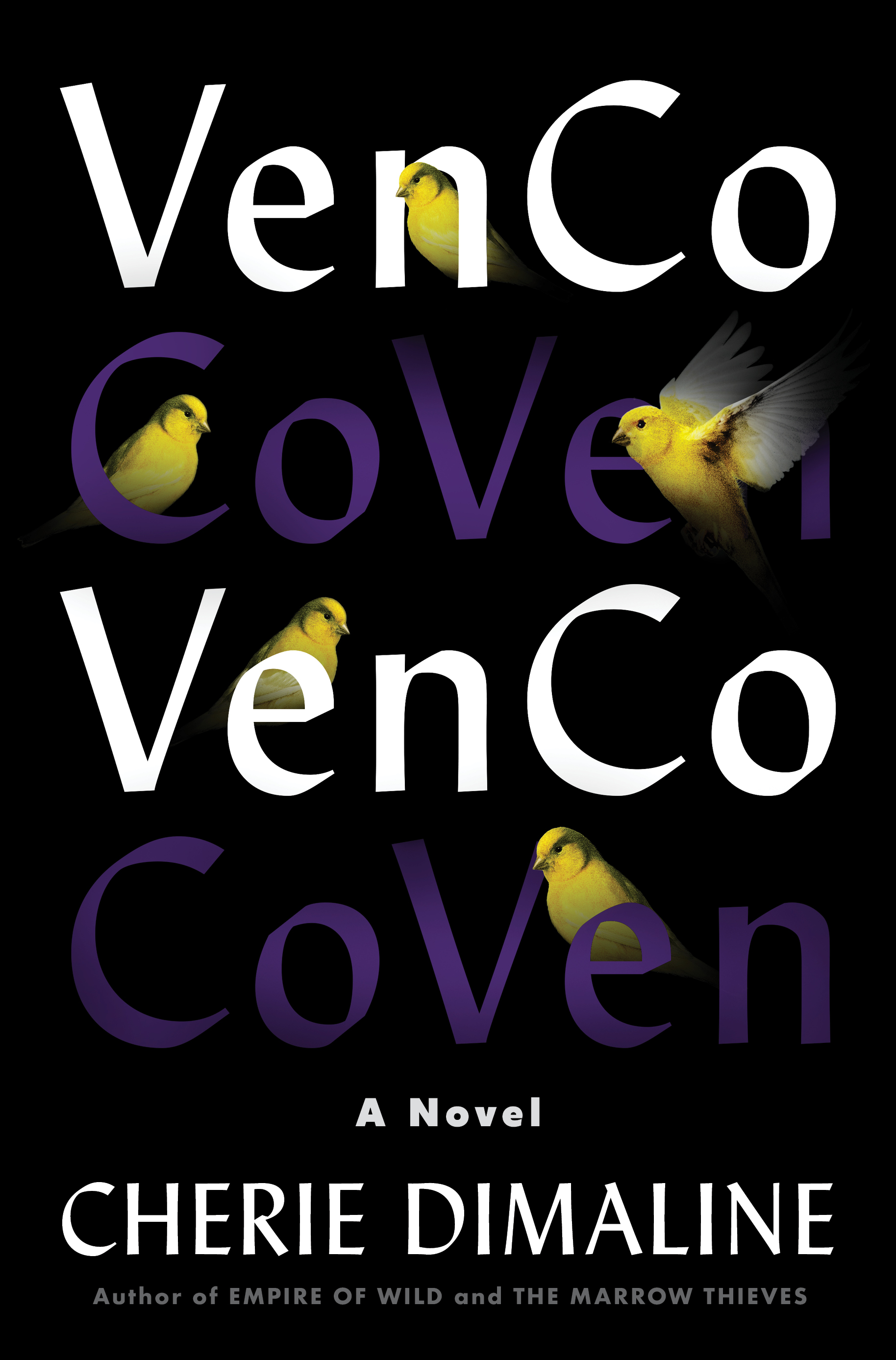
VEN.CO, sapphic Indigenous fantasy drenched in gynergy to keep you sane this Yule

VEN.CO
CHERIE DIMALINE
William Morrow (non-affiliate Amazon link)
$12.99 Kindle edition, available now
Rating: 4* of five
The Publisher Says: Lucky St. James, a Métis millennial living with her cantankerous but loving grandmother Stella, is barely hanging on when she discovers she will be evicted from their tiny Toronto apartment. Then, one night, something strange and irresistible calls out to Lucky. Burrowing through a wall, she finds a silver spoon etched with a crooked-nosed witch and the word SALEM, humming with otherworldly energy.
Hundreds of miles away in Salem, Myrna Good has been looking for Lucky. Myrna works for VenCo, a front company fueled by vast resources of dark money.
Lucky is familiar with the magic of her indigenous ancestors, but she has no idea that the spoon links her to VenCo’s network of witches throughout North America. Generations of witches have been waiting for centuries for the seven spoons to come together, igniting a new era, and restoring women to their rightful power.
But as reckoning approaches, a very powerful adversary is stalking their every move. He’s Jay Christos, a roguish and deadly witch-hunter as old as witchcraft itself.
To find the last spoon, Lucky and Stella embark on a rollicking and dangerous road trip to the darkly magical city of New Orleans, where the final showdown will determine whether VenCo will usher in a new beginning…or remain underground forever.
I RECEIVED A DRC FROM THE PUBLISHER VIA NETGALLEY. THANK YOU.
My Review: VenCo, a front corporation for a CoVen (get it?) is a really fun gynergetic fantasy of what it would take to overwhelm the patriarchy and restore women to power.
Do you need something else to get one for this hijacked-by-jesus (who has a sly off-kilter cameo) sacred solstice holiday?
How about this: Lucky, our PoV character, is at a low ebb when we meet her...she's been struggling along, caring for her dementia-ridden paternal grandmother, scraping the money to survive, and now...the capitalist axe comes down, they're losing their home. Relatable, if in a grim way, to most all of us in or after middle age. Plot twist: It's now that Lucky discovers she's a witch, and the coven that's forming needs her...but not in Toronto, in New Orleans. The coven is forming to bring the world that Lucky's been angry with for most of her life, patriarchal racist exploitive horror that it is, to an end. She's got to assist the assembled women...including transfem Freya, explicitly accepted as a woman...in locating and assembling the spoons that'll generate the power they need to accomplish the task.
There are lots of names that don't always have solid characters attached, there is a notable holeyness to the plot, there is a powerful aura of wish fulfillment here. There is also an even-handed treatment of adversarial relationships. There is a demonization of Patriarchy, it's true, but not (to my surprise) of men.
The reason I gave it four stars is that this story was just plain fun to read. I wish it had been a wee tiny tidge tighter of plot. I'm not going to hold it up as a best of my reading year book. But I loved feeling so at home with Lucky, her deeply stressful life, and her middlescent discovery of her powers and her purpose. I thoroughly agree, in 2024, with the need to smash the Patriarchy and all its boosters and adherents. I was deeply gruntled by the transfem Freya simply...being...unremarkably one of the coven.
If you're going to be among the unenlightened, even the benighted, this coming Yule, bring this on your Kindle. You'll have an escape into a much nicer version of the world at hand, and a little spirit boost as the impending events of 2025 loom ever larger.
Friday, December 30, 2022
A MINOR CHORUS, chorus yes but not a minor one & HUGS AND CUDDLES, the most amusingly inapt title of 2022
A MINOR CHORUS
BILLY-RAY BELCOURT
W.W. Norton
$15.95 trade paper, available now
Rating: 4* of five
ONE OF NBC'S BEST LGBTQ BOOKS OF 2022!
The Publisher Says: A debut novel from a rising literary star that brings the modern queer and Indigenous experience into sharp relief.
In the stark expanse of Northern Alberta, a queer Indigenous doctoral student steps away from his dissertation to write a novel, informed by a series of poignant encounters: a heart-to-heart with fellow doctoral student River over the mounting pressure placed on marginalized scholars; a meeting with Michael, a closeted man from his hometown whose vulnerability and loneliness punctuate the realities of queer life on the fringe. Woven throughout these conversations are memories of Jack, a cousin caught in the cycle of police violence, drugs, and survival. Jack’s life parallels the narrator’s own; the possibilities of escape and imprisonment are left to chance with colonialism stacking the odds. A Minor Chorus introduces a dazzling new literary voice whose vision and fearlessness shine much-needed light on the realities of Indigenous survival.
I RECEIVED A DRC FROM THE PUBLISHER VIA EDELWEISS+. THANK YOU.
My Review: When one reads the book description, there's very little doubt that most of us will be reading this as autofiction...as Billy-Ray Belcourt using the antique roman à clef to give us the keys to the kingdom. But that's never said anywhere. It's not part of the interviews I've read or listened to. I think, in fact, that's a quiet and much-thought-over means of demonstrating how identities are forced on us. Are forced by us, the readers of a novel, onto the author of the novel.
Indigeniety is an indignity of an identity. "Indigenous" is a label of Otherness, much as is "Queer" or "Gay" or "Two-Spirit." Labels are the source of stories, though, and the world's words were invented to make stories so us gossipy apes could make Othering a thing. Assigned by others, Othering is a burden many of us bear and many of us bear multiple ways. We aren't, as it unfolds, allowed much in the way of access to the main character's self-ness; he's collecting data, having copious amounts of sex, and eliciting intimacy from people still carrying horrible scars from being abandoned as children, being addicted to substances, being belittled and having their characters besmirched for queerness or Indigeniety. Or both. No one in this mill-race of ideas and images is in sharp focus. It's that fact that ate a star off my rating...if I have only misty-edged portraits to look at instead of vibrant, violent even, alive people, I respond without the visceral burst of passion I seek in novel-reading as I read their stories.
Author Belcourt being a tyro novelist, and his profession being a poet, this is completely understandable as a technique. It felt chosen, selected for its effect, not as though he simply didn't know how to do any different. That's why that fourth star is still there. I'm forgiving of first-novel mistakes or overreaches but I note them and grade my responses accordingly. I did not get that "oops" sensation from these memory-speaking characters, despite the fact that I wanted to know more about them. More was not to be offered. That is, as I realized, part of the point: What the reader wants is what the colonial master wants, more! more! always more! where Author Belcourt isn't offering it.
There is, then, a subtlety of reflection in this examination of the gulfs between striving and surviving; between surviving and thriving. The novel's structure and style are offers of mirror time. See what this world's demands cost? The price that some must pay while most will never even realize it's exacted on their behalf?
It's a delight of a read. It speaks its truth honestly and makes its voice honey-sweet.
But it is here to tear the tape off your eyes and yank the sock from your mouth.
++++++++++++++++++++++++++++++++++++++++++++++++++++++++++++++++
HUGS AND CUDDLES
JOÃO GILBERTO NOLL (tr. Edgar Garbelotto)
Two Lines Press
$14.95 trade paper, available now
Rating: 4* of five
The Publisher Says: After abandoning his traditional life in a deteriorating Porto Alegre, the narrator of Hugs and Cuddles zealously recommits himself to a man he calls “the engineer”, a childhood friend with whom he shared a pivotal sexual encounter. Many years have passed since their prepubescent wrestling; everywhere around them is a nation in decline. Representatives of the Brazilian state—everyone from government officials to the impoverished—endlessly harass passers-by for donations to “the cause,” even as a mysterious plague rages. Never mind that. Our insatiable narrator, driven to discover his true self through increasingly transgressive sexual urges, is on an epic journey through the shadows of this dysfunctional yet polite society.
The resulting novel is the late João Gilberto Noll’s most radical statement: A Book of Revelations-grade voyage to the end of gender and the outermost reaches of sexual and artistic expression. Nimbly translated from Portuguese by Edgar Garbelotto, Hugs and Cuddles is an unapologetically explicit fable of fluidity that takes readers from decaying city centers to the dark corridors of a mysterious submarine to a miserable hovel in the rainforest, where, at long last, our narrator finds peace.
I RECEIVED A DRC FROM THE PUBLISHER VIA EDELWEISS+. THANK YOU.
My Review: Remember when I reviewed Quiet Creature on the Corner back in 2016? It's the very first Noll story to appear in English. It contained non-consensual heterosex, and it gave me a definite dirty-old-man vibe. That is to say, the book's for a dirty old man not that I'm one!
Buckle up for this tale, ye of little sexcapade tolerance.
There is nothing for it but to say it: Noll's got the one-handed reader squarely in his sights from giddy-up to whoa. If you can think of a way to think about sex, it's in this book. I'm not at that stage of life anymore, but let me tell you it's a heavy breather's dream book.
There is a salad dressing of family secrets, of loyalty given but not reciprocated, reciprocated but betrayed, of gender identities as traps and prisons and comforting hiding places...it's a story that never settles into one groove. There are half a dozen grooves. They each matter, and in the end, each contains a clue to the preoccupations of Author Noll's writing: Honesty and clarity are only so useful in this life but a well-crafted line of bullshit can guide, sustain, and reward you.
The style of the book should be no issue to those who read Milkman or Poguemahone. It's a long, divagating paragraph of startling complexity. Yet the burden of the lyric is simple, that being centered on sex as activity is only fun if you play with sex as biology defines it. The way in and the way out of a soul is the same as it is for a body.
If the roman-fleuve formal technique were somehow packed tight into this book's sausage-casing of 240 pages, it would resemble the scope and the effect of the paragraph as we move from a submarine to a rural shack, from the kind of sex that lives in your memory to the kind you'd pay money to forget. There's not one page not steeped in sex, whether actual sexual activity or contemplating it.
All of which, most curiously, is the opposite of erotically thrilling to me. I quickly discounted the erotic tone of the writer's discussion of personhood, belonging, and power dynamics. It became for me a kind of background, a soundtrack...the sounds!...and thus led me to the sad, wistful realization that Author Noll was always questing, Quixote-like, for the one greatest possible reward of sex: Connection. Giving your sexual energy to someone in return for their emotional vulnerability isn't routinely rewarded. It felt to me that, through this entire read, I was hearing a longing tone and a sad wistful sigh as another orgasm rocked the narrator.
It is, in the end, a sad acknowledgment of the "eternal hell of libido" as the organzing principle of a life. Fascinating, strong meat yet savory in its easy-goes-down tartare preparation. Definitely a worthy addition to your shelf.
Tuesday, October 25, 2022
ALL THE QUIET PLACES, debut YA novel by & about First-Nations youth caught in tumultuous times & WHAT IS LEFT THE DAUGHTER, CanLit monadnock Howard Norman's YA-themed novel
ALL THE QUIET PLACES
BRIAN THOMAS ISAAC
Brindle & Glass
$18.00 trade paper, available now
Rating: 4.5* of five
The Publisher Says: Brian Isaac's powerful debut novel All the Quiet Places is the coming-of-age story of Eddie Toma, an Indigenous (Syilx) boy, told through the young narrator's wide-eyed observations of the world around him.
It's 1956, and six-year-old Eddie Toma lives with his mother, Grace, and his little brother, Lewis, near the Salmon River on the far edge of the Okanagan Indian Reserve in the British Columbia Southern Interior. Grace, her friend Isabel, Isabel's husband Ray, and his nephew Gregory cross the border to work as summer farm labourers in Washington state. There Eddie is free to spend long days with Gregory exploring the farm: climbing a hill to watch the sunset and listening to the wind in the grass. The boys learn from Ray's funny and dark stories. But when tragedy strikes, Eddie returns home grief-stricken, confused, and lonely.
Eddie's life is governed by the decisions of the adults around him. Grace is determined to have him learn the ways of the white world by sending him to school in the small community of Falkland. On Eddie's first day of school, as he crosses the reserve boundary at the Salmon River bridge, he leaves behind his world. Grace challenges the Indian Agent and writes futile letters to Ottawa to protest the sparse resources in their community. His father returns to the family after years away only to bring chaos and instability. Isabel and Ray join them in an overcrowded house. Only in his grandmother's company does he find solace and true companionship.
In his teens, Eddie's future seems more secure—he finds a job, and his long-time crush on his white neighbour Eva is finally reciprocated. But every time things look up, circumstances beyond his control crash down around him. The cumulative effects of guilt, grief, and despair threaten everything Eddie has ever known or loved.
All the Quiet Places is the story of what can happen when every adult in a person's life has been affected by colonialism; it tells of the acute separation from culture that can occur even at home in a loved familiar landscape. Its narrative power relies on the unguarded, unsentimental witness provided by Eddie.
I RECEIVED A DRC FROM THE PUBLISHER VIA EDELWEISS+. THANK YOU.
My Review: This beautifully written debut novel, telling a deeply affecting story of a boy's coming of age amid loss and deprivation, was longlisted for the Scotiabank Giller Prize in 2022. I'm a bit surprised that it didn't make the shortlist because it's got the power and the credibility to impress any judging panel. Still...however they chose, the judges chose this story to stay longlisted.
Eddie Toma is a character I recognize...a youth whose rudder isn't calibrated like he's told it's supposed to be. It's an adolescent trait, of course, but the issues Eddie is coping with are his life are those unique to an unvalued Indigenous male. In a settler-colonial society he isn't going to find a lot of validation. What he has, in compensation, is a formidable grandmother who models a moral compass nonpareil. He spends his entire growing-up time torn between the need, like all of us, to figure out what the world is about, and the impoverished person's need to find enough food to fill his hunger. His life in the white-people school in the nearest town is a nightmare of bewilderment...how is he supposed to know about racism? until he started school he'd never even been to the white people who lived across the road's home!...and there is no one to explain anything to him at home or at school.
Except Eva, the white girl who lives across the road...she's kind, and she's weird, and she's got something Eddie can't quite figure out going on in her mind. (That remains true all through the book.) Eva is a beautiful, willful, intelligent girl caught in a place too small to hold her talent, still less her interest. As Eddie and Eva continue to knock their corners together and as Life gives them nasty buffets and blows, they simply get on with getting on. Growing up. Learning and wondering and trying stuff out.
When I think about the way the story unfolds after reading the ending of the book, I feel so much more as though Author Isaac brought his bluntest weapons to the tale's wordsmithing. I was always involved in Eddie's solitary life, weirdly lived among the crowds of people who were Others to Eddie and who in their turn Othered him. I wished, at every failed opportunity to make a connection with someone, that I could go into the pages and hug Eddie. I wished his family had seen him, the "him" that this novel builds, the real him. His mother was challenged at every single step by single motherhood, by racial prejudice, by the judgment and unkindness of the world; her treatment of her sons was only marginally better than their treatment at the world's hands, and it's there that I wanted to go be a White Savior.
It's not, then, the happiest of lives that Eddie and his family live. He loves, I think, almost no one but he crushes on Eva and still can't connect with her. She, in her turn, is both kind and cruel. She's a kid...she's a rebel...she's a privileged white lass whose feelings for an Indigenous lad are titillatingly forbidden, yet came across to me as sincere. As the years progress, Eddie can't make sense of her, can't make sense of his burgeoning feelings for her, can't take in the manifold cruelties he's undergoing on every level except one quiet refuge: His grandmother.
His mother's mother is a calm center of this chaotic bunch. Even her white racist neighbors feel respect for her, though they never express it without nastiness. Eddie loves her, in the best way a deprived and neglected heart like his can love. Only to her can he turn in all his bewilderment and rage, with all his confused longings for nameless-to-him caring and nurturing. From her he absorbs respect for the wild world, and her son Alphonse (whose life doesn't include much voluntary time spent with any kids) leads him by example to knowledge of and connection with his environment. These factors enable Eddie to get through the disasters of most all colonialism-, racism-, and poverty-blighted lives. He is, at base and at heart, only truly, trustingly at home in the wild world.
The ending of the story is, I confess, a bit downbeat for my taste; it's the reason I'm not giving the read all five stars. It makes perfect sense. It is exactly what, I suspect, happened to someone, somewhere in Author Isaac's own past. It is not false; it is just...so very, very sad. I wouldn't recommend this as a read for someone needing a cup of cheer. But I do recommend that you read this tender, loving, cruelly realistic tale of life lived in racism's ugly glare.
++++++++++++++++++++++++++++++++++++++++++++++++++++++++++++++++
WHAT IS LEFT THE DAUGHTER
HOWARD NORMAN
Mariner Books
$14.99 trade paper, available now
Rating: 4* of five
The Publisher Says: Howard Norman, widely regarded as one of this country's finest novelists, returns to the mesmerizing fictional terrain of his major books—The Bird Artist, The Museum Guard, and The Haunting of L—in this erotically charged and morally complex story.
Seventeen-year-old Wyatt Hillyer is suddenly orphaned when his parents, within hours of each other, jump off two different bridges—the result of their separate involvements with the same compelling neighbor, a Halifax switchboard operator and aspiring actress. The suicides cause Wyatt to move to small-town Middle Economy to live with his uncle, aunt, and ravishing cousin Tilda.
Setting in motion the novel's chain of life-altering passions and the wartime perfidy at its core is the arrival of the German student Hans Mohring, carrying only a satchel. Actual historical incidents—including a German U-boat's sinking of the Nova Scotia-Newfoundland ferry Caribou, on which Aunt Constance Hillyer might or might not be traveling—lend intense narrative power to Norman's uncannily layered story.
Wyatt's account of the astonishing—not least to him—events leading up to his fathering of a beloved daughter spills out twenty-one years later. It's a confession that speaks profoundly of the mysteries of human character in wartime and is directed, with both despair and hope, to an audience of one.
An utterly stirring novel. This is Howard Norman at his celebrated best.
I CHECKED THIS BOOK OUT FROM THE LIBRARY. USE THEM OFTEN, THEY LIVE AND DIE ON OUR PATRONAGE.
My Review: When an author of Howard Norman's stature uses the epistolary storytelling technique, the chances of disappointment...always higher when this difficult-to-master form is used...shrink back into insignificance. As expected, then, this read was a master class in what and how to make of the epistles in question.
Wyatt's parents aren't alive as we meet him. I got a strong intimation that he, looking back on a whole family's life pretty passionately (if unhappily) lived, didn't feel they were alive before they each committed suicide for mixed-up love of the same woman. If I had to guess (Author Norman doesn't over-explain anything, ever) I'd say Wyatt's life more complicated than most from the very beginning. His letter to his largely unseen daughter, however, is all about putting forward the facts of her paternal family's life as he recalls them. It felt to me as though Author Norman's telling of the tale was direct and honest; so Wyatt, then, wasn't aware even in retrospect of his life's peculiarly high levels of complexity.
In The Highland Book of Platitudes, Marlais, there's an entry that reads, "Not all ghosts earn our memory in equal measure." I think about this sometimes. I think especially about the word "earn," because it implies an ongoing willful effort on the part of the dead, so that if you believe the platitude, you have to believe in the afterlife, don't you? Following that line of thought, there seem to be certain people—call them ghosts—with the ability to insinuate themselves into your life with more belligerence and exactitude than others—it's their employment and expertise.
With all the arousal hormones Wyatt's story begins with, and given the fact that he's writing to his twentyish daughter, this is a story pretty much guaranteed to be about the erotic charge that a messy life provides and more importantly about its costs. Wyatt's unrequited love for a person in his family circle who is not a relative is the stuff of life. I suspect it was deeply relatable to anyone who's ever been part of a blended or a found family. The object of his affections, herself an added person (one whose family isn't a birth family), falls madly in love with someone socially inconvenient: A German émigré, and this story's set during World War II. So there's another level of relatability, as what adult has made it this far without an unrequited love?
My whole life, Marlais, I've had difficulty coming up with the right word to use in a given situation, but at least I know what the right word would have been once I hear it.
The problem this inability brings with it, or perhaps the character trait it points up, is that of passivity. Wyatt is not a doer but a done-to. Nothing that happens in his (passive, epistolary) account of his life to the daughter he doesn't know is as a result of his actions. The one truly, damningly awful thing he's involved in, and for which he is now seeking his daughter's forgiveness, is a result of his inaction, his inability to stand for something.
I realize I've sometimes raced over the years like an ice skater fleeing the devil on a frozen river.
–and–
I refuse any longer to have my life defined by what I haven't told you.
But what he does, this man of inaction, is write the young woman a letter. How typical of him...make an effort but make it ineffectually. What a letter does is enable him to remain inactive yet still offer, as if from behind a wall, an accounting of the young woman in question's heritage. What happens as a result? We never know; Author Norman's story is of Wyatt, not Marlais.
You'll have to decide if that's a deal-maker or -breaker for you. I fall on the line between those poles. I need to feel a story is complete, fulfilling its brief, to really lose myself in it. The musicality of Author Norman's line-by-line creation can draw one along for a good while but there's always that need to have some story pay-off for me. I was not all the way satisfied...I wasn't dissatisfied...there was a strange liminality in this tale of passive inaction's consequences. I would recommend you read the book. I wouldn't recommend it to you, however, of you're in the mood for a propulsive plot-driven thrillride. Does the read repay the effort? It did for me—mostly.
I think Author Norman turned me into Wyatt!
Wednesday, June 8, 2022
WOMAN OF LIGHT, astounding first novel though not first book
WOMAN OF LIGHT
KALI FAJARDO-ANSTINE
One World
$28.00 hardcover, available now
Rating: 4* of five
The Publisher Says: A dazzling epic of betrayal, love, and fate that spans five generations of an Indigenous Chicano family in the American West, from the author of the National Book Award Finalist Sabrina & Corina
“There is one every generation—a seer who keeps the stories.”
Luz “Little Light” Lopez, a tea leaf reader and laundress, is left to fend for herself after her older brother, Diego, a snake charmer and factory worker, is run out of town by a violent white mob. As Luz navigates 1930’s Denver on her own, she begins to have visions that transport her to her Indigenous homeland in the nearby Lost Territory. Luz recollects her ancestors’ origins, how her family flourished and how they were threatened. She bears witness to the sinister forces that have devastated her people and their homelands for generations. In the end, it is up to Luz to save her family stories from disappearing into oblivion.
Written in Kali Fajardo-Anstine’s singular voice, the wildly entertaining and complex lives of the Lopez family fill the pages of this multigenerational western saga. Woman of Light is a transfixing novel about survival, family secrets, and love, filled with an unforgettable cast of characters, all of whom are just as special, memorable, and complicated as our beloved heroine, Luz.
I RECEIVED A DRC FROM THE PUBLISHER VIA NETGALLEY. THANK YOU.
My Review: What happens when a determined woman meets a wall of silence? When we're very lucky, and she's very lucky, a writer comes on the scene and becomes An Author. That's the trajectory of Author Fajardo-Anstine. Sabrina & Corina, her literary debut, was a collection of stories and...it went nowhere. It wasn't a flop. It was invisible.
Bemoaning her fate being beneath the bearer of such stories to the world, she got up and made a book tour for herself...got the grassroots interested in the book...and got nominated for a National Book Award. For a debut collection of stories! Grassroots support is crucial, but let's be honest: You gotta have the chops to get anywhere after that.
And here we are, talking about Author Fajardo-Anstine's debut novel, a real gift of a tale about people whose American history goes much deeper than the majority of those reading this blog's history goes. It's not a linear, "in 1868 this unusual thing happened, in 1879 the next unusual thing happened..." narrative strategy. Luz, our literal Woman of Light, is also our PoV character. Everything that happens to her is grounded, contextualized, in her family's...her people's...history. It's a scary thing to think of taking on this much underknown history, and Author Fajardo-Anstine is up to the task. You, the reader, won't get it spoon-fed to you. I won't make it sound like work, or an assignment, but it is not effortless storytime fiction.
That said, the stories are wonderfully deeply told, limned against a background not unfamiliar today. It's not like the USA is racism-free. It's not like it was in earlier times, in that it's still regarded as a more fringe belief than it was in, for example, Luz's 1933 Denver. But the KKK is recrudescing under new names, the old hate gets poured into new bottles and different labels get slapped on them. Make no mistake, it is still less pervasive than the world Luz, her cousin Lizette, her brother the hapless Diego, and company all face every time they open the door.
It's Diego, and David, and frankly all the men in the book, that brought an inevitable fifth star off the rating. I wanted to feel immersed in a time and a place, and was; but the caddish men, not a decent soul among them, made me think "oh, twenty-first century feminism goggles are on, so I (sadly a Y-chromosome bearing person) am in for a drubbing." There are white people who will feel left out, too, but that comes with the story and is, frankly, the point...white folks don't need to be centered, or even there on the periphery, if the author telling the story of a time and place doesn't want them to be. Men, though? She's got those. And does she unload on them. Spineless and useless; abusive and cruel; just flat evil (as anyone who joins the KKK in fact was).
I don't think it was necessary, and it smacks of score-settling. So there went star #5.
Still think it's time to rev up your book club's drinks tray, y'all, and get this terrfic, well-told, challenging, and deeply satisfyingly immersive read on the coffee table.
Monday, August 30, 2021
MY HEART IS A CHAINSAW, latest gore-with-more from multi-award-winning horror dude Stephen Graham Jones
MY HEART IS A CHAINSAW
STEPHEN GRAHAM JONES
Saga Press
$26.99 hardcover, available now
Nominated for the BEST NOVEL AWARD—2021 SHIRLEY JACKSON AWARDS! Winner annunced on 29 October 2022.
A 2021 NPR BEST BOOK OF THE YEAR!
WINNER OF THE 2022 LOCUS AWARD—BEST HORROR NOVEL! Watch the ceremony here.
Rating: 4.75* of five
The Publisher Says: In her quickly gentrifying rural lake town Jade sees recent events only her encyclopedic knowledge of horror films could have prepared her for in this latest novel from the Jordan Peele of horror literature, New York Times bestselling author Stephen Graham Jones.
“Some girls just don’t know how to die…”
Shirley Jackson meets Friday the 13th in My Heart Is a Chainsaw, written by the author of The Only Good Indians Stephen Graham Jones, called “a literary master” by National Book Award-winner Tananarive Due and “one of our most talented living writers” by Tommy Orange.
Alma Katsu calls My Heart Is a Chainsaw “a homage to slasher films that also manages to defy and transcend genre.” On the surface is a story of murder in small-town America. But beneath is its beating heart: a biting critique of American colonialism, Indigenous displacement, and gentrification, and a heartbreaking portrait of a broken young girl who uses horror movies to cope with the horror of her own life.
Jade Daniels is an angry, half-Indian outcast with an abusive father, an absent mother, and an entire town that wants nothing to do with her. She lives in her own world, a world in which protection comes from an unusual source: horror movies…especially the ones where a masked killer seeks revenge on a world that wronged them. And Jade narrates the quirky history of Proofrock as if it is one of those movies. But when blood actually starts to spill into the waters of Indian Lake, she pulls us into her dizzying, encyclopedic mind of blood and masked murderers, and predicts exactly how the plot will unfold.
Yet, even as Jade drags us into her dark fever dream, a surprising and intimate portrait emerges…a portrait of the scared and traumatized little girl beneath the Jason Voorhees mask: angry, yes, but also a girl who easily cries, fiercely loves, and desperately wants a home. A girl whose feelings are too big for her body. My Heart Is a Chainsaw is her story, her homage to horror and revenge and triumph.
I RECEIVED A DRC FROM THE PUBLISHER VIA NETGALLEY. THANK YOU.
My Review: There are all sorts of ways to read a Stephen Graham Jones book. Surfaces work...there's always a story hanging around, you won't be wandering lost in thickets of writing-armpit sweat-watered weeds...references work too, you can unpick your memories of the midnight movies or frightfrests your friends threw (or open IMDb if you're really young)...but I think the best way is to make it through as it's happening, to be there as Jade walks across the graduation stage or through walls or up into skies limited only by the basic laws of physics.
The reason I feel that last works best is that, by the time I'd reached the end of this read, and then read Author Stephen's Acknowledgments after the wrenching and impossibly sad final scene, I was so wrung out that I simply accepted that everything I'd just been through had been intended to do what it did to me. As I'm not one to write book reports (ask Mr. Singleton! never turned so much as one in during high school) I'm not going to try to do that at this late date. I referred to this book's immediate older sibling, The Only Good Indians, as "gore with more" and that's an assessment I stand by as applied to all of Author Stephen's books. Part of that "more" is the strangely hypnotic effect of the story arc receding from view...the interstitial "SLASHER 101" essays addressed to the One Good Teacher (of history, naturally) Mr. Holmes are well and truly weirding Your Faithful Reader out. When they switch addressees, it gets even weirder...but in the end, it's painfully intimate and deeply instructive to read them.
In common with all Author Stephen's books, you mere peon of a purchaser have no rights. You're not stupid, you've read some of his other work (at least The Only Good Indians!), you're aware that horror is in store. So surrender your volition. Then the entire experience of being in Jade Daniels's rage-filled head makes all the sense in the world. Because then you're not actually sure if ANY of this is happening in meatspace. Is this an adolescent with anger and abandonment issues responding to the end of what never was childhood? Is this a young woman processing the pain and rage of a life that was wished on her by weaker, worse people than she was? There's a sparkling moment of fizzing delight when Jade meets Letha, a beautiful rich kid whose father has a trophy wife and whose presence in the town of "Proofrock" (think a minute, and hard, for more than the surface snicker; that's all it takes to turn it into a shiver), when Jade anoints her "the Final Girl." That's both when the tale gets grounded in consensus reality and when its ascent into the dark and cold vault of Jade's own head is cemented.
I'm always a fan of gerunding done with panache...Author Stephen does it with panache. At one point, Jade Holden Caulfields across a lawn, and that's me dead cackling. I think there are few greater pleasures than easter-egging your readers' experience...hoping they'll get most of them. I think the fun of reading a book whose author has chosen a niche to write in, one with an astoundingly vast mythos/history/background to explore, is in part the recognition factor of word-play. Yes, it's about slasher-film homage, and no Holden Caulfield isn't slashed to death (though generations of English students have no doubt fantasized that Salinger met that fate after writing it), but he *is* the prototype of the Angsty Teen too smart for easy answers. With everything Jade's carrying around, she's not one whit less burdened than Holden and possibly by some similar troubles given that she's got A Thing growing up strong for Letha.
Adolescent sexuality is always fraught. Parents play their roles in shaping it, either with rule or without them, with clamp=downs or without supervision, there's no right way to ride this roller-coaster. But the issue facing Jade isn't made any easier by her absolute conviction that Letha is The Final Girl, that staple of the slasher film, therefore of necessity being lustrous and almost superhuman in her glorious Otherness. That's how she's supposed to be, right? Jade "doesn't make the rules...just happens to know them all." Her unique and defining obsession with slashers is gong to pay dividends, right? Because she's preparing the Final Girl for her role, unlike most...she won't be surprised by the tragedies.
I think I speak for all readers when I say that the way this blows up can only be described as FUCKING EPIC.
And from that point on, the cigarette boat is away and the pace does not let up.
There are the obligatory twists and turns, the reveals that aren't *quite* reveals, and the accustomed ways that Author Stephen's practiced to get your kishkes kicking and your shvitzer sprinkling. You can't fault the man on delivering the suspenseful goods! If you're in the market for a low-gore delivery of suspense, however, look elsewhere. The way this works is for your expectations to be manipulated so I won't be discussing particulars. Suffice to say I was taken in. More than once. And I'm a pretty well-broken-in reader....
Still, there's no point it wondering why no good deed goes unpunished or how exactly it is that one's expected to walk away from what can not help but feel like a set up straight from a film. The pain and the passionate pull of it will reach some screeching crescendo, won't it, just give it a little more time and it has to!
Nonsense, says the Great God Author.
By the time we've reached the moment when there is no more to give, when the entire story's gone to the most extreme place that it can go...there is something more in the tank for a send-off, and there's no way that you'll believe your eyes when you get there.
Some things just can't be put right. And others can't be left wrong. The issue is...who decides.
Subscribe to:
Posts (Atom)