Pages
- Home
- Mystery Series
- Bizarro, Fantasy & SF
- QUILTBAG...all genres
- Kindle Originals...all genres
- Politics & Social Issues
- Thrillers & True Crime
- Young Adult Books
- Poetry, Classics, Essays, Non-Fiction
- Science, Dinosaurs & Environmental Issues
- Literary Fiction & Short Story Collections
- Sookie Stackhouse/Southern Vampire Books & True Blood
- Books About Books, Authors & Biblioholism
Showing posts with label settler colonialism. Show all posts
Wednesday, May 13, 2026
NEWCOMERS: The Story of Anthony and Grietje and the Founding of New York, or "Why I ❤NY"
NEWCOMERS: The Story of Anthony and Grietje and the Founding of New York
ALAN MIKHAIL
Liveright / W.w. Norton (non-affiliate Bookshop.org link)
$28.45 ebook, available now
Rating: 4.5* of five
The Publisher Says: The exceptional tale of an unorthodox, seventeenth–century married couple whose rags-to-riches story fundamentally rewrites our knowledge of American history at its very beginnings.
A man thought to be Muslim from Morocco and a German barmaid are hardly the image we have of America’s founders. In Newcomers, Alan Mikhail upends the traditional story of American beginnings through the tale of Anthony “the Turk” and Grietje Reyniers.
Married in Amsterdam, they arrived in 1630s Dutch New Amsterdam, hoping to forge a new life. Always outsiders in the young colony, they battled Dutch authorities, brawled with neighbors, and seized land from Native Americans. In this revisionist portrait of the early American family, we learn of anti-Muslim sentiment through Anthony and of female defiance through Grietje.
Eventually banished from Manhattan to Long Island, Anthony and Grietje farmed, prospered, and raised a family whose descendants included the Vanderbilts and President Harding. Promising “to change the way we understand Colonial Gotham’s formative first years” (Susanah Shaw Romney), Alan Mikhail’s Newcomers provides revelatory insights into the seventeenth-century origins of New York.
I RECEIVED A DRC FROM THE PUBLISHER VIA EDELWEISS+. THANK YOU.
My Review: The New World was always a frontier where European countries saw the utility of sending its misfits, its non-conforming people, its "undesirables" to make their own way. It was better that way, really...these were the people who gave someone powerful some kind of uncomfortable trouble, and as we're all quite clear even unto today that is simply not to be borne. By them. By you? Troublesome peasant, it is your fault and you must pay the price of being obstreperous and too difficult for {whoever}'s comfort by leaving everything you've ever known or owned to begin again in an utterly alien place. Survive or not, it's up to you.
Anthony and Grietje Jansen van Salee were the survivor types. They stood up for themselves, mixed-race man of ambition and drive and mouthy broad with a gift for invective that they were. Quintessential New Yorkers, in fact; though there was no such identity in the late seventeenth century. They left a restrictive, stifling life of economic precarity and social exclusion for the possibilities of the edge of the map, as it was then. I'm glad Dr. Mikhail introduced me to Anthony and Grietje because I think they're my (spiritual) ancestors. They set the pattern for people like me who don't think or act the way our peers and neighbors do because we don't like their ways and see no reason to pretend otherwise, who find our home here in New York.
The legal records that Dr. Mikhail draws from, and they're extensive (as well as footnoted to a fare-thee-well), show that Anthony and Grietje totally never stopped being difficult. Their neighbors in Dutch colonial Manhattan didn't much like having a "Turk" (mixed-race Anthony, always suspected of being Muslim despite no evidence existing to support that idea) and a mouthy whore (grit-loaded survivor Grietje) in their midst. Off to the wilds of Brooklyn with you, aggressive and non-conformist folk that you are! Even non-conforming people don't like non-conformists.
Is this ringing any bells, Islamophobic sex-negative leftist political types who apply purity tests to each other? Who exile their leaders for not being "perfect" and thus lose elections but win at the Pure Ideology game?
Anthony and Grietje prospered in their next exile as much as in their first. Their energy was tremendous so when it could be directed mostly at their real goals...prosperity for themselves...it was a great benefit for the colonials as well as themselves. The people it cost the most were not their colonist neighbors but the Native Americans the entire settler-colonial enterprise harmed the most. Anthony and Grietje left marks there as well, so truly set the pattern for all us New Yorkers to come by their darker, less benign actions as well as their courageous, trailblazing ones.
I felt very seen in reading this very well-presented story. It's true that Anthony, after Grietje's death, returned to Manhattan...the quintessential Manhattanite, move to Long Island to raise the kids and come home when they're grown! these two are perfect twenty-first century stereotypes!...it's also true that Anthony did things that look terrible to our eyes like have Native slaves-in-fact if not name to work lands he stole from them, but were part of the entire settler-colonial enterprise that white people like me are the beneficiaries of. There are few black-and-white actions in this our life.
Dr. Mikhail is very clear that people are not pure, that actions in context look different as the context changes over time, and that this partial and compromised record of two ordinary peoples' extraordinary choices and actions can never be considered complete or definitive. Defining people long-dead by the records they leave behind is always an act of interpretation. That does not mean it is not also an act of truth-telling, only that the truths so told must be viewed as contingent.
Maps and illustrations completed my happy journey through the lives of two remarkable spiritual ancestors I'm glad I got to know.
Wednesday, December 17, 2025
THE BULLET SWALLOWER, La Frontera's reckoning on the page
THE BULLET SWALLOWER
ELIZABETH GONZALEZ JAMES
Simon & Schuster (non-affiliate Bookshop.org link)
$13.99 ebook, available now
Rating: 4.25* of five
The Publisher Says: A dazzling magical realism western in the vein of Cormac McCarthy meets Gabriel García Márquez, The Bullet Swallower follows a Mexican bandido as he sets off for Texas to save his family, only to encounter a mysterious figure who has come, finally, to collect a cosmic debt generations in the making.
In 1895, Antonio Sonoro is the latest in a long line of ruthless men. He’s good with his gun and is drawn to trouble but he’s also out of money and out of options. A drought has ravaged the town of Dorado, Mexico, where he lives with his wife and children, and so when he hears about a train laden with gold and other treasures, he sets off for Houston to rob it—with his younger brother Hugo in tow. But when the heist goes awry and Hugo is killed by the Texas Rangers, Antonio finds himself launched into a quest for revenge that endangers not only his life and his family, but his eternal soul.
In 1964, Jaime Sonoro is Mexico’s most renowned actor and singer. But his comfortable life is disrupted when he discovers a book that purports to tell the entire history of his family beginning with Cain and Abel. In its ancient pages, Jaime learns about the multitude of horrific crimes committed by his ancestors. And when the same mysterious figure from Antonio’s timeline shows up in Mexico City, Jaime realizes that he may be the one who has to pay for his ancestors’ crimes, unless he can discover the true story of his grandfather Antonio, the legendary bandido El Tragabalas, The Bullet Swallower.
A family saga that’s epic in scope and magical in its blood, and based loosely on the author’s own great-grandfather, The Bullet Swallower tackles border politics, intergenerational trauma, and the legacies of racism and colonialism in a lush setting and stunning prose that asks who pays for the sins of our ancestors, and whether it is possible to be better than our forebears.
I RECEIVED A DRC FROM THE PUBLISHER VIA EDELWEISS+. THANK YOU.
My Review: Inherent in any story set in the western part of the US is racism, is settler colonialism is the trauma of violence...institutionalized all the way to interpersonal. "The past is not so far away as you might think. Nor the future, for that matter. No man lives free from history." This is the beating heart of the story, in fact of the entire setting in real world terms. No one is free from history.
Jaime, in his reckoning with that aperçu's truth, receives...non-corporeal, I guess...divine, malign, either, probably both, but certainly not of consensus reality assistance from the aptly named Remedios. He's made privy to the, well, Akashic records of his family's deeds. I can only imagine the horrible burden of knowing the inalterable and undeniable facts of your very roots in reality.
Are we in fact our relatives' keepers after all? Is that the myth of Cain and Abel's longevity explained? I know Jaime believes the information he now has is true but he does not question what truth it tells. If an entity asserted I was responsible for balancing the scales of an entire lineage, I'd want to see some ID proving the authority of this assertion.
Jaime not being so suspicious and mistrustful, off we go into the blood-soaked deeds and violent cruelties of the past. It's an open question if this results in a better book than a "straight" magical-realist tale, as these limit their violences more than this full-throated shout of rage does.
When it comes to the acceptance of personal accountability for actions rendered unchangeable by time's passage I'm of two minds. We unquestionably live within the blast radius of our predecessors' decisions, actions, inactions. It is not logical to deny this fact. What do we owe the present for the actions of the past? Not nothing, that's absurd and greedy because it's only ever applied to the beneficiaries while the descendants of those who suffered and lost bear the consequences forever. Where is a reasonable balance point?
Jaime's resolution is the source of my missing star. In the final chapter there is a revelation that emphasizes the magical realism throughout the story was baked in from giddy-up to whoa. It vitiates the journey Jaime has been on from my point of view, but it is very much of a piece with the spooky frame we're looking at the picture within.
Solidly four stars, transported me to my kidhood in Mercedes, Texas, and will transport you, too. Needing to be somewhere your family is not for the Yuletide celebrations? Here's a book that's set in a uniquely characterful corner of the US that has a lot to answer for historically. What could be more apt for reading in family-togetherness time?
Sunday, April 6, 2025
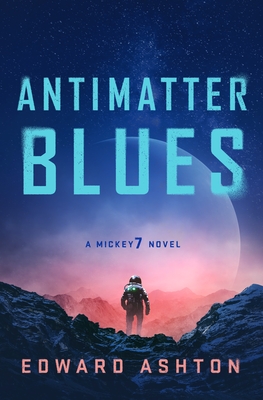
ANTIMATTER BLUES, Edward Ashton's second Mickey7 novel

ANTIMATTER BLUES (Mickey7 #2)
EDWARD ASHTON
St. Martin's Press (non-affiliate Amazon link)
$11.99 ebook, available now
Rating: 4* of five
The Publisher Says: Summer has come to Niflheim. The lichens are growing, the six-winged bat-things are chirping, and much to his own surprise, Mickey Barnes is still alive―that last part thanks almost entirely to the fact that Commander Marshall believes that the colony’s creeper neighbors are holding an antimatter bomb, and that Mickey is the only one who’s keeping them from using it. Mickey’s just another colonist now. Instead of cleaning out the reactor core, he spends his time these days cleaning out the rabbit hutches. It’s not a bad life.
It’s not going to last.
It may be sunny now, but winter is coming. The antimatter that fuels the colony is running low, and Marshall wants his bomb back. If Mickey agrees to retrieve it, he’ll be giving up the only thing that’s kept his head off of the chopping block. If he refuses, he might doom the entire colony. Meanwhile, the creepers have their own worries, and they’re not going to surrender the bomb without getting something in return. Once again, Mickey finds the fate of two species resting in his hands. If something goes wrong this time, though, he won’t be coming back.
I RECEIVED A DRC FROM THE PUBLISHER VIA NETGALLEY. THANK YOU.
My Review: I AM A VERY BAD MAN. I read this book in November 2022, made some notes on a document last computer, and...brain being its usual saboteur self...filed it as "done and dusted" thus forgetting to write an actual review.
Thank all those useless gods I never delete documents.
This is textbook idiotry. Guard against this carelessness, all y'all, and you will maintain your good standing with the review aggregators. Perfectionism is Public Enemy #1 for book reviewers, that is if they want to have their pick of the goodest of the good stuff to read. I am super lucky in that I do get a lot of excellent reads, but a chunk of disappointing turndowns too.
But enough about me, let's discuss Author Ashton's second Mickey7 novel. Well...this is Blogger so no one can talk to me here so I'm more or less soliloquizing. Still.
I hope you've read Mickey7 and seen Mickey 17 by now. If not I strongly urge you to do so; the latter in a theater. I'll say that the film deserves a sequel mostly because Niflheim is such a great visual experience, and seeing that cast (as necessarily amended) perform this story would be a major hoot. Robert Pattinson's endearing turn as an Expendable reformed many many times...eighteen to be precise...was pitch-perfect. This idea of slave labor made palatable to bourgeois sensibilities by being done by not-quite humans is one I've enjoyed since encountering it in Doctor Who's Eleventh Doctor episode "The Almost People" in 2011. I'm quite sure the earlier written versions, eg Cordwainer Smith's Scanners or the opposite end of the social scale of Richard K. Morgan's "Meths,", provided some inspiration for the Expendables and are due a lot of credit, but for me seeing the embodiment of the slave class as people-but-not-quite created by technology was a key a-ha moment.
Mickey7, now back to being Mickey Barnes after the events of the first book, is no longer considered an Expendable. He is also now the only person on Niflheim who can communicate with the planet's aboriginal inhabitants, the creepers. Interspecies harmony is, as always seems to be the case when equals share territory, conditional and intermittent. As this story opens, things are about to bust into open conflict because the creepers have The Bomb, just as the colonists need to use it for the fuel they'll need to survive a Niflheim winter. (Funny how it's always okay for the colonizers to have The Bomb but never the aboriginals.)
Hijinks of the bloodiest, most lethal sort seem destined to ensue. Of course the whole plot hinges on whether and how they ensue, or don't, and whether poor schlemiel Mickey7 (no more intellectually gifted now he's no longer considered an Expendable) can get The Bomb's urgently needed fissile material back from the very anxious creepers.
As he can communicate with them after a fashion, he's privy to a fact...the creepers seem to have another enemy besides the colonists...that could bring about a more secure peace as well as get The Bomb's fissile material back before winter comes to freeze the colonists into personcicles. Nothing like ganging up on a common enemy to create a warm glow of camaraderie, is there.
Shorter and lighter than Mickey7, this read was from the off one I'd hold to a lower standard. It's truly as fun a read as the first was, it's a solidly executed plot, and it has the great good fortune of lifting a lighter psychic load than its older sibling. Most of the hardest to explain stuff is already explained. We're more about learning Mickey7's mannerisms and exploring his human limitations. I think it was a lot less substantive (not always a bad thing), and as stated above, would greatly enjoy a film of it. Not very likely as Director Bong's not a maven for sequels.
The ethical considerations of colonialism are less weighty than those of slavery to my mind. That makes this story a very easy-to-enjoy diversion.
Sunday, April 7, 2024
THE MISSION HOUSE, Carys Davies tells the tale of a post-colonial colonizer's Finding Himself ::eye roll::
THE MISSION HOUSE
CARYS DAVIES
Scribner
$16.99 trade paper, available now
Rating: 4* of five
The Publisher Says: In The Mission House, Hilary Byrd flees his demons and the dark undercurrents of contemporary life in England for a former British hill station in south India. Charmed by the foreignness of his new surroundings and by the familiarity of everything the British have left behind, he finds solace in life’s simple pleasures, travelling by rickshaw around the small town with his driver Jamshed and staying in a mission house beside the local presbytery where, after a chance meeting, the Padre and his adoptive daughter Priscilla take Hilary under their wing.
The Padre is concerned for Priscilla’s future, and as Hilary’s friendship with the young woman grows, he begins to wonder whether his purpose lies in this new relationship. But religious tensions are brewing and the mission house may not be the safe haven it seems
I RECEIVED A DRC FROM THE PUBLISHER VIA NETGALLEY. THANK YOU.
My Review: Hilary Byrd is coming unglued. He's in the early stages of a mental breakdown, he's fast departing the middle-aged years with their gradual loss of the pleasant illusion of a limitless future, and he's at odds with modern England at every turn. His rock of a sister can't seem to save him from this sense of being cut off, so for once in his life he takes a decision. He decides, about his own life's direction, that he will go Find Himself in India.
She disapproves of this, really for quite sensible reasons, but the time to be sensible is past.
I was ready, at that point, to stop reading for good. After all, I liked—a lot—but didn't love Author Carys's novella West, with its gorgeous sentences and its superbly concentrated plotting. I thought this read would be a similar exercise. So I put it down at this rather mundane point, and didn't pick it up until I read this year's glorious paean to Love, and lovingkindness, Clear.
This turbocharged my willingness to look further into this take on self-discovery through travel to "exotic" locale...a drearily bourgeois genre that I really, really do not like. Elizabeth Gilbert and Peter Mayles ruined it for me with their icky Othering search for "Authenticity" which comes across to me in this elder stage of my life as "authentoxicity." I am shocked at anyone, in the twenty-first century, who can make it all the way through a story like those without thinking, "interrogate your privilege, or at the very least recognize it!" That is, of course, the person of the Twenties talking to people of the Nineties...societal advances do not travel against time's arrow.
But this story isn't of its time...its time is now...nor is it about another time, it's set now. Just not here. Ooty, the old British "hill station" where the book is set, is in South India. Are your feelies itching as much as mine right now? I mean...hill station! That really übercolonial concept of "place the colonizers go to escape the commonfolk when it gets too hot." And a British guy rents a mission house, where the imperialists of the spirit retired from their efforts to screw up the indigenous population's relationship to their own souls with the caustic bleach of christiainty!
The icks are building steadily.
This, then, was not the most satifying of follow-up reads to my joyously absorbed Clear. I'm not revealing my dark corners when I say that all things christian leave me coldly hostile. Hilary isn't much of a christian, demonstrating a glancing awareness of but no familiarity with the mythos. His occupancy of a younger colonialist man's living quarters that were built as, and still serve as, a locus for slopping this terrible blighting thought pollution all over poor India (which, not coincidentally, has its own history of exporting religious intolerance). That young man's rush home to Canada is, permaybehaps, intended to serve as a kind of Divine Will's invitation for void-of-course Hilary to come be a white savior. I got that vibe as his relationship with Priscilla deepened, mostly because of "the Padre," who I took against from giddy-up to whoa.
Nonetheless, I can say that my tonal twangs where I was likely meant to thrum instead, were idiosyncratic to me. I think a person less repulsed by christian overtones might not even see them in this story. My discomfort with the ableist misogyny, the colonialist-Finding-Himself in the former colony, and that really terrible Padre, means all my stars are for the beautiful sentences, unfolded with the inevitability of flower petals obeying Bernoulli's spiral.
Not my most resounding recommendation, I fear.
Tuesday, February 20, 2024
THE MARS HOUSE, latest from the ever-delightful Natasha Pulley
THE MARS HOUSE
NATASHA PULLEY
Bloomsbury USA
$15.99 ebook, available now
Rating: 4.8* of five
The Publisher Says: From the author of The Watchmaker of Filigree Street, a queer sci-fi novel about an Earth refugee and a Mars politician who fake marry to save their reputations—and their planet.
In the wake of environmental catastrophe, January, once a principal in London’s Royal Ballet, has become a refugee on Tharsis, the terraformed colony on Mars. In Tharsis, January’s life is dictated by his status as an Earthstronger—a person whose body is not adjusted to Mars’s lower gravity and so poses a danger to those born on, or naturalized to, Mars. January’s job choices, housing, and even transportation options are dictated by this second-class status, and now a xenophobic politician named Aubrey Gale is running on a platform that would make it all worse: Gale wants all Earthstrongers to be surgically naturalized, a process that can be anything from disabling to deadly.
When Gale chooses January for an on-the-spot press junket interview that goes horribly awry, January’s life is thrown into chaos, but Gale’s political fortunes are damaged, too. Gale proposes a solution to both their problems: a five-year made-for-the-press marriage that would secure January’s financial future without naturalization and ensure Gale’s political future. But when January accepts the offer, he discovers that Gale is not at all like they appear in the press. And worse, soon, January finds himself entangled in political and personal events well beyond his imagining. Gale has an enemy, someone willing to destroy all of Tharsis to make them pay—and January may be the only person standing in the way.
I RECEIVED A DRC FROM THE PUBLISHER VIA NETGALLEY. THANK YOU.
My Review: This has a very "ripped-from-the-headlines" feel, like a big issues-driven Movie of the Week in the 1980s. The playfulness that the author, comme d'habitude, uses to frame her presentation of the Issues made me smile. I am particularly fond of the way she plays with the MM romance trope of a fake marriage that leads to a real relationship, in the context of a serious contemplation of the refugee crisis and the ever-increasing backlash againt gender minorities.
No one ever accused Author Pulley of lacking ambition.
Even inclusivity excludes, when it is a mandate...I am not a they, I am a he, and will resist being "they"d because of the same reasons I ask people what their not-always-obvious pronoun preference is. Like any overarching solution, it will not work for everyone...like absurd wealth disparities don't, like hypercompetition won't. And, as I expect from the author of The Kingdoms and The Secret Life of Valery K., that is the point. She invites us in to have a good, solid storytelling, then the real purpose sort of creeps up behind your chair and slaps some ropes around your wrists so you *need* to know what happens while also getting yor mind wedged open a bit.
Like the surgical "naturalization" of the Earthstrong immigrants that will artificially weaken them to make the like "real" Martians instead of merely imprisoning them in tightly binding suits...oh my goodness, the unpleasant parallels to our culture war over transness and the nature of being a "real" something. "We must PROTECT our weakest from these interlopers!" The eternal cry of the high-control fascist-leaning cultural bully. The Earthstrong immigrants have a terrible social ostracism as threats to the adapted Martians, confined to menial labor that renders their actual physical power differential a big advantage.
January, our main character, is the only character referred to by a masculine pronoun. As a former dancer, he is strong and lithe even by Earth standards. This makes him a scary monster of a beast to the adapted Martians, much less gravity having attenuated their strength and stamina. This is quite a come-down for him since he was once a principal dancer at the Royal Ballet. It does make his masculine pronoun feel simultaneously othering and fetshizing...like all perceived-stronger minorities his gender is hyperemphasized. This makes his union with Martian nativist Senator Gale, whose impromptu soundbite caused January tremendous social trouble, all the more trenchant in its commentary on the social construction of gender and the fetishization of, especially the visible, Others in a society.
Like we do with highly intentionally muscular men, heavy-breasted women whose endowments are clearly artificially augmented, and those whose skin and/or eye colors are not like the resident majority's are.
This, then, is Author Pulley at her tendentious best. The invitation to think through the role of fetishization, or simply enjoyed as the slow, rocky coming-together of two people from opposite sides of an ideological divide, is there. It is up to you which one you wish to foreground as you read the book. The interpersonal stakes are not shorted, or allowed to dominate; they are, as always in this author's œuvre, balanced carefully thus enriching each strand.
What makes the read just less than five stars for me is my rather less than enjoyment experienced by the inclusion of resurrected wooly mammoths. The entire ecological commentary is, for my money, twee and forgettable, though of course well-crafted...I just do not buy the animals' PoV bits, which thankfully are confined to footnotes. This is a facet that will delight some but did not me.
A worldbuilding tour de force, a meet-cute/fake marriage queer love story, a takedown of high-control ideology, and most of all a chance to fall in love alongside two wounded souls who had to travel from literal different planets to find their happiness.
Monday, February 28, 2022
NO STUDY WITHOUT STRUGGLE, a different lens on an ongoing, increasingly urgent social issue
NO STUDY WITHOUT STRUGGLE: Confronting Settler Colonialism in Higher Education
LEIGH PATEL
Beacon Press
$24.95 hardcover, available now
Rating: 4* of five
The Publisher Says: Examines how student protest against structural inequalities on campus pushes academic institutions to reckon with their legacy built on slavery and stolen Indigenous lands
Using campus social justice movements as an entry point, Leigh Patel shows how the struggles in higher education often directly challenged the tension between narratives of education as a pathway to improvement and the structural reality of settler colonialism that creates and protects wealth for a select few.
Through original research and interviews with activists and organizers from Black Lives Matter, The Black Panther party, the Student Nonviolent Coordinating Committee, the Combahee River Collective, and the Young Lords, Patel argues that the struggle on campuses reflect a starting point for higher education to confront settler strategies. She reveals how blurring the histories of slavery and Indigenous removal only traps us in history and perpetuates race, class, and gender inequalities.
By acknowledging and challenging settler colonialism, Patel outlines the importance of understanding the relationship between the struggle and study and how this understanding is vital for societal improvement.
I RECEIVED THIS DRC FROM THE PUBLISHER VIA EDELWEISS+. THANK YOU.
My Review: Universities are under siege from as many angles as there are. Activists have campaigned, more or less successfully, for disinvestment from socially irresponsible industries. They've made the possession of a racially insensitive mascot a lightning rod for criticism. These news stories are commonplace enough to be readily Google-able, and to have a selection of attitudes and viewpoints from which to choose.
I'd also recommend taking a few minutes to read Author Patel's Q&A on The Beacon Broadside's website for a trenchant, quotable précis of her thoughts on this difficult to dismiss subject. It is a clear statement of her purposes in writing this book.
What makes this a worthwhile read is that it requires the reader to re-evaluate every university activity. There comes first identifying then admitting prospects "worthy" of the opportunity, with the "right kind" of work ethic both within their schools and outside them. Next the institution busies itself with identifying, designing, and inculcating the capitalist dogmas that will serve the needs of the ownership class. And finally, the cruelest step: indenturing students with mountains of debt to that ownership class for the privilege of enjoying the experience, which serves to prevent the offensive-to-them class and ethnic mixing. The fear being that, unburdened by economic chains, their students will inevitably rise above their starting points and cause their owners' control to be diluted. Reading Author Patel's work will, I'm sure, give the students and their parents the perspective to see through a definitively different lens. What makes that a good idea is that many will experience a sudden and usually pretty painful awakening. Those who are screaming about "critical race theory" are calling this propaganda spreading, brainwashing, or just plain indoctrination. As always, examine the accuser's accusations for cues as to the real source of their rage: the examination Author Patel demands we her readers undertake will cause some number of us to reject our present indoctrination as the unfair, exclusionary artifact of an exploitive ownership class's control paradigm.
Since I've already had a pitcher of that Kool-Aid, this wasn't fresh stuff for me.
What I needed to learn about was Author Patel's encouragement of the University's students to interrogate everything they are being offered through the awareness of settler colonialism's existence, reach, and signals of control. Her book is a call to arm yourself, youthful learners, with skepticism and information, not simply and passively accept the way things are without understandig how they got that way and who wants them to stay that way.
What lowers my rating to four of five stars is my sense that the message, while complete and well-thought-through, isn't presented in such a way as to lead to action. In the world of young persons it's my experience that theory is best left to emerge from actions at the maxiumum possible number of times. I'd've been much more stirred and delighted had I seen some non-theoretical analysis..."when one sees this, then that is the likeliest cause; now, do this or that to draw attention to it with the aim of changing it." After all, Author Patel spoke to many whose lives of resistance and struggle included forging action agendas. Why not bring this facet, underpinning the work as it does, to the fore?
But never mind all that Monday-morning quarterbacking. The book that is here, that is available from the estimable Beacon Press, will offer you much. If your child is leaving for college soon, I want to push you towards the read with some extra fervor. If your child is in school now, please send them one. There is no bad or wrong time to give someone not yet ossified into a brittle psychic shape the chisels and files and rasps to add refinement and enhancement to their awareness.
Thursday, November 4, 2021
POWER BORN OF DREAMS: My Story is Palestine, a graphic novel of the bitterness of Home-lessness
POWER BORN OF DREAMS: My Story is Palestine
MOHAMMED SABAANEH
Street Noise Books
$15.99 trade paper, available now
Rating: 4.5* of five
The Publisher Says: What does freedom look like from inside an Israeli prison?
A bird perches on the cell window and offers a deal: “You bring the pencil, and I will bring the stories,” stories of family, of community, of Gaza, of the West Bank, of Jerusalem, of Palestine. The two collect threads of memory and intergenerational trauma from ongoing settler-colonialism. Helping us to see that the prison is much larger than a building, far wider than a cell; it stretches through towns and villages, past military checkpoints and borders. But hope and solidarity can stretch farther, deeper, once strength is drawn of stories and power is born of dreams. Translating headlines into authentic lived experiences, these stories come to life in the striking linocut artwork of Mohammad Sabaaneh, helping us to see Palestinians not as political symbols, but as people.
I RECEIVED A DRC FROM THE PUBLISHER VIA EDELWEISS+. THANK YOU.
My Review: The author/artist, whose lived experience this graphic novel is born out of, made a beautiful work of art out of suffering.
The linocuts used to create the illustrations are truly brutal, absolutely unsparingly blocky and confining, and that is the essence of the story he is telling us in his words and images. It's my worst nightmare, claustrophobia, made in art. There's nothing worse than the feeling of being TRAPPED, of having no agency in the workings of your own world...you exist that way, you don't live. In the beginning of the book, you're not told what happened to bring the author/artist into an Israeli prison. We're just...in there. We are, like him, forced to experience imprisonment, though we're unaware of why and presumably he is...there's a line that a guard shouts at him about wanting to become a martyr, so I can deduce from that there is a violent act in the man's past. Or the planning of one, or just the suspicion of the planning of one...societies that exist inside a conflict paradigm are noticeably more paranoid than ones that don't.
The flights of the bird the author/artist creates to make the stories of others come alive are beautifully imagined. The linocut technique carries through the sense of enclosure, of stasis within a field; the bird's flights aren't escapes but reminders of the nature of imprisonment, confinement. It is this essential feature of the story that I found least convincing, though. I wasn't sold on the narrative device providing an urgently needed contrast to the overall looming, enclosed tone of the book.
The awful entanglement of the body in the emotional and mental space of imprisonment, confinement, comes through more clearly than ever as the author presents us with the stories of other Palestinians, those not imprisoned with him, as they navigate the awfulness of never being allowed a sense of Home or even of safety in this place they, and their ancestors before them, once were masters of their own fates within.
The entire experience of this artwork, this passionately lived experience of being disempowered, unhomed, dehumanized for wanting what someone else has simply...taken...as their right, their just compensation for a world that you didn't agree with or agree to be identified with's abuse of them...there is no right? There is no Right? Who says? Why do you say there's no solution, because you don't want the one the other side wants? Then when will stories like this one ever cease? Can they ever become history, when they aren't even acknowledged as History?
This Yuletide, pick up a piece of Art, a fragment of story, that you really don't know how much you don't know about. A book like this, with its personal tales as well as a more scholarly, factual end-story, will give you the personal perspective of people you don't know or know about.
Then realize: The issues in this book are not solely Over There. They apply right here on your doorstep. So take a moment to recognize and realize that everything you possess, everything you take for granted, has a cost. And not solely to you.
Subscribe to:
Posts (Atom)