Showing posts with label Black History Month. Show all posts

Monday, February 23, 2026

RISE AND RESIST: How to Reclaim Workplace Equity and Justice, resistance needs many fronts to be effective


RISE AND RESIST: How to Reclaim Workplace Equity and Justice
JANICE GASSAM ASARE, PhD

Berrett-Koehler Publishers (non-affiliate Bookshop.org link)
$24.95 all editions, preorder now for delivery on 24 February 2026

Rating: 4* of five

The Publisher Says: This powerful guide draws on strategies from Black resistance movements and merges historical wisdom with modern technology to combat the DEI backlash and build sustainable workplace equity in today’s hostile climate.

As the unprecedented backlash against diversity, equity, and inclusion intensifies—with corporations dismantling initiatives, lawmakers passing anti-DEI legislation, and post–George Floyd promises abandoned—this tactical handbook arms advocates with revolutionary resistance strategies drawn from Black historical movements.

Dr. Janice Gassam Asare transforms centuries of Black resistance wisdom—from Underground Railroad networks to civil rights organizing tactics—into modern resistance plans, wielding ethical AI as a force multiplier to create sustainable change that outlasts corporate whims and political cycles.

Each chapter grounds modern workplace tactics in revolutionary approaches of more than twenty prominent Black historical figures, including the following:

Ida B. Wells—Documentation techniques for workplace injustice inspired by her work
Ella Baker and Fred Hampton—Coalition-building methods from the American civil rights movement
Toni Morrison and Angela Davis—Narrative control strategies drawn from their celebrated writing

Whether you’re a DEI practitioner navigating corporate pushback, an employee experiencing equity rollbacks, or a leader committed to sustainable inclusion, this handbook provides battle-tested strategies for preserving workplace equity—even in hostile environments.

This isn’t just about surviving the backlash. It’s about reimagining workplaces where everyone thrives.

I RECEIVED A DRC FROM THE PUBLISHER VIA EDELWEISS+. THANK YOU.

My Review
: A hybrid how-to, why-to, and pep talk by an organzational psychology graduate with a track record:
Dr. Janice Gassam Asare is a journalist, speaker, trainer, consultant, and podcaster whose Forbes articles have garnered over 9 million views. Her writing appears in Harvard Business Review, Business Insider, and Fast Company, and she reaches over 170,000 followers across social platforms. A LinkedIn Top Voice in Racial Equity, Dr. Asare creates courses for LinkedIn Learning and Udemy Business. She holds a doctorate in applied organizational psychology and previously served as an assistant professor of management at Sacred Heart University before focusing on her consultancy. She delivers approximately fifty speaking and training engagements annually, helping organizations create more equitable workplaces.
This is her bio from the publisher.

By bringing together the tried-and-true techniques of past Black resistance and inclusion heroes in one book, Author Janice Gassam Asare taps into the most important asset in her field's arsenal: direct experience of success. As a field of psychological practice, organizational psychology has been evolving since its creation in the 1880s from industrial-worker adjustments...research that centered interest by management in reduction of expensive turnover hiring, problematic labor relations, etc., to the current efforts centering the needs of workers to experience their workplaces as safe, fair places where baseline survival is no longer the main focus of employment.

No wonder capitalists hate it.

Focusing on resistance to abusive practices involves learning what you need to know about behaviors, about what organizations will require in the way of proof of claimed harm, and why your voice should be raised in self-defense.

It's a solid, compact, effective read for anyone concerned about the way a workplace can...and should...function to better all within it.

Friday, February 28, 2025

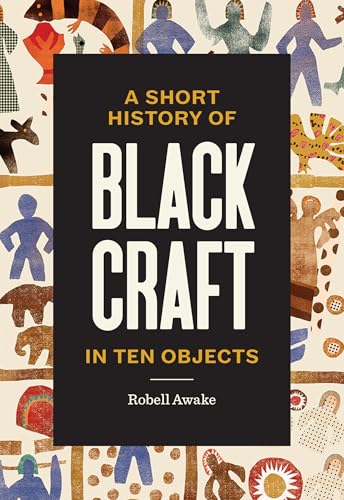
A SHORT HISTORY OF BLACK CRAFT IN TEN OBJECTS, beautiful gift object as well as solid primer on crafts-as-art


A SHORT HISTORY OF BLACK CRAFT IN TEN OBJECTS
ROBELL AWAKE
(illus. Johnalynn Holland; afterword by Tiffany Momon)
Princeton Architectural Press (non-affiliate Amazon link)
$12.99 ebook editions, available now

Rating: 4.5* of five

The Publisher Says: Ten beautifully illustrated essays tell the stories of handcrafted objects and their makers, providing inspiration and insight into Black history and craftsmanship.

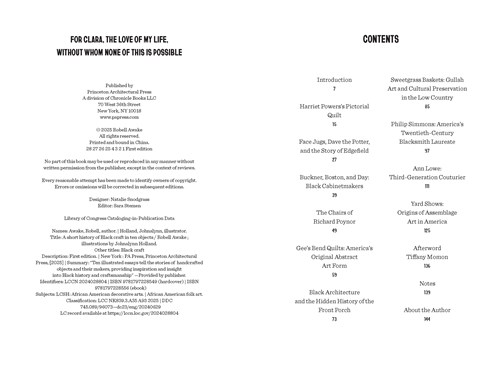
Black artisans have long been central to American art and design, creating innovative and highly desired work against immense odds. Atlanta-based chairmaker and scholar Robell Awake explores the stories behind ten cornerstones of Black craft, including:
  • The celebrated wooden chairs of Richard Poynor, an enslaved craftsman who began a dynasty of Tennessee chairmakers.
  • The elegant wrought-iron gates of Philip Simmons, seen to this day throughout Charleston, South Carolina, whose work features motifs from the Low Country.
  • The inventive assemblage art and yard shows of Joe Minter, James Hampton, Bessie Harvey, and others, who draw on African spiritual traditions to create large-scale improvisational art installations.

  • From the enslaved potters of Old Edgefield, South Carolina, to Ann Lowe, the couture dressmaker who made Jacqueline Kennedy's wedding dress, to Gullah Geechee sweetgrass basket makers, to the celebrated quilters of Gee's Bend, A Short History of Black Craft in Ten Objects illuminates the work of generations of Black craftspeople, foregrounding their enduring contributions to American craft.
  • BLACK CRAFT AND AMERICANA: Delving into the history of Black skilled artisans, estimated to have outnumbered white artisans five to one in the southern United States in the late 1800s, this unique art history book celebrates handcrafted objects that reflect the dynamic nature of Black culture.
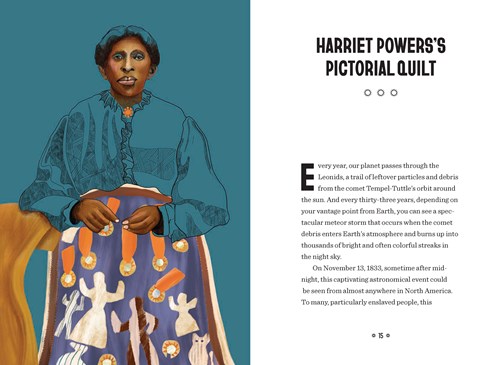
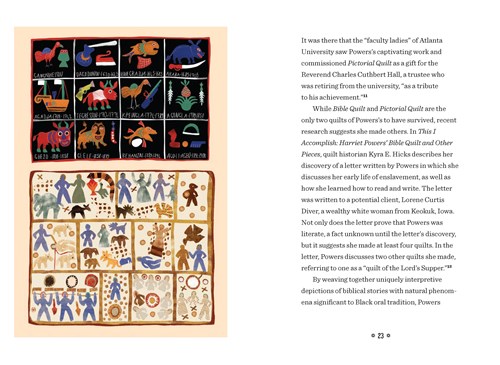
  • DYNAMIC ILLUSTRATED ESSAYS: Luminous color illustrations by artist Johnalynn Holland highlight beloved craft objects and their makers, creating a fascinating volume to study and treasure.
  • ART HISTORY EXPERTISE: Author Robell Awake is a notable furniture maker, artisan, and educator whose work has been featured in the New York Times and in group shows at Verso Gallery in New York City and the Center for Craft in Asheville, NC. Dr. Tiffany Momon, who contributes an afterword, is the founder and co-director of the Black Craftspeople Digital Archive and a leading scholar of Black history and African American placemaking throughout the southeast.
  • BEAUTIFUL GIFT BOOK: The gorgeous design is ideal for art collectors and craft enthusiasts, as a keepsake reminder of Black heritage, for Black History Month and beyond.

  • I RECEIVED A DRC FROM THE PUBLISHER VIA EDELWEISS+. THANK YOU.

    My Review
    : There's a lot to love about Black History Month. One big thing is its use as a goad to look out for Black creators, and creativity centering Black life and experiences, in my otherwise very, very white life. I am an old white man and really appreciate the push to look out for ideas and art I don't see on the regular.

    I think you're going to like it. Look:

    Laying out the course we'll follow.

    So beautiful, the evocation of the spirit of the quilt.


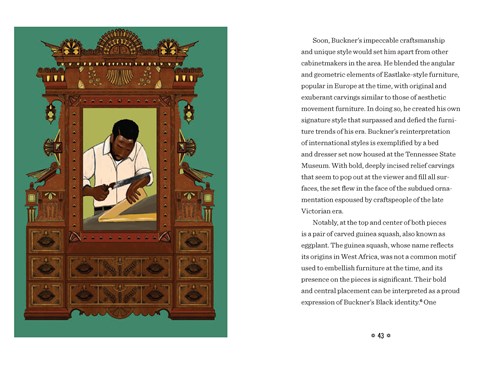
    They're stunning as art; they're vital as cultural documents.

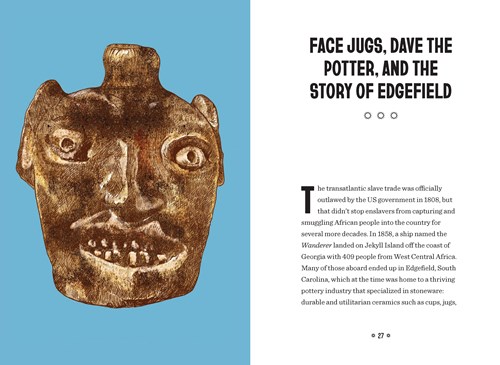
    This kind of pottery makes my hairs stand up. Such a shot of Truth! It's a personality, it's a real Presence, an avatar of interiority.


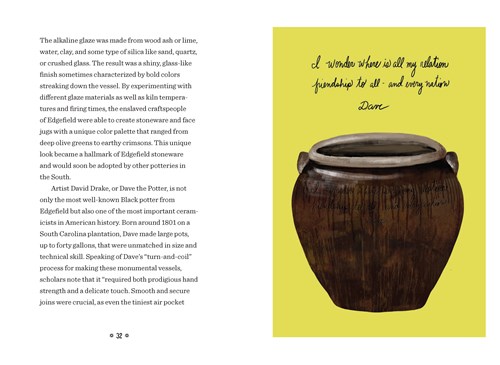
    Speaking real, home truth there, Dave.


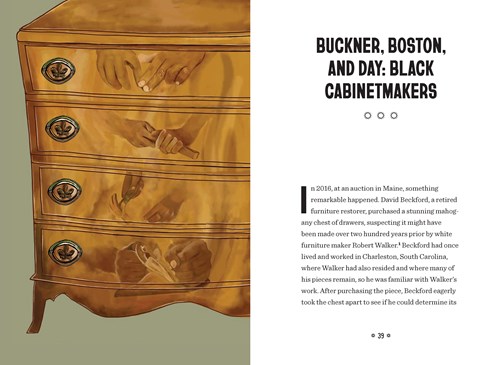
    It's a bureau that, as I look at it, is exactly like one Mama had; I wonder if that one was made by a Black craftsman, and I have no way to know....

    A beautiful object about beautiful objects. An adornment for the coffee table. The essays aren't exactly stunning prose, or hugely academic; they're tonally appropriate enhancements of one's existing, or good seedstock for one's entirely absent, knowledge base of the long, long tradition of Black art in the craft sphere. Can't quite give it that full fifth star because it's doing its job but not stretching me as a reader; it will others, though.

    Monday, September 25, 2023

    BAYARD RUSTIN: A Legacy of Protest and Politics surveys a life lived in resistance, & LOST PROPHET: The Life and Times of Bayard Rustin, biography of his gayness


    BAYARD RUSTIN: A Legacy of Protest and Politics
    MICHAEL G. LONG
    (editor)
    NYU Press
    $27.95 harcover, available tomorrow

    Rating: 3.5* of five

    The Publisher Says: Celebrates the life and legacy of Bayard Rustin, the civil rights leader behind the 1963 March on Washington for Jobs and Freedom

    While we can all recall images of Martin Luther King Jr. giving his “I Have a Dream” speech in front of a massive crowd at Lincoln Memorial, few of us remember the man who organized this watershed nonviolent protest in eight short weeks: Bayard Rustin.

    This was far from Rustin’s first foray into the fight for civil rights. As a world-traveling pacifist, he brought Gandhi’s protest techniques to the forefront of US civil rights demonstrations, helped build the Southern Christian Leadership Conference, led the fight for economic justice, and played a deeply influential role in the life of Dr. King by helping to mold him into an international symbol of nonviolent resistance. Rustin’s legacy touches many areas of contemporary life—from civil resistance to violent uprisings, democracy to socialism, and criminal justice reform to war resistance.

    Despite these achievements, Rustin was often relegated to the background. He was silenced, threatened, arrested, beaten, imprisoned, and fired from important leadership positions, largely because he was an openly gay man in a fiercely homophobic era. With expansive, searching, and sometimes critical essays from a range of esteemed writers—including Rustin’s own partner, Walter Naegle—this volume draws a full picture of Bayard a gay, pacifist, socialist political radical who changed the course of US history and set a precedent for future civil rights activism, from LGBTQ+ Pride to Black Lives Matter.

    I RECEIVED A DRC FROM THE PUBLISHER VIA EDELWEISS+. THANK YOU.

    My Review
    : Too long ignored for being queer and open about it, the life of a Quaker resistor of Wrong and Wickedness was a complicated one. I wish this collection of essays had been edited to reduce the repetition of basic information about him, but appreciate that it was done at all.

    I imagine the experience of being friends with Bayard Rustin was pretty fraught...his stadards were very high and his judgments usually spot-on, which combination is uncomfortable for himself and others. This reality played itself out in his double invisibility in gay-rights circles: Blackness and religious belief. He felt he wasn't needed or wanted in that world so, until he fell in love with Walter Naegle at 65, he focused on Black liberation and didn't involve himself in gay rights. The sad part to me is that the man was ahead of his time in his politics, his morals, and his social beliefs, and still deeply internalized both homophobia and misogyny.

    If you're utterly unfamiliar with Rustin, this collection of essays will fill you in. Read the way any collection should be, piece by piece over time, the cumulative effect is to bring an unjustly underknown man's contributions to the best things that happened in the era of Civil Rights expansion to light. He is, be aware, not critically examined in these essays. Part three of the collection, "What Rustin Means to Me," is probably my favorite to read because the legacy of this upright, intelligent, unsparing actor on the public stage is dealt with by those whom he has inspired. I suppose anyone who stood up for an unpopular belief because it was right to do so can't hope for a better legacy.

    +++++++++++++++++++++++++++++++++++++++++++++++++++++++++++++++++


    LOST PROPHET: The Life and Times of Bayard Rustin
    JOHN D'EMILIO

    The Free Press
    $11.99 Kindle edition, available now

    Rating: 4.5* of five

    The Publisher Says: Bayard Rustin is one of the most important figures in the history of the American civil rights movement. Before Martin Luther King, before Malcolm X, Bayard Rustin was working to bring the cause to the forefront of America's consciousness. A teacher to King, an international apostle of peace, and the organizer of the famous 1963 March on Washington, he brought Gandhi's philosophy of nonviolence to America and helped launch the civil rights movement. Nonetheless, Rustin has been largely erased by history, in part because he was an African American homosexual. Acclaimed historian John D'Emilio tells the full and remarkable story of Rustin's intertwined lives: his pioneering and public person and his oblique and stigmatized private self.

    It was in the tumultuous 1930s that Bayard Rustin came of age, getting his first lessons in politics through the Communist Party and the unrest of the Great Depression. A Quaker and a radical pacifist, he went to prison for refusing to serve in World War II, only to suffer a sexual scandal. His mentor, the great pacifist A. J. Muste, wrote to him, "You were capable of making the 'mistake' of thinking that you could be the leader in a revolution...at the same time that you were a weakling in an extreme degree and engaged in practices for which there was no justification."

    Freed from prison after the war, Rustin threw himself into the early campaigns of the civil rights and anti-nuclear movements until an arrest for sodomy nearly destroyed his career. Many close colleagues and friends abandoned him. For years after, Rustin assumed a less public role even though his influence was everywhere. Rustin mentored a young and inexperienced Martin Luther King in the use of nonviolence. He planned strategy for the Southern Christian Leadership Conference until Congressman Adam Clayton Powell threatened to spread a rumor that King and Rustin were lovers. Not until Rustin's crowning achievement as the organizer of the 1963 March on Washington would he finally emerge from the shadows that homophobia cast over his career. Rustin remained until his death in 1987 committed to the causes of world peace, racial equality, and economic justice.

    Based on more than a decade of archival research and interviews with dozens of surviving friends and colleagues of Rustin's, Lost Prophet is a triumph. Rustin emerges as a hero of the black freedom struggle and a singularly important figure in the lost gay history of the mid-twentieth century. John D'Emilio's compelling narrative rescues a forgotten figure and brings alive a time of great hope and great tragedy in the not-so-distant past.

    I CHECKED THIS BOOK OUT OF MY LOCAL LIBRARY. USE THEIR SERVICES OFTEN, THEY NEED US!

    My Review
    : So, after deciding that I wanted a biography of the complex gay man Bayard Rustin while reading essays about him, I found this hefty tome. I love library lending because I couldn't justify spending full price on a book I expected to admire not like when my $12 investment represents 5% of my total monthly spending power.

    I'm going to buy it for myself now because I want to support this historian whose stylish writing and tireless researching of a crucial figure in gay and Black history has enriched my life.


    Rustin's Quaker upbringing strongly influenced his social-justice compass and his anti-violence stance. He refused to serve any military or enabling function in World War II, serving instead jail time for following his conscience. He was consistently anti-war and anti-colonialist in his world view, modeling his resistance to them on Mohandas K. Gandhi's successful anti-British actions in India. Rustin, and mentor A. Philip Randolph, founder and leader of the Brotherhood of Sleeping Car Porters, planned a mass march on Washington in 1941 for the same goals that the 1963 event had (Jobs and Justice) but called it off because President Roosevelt asked them to. The brink of war was used as an excuse to delay urgent public action...as always...but both men were active in making sure the March on Washington took place, at last, in 1963. We remember it mostly for assassinated leader Martin Luther King, Jr.,'s rousing and glorious "I Have A Dream" speech. If, like most, you've only ever seen the highlight reel version, go treat yourself to the entire seventeen and a half minutes at the link. But Randolph, responding to ongoing scurrilous efforts to paint MLK and Rustin as sexual lovers not friends, really shone in his ringing defense of Rustin's involvement as the leader and backstage manager of this titanic event that kickstarted so many changes in US society: "Bayard Rustin IS the March on Washington." He faced down, on behalf of his gay friend and fellow life-long resistor of social and political injustice, the President of the USA, J. Edgar Hoover ofthe FBI...arguably the more powerful of the two men...and Adam Clayton Powell, Harlem's immensely influential Congressman, who coveted Rustin's control and directive roles.

    The over five hundred pages of this story aren't a chore to read. The reason is that Author D'Emilio made the effort to make it a story. Many, if not most, biographers are excellent researchers and fans of their subjects; fewer wre storytellers with an eye for the illustrative anecdote. My best example is the moment when, during a public meeting after the Montgomery, Ala., church bombing killed four little girls, Rustin took those loudly calling for a violent response to task by accusing them of proposing to accomplish nothing.

    That is some kind of drama, folks, and it perfectly encapsulates a lifetime of Rustin's moral and political learning.
    What leads me to talk about this lost prophet, buried in homophobic judgment, in connection with the essays just published about him, is the fact that Rustin had so much internal-to-the-struggle opposition to cope with that his never hidden, never centered homosexuality was never the focus of his resistance to power's abuses. Bear in mind that a known, avowed homosexual Black man was principally responsible for the community activism model and playbooks that succeeded in achieving the end of the legal fig-leaf of Jim Crow laws in the US. Could he have done the same had he set his sights on axhieving the same for queer folk, when the DSM-II of NINETEEN SIXTY-EIGHT still defined homosexuality as a mental illness, and the Feds led by Hoover had barely stopped the Lavender Scare? During the latter events, do not ignore, Rustin was a victim and STILL LED THE MARCH ON WASHINGTON!

    Sorry. The awfulness of his treatment during his life by his fellow Quakers and Christians, and after his death by literally everyone simply forgetting he existed, lead me to the shouting.

    The man himself noted that liberals couldn't hate Blacks and Latinos anymore, but they sure could—and did—hate fags. Realist that he was, he spent his life of organizing, resisting, and inspiring in the fields where he could do the most good. Admirably clear-sighted and honestly, to me at least, movingly generous of spirit of him not to insist on perfection but work for better. Events have proven his approach was effective for QUILTBAG folk as much as for ethnic minorities.

    I salute author D'Emilio for putting in the hard labor and the gigantic energy to create this readable, enjoyable story of an important and ignored man, his life and his loves and his legacy. A perfect accompaniment to Bayard Rustin: A Legacy of Protest and Politics.

    Monday, February 28, 2022

    NO STUDY WITHOUT STRUGGLE, a different lens on an ongoing, increasingly urgent social issue


    NO STUDY WITHOUT STRUGGLE: Confronting Settler Colonialism in Higher Education
    LEIGH PATEL

    Beacon Press
    $24.95 hardcover, available now

    Rating: 4* of five

    The Publisher Says: Examines how student protest against structural inequalities on campus pushes academic institutions to reckon with their legacy built on slavery and stolen Indigenous lands

    Using campus social justice movements as an entry point, Leigh Patel shows how the struggles in higher education often directly challenged the tension between narratives of education as a pathway to improvement and the structural reality of settler colonialism that creates and protects wealth for a select few.

    Through original research and interviews with activists and organizers from Black Lives Matter, The Black Panther party, the Student Nonviolent Coordinating Committee, the Combahee River Collective, and the Young Lords, Patel argues that the struggle on campuses reflect a starting point for higher education to confront settler strategies. She reveals how blurring the histories of slavery and Indigenous removal only traps us in history and perpetuates race, class, and gender inequalities.

    By acknowledging and challenging settler colonialism, Patel outlines the importance of understanding the relationship between the struggle and study and how this understanding is vital for societal improvement.

    I RECEIVED THIS DRC FROM THE PUBLISHER VIA EDELWEISS+. THANK YOU.

    My Review
    : Universities are under siege from as many angles as there are. Activists have campaigned, more or less successfully, for disinvestment from socially irresponsible industries. They've made the possession of a racially insensitive mascot a lightning rod for criticism. These news stories are commonplace enough to be readily Google-able, and to have a selection of attitudes and viewpoints from which to choose.

    I'd also recommend taking a few minutes to read Author Patel's Q&A on The Beacon Broadside's website for a trenchant, quotable précis of her thoughts on this difficult to dismiss subject. It is a clear statement of her purposes in writing this book.

    What makes this a worthwhile read is that it requires the reader to re-evaluate every university activity. There comes first identifying then admitting prospects "worthy" of the opportunity, with the "right kind" of work ethic both within their schools and outside them. Next the institution busies itself with identifying, designing, and inculcating the capitalist dogmas that will serve the needs of the ownership class. And finally, the cruelest step: indenturing students with mountains of debt to that ownership class for the privilege of enjoying the experience, which serves to prevent the offensive-to-them class and ethnic mixing. The fear being that, unburdened by economic chains, their students will inevitably rise above their starting points and cause their owners' control to be diluted. Reading Author Patel's work will, I'm sure, give the students and their parents the perspective to see through a definitively different lens. What makes that a good idea is that many will experience a sudden and usually pretty painful awakening. Those who are screaming about "critical race theory" are calling this propaganda spreading, brainwashing, or just plain indoctrination. As always, examine the accuser's accusations for cues as to the real source of their rage: the examination Author Patel demands we her readers undertake will cause some number of us to reject our present indoctrination as the unfair, exclusionary artifact of an exploitive ownership class's control paradigm.

    Since I've already had a pitcher of that Kool-Aid, this wasn't fresh stuff for me.

    What I needed to learn about was Author Patel's encouragement of the University's students to interrogate everything they are being offered through the awareness of settler colonialism's existence, reach, and signals of control. Her book is a call to arm yourself, youthful learners, with skepticism and information, not simply and passively accept the way things are without understandig how they got that way and who wants them to stay that way.

    What lowers my rating to four of five stars is my sense that the message, while complete and well-thought-through, isn't presented in such a way as to lead to action. In the world of young persons it's my experience that theory is best left to emerge from actions at the maxiumum possible number of times. I'd've been much more stirred and delighted had I seen some non-theoretical analysis..."when one sees this, then that is the likeliest cause; now, do this or that to draw attention to it with the aim of changing it." After all, Author Patel spoke to many whose lives of resistance and struggle included forging action agendas. Why not bring this facet, underpinning the work as it does, to the fore?

    But never mind all that Monday-morning quarterbacking. The book that is here, that is available from the estimable Beacon Press, will offer you much. If your child is leaving for college soon, I want to push you towards the read with some extra fervor. If your child is in school now, please send them one. There is no bad or wrong time to give someone not yet ossified into a brittle psychic shape the chisels and files and rasps to add refinement and enhancement to their awareness.

    Friday, February 25, 2022

    THE MAN WHO LIVED UNDERGROUND, decades lost in drawers because white people


    THE MAN WHO LIVED UNDERGROUND
    RICHARD WRIGHT

    Library of America
    $19.95 all editions, available now

    Rating: 5* of five

    The Publisher Says: A major literary event: an explosive, previously unpublished novel from the 1940s by the legendary author of Native Son and Black Boy.
    Fred Daniels, a black man, is picked up randomly by the police after a brutal murder in a Chicago neighborhood and taken to the local precinct where he is tortured until he confesses to a crime he didn't commit. After signing a confession, he escapes—or is permitted to escape—from the precinct and takes up residence in the sewers below the streets of Chicago.

    This is the simple, horrible premise of Richard Wright's scorching novel, The Man Who Lived Underground, a masterpiece written in the same period as his landmark books Native Son (1940) and Black Boy (1945) that he was unable to publish in his lifetime. Only small parts of it have appeared in print, and in a significantly redacted form it would eventually be included in the short story collection Eight Men (1961). Now, for the first time, by special arrangement with the author’s estate, the full text of the work that meant more to Wright than any other (“I have never written anything in my life that stemmed more from sheer inspiration”) is published in the form that he intended, complete with his companion essay, “Memories of My Grandmother.” Malcolm Wright, the author’s grandson, contributes an afterword.

    I RECEIVED A DRC FROM THE PUBLISHER VIA NETGALLEY. THANK YOU.

    My Review
    : Richard Wright was one of the twentieth century's crop of Great American Storytellers, a writer whose entire life of creation was a gift to a country that did not deserve his passionate voice calling into the face of its indifference that we can be better, do better, and must in order to survive.

    People my age were required to read Native Son in high school English, and I am so very glad we were. I wouldn't have picked up the book any other way. It needed to be shoved on me. And wonder of wonders, the Austin (Texas) Independent School District of the early 1970s did. It was a tough thing to let myself believe, that people simply but sincerely hated for no better reason than someone was a different skin color than they were. I assumed all those yahoos were just performing their snotty, hateful idiocy like they did their fake homophobia; it seemed to me that racism against Black and Hispanic students was the same. Anything to look cool, after all, and these were teenagers whose ideas of Cool were neither self-reflective nor rebellious enough to have progressed from the 1950s their own parents were stuck in.

    Then we read the equally astounding true-crime (I call racism a crime and am not likely to stop doing so) Black Like Me, an account of a white man passing as Black in the Jim Crow South. It too was gut-wrenching, but was different in kind than the novel Native Son. A factual report...well, I am quite sure that my own racism got hard, hard knocks that year. (I am fully aware that I'm complicit in racist society, that in no way am I "not a racist" just because I support Black political candidates and so on.) It's a pity we couldn't have read this jaw-dropping, intense, visceral evocation of the Other as refiner and perfecter of his Othering. It is the apotheosis of Otherness and Othering that this intense story tells its readers.

    Anyone who's paid me any attention knows that I can be run off from continuing a read by child abuse, by use of the n-word, by cruelty to animals...the list goes on...and not a few unfriendlies are smirking in anticipation of taxing me with this book's abusive, rage-filled, n-word-bombing ethos...how can I give this five stars and still abandon ship with content warnings in other, arguably less offensive cases? Because Richard Wright never does a single thing to make the awfulness of PoV character Fred Daniels's world sensational. The author isn't kidding around, bedizening a story with nastiness to provoke a response. He is telling a story about how Othering a man will, over time, after many small and large blows and much deliberate infliction of every kind of pain, turn him in to the thing that he was not, did not want to be, and could not bear to know that he now was.

    It worked, in its honesty and its clarity of purpose. I left the sewer Fred lived in without regret, without revulsion, and with the most horrified, profound acceptance of Fred as he was abused and neglected into being. Acceptance of his re-creation, transformation.

    In the inexcusably hate-filled twenty-first century, we are fighting the battle that Fred lost all over again. There are wins...the conviction of Ahmaud Arbery's murderers...there are defeats, the gerrymandering cases standing out to me as disasters to Black people...but the trend is towards, as it ever was, the endless and pointless perpetuation of hate based on stupidity among the haters and truculence among the hated.

    Books like this are strong medicine against both ends of the spectrum. Fred, a victim, sees what the System does to people, and ultimately still surrenders to it. Not to fight against the dehumanizing and brutalizing actions and inactions of the system that allows Fred to exist in the literal sewers is to acquiesce in the process of creating more Freds...and that is a moral wrong and a societal tragedy. Author Wright doesn't allow his readers the luxury of redemption. This book remained unpublished for seventy years because it is the most hopeless document of degradation's triumph I've ever read. White people of the 1940s would've been offended by the clear-eyed assertion of police violence as it happened...nowadays that illusion is gone...but they wouldn't have wanted to read about a good man surrendering his humanity regardless of that knee-jerk response. The accusing fingers pointing back at them as they called out Author Wright for his bleak treatment of Fred (theirs was the system he succumbed to, after all) were simply too on-the-nose.

    There is an extended essay included with the novel entitled “Memories of My Grandmother” that enables our appalled eyes to see where so much of the story we've just read originated. The fact that Christian religion played such a big role in Wright's formation into a man capable of the kind of wordsmithing he does isn't a big surprise. I'm very grateful that the author's daughter required the essay to be published within the book containing the novel...it's a long piece and, even if you're on the fence about reading the novel, I hope you'll consider procuring it to read the essay alone. It is a marvelous explication of how each generation forms the next, for good and ill.

    What Author Wright isn't, in the writing of this story, is subtle. The metaphors defining it simply aren't debatable: Whites own the sunshine and consign the Blacks to the literal sewers to eke out whatever existences they can. A Black man who's innocent of any crime is shoved into the sewer with the rest of the leavings because he's never had a place in the sunshine that was truly his. As he copes increasingly poorly with the sewers, he's not allowed to leave them; he's run away from the white police, deprived them of their fun of torturing and eventually killing him, so they say "stay there and die."

    The author doesn't, then, offer Redemption to either side. It's a very uncharitable and un-Christian thing to withhold. But he's got a reason, does Author Wright: "Chickens come home to roost, don’t they?" his daughter quotes him as saying.

    They very much do. The perch they roost on is, in this rare and exquisitely painful read, your complicit soul.

    Wednesday, February 23, 2022

    CAROLINA BUILT, fictionalized story of a superbly determined woman's battles


    CAROLINA BUILT
    KIANNA ALEXANDER

    Gallery Books (non-affiliate Amazon link)
    $13.99 ebook edition, available now


    Rating: 4* of five

    The Publisher Says: This “exuberant celebration of Black women’s joy as well as their achievements” (Kate Quinn, New York Times bestselling author) novelizes the life of real estate magnate Josephine N. Leary in a previously untold story of passion, perseverance, and building a legacy after emancipation in North Carolina.

    Josephine N. Leary is determined to build a life of her own and a future for her family. When she moves to Edenton, North Carolina from the plantation where she was born, she is free, newly married, and ready to follow her dreams.

    As the demands of life pull Josephine’s attention away, it becomes increasingly difficult for her to pursue her real estate aspirations. She finds herself immersed in deepening her marriage, mothering her daughters, and being a dutiful daughter and granddaughter. Still, she manages to teach herself to be a businesswoman, to manage her finances, and to make smart investments in the local real estate market. But with each passing year, it grows more and more difficult to focus on building her legacy from the ground up.

    “Filled with passion and perseverance, Josephine Leary is frankly a woman that everyone should know” (Sadeqa Johnson, author of Yellow Wife) and her story speaks to the part of us that dares to dream bigger, tear down whatever stands in our way, and build something better for the loved ones we leave behind.

    I RECEIVED A DRC FROM THE PUBLISHER VIA NETGALLEY. THANK YOU.

    My Review
    : It's always been hard to be a woman. In the US, it's always been hard to be Black. Now put the two disadvantages together...that's what Josephine Leary is up against. She's equal to any task, though; the novel begins in 1870, during the last days of Reconstruction. Having lived her childhood as a slave, Josephine knows that every single act she takes in this life has to have as its aim the increase of freedom and the assurance of security for herself, her husband, and their two daughters, as each addition to her life is made.

    Her slaveowner was also her father, and that piece of "good luck" played out in her favor. She was able to buy the barbershop she and her husband ran together from him. And from there forward, it was all Mrs. Leary and all the way up Sweety, her husband, backed her.

    Until her success threatened his Manhood.

    It's a testament to the author's ability to pace a story that I didn't just quietly close the book and ignore it at that point. I know it happened; I am told it still happens. But it makes for dull reading, the expected flaw in the expected place. But to her credit, Author Alexander dwells on it not...it's not like it's played down but it's not protracted either.

    What made me so dad-blamed mad that I screamed at my Kindle (for which I apologize to my roommate, he was sleeping and was utterly terrified as I shouted "NO SHE DID NOT!!" into the dark) came close to the end of the book when there's a fire that deprives Mrs. Leary of her (uninsured, of course, she was a Black woman, who'd write that policy in the 1890s?!) hard-earned gains! But...and this is where I almost cheered but was too shy to wake the grouch up again...she still owned the land. And she chose to rebuild, to build back better.

    Unlike certain scumbag politicians with "R"s after their names.

    Well, that all sounds very five-starry, doesn't it? But there's a four up there...and I feel generous giving it. The fact is that this is a very dialogue-heavy novel and there's not much vigor in the dialogue. It's not awful but it doesn't lend itself to quoting the quotable quotes. There's not any.
    "The only thing that truly frightens me is the idea that I might not take full advantage of the gift of freedom. I refuse to let that happen."

    And that is as snappy as it gets. I'm in total agreement with the sentiment. I just wish it had more oomph behind it.

    But in the end, this is an historical novel and it's a lot better served by thinking of it as a novelized biography. Josephine Leary very much deserves to be remembered for her indomitable will, her savvy, and her sheer cussèd determination to overcome every obstacle the world shoves in front of her. Reading the story is a good, and a worthy, way to honor the memory of such a remarkable person.

    Saturday, February 19, 2022

    HOWARD ZINN'S SOUTHERN DIARY: Sit-Ins, Civil Rights, and Black Women's Student Activism...what it says outside you get inside


    HOWARD ZINN'S SOUTHERN DIARY: Sit-Ins, Civil Rights, and Black Women's Student Activism
    HOWARD ZINN, ROBERT COHEN
    (editor)
    Foreword by Alice Walker
    University of Georgia Press
    $24.95 trade paper, available now

    Rating: 4.25* of five

    The Publisher Says: How young black women fought paternalism on campus and Jim Crow downtown, and how Howard Zinn was fired for supporting them

    In the 1960s, students of Spelman College, a black liberal arts college for women, were drawn into historic civil rights protests occurring across Atlanta, leading to the arrest of some for participating in sit-ins in the local community. A young Howard Zinn (future author of the worldwide best seller A People’s History of the United States) was a professor of history at Spelman during this era and served as an adviser to the Atlanta sit-in movement and the Student Nonviolent Coordinating Committee (SNCC). Zinn mentored many of Spelman’s students fighting for civil rights at the time, including Alice Walker and Marian Wright Edelman.

    As a key facilitator of the Spelman student movement, Zinn supported students who challenged and criticized the campus’s paternalistic social restrictions, even when this led to conflicts with the Spelman administration. Zinn’s involvement with the Atlanta student movement and his closeness to Spelman’s leading student and faculty activists gave him an insider’s view of that movement and of the political and intellectual world of Spelman, Atlanta University, and the SNCC.

    Robert Cohen presents a thorough historical overview as well as an entrée to Zinn’s diary. One of the most extensive records of the political climate on a historically black college in 1960s America, Zinn’s diary offers an in-depth view. It is a fascinating historical document of the free speech, academic freedom, and student rights battles that rocked Spelman and led to Zinn’s dismissal from the college in 1963 for supporting the student movement.

    I RECEIVED A DRC FROM THE PUBLISHER VIA EDELWEISS+. THANK YOU.

    My Review
    : There is no quisling like a race quisling. Spelman College, an institution of higher education for wealthy Black families, operated "in loco parentis" and, in typical midcentury overreach, became the controlling patriarch of its woman students' every single act. They were aiming for a complete absence of any breath of scandal. A Spelman alumna was Caesar's wife, blameless in all ways, and President Albert Manley (don't think that name didn't suit him to a "T") was going to make sure the women at 1960s Spelman were perfectly prepared to be housewives and helpmeets for Black executives, free of radical notions about race equality and gender parity.

    Along comes new History professor Howard Zinn, radical New York Jew....

    What makes this a good read is what makes any personal story a good read. The diary of a very interesting person, a person who's entire being is dedicated to breaking bad stuff and gluing it back together into better shapes, is going to be of interest to at least a few of us. When that person is someone whose way with words is demonstrably snappy, merging erudition with sarcasm and bypassing facetiousness to jab sharp elbows of truth-telling into the soft midriffs of the Status Quovians, chances are you're in for a good read.

    Robert Cohen had access to Zinn's diaries before others in order to annotate and analyze the source material aided by a grant from New York University's Steinhardt School of Culture, Education, and Human Development. The purpose of the grant was to support research that could illuminate previously unknown connections and bring to light buried facts in Cohen's area of scholarship, social movements in higher education. This project combines the diaries of a major cultural figure with interviews of some women whose lives he touched (eg, Alice Walker) and the profound changes he catalyzed in some of them. It is hard to overstate Zinn's personal charisma. It is hard to overestimate the role contact with such a live wire has on a person beginning to form an identity. And Zinn's desire to assist the USA in birthing a fairer, more inclusive culture in all ways should've found friends in Spelman's hierarchy.

    It very much did not.

    Zinn was harassed and abused by senior colleagues, going so far as Spelman President Manley threatening him with an entirely fabricated sex scandal, for having the audacity to try to prepare his charges for the world of equal rights that Dr. Martin Luther King, Jr., was advocating across the street at Morehouse College. Ultimately, Zinn was forced to leave Spelman after seven years without tenure and was handed over to Boston University for a twenty-four year career of pushing aside the nostrums and asininities of US "education" in the History and Social Studies fields.

    What makes this book fun to read is Editor Cohen's trenchant annotations and explications of the diary herein. The thing about a diary is that it's not usually meant for other eyes...but there's a hint that Zinn was slyly glancing over his shoulder at us from beyond the grave. What I enjoyed most were the moments that Cohen asks Zinn's former students about events in the diary. The putative subject of Zinn's "sexual harassment" was floored that this had ever been mooted! Manley, the President, was so desperate to protect what he saw as Spelman's selling point to wealthy parents...the oppressive in-loco-parentis system, the focus on high-brow, low-conflict education...that he would stoop to telling a lie that (had Zinn not caved and left the school) would've destroyed both lives.

    This is not an unusual thing for a boss to have done, or even to do still. But the proof that it was being fired UP is what wonderful and important stuff happened at Boston University afterwards.

    The problem with reading a book like this is the inevitable overage. Overexplaining. Overreaching to grasp a conclusion. Overdoing the support of a point of view. In the case of this book's subject, this book's timing, these were inevitable and expected. I was left wishing for less not more. But I appreciated the Catch-22 the simple existence of this book represents. Scholars need more, more proof more sources more citations, in order to survive as scholars. You can bet you'll see this book cited a great deal. The primary sources it relies on are brand new to scholarship. The interviews Editor Cohen conducted will, within a depressingly short time, be impossible to repeat due to aging and mortality. Luckily for the reader, this is not a painful overabundance of blah, bland, beige verbiage. I would caution not-scholarly readers to use the Oystercatcher Method: Fly in, skim catch crunch, swallow and move on; then wade through, dig, scuff up lower levels of tasty morsel, repeat later.

    I won't give it five stars simply because there's so much information that requires additional effort to contextualize, but I will give it four-and-a-quarter because it's lively, trenchant, and conversational when it matters most to be those things for the story being told.

    Thursday, February 9, 2017

    THE PRIZE, a damning indictment of greed and careerism with a huge dollop of blame for the Lady Bountiful syndrome

    THE PRIZE: Who's in Charge of America's Schools?
    DALE RUSSAKOFF

    Mariner Books
    $15.95 trade paper, available now

    Rating: 4* of five

    The Publisher Says: Mark Zuckerberg, Chris Christie, and Cory Booker were ready to reform our failing schools. They got an education.

    When Mark Zuckerberg announced to a cheering Oprah audience his $100 million pledge to transform the downtrodden schools of Newark, New Jersey, then mayor Cory Booker and Governor Chris Christie were beside him, vowing to help make Newark “a symbol of educational excellence for the whole nation.” But their plans soon ran into the city’s seasoned education players, fierce protectors of their billion-dollar-a-year system. It’s a prize that, for generations, has enriched seemingly everyone, except Newark’s children.

    Dale Russakoff delivers a riveting drama of our times, encompassing the rise of celebrity politics, big philanthropy, extreme economic inequality, the charter school movement, and the struggles and triumphs of schools in one of the nation’s poorest cities. As Cory Booker navigates between his status as “rock star mayor” on Oprah’s stage and object of considerable distrust at home, the tumultuous changes planned by reformers and their highly paid consultants spark a fiery grass-roots opposition stoked by local politicians and union leaders. The growth of charters forces the hand of Newark’s school superintendent Cami Anderson, who closes, consolidates, or redesigns more than a third of the city’s schools—a scenario on the horizon for many urban districts across America.

    Russakoff provides a close-up view of twenty-six-year-old Mark Zuckerberg and his wife as they decide to give the immense sum of money to Newark and then experience an education of their own amid the fallout of the reforms. Most moving are Russakoff’s portraits from inside classrooms, as homegrown teachers and principals battle heroically to reach students damaged by extreme poverty and violence.

    The Prize is an absorbing portrait of a titanic struggle, indispensable for anyone who cares about the future of public education and the nation’s children.

    Another gift from a special friend. Thank you, darling heart, but can I have a comic book now?

    My Review: Betsy DeVos is the Secretary of Education. That sentence, plus the one about the racist, sexist shitheap that is Jeff Sessions becoming the Attorney General, really should drive home the point that these people your fellow Americans voted into office are the lowest of the low, the lowest and the least principled represented in halls of power where their like should simply never be allowed.

    I do not belong to the school of thought advocating healing our divisions. I advocate the secession of the decent people from the rotten-souled fascist right-wing rest of y'all. And we'll take our tax money with us...we pay more than we get.

    But then my conscience gets to me. What about the desperately poor and the hungry whose lives will, horribly, get still worse? The schools that will close? The school lunch programs that will vanish forever?

    This book makes the cost of the Union's dissolution stark. It's never mentioned. It's not part of Dale Russakoff's brief in the least. But listen to this:
    To those...who see education through the lens of students and classrooms, it is obvious that urban public schools are being asked to overcome nothing less than the effects of poverty. Reformers are right...to insist on consistently excellent teaching and leadership, but the results in Newark and in distressed cities across the country make clear that much more support is needed.
    Given that most of the nation's schools are financed by property taxes (a system as blatant in its intent to preserve and protect the existing system of privilege as can be designed), and given that US government spending on early childhood support is abysmal compared to the entire rest of the planet, where is that support meant to come from? DeVos won't be there in her seat of power advocating for the Head Start program or the school lunch program. So now what?

    Here's one perspective:
    “Education reform is not about its leaders and their prerogatives. It’s about communities,” Michael Lomax, president of the United Negro College Fund and an ardent reformer, wrote on The Root, an online magazine. “Education reform doesn’t have to be—indeed, cannot be—force-fed to communities of color . . . We can be equal partners in ensuring what is best for our children and all children. It won’t work any other way.”
    Inviting dialogue! Wow. What a concept. Except that there are a lot of people with huge financial stakes in the status quo that do NOT want to see reform. A 1994 Department of Education audit (mentioned in the book) of the Newark system found breathtaking corruption, a building that a school board member was selling to the district for $2.7 million that was generously worth under $200,000 being the one I was most repulsed by. In fact, "outsider" Democrat Newark mayor Cory Booker presented machine Republican New Jersey Governor Chris Christie with a school reform plan that warned explicitly against opening the process to public scrutiny since the unions and the other money-suckers would subvert or derail the process to protect their slots at the trough. (My phrase, not his.)

    Then again, it's not just the greed factor that's at work in this process and its manifest failures:
    “Education reform comes across as colonial to people who’ve been here for decades,” [an insider] said. “It’s very missionary, imposed, done to people rather than in cooperation with people.”
    So even though our kids are failing to get even the minimal education they're being offered in the first place, who the hell asked your white ass to come sit at the table and tell us what's what? The Annenberg education initiatives of the 1990s (the Chicago branch of which featured one Barack Obama among its leading lights) faced the same issues. Here's a piece by a Teach for America alumnus. He isn't sanguine about the efficacy or the future of the program. Russakoff gives more detail, which I felt was nicely summed up by this:
    “The ethos when I went through Teach for America was that good teaching and good leadership could solve the problems of poverty,” said [a Newark program participant]. “That’s part of the pie, but that’s not all of the pie. Our most dynamic teachers were burning out—the need and anger in the children, the mental health issues, the absenteeism, the transience.” They were witnessing the effect of what researchers call adverse childhood experiences, multiple traumas that, studies have shown, significantly interfere with learning and focus in children in the most disadvantaged communities.”
    Back to the problems of poverty that education is being asked to overcome. That is manifestly absurd. Education is the way out of poverty. This is an article of faith among the educated. But what does that statement look like to a child whose world contains one educated person, usually not of his or her own ethnic background? "Be like me," they hear said earnestly and with all the best wishes in the world.

    How? What does that look like?
    Research had shown that children in the lowest-income families heard only a fraction of the words or conversations that were the daily bread of the more affluent. By age three, the difference was an astonishing twenty million words. (my emphasis)
    By. Age. THREE.

    Are you getting a view of the biblical proportions of this problem yet? The sheer magnitude of the changes needed to make even a minuscule dent in the problem? The reformers have hammers. The problems become nails:
    “A lot of high-stakes accountability has become self-defeating—focusing solely on the identification of bad schools, the bad teachers, as opposed to creating a signal and involving teachers in processes that lead to investigations and changes,” [an expert] said.”
    So here's The Purpose Explained:
    [An expert] said the system, known as Student Growth Percentile, was designed to measure student gains or losses, not to assign blame or credit for them. “Simply focusing on teachers as being the only potential cause of growth of students is pretty obviously myopic..." The data would be more useful...as a starting point for discussions with teachers on the reasons individual students are improving or losing ground, which could include many factors in and out of school.
    Mmm hmm. Statistics used as ploughshares, not swords, in the battle to save yet another generation of poverty-mired Black children from a lifetime of marginal existence. That's gonna happen. After all, the entire system isn't based on the need for the Black child to grow up to be a grunt worker, a pawn, or a prisoner, is it?
    /sarcasm

    So what's the answer? Mark Zuckerberg, who comes across in this book as a genuinely well-meaning man with a slightly different hammer he wants to wield on Newark's public school system:
    Zuckerberg’s document laid out similar goals: “Restructure pay scale to increase base salaries for new hires . . . Abolish seniority as a factor in all personnel decisions and incentivize the removal of poor performers.” He also wrote that he wanted the best teachers to receive bonuses of up to fifty percent of their salary, the kind of incentives paid to top workers in Silicon Valley.”
    Selected from among many other equally utopian proposals to stand for the dangers of false equivalency in public conversation about society's needs. Zuckerberg, a political conservative, wants to model the world on a business platform created by and for people who are high achievers. In Alcoholics Anonymous, this is called "acting as if," or "fake it til ya make it," an idea that behavior becomes habit becomes character.

    Oh dear. That's not such a great idea, Zuck, especially since your own organization is so...fallible, let's say, due to its constituent members aping your own regressive politics and enforcing the attendant repressive and unpleasant standards on the billions who don't want any part of them. But that's another rant for another day.

    Businesses aren't by their nature equipped to deliver what the teachers in the trenches say with near unanimity what they really want:
    [T]eachers consistently tell researchers that, given the choice, they would opt for a good principal and supportive working conditions over merit pay. Indeed, research had found no correlation between merit pay and student achievement, although reformers and venture philanthropists were fighting hard to make it a staple of new teacher contracts.
    So that's easier and cheaper than the throw-money-at-the-problem shtik, right? That's the teachers sorted. And the kids?
    Children with more than one traumatic experience—violence, severe poverty, family breakup, or substance abuse in the home—were more than twice as likely as others to fail at least one grade.
    And we're back to square one: Support the family that a child comes from, help the family eat, live in a stable location, get the services that it needs, and the battle's more than half won.

    Does any of that seem to you likely to happen in Trump's America?

    Wednesday, February 8, 2017

    TEARS WE CANNOT STOP, a heartfelt sermon to an absent congregation

    TEARS WE CANNOT STOP: A Sermon to White America
    MICHAEL ERIC DYSON

    St. Martin's Press
    $24.99 hardcover, available now

    Rating: 4.5* of five

    The Publisher Says: Short, emotional, literary, powerful―Tears We Cannot Stop is the book that all Americans who care about the current and long-burning crisis in race relations will want to read.

    As the country grapples with racist division at a level not seen since the 1960s, one man's voice soars above the rest with conviction and compassion. In his 2016 New York Times op-ed piece "Death in Black and White," Michael Eric Dyson moved a nation. Now he continues to speak out in Tears We Cannot Stop―a provocative and deeply personal call for change. Dyson argues that if we are to make real racial progress we must face difficult truths, including being honest about how black grievance has been ignored, dismissed, or discounted.

    The time is at hand for reckoning with the past, recognizing the truth of the present, and moving together to redeem the nation for our future. If we don't act now, if you don't address race immediately, there very well may be no future.

    THE PUBLISHER PROVIDED ME WITH A REVIEW COPY AT MY REQUEST. THANK YOU!

    My Review: I don't take my white male privilege as my due. I recognize that, even in my state of disability and deeply offensive otherhood by being unapologetically gay and intelligent in a world that really really dislikes both those qualities, I am still protected by a halo of white maleness from the full force of contumely routinely piled on others. I'm not stopped by cops while walking on the boardwalk. I'm not made a target by predators as I wander through my wealthy little town. I'm not, in short, Black or Latinx or Desi.

    Dyson is still speaking to me in my bastion of safety. I'm not immune to racism because I don't personally practice it. I am the beneficiary of racism's unbearable viciousness. Every unsolved murder of a Black man or teen or child hit by a stray bullet fired in a dispute over goodness knows what (that happened year before last in Hempstead, a few minutes from where I live) suffers from a lack of what I have without question: The full protection of the society I live in, however grudgingly offered. I can demand that the institutions in place give me what I need. Others can't. And that is institutionalized racism at its most disagreeable. Because I, and so many like me, can make these demands, others are perforce denied their access to them. It is a scarcity model, a zero-sum game, where my privilege comes at the expense of your access to the spoils.

    How does one cause those who have abundant goods, easy access to services and wealth, to share with those who have not? Dyson exhorts and educates the white elite to enjoin us to see things as they are. Then we're left to question our consciences as to whether the way things are is okay with us. My answer is "no I'm not okay with it" and still that makes no difference in the world at large. It brings institutional racism no closer to collapse. And, crucially, it brings me into no significant danger of losing my white male privilege. Dyson has effectively presented me the case for my privilege to end; he and I together with the people of conscience can only exhort, can try to explain to any audience we can find that as "guiltless" as we may be in our own hearts, we need to put our hands to the divine work of ending our own luxury.

    Savonarola tried that. Got him burned at the stake. The Black Panther Party has advocated for this for over 50 years. Got their leaders jailed, murdered, marginalized. White America isn't in the pews listening to the sermon, Dr. Dyson. The converts are, I hope, already out there flapping their gums about the subject. I bash my keyboard to bring awareness to the issues of exclusion and denial. This is my way of encouraging all my fellows in privilege to resist the understandable desire to (silently, tacitly) accept the tainted gifts that the kakistocracy currently ascendant in US politics delivers to us.

    Despite the urge to put a book that makes you feel ashamed of things you think you can't control or influence right down on the nightstand, I ask you please to stop yourself from the easy course. Please pick the book back up. Please understand that Dyson is extending a hand to you, palm up, to offer you reasons to take action and make decisions that support true equality. Put your palm to his. Take that action, make that decision, no matter how small or how "useless." There is a reason for you to do the right thing:
    We don't hate you, white America. We hate that you terrorize us and then lie about it and then make us feel crazy for having to explain to you how crazy it makes us feel. We cannot hate you, not really, not most of us; that is our gift to you. We cannot halt you; that is our curse.

    #ReadingIsResistance

    Sunday, February 5, 2017

    GHETTOSIDE, being a jeremiad of a review of a jeremiad of a book


    GHETTOSIDE: A True Story of Murder in America
    JILL LEOVY

    Spiegel & Grau
    $16.00 trade paper, available now

    Rating: 4.5* of five

    The Publisher Says: On a warm spring evening in South Los Angeles, a young man is shot and killed on a sidewalk minutes away from his home, one of the thousands of black Americans murdered that year. His assailant runs down the street, jumps into an SUV, and vanishes, hoping to join the scores of killers in American cities who are never arrested for their crimes.

    But as soon as the case is assigned to Detective John Skaggs, the odds shift.

    Here is the kaleidoscopic story of the quintessential, but mostly ignored, American murder—a “ghettoside” killing, one young black man slaying another—and a brilliant and driven cadre of detectives whose creed is to pursue justice for forgotten victims at all costs. Ghettoside is a fast-paced narrative of a devastating crime, an intimate portrait of detectives and a community bonded in tragedy, and a surprising new lens into the great subject of why murder happens in our cities—and how the epidemic of killings might yet be stopped.

    This book was a holiday gift from a special friend. "Thanks" honey, I love you too.

    My Review: I had nightmares reading this damned book. I finish a book a day. This one took me a solid month of on-again, off-again "holy shit I can't, I just can't" reading to finish. I'm a privileged fuck. I always was. I think my one hope for any redemption is that I've never been under any illusion I wasn't. This is a read to make a decent soul scream and rage against the horrors of an everyday reality *in*our*own*country* that is so, so, I can't...I do not possess a word anywhere in my brain that's equal to the towering emotional and political indignation, fury, disgust, horror, agony, grief that I am experiencing.

    I'll attempt to be a bit more rational from here on out. I think quoting Leovy herself will help with my incoherent outrage.

    Start with this. Leovy's commonsensical reduction of the problem facing our country's law enforcement machinery, the notable lack of a will to do the right thing:
    ...[T]o assert that black Americans suffer from too little application of the law, not too much, seems at odds with common perception. But the perceived harshness of American criminal justice and its fundamental weakness are in reality two sides of a coin, the former a kind of poor compensation for the latter. Like the schoolyard bully, our criminal justice system harasses people on small pretexts but is exposed as a coward before murder. It hauls masses of black men through its machinery but fails to protect them from bodily injury and death. It is at once oppressive and inadequate.
    That's pretty much the entire book's point in a nutshell. Understand this, really get it, and you'll be able to read this book without feeling bitch-slapped by the facts. It won't help one iota with the emotional shellacking you're going to take. Yep, that's right laddies and gentlewomen, this another Eat-Your-Spinach Book! Oh boy oh joy, Jeremiah bar Derus slings another jeremiad at ya!

    But c'mon, read this and tell me that you can't see why:
    Society's efforts to combat this mostly black-on-black murder epidemic were inept, fragmented, underfunded, contorted by a variety of ideological, political, and racial sensitivities. When homicide did get attention, the focus seemed to be on spectacles — mass shootings, celebrity murders — a step removed from the people who were doing most of the dying: black men.

    They were the nation's number one crime victims. They were the people hurt most badly and most often, just 6 percent of the country's population but nearly 40 percent of those murdered. People talked a lot about crime in America, but they tended to gloss over this aspect — that a plurality of those killed were not women, children, infants, elders, nor victims of workplace or school shootings. Rather, they were legions of America's black men, many of them unemployed and criminally involved. They were murdered every day, in every city, their bodies stacking up by the thousands, year after year.
    These facts constitute an invitation to jeremiadize, no? The appalling stark factual truth makes for bad feelings but better votes, or so I hope. The facts of young Bryant Tennelle's murder aren't unusual. They're quite appallingly routine, in fact. I can't see any reason to pretend otherwise. His father is one of the good guys...a cop...but he was just like a million other young Black men in his neighborhood. And he paid with his life for his father's decision not to leave the world he grew up in, the world of violence and death and grief that generations of political and social inaction at the least destructive and targeted harassment at the worst have created. Make no mistake: Leovy shows clearly that this situation isn't new, isn't accidental, it isn't some ghastly malevolent internal evil inherent in South Central's men. It's us, the rich white people who vote for Law-n-Order for no free rides for moochers for the eternal unchallenged supremacy of Our Kind over the lower orders. Or, to put it simply, Trump's Murrika.

    The fact is that this carefully constructed economic and social apartheid has predictable consequences. Among them is the inevitable rise of illegal shadow economies centered around illegal activities. How the hell else are you supposed to be part of this giant consuming machine? It takes money to be one of those getting and spending, and flipping burgers at Mickey D's isn't going to get you an Escalade:
    When your business dealings are illegal, you have no legal recourse. Many poor “underclass” men of Watts had little to live on except a couple hundred dollars a month in county General Relief. They “cliqued up” for all sorts of illegal enterprises, not just selling drugs and pimping but also fraudulent check schemes, tax cons, unlicensed car repair businesses, or hair braiding. Some bounced from hustle to hustle. They bartered goods, struck deals, and shared proceeds, all off the books. Violence substituted for contract litigation. Young men in Watts frequently compared their participation in so-called gang culture to the way white-collar businessmen sue customers, competitors, or suppliers in civil courts. They spoke of policing themselves, adjudicating their own disputes. Other people call the police when they need help, explained an East Coast Crip gang member. “We pick up the phone and call our homeboys.”
    Unpurse your fucking lips, hypocrite. You're right there with your VISA in your wallet and your mortgage payments met. You're in this hip-deep and you've made it look good in a big public way. Of course everyone else wants it too. Everyone in the world wants it too, and that's how we got this far down the rabbit hole that's rapidly turning into a black hole swallowing the entire substance of the planet. Bryant Tennelle could have had your kind of life, if he'd been able to keep his own. He was a middle-class kid in a world where walking the tables to middle classdom is only possible when you join the alternative economy and its social offshoots, or you sell out and support the "legitimate" system.
    One of Skaggs’s colleagues picked up a word a Watts gang member used to describe his neighborhood: ghettoside. the term captured the situation nicely, mixing geography and status with the hustler’s poetic precision and perverse conceit. It was both a place and a predicament, and gave a name to that otherworldly seclusion that all violent black pockets of the country had in common—Athens, Willowbrook, parts of Long Beach, Watts. There was a sameness to these places and the policing that went on in them. John Skaggs was ghettoside all the way.
    The author has quite a case of hero worship for John Skaggs. I am right there with her on the fact that he is a decent and honorable man. Based on the book's portrayal of him, I think his desire to do the right thing is just a part of him, like his hair or his eyes.

    I can genuinely understand how a man of his caliber would look around and say to himself, "No."
    Explicitly confronting the reality of how murder happens in America is the first step toward deciding that it is not acceptable, and that for too long black men have lived inadequately protected by the laws of their own country.
    It's obvious and inescapable that this is reality. A man like John Skaggs isn't built to see this and not do what he can to change it. But there's a price to pay for this kind of starchiness. He doesn't come across as a very approachable person. Does that matter? In the wider scheme of things, not really; but it makes the book a bit hard to carry on with at times. Author Leovy's obvious admiration for Skaggs increases the effect.

    But listen up, internet-enabled scions of generations of privilege and oppression: Change is Gonna Come. Get on board or you'll really, really, really regret it. Ask the poor white people who voted for Trump. They know.

    Saturday, February 4, 2017

    THE BLACK CALHOUNS, proof that history is fluid when more voices join the conversation


    THE BLACK CALHOUNS: From Civil War to Civil Rights with One African American Family
    GAIL LUMET BUCKLEY

    Grove Press
    $17.00 trade paper, available now

    Rating: 3.5* of five

    The Publisher Says: In The Black Calhouns, Gail Lumet Buckley—daughter of actress Lena Horne—delves deep into her family history, detailing the experiences of an extraordinary African-American family from Civil War to Civil Rights.

    Beginning with her great-great grandfather Moses Calhoun, a house slave who used the rare advantage of his education to become a successful businessman in post-war Atlanta, Buckley follows her family’s two branches: one that stayed in the South, and the other that settled in Brooklyn. Through the lens of her relatives’ momentous lives, Buckley examines major events throughout American history. From Atlanta during Reconstruction and the rise of Jim Crow, to New York City during the Harlem Renaissance, and then from World War II to the Civil Rights Movement, this ambitious, brilliant family witnessed and participated in the most crucial events of the 19th and 20th centuries. Combining personal and national history, The Black Calhouns is a unique and vibrant portrait of six generations during dynamic times of struggle and triumph.

    ATLANTIC MONTHLY PRESS SENT ME A REVIEW COPY AT MY REQUEST. THANK YOU!

    My Review: There is a television miniseries on its way via ABC Studios. Here's to hoping they do it justice.

    My goddesses. There is so much I personally don't know about the African American history of my own country. The saga of the Calhouns is epic, and an instructive look at the roots of white nationalism in the demagoguery of politicos hoping to be elected to office. Vile, disappointing, unsurprising given today's terrors.

    The author understandably focuses on her famous mother, Lena Horne, for specifics and anecdotes to enliven her historical thesis about the existence and condition of an African American elite in each decade following the American Civil War. That's inevitable, I suppose; had she done otherwise, assuming she possessed the information to do so, this book would've been as thick as a Bible and about as interesting. Gadzooks were there a lot of Calhouns and cousins and families and friends and husbands and...well, let's just say that a four-line summary of the huge majority of the dramatis personae still pumps us to over 300pp of relatively dry material.

    It's the relatively dry part that bothers me the most. I am entirely sure that Author Buckley possesses the chops to do more with even cursory mentions than is done here. I am even more sure that fewer names and more anecdotes/reminiscences/stories would've made for a deliciously readable, dare I say it novelistic, book.

    Not that there is a single thing *wrong* with this book. There's a slightly slippery slope in the alternating north/south chapter format; it starts to feel forced. Believe me when I tell you that this isn't anything more than a quibble. I don't at all want to give you the impression that the book isn't a terrific investment of your eyeblinks, especially my fellow white folks who are earnestly seeking some road signs in this complicated minefield that is race relations. It helps that Author Buckley has a background in history. Her potted course in American race relations is richer for it.

    Don't miss this chance to learn about race-related issues in a relatively painless way, from the "other" side of the issue.