Showing posts with label Black creator. Show all posts

Tuesday, December 10, 2024

SOUL BEAT Volume 1: The Payback, first in the AM TANKS / Soul Beat series


SOUL BEAT Volume 1: The Payback
MORGANNE WALKER

Rockport Publishers (series via Saturday AM)
$13.99 trade paper, available now

Rating: 4* of five

The Publisher Says: Soul Beat, Volume 1 tells the story of a promising boxer who takes on the challenge of destroying the Devil by finding a series of ancient artifacts.

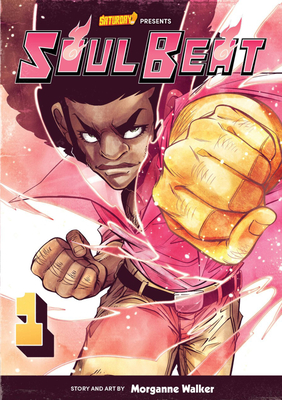
In Soul Beat, Volume 1, after a fateful encounter to save his friend, pro-boxer and 70s-loving soul brother Dante Alfonse will pursue his toughest challenge yet: defeat the Devil himself—or die trying!

Dante Alfonse is a promising boxer who’s more than capable of taking on any opponent, inside or outside of the ring. Whether it’s a bully in his neighborhood or even stopping a robbery, he’s quick to step in and hold down his city. Of course, when your name means “to endure," being an unstoppable force for good comes naturally! But sometimes, good deeds attract unwanted attention…

Such is the case when Dante tries to defend his friend and mentor, Ben, from being killed by the worst person imaginable: the Devil himself! Now targeted by the forces of evil for his interference, Dante must use the knowledge his mentor left him and hone his newfound spiritual powers, not only to save his own life but to destroy the Devil before more lives are ruined.

To his surprise, he’s not alone. A centuries-long feud between Heaven and Hell begins to surface in the Mortal World, and both sides have their reasons for wanting Dante on their side of the fight. Caught in the crossfire, he’ll have to figure out which side he’s on, uncover the truth surrounding his mentor’s mysterious past, and ultimately show the afterlife what it really means to have soul!

Soul Beat is rated T for Teen, recommended for ages 13 and up.

Saturday AM, the world’s most diverse manga-inspired comics, are now presented in a new format! Introducing Saturday AM TANKS, the new graphic novel format similar to Japanese Tankobons where we collect the global heroes and artists of Saturday AM. These handsome volumes have select color pages, revised artwork, and innovative post-credit scenes that help bring new life to our popular BIPOC, LGBTQ, and/or culturally diverse characters.

I RECEIVED A DRC FROM THE PUBLISHER VIA EDELWEISS+. THANK YOU.

My Review
: I grew up in the 70s. I don't believe in the Devil, or the christian theology it springs from. I don't like reading comics.

What the ever-lovin' hell is a four-star rating doing up there?! A black man fighting evil in the 70s is a message I'd like to amplify; a struggle against the whole world towards self-belief, ditto; stareable, emotionally charged artwork completes my trifecta of reasons. I also realize when I'm not the target audience, and judge things by a more accepting standard. No, I won't but one for myself; I *would* buy one for my (age-appropriate, thirteen up) grand.

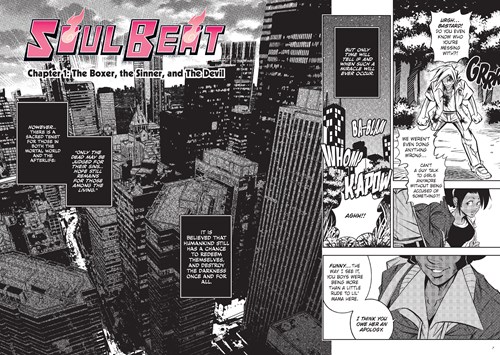
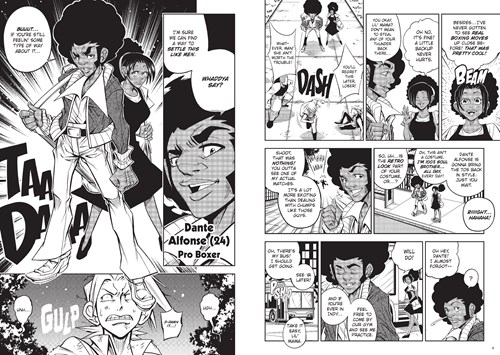
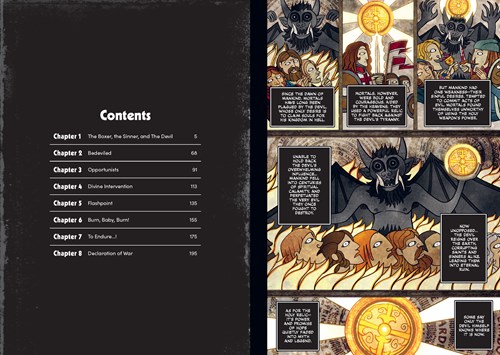
I think these three spreads will tell you what you want to know in advance of ordering a gift for the teen boy (I don't know any girls likely to enjoy this, of any age; it's violent and male-centered, so not really something I myownself would give to a girl). The message of self-belief and not listening to the naysayers is probably most well-suited to the teen boy in a social environment of deep negativity and racial prejudice.

Monday, April 8, 2024

THE HOUSE OF BEING, Poet Laureate Trethewey's entry into Yale's Why I Write series


THE HOUSE OF BEING (Why I Write series)
NATASHA TRETHEWEY
Yale University Press
$18.00 hardcover, available now

Rating: 4.8* of five

The Publisher Says: An exquisite meditation on the geographies we inherit and the metaphors we inhabit, from Pulitzer Prize winner and nineteenth U.S. poet laureate Natasha Trethewey

In a shotgun house in Gulfport, Mississippi, at the crossroads of Highway 49, the legendary highway of the Blues, and Jefferson Street, Natasha Trethewey learned to read and write. Before the land was a crossroads, however, it was a a farming settlement where, after the Civil War, a group of formerly enslaved women, men, and children made a new home.

In this intimate and searching meditation, Trethewey revisits the geography of her childhood to trace the origins of her writing life, born of the need to create new metaphors to inhabit “so that my story would not be determined for me.” She recalls the markers of history and culture that dotted the horizons of her the Confederate flags proudly flown throughout Mississippi; her gradual understanding of her own identity as the child of a Black mother and a white father; and her grandmother’s collages lining the hallway, offering glimpses of the world as it could be. With the clarity of a prophet and the grace of a poet, Trethewey offers up a vision of writing as of our own lives and the stories of the vanished, forgotten, and erased.

I RECEIVED A DRC FROM THE PUBLISHER VIA NETGALLEY. THANK YOU.

My Review
: Her mother sang her John Brown's Body as a means of soothing the Chernobyl-level burn of racism as the mixed-"race" (how I hate that we still use that horrible, divisive pseudoscientific calumny by default!) family drove past confederate battle flags! (Frequently, then, in her home state of Mississippi...it's on their state flag.) Now, how horrifying an image is that, when that damn dirge that starts with the words "John Brown's body lies a-moldering in the grave" is soothing?! This is the absolute most powerful statement of the horrors the convulsively dying Jim Crow system of the US South inflicted on people of color (another digression: This locution is deeply uncomfortable to white people like me who, in the 1960s, were loudly excoriated for calling African-Americans either "black" or "colored" in the South).

Returning to my scheduled review: Poet Trethewey was unique, then, from birth forward. She was the product of miscegenation (that horrifying term I'm glad I need to define) as her parents were not legally married in her home state until Loving v. Virginia was decided a year after she was born. Her Black matrilineal line was stuffed with women who had embodied what can only be called triumphs of the will, and all the merrier to say that when I know that this application of that phrase will horrify Nazi true believers. The influence of her poet/professor papa is no doubt there somewhere, but Poet Trethewey does not work on one cylinder, she fires on all of 'em.

I can imagine some astute observers wondering what the devil is going on here. Mudge HATES poetry! some are thinking. Some are quite correct. I loathe the experience of reading poetry the same way I loathe the experience of riding the bus. It's crammed with stuff I don't want to know about, it's uncomfortably tight to sit in and in no way offers me enough room or seats designed for my spatial dimensions, it sways and janks and judders over each crack in the road, and the air conditioning almost never works until it suddenly blasts January-on-the-Siberian-steppe gales for a few seconds.

That does not mean I am insensible to its influence on most people. I see it, I get it, I am not of that group but they are quite clearly expressing their approval. And, lest we lose sight of this, the book is Poet Trethewey's *writing about writing*; that is always interesting. As I suspect all good writing must be, the life led by the child-poet became the matter of the adult; in her experiences of racism, white supremacy, and Southern culture, she speaks with a voice that reaches deep into the National Conversation of the US as well as into the emotional cores of many, many, many people.

At under 100pp, this is an afternoon's read for me. It was a pleasure to read...if you've read Memorial Drive, her memoir, you'll know that Poet Trethewey is gifted in prose writing, and if you haven't what is wrong with you?!...and measures her life against her need to write, like a learner sounding out words in a new language. The essay is part of Yale University Press's terrific series of writerly essays. I have only one cavil to report. I felt the origin of the essay as a lecture rather more than I would have liked. I put it down to the poet's innate aurality of expression. I ended up needing to read passages aloud to understand what was being said, and that was also the only way I felt I *got* the Southernness of the Trethewey household. (This also got me very dark glowers from my roommate who is hostile to things literary.)

Hardly a sin, but for this reader a discomfort I could've done without. So can I recommend it to you? Absolutely, and I do. I think anyone interested in writers as entities who transmute life into Art, people intrigued by the shocking dichotomies of Southern culture, and women who batten on reading the success and happiness of their fellows, will all be especially gruntled. I hope men who wonder what hell the fuss about this poetry thing is will give it a read, too, as well as any and all people of color looking to gladden themselves on the success of their own.

Wednesday, February 7, 2024

MAGE OF FOOLS, SF novel by Black woman creator tha SLAPS


MAGE OF FOOLS
EUGEN BACON

Meerkat Press
$15.95 trade paper, available now

Rating: 4* of five

The Publisher Says: In the dystopian world of Mafinga, Jasmin must contend with a dictator’s sorcerer to cleanse the socialist state of its deadly pollution.

Mafinga's malevolent king dislikes books and, together with his sorcerer Atari, has collapsed the environment to almost uninhabitable. The sun has killed all the able men, including Jasmin’s husband Godi. But Jasmin has Godi’s secret story machine that tells of a better world, far different from the wastelands of Mafinga. Jasmin’s crime for possessing the machine and its forbidden literature filled with subversive text is punishable by death. Fate grants a cruel reprieve in the service of a childless queen who claims Jasmin’s children as her own. Jasmin is powerless—until she discovers secrets behind the king and his sorcerer.

I RECEIVED A DRC FROM THE PUBLISHER VIA EDELWEISS+. THANK YOU.

My Review
: Lyrical prose...maybe sometimes too lyrical for its own good...telling a tale of monopoly, abuse of power, an apartheid of haves and have-nots, that not coincidentally resembles the modern technological world metastasizing across the agrarian peasantry of Africa and keeping its fruits entirely apart from those who feed them.

The worldbuilding is *stellar*, the narrative drive does not let up, and the plot speaks to my Social Justice Warrior soul. So what happened to that fifth star, you wonder. The story is told in eight parts, each of many chapters, and in almost as many viewpoints. I get that this is a choice made to facilitate the slightly seasick sense of the story’s walled-off world, where nothing is shared, nothing is given away, and the walls that enclose you form strict limits that are transgressed at the greatest possible risk to life and limb. When we learn that technology emanates from actual aliens, it comes less as a surprise than as a peek over a wall...not, for this reader, the best way to induce full investment. The upside of the structure for me was that I was always in a state of readiness for the next shift, the next magical revelation, and the horrors that always lurk where magic and technology collide. But I was always riding along, moving forward, keeping up...never getting to know anyone well enough to feel deeply with them in their tragedies, not even Jasmin.

In a time where the tsunami of Information is drowning the wisdom and the guidance humans need by replacing stories with infotainment, this book’s lushness of both imagination and prose, its demand for you to pay attention to where you are, who is speaking to you, and what they want you to know, is very evocative. It summons darkness, it rings the feeding bell for the monsters implicit...even inherent...in totalitarian systems. Learn what those who least want you to resist least want you to know if you plan to live instead of exist.

Resistance is not, in fact, futile.

Costly. Dreadfully painful. But never futile. Villains can, and must be, fought at every level and with every atom of one’s being. The price is awful, but the price of submission is even worse.

Monday, February 5, 2024

BE NOT AFRAID OF MY BODY: A Lyrical Memoir gives us a view of life that is triple silenced, Black & queer & male


BE NOT AFRAID OF MY BODY: A Lyrical Memoir
DARIUS STEWART

Belt Publishing
$19.99 trade paper, available tomorrow

SHORTLISTED FOR THE 37TH Lambda Literary Awards for Gay Memoir.

Rating: 4.5* of five

The Publisher Says: From an exhilarating new voice, a breathtaking memoir about gay desire, Blackness, and growing up.

Darius Stewart spent his childhood in the Lonsdale projects of Knoxville, where he grew up navigating school, friendship, and his own family life in a context that often felt perilous. As we learn about his life in Tennessee—and eventually in Texas and Iowa, where he studies to become a poet—he details the obstacles to his most crucial hiding his earliest attraction to boys in his neighborhood, predatory stalkers, doomed affairs, his struggles with alcohol addiction, and his eventual diagnosis with HIV.

Through a mix of straightforward memoir, brilliantly surreal reveries, and moments of startling imagery and insight, Stewart’s explorations of love, illness, chemical dependency, desire, family, joy, shame, loneliness, and beauty coalesce into a wrenching, musical whole. A lyrical narrative reminiscent of Saeed Jones’s How We Fight for Our Lives and Kiese Laymon’s Heavy, Be Not Afraid of My Body stands as a compelling testament to growing up Black and gay in America, and to the drive in all of us to collect the fragments of our own experience and transform them into a story that does justice to all the multitudes we contain.

I RECEIVED A DRC FROM THE PUBLISHER. THANK YOU.

My Review
: Honesty, the true and fully realized kind, is often not kind to the subject or the teller. Author Stewart is fully honest in this memoir of Black male gayness.

The light it shines on himself, and Black culture’s fraught relationship with masculinity, queerness of all sorts, and what we seem unable to stop calling "race" despite the term’s horrifying baggage and unscientific pallor, is unsparing. It does no one any flattering favors to be seen in a searchlight’s beam. What Author Stewart set out to accomplish, so it seemed to me, was to make the cost of Othering...to the Othered as well as those who do the othering...personally real. Memoir only accomplishes that when it is honest and not self-serving.

The honesty about his sexual nature is both refreshing and difficult to read. The author’s Blackness was a lure and a weapon in his sexual arsenal. He details his encounters with white men who fetishized his skin color and their perceptions of who and what that meant he was. He does not fail to address the reciprocal fetishization, and honestly, so it did not come across in the reading as a scolding or a condemnation. His great anxitey about being perceived by others as effeminate, which is perceived as unforgivable in hypermasculinized Black culture, informs his sexual behavior. Being penetrated is the Ultimate Awful Sin against masculinity in US culture in general. Being penetrated by white men is the Ultimate Taboo for Black gay men. So, of course, what could possibly be more thrilling and desirable?

It should be to no one’s pearl-clutching amazement that young Darius Stewart found himself in the demimonde of social and sexual transgressors; and that he began to address the pain and self-image issues of being Other among those culturally Othered with self-medication aka drug and alcohol abuse. As is so often the case, this came with the risky sexual behavior that, in the 1990s, was almost certain to result in HIV infection. It does for Author Stewart, and while he is of the generation where HIV infection is a treatable, manageable condition and not a death sentence, it still had..and has...consequences that are unpleasant to cope with.

No part of Author Stewart’s journey was spared in his remembering eyes. He is unflinching in telling us how horrified he was to realize his undeniable gayness would not go away no matter how hard his childhood self prayed for it to. He could not pass as straight no matter how hard his teen self tried to. He was always, irreducibly, himself.

It takes a long time for that realization to become okay. More especially when even the Others your skin color places you among then Other you for your essential self, and heap hatred and abuse on you for this other Othering. It feels like no small miracle that Author Stewart chose to survive instead of taking the high-speed exit of suicide.

A deep self-reckoning like this book is, is a rare reading pleasure. I encourage all y’all not to miss this one.

Sunday, June 19, 2022

REVOLUTIONS OF ALL COLORS, bisexual love & happiness just beyond reach


REVOLUTIONS OF ALL COLORS
DEWAINE FARRIA

Syracuse University Press
$22.95 hardcover, available now

Rating: 4.25* of five

The Publisher Says: Gabriel Mathis, a twenty-three-year-old aspiring fantasy writer and reluctant Russophile, travels to Ukraine to teach English and meets the love of his life: an international arms dealer very much out of his league. Simon—a former Special Forces medic, torn over a warped sense of duty and a child he did not want—returns to the US to pursue his dream of becoming a mixed martial artist. After spending his adolescence defending his bisexuality, Michael makes his mark in New York's fashion industry while nursing resentment for a community that never accepted him.

Farria traces the lives of brothers Michael and Gabriel and their friend Simon from adolescence to their mid-twenties, through Oklahoma, Afghanistan, New York, Somalia, Ukraine, and New Orleans. Revolutions of All Colors is a brash, funny, and honest look at the evolution of characters we don't often see—black nerds and veterans bucking their community's rigid parameters of permissible expression while reconciling love of their country with the injustice of it.

At its core, this is a novel about the uniquely American dilemma of chiseling out an identity in a country still struggling to define itself.

I RECEIVED A DRC FROM THE PUBLISHER VIA EDELWEISS+. THANK YOU.

My Review
: So, what does one do with a story that sets him reeling, causes hours-long meditation breaks, and ultimately makes him want to scream in outrage? How, on each and every page, something just...beats against the inside of his skull? No, not the racism.

I'm used to stories about how hard it is to be Black, but told in the SATANIC SECOND PERSON?! Okay, okay, not *all* of it's in the Satanic Second, but more than the occasional bit it...everything from Simon's PoV. (And why doesn't Michael have a voice? The bisexual and proud of nothing man could be a novel by himself!)

Oh my stars and garters, it took a lot out of me to finish this really well-structured, emotionally resonant as only the most complete and truthful ones are, novel of three brothers. Well, two brothers and a brother-friend who's essentially raised by their father. Quite, quite fraught, these relationships...and it shows in the way the narratives are created: Simon, the outsider, gets the Satanic Second Person narrative voice, which hurts me to see or say; Gabriel (every time I read his name I hear Blow Gabriel Blow, even before...events...transpire) the direct address of first person along with his beguiling love interest the Ukrainian arms dealer; Michael...a ghost, no direct narrative. It's a complicated schema (in the literary sense) that guides the reader's perceptions and responses to each character. It also reinforces the characters' own sense of themselves, with Simon being the perpetual outsider, only addressed never addressing, and Michael the unwanted Other, something he can never forgive the world for. He opts out...bullied bisexual different lad, it's the only way he can see to make himself the center of his own story. He has to vanish himself from the world he came from to present himself in his new milieu of the fashion and beauty industry. And how perfect is that, I ask you....

So the burden of this refrain is that fathering isn't parenting, and mothering can only get a boy so far. The people in your life, all of them, are part of your coming-to-be process for better or worse, and they're there because they could be, chose to be, and chose you. Again, for better or for worse. Simon, whose wildness is more a cosmic scream of agony, never stops, rarely slows, and always disappoints. Hey, it's an identity...and Michael, whose fade-away was so much less theatrical than Simon's, is the one who calls him to account. When their father, their shared father, dies, as we know our elders must, it's bog-standard typical of Simon that he doesn't show for the funeral of this man whose presence in his life was an anchor, a stability that he had to reject to bring into the open the rejection he feels he must deserve. "He was your father too. Closest thing you had. But fatherhood doesn’t mean shit to you, does it?" says Michael, invisible gone-away Michael, to him, hitting the one sore spot that only your real family can reach.

The blow lands; the wound is mortal; but to what, remains the question.

The read is part of the Syracuse University program called the "Veterans Writing Award sponsored by the Institute for Veterans and Military Families and Syracuse University Press." Longer-term readers will remember my review of Thomas Bardenwerper's Mona Passage, also a winner of this prize, and see the thread that connects them: I like reading about people not like me, and not like me in positive, interesting ways. Author Farria writes as a veteran (as I am not) and about bisexual Black men, absolute hen's teeth in the QUILTBAG representation algorithm. Bisexual when unmodified by "man/male/men" is now meant to be read as "woman." Or so it seems in the marketing done to the QUILTBAGgers. I am all for that changing to include the bisexual men of our various overlapping communities.

What made this novel such a good read for me was that acknowledgment that we, the QUILTBAG folk, exist in all families, take up space that we deserve and we are entitled to, and that goes for every family everywhere. It's telling that Michael's bullying drives him away; it's telling that he is the only one to have the standing to call out Simon, the man mired in a sense of himself as unworthy, because Michael has been sent that message as well. It's the way Author Farria makes all those pieces come together that gives me such a vivid and personal sense of this read's message of inclusiveness. It's a screwed up family that produced Simon, Michael, and Gabriel, but it's a family and it is a powerful one to make men whose monstrous sadness and pain didn't destroy them. Take a minute...think about your own life...what were the before-and-afters there? These three men, brothers, are bound by that before-and-after that came long before the showy, flashy one.

Definitely a talented writer's first novel. May many more follow it.

Monday, July 12, 2021

GIVE MY LOVE TO THE SAVAGES, stories in the key of Black (fantasy) life


GIVE MY LOVE TO THE SAVAGES: Stories
CHRIS STUCK

Amistad Books
$25.99 hardcover, available now

FINALIST FOR THE PEN/Robert W. Bingham Prize for Debut Short Story Collection! Winners announced on 28 February 2022.

Rating: 4* of five

The Publisher Says: A provocative and raw debut collection of short fiction reminiscent of Junot Diaz’s Drown.

A Black man’s life, told in scenes—through every time he’s been called nigger. A Black son who visits his estranged white father in Los Angeles just as the ’92 riots begin. A Black Republican, coping with a skin disease that has turned him white, is forced to reconsider his life. A young Black man, fetishized by an older white woman he’s just met, is offered a strange and tempting proposal.

The nine tales in Give My Love to the Savages illuminate the multifaceted Black experience, exploring the thorny intersections of race, identity, and Black life through an extraordinary cast of characters. From the absurd to the starkly realistic, these stories take aim at the ironies and contradictions of the American racial experience. Chris Stuck traverses the dividing lines, and attempts to create meaning from them in unique and unusual ways. Each story considers a marker of our current culture, from uprisings and sly and not-so-sly racism, to Black fetishization and conservatism, to the obstacles placed in front of Black masculinity and Black and interracial relationships by society and circumstance.

Setting these stories across America, from Los Angeles, Phoenix and the Pacific Northwest, to New York and Washington, DC, to the suburbs and small Midwestern towns, Stuck uses place to expose the absurdity of race and the odd ways that Black people and white people converge and retreat, rub against and bump into one another.

Ultimately, Give My Love to the Savages is the story of America. With biting humor and careful honesty, Stuck riffs on the dichotomy of love and barbarity—the yin and yang of racial experience—and the difficult and uncertain terrain Black Americans must navigate in pursuit of their desires.

I RECEIVED A DRC FROM THE PUBLISHER VIA NETGALLEY. THANK YOU.

My Review
: I seriously doubted that I'd get deeply enmeshed in this book because Race. Such a stupid, racist thought...and so untrue in the end. I feel vindicated in continuing to prosecute my ongoing battle against the ossification of my brain. Why, I even read another YA book recently and y'all *know* how much I don't like teenagers. Even gay ones.

But this collection, now, this is the stuff I think I'll find every time I try something fresh. I am so often disappointed...not always the author's fault...that, when I find writers like Author Stuck I'm a little wary. "Is this the only one? Can and/or will he do more, get even better?" I'm hoping he can, and will, because a writer who looks at the world from his oddball angle is a deep pleasure to read.

I will, by long-established custom, use the Bryce Method of short, separate impressions and distinct individual ratings for the stories to come to a gestalt understanding of this debut collection.

Every Time They Call You Nigger uses the Satanic Second (person) for a chest-pokey yuck-ptui feel. Still:
"You like this because you now know the difference between Black people and niggas,the difference between niggers and niggas. You think you're a Jedi in understanding the code. Though you walk through the valley of the shadow of race, you will fear no evil."

But you will fear The Void...adulthood, with its hostages to fortune, comes to us all and gives us perspectives we never expected to get. We're all going to be in the struggle to make a future we can stand to leave behind. 4 stars

How to Be A Dick in the Twenty-First Century presents Richard Dickerson, fifty-something bald five-six Black billionaire, as his apotheosis into Dickhood is attained:
No matter the season, my entire body was always aroused, itchy, throbbing. That was my mentality, too. The testosterone, it was how I got ahead, my assertiveness, my swagger. As a man, it was expected of me. As a Black man, it was required.

This satirical take on end-stage capitalism via "Metamorphosis" made me chuckle a lot. No matter what one tries, has done or does, the fact is you're always you. For better or worse. 4.5 stars

Lake No Negro takes polyamory to the weird, domestic-drama cleaners...Andre's got a lot to prove, Tanya's got nothing to lose. The Senior Moments in that ménage are about to get dramatically more Fraught. Kind of fun...pretty seriously slight. 3 stars

And Then There Were the Norrises contains the multitudes of a gay twelve-year-old kid (called "Chuck" for fuck sake!) in WITSEC with a depressingly dysfunctional pair of "parents" and a bad habit of being way, way too smart:
By then, my mother was the only one in the family who would speak to me in civil tones. At dinner that night, she asked if I'd met anyone at school. Before I could answer, my older sister, Trudy, muttered, "highly unlikely, Mother," in her little look-at-me, I-suddenly-have-boobs way.

But in fact, and not for the first time, Love blooms with a low-class no-count white kid named Sterling Silver. Who probably saved the kid's life by introducing him to normal-boy shit. When you're twelve, three months changes the world. Sad, also really funny, and very, very 1980s. 4 stars

Cowboys doesn't make you long for the Good Old Days of being midtwenties and middlin' stupid on the sauce. But gettin' a job at the Waxsonian Museum, owned by Dick Doberman the Vietnamese refugee made good enough to keep the doors of the place open? THEN, listen to this!, THEN lettin' your loser cracker co-worker talk you into helping his brother the bail bondsman collar a skiptrace wanted for felony grand theft...yeah. That's where we're headed. Funny, grisly, just stinkin' awful. 4 stars

Chuck and Tina Go On Vacation doesn't break new ground, but does remind us that we're all alive even when we're not Living.
Chuck hit the Book It Now button and saw the final price. Really, it wasn't that bad. But all he could think was their next credit card bill, and their student loans. Their balances were up there, a frothy wave of already-spent cash cresting over their heads.

It's just that there's no way to keep score, they aren't tethered to any one or thing, not even each other really...when Chuck gets so sick he longs for death and Tina gets so high she can't remember why she cared what anyone thought (but don't tell Chuck!) they still fail to be together. Not even when their social-media lameness results in a back-home disaster. It's like Marla, Tina's "friend" says after scoffing at her tears: "Girl, this is New York. Either move or stop crying." This is not Tina's world, and Chuck doesn't even belong in this one still less the one she belongs in...in her dreams. 4 stars because it's The Little Horses of Tarquinia only Black and in Mexico.

This Isn't Music uses the Satanic Second again, gawd how I hate having my chest poked! and also gets Nick and Lily to cross several Black-plus-white lines...he says he's her Mandingo! And she doesn't file for divorce from her phone!...and then they relapse into intimate apathy with his dementia-addled father. Or they will, you can bet, after he sorta-kinda ends his, what is it?, not so much affair as too-good-friendship with fellow white-on-Black sufferer Billie. Whose white is Tyrone (not Black, Irish!), who doesn't want to fuck anymore because...well, if what happened to him had happened to me I'd never so much as undress in front of anyone ever again. And still...there's the Big Nothing at the center of this Life that barely feels alive inside, "Know this: No matter how much you hate it, this is your life," Nick. I was enrapt. I read bits to my Young (mixed race) Gentleman Caller, and watched him furrow his brow.... 4.5 stars

The Life and Loves of Melvin J. Plump, Esq. showed me my ugliest self, and my worst self, but by gawd I will be damned if I'll be identified with a rotten-souled Repulsivecan!
{The therapist} deflated with one of her nose-whistling sighs. "And just what kind of people are they?"
"You know, sun visors and fanny packs, socks and sandals. The true soul of America."
–and–
The vessel was Vegas and the Mall of America but with a rudder and lifeboats. And I kept wondering how the behemoth didn't sink.

(I myownself quietly wondered "why" as well....) See? That's how these stories get to you. Sneakily. With stealth. In pieces and by increments. 5 stars

Give My Love to the Savages means, basically, exactly what you think it should mean. Junie, a twenty-year-old slacker without any discernible sense of self-worth, comes to Los Angeles to spend spring break with his shyster father, the used-car magnate. The catch is, it's the Rodney King Uprising of 1992 and there is a giant fire taking the space LA usually leaves for its nasty racism.

As an interracial-marriage kid, he's got no fixed identity and the Great Urge Downward to atone for the rotten hate crime he did nothing to stop. His white father, a narcissistic user, accidentally...irresponsibly...puts him in the right place to really hit the loud pedal on his psycho-social slide. 4 stars

Maybe it's the fact that I knew his editor long, long ago (hi Tracy!); maybe it's my inability to pass up writers whose taste and talent is for grit lit, Negro Noir, the potholes-and-passions writers...this is a debut I really want to see get more book-siblings.
Saturday, May 15, 2021

A RIVER CALLED TIME, slow and inexorable and deep...but not a good trip

A RIVER CALLED TIME
COURTTIA NEWLAND

Akashic Books
$28.95 hardcover, available now

SHORTLISTED for the 2022 Arthur C. Clarke Award! Winner announced 26 October 2022.

Rating: 3.5* of five

The Publisher Says: A monumental speculative fiction story of love, loyalty, politics and conscience set in parallel Londons

The Ark was built to save the lives of the many, but rapidly became a refuge for the elite, the entrance closed without warning.
Years after the Ark was cut off from the world, a chance of survival within its confines is granted to a select few who can prove their worth. Among their number is Markriss Denny, whose path to future excellence is marred only by a closely guarded secret: without warning, his spirit leaves his body, allowing him to see and experience a world far beyond his physical limitations.

Once inside the Ark, Denny learns of another with the same power, whose existence could spell catastrophe for humanity. He is forced into a desperate race to understand his abilities, and in doing so uncovers the truth about the Ark, himself and the people he thought he once knew.

I RECEIVED A DRC FROM THE PUBLISHER VIA EDELWEISS+. THANK YOU.

My Review
: Author Newland is definitely a Writer. There is a gravitas to the ways he expresses his ideas, a fullness to the meanings of his phrases in their context. For the first third of this book, I thought I was looking at four, four and a half if he got the lead out and pushed the story along faster, stars. The idea of a man who can travel across the multiverse...African cosmology the dominant spirituality...decolonizing reality! I am down. But then the cracks appeared.

It is awful to write this: After working on this amazing, delightful idea for twenty years, Author Newland gave us half a great book.

The Ark, a domed city, isn't the amazing thought that the author appears to think it is. The image of the Insider/Outsider trope is very well-worn a path to walk. The ghettoized lower class, the generational wealth transfers that absolutely determines the lifestyle you and your descendents will have, the self-sacrificing mother who expects her child to support her when he gets inside...these aren't new. The truth is that the author's writing career has not been in the genres of sci fi, fantasy, or alternate history (is it a genre or a setting? I won't wade into that here), so what feels of itself fresh to him is bog-standard stuff to old genre hands. What *is* fresh and cool and amazing is the worlds he sends his main character to, and it is those Author Newland isn't giving us enough of.

The alternate, uncolonized world that our hero travels to is fascinating. The continent of Africa has so very many indigenous relgions and spiritual traditions...how wonderful to have them foregrounded for once. But the author's choices of spiritual traditions represented didn't feel in any way organic to his main character. That meant the points of divergence between his character's home timeline and the one he travels to aren't as clear to me as a reader. The astral travel factor can be blamed for part of it. Is it technological, spiritual, either, both? Why? This fuzziness kept my focus diffuse. I think it kept his focus diffuse, too. His admirable inclusiveness leads to too many faces and each with too little time to make the experience as enfolding as it could, and should, have been.

I am able to slide past most of that, getting into a four-star mindset, when sexual violence against a woman is used to motivate a man into action. And the perpetrator suffers no consequences. And the main character? All but shrugs as he moves on with his life.

Fiction reflecting the ills of society back to us should not, in my view, continue to use outdated and harmful tropes unaltered. It isn't the author's best choice, and that along with other areas of niggling dissatisfaction brought me down to three and a half stars where I'd badly wanted to give four.

It's a shame. I hope you'll take the book out of the library at some point, give it your time and attention. I'd love to know if others feel my criticisms are misplaced or too harsh.

Tuesday, May 11, 2021

A MASTER OF DJINN, first full-length Dead-Djinn-verse novel


A MASTER OF DJINN
P. DJÈLÍ CLARK
(Dead Djinn Universe #1)
Tor.com Publishing
$18.99 trade paper, available now

WINNER OF THE 57th ANNUAL NEBULA AWARD—BEST NOVEL!

WINNER OF THE 2022 LOCUS AWARD—BEST FIRST NOVEL! Watch the award ceremony here.

WINNER OF THE 2022 IGNYTE AWARD FOR BEST NOVEL!

A BOOKRIOT BEST BOOK OF 2021!

A NEW YORK PUBLIC LIBRARY 2021 BEST BOOK FOR ADULTS RECOMMENDATION!

Enjoyable author interview at BookPage!

WINNER OF THE 57th ANNUAL NEBULA AWARD—BEST NOVEL! Winners announced 21 May 2022 at the Online Nebula Conference awards ceremony.

Rating: 4* of five

The Publisher Says: Nebula, Locus, and Alex Award-winner P. Djèlí Clark returns to his popular alternate Cairo universe for his fantasy novel debut, A Master of Djinn And read Arley Sorg's interview with Author Clark!

Cairo, 1912: Though Fatma el-Sha’arawi is the youngest woman working for the Ministry of Alchemy, Enchantments and Supernatural Entities, she’s certainly not a rookie, especially after preventing the destruction of the universe last summer.

So when someone murders a secret brotherhood dedicated to one of the most famous men in history, al-Jahiz, Agent Fatma is called onto the case. Al-Jahiz transformed the world 50 years ago when he opened up the veil between the magical and mundane realms, before vanishing into the unknown. This murderer claims to be al-Jahiz, returned to condemn the modern age for its social oppressions. His dangerous magical abilities instigate unrest in the streets of Cairo that threaten to spill over onto the global stage.

Alongside her Ministry colleagues and her clever girlfriend Siti, Agent Fatma must unravel the mystery behind this imposter to restore peace to the city - or face the possibility he could be exactly who he seems....

I RECEIVED A DRC FROM THE PUBLISHER VIA NETGALLEY. THANK YOU.

My Review
: Let's just get that missing star dealt with: Ten w-bombs. Normally that's a whole star gone, but it's only a half here. It was "I feel a villain rant coming on" and "Sniffing a sharp nose, he made a bitter face" and Sobek, bless his scaly hide and hungry jaws, that made me think twice. Then the mechanical eunuchs, the Ministry's Brain, the wonderful inventive world that I am invited to share...despite being spat upon with disrespectful w-verbing...okay.

There are really terrific lines. There are Zack-Snyder-meets-Michael-Bay battle scenes. There is a majgicqk system that is more fun than three dozen djinn in a jar. The Ifrit Kings! What a gorgeous scene that will be in the film!

As I suspect y'all who haven't yet read the book are beginning to gather, this was a hit with me.

Fatma and Hadia, her new Modern Woman partner from Alexandria, are the ladies from the Ministry of Alchemy, Enchantments and Supernatural Entities. Because, you see, the world has majgickq in it again since al-Hafiz, who pierced the interdimensional boundaries and allowed the Earth's myriad supernatural creatures, and the anti-physics the can wield, tore a hole in the Kaf (a mountain). I'd like, at this point, to recommend that anyone who hasn't read the novellas and short story I've reviewed here (the first two tales) and here (third tale) in that order. Two are free to read online, and the third is $3.99 on Kindle or other ereader.

The best thing about blogging is I now don't have to worry about spoilers anymore, if you're still here and not heeding my recommendation to seek out the rest of the world-building bits of the story in order, it's not my problem! A magazine site would insist that I consider the spoilerphobic soul's delicate eyestalks. I won't spoil what I consider the bits that make the trip worth taking.

And that is a lot. There are so many things I absolutely felt as though I'd *combust* if I didn't have someone to talk about them to! But it really isn't fair to say what happened on the palace roof until you've been there.

So here's the stuff I want to let everyone know.

Author Clark built this Cairo on a fascinating premise. He has already pulled magjiqck back to Earth. But he's also pulled a Cairene industrial revolution, a social ferment with workers' and women's rights being openly debated, a world with European colonialism on the run, and a lesbian couple leading us through the whole minefield of issues...and no one thinks much of it...into being. But Author Clark still manages to pack a gigantically important coming-out scene into the proceedings, one that explains little mysteries from the past and makes certain events in the future a lot less deus ex machina-y. This is some busy worldbuilding.

The colonialism-on-the-run part comes as a result of al-Hafiz chosing to restore magjiqck in Cairo itself. In doing so, he takes the former Ottoman colony of Egypt out of the British and the Turkish spheres. It is accomplished in 1872, which history buffs will recall as a difficult time in Egypt and Sudan...the Mahdi arose to lead resistance to both the Khedive and the British, whose combined efforts were destabilizing the local economy and religious issues were bubbling away. So here, we have instead fictional al-Hafiz guiding the world in a different direction but with many, many more times the power and success in re-ordering the system of the world compared to the factual resistance leader.

Also about that time, Napoleon III of France was defeated by the Prussians in a *nasty* war; the German Empire was whomped up in place of the Kingdom of Prussia; there was an organized independence movement called the Indian National Congress founded in 1885; and a little thing called the Berlin Conference was held to divide up Africa into "zones of influence." This alternate timeline, Author Clark has the latter conference take place but as a planning session to stop the African and Arabian djinn and other creatures from defeating the colonizers. (It does not work, as we see; nor in largely decolonized alternate India, either.) So a time of restless ferment is co-opted by the returned supernaturals to upset the world you and I live in!

All is not paradisical. We're treated to much glancing contact with German goblins (predictably revoltingly racist), among other different national supernaturals, as they exert some difficult to ignore pressure on Humankind's affairs. This happens at the Egyptian King's peace summit, the reason this particular story is happening. There is mounting pressure for war in Europe, and Egypt (a neutral country interested in peace so its magical industries can make and sell goods) wants to see if it can be averted. The other organizer of the summit is a crackpot Englishman, third son of a Duke, who lives in Cairo because he's besotted by magjiqck and also wants the world to remain at peace so we can all Learn To Be Better. *snort* It is his murder that begins the destabilization of Cairo that Fatma and the Ministry must fight.

As the summit approaches, al-Hafiz...gone from this plane since 1872...suddenly returns! And is inexplicably trying to bollix things up so the peace summit turns into a war congress. All of this in Cairo and under the noses of the Ministry of Alchemy, Enchantments and Supernatural Entities. Since al-Hafiz is...gone, dead, translated...they call his recrudescence "the Impostor" and set about doing the usual police-y things to stop him from spreading unrest while world leaders are in Cairo.

I really must take just a moment to cough into my hanky about the fact that Kaiser Wilhelm II is at this conference in person and seemingly without his factual badly damaged arm. President Poincaré of France is there, too. No mention of Franz Joseph of Austria-Hungary, and the Turkish Sultan is effectively hiding behind the Kaiser's coattails...we have no American President Taft? But anyway...the house is full and al-Hafiz treats us to a truly exciting scene as he appears among the leaders! The beauty of that scene is the realism of a determined saboteur merely needing to bring up impolitic realities to threaten world peace.

It's stuff like this that makes me croon in delight. I appreciate the grace notes...a city full of leaders with a revolutionary stalking the streets and rousing up the impoverished! But we don't stop there, we get a battle scene before and a fight scene during. Yes, Author Clark knows how to make the adrenaline users buy right on in to his story.

And since we're packing in action, let's not forget that the Ministry has a lot to do to make the leaders safe and clean up this unsettled political landscape! We have Zagros back, the Ministry's Marîd librarian; we have the Angels in their bureaucratic collective glory back; we have Fatma learning how to trust her new partner Hadia; we re-meet Aasim and Hamed and Onsi. There is a gigantic battle about every thirty or so pages. Lots of property damage. Many problems with identifying the imposter al-Hafiz, learning the hows and whys of the magic that makes him appear invincible.

It's all very clever, but it's not all the same story.

And that's why this is a four-star, not a four-and-a-half star, review. Author Clark has written, until now, novellas, novelettes, and short stories in this universe. I think the story he wants to tell here, and I haven't even made much of the ripening and deepening of Fatma's love affair with Siti-Abla (no explanation is ever given for the woman's having two different names, though there is a really obvious one that goes unused), needed a novel's length to make it work. My issue is that his heroic efforts couldn't keep all the balls in the air at the same time.

It's still a fun and often funny read (see my first sentence for examples). But when Fatma the investigator actually has interviewees telling her where to go next...when Hadia the new partner is simultaneously dumped when things get violent then forgotten for a chapter or two when interviewing is taking place...when the djinn, the Ifrits, the Janns, and the ghuls, the nasnas, are reduced to quick, broad strokes because honestly there isn't time to do more...there needed to be a more unforgiving editorial stance taken. Do more to build Zagros and the other major djinn Siwa, or reduce them to one-hit and gone props. The ghuls are supernumeraries, so I'm not clear why the kind of ghul al-Hafiz summoned was different from the rest; was that necessary? It doesn't seem so to me.

But I'm disinclined to keep star-breaking because, when I realized the perpetrator's silhouette was very quietly limned against a shadow just in slightly darker colors, I was very pleased at the effect's subtlety. The identity of al-Hafiz's faker was satisfying because it wasn't trumpeted but was made clear to the attentive. The developments between Fatma and Siti need to continue, of course, but the main areas of conflict are starkly present as of now. Hadia is someone I think Author Clark wanted to be more in touch with, so to speak, but the over-stuffed yet under-baked plot wasn't allowing that. Future books will, I trust, give him room to make her more than a hijab with martial arts skills (though that is pretty awesome as a start).

I like this world; I like this book; I like what I see as the possibilities and energy in Author Clark's writing. As first novels go, this one is superior in conception and execution to most, and in genre terms displays the bravado and chutzpah that augur well for more and better to come.

Monday, May 10, 2021

A DEAD DJINN IN CAIRO, first in the Dead Djinn Universe stories, and THE ANGEL OF KHAN EL-KHALILI, second short story in the series

A DEAD DJINN IN CAIRO
P. DJÈLÍ CLARK
(Dead Djinn Universe #0.5) And read Arley Sorg's interview with Author Clark!
Tor.com
FREE online read!

Rating: 3.5* of five

The Publisher Says: Egypt, 1912. In an alternate Cairo infused with the otherworldly, the Ministry of Alchemy, Enchantments and Supernatural Entities investigate disturbances between the mortal and the (possibly) divine. What starts off as an odd suicide case for Special Investigator Fatma el-Sha’arawi leads her through the city’s underbelly as she encounters rampaging ghouls, saucy assassins, clockwork angels, and plot that could unravel time itself.

My Review: In honor of the publication tomorrow of the first full-length novel in Author Phenderson Djèlí Clark's Majgickqal-Cairo steampunk series, as well as his publishing career, let's revisit the place it all began.

Fatma of the Ministry of Alchemy, Enchantments and Supernatural Entities, and Aasim, the Cairo policeman, are two of the series' through-line characters. They, and the utterly transformed-by-magic Cairo they live in, are introduced in this little gem of a procedural tale.
Fatma sat back in a red-cushioned seat as the automated wheeled carriage plowed along the narrow streets. Most of Cairo slept, except for the glow of a gaslight market or the pinprick lights of towering mooring masts where airships came and went by the hour. Her fingers played with her cane’s lion-headed pommel, watching aerial trams that moved high above the city, crackling electricity illuminating the night along their lines. Their carriage passed a lone man in a rickety donkey cart. He drove his beast at a slow trot, as if in defiance of the modernity that surrounded him.

“Another damned ghul attack!” Aasim exclaimed. He sat opposite her, reading over several cables. “That’s odd. They didn’t kill anyone—they took them. Snatched them and ran right off.”

Fatma looked up. That was odd. Ghuls fed on the living. Their victims were usually found half-devoured. They weren’t in the habit of stealing people.

Now, the scene and the stakes are set: These two are working on more than one case, like law enforcement everywhere, but they are clearly up to their necks in a very different place from where thee and me live. And, it turns out, this is *exactly* what I've been waiting for!

Beneath the tree, a tall figure inspected a curious structure of overlapping gear wheels—some massive, others small and delicate as a coin. Each had been cut with precision, so that their teeth meshed seamlessly together. Their surfaces were engraved with metal script, some she knew to be numerals. At their arrival, the tall figure broke from his inspection and turned about.

With effort, Fatma suppressed a gasp similar to the one that escaped Aasim’s lips. It was always an odd thing to be in the presence of an angel—or at least the beings that claimed to be so.

They had appeared after the djinn, suddenly and without warning. Considerable debate was expended on affirming their identity. The Coptic Church argued that they could not be angels, for all such divinities resided in heaven with God. The Ulama similarly asserted that true angels had no free will, and could not have simply come here of their own volition. Both issued cautious statements naming them, at the least, “otherworldly entities.” The self-proclaimed angels were silent on the matter—validating no particulars of either faith, and remaining enigmatic regarding their motives.

It's this kind of enough-but-not-too-much detail that is what makes Author Clark's writing work for me. This first-in-series story, nominated for a 2017 Locus Award for Best Novelette, convinced me to get as much of this Universe as I could as fast as I could; now my patience (enforced, but it still counts) is at last rewarded.

+++++++++++++++++++++++++++++++++++++++++++++++++++++++++++++++++

THE ANGEL OF KHAN EL-KHALILI
P. DJÈLÍ CLARK
(Dead Djinn Universe #0.6)
Tor.com
FREE online read!

Rating: 3.5* of five

The Publisher Says: We are overjoyed to be reprinting “The Angel of Khan el-Khalili” by P. Djèlí Clark, set in the same world as A Master of Djinn, out on May 11!

The story first appeared in the anthology Clockwork Cairo: Steampunk Tales of Egypt, edited by Matthew Bright and published by Twopenny Press.

My Review: This meditation on the price of Truth and the unlikelihood of Honesty being its own reward is told in the second person. This is, I need not tell anyone of my acquaintance, a Literary Original Sin and usually causes me to slam covers and jab power buttons with disgust and outrage.

Author Clark, somehow, is immune to this inflexible rule being applied to him. In fact, these beahviors didn't so much as occur to me. After reading the very, very moreish A Dead Djinn in Cairo, and realizing that I would get some more background on the Angels introduced in that novelette I simply soldiered on into this short story. And look what rewarded me almost at once:
Angels arrived in Cairo some forty years past. Your parents had been children then, but they still tell you stories of al-Jahiz—the disappeared Soudanese mystic, scientist, madman—whose fantastic machines had sent magic pouring into the world with the force of an unstoppered sea.

I absolutely love this world. I am besotted with its clockwork boilerplate eunuchs (robots to thee and me), I am fascinated at the setting of Cairo, that most astonishing of cities with its shocking heat, its soft light, and its myriad of people all of whom seem to have a pack of Gauloises secreted on them somewhere. I even like its magjicqk system! Djinns and ifrits and Marîds and ghuls...turns out maybe what I've been allergic to all these years might not be majgiqck per se but just be the samey Tolkieny elves and fae and stuff.

So after meeting the Angel in the first story, I was really ready for this expansion of my knowledge about them in the contect of this glorious new Universe. I did get some satisfaction:
But angels are another matter. They are rarer things, ethereal beings who shroud their bodies behind contraptions of mechanical grandeur and hold themselves apart from mortals and djinn alike. None, not even the religious bodies of Cairo, have been able to discern the reason for their coming. And they have remained equally enigmatic.

But this is a short story. It's hard for me to get more than a partial lock on what the heck's going on and who will be repeating in the series from such a condensed dosage. The enigma of Angels is ongoing here and, well, like second-person allergy, I will just have to get over my greed for more until it's Author Clark's desire to give it to me.

None of the characters in this short piece appear to recur in the novel. It's not like that's a bad thing; I'm accustomed to being a little more fully knitted into the fabric of a series, though. What does happen here is the Universe expands its spiritual borders in an anti-capitalist direction, and that's just hunky-dory by me! Poor little Aliaa, the seeker of a miracle from Seeker the Angel, has a sister in dire, dire straits. The poor thing is dying of burns she got saving other workers from a fire that broke out in the dress facotry where she works. With, in fact, her fifteen-year-old sister Aliaa.

Shades of the Triangle Shirtwaist Factory fire. And, not coincidentally, Tor.com's 2014 Hugo-nominated novella Burning Girls, which I rated quite highly. That tragedy is intensely relevant again in this day and time, as workers' rights and voters' rights and the simple right of nonwhite persons to exist unmolested in the US are under active attack from the scum on the political right again. Still. Still and again.

And I can honestly, unreservedly say to you that second-person narration, majgiqck that works, and deeply, deeply painful life lessons for a teenaged protagonist...as fat a lump of Mudge-kryptonite as you can imagine, in other words...does not matter to my pleasure in this compact read. It's free. Give it a whirl. Then go read my review of The Haunting of Tram Car 015, a very, very funny and very wickedly pointed expansion of Hamed and Onsi's roles in the ongoing series.

Tuesday, October 20, 2020

THE HAUNTING OF TRAM CAR 015, a delightful if short hit of an alternate steampunk Cairo...with Djinn!

THE HAUNTING OF TRAM CAR 015
P. DJÈLÍ CLARK
(Dead Djinn Universe #0.7)
Tor.com Publishing
$3.99 ebook editions, available now

Rating: 4* of five

The Publisher Says: The Haunting of Tram Car 015 returns to the alternate Cairo of Clark’s short fiction, where humans live and work alongside otherworldly beings; the Ministry of Alchemy, Enchantments and Supernatural Entities handles the issues that can arise between the magical and the mundane. Senior Agent Hamed al-Nasr shows his new partner Agent Onsi the ropes of investigation when they are called to subdue a dangerous, possessed tram car. What starts off as a simple matter of exorcism, however, becomes more complicated as the origins of the demon inside are revealed.

I RECEIVED A DRC OF THIS TITLE FROM TOR.COM FOR REVIEW.

My Review
: When I asked for more after reading A Dead Djinn in Cairo, I sorta-kinda vaguely hoped that there would, one day, maybe be more. Then this book came out. It doesn't feature Fatma as the main Ministry of Alchemy, Enchantments and Supernatural Entities agent on the case, but Hamed and Onsi grew on me fast. And, of course, the inclusion of Siti was welcome as it assured me this was well and truly part of a Cairo I absolutely believe is real and wish to emigrate to now, please.

Ahem.

And now there's a lovely new title, A Master of Djinn, coming on 11 May 2021! In fact, we'll get Fatma and Siti back at the center of the doings, so all will be extra-special right with my reading world.

This story, of a spirit entity (NOT like a Djinn, as Zagros the Ministry's librarian Djinn bristles at Hamed) called an "al" (plural "alk") that's arrived from Armenia to ply its evil, baby-stealing ways; it involves graft (a Transportation ministry bureaucrat doing what he didn't oughta), confusion (Hamed seeking help from a sheika and a sexy transgender Djinn to perform a Zal exorcism-y thing), and a lot of humility instead of humiliation. Hamed and Onsi do a deeply shocking thing to slip past the al's nervous vigilance, something their patriarchal upbringings wouldn't find agreeable, but to them it's far superior a choice than failing to protect Cairo's mothers.

There are scenes of action with the men pursuing the al, there are scenes of fun, deep brain-work where the author gets to infodump you about this delicious anti-colonial alternate history without feeling like it's him forcing you to eat your spinach, and there's a beautifully queer undertone to the proceedings that agrees with me. If you know it won't agree with you, skip on.

Now, it's clear that I love this world. Anyone who has read my deep and caustic growls about majgickq in my alt-hist will even now be sharpening their quill to jab out a "GOTCHA!!" message. This series has majgicqk in it, yes; the magjicqk is integral to the action, yes; and no, I am not fleeing at top speed. So before the ringing cries of "hypocrite!" begin their rise from ill-mannered and poorly bred peoples' keyboards, listen up: I'm not interested in medieval-Europe-with-monsters, WWII-with-werewolves/aliens, or their like. Tired of those stories. Cultures not European? You interest me strangely, Tale-spinner, come and say on.

I wouldn't say you should read this book first, but definitely before the new one comes out. And definitely read it. I know it's a quick hit, and it's hard to invest in something this concentrated when you wonder if you can come home again. Now you know you can, indulge! (But be alert for the one, and only one, w-bomb.)