Showing posts with label coming to terms. Show all posts

Monday, January 12, 2026

JEAN, adolescent heartbreak made tougher by class divide


JEAN
MADELEINE DUNNIGAN

W.W. Norton (non-affiliate Bookshop.org link)
$28.99 all editions, available now

Rating: 4* of five

The Publisher Says: Seventeen–year–old Jean, a troubled Jewish boy caught in the countercultural swirl of 1970s London, arrives at Compton Manor, a rural alternative boarding school for boys with “problems.” Though he is an outcast among these outcasts, he is befriended by Tom, a much wealthier, more popular classmate, and it seems as if Jean’s world might change.

When things turn romantic, Jean is tipped into a heady, overwhelming infatuation. What before seemed odd now brims with promise—the compulsory farming at school, reading poetry aloud, pagan ritual—and Jean thinks he might even pass his exams. But the differences between Tom and Jean—Tom is tuition–paying, Jean is on a scholarship; Tom social, Jean reclusive—create too wide a chasm to cross.

Set over one hot summer, Jean is a startlingly assured debut about the kinds of love that break us and make us whole.

I RECEIVED A DRC FROM THE PUBLISHER VIA NETGALLEY. THANK YOU.

My Review
: Choosing not to use conventional punctuation is the root of many novelists' downfall. As a debut novelist, Author Dunnigan set herself this monumental task, on top of several other monumental tasks in telling the story of a young Queer boy coming alive to sex and sexuality in a highly specific milieu. It is an uneven success at them all. The least successful is the sense of place; it's 1976 in London, but if you want to be transported to 1976 London, this is not your best choice of a read.

Jean is a scholarship boy in a behavioral-problem-student boarding school. It's a sketched in place, apart from some unpleasantly graphic dealings with animals dead and alive. Those are extremely particular environments; with a reader's expectations set on feeling immersed in the world they're not successful. I can't say I was ever more than tangentially aware of the environment. It is not described or, better still, evoked. It's stated this is where the action takes place. It works against the sense of place for the characters, teen boys mind you, to wander around in time as the narrative continues. This is how an older person experiences time...this connects to *that* and whatever happened to him anyway but this jerk can't cut in line! No! get back to your place while I find my damn wallet again did I leave it on the counter? oh good there it is.

Teenagers aren't prone to this yet, every moment is real! alive! pulsing with possibility! especially when you're newly In Love with the most gorgeous exciting amazing boy on the planet who has the sexiest...oh my he's hot. What this does give the reader is the World of Jean, all third person, all interior, all solipsistic as a boy usually is.

Punctuation keeps the stream of consciousness from bursting the banks and making a mess. This story is the mess that punctuation and dialogue tags prevent. It's not bad, as in not incompetent in any way. It's just more work than it needs to be to pick the threads of doomed adolescent heartbreak out of the verbs. As a superannuated version of Jean, I can say Author Dunnigan's chosen a strangely indirect way to deal with adolescent male libido by distancing the reader from it in this stream of consciousness. It's almost sexless sexuality presented in the flashes of memory and the internal asides and other tangential evocations.The way she's chosen to present him to us felt distancing to me because he is not experiencing the moment. He's a teen boy in love, he would be thinking A LOT about sex in direct and physical terms, since he isn't a virgin any more.

I'm still excited by the read. I liked the experience of Jean's rootlessness, his inability to see anything not directly pointed out to him. I think a big part of my desire to keep reading was rooted in my sense that, for all the author's odd choices and off framing that didn't work for me, I got to see the world from the haze of Wrongness that Jean has always felt...that so many like him, limited, ungainly, graceless, feel. It was a big mental leap to be in Jean's skin. He does not think ahead, he is not aware of others as real, he can't fully grasp his choices are in fact his own. Jean does not make choices. Things happen to Jean. The constant tobacco use and the uncontrolled drug use were deeply familiar, very much part of adolescence in the era. In the end, Jean is a boy whose manhood we don't get to see but which is not likely to be much better than his adolescence of betrayals has been.

My recommendation sounds grudging. It really isn't. This is a debut novel that takes a big swing. It is more successful than not; it's only that the presentation isn't going to entice readers who aren't already fans of stream-of-consciousness storytelling. It felt fine to me, and might to you if you're willing to make room for a man being born and broken at the same time.

Monday, December 15, 2025

THE SUPERSONIC PHALLUS, gay historical romantic story


THE SUPERSONIC PHALLUS
STEVEN KEY MEYERS

The Smash-And-Grab Press (non-affiliate Bookshop.org link)
$2.99 ebook, available now

Rating: 4* of five

The Publisher Says: When cub reporters Dean and Sam of the Sinai, Colorado Sentinel investigate UFOs seen over Two-Mile Mesa, they have no idea of what they’re about to face—or of what they’ll end up doing. The time is July 1947—the great flying-saucer scare, when thousands of Americans suddenly report seeing UFOs over every part of the country.

Dean is gay, but Sam (our narrator) is decidedly not! But as they interview witnesses and maintain high-altitude stakeouts, Sam begins to fall in love with Dean. Are the UFOs to blame? Is Dean merely the handsomest man Sam’s ever seen, or a space alien? And are the UFOs actually Russian aircraft out to steal U.S. atomic secrets?

The Air Force sends P-51 Mustang fighters to shoot down Sinai’s aerial invaders, even as the Government insists people are just seeing weather balloons. But one night, after a veritable supersonic phallus streaks overhead, Dean and Sam risk everything to let the world know the truth.

I RECEIVED A DRC FROM THE PUBLISHER VIA NETGALLEY. THANK YOU.

My Review
: Sam...married, kid, wife pregnant...wakes up to man sex when Dean enters his life. It's the Cold War, the Lavender Scare, and they're chasing the newly-named UFOs as sightings make the world news...are they Soviet spies, are they really aliens, is this some secret intelligence project we lifted from the recently-defeated Nazis? No one knows but Sam and Dean mean to find out.

It's all told from Sam's PoV and in his voice, which honestly feels light and humorous. I was surprised by that, as he is a man with some deeply unsettling issues to deal with. Not least really lusting after Dean; though that one's tough for anyone anytime. You want someone you're not married to, that's trouble; but they're same sex and the world, the Army, the government in general are all having fits because queers = bad, queers = spies...humor might not be everyone's first option of tone.

It's not comedy, it's not tragedy, it's a dramedy. I smiled more than I laughed, first when I found out out heroes are Sam and Dean and we're in a paranormal hunt for facts and truth. I wondered if it would be fanfic for Supernatural, but that was not my impression as I read along. I'd wondered also if we were to be treated to sex scene(s) but this too was not wher Author Meyers was headed. Sam's awakening was enough of a stretch, in that day and time. Plus when you live in a small town (Roswell is clearly the model) and are pursuing the armed forces to give you information they do not want you to have...well, first rule of surviving in the news biz is "never hand your enemy the gun."

It's a short read. I'm really glad I read it to keep my mind occupied with troubles not immediate to me or real but really grounded and relatable. What it did for me was make me aware that I live a deeply fortunate life as a gay man in the twenty-first century, and how very under threat that is.

Gratitude, meet vigilance, y'all're gonna be roommates in my skull.

Fun, light of tone and serious of purpose. Serves both masters very well indeed, and for three bucks as an ebook, you won't go wrong.

Monday, July 7, 2025

THE LAKE'S WATER IS NEVER SWEET, apt title for people who can't catch a break


THE LAKE'S WATER IS NEVER SWEET
GIULIA CAMINITO
(tr. Hope Campbell Gustafson)
Spiegel & Grau (non-affiliate Bookshop.org link)
$29.00 ebook, available now

Rating: 4.5* of five

The Publisher Says: In her English-language debut, award-winning Italian novelist Giulia Caminito follows a teenage girl as her family transitions from Rome’s impoverished outskirts to a fraught new beginning in a tranquil lakeside town, capturing the disillusionment, loneliness, and rage that defined a generation.

In the 1990s, Gaia’s family moves from the neglected peripheries of Rome to an idyllic lakeside town twenty miles away, in search of a new life that will lift them out of poverty. Each of them bears their own scars: Gaia’s strong-willed mother is fiercely determined to secure a better future for her children at any cost; her father, a once proud man, now suffers in bitter silence after a devastating accident; her anarchist older brother rebels against the political apathy he sees at home; and her young twin brothers wordlessly bear witness to a family in decay.

When Gaia meets two local girls, Agata and Carlotta, the trio builds a fragile friendship throughout their adolescence based as much on their insecurities and jealousies as it is on their mutual affection. Gaia’s encounters with callous boys and contemptuous teachers convince her that she might always be an outsider—excluded from a privileged life and perhaps even beyond the possibility of happiness. Faced with bullying and betrayals among her peers and immense pressure from her mother to excel, Gaia turns inward and her world becomes increasingly insular. Then tragedy strikes her friend group. As more friends slip away and her family fractures, Gaia vows to make the world pay for all the things it has denied her.

Winner of the Campiello Prize, The Lake’s Water Is Never Sweet is an unflinching portrait of a generation, striving to make a place for themselves in a world markedly different from the one their parents promised them. With psychological acuity and stylish prose, Caminito takes us into the volatile, searching mind of a young woman torn between her desire to connect with others and her drive for self-preservation. In a novel that has been acclaimed by readers around the world, Caminito shows how tenderness and fragility often lie just beneath the surface of simmering fury.

I RECEIVED A DRC FROM THE PUBLISHER VIA NETGALLEY. THANK YOU.

My Review
: Gaia narrates this story to us, in all her adolescent angst, pain, confusion, bewilderment...all the usual things an adolescent in the middle of the utterly mystifying process of finding out who she is, what she wants, how she's going to set about getting it, feels.

That does not sound like a book I'd like very much. And yet you see those four stars up there. Where'd they come from?

From a scaffolding that wasn't safe. From a stable that showed Gaia she didn't have the power to heal the wounds betrayal leaves. From a bag of rotting lemons, from a carnival shooting game, from texts that can't be answered...from, in other words, life as it is lived.

Watching in real-time someone coming of age is *maddening* because you're helpless. Reading a novel about a young woman becoming herself is both faster and friendlier on the patience. Gaia's got a hard row to hoe in this life, her entire family's very badly broken in real, honest ways. That leaves her to do what she can with what she's got, and that is never enough. Nothing is ever enough when you're working on, working out, yourself. You paste together the bits you can find, then paper over the holes and cracks and voids. It is how humans have always done it, don't be fooled by fools telling you it used to be easier, it was better when..."when" is the slipperiest word in English. "When" never comes, never came, isn't coming, got lost. "When" immigrated from Old Frisia, from Proto-Indo-Europe whatever wherever whenever that happened. Who needs "when" because we have "now."

And "now" is Gaia's native land.

It was clear to me the story here was not purely foundationally fiction. The author says so in her last word on the subject. She's Gaia; other girls from her past were Iris and Agata. It doesn't help, particularly, to know that but it does make me trust the author more. She's honest; she wrote a novel about realness by using reality, and one person's reality is never, ever enough...see above...for a whole novel. It's too much and never enough, like Mary Trump says. We're not enough for fiction; we're too much for Life. It's a puzzlement, remember Yul Brynner talking those lines on pitch? And no king like The King and I ever spoke greater sooth. Imagine not feeling puzzled! Imagine feeling so sure of yourself that you, a teen anarchist boy, run your family! Imagine how *little* you feel in the face of Life, and you power through anyway, and rotten-souled bastards take your life, your living, your family's home.

Imagine.

And yet here we are. Absolutely in the same place we were, only without instead of with.

Read The Lake's Water Is Never Sweet by Giulia Caminito as translated by Hope Campbell Gustafson and imagine.

Friday, February 21, 2025

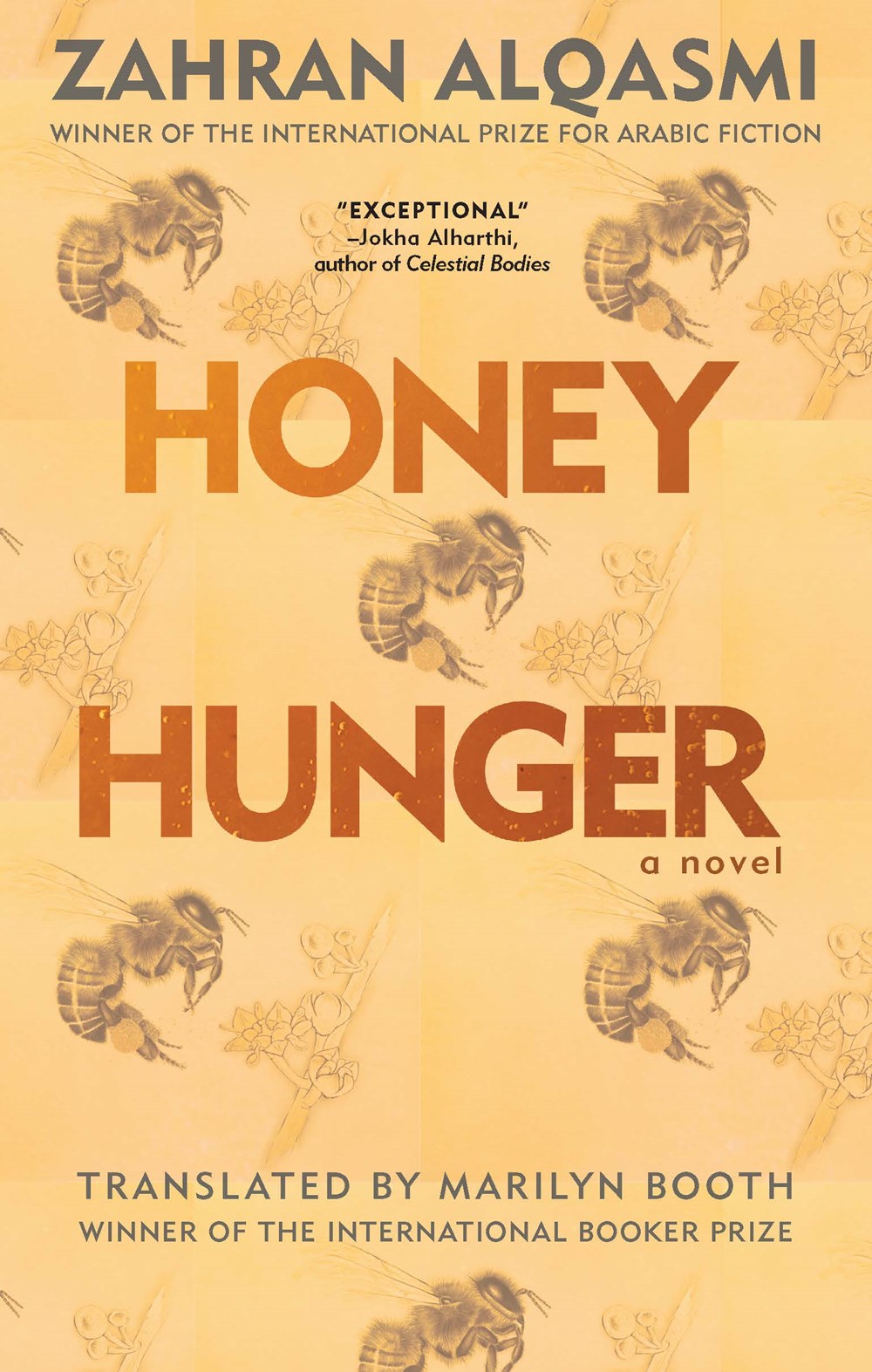
HONEY HUNGER: A Novel, Marilyn Booth's excellent translation of Zahran Alqasmi's novel of Oman


HONEY HUNGER: A Novel
ZAHRAN ALQASIMI
(tr. Marilyn Booth)
Hoopoe Books|American University in Cairo Press (non-affiliate Amazon link)
$18.95 ebook edition, available now

Rating: 4.75* of five

The Publisher Says: A breathtaking novel of longing, uncertainty, and ultimately of hope, written by an International Prize for Arabic Fiction-winning author and an International Booker-prize winning translator

Azzan is a beekeeper in a rural community in Oman. Devoted to tending his bees and searching for wild hives, he encounters Thamna, a lone shepherd woman, on a mountain slope and is captivated by her and her honey-colored eyes. Across the breathtaking vistas of Oman’s remote mountains and plains, Azzan’s troubled past and present unfold. A disappointment to his family, he turns to drink, and ultimately discovers the healing power of his beekeeping, before an accident in which he loses all.

Zahran Alqasmi’s masterful novel thrums forward with a subtle momentum. His lucid, poetic writing conveys a visceral sense of time and place, of the fragile ecologies inhabited by both bees and humans alike, in this intense and compelling novel of loss and hope.

I RECEIVED A DRC FROM THE PUBLISHER VIA EDELWEISS+. THANK YOU.

My Review
: Does the old nostrum, "still waters run deep," ring a bell in your cultural education? Azzan is the personification of it. He's quiet on these pages. He's still physically and psychically until summoned into action in service to some need. Author Alqasmi uses his stillness to carefully, incrementally, accustom you to the reality of Oman, of a place he seems to assume you will want to know feel and smell and hear, without intrusive human-ness. Gradually, Azzan's eyes...our cameras onto this sparely furnished landscape...show us more, bring us to the places—in the company that hearken to the quiet sounds that we call "silence" in technology's noisy embrace. Azzan's not a beekeeper by happenstance, either as a character or a PoV.

These are the choices that lead you the audience into the creation of an author whose poetry output outweighs his prose, ten to four; but whose prose garnered him the 2023 International Prize for Arabic Fiction (IPAF) for The Water Diviner; I believe this is the immediate predecessor to this novel in Arabic. It is obvious to me that the quality of the vision here is not a chance sport, an artifact of a talented translator's vision alone. That disappointment has befallen me before when a multiple translation career has yielded...inconsistent...results. Being the first of his works translated into English, I could still be disappointed; it just *feels* like a good bet to make, after reading this story.

I'm sure the idea of beekeeping in a landscape as arid as Arabia is overall seems odd. It is an ancient reality though. Deserts bloom, even if sparingly. Beekeepers are not hugely wealthy anywhere bit seldom lack for work for very long. It is a surprisingly mobile task in this story, one that enables Azzan to be see, hear, participate in, a lot of lives in making his life with bees. The honey they make is the life he leads; but it's also large in the life of the people. The product that makes life just enough less harsh to be fun at times for the people Azzan's belovèd bees serve. His knowledge of the lies, cheats, and kindnesses others never even think they don't know about all revolve around his deep and unwavering interest in and commitment to his charges the bees.

It gives the author a free rein to point up character traits in the narrator's orbit and beyond, for good and for ill; is Thamna, the herdswoman he encounters so fleetingly, an object of obsessive lust, actual love, or simply a fixation because of her novelty in his mostly male world? Does his thinking about bees, those matriarchal marvels without a permanent male presence, and their coveted honey drive or lead his itinerancy? If he's led by it, it makes his questing for wild honey that much more about the world he observes so intently; if driven instead, that condition of needing the honey makes his sharply observant eye that of the exploiter, the taker of all the work of others he is not entitled to have. All of these are within this novel's possible meanings.

Azzan's obsession with bees and their care is, while unusual to the US-fiction reader, an outgrowth of his blighted past. He is a recovering alcoholic in a society that frowns on alcohol use. He has never been a success, felt as though he was enough for or even wanted by those who raised him. It is this strange selfness, this sense of himself as needing and wanting but never receiving unless he takes (as from the bees, his compatriots), that is reinforced by the lyrical language of description that never devolves into possession; rather it settles on taking the product without "owning" the producer, on caring for and feeling committed to the bees, the goats, the donkeys and living among them in place of being their "owner."

Is that the place held by the exploiter, the user, the rentier? Azzan does not give off that vibe; I can still see it in the flow of his honeyed words of praise and appreciation and admiration for the bees. It comes down to the sense the author gives all these people who live among the animals they use; they take on the risks and protect their charges from harms they will all suffer from. In return they exert a right to practical rewards of sustenance.

A man who longs for love he is sure he does not deserve and whose object is safely always independent of his custodial care and capable of being just fine without him sounds to me like a man in need of a perspective check; he's fine how he is, too, just busily denying himself the peace of contentment to punish his perceived failings as received from the eyes and ideas of others.

So with all this praise why not five whole stars? Because these ideas and words of beauty and layers of meaning come with a labor tax of non-Western-standard punctuation and dialogue tags. I don't think that's a bad thing myownself. It does mean I can't five-star flag it for all y'all to pick up and devour ASAP. So many won't work this hard. Heck, even *I* had to read some things over twice to choose meanings that would change depending on to whom I attributed the words.

For me that's fun, for most it's work, so four and three-quarter stars seems fair.