Pages
- Home
- Mystery Series
- Bizarro, Fantasy & SF
- QUILTBAG...all genres
- Kindle Originals...all genres
- Politics & Social Issues
- Thrillers & True Crime
- Young Adult Books
- Poetry, Classics, Essays, Non-Fiction
- Science, Dinosaurs & Environmental Issues
- Literary Fiction & Short Story Collections
- Sookie Stackhouse/Southern Vampire Books & True Blood
- Books About Books, Authors & Biblioholism
Showing posts with label ecological awareness. Show all posts
Monday, June 15, 2026
THE BEASTS OF THE EAST: The Fall and Rise of America's Eastern Wilderness, positive stories from the frontlines of ecological recovery
THE BEASTS OF THE EAST: The Fall and Rise of America's Eastern Wilderness
ANDREW MOORE
Mariner Books (non-affiliate Bookshop.org link)
$15.99 ebook, available now
Rating: 4.25* of five
The Publisher Says: A celebration of the extraordinary lost natural wonder of the eastern U.S.—once the center of American wildness before its despoliation—and a lively tour through recent efforts to return elk, bison, wolves, and other creatures to their verdant native landscapes.
Before skyscrapers and smokestacks rose across the eastern U.S., elk, bison, wolves, and cougars roamed. Typically imagined as icons of the West, these large mammals are in fact native to what was once a kind of Eden—towering forests in the Northeast, rolling prairies in the Midwest, and cypress swamps in the Deep South. But, in mere decades, industrialization and unregulated hunting brought these emblems of the East to the precipice of extinction; by the 1950s, squirrels were one of the few wild mammals an easterner was likely to encounter.
Now, even as the climate and biodiversity crises loom, eastern wildlife are staging an unlikely comeback. Herds of bison graze on Illinois prairies, red wolves lurk in North Carolina’s coastal marshes, and abandoned coal mines in Kentucky are now home to thousands of elk. Such rewilding promises to restore balance to eastern ecosystems and return one of the most biodiverse regions in the world to its former luster—but not without controversy.
In Beasts in the East, we follow environmental writer and James Beard Award finalist Andrew Moore as he meets conservationists, hunters, biologists, and nature lovers as they confront herculean How can we enable wildlife migration in the midst of suburban sprawl? Are these success stories viable in the long-term? When humans and wildlife come in close contact, how do we define wilderness?
I RECEIVED A DRC FROM THE PUBLISHER VIA NETGALLEY. THANK YOU.
My Review: As Fathers' Day looms, the eternal conundrum of what to get Dad or father-figure that is nit some wearable or technological frippery he'll forget he owns is pressing. If your Dad's like me, he reads or watches news and frets about you, your kids, or the world going directly to hell in his lifetime.
He/we ain't all the way wrong.
BUT! There is hope to be found. It's true we've screwed up the planet pretty hard and done too little to fix it. Some people have done more than most to ameliorate some of the worst, stupidest damage our (well my anyway) generation, the Boomers, have done. Their successes are underdiscussed generally, and likely do not reach far enough into awareness to combat the gloom that's so paralyzing.
Author Moore, whose delightful book Pawpaw: In Search of America’s Forgotten Fruit was nominated for a James Beard Foundation Award in 2016, writes capably and informatively about the successes and the failures of the US scientific and govermental bodies charged with mitigating disasters their predecessors either caused or failed to prevent. It's a chonky boi, weighing in at almost 450 pages, but that's how much room is needed to really do justice to the good and the bad news.
I don't know about the men in your gifting circle but I don't trust the happy-clappy "this is fine" dawgs who tell us good things and chirp relentlessly cheery stuff from their high perches. I guess they see different landscapes from up there, whereas I see and smell sewage while they're making noise meant to distract me. I trust Author Moore's presentation of the significant environmental gains all over the highly urbanized Eastern US *because* the failures aren't ignored or hurried past; they're not lingered over, either, which is the other untrustworthy pole: sticking into gloom and doom.
There are copious notes, sources that held up everywhere I stress-tested them, and a tone of honest and truthful pleasure in the impressive successes won. The battles going well, eg red wolves rewilded in North Carolina, truly heartened me. I was astonished to learn there were populations of bison as far East as Pennsylvania! Imagine looking out of your sod hut in Pittsburgh and seeing a six-foot tall bison wandering the streets! Less surprising was the story of the reclaimed tall-grass prairies of Illinois that now sustain smallish herds of bison, but keep expanding.
The many people Author Moore consulted in preparing the book all come across as guardedly optimistic...I've mentioned the absence of chirpiness...which, given their various fields of knowledge and work, makes me believe we're not Doomed!...Doooomed!...just yet.
Given how little celebratory noise I hear daily and how assiduously I seek it out, I think a book like this is a good gift idea for Dad, Uncle, father-figure who also gets tired of treading sewage not water, and still can't believe or trust the sunshine enema people to be fully truthful. It's evidently expertise-laden author does an admirable tightrope walk with his tone of delivery. Including so many sources is helpful too.
It's good to offer a counter-narrative to doom and gloom that's grounded in facts and data. A very good gift for anxious science nerds of every gender.
Friday, December 12, 2025
PEOPLE AND PEPPERS: A Romance, botanically savvy man goes public
PEOPLE AND PEPPERS: A Romance
KELVIN CHRISTOPHER JAMES
Harvard Square Editions (non-affiliate Bookshop.org link)
$27.50 paperback, available now
Rating: 4* of five
The Publisher Says: Gossipy, intimate, and provocative, and set in Trinidad and New York City, People and Peppers, A Romance gives a diverting peek into the nuances of a Caribbean island’s callaloo of inter-racial and multicultural social mores. James’s main characters are complex, motivated, and fun to know. Tall and handsome, the main protagonist, Vivion K Pinheiro, is the bastard of a half-Portuguese, half Afro-Haitian woman, and an attractive New Yorker with carrot-colored hair who danced beautifully.
Accomplished as well, Vivion has earned national prestige as a scholar and athlete. As a young man trying to realize dreams, he can be selfish yet thoughtful, deceptive yet generous—no real villain, just a callow fella getting over by pulling the tricky strings of privilege and personal charm.
An important factor in his dream actualization is Vivion’s doting, wealthy mother to whom he confessed an ambition to construct an ecologically sensitive, self-sufficient house on countryside property she bought for him. He imagines the finished structure to be surrounded by a pepper farm that grows Moruga Red Scorpion peppers—the hottest on the planet.
A significant stubbing-stone to his ambitions though, is a habit of dodging difficulties—when the goings get tough, Vivion’s gone. How he deals with this failing is only one serving of this fine novel. Of other satisfying portions is the influence of the women in his life. In earlier novels, James’s female characters have been admirable stalwarts and he doesn’t disappoint here. Andaluza, the mother, is an indulgent one. Nikki, the lover, is a strong other. This empathetic novel superbly speaks to women’s compassion and tolerances in the name of love. So let’s live with Vivion as he discovers and submits to the sublime effects of romantic love and father issues.
I RECEIVED A DRC FROM THE PUBLISHER VIA EDELWEISS+. THANK YOU.
My Review: A novel with a lovely Trinidadian voice, This story of a feckless, flighty boy who's got a terrific idea...grow the hottest pepper available in an ecologically sustainable way...without any idea of what to do with the results.
All y'all already know I'm a fan of non-standard English voices...see my Celeste Mohamed reviews...and Caribbean ones in particular, so it's no surprise I enjoyed this read. Seeing still more of Trinidad's complex and varied society from a new, male viewpoint was also very interesting. Author James is not seeing the same way as Author Mohamed. Andaluza is not comparable to Jayanti, Salma, or Abby from the Mohamed stories; she's a different class, a different ethnicity, living in a similar but not shared world. As a wealthy woman of African descent, her bearing a son to a white man was shocking...and blights to some degree her lighter-skinned boy's prospects. Vivion, of course, is in a middle ground; his mother's unmarried status, but access to money makes this privileged son pretty much as one would expect him to be no matter where he hails from. His Mama will bail him out; his girl Nikki, an Indian Muslim, will stick by him; he's a bog standard spoiled boy.
When Vivion finally acts the part of a man and sets out to sell his super-peppers in New York, I got the darkest, most unnerved premonition of disaster...none of his women were going with him. All spoiled little boys feel invincible, like they can't be duped or swindled or misled. We all know where that leads...right into the hands of serious swindlers. It's not like he had not had this happen to him before....
As life at home in Trinidad keeps going in its course, Nikki and Andaluza form their own relationship that's not centered on Vivion. Their connection, formed around their shared affection for the spoiled Vivion, ripens into something more life-affirming as time goes by. It's a part of a story that takes its time to acquaint you with its world and people. This is not a one-sitting book.
Why I rate it four stars, not more, is this pacing issue. It's intentional, far as I can tell. There is no telltale sign, like a sudden infodump, to suggest the author simply lost control of the narrative. It still feels slower than the events that unfold warrant to me. I was very interested by Vivion's savvy decision to grow the hottest peppers around in a world where capsaicin is used in remedies a lot, and hottest peppers are quite prized in an affluent subculture simply for their own sake.
I was glad to have read this book. Its careful storytelling might not move swiftly but it does move well.
Wednesday, July 2, 2025
WE ARE EATING THE EARTH: The Race to Fix Our Food System and Save Our Climate, klaxon in your ear
WE ARE EATING THE EARTH: The Race to Fix Our Food System and Save Our Climate
MICHAEL GRUNWALD
Simon & Schuster (non-affiliate Bookshop.org link)
$29.99 hardcover, available now
Rating: 4* of five
The Publisher Says: From the author of New York Times bestseller The New New Deal, a groundbreaking piece of reportage from the trenches of the next climate the fight to fix our food system.
Humanity has cleared a land mass the size of Asia plus Europe to grow food, and our food system generates a third of our carbon emissions. By 2050, we’re going to need a lot more calories to fill nearly 10 billion bellies, but we can’t feed the world without frying it if we keep tearing down an acre of rainforest every six seconds. We are eating the earth, an ingenious phrase coined by Michael Grunwald, and the greatest challenge facing our species will be to slow our relentless expansion of farmland into nature. Even if we quit fossil fuels, we’ll keep hurtling towards climate chaos if we don’t solve our food and land problems.
In this rollicking, shocking narrative, Grunwald shows how the world, after decades of ignoring the climate problem at the center of our plates, has pivoted to making it worse, embracing solutions that sound sustainable but could make it even harder to grow more food with less land. But he also tells the stories of the dynamic scientists and entrepreneurs pursuing real solutions, from a jungle-tough miracle crop called pongamia to genetically-edited cattle embryos, from Impossible Whoppers to a non-polluting pesticide that uses the technology behind the COVID vaccines to constipate beetles to death. It’s an often infuriating saga of lobbyists, politicians, and even the scientific establishment making terrible choices for humanity, but it’s also a hopeful account of the people figuring out what needs to be done—and trying to do it.
Michael Grunwald, bestselling author of The Swamp and The New New Deal, builds his narrative around a brilliant, relentless, unforgettable food and land expert named Tim Searchinger. He chronicles Searchinger’s uphill battles against bad science and bad politics, both driven by the overwhelming influence of agricultural interests. And he illuminates a path that could save our planetary home for ourselves and future generations—through better policy, technology, and behavior, as well as a new land ethic recognizing that every acre matters.
I RECEIVED A DRC FROM THE PUBLISHER VIA EDELWEISS+. THANK YOU.
My Review: If one emerges from this read an ardent capitalist, political "conservative", and a climate-change skeptic, one is defective intellectually and morally.
Honestly I could end the review there because anything else I say will only be repetition of these statements with embellishments.
We are at a crossroads in many areas of our existence as a species. We have access to immense mountains of information and have little training to contextualize and interpret it. We are, for the first time ever, able to see with our own eyes, the entire Earth as it appears from space...a literal god's-eye view...and have done nothing to make that unique in humankind's entire history as a species awareness part of our worldview. We act as though problems are local, or localizable, and have just one cause so need only one solution.
Nothing in Nature supports this delusion. It is debunked in immense bodies of data collected, analyzed, and tested over generations now. Bad-faith arguments made by profit-seeking entities have ruined, to an extent I naïvely thought was actually impossible, the very idea of the data we already have being usable to start patching up the mess we have before us.
Books like this one walk you through the way we know what we know...briskly, but with integrity and expertise balanced by enthusiasm...and what we can in fact do now to make a positive impact on the course we're taking. I could wish for more viewpoints drawn from our Global Southern neighbors, and the women who outside the West perform the vast majority of food growth and harvest. I could wish for a less preaching-to-the-choir bent to the narrative.
But I can't fault Author Grunwald's data sources or synthesis. I can't fault his palpable sense of urgency. I can't help but wish more of y'all would get the message he's putting out: Action is the need and it's an urgent one.
Tuesday, July 1, 2025
RED FLAG WARNING: Mutual Aid and Survival in California’s Fire Country, a very useful anthology of leaders-by-example
RED FLAG WARNING: Mutual Aid and Survival in California’s Fire Country
DANI BURLISON & MARGARET ELYSIA GARCIA (editors; introduction by Manjula Martin)
AK Press (non-affiliate Bookshop.org link)
$18.00 ebook, available now
Rating: 4* of five
The Publisher Says: Two survivors of California fires compile a guide for living physically, mentally, and emotionally amid ecological destruction.
When warm temperatures, low humidity, and strong winds combine they produce an increased risk of fire danger called a "red flag warning"—a common event in Northern California. Through essays and interviews, Red Flag Warning sheds light on how wildfire impacts our communities and offers wisdom on living with fire from Indigenous Californians, community organizers, mental health care workers, environmentalists, fire analysts, sustainable loggers, parents, and more.
The collection explores the ways these fires take root and impact rural and urban Northern California, it examines our relationships to place and community and to understand the importance of mutual aid, organizing, community care, land stewardship, and resilience. Red Flag Warning covers the stories not frequently found in the often disaster-porn obsessed media and exposes what is lost in the news written by parachute journalists. Readers are invited to examine what fire can and does mean to them, what it means for us to reimagine the world, to prepare for the worst, and to examine flames through different lenses. Contributors include Manjula Martin, Hiya Swanhuyser, Zeke Lunder, Lasara Firefox Allen, Margo Robbins, Kailea Frederick, Redbird Willie, and more.
I RECEIVED A DRC FROM THE PUBLISHER VIA EDELWEISS+. THANK YOU.
My Review: "Victims of climate disaster" is a very effective distancing and Othering way to look at the results of humanity's unbridled greed. It puts the reader, or viewer, outside the horrors enacted for their titillated pity.
This anthology of essays is not about that. It is a series of accounts from the people in the (sometimes literal) trenches; these are the stories that your news source draws from to present its gods'-eye view and enable thereby your hunger for information without the emotional investment of intimacy.
Tear off the bandage, look at the real wound.
We're pretty complacent, us readers. We eagerly feed our heads information. It's the miracle, and I do not use the term lightly, of the internet age. We sit on an IMMENSE information structure, one designed ad hoc. We get to edit what from it we consume, how we consume it...we never need to examine the act of consumption itself. When one consumes a thing it must be processed, broken into needed and not-needed parts, then winnowed to remove the not-needed bits.
Our minds perform this function automatically (thanks to many thousands of hours' training), just like our guts do with sustenance. The main difference is we can train our brains to do different things more readily than our guts. What we put into them is in both cases the determining factor of what we get out.
Consuming more "disaster porn" reportage is not informing you of anything more than some selectively presented bits of fact in a heavy sauce of context, aka distortion. It's not usually done maliciously or with the intent to misinform you, but that is always, inevitably, the effect of choosing an "angle" to report.
This very short anthology, under two hundred pages, is an excellent way to jailbreak your information stream with stories of how people really there, with property at risk and friends/lovers/neighbors to care for, managed the balancing act of keeping themselves safe while taking needed action. What did they lose? Who did they lose? How does the world look to them now? What does taking personal action look like in an overwhelming, immense, uncontrollable apocalypse?
More news coverage will only create a seriously unhelpful sense of remove from what is happening to us. It is not just happening around us. In the voices of those who actually faced this unimaginable horror and still used their learned empathetic response to do something selfless, the essays here give us a gift of example to use and to praise. Not every essay is perfectly polished, or equally carefully thought out; but that's the nature of this format, and they all add their bit to the gestalt: Do something. Help. Serve a greater purpose.
Learn and take inspiration from these stories of what ordinary people, acting on their empathetic promptings, did (and can do) for themselves and each other.
Friday, February 21, 2025
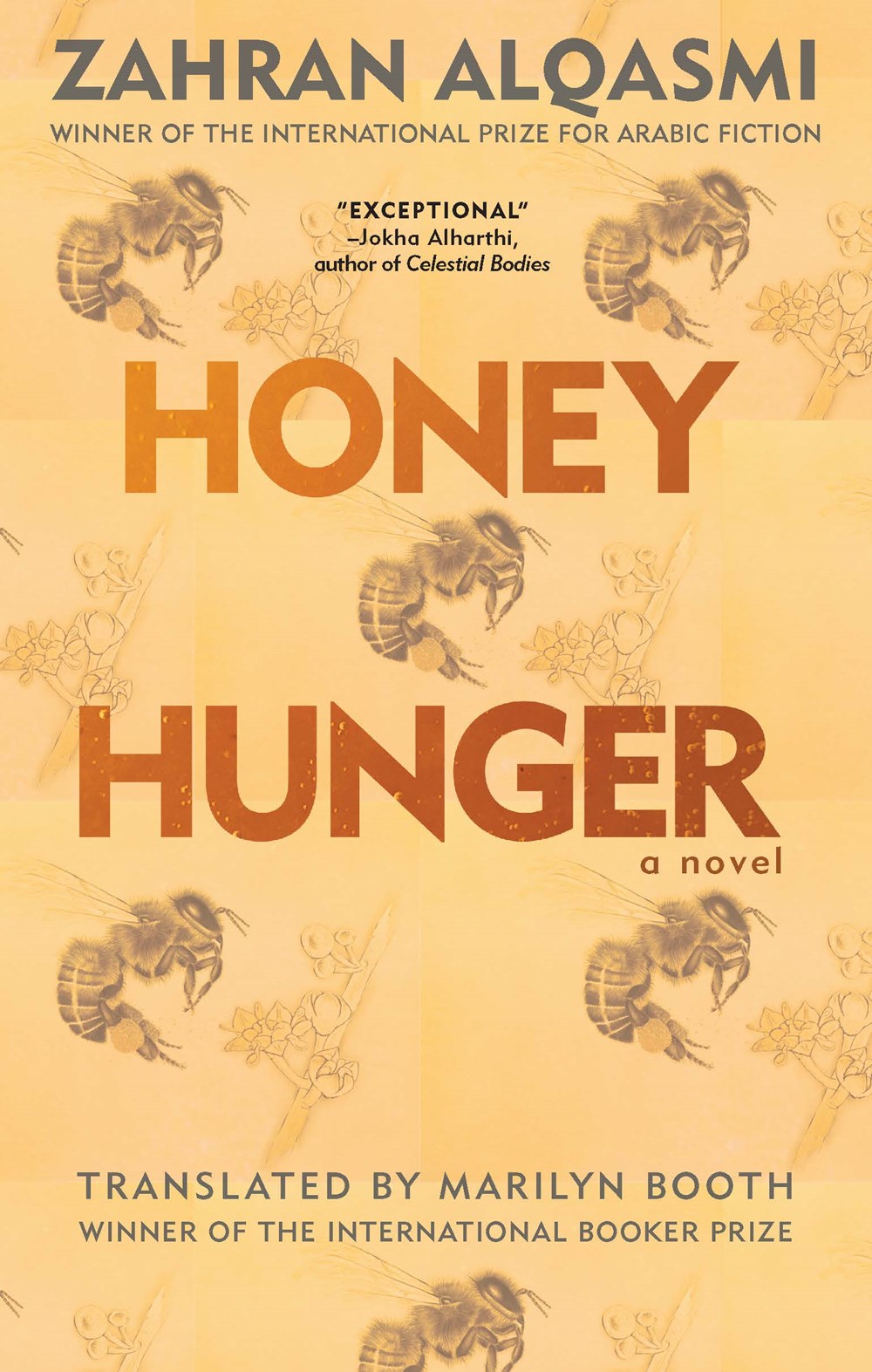
HONEY HUNGER: A Novel, Marilyn Booth's excellent translation of Zahran Alqasmi's novel of Oman
HONEY HUNGER: A Novel
ZAHRAN ALQASIMI (tr. Marilyn Booth)
Hoopoe Books|American University in Cairo Press (non-affiliate Amazon link)
$18.95 ebook edition, available now
Rating: 4.75* of five
The Publisher Says: A breathtaking novel of longing, uncertainty, and ultimately of hope, written by an International Prize for Arabic Fiction-winning author and an International Booker-prize winning translator
Azzan is a beekeeper in a rural community in Oman. Devoted to tending his bees and searching for wild hives, he encounters Thamna, a lone shepherd woman, on a mountain slope and is captivated by her and her honey-colored eyes. Across the breathtaking vistas of Oman’s remote mountains and plains, Azzan’s troubled past and present unfold. A disappointment to his family, he turns to drink, and ultimately discovers the healing power of his beekeeping, before an accident in which he loses all.
Zahran Alqasmi’s masterful novel thrums forward with a subtle momentum. His lucid, poetic writing conveys a visceral sense of time and place, of the fragile ecologies inhabited by both bees and humans alike, in this intense and compelling novel of loss and hope.
I RECEIVED A DRC FROM THE PUBLISHER VIA EDELWEISS+. THANK YOU.
My Review: Does the old nostrum, "still waters run deep," ring a bell in your cultural education? Azzan is the personification of it. He's quiet on these pages. He's still physically and psychically until summoned into action in service to some need. Author Alqasmi uses his stillness to carefully, incrementally, accustom you to the reality of Oman, of a place he seems to assume you will want to know feel and smell and hear, without intrusive human-ness. Gradually, Azzan's eyes...our cameras onto this sparely furnished landscape...show us more, bring us to the places—in the company that hearken to the quiet sounds that we call "silence" in technology's noisy embrace. Azzan's not a beekeeper by happenstance, either as a character or a PoV.
These are the choices that lead you the audience into the creation of an author whose poetry output outweighs his prose, ten to four; but whose prose garnered him the 2023 International Prize for Arabic Fiction (IPAF) for The Water Diviner; I believe this is the immediate predecessor to this novel in Arabic. It is obvious to me that the quality of the vision here is not a chance sport, an artifact of a talented translator's vision alone. That disappointment has befallen me before when a multiple translation career has yielded...inconsistent...results. Being the first of his works translated into English, I could still be disappointed; it just *feels* like a good bet to make, after reading this story.
I'm sure the idea of beekeeping in a landscape as arid as Arabia is overall seems odd. It is an ancient reality though. Deserts bloom, even if sparingly. Beekeepers are not hugely wealthy anywhere bit seldom lack for work for very long. It is a surprisingly mobile task in this story, one that enables Azzan to be see, hear, participate in, a lot of lives in making his life with bees. The honey they make is the life he leads; but it's also large in the life of the people. The product that makes life just enough less harsh to be fun at times for the people Azzan's belovèd bees serve. His knowledge of the lies, cheats, and kindnesses others never even think they don't know about all revolve around his deep and unwavering interest in and commitment to his charges the bees.
It gives the author a free rein to point up character traits in the narrator's orbit and beyond, for good and for ill; is Thamna, the herdswoman he encounters so fleetingly, an object of obsessive lust, actual love, or simply a fixation because of her novelty in his mostly male world? Does his thinking about bees, those matriarchal marvels without a permanent male presence, and their coveted honey drive or lead his itinerancy? If he's led by it, it makes his questing for wild honey that much more about the world he observes so intently; if driven instead, that condition of needing the honey makes his sharply observant eye that of the exploiter, the taker of all the work of others he is not entitled to have. All of these are within this novel's possible meanings.
Azzan's obsession with bees and their care is, while unusual to the US-fiction reader, an outgrowth of his blighted past. He is a recovering alcoholic in a society that frowns on alcohol use. He has never been a success, felt as though he was enough for or even wanted by those who raised him. It is this strange selfness, this sense of himself as needing and wanting but never receiving unless he takes (as from the bees, his compatriots), that is reinforced by the lyrical language of description that never devolves into possession; rather it settles on taking the product without "owning" the producer, on caring for and feeling committed to the bees, the goats, the donkeys and living among them in place of being their "owner."
Is that the place held by the exploiter, the user, the rentier? Azzan does not give off that vibe; I can still see it in the flow of his honeyed words of praise and appreciation and admiration for the bees. It comes down to the sense the author gives all these people who live among the animals they use; they take on the risks and protect their charges from harms they will all suffer from. In return they exert a right to practical rewards of sustenance.
A man who longs for love he is sure he does not deserve and whose object is safely always independent of his custodial care and capable of being just fine without him sounds to me like a man in need of a perspective check; he's fine how he is, too, just busily denying himself the peace of contentment to punish his perceived failings as received from the eyes and ideas of others.
So with all this praise why not five whole stars? Because these ideas and words of beauty and layers of meaning come with a labor tax of non-Western-standard punctuation and dialogue tags. I don't think that's a bad thing myownself. It does mean I can't five-star flag it for all y'all to pick up and devour ASAP. So many won't work this hard. Heck, even *I* had to read some things over twice to choose meanings that would change depending on to whom I attributed the words.
For me that's fun, for most it's work, so four and three-quarter stars seems fair.
Labels:
#WITMonth,
Arabic translation,
beekeeping,
bees,
coming to terms,
ecological awareness,
ecology,
Hoopoe Books,
low self-esteem,
lyrical prose,
Marilyn Booth,
novel,
Oman setting,
Zahran Alqasmi
Saturday, December 7, 2024
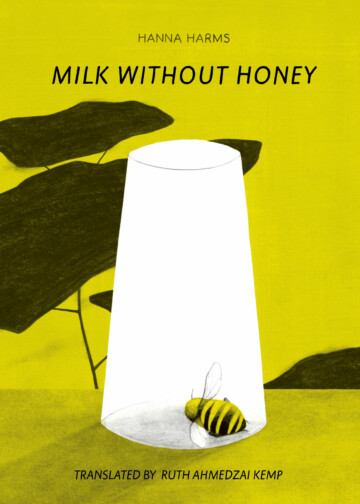
MILK WITHOUT HONEY, elegant graphic non-fiction about bees gracefully translated from German
MILK WITHOUT HONEY
HANNA HARMS (tr. Ruth Ahmedzai Kemp)
Street Noise Books
$21.99 trade paper, available now
Rating: 4.5* of five
The Publisher Says: What would the future of the world look like without bees?
MILK WITHOUT HONEY chosen for NPR’s BOOKS WE LOVE!
Bees are vital to securing our food supply. We could live in a paradise where insects, especially bees pollinate fragrant seas of flowers whose fruits we harvest. Instead, vast lawns are now replacing flower gardens, and agriculture is characterized by monocultures. Pesticides and climate change are also causing insect mortality, with dramatic consequences for the global ecosystem. As we destroy the insect populations, honey is just one of many foods that will no longer be available to us, unless we learn to honor our innate connection with nature before it's too late.
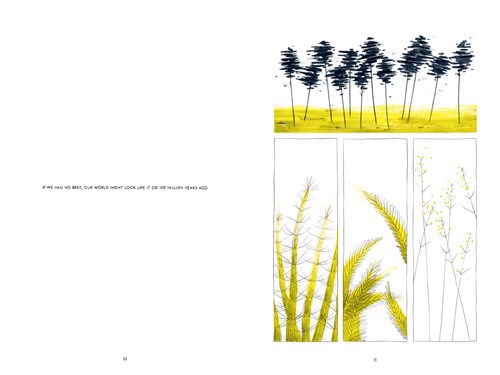
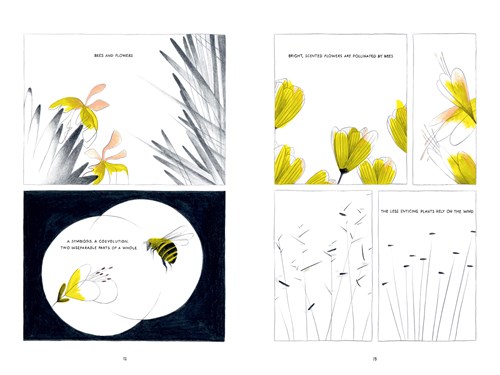
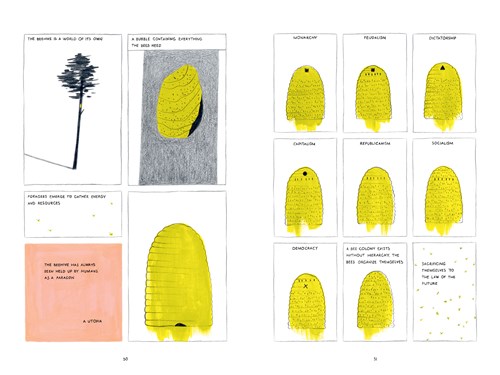
In gorgeous, limited palette artwork, using contemplative images as well as informative charts, Hanna Harms brings us into the world of bees: their hives, their colonies, and their interactions with the global ecosystem. This is the perfect gift book for anyone concerned about climate change and the environment.
About the Author
Hanna Harms is an illustrator and comic author. She graduated from the Münster School of Design in Germany. She is currently studying for an MA in illustration at the Hamburg University of Applied Sciences. Hanna is co-editor and author of the comic zine Sander. The German edition of this debut graphic novel Milch ohne Honig, won the Ginco Award in 2020 in the Best Nonfiction Comic category.
I RECEIVED A DRC FROM THE PUBLISHER VIA EDELWEISS+. THANK YOU.
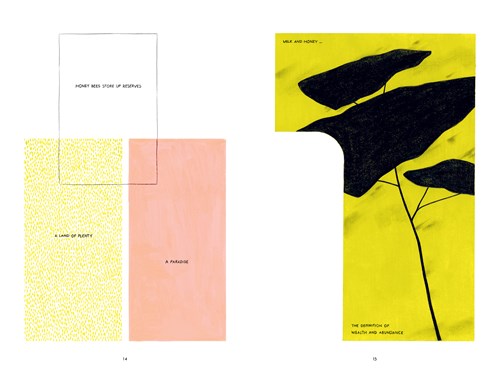
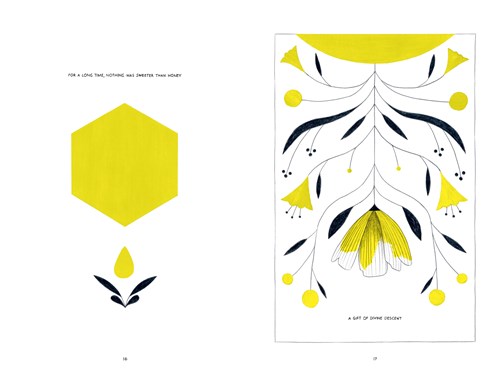
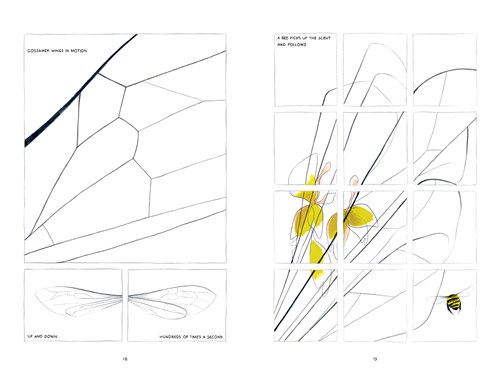
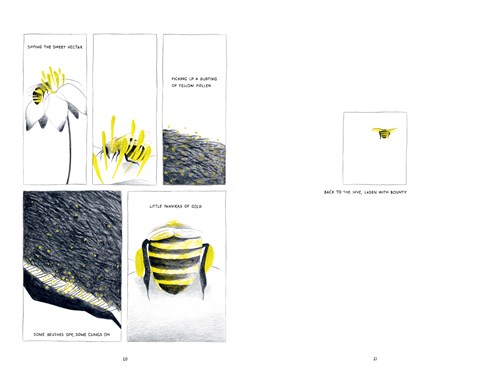
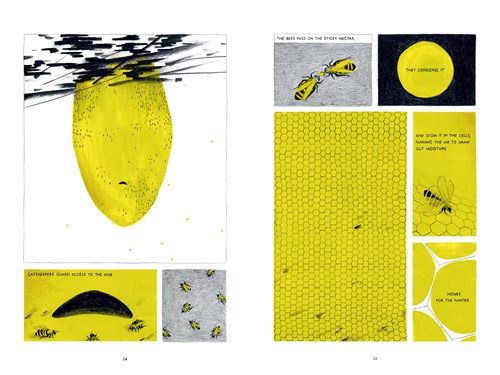
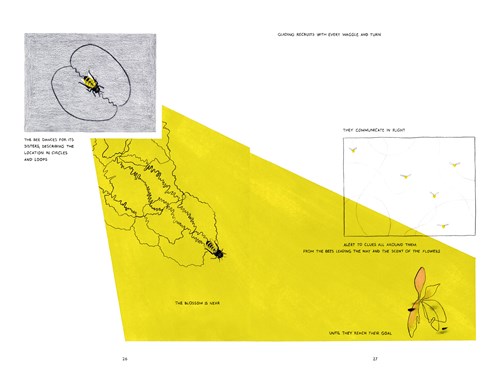
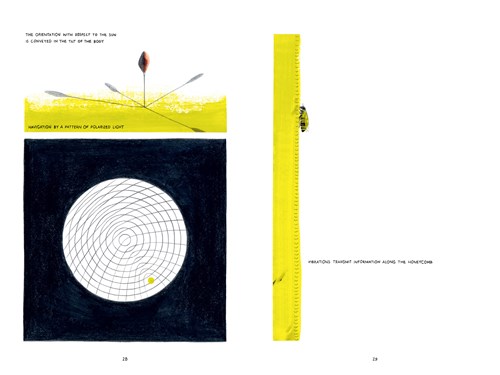
My Review: A book receiving wide notice, a lot of praise, and all of it well-deserved. The author is German, and translator Ruth Ahmedzai Kemp did a seamless job of rendering the text into equally elegant English. Look at these spare, graceful pages:

Remember when I praised BIOGRAPHY OF A FLY by Jaap Robben? The style here is very similar, so of course I'm inclined to enjoy it.
The choice of yellow and black for the presentation is logical...what color is a bee, after all...but I wish they'd gone just a bit more bee-and-honey with the shade. As it is, the book is more pee-and-yellowjacket. It got a touch wearing. That's why the book only got 4.5 stars instead of five, which it otherwise fully merits.
That did not stop me from devouring the book, pardon my wordplay, eager to possess the images that Author Harms has created to explicate the nature of the problem that bees face. The depths of our species' dependence on the bee for its labors to feed itself, which thereby feeds us, makes this a very urgently needed book.
I hope you'll add it to your young ecowarrior's pile of gifts this Yule.
Friday, December 15, 2023
JANE'S COUNTRY YEAR, another Handheld Classics reissued delight
JANE'S COUNTRY YEAR
MALCOLM SAVILLE
Handheld Classics
$19.99 trade paper, available now
Rating: 4.5* of five
The Publisher Says: The first edition since 1946, with full colour illustrations throughout.
'At last she reached the brow of the hill ... now the country opened out below her and she looked down into a wide and lovely valley ... Still patched with snow the little fields spread like a carpet below her and here and there a farmhouse with barns and golden ricks was clearly seen. Across the plain ran, straight as a ruler, a railway line and she saw a toy train puffing and crawling across the picture.'
Malcolm Saville's classic novel is about eleven-year old Jane's discovery of nature and country life during a year spent convalescing on her uncle's farm, after having been dangerously ill in post-war London. This deeply-felt novel was written while Saville was extending his range as a writer, alongside his very successful Lone Pine adventure series, and nature anthologies for children. Inspired by the experiences of Saville's own god-daughter, this marvellous novel is full of the wonder of discovery, as well the happiness of regaining health, making friends, and learning to love the natural world. The novel is also a record of rural England eighty years ago, written by one of the great twentieth century English nature writers.
The Introduction is written by Hazel Sheeky Bird of the University of Newcastle. The illustrations by Bernard Bowerman have been reproduced from the first edition.
I RECEIVED A DRC FROM THE PUBLISHER VIA EDELWEISS+. THANK YOU.
My Review: A quiet, gentle read for your tween-years reader. Beautiful reprint edition of a very prolific author for children's post-WWII novel. It follows Jane, a young girl recuperating from a serious illness at her aunt and uncle's farm in rural England. The framing device is, I know you'll know from the off, an excuse to write an elegy for the rural life that generations of people around the world were abandoning in increasing numbers as the world adjusted to new realities.
The text is, of course, not telling you this directly. It's a very sweet, very detailed love-letter to a vanishing time as it faded away. The reason it is interesting to read now is the world is rediscovering a need, once amply fulfilled, to recognize and relate our lives to the rhythms of the natural world. We do our descendants a service by giving them books of this sort. The way that urban outsider Jane comes to understand and treasure this world and its beauties and cycles is edifying without feeling condescending.
A kid today will read this with a sense of shock, I think, that this was ever a way of life that millions followed. It is clearly written and, while there are people winking in it, they are doing so from adult to child, so it's revoltingly condescending but not unexpected. The kind of folk who lived this life at that distant time:
...would have done the w-verb without thinking a thing of it. *shudder* The good old days, they were rotten.
The Introduction by Hazel Sheeky Bird is a wondeful overview of Saville's extended career as a writer for tweens and teens. It makes the book suitable for adults nostalgic for an earlier way of life by contextualizing it in its social milieu. I guess most of the people I'd gift it to, those between 11 and 14, will skip past that essay. If you were old enough to remember the Coronation, or the Rosenberg case, this book with Introduction will very likely hit every last nostalgia bump on your noggin.
Gifted to yourself or a younger reader, one who is beginning to wonder about the natural world around them, this novel of self-discovery, and family love, and the cycle of the seasons embedding them all, will hit a high note for #Booksgiving.
Subscribe to:
Posts (Atom)