Showing posts with label pre-Stonewall gay life. Show all posts

Monday, June 16, 2025

DISORDERLY MEN: A Novel, unnerving in its clarity and emotional acuity...devastating, sleep-robbing historical fiction


DISORDERLY MEN: A Novel
EDWARD CAHILL

Empire State Editions (non-affiliate Bookshop.org link)
$27.99 ebook, available now

Rating: 4.75* of five

The Publisher Says: Three gay men in pre-Stonewall New York City find their fates thrown together in the police raid of a Village bar.

Roger Moorhouse is a Wall Street banker and Westchester family man with a preciously guarded secret. As the shouting begins and flashlights blaze in his face, the life he’s carefully curated over the years—a fancy new office overlooking lower Broadway, a house in Beechmont Woods, his wife and children—is about to come crashing down around him.

Columbia literature professor Julian Prince lives a comparatively uncloseted life when he finds his first committed relationship tested to its limits. How could he explain to Gus, a fearless young artist, that he couldn’t stay with him that weekend because the woman who was still technically Julian’s fiancée would be visiting? But when Gus is struck unconscious by a police baton, Julian comes out of hiding to protect him, even if exposure means losing everything.

For Danny Duffy, an Irish kid from the Bronx with a sassy mouth and a diverse group of friends, the raid is a galvanizing, Spartacus moment. Danny doesn’t have too much left to lose; his family has just disowned him. But once his name appears in the newspaper, he’ll be fired from his job at Sloan’s Supermarket, where he’s risen to assistant manager of produce, and begin a journey that veers between political enlightenment and violent revenge.

The three men find themselves in a police wagon together, their hidden lives threatened to be revealed to the world. Blackmail, a private investigator, Gus’s disappearance, and Danny’s quest for retribution propel Disorderly Men to its piercing conclusion, as each man meets the boundaries of his own fear, love, and shame. The stakes for each are different, but all of them confront a fundamental question: How much happiness is he allowed to have . . . and what share of it will he lay claim to?

I RECEIVED A DRC FROM THE PUBLISHER VIA EDELWEISS+. THANK YOU.

My Review
: The chilling truth is that, within my own lifetime, queer life has never been safer than it is now; and it has never been under more sustained attack than it is now.

This novel takes you into the deep, dark chasm of gay males' knife-edge of tolerated behavior when "They" decide to unleash the fury of institutional prejudice on these gay men. It doesn't take much to push an ordinary guy off his place in the socioeconomic pecking order in those times.

What made me feel so afraid was that I had friends and family who were the exact contemporaries of these men. I'd heard similar stories, though not specifically about Stonewall. In that recognition and recollection was a huge ball-peen hammer that hit me again and again. This is the existence the people who drew up Project 2025 believe is the right and proper one for me, men like me, and our siblings across the spectrum of minority behavior. These are the feelings, the troubles, the disasters that they *want*us*to*experience. It is only because, after a while, I felt more like I was reading (good) narrative non-fiction, not a novel, that I was compelled to dock a quarter star off a perfect five.

It's chilling to know this from their own keyboards and placards and gunsights.

I encourage you to read it, cishet, religious, leftist, or simply sentient emotionally literate people. Feel from the inside how this world was for those condemned to it.

Reading truly is resistance.

Sunday, June 23, 2024

PRIVATE WORLDS: Growing Up Gay in Post-War Britain, elegy for a life spent without


PRIVATE WORLDS: Growing Up Gay in Post-War Britain
JEREMY SEABROOK

Pluto Press
$19.95 trade paper, available now

Rating: 3.5* of five

The Publisher Says: In 1950s suburban England, a friendship bloomed between Jeremy Seabrook and Michael O’Neill—two gay men coming of age at a time when homosexuality was still a crime. Their relationship was inflected by secrecy and fear; the shadows that had distorted their adolescent years were never wholly dispelled, long into their adult life. Lyrical, candid and poignant, this is a tale of sexual identity, working-class history and family drama. A memoir of unparalleled authenticity, Private Worlds is an elegy for a doomed friendship.

I RECEIVED A DRC FROM THE PUBLISHER VIA EDELWEISS+. THANK YOU.

My Review
: The US class system impacted me far less than the UK version did young Seabrook, thank all the nonexistent gods. The possession or absence of a "posh" accent is greatly deterministic of one's future; the comparable thing here is the Southern twang, which (no matter where the business is centered) will keep one in the lower ranks. I, being gay and really unwilling to pretend otherwise, felt the sting of exclusion, so that reality was shared by the author and me. His eventual success has been built on being a self not supported by the world he came from; escape by jettisoning the weight of his class identity. Seabrook and O'Neill each accomplished this by being bolshie leftists in an England that was convulsing from the wounds of Empire, birthing today's hideous US-style fascist plutocratic class system.

That doomed, deep love, found and lost early, was part of my life as well. The friendship blighted by the need to dissemble; the deeper connection denied by the caustic effects of powerlessness, of the absence of role models for doing the open and honest thing by each other, was all too painfully relatable to me. It's shocking to me, looking back, that my life was not more blighted by this distorting pressure to be someone I was not and, moreover, did not ever want to be...his life, from my outsider point of view, was more so than mine.

That story is not mine to tell. Author Seabrook and O'Neill have a longstanding public connection, and have each analyzed the way their milieu had them jointly "fail{ing} to grow up together"...a phrase, and an idea behind it, I'd like to pay honor to by saying I wish to hell I'd said that first. The class system's role in this failure was, probably because I'm from the US, not as real as was the way the precocious thwarted-single-mother-raised boy was forced to dissemble. His friendship with O'Neill, ostensibly the focus of this book, feels more like a well-polished lens for him to examine himself and his failed world-beating dreams.

Seabrook and O'Neill (born and raised a Londoner, a key component of his identity as an outsider in the English North) affected a caustic ironical distance from their neighbors. An intellectual pose of studying these Others, who in their turn Othered these bumptious boys for being queer, froze into an outsider identity, an observer stance, that would enable them to "overcome" their background only by treating it as fodder, material for their real life's work in sociological study. Dealing with this really unappealing trait now, Author Seabrook seems paralyzed by his recognition of its cruelty. That this is cruelty returned for cruelty given is not, to my surprise, part of his path to self-forgviness. The ironic separation has an inevitable distancing effect between the friends...how could it not...and that gets his focus. I was surprised by how bitterly he seems to regret the dark space left by O'Neill's separate personhood, and how little kindness he seems to extend to that early Seabrook boy. Judging one's earlier self is easy. Forgiving them is, apparently, not.

A fascinating dive into an intelligent man's past love for his intellectual equal and emotional opposite. I'm sure anyone who's read and liked Édouard Louis or Jon Fosse as tellers of personal and immutable truth will batten on this book.

Tuesday, June 14, 2022

BORN TO BE POSTHUMOUS, as mordantly amusing as it sounds


BORN TO BE POSTHUMOUS: The Eccentric Life and Mysterious Genius of Edward Gorey
MARK DERY

Little, Brown
$35.00 hardcover, available now

Rating: 4* of five

The Publisher Says: From The Gashlycrumb Tinies to The Doubtful Guest, Edward Gorey's wickedly funny and deliciously sinister little books have influenced our culture in innumerable ways, from the works of Tim Burton and Neil Gaiman to Lemony Snicket. Some even call him the Grandfather of Goth.

But who was this man, who lived with over twenty thousand books and six cats, who roomed with Frank O'Hara at Harvard, and was known—in the late 1940s, no less—to traipse around in full-length fur coats, clanking bracelets, and an Edwardian beard? An eccentric, a gregarious recluse, an enigmatic auteur of whimsically morbid masterpieces, yes but who was the real Edward Gorey behind the Oscar Wildean pose?

He published over a hundred books and illustrated works by Samuel Beckett, T.S. Eliot, Edward Lear, John Updike, Charles Dickens, Hilaire Belloc, Muriel Spark, Bram Stoker, Gilbert & Sullivan, and others. At the same time, he was a deeply complicated and conflicted individual, a man whose art reflected his obsessions with the disquieting and the darkly hilarious.

Based on newly uncovered correspondence and interviews with personalities as diverse as John Ashbery, Donald Hall, Lemony Snicket, Neil Gaiman, and Anna Sui, Born to be Posthumous draws back the curtain on the eccentric genius and mysterious life of Edward Gorey.

I CHECKED THIS BOOK OUT OF THE LIBRARY. SIX TIMES. ULTIMATELY A LIBRARIAN BOUGHT ME A SALE KINDLEBOOK. (True story!)

My Review
: There are few things my elder sister and I agree on. One of them is that Edward Gorey's a bloody genius, and about as hilarious as it's possible to be. (We also both love Jo Walton, so it's not as though she's a waste of space. Entirely, anyway.)

That's what Edward Gorey's superpower is, though. He speaks to a certain inner weirdo in some people, a rebellious streak that demands the sheer nonsensical pointlessness of Life be acknowledged and celebrated. Poor Xerxes...a Gashlycrumb Tiny I truly felt for.

Now that Gorey's safely dead, what's the skinny on his narrow gay ass? Welllll...not that fascinating, if I'm honest. He was exactly as you'd expect someone who could think up a child called "Xerxes" would be. Strange, a misfit, completely and utterly himself because he *designed* himself with great care. His artwork was justly celebrated for its technical merit...by three or four people. Weirdness exacts costs from the weirdo. Gorey was famous...if you know who he is. I'm never sad or sorry that I know who he is, unlike many famous people. But Gorey's talent as an artist was never the subject of major retrospectives at the Museum of Snooty Stuff or the Obscene Wealth Collection.

Unlike most of the art you'll see in those cultural institutions, you've seen a Gorey image. (If you're reading this blog, you have.) The Mystery! series opening sequence? Gorey. The 1950s Anchor Books images? Gorey. Over 100 of his own books, popular culture objects. He was a niche force, but a force nonetheless.

However, Dery's exhaustively researched biography goes into some detail about the skinny on Gorey's sexual nature. I think, like Greta Garbo, he wanted to be left alone. He never, ever once said he was gay. He lived through Stonewall...long after it was entirely okay with most people to come out as gay, he didn't.

Because he wasn't.

He said, in an interview collected in Ascending Peculiarity, "I'm neither one thing nor the other particularly. I am fortunate in that I am apparently reasonably undersexed or something ... I've never said that I was gay and I've never said that I wasn't ... what I'm trying to say is that I am a person before I am anything else ... " That, mes amis, is a clear statement of being. He was what we, in 2022, call "asexual." That doesn't prevent him from presenting himself in a striking and deeply queer-coded manner. But if the twenty-first century has taught me anything, it's that people are who and what they say they are. Gorey? Asexual, and presenting himself as a strange misfit. And that is all there is to it.

I wasn't pleased by Author Dery's claiming of him for the gay men of the world solely because we have his own words on the subject and they are not, despite the fact they could easily and safely have been, "I am gay." So. He wasn't. Yes, let's claim him as an ikon of the QUILTBAG spectrum! Yes, let's celebrate his Otherness, his determined design of his Otherness, and the glorious art that came out of it..."There's so little heartless work around," said Gorey. "So I feel I am filling a small but necessary gap."

But let's not posthumously (!) reassign his stripe on the flag for our own need to possess him. Let's celebrate the way he said he was with the gratitude and laughter and little frisson of unnerved nerves that he designed it to evoke in his viewers.

Friday, January 14, 2022

FADEOUT, fifty-two years of Brandstetter in the world but no films?!


FADEOUT
JOSEPH HANSEN

Soho Syndicate (non-affiliate Amazon link)
$9.99 Kindle edition, available now

Rating: 5* of five

The Re-Publisher Says: Published fifty years ago, a time when being gay was illegal in 49 out of 50 states, Joseph Hansen’s first Dave Brandstetter novel shattered stereotypes and redefined the Private Eye novel as we know it.

Five decades after its original landmark publication, Joseph Hansen’s Fadeout is as fresh and important as ever. Preceded only by a handful of gay protagonists in crime fiction, Hansen’s Dave Brandstetter, a ruggedly handsome World War II vet with a quick wit, faultless moral compass, and endless confidence, shattered stereotypes and won over a large reading audience, a feat previously considered impossible for queer fiction.

Set in the mid-1960s, Fadeout centers on the disappearance of a southern California radio personality named Fox Olson. A failed writer, Olson finally found success as a beloved folksinger and wholesome country raconteur with a growing national audience. The community is therefore shocked when Olson’s car is found wrecked, having been driven off a bridge and swept away in a fast-moving arroyo on a rainy night. A life insurance claim is filed by Olson’s widow and the company holding the policy sends their best man to investigate. The problem is that Olson’s body was never found. Not in the car. Not further down the river. As Dave Brandstetter begins his investigation he quickly finds that none of it adds up.

I RECEIVED A DRC FROM THE PUBLISHER VIA EDELWEISS+. THANK YOU.

My Reviews
: First, a 2013 rumination:
I've recently completed a re-read of all twelve Brandstetter books. Why the heck not, it beats writing a new ending for my own book, right? Especially a book I thought of as done, but...oh heck, never mind.

My crazy mother bought this book when it came out because she liked mysteries. It was a little too hard-boiled for her, but she got the next three or so because she just loved the writing. When I was about 12, she handed this one to me when I expressed my joy at reading The Maltese Falcon with the offhand remark, "oh well then, this one'll slay ya."

Wow. A gay OLD man! People like me before there was a me!!

That really mattered to me, since there was such a lack of public and accepted gayness in the Austin of 1971. I remember knowing there were gay guys at the University because the sister who went there complained about it. I remember knowing the term "gay" from a friend of that same sister's who used it, and explained it when asked. The sister in question said, "oh geez he means queers, Rich, the faggots who mince around yelling about rights."

My mother is not the only judgmental and nasty woman I grew up with.

Well, that sort of interchange made Brandstetter all the more pleasurable for me to read! I loved him for being himself, despite his own father's disapproval, and for being a widower...a relationship ends before the series begins, and it was a revelation to me that such a relationship was *possible*. What a wonderful man Joseph Hansen must be, I thought, to create this unicorn of a character.

As the mystery unfolds, Dave Brandstetter does too. He learns so much about the victim, and so much of that resonates with him...Dave just can't stop the grieving he's going through for his dead love from connecting him to the people in his life, even as he makes the honorable choice not to take comfort that's offered to him by someone even more vulnerable than he is.

What I know now as someone older than the old man I thought Dave was in the book...Hansen knew what he was talking about when the subject is grief and grieving. Dave's pain made me weep as a kid. It does so much more to the grief-veteran old-man me...makes me sit, shocked, as I'm taken in to this most personal and intimate of places. Sex is less intimate than a person sharing this passage with you. As a re-reader, I had my initial youthful response in mind. Then the reality hit, and the impact was profound.

When there's writing like this, storytelling like this, out there in the world, why are so many people gobbling down so much crap?

My present-day response to re-reading this glory of a noir story:
Revisiting this read still more decades later, I am much more impressed with Author Hansen's feat of derring-do in writing the absolutely ordinary Dave as a queer gent of a certain age. These are excellent California Noir novels, as Michael Nava says in his Introduction, and it is homophobia and nothing else that keeps Hansen off the lists of the great practitioners of this art.

I thank you, Soho Syndicate, for republishing the series. Thanks, Edelweiss+, for the DRC. Most of all, and most heartfelt indeed, are the thanks I offer to my forerunner Joseph Hansen for holding the spiky branches back and showing my ever-searching eyes the safest path to being a good man was the honest one.


When all is said and done, when this mystery is...not solved, exactly...resolved, let's say, one feels that Justice has been served and the world's wicked, awful ways aren't triumphant when it really mattered. This time.

Saturday, June 26, 2021

PHILIP SPARROW TELLS ALL, a long-forgotten side of a queer elder statesman's career


PHILIP SPARROW TELLS ALL: Lost Essays by Samuel Steward, Writer, Professor, Tattoo Artist
SAMUEL STEWARD (author) & JEREMY MULDERIG (editor)

Foreword by Justin Spring, author of SECRET HISTORIAN: The Life and Times of Samuel Steward, Professor, Tattoo Artist, and Sexual Renegade
University of Chicago Press
$20.00 ebook or trade paper editions, available now

Rating: 4.75* of five

The Publisher Says: Samuel Steward (1909–93) was an English professor, a tattoo artist for the Hells Angels, a sexual adventurer who shared the considerable scope of his experiences with Alfred Kinsey, and a prolific writer whose publications ranged from scholarly articles to gay erotica (the latter appearing under the pen name Phil Andros). Perhaps his oddest authorial role was as a monthly contributor between 1944 and 1949 to the Illinois Dental Journal, an obscure trade publication for dentists, where writing as Philip Sparrow he produced a series of charming, richly allusive, and often quirky essays on a wildly eclectic assortment of topics.

In Philip Sparrow Tells All, Jeremy Mulderig has collected thirty of these engaging but forgotten columns, prefacing them with revealing introductions that relate the essays to people and events in Steward’s life and to the intellectual and cultural contexts in which he wrote during the 1940s. In these essays we encounter such famous friends of Steward as Gertrude Stein, André Gide, and Thornton Wilder. We hear of his stint as a holiday sales clerk at Marshall Field’s (where he met and seduced fellow employee Rock Hudson), of his roles as an opera and ballet extra in hilariously shoddy costumes, of his hoarding tendencies, his disappointment with the drabness of men’s fashions, and his dread of turning forty. We go along with him to a bodybuilding competition and a pet cemetery, and together we wander the boulevards of Paris and the alleys of Algiers. Throughout, Mulderig’s entertaining annotations explain the essays’ wide-ranging allusions and also highlight their gay subtext, which constituted a kind of private game that Steward played with his mostly oblivious audience of Midwestern dentists.

The first collection of any of Samuel Steward’s writings to be republished since his death in 1993, Philip Sparrow Tells All makes these lost essays available to a broad readership that Steward imagined but never actually enjoyed when he wrote them. In doing so, it takes a major step toward documenting his important place in twentieth-century gay literature and history.

I REQUESTED AND RECEIVED A REVIEW COPY FROM THE PUBLISHER. THANK YOU.

My Review
: First, read this:
There is a quality to the City of the Big Shoulders that grows on a person, like the taste of a martini, like learning to like pineapple and cottage cheese. There are so many things against it that have to be forgotten. When we first arrived we hated it—the dirty papers flying loosely on the streets, the sprawling quality it had, the "maryann" backs of the apartment houses that you see from the elevated tracks as the train groans and screeches on its way to the Loop. We loathed the dirty clothes hanging on the little wooden back porches, we suffered over the unbelievable squalor and filth of the south-side tenements, the naked babies playing in the mud of the backyards—and the incredible hypocrisy of the bright shops on Michigan Boulevard, and the white lights on the whiter Wrigley Tower.
    from "On Chicago"

Now, go read his Wikipedia page to get a sense of why this basic little twink was a Very, Very Big Deal; it explains a lot when you know he was a literary writer of merit while young, an esteemed literary scholar during middle age, and a pornographer of godlike renown in his later years. Throughout his life he was the proverbial "good time had by all," racking up over eight hundred (800!) sex partners in a Satyr-esque lifetime of over four thousand five hundred (4,500!!) sexual encounters.

He even impressed Alfred Kinsey. (You know, the one Liam Neeson played in that movie, the one you're referencing when you say someone's a "Kinsey 6" or whatever.) His journals and other related materials went to the Kinsey Institute...I'm sure they're still popping students' eyes.

Knowing what we know now of Steward's life and lifestyle, one can't but help wondering rather bemusèdly what the hell the Illinois Dentistry Journal was thinking when they asked Professor Steward to write a column for them. Reading these pieces with modern eyes, it's damned incredible what he was able to get away with saying. But in 1944, when he began this work, he was an outwardly respectable scholar...how far social media has dragged (!) us into the private lives of all the people we know! A simple Googling, had it existed in 1944, would've made the staid, stolid dentists of Illinois aware that they wouldn't want Steward's hands anywhere near their instruments.

So to speak.

Probably the most fun thing about reading this collection, for me as a gay kid who loved Phil Andros's first-person hustling tales, is the astonishing freedom to camp it up that came from invisibility! There is no single-edged sword, is there. It delighted me to spend time with Uncle Philip (Auntie Philip?) as we went behind the scenes at the Opera...a thing one should really never do with the performing arts, go look behind the curtain, it utterly ruins the illusions and one can not ever recover them.
I showed up at seven, trembling a little. I heard my name called, and within moments was being whisked up the elevator to the fifth floor...where the men dressed. ... The costume master handed me a mustard-colored costume: a pair of breeches, a short bolero jacket, a string of red cheesecloth for a necktie, and a salmon-colored cummerbund to wrap around my manly form. ... Within a short while I discovered that the breeches were size 46, which is a little large for my svelte thirty-inch waist. I was soon madly fumbling at my rear, trying to pull in the straps and pin myself together. ... At last a kind old gentleman saw my troubles. "Come here," he said. He applied two safety pins, took an extra-long cummerbund, and twirled me into it. Then he took two three-inch folds in my rear, and warned me not to turn my backside to the audience. And we went down to the stage, where a little man rubbed our cheeks briefly with bright rouge, and with a black eyebrow pencil gave us romantic sideburns, and let us go.
    from "On Operas and Operating"

It's like being backstage again...the bit about the cummerbund, for the uninitiated, is precisely accurate. One cannot put on a real cummerbund solo. One needs a deft companion to hold the long cloth at precise and varying angles while one (gracelessly, in my case) twirls and the cummer does its bunding of your trousers. Excellent practice for diapering a toddler, I note for those who might benefit from this knowledge.

One of my mother's cultural touchstones, and thus mine by osmosis, was the inimitable food writer M.F.K. Fisher. She introduced the concept of Dining to many an aspiring flyover-country lassie like Mama. If you have never encountered her lapidary prose, and her conoisseur's eye for what makes a meal A Feast, please do not read the rest of this review until you've procured and at least sampled The Measure of Her Powers or The Art of Eating, which last title is free to read for Amazon Prime members! Oh, don't just take my word for it; read Philip Sparrow's "On How to Cook a Wolf" to get the arch, exquisite Friend-of-Dorothy look at the medieval table's, ermmm, pleasures. There is a recipe to cook a wolf! Fisher quotes it, so does Auntie; and then, in the dropping-of-hairpins to end them all, says this:
For my part, I cannot rest until I find a wolf to try it. Unfortunately, there is in these parts a scarcity of the four-legged kind, so I have a notion to call up "Esquire Escorts" [Bonded Male and Female Escorts for All Occasions] and ask them to send me out an unbonded one, a tall, husky, grey-eyed blond of the two-legged variety. Then, clutching my trusty cudgel, I'll lay him flat as he enters the door, and set to work.
    from "On How to Cook a Wolf"

Whoa, Nelly! (or nelly, I suppose) That's pretty darned Out for that day and time...and his audience wouldn't've known that a "wolf" in the time's gay argot was a studly muffin who did boys on the side, like the current term "trade" covers. Sam Steward was a twink, thin and blond and very much a bottom in today's parlance. He was also a genuine masochist, he liked the leathers and the games of dominance and submission too...but mostly, in his own time, he was invisible as a gay man because there wasn't a large group of people aware of such beings existing among them...and it shows, as we say now.

What I think you might wonder, you poor benighted straight person who happened across my blog, is how the hell you're supposed to be in on the joke when I might as well be speaking Croatian to you right now. Editor Mulderig to the rescue! Everything I've just told you is on the page with the article I'm quoting. It's not called out in a footnote...it's just printed at the bottom of the page and references to the place in the text are in italics to call your attention, eg:
a wolf to try it. In the urban parlance of the early twentieth century, ...

This is, after all, an academic press's book; one must expect the resident academicians have worked their magic on the obscure points in the text. It's hugely helpful; it's unobtrusive; and in the end it added immeasurably to my pleasure in the read.

That said, the pleasure was one I felt inclined to prolong. One, sometimes two, pieces back-to-back; selected on whim, or mood, not in chronological order; thus it took about four times as long to read the whole text as it would have had it been a novel or other form of narrative. The articles, their subjects, the gestalt of the pieces being written for dentists who almost certainly were innocent of any knowledge of what Auntie Philip was really saying, the biographical detail that the author had serious hotness for the editor he was working for; all of it makes this 256-page slenderness of a treat so much more delicious than most summer reads you can buy.

Just spread the pleasure out over more time and savor the spicy scent of cakes long since baked and tea long since served.

Monday, June 21, 2021

TAB HUNTER CONFIDENTIAL, the late hunky heart-throb's own words telling his own story


TAB HUNTER CONFIDENTIAL: The Making of a Movie Star
TAB HUNTER
with Eddie Muller
Algonquin Books (non-affiliate Amazon link)
$12.99 Kindle edition, available now

Rating: 3.5* of five

The Publisher Says: Welcome to Hollywood, circa 1950, the end of the Golden Age. A remarkably handsome young boy, still a teenager, gets "discovered" by a big-time movie agent. Because when he takes his shirt off young hearts beat faster, because he is the picture of innocence and trust and need, he will become a star. It seems almost preordained. The open smile says, "You will love me," and soon the whole world does.

The young boy's name was Tab Hunter—a made-up name, of course, a Hollywood name—and it was his time. Stardom didn't come overnight, although it seemed that way. In fact, the fame came first, when his face adorned hundreds of magazine covers; the movies, the studio contract, the name in lights—all that came later. For Tab Hunter was a true product of Hollywood, a movie star created from a stable boy, a shy kid made even more so by the way his schoolmates—both girls and boys—reacted to his beauty, by a mother who provided for him in every way except emotionally, and by a secret that both tormented him and propelled him forward.

In Tab Hunter Confidential: The Making of a Movie Star, Hunter speaks out for the first time about what it was like to be a movie star at the end of the big studio era, to be treated like a commodity, to be told what to do, how to behave, whom to be seen with, what to wear. He speaks also about what it was like to be gay, at first confused by his own fears and misgivings, then as an actor trapped by an image of boy-next-door innocence. And when he dared to be difficult, to complain to the studio about the string of mostly mediocre movies that were assigned to him, he learned that just like any manufactured product, he was disposable—disposable and replaceable.

Hunter's career as a bona fide movie star lasted a decade. But he persevered as an actor, working continuously at a profession he had come to love, seeking—and earning—the respect of his peers, and of the Hollywood community.

And so, Tab Hunter Confidential is at heart a story of survival—of the giddy highs of stardom, and the soul-destroying lows when phone calls begin to go unreturned; of the need to be loved, and the fear of being consumed; of the hope of an innocent boy, and the rueful summation of a man who did it all, and who lived to tell it all.

***R.I.P. TAB HUNTER*** He died 8 July 2018 at 86. He was married to Allan Glaser for 35 years.

My Review: Memoir of 1950s movie heartthrob Tab Hunter, his Southern California sun-kissed boyhood, his coming of gay age, and the effects of being part of the star-maker machinery of Hollywood as it existed at that time on a modestly talented, very very pretty boy. It's obvious that Mr. Hunter paid attention to the business of Hollywood...he gives a real and thorough account of the whys and wherefores of the last gasp of the studio era's decisions.

Not as salacious as some, and a whole lot sweeter than most. Mr. Hunter says very few unpleasant things about others in his memoir, and is in fact so generous to his exes that I wonder how large a role the Algonquin legal department played in the setting of the tone. Either that or this is one of the NICEST old stars ever born. The photos are all nicely chosen to illustrate Mr. Hunter's textual points. I liked this book, but I don't think anyone not interested in Hollywood, gay Hollywood, or the Fifties would do anything more than yawn through a Pearl-Rule 50pp. And, it is important to say, he is very much not telling a happy coming-out story. "Out" is not the goal of the book, so be aware of that fact and adjust your expectations or avoid the read.

If you ever had the pleasure of hearing his one-man show, you'll sniffle a little at some of his trademark nostrums:
You see, people hang labels, tags of false identification, on the people that disturb their own sense of reality too much, like the bells that used to be hung on the necks of lepers.
–and–
Sometimes when you’re confused, you push away the people you shouldn’t. You’re either afraid of being hurt or of hurting them.
–and–
I had become aware of the three stages of stardom. First is 'Get me Tab Hunter,' followed by, 'Get me a Tab Hunter type,' followed by, 'Who the hell is Tab Hunter?'

Friday, November 8, 2019

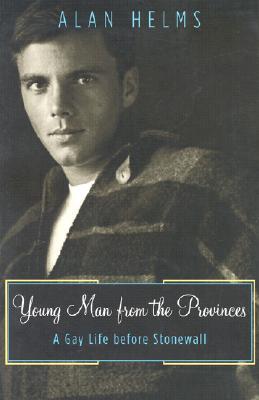
YOUNG MAN FROM THE PROVINCES, gay life as a sex toy in the pre-Stonewall world


YOUNG MAN FROM THE PROVINCES: A Gay Life Before Stonewall
ALAN HELMS

University of Minnesota Press
$16.95 trade paper, available now

Rating: 3.5* of five

The Publisher Says: Young, intelligent, and handsome, Alan Helms left a brutal midwestern childhood for New York City in 1955. Denied a Rhodes scholarship because of his sexual orientation, he soon became an object of desire in a gay underground scene frequented by, among many others, Noel Coward, Leonard Bernstein, and Marlene Dietrich. In this unusually vivid and sensitive account, Helms describes the business of being a sex object and its psychological and physical toll.
"Riveting."- New York Times Book Review

"Extraordinary and elegantly written. A record of a gay world that has virtually disappeared over the past twenty-five years of liberation and fifteen years of AIDS." -Boston Globe

"A beautifully written memoir. Helms sped through the celebrity-packed fast lanes, but he has learned how to stand back and get some perspective." -Los Angeles Times

"Sublimely funny, engaging, pathetic, highly literary, and painful to read. Helms seems like a gay Everyman whose quest for self-knowledge, respect, and contentment in this contemptuous world mirrors that of many other marginalized people." -Bloomsbury Review

Alan Helms is professor of literature at the University of Massachusetts, Boston.

I RECEIVED A REVIEW COPY OF THE BOOK FROM THE PUBLISHER. THANK YOU.

My Review
: Beloved Boston cultural institution Alan Helms had a wildly exciting past! See the film! Admire his art collection, appreciate his cultured and elegant way of speaking, his breadth of cultural knowledge, and his charming sweetness.

What does a young, abused man from flyover country do the moment he realizes he's queer? RUN! Get to New York City as soon as possible. He got to Columbia University in 1955, leaving behind a life in Indianapolis, Indiana, that could charitably be described as "uncongenial." A father who thought his son was a bitter disappointment...how many of us queer boys can relate to that...a mother whose situation wasn't a lot better than his, a younger brother whose close brush with death was the single moment in his childhood when peace reigned. None of this is a recipe for a healthy adulthood...and add in the author's understandable, if off-putting, self-absorbtion and you get a difficult-to-empathize-with narrator.

But he was So. Beautiful. Look at that face on the cover! Hoo-ee!

And the awfulness of that...wow...to be so pretty and so readily available and so snobby, who can claim to be surprised that he wasn't a pleasant person? His sexual awakening came at the price of being raped. His family life prepared him for a life of abuse. He dived into it in the glamorous world of closeted gay life pre-Stonewall. Pretty sexually available intelligent boys found innumerable lovers, and the author wasn't about to say no. (I totally relate to this and would've done precisely the same in his shoes. Damn the bad luck of not being pretty!) So a decade and a half passed in what I imagine was a golden haze...this book's largest part. It's a bit less charming to me than it might be to a younger reader. I look at the wreckage he glosses over and think, "there's the real story."

Yes, sleeping with famous Hollywood stars and titled Eurotrash is all very well. But the people you stood up, the ones whose parties weren't quite glam enough that you said you'd attend, and so on and so forth? How did you sleep, look in the mirror, launch yourself at the next big fish in your hifalutin' pond without thinking about them?

The Fall took place when he was thirtyish, and some semblance of human feeling broke the ice he'd cultivated to keep his agony at bay and under the surface of a freezing cold lake he called his heart. Escape to Boston and the tender mercies of a shrink who began the process of waking the author up from his frozen state. Then it happened: His body aged. He wasn't the hot young muffin anymore; he wasn't even visible to the hot young muffins. That had to be a bad, bad day.

Now, let me not try to hide my glee here. This event has occurred in my life, too. I can not imagine how much worse it was for a formerly gorgeous creature, feted and celebrated and wined and dined, to be cut off from that gushing geyser of distractions. Luckily for his sanity, Helms had a brain and a deep love for the life of the mind that he'd never left behind or neglected. While learning what he'd never known, that feelings are best felt in the moment and not in retrospect, I'm sure he left yet more carnage in his wake. But the fact that no one ever killed him means that he learned enough to at least fake his way through professional, if not personal, relationships. So hope still shines for him to pull his head out of his ass and recognize that, in his swan-paddle through youth, he got into some ugly emotional habits that would be wise for him to shed before he's patted in the face with a shovel and 120 cubic feet of dirt dropped on him.

I guess it shows that I don't like the man too much. Yes, part of it is envy: I would've LOVED to live among those glittering parties and glamorous people, and I'm jealous that he won nature's looks lottery. But more of it is the sense that grew and grew as I read his (ampersand-laden) memoir that he wasn't sharing his journey with me.

He was bragging that it happened.

I suppose I would too, and that is a disappointing self-revelation that elicits deep sadness in my shallows. Read the book, o ye queer boys over 50 to relive a lovely, dead time when we were few but fabulous; QUILTBAG youth, especially young and pretty ones, definitely think about your history; y'all straight folks, mm, on balance I'd say not unless your Gay BFF approves it for your personal tastes.