Pages
- Home
- Mystery Series
- Bizarro, Fantasy & SF
- QUILTBAG...all genres
- Kindle Originals...all genres
- Politics & Social Issues
- Thrillers & True Crime
- Young Adult Books
- Poetry, Classics, Essays, Non-Fiction
- Science, Dinosaurs & Environmental Issues
- Literary Fiction & Short Story Collections
- Sookie Stackhouse/Southern Vampire Books & True Blood
- Books About Books, Authors & Biblioholism
Showing posts with label popular history. Show all posts
Monday, December 8, 2025
FERNANDO: A Song by ABBA, a breath of fresh anticapitalism for Yuletide refreshment
FERNANDO: A Song by ABBA
KAY DICKINSON
Duke University Press (non-affiliate Bookshop.org link)
$22.95 paperback, available now
Rating: 4.5* of five
The Publisher Says: Kay Dickinson outlines how ABBA’s mega-hit song “Fernando” could express support with anti-capitalist and Third World liberation while simultaneously becoming an icon of global capital.
Since its release in 1976, ABBA’s song “Fernando” has been loved by fans around the globe both for its sing-along chorus and its revolutionary spirit. In Fernando, Kay Dickinson takes readers from Sweden and Chile to Australia and Poland, tracing the complicated ways the song could express support with anticapitalist and Third World liberation struggles while remaining an unrepentant commodity. A song about freedom fighters was unlikely to become a pop mega-hit, yet as Dickinson demonstrates, ABBA’s lucrative, longstanding appeal rests on their ability to bridge contradictions within everyday life.
Five decades later, “Fernando’s” rousing calls for freedom continue to resonate with gay liberation movements and other social struggles, demonstrating how a song can be both revolutionary and an envoy for global capital.
I RECEIVED A DRC FROM THE PUBLISHER VIA EDELWEISS+. THANK YOU.
My Review: We interrupt our dive into the shallow, luxuriantly populated waters of consumer capitalism to clamber, just briefly, onto the rock of social responsibility. Never fear, we're still dabbling our toeses into the lovely warm consumerist dreamworld! ABBA was hugely commercially successful, and never pretended that was not the point of "Fernando."
Gotta meet people where they are. If the people do not want to listen to you, your message is unheard. This is a profound insight I try not to forget but regularly do...just look at my blog's viewership numbers.
This tune burst onto the scene like a cannonade from the Crimean War. It was *everywhere* and it was not just Anglophone-famous. It's about regular fighters in the 1910 Mexican Revolution. It is hard to think of a more anti-oligarchic, anti-capitalist popular uprising than this one was. (It failed; let's save that discussion for another time.)
In ABBA's earworm-y tunefulness, they made the record industry (and themselves) quite a lot of money around the world...this tune's popularity in Hispanophone countries seems self-evident, but there are layers and levels to the popularity of the song that differ from market to market. Author Kay Dickinson explores some relevant examples of different reasons for a Swedish group's Anglophone product resonating in places you wouldn't expect.
It's worth noting that this is a popular history, not a musicological tome. I could read it for hours at a stretch without resorting to the dictionary. I was also that immersed and that invested in the subject matter. My car's radio sound is still the way I "hear" this song when earwormed by it...it's tat powerful...and that should say it all to a prospective buyer. Gifting or self-gifting, this is a book perfectly timed...fifty years ago is still alive to many of us...and perfectly aimed at the interests of those nostalgic, those curious, and those seeking some reminder that participating in and benefiting from capitalism does not require one to surrender one's soul. Speaking of which, some photos would've bounced this into five-starhood...
Thursday, November 13, 2025
GEMINI: Stepping Stone to the Moon—The Untold Story, the Moon landing's precursor
GEMINI: Stepping Stone to the Moon—The Untold Story
JEFFREY KLUGER
St. Martin's Press (non-affiliate Bookshop.org link)
$16.99 ebook, available now
Time's The 100 Must-Read Books of 2025 selection
Rating: 5* of five
The Publisher Says: From the bestselling author of Apollo 13 comes the thrilling untold story of the pioneering Gemini program that was instrumental in getting Americans on the moon.
Without Gemini, there would be no Apollo.
After we first launched Americans into space but before we touched down on the moon’s surface, there was the Gemini program. It was no easy jump from manned missions in low-Earth orbit to a successful moon landing, and the ten-flight, twenty-month celestial story of the Gemini program is an extraordinary one. There was unavoidable darkness in the program—the deaths and near-deaths that defined it, and the blood feud with the Soviet Union that animated it.
But there were undeniable and previously inconceivable successes. With a war raging in Vietnam and lawmakers calling for cuts to NASA’s budget, the success of the Gemini program—or the space program in general—was never guaranteed. Yet against all odds, the remarkable scientists and astronauts behind the project persevered, and their efforts paid off. Later, with the knowledge gained from the Gemini flights, NASA would launch the legendary Apollo program.
Told with Jeffrey Kluger’s signature cinematic storytelling and in-depth research and interviews, Gemini is an edge-of-your-seat narrative chronicling the history of the least appreciated—and most groundbreaking—space program in American history. Finally, Gemini’s story will be told, and finally, we’ll learn the truth of how we landed on the moon.
I RECEIVED A DRC FROM THE PUBLISHER VIA NETGALLEY. THANK YOU.
My Review: First, read this:
America would ultimately celebrate Mercury and Apollo—its first venture into space and its first venture to another world—louder and longer and with more passion than it would celebrate Gemini, the middle sibling of the manned space program. But it was Gemini that taught the US to live in space, to work in space, to walk in space, to thrive in space. Without Gemini, men would never have walked on the moon. The green shoots of space habitation poked up in the soil that was the Gemini program. Sixteen men flew those ten missions—and those same sixteen men have never been fully celebrated for the greatness they exhibited. Let history right that wrong at last.I was alive, and eagerly obsessed, for the whole space race. I honestly forgot Gemini existed until I was reminded by this book. I'd say the author got his thesis exactly right...we needed the knowledge gained by the Gemini program to land on the moon, but once that happened, we rather forgot the Gemini program that taught us the lessons.
So I read this fascinating, detailed recapitulation of all the many milestones the Gemini and its personnel achieved, the engineers as well as the astronauts, the designers and testers and troubleshooters...all making important contributions to the pursuit of real knowledge. I was as exciting to me as it was when I watched Uncle Walter (Cronkite) carefully elucidating the sheer miraculous science underpinning these incredible achievements.
As an old man I'm more aware of the reasons the space race took place. I'm still astounded that the Congress appropriated that much money to accomplish these scientific goals. I'm still sad that the education budget was ever-expanding then because we wanted our country to have the knowledge base to solve these sorts of problems to achieve the goal of solving them, no matter it was for a political game of one-upsmanship. We now have a system that's not interested in this kind of goal anymore. "AI" is a cash grab and a thought-control mechanism, not a pursuit of knowledge that resulted in huge advances in chemistry and engineering and electronics that ended up benefiting the general public.
Gemini's technical achievements were lovely to recall because the public was very invested in their success. I remember the techno-optimism of the era with wistful amusement. I'd love to see something get the hoi polloi reinvested in expanding human knowledge for the simple reason that it is a worthy goal. Alas....
I deeply enjoyed the period headlines, reimmersing me into the era's emotional valence; I was delighted that there were notes and a bibliography to allow me to follow the author's thought processes; I appreciated the clarity of the technical talk, the way the jargon was explained (though one is expected to recall the details, they aren't continually restated) in context.
The audience for the story is me: someone who wants technical explanations with context, not a social history with some jargon sprinkled in. Put in the effort and the story's rewarding. The telling in non-fiction terms might not work for you, so I recommend reading a Kindle sample to see if you resonate positively with Author Kluger's writing.
My fellow elderly kids of the 1960s might really love this as a Yule gift. I know I'd've been thrilled by it had I received it as a gift!
Monday, November 4, 2024
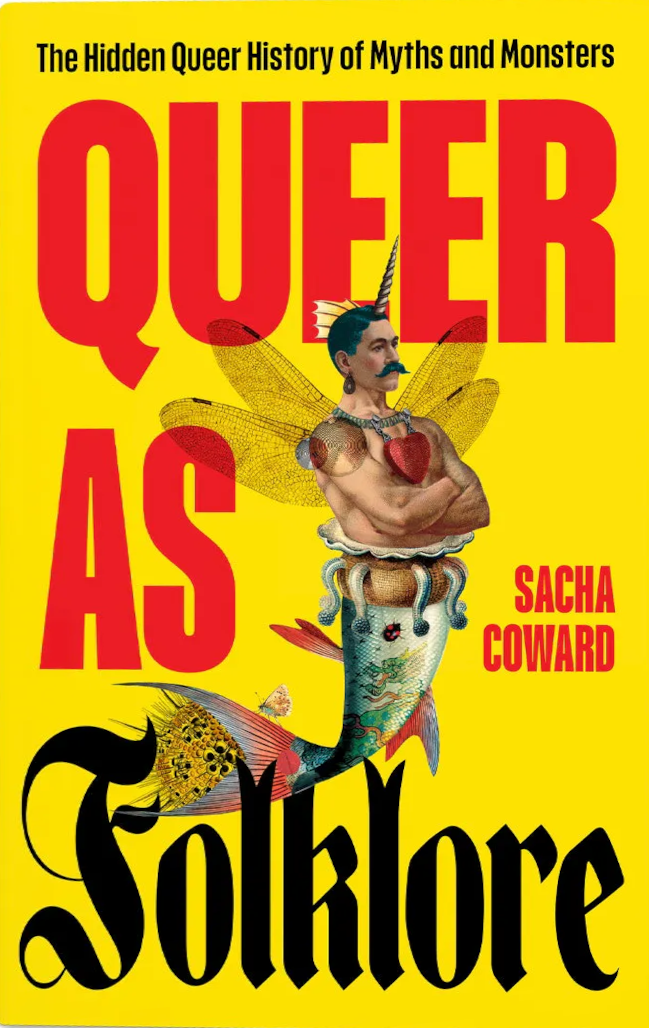
QUEER AS FOLKLORE: The Hidden Queer History of Myths and Monsters, straight-peoples' anxieties and hostilities seen from the other side

QUEER AS FOLKLORE: The Hidden Queer History of Myths and Monsters
SACHA COWARD
Unbound
$25.00 trade paper, available now
Rating: 4.5* of five
The Publisher Says: Queer as Folklore takes readers across centuries and continents which reveals the unsung heroes and villains of storytelling, magic and fantasy. Featuring images from archives, galleries and museums around the world, each chapter investigates the queer history of different mythic and folkloric characters, both old and new.
Leaving no headstone unturned, Sacha Coward will take you on a wild ride through the night from ancient Greece to the main stage of RuPaul’s Drag Race, visiting cross-dressing pirates, radical fairies and the graves of the ‘queerly departed’ along the way. Queer communities have often sought refuge in the shadows, found kinship in the in-between and created safe spaces in underworlds; but these forgotten narratives tell stories of remarkable resilience that deserve to be heard.
Join any Pride march and you are likely to see a glorious display of papier-mâché unicorn heads trailing sequins, drag queens wearing mermaid tails and more fairy wings than you can shake a trident at. But these are not just accessories: they are queer symbols with historic roots.
To truly understand who queer people are today, we must confront the twisted tales of the past and Queer as Folklore is a celebration of queer history like you've never seen it before.
I RECEIVED A DRC FROM THE PUBLISHER VIA NETGALLEY. THANK YOU.
My Review: Funny how the stories of queerness, of love between same-sex couples, are so very often found in "monster" tales, isn't it. I mean, the rise of vampire fiction as AIDS bit gay men hard is a tough sell as coincidence. Back a way we have Dr. Fankenstein building his perfect man, who then gets all freaked out because he isn't just like the other boys; we have the enduring folktale of Beauty and the Beast, as queer a metaphor as you can find; we have the Greek gods taking outlandishly unlikely forms to get off with humans.
And that's just the Western world.
In modern times there are the just barely clothed superheroes in comic-book or filmed form, flaunting their junk in our faces at $25 a ticket or graphic novel (aka comic book) with oblivious or deeply in denial boys of all ages perving on their favorite characters' amazing prowess without seeming to have a single introspective neuron firing. These hypermasculine avatars of (mostly) toxic masculinity go around destroying things with their unstoppable powers; what better way for these theater-loads of bottoms to get their desperate need to be dominated, wrecked, brutalized met safely and without admitting to themselves their need is deeply, deeply sexual? Likewise the astonishing-to-me rise of RuPaul and drag as mass entertainment...male parodies of femininity enacted for the audience's titillated amusement. There is no filmed entertainment of any sort that doesn't rely on the universal human lust for voyeurism. If I'm at all honest, that applies to literature and reading as well.
Those sour reflections out of the way, let's talk about the *fun* of it all.
The author's done a creditable job of assembling fun examples of myths and folktales that present queerness in a framework of plausible deniability, as has ever been the case. We've always been here...just have to listen to the quiet parts in between the blaring trumpets of heteronormativity. Only in recent times have we been able to say the quiet parts out loud, and it makes the control freaks and haters absolutely wild with fury that anyone could not want to be exactly like them.
Hm. I seem not to have left the sourness behind after all. Well, take the rough with the smooth, laddies and gentlewomen. I listen to unreflective heteronormativity all day every day. Listen to how it feels to be consciously aware of the receiving end of a microaggression for a change. It's never been what you meant, it's always been what the audience hears.
The audience for this survey course in queer identity is in for a treat in terms of the author's clear desire to bring us history burnished to a mellow, shadow-melting glow of inclusion. The care with which he draws lines between what modern people mean by queerness, and the often very different understandings of gender and sexuality people held in earlier times, is both commendable and clarifying. It enables us to respond honestly from within our framework to stories coming from a different framework. It's often done anecdotally, using reports of experience, so data-driven readers might not like this narrative choice. We're in the unabahedly popular arena in this book. Applying academic rigor to the way the author informs us of the existence and the resonances of queer icons in our (Western) cultural history is unwarranted.
Breadth and anecdotality (I think I just invented that word) are both strengths and weaknesses. As always. No tool cannot also function as a weapon. I did wonder at times where the heck Author Coward found his examples of modern peoples' resonances with the stories we inherited from the foreparents. At times this is my favorite thing about the read; at others, it feels...grafted on, placed too carefully to feel entirely natural.
I am mostly unhappy, to the extent I actually am, with the absence of world cultures' representation. I understand this isn't sold or described as about world cultures, but tell me in the subtitle..."The Hidden Queer History of Western Myths and Monsters, f/ex...that I'm not getting this broader focus. I promise I'd still buy and read it. So now you know where that last half-star went.
Still a good read, still a great gift, still something I want people to know is available for their amusement and edification.
Subscribe to:
Posts (Atom)