Showing posts with label history of science. Show all posts

Monday, June 8, 2026

ANDREA WULF'S PAGE: THE INVENTION OF NATURE: Alexander von Humboldt's New World; and THE TRAVELER: One Man's Quest for Humanity from the South Seas to Revolutionary Paris


THE TRAVELER: One Man's Quest for Humanity from the South Seas to Revolutionary Paris
ANDREA WULF

Alfred A. Knopf (non-affiliate Bookshop.org link)
$14.99 ebook, preorder now for delivery 9 June 2026

Rating: 4.75* of five

The Publisher Says: Step into the life and times of George Forster, the young naturalist and revolutionary who journeyed to the far reaches of the known world and whose radical ideas about humanity and freedom made waves in eighteenth-century Europe—from the bestselling author of The Invention of Nature and Magnificent Rebels.

From an early age, it was clear that George Forster possessed a brilliant mind. A polyglot and gifted scientist, he became an invaluable asset to the ambitions of his domineering father, Reinhold. As a young boy, he travelled with his father from the plains of West Prussia to the wild shores of the Volga to St. Petersburg and London on scientific endeavors, and soon became the breadwinner by publishing translations of hugely popular exploration accounts. When Reinhold Forster was offered the position of naturalist aboard Captain James Cook’s second voyage, he accepted on the condition that his seventeen-year-old son serve as his assistant.

The HMS Resolution set sail in 1772 with orders to find the hypothetical southern continent of Antarctica. On her voyage to the Antarctic Circle and the islands of the South Pacific—including New Zealand, Vanuatu, Tonga, Tahiti, and Easter Island—the Resolution carried the ambitions of the most powerful empire in the world. But George Forster brought an understanding that was centuries ahead of the attitudes of his day—his ideas belonged to the future. A remarkable observer, linguist, artist, and writer whose intelligence surpassed that of his own father, he studied the diverse cultures of the world without prejudice and sought to uncover our common humanity. He was a traveler in body and mind—not bound by place, people or establishment.

Recognized as one of Europe’s brightest minds on his return, Forster held positions across the continent and regaled the world not only with tales from his travels but also radical ideas about human nature. He would write against empire, white supremacy, and slavery. He would become a revolutionary and be declared an outlaw. He would never seek to control others as he had been controlled by his father, and even embraced a liberal idea of marriage, accepting his wife’s affairs and independence Andrea Wulf’s The Traveler recounts an extraordinary life largely forgotten by history, the tale of a man who broke with convention and was unafraid to critique the world around him in dedication to his belief in the human right to dignity, equality, and freedom.

I RECEIVED A DRC FROM THE PUBLISHER VIA NETGALLEY. THANK YOU.

My Review
: A man as astonishing as Author Wulf's previous science-biography topic, Alexander von Humboldt (see below). Forster has been brought out of obscurity at a time when his delighted curiosity in the world is curdling die to the way we as a species ignored the warnings of imbalance von Humboldt was observing and reporting on. Forster is still known to us today because he wrote of his travels extensively. He was unusual for his attention to the contributions of women and his respect for the contributions of non-whites in many fields around the world. He died before he was fifty; it's a sadness to me personally that he and Alexander von Humboldt never traveled together. As Forster was two decades older than von Humboldt, I can only dream of what the synergy in these men's inclusive, broad views might have gifted us.

A man born in 1754 writing passionately about the flimsiness and dishinesty of white supremacy, and the idiocy of the idea of dominionism deserves a wide audience in the twenty-first century. If we're going to lionize dead white men, let's lionize George Forster the proponent of equality, the supporter of women's rights, the spreader of Enlightenment values. Here's a British man worthy of our respect and deserving of emulation.

Forster's travels broadened his mind and his spirit. He was a person who saw, as his private papers show, the connections among people in a time when colonialism and sexism were drawing ever thicker lines between us. I am saddened that his first-hand observations of the idiocy and evil that Othering (in today's terminology) colonized people was exacting never gained traction. I dream of a Forster who lived to lift up Mary Wollestonecraft, who worked effectively with Revolutionary Parisians to moderate the evils inherent in destroying systems to rebuild them fairly.

Author Wulf has, as is her wont, seen past History's battlefied fog to choose another target of worth and merit to remind us how long the world has been falling from Grace.

And how many before us saw it.

Honoring their legacies by taking action seems appropriate to me. I hope you'll read this dynamically written, thoroughly researched work on an unjustly underknown thinker, and feel inspired to do just that.

++++++++++++++++++++++++++++++++++++++++++++++++++++++++++++++++


THE INVENTION OF NATURE: Alexander von Humboldt's New World
ANDREA WULF

Vintage Books (non-affiliate Bookshop.org link)
$9.99 ebook, available now

Rating: 4.75*of five

The Publisher Says: Alexander von Humboldt (1769–1859) was an intrepid explorer and the most famous scientist of his age. In North America, his name still graces four counties, thirteen towns, a river, parks, bays, lakes, and mountains. His restless life was packed with adventure and discovery, whether he was climbing the highest volcanoes in the world or racing through anthrax-infected Siberia or translating his research into bestselling publications that changed science and thinking. Among Humboldt’s most revolutionary ideas was a radical vision of nature, that it is a complex and interconnected global force that does not exist for the use of humankind alone.

Now Andrea Wulf brings the man and his achievements back into focus: his daring expeditions and investigation of wild environments around the world and his discoveries of similarities between climate and vegetation zones on different continents. She also discusses his prediction of human-induced climate change, his remarkable ability to fashion poetic narrative out of scientific observation, and his relationships with iconic figures such as Simón Bolívar and Thomas Jefferson. Wulf examines how Humboldt’s writings inspired other naturalists and poets such as Darwin, Wordsworth, and Goethe, and she makes the compelling case that it was Humboldt’s influence that led John Muir to his ideas of natural preservation and that shaped Thoreau’s Walden.

With this brilliantly researched and compellingly written book, Andrea Wulf shows the myriad fundamental ways in which Humboldt created our understanding of the natural world, and she champions a renewed interest in this vital and lost player in environmental history and science.

I CHECKED THIS BOOK OUT FROM THE PRIME LENDING SERVICE.

My Review
: Start your journey into Alexander von Humboldt's character and intellect here:
“The effects of the human species’ intervention were already ‘incalculable’, Humboldt insisted, and could become catastrophic if they continued to disturb the world so ‘brutally’. Humboldt would see again and again how humankind unsettled the balance of nature.”
This man, born the year a crucial observation of a Transit of Venus was measured, and died the year of the Carrington Event, was tied to science at both ends.

It's probably down to the fact that he was gay that he's never been lionized in US scientific education the way Lord Kelvin, Sir Humphry Davy, Leibniz, or Pasteur have. Yes, German-language output isn't hugely well-represented in general US scientific awareness to this day; if ever someone deserves an exception, it's the man who has a bay in California, a current running up our Pacific coast, and a species of giant squid found in ever-northening parts of that coast, named for him.

He was a very good writer (seriously...read Cosmos, it was as big a bestseller as On the Origin of Species by his follower Darwin and is an excellent browsing book), which led to his excellent observational science influencing multiple generations of scientists who founded new fields of study by expanding his work. His way of seeing Earth as a system is now the dominant view, expressed thusly by Author Wulf: "He saw the earth as one great living organism where everything was connected, conceiving a bold new vision of nature that still influences the way that we understand the natural world."

His writing skills were also useful in his later-life career as a diplomat, most enduringly to the Court of King Louis-Phillippe of France. I do not know of any English translations of his diplomatic correspondence, but I wager cash money they make for absorbing reading. His Prussian monarch did not compel von Humboldt to attend hid, perform diplomacy for him, because the guy was boring. He charmed his friends, he charmed the many people his scientific and diplomatic duties brought him into contact with, he charmed several younger men enough that one of them, a Peruvian aristocrat, got jealous enough when he was dumped...that's so unkind, let's say left behind when von Humboldt departed...that he leveled the accusation of our guy visiting a Quito brothel for men who like men. von Humboldt was known to be "like that" but, as always, exceptional talent...and a lack of a widely used "scientific" term for men romantically and sexually interested in other men like "homosexual"...gets judged by other rules. Author Wulf doesn't delve into this aspect of his life, though it's interstitially there; her focus is instead on the immensity, the Forrest-Gumpian breadth of his social circle, and drawing some conclusions about his influence that veer into Great Man Theory territory. I'm not all the way able to get past that discomfiting adulatory tone, despite feeling its pull very strongly. I'd give this read five or even six stars of five with some critical distance baked in; as it is four-and-three-quarters give me wiggle room fo work out my squeam.

It's a long read, it's an impactful resuscitation of a reputation very sadly in need of it among Anglophone readers, and if imperfect is still a very great pleasure to read.

Wednesday, May 27, 2026

A BIRD'S IQ: Innovation, Intelligence, and Problem Solving in the Avian World


A BIRD'S IQ: Innovation, Intelligence, and Problem Solving in the Avian World
LOUIS LEFEBVRE
(tr. Pablo Strauss)
Greystone Books (non-affiliate Bookshop.org link)
$28.00 all editions, available now

Rating: 4.5* of five

The Publisher Says: For readers of Jennifer Ackerman comes a captivating exploration of avian intelligence that challenges traditional wisdom about animal cognition.

Surveying a wide variety of birds, including crows, finches, tits, and parrots, Louis Lefebvre, a world-renowned expert in animal behaviour, describes the remarkable innovations and problem-solving abilities of species often dismissed as ‘featherbrains’. From crows using cars as nutcrackers to cockatoos crafting tools, Lefebvre reveals how birds exhibit creativity, social learning, and even cultural transmission — traits once thought to be exclusive to humans and other primates.

Blending his decades of scientific research with engaging anecdotes, Lefebvre examines the evolutionary forces that have shaped avian intelligence. He explores how birds adapt to urban environments, innovate in response to challenges, and pass down knowledge across generations. This goldmine of bird behaviour yields an ‘innovation quotient’ widely used by researchers to measure and rank how innovative a bird species is. Using his encyclopaedic knowledge, Lefebvre answers questions such as:
  • When a bird species learns a new technique, how do their innovations spread?
  • Why is research on bird cognition being used to train AI models and even robots?
  • What makes certain birds endlessly innovative while others stubbornly repeat the same behaviors?
  • When a bird species learns a new technique, how do their innovations spread? Why is research on bird cognition being used to train AI models and even robots? What makes certain birds endlessly innovative while others stubbornly repeat the same behaviours? With vivid storytelling and groundbreaking insights, A A Bird’s IQ invites readers to reconsider their perceptions, celebrating the ingenuity of birds and highlighting the interconnectedness of all intelligent life.

    I RECEIVED A DRC FROM THE PUBLISHER VIA EDELWEISS+. THANK YOU.

    My Review
    : I loved this read. I am, as I think those familiar with my writing over the years will know, a corvidophile...crows particularly but ravens and magpies as well...as I find their intelligence palpable. It is obvious to me that I am in the presence of a sentient being when I'm around corvids, there's that recognition of fellowship that really can't be denied. Or I can't deny it anyway.

    Author Lefebvre seems to have had a similar experience though not specifically with corvids. His research into the intelligence of birds is built on a much longer tradition of inquiry into the subject than I ever suspected. It's a big part of my pleasure in reading this book to learn as much as I did about the history of research into avian intelligence. It felt as though I was sitting in an armchair next to him, having a wide-ranging conversation about science and its history wherein he answered my questions without my actually vocalizing them. It sounds fanciful, I know, but it was my emotional experience of this kind of intimacy that made the read so different from other popularizations of important scientific study.

    It really isn't a bit surprising that I'd have this experience while reading A Bird’s IQ when you learn that Author Lefebvre is also a novelist...one nominated twice for Canada's Governor General's Award for French-language fiction, so clearly possessed of solid narrative-creation chops. I liked the experience I had learning about the intelligence of dinosaurs which is where I'm clearly going to go since I'm still an eight-year-old when it comes to dinosaurs. (And yes, birds are unquestionably dinosaurs.) It can, however, lead to a bit of prolixity about what the kids (ie anyone under fifty) seem to like calling "side quests" into matters like a scientist's name-change, or the challenges of gathering usable data from birding-centered magazines published in England between the World Wars. Fascinating, but better left in the source notes.

    If I have a moment of...hesitation, let's call it, about some of Author Lefebvre's contentious assertions about cultural transmission of knowledge in bird populations, it's one that Author Lefebvre foresaw and forestalled by couching his contention of this fact in careful terms. The anecdotal evidence for this method of learning in bird populations is voluminous. It's not rigorous scientific data, and Author Lefebvre, to his credit, never tries to present it as such. He also very specifically states he does not share Rupert Sheldrake's more controversial ideas about how that kind of knowledge transmission could take place. As I am a bit uncomfortable with presenting that body of knowledge as scientific myownself, I am in harmony with Author Lefebvre on this point.

    As I am very much a satisfied reader of this book, I want to assure all who read this review that it's not perfect in my eyes, or in the author's. It is an interim progress report on a career's-worth of experience, knowledge-gathering, and synthesis. It's well presented. It's well sourced. It's mae to bring fundamentals of the topic to broad attention, and couched in language that does this unintimidatingly well. It also affords the author's scientific peers access to his resources and his thinking leadiing to the conclusions presented...all in the same sentences and style. And, of the greatest value to both audiences, Author Lefebvre does not present his case as closed, does not claim a unique and conversation-ending breakthrough is in the text.

    He is too sensible of work needing to be done and too respectful of the contributors to the overall field of research into intelligence. I was never more surprised in the read than when I learned how much two-way influence into robotics and "AI" there was. A story of how we got to where we are, and how much where we are has resonances beyond the obvious, in using our own intelligence to understand intelligence, expand its impact, and...I hope...gain humility about ourselves by learning about and from those unlike us.

    Wednesday, February 25, 2026

    PICKY: How American Children Became the Fussiest Eaters in History, Dr. Spock has a LOT to answer for


    PICKY: How American Children Became the Fussiest Eaters in History
    HELEN ZOE VEIT

    St. Martin's Press (non-affiliate Bookshop.org link)
    $14.99 ebook, available now

    Rating: 4.5* of five

    The Publisher Says: An eye-opening investigation into why American kids no longer eat broadly and with gusto

    Are children naturally picky? It sure seems that way. Yet, amazingly, pickiness used to be almost nonexistent. Well into the 20th century, Americans saw children as joyful omnivores who were naturally curious and eager to eat. Of course, this doesn't make sense today. Don't kids have special taste buds? Aren't they highly sensitive to food's texture and color? Aren’t children incapable of liking “adult foods,” and don’t parents risk harming kids psychologically by urging them to eat?

    But Americans in the past didn’t think any of those things. They assumed that children could enjoy the same foods as adults, and children almost always did. They loved spicy relishes, vinegary pickles, and bitter greens. They spent their allowances on raw oysters and looked forward to their daily coffee. So how did modern kids become such incredibly narrow eaters? The story is fascinating – and about much more than rising abundance. Picky shows how fussy eating came to define "children’s food" and reshape American diets at large. Maybe most importantly, it explains how we can still use the tools that parents used in the past to raise happy, healthy, wildly un-picky kids today.

    I RECEIVED A DRC FROM THE PUBLISHER VIA NETGALLEY. THANK YOU.

    My Review
    : I wasn't a picky eater because I was raised by parents who loved food. I'm so grateful to them for the lesson they each taught: "try it, if you don't like it you don't have to finish it."

    I'm also old. This message was more common among the Depression-era denizens who raised me than postwar-boom kids who raised the picky eaters we're discussing in this book.

    As "experts" got hold of the conversation around food (author's scare quotes), the wheels came off. We know from decades of research findings being reported and then challenged, the "experts" (remember, not my scare quotes!) have been tarred by the backlash that keeps growing against expertise in general. It feels kind of justified to me, in this case, because there are no real reasons that the advice the "experts" gave should have been heeded as none of them made any sense at all. But, well, expertise needs to be respected. It's the world now that does NOT respect expertise that's in terrible trouble.

    Author Veit has researched the question "is a generation of US-born kids pickier in their food choices than earlier generations?" and presented findings and posited reasons for the findings. It is a fascinating topic. The sources are broad-based and wide-ranging; cited in line which I appreciate; and to the extent I randomly sampled credible. What they aren't, and what the book itself isn't, is prescriptive. Nowhere in the text is there a solution to a problem identified. It was not promised, it was not suggested in the research sources to be intended; I bring it up because I don't want to give the impression there is anywhere anything about addressing the behavior being studied.

    I get the impression that the title led previous readers down that garden path. Don't be one of them! I'm interested in the subject of picky eating because it seems so absurd to allow it. I was glad to read Author Veit's study because I feel much less...superior...about the realities of the issue. I think there's a lot of value in this lens on our present social moment's roots and results. I felt there was genuine curiosity, a real "I need to know" on the author's part, and I resonated with that feeling. It gave me a four-star reading experience. I was impressed with her research, her cogitations on the research, and convinced by her conclusions based on them. I was perhaps less drawn in than I might have been by the shifts I felt between the presentation of her digests of research and the chattier tone of her presentation of her conclusions drawn from it...this was more like feeling some charming cocktail-party acquaintance was suddenly taking me into the lecture hall.

    Entirely irrelevant to the value I received from the read. It was a factor that impacted me on a reading-pleasure level alone. You might feel entirely differently. I hope you will get the book to find out for yourself.

    Monday, February 23, 2026

    I TOLD YOU SO!: Scientists Who Were Ridiculed, Exiled, and Imprisoned for Being Right, organizations always protect orthodoxy


    I TOLD YOU SO!: Scientists Who Were Ridiculed, Exiled, and Imprisoned for Being Right
    MATT KAPLAN

    St. Martin's Press (non-affiliate Bookshop.org link)
    $15.99 ebook, available now

    Rating: 5* of five

    The Publisher Says: An energetic and impassioned work of popular science about scientists who have had to fight for their revolutionary ideas to be accepted—from Darwin to Pasteur to modern day Nobel Prize winners.

    For two decades, Matt Kaplan has covered science for the Economist. He’s seen breakthroughs often occur in spite of, rather than because of, the behavior of the research community, and how support can be withheld for those who don’t conform or have the right connections. In this passionately argued and entertaining book, Kaplan narrates the history of the 19th century Hungarian physician Ignaz Semmelweis, who realized that Childbed fever—a devastating infection that only struck women who had recently given birth—was spread by doctors not washing their hands. Semmelweis was met with overwhelming hostility by those offended at the notion that doctors were at fault, and is a prime example of how the scientific community often fights new ideas, even when the facts are staring them in the face.

    In entertaining prose, Kaplan reveals scientific cases past and present to make his case. Some are familiar, like Galileo being threatened with torture and Nobel laureate Katalin Karikó being fired when on the brink of discovering how to wield mRNA–a finding that proved pivotal for the creation of the Covid-19 vaccine. Others less so, like researchers silenced for raising safety concerns about new drugs, and biologists ridiculed for revealing major flaws in the way rodent research is conducted. Kaplan shows how the scientific community can work faster and better by making reasonably small changes to the forces that shape it.

    I RECEIVED A DRC FROM THE PUBLISHER VIA NETGALLEY. THANK YOU.

    My Review
    : I'm not often surprised by the organization of non-fiction, at least not in a positive way. In the case of this book, I expected it to be split into chapters, perhaps chronologically presented, by the scientist under discussion. Instead I got a very effective, more fluidly narrative, organization by...umm...style of heresy, shall we say.

    Because that's really what this book traces. Heresy, thank you Wikipedia, is "any belief or theory that is strongly at variance with established beliefs or customs, particularly the accepted beliefs or religious law of a religious organization." Any organized field of study with a governing body, a code of ethics, and professional credentialing requirements from the Society of Vertebrate Paleontology (SVP) to the American Medical Association (AMA) has orthodoxies, has institutional biases, has entrenched powers in the field that do not welcome viewpoints or research findings or demonstrations that question or...horripilation!...disprove their beliefs. It's human nature.

    Yet there will always be the mavericks who try to do exactly that. The professional trouble they face is in direct proportion to their success in the challenge. Often they're treated as whistleblowers. It is an ugly truth of human nature that the powerful protect themselves before all other considerations, and science is a human endeavor that attracts lots of money so it behaves this way in spades.

    It's more notable in the sciences because they each and all depend for their existence, let alone progress, on the people who live out the Asimov-attributed quote: "The most exciting phrase to hear in science, the one that heralds new discoveries, is not “Eureka!” (I found it!) but “That’s funny…” (though the attribution seems to be spurious)".

    I myownself am most personally impacted by the work done by maverick genius Katalin Karikó (featured in this book), whose mRNA discoveries led to the creation of COVID vaccines of enormous effectiveness. I live among smokers, old people, and the enfeebled. I got COVID several times, and unlike over fifty of the people in my facility who died, was never even hospitalized. I was miserably sick once, mildly ill once, and would never have known it was more than a mild cold twice had I not taken a home test which would never have existed before her work made it conceivable). You better believe I get my flu and COVID vaccines annually, and they would not have existed had a heretical voice in medical research not refused to be silenced.

    Read this fascinating work celebrating the contrarians, the heretics, the whistleblowers who disrupt the cozy, never-change, "shut up and calculate" hierarchies inherent in institutional science. (And all other fields, of course.) Read it because you benefit from their work; read it because they're interesting people; read it because your culture would not *exist* without them.

    But read it mostly because it's really very good. It's a job of writing that, on its own merits, I'd give four and a half stars to; the extra half-star is my acknowledgement of how very, very urgently we need mavericks and contrarians when we are facing multiple existential challenges and crises that science has both created and is uniquely able to solve...only not with the orthodox thinking that got us here.

    Preorders are being taken. Ask your library to get copies. But pay attention to message and delivery!

    Wednesday, February 11, 2026

    THE CURE FOR EVERYTHING: The Epic Struggle for Public Health and a Radical Vision for Human Thriving


    THE CURE FOR EVERYTHING: The Epic Struggle for Public Health and a Radical Vision for Human Thriving
    MICHELLE A. WILLIAMS
    with Linda Marsa
    One World (non-affiliate Bookshop.org link)
    $13.99 ebook, available now

    Rating: 5* of five

    The Publisher Says: The inspiring story of how we overcame a history of infectious disease, poisonous environments, and early death and unlocked an explosion in human potential—and a vision for the work ahead to optimize human flourishing in the twenty-first century

    Public health is an unusual discipline—a combination of science, sociology, politics, and logistics—with a simple goal: to create the conditions for human thriving. Despite a century of massive improvements in our health and quality of life, Americans—reeling from our disastrous pandemic response, epidemics of depression and isolation, and a failing healthcare system—are understandably distrustful of public health. But the true history of public health doesn’t just reveal one of the greatest feats in human history—our great escape from early death and infectious disease—it points toward a future of even greater improvements. The cure for everything? It’s all of us, working together for our collective health.

    Michelle A. Williams, one of the country’s true innovators in public health, here tells the dramatic hidden history of public health in America: a story of how radicals and renegades—from W.E.B. Du Bois to Alice Hamilton to the activists of ACT UP—and the institutions and infrastructure we built together helped transform our world. As she takes readers through these dramatic stories, she draws out their deeper lessons. In the end, she makes a powerful argument that it is public health that should drive our country’s policies and politics—that if our policies fail to increase the health and well-being of everyone, regardless of race or economic status, we have failed as a society.

    Here is a dramatic, sweeping history with a galvanizing vision for how we can address new threats and complete the unfinished business of public health.

    I RECEIVED A DRC FROM THE PUBLISHER VIA NETGALLEY. THANK YOU.

    My Review
    : Public health, in thae definition fronted by Wikipedia, is "the science and art of preventing disease" and I have only one quibble with this as a jumping-off point for studying the subject: the phrase is rightly "art, and science, of preventing disease."

    Firstly the art of medicine is best acknowledged as such; secondly the science is a fully separate topic the way I've punctuated it. Both are crucial, essential components of the field we call "public health," along with huge doses of politics and other coalition-building matters. Author Williams has an impressive and extensive CV that demonstrates her knowledge of public health is not solely theoretical. Make no mistake, in a career of fortyish years Author Williams has worked on tough health problems as far afield from academia as Haitian perinatal health.

    A wad of notes, a premise that explains her career, a publisher excited to present the book. It's all gone right so far. How about the story she's telling?

    I came into adulthood as AIDS was making itself known. I had an anti-vaxxer mother who lied to the schools I attended that of course I'd been vaccinated! I hadn't apart from polio when I was two, my father...polio survivor himself...had it done and her fury was loud and scary to tiny little me, and smallpox, when my doctor just did it and told her afterwards she was an idiot and to pull her head out of her ass (in those words) and remember her little brother's death (he had been her own doctor in childhood). No others, no MMR, no DPT, I got the diseases instead. My interest, then, in the topic is rooted in personal experiences I wouldn't wish on anyone not named Trump.

    Author Williams speaks to me directly by speaking of the people, the movers and shakers, the subversive insurgents, the deeply humane empaths and the policy wonks who completely devoted themselves to bettering the lives of their fellow humans. I really expected the read to leave me more admiring than impressed. It left me both. I don't think the prose, largely (I assume) penned by health-focused journalist Linda Marsa, is noteworthy, in either elegance or lack thereof. It is precise, it is selected with an aim in mind to inform, to convey huge swaths of research without making the layperson feel talked down to or left behind. It is a successful effort. It is a hugely important story of one of the most astounding, and undercelebrated, achievements made by individual people moving massive inertial forces by dint of sheer stubborn refusal to give up. These many people who worked to find reasons for catastrophes of preventable deaths on a scale I myownself quail before are celebrated and named. Their contributions are brought to your eyes for what is very often the first time.

    I give the book all five stars because I have not read a more succinct, informative treatment of a subject within the history of science that is more pleasantly conversational, less irritatingly superior of tone, or more urgent to grasp. We are witnessing an appalling and potentially lethal dismantling of a system dedicated to public health. It behooves each of us to learn as much as possible about how we achieved the heights before we are cast back into the depths. It will, I expect, create a lot of new advocates for our threatened public health system.

    Thursday, November 13, 2025

    GEMINI: Stepping Stone to the Moon—The Untold Story, the Moon landing's precursor


    GEMINI: Stepping Stone to the Moon—The Untold Story
    JEFFREY KLUGER

    St. Martin's Press (non-affiliate Bookshop.org link)
    $16.99 ebook, available now

    Time's The 100 Must-Read Books of 2025 selection

    Rating: 5* of five

    The Publisher Says: From the bestselling author of Apollo 13 comes the thrilling untold story of the pioneering Gemini program that was instrumental in getting Americans on the moon.

    Without Gemini, there would be no Apollo.

    After we first launched Americans into space but before we touched down on the moon’s surface, there was the Gemini program. It was no easy jump from manned missions in low-Earth orbit to a successful moon landing, and the ten-flight, twenty-month celestial story of the Gemini program is an extraordinary one. There was unavoidable darkness in the program—the deaths and near-deaths that defined it, and the blood feud with the Soviet Union that animated it.

    But there were undeniable and previously inconceivable successes. With a war raging in Vietnam and lawmakers calling for cuts to NASA’s budget, the success of the Gemini program—or the space program in general—was never guaranteed. Yet against all odds, the remarkable scientists and astronauts behind the project persevered, and their efforts paid off. Later, with the knowledge gained from the Gemini flights, NASA would launch the legendary Apollo program.

    Told with Jeffrey Kluger’s signature cinematic storytelling and in-depth research and interviews, Gemini is an edge-of-your-seat narrative chronicling the history of the least appreciated—and most groundbreaking—space program in American history. Finally, Gemini’s story will be told, and finally, we’ll learn the truth of how we landed on the moon.

    I RECEIVED A DRC FROM THE PUBLISHER VIA NETGALLEY. THANK YOU.

    My Review
    : First, read this:
    America would ultimately celebrate Mercury and Apollo—its first venture into space and its first venture to another world—louder and longer and with more passion than it would celebrate Gemini, the middle sibling of the manned space program. But it was Gemini that taught the US to live in space, to work in space, to walk in space, to thrive in space. Without Gemini, men would never have walked on the moon. The green shoots of space habitation poked up in the soil that was the Gemini program. Sixteen men flew those ten missions—and those same sixteen men have never been fully celebrated for the greatness they exhibited. Let history right that wrong at last.
    I was alive, and eagerly obsessed, for the whole space race. I honestly forgot Gemini existed until I was reminded by this book. I'd say the author got his thesis exactly right...we needed the knowledge gained by the Gemini program to land on the moon, but once that happened, we rather forgot the Gemini program that taught us the lessons.

    So I read this fascinating, detailed recapitulation of all the many milestones the Gemini and its personnel achieved, the engineers as well as the astronauts, the designers and testers and troubleshooters...all making important contributions to the pursuit of real knowledge. I was as exciting to me as it was when I watched Uncle Walter (Cronkite) carefully elucidating the sheer miraculous science underpinning these incredible achievements.

    As an old man I'm more aware of the reasons the space race took place. I'm still astounded that the Congress appropriated that much money to accomplish these scientific goals. I'm still sad that the education budget was ever-expanding then because we wanted our country to have the knowledge base to solve these sorts of problems to achieve the goal of solving them, no matter it was for a political game of one-upsmanship. We now have a system that's not interested in this kind of goal anymore. "AI" is a cash grab and a thought-control mechanism, not a pursuit of knowledge that resulted in huge advances in chemistry and engineering and electronics that ended up benefiting the general public.

    Gemini's technical achievements were lovely to recall because the public was very invested in their success. I remember the techno-optimism of the era with wistful amusement. I'd love to see something get the hoi polloi reinvested in expanding human knowledge for the simple reason that it is a worthy goal. Alas....

    I deeply enjoyed the period headlines, reimmersing me into the era's emotional valence; I was delighted that there were notes and a bibliography to allow me to follow the author's thought processes; I appreciated the clarity of the technical talk, the way the jargon was explained (though one is expected to recall the details, they aren't continually restated) in context.

    The audience for the story is me: someone who wants technical explanations with context, not a social history with some jargon sprinkled in. Put in the effort and the story's rewarding. The telling in non-fiction terms might not work for you, so I recommend reading a Kindle sample to see if you resonate positively with Author Kluger's writing.

    My fellow elderly kids of the 1960s might really love this as a Yule gift. I know I'd've been thrilled by it had I received it as a gift!

    Saturday, December 14, 2024

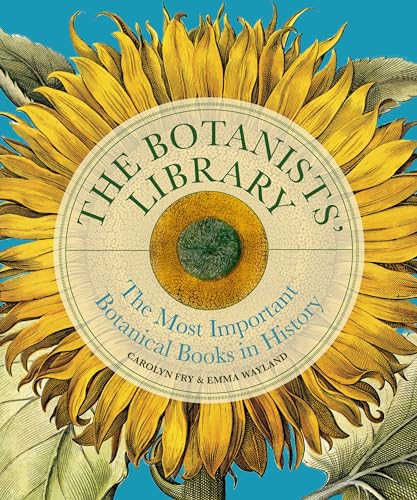
    THE BOTANISTS' LIBRARY: The Most Important Botanical Books in History is one gorgeous book...even on a tablet!


    THE BOTANISTS' LIBRARY: The Most Important Botanical Books in History
    CAROLYN FRY & EMMA WAYLAND

    Ivy Press (non-affiliate Amazon link)
    $40.00 hardcover,available now

    Rating: 4.5* of five

    The Publisher Says: Discover a vast treasure trove of botanical knowledge in The Botanist’s Library, a superbly illustrated collection of 300+ seminal books and illustrations from throughout history.

    From the earliest manuscripts penned by visionary naturalists, to the modern tomes that continue to shape our understanding of the plant kingdom, this book is a testament to the tireless dedication of the world's greatest botanists. Its compelling narrative and visual journey make it a must-have addition to the library of anyone fascinated by the beauty and complexity of the plant kingdom.

    This complete guide traces the development of botanical science through era-defining publications, covering:
  • Historia Plantarum, the first history of botany, written between c. 350 BC and c. 287 BC, in which Theophrastus described plants by their uses, and attempted a biological classification, based on how plants reproduced, to the authors of the herbals of the 16th century
  • Brunfels, Fuchs, Bock and Mattioli, who regarded plants as the vehicles of medicinal virtues
  • The golden age of the 18th- and 19th-century flower hunters, who travelled to every corner of the world in search of new and exotic plants
  • Today’s most significant works of botanical reference
  • Each chapter delves into the pages of a seminal work, unveiling the insights, controversies, and stories behind the books that have shaped our understanding of the plant world. Whether you are a seasoned botanist, a budding enthusiast, or simply someone with an insatiable curiosity about the natural world, The Botanist's Library offers a comprehensive reference that will enrich your understanding of botany and its evolution.

    I RECEIVED A DRC FROM THE PUBLISHER VIA EDELWEISS+. THANK YOU.

    My Review
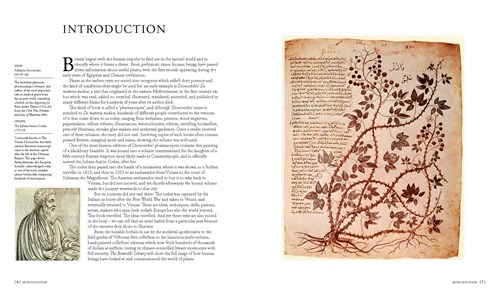
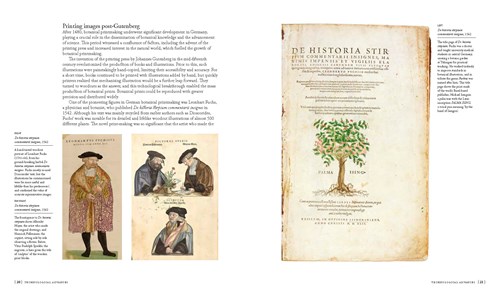
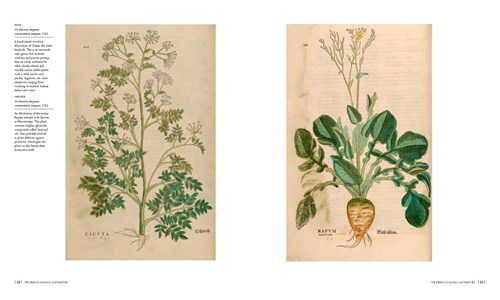
    : Looking at beautiful books is only made more satisfying when they are books about books. Here we have a book about the reasons for, the history and contributions of, and the need to preserve, ancient books of botany. The topics of botany's history, its centrality to the development of science and the scientific method, and...surprisingly to me...the art of printing get a pretty thorough overview here. Centuries of work by many talented people including women (at a time when that was not normal) are laid before what I expect will be your admiring gaze.

    These sample spreads will show you just how well the authors and the publishers understood what the assignment was:

    Why did I, after saying only laudatory things, knock a half-star off this beautifully illustrated, well-written book's score? I have a quibble with a thorough book promised and a truncated one delivered. The subject is huge, this book shouldn't be called a "comprehensive reference." An entire physical library can be, and has been more than once, dedicated to even just the scientific edges of the topic. It's not possible to do a comprehensive anything on a subject of this age and magnitude.

    That doesn't mean this utterly gorgeous object should not find its way to your coffee table for Yule. It should. I viewed it on my Galaxy tablet and it looked spectacular, so assuming you're not looking at it on an ereader, a digital version for yourself if you're gifting a hardcover to someone you love like sixty will give you value for dollar spent.

    Friday, December 22, 2023

    THE JANUS POINT: A New Theory of Time, difficult, worthwhile read for #Booksgiving


    THE JANUS POINT: A New Theory of Time
    JULIAN BARBOUR

    Basic Books
    $32.00 hardcover, available now

    Rating: 4* of five

    The Publisher Says: In a universe filled by chaos and disorder, one physicist makes the radical argument that the growth of order drives the passage of time — and shapes the destiny of the universe.

    Time is among the universe's greatest mysteries. Why, when most laws of physics allow for it to flow forward and backward, does it only go forward? Physicists have long appealed to the second law of thermodynamics, held to predict the increase of disorder in the universe, to explain this.

    In The Janus Point, physicist Julian Barbour argues that the second law has been misapplied and that the growth of order determines how we experience time. In his view, the big bang becomes the "Janus point," a moment of minimal order from which time could flow, and order increase, in two directions. The Janus Point has remarkable implications: while most physicists predict that the universe will become mired in disorder, Barbour sees the possibility that order — the stuff of life — can grow without bound.

    A major new work of physics, The Janus Point will transform our understanding of the nature of existence.

    I RECEIVED A DRC FROM THE PUBLISHER VIA NETGALLEY. THANK YOU.

    My Review
    : On the Solstice, I think a lot about time. Why time's arrow only points in one direction, for example. I am always bothered by the implication inherent in the laws of physics that we presently understand that this is an observational artifact, not part of the structure of physics.

    While I sit and ponder the strange dichotomies between what we observe and what theory tells us is possible, Author Barbour sets himself the task of learning the why, and questioning the how, of all the factors in physics that determine this issue's boundaries. That is an immense task.

    It is also one well beyond most people's educational, vocational, and experiential capacities. The author isn't writing an academic paper in this book. He is, however, presupposing a lot of knowledge on the reader's part...if you don't know what a Boltzmann brain is, for example, this book will be lost on you...and even for those with the requisite grounding in at least the people who created the outlines of the Standard Model of particle physics, the need for frequent research breaks, aka "fallings down the many rabbit holes", is ever-present.

    Very much not a Wikipedia-level treatment of an immensely important topic being argued, studied, researched, and pondered by some of the best-furnished minds in the field of physics today; yet it does not repel boarders with its case-shot loaded cannons of erudition. Author Barbour is quippy and quotable. The problem is quoting him won't help. This is someone with a very broad grasp of physics, history, cultural anthropology, etc. He lays out arguments that I suspect I only dimly grasp for his new model of endlessly repeatable order, ie creation of matter instead of its inevitable and complete decay, grounded in all the currents of thought there are.

    Not, as you'd expect, a mere bagatelle to be consumed of an evening. Took me two years to read it, and I regret not a page or a minute of it. I was rewarded with a greatly expanded idea of what the science of physics is reaching for in its quest for a unified theory.

    At this #Booksgiving moment, self-gifting this immensely challenging and deeply absorbing book is a great way to invest in your brain's expansion in entirely new ways and directions. It will be a Project. It is also well worth your eyeblinks.

    THE IDEA OF THE BRAIN: The Past and Future of Neuroscience, very readable treatment of the State of the Art in neuroscience


    THE IDEA OF THE BRAIN: The Past and Future of Neuroscience
    MATTHEW COBB

    Basic Books
    $32.00 hardcover, available now

    Rating: 4* of five

    The Publisher Says: A powerful examination of what we think we know about the brain and why—despite technological advances—the workings of our most essential organ remain a mystery.

    For thousands of years, thinkers and scientists have tried to understand what the brain does. Yet, despite the astonishing discoveries of science, we still have only the vaguest idea of how the brain works.

    In The Idea of the Brain, scientist and historian Matthew Cobb traces how our conception of the brain has evolved over the centuries. Although it might seem to be a story of ever-increasing knowledge of biology, Cobb shows how our ideas about the brain have been shaped by each era's most significant technologies. Today we might think the brain is like a supercomputer. In the past, it has been compared to a telegraph, a telephone exchange, or some kind of hydraulic system. What will we think the brain is like tomorrow, when new technology arises? The result is an essential read for anyone interested in the complex processes that drive science and the forces that have shaped our marvelous brains.

    I RECEIVED A DRC FROM THE PUBLISHER VIA NETGALLEY. THANK YOU.

    My Review
    : The brain...the thing that is translating these geometric shapes on a screen into words, ideas, thoughts...is weirdly pulled apart and put together again in our age of tecnological marvels, yet lacking a paradigmatic metaphor. The many paradigms that we've fitted around our brains since we figured out the ancient system of thinking that had the heart at the center of intellect worked fine...until they broke trying to explain new data on brain function.

    Well, you might think, so what? They're metaphors, not facts.

    That's true as far as it goes. The role of a paradigmatic metaphor, like the best we have today of a supercomputer, isn't just to provide useful handles to grasp the still-elusive overarching explanation of what, how, and why the brain is and does. Thomas Kuhn, philosopher of science, said (in essence) that paradigms work until they don't and until new paradigms emerge, progress stalls.

    That is where we stand now, atop a mountain of recently acquired data that blows up the supercomputer metaphor, but without another paradigmatic metaphor to shift to. We need, in short, another great leap forward like Darwin's theory of evolution was for millennia of accumulated biological data, to help us see how this immense pile of information can be turned into a fuller and more useful understanding of the brain and its processes.

    While this is not the most fluffy and amusing read of 2023, it was deeply informative and very much an eye-opener. I had thought the neurologists were much farther behind the other sciences than they, in fact, are...much has been learned with the existence of fMRI machines and the technological like. The downside of these sorts of advances come when the private sector steps in to monetize the discoveries. They have no interest in helping people with the tech advances unless there's profit in it. The story of a severely epileptic woman whose life was completely changed by a brain implant being developed by a start-up, which then went bust, and the device (patent-protected) was permanently turned off, was particularly illustrative of the issue's costs.

    Readable, informative, trenchant. Not easy to digest, but repays the effort put in with a very expanded view of whre science has come after its explosive beginnigs. Made me eager to see what comes next.

    If, that is, I live that long...look how long it was between Linnaeus inventing the idea of species and Darwin explaining how they came to be in the first place.