Showing posts with label 1590s setting. Show all posts

Wednesday, April 9, 2025

PERSPECTIVE(S): A Novel, Laurent Binet being his most sibylline self


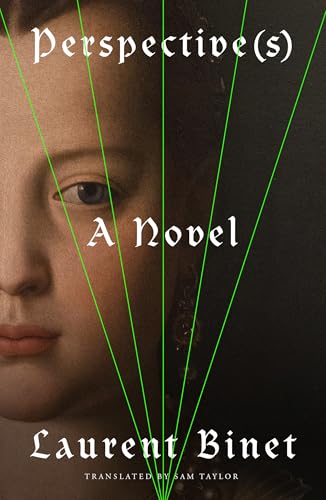
PERSPECTIVE(S): A Novel
LAURENT BINET (tr. Sam Taylor)
FSG (non-affiliate Bookshop.org link)
$18.00 paperback, available now

Rating: 4.5* of five

LONGLISTED for the 2026 Dublin Literary Award...the shortlist of six will be announced on 7 April 2026, the winner(s) in May's festival.

The Publisher Says: A pulse-quickening murder mystery set in Renaissance Florence by the renowned author of HHhH.

As dawn breaks over the city of Florence on New Year’s Day 1557, Jacopo da Pontormo is discovered lying on the floor of a church, stabbed through the heart. Above him are the frescoes he labored over for more than a decade—masterpieces all, rivaling the works of Michelangelo in the Sistine Chapel. When guards search his quarters, they find an obscene painting of Venus and Cupid—with the face of Venus replaced by that of Maria de’ Medici, the Duke of Florence’s oldest daughter. The city erupts in chaos.

Who could have committed these crimes: murder and lèse-majesté? Giorgio Vasari, the great art historian, is picked to lead the investigation. Letters start to fly back and forth—between Maria and her aunt Catherine de’ Medici, the queen of France; between Catherine and the scheming Piero Strozzi; and between Vasari and Michelangelo—carrying news of political plots and speculations about the identity of Pontormo’s killer. The truth, when it comes to light, is as shocking as the bold new artworks that have made Florence the red-hot center of European art and intrigue.

Bursting with characters and historical color, Laurent Binet’s Perspective(s) is a whodunit like no other—a labyrinthine murder mystery that shows us Renaissance Florence as we’ve never seen it before. This is a dark, dazzling, unforgettable read.

I RECEIVED A DRC FROM THE PUBLISHER VIA NETGALLEY. THANK YOU.

My Review
: From the framing device of a trove of discovered letters forward, this book represents the kind of games I most enjoy authors playing. Binet's the son of an historian, and it shows...for good and ill. The good is the playfulness of his choices to focus narrative attention on; the ill is his necessary fictionalizing of real figures of the well-studied past at times slipping into...absurdity, silliness, OTT recherche Proustian locutionary excess?...well, too-muchness, anyhow.

It is, I'll say clearly and now, well worth the effort to accept without engaging too much critical overdrive. (My worst readerly failing.)

Sort out fact from fiction exactly as much as suits you; nothing in your pleasure will change knowing more than you're told on the pages of the story about the people (note I did not say characters) on these pages. The murdered man emerges as we all do from the memories of those around us, as a blurry-edged shadow. It is unclear to me if he was actually guilty of lèse-majesté—and I do not care to establish this. Or any other of the many interesting side-lights Author Binet shines onto Savonarola's Florence. (I'd be a really bad puritan. I've always got a question they don't like, and am absolutely guaranteed to perform every sex act they abominate...in public, to show how they can't tell *me* what to do!)

The character Vasari is, in a word, adroit. No matter what he's asked to do, or be, or fix, he's got it, understands the assignment and the subtext, has a guy who knows a guy on his side. It's always good to know a Vasari because he might be oily but he's effective. People in power love Vasari-type guys. If you're the guy he knows who's got the connections he can use, you will never get public credit—that's all his—but he won't forget you. Until he does.

No, not a bestie to rely on, but a great guy to read about, and a top-notch sleuth.

As the pages flew by I realized I was in that reading flow state that's ever elusive. I was deep into Author Binet's imagination (Michelangelo as gossipy old queen, Marie de'Medici as old queen in political hot water) and unaware of the ever-advancing hour. When I closed the cover at two-thirty, I was sad to see it all end. I'm not sure why the very slightly repetitious recaps Binet's Vasari offers the reader to explain the resolution of the killing didn't weigh more heavily on my pleasure in the read...my conclusion is that I like Vasari's very natural-feeling shifts in tone. These do, however, slow the story's roll a but more than I myownself would prefer (that missing half-star above). Vasari is, as mentioned before, an operator, so he's bound to have different conversational registers for different people. In an epistolary novel that's both easy to present and easy to explain. No one in this collection of invented letters has an overview of the situation, just one corner of the composition, so everyone's responding to events as honestly as they feel safe doing; but they're all watching their tone because this was a dangerous time (see link to Savonarola above). It's similar to the effect of my doted-on The Case of Cem.

I'm delighted with this read. I'm recommending it to most all y'all because it's fun to see an author summon the attitudes of people long-dead in this honest, ambivalent way. I don't think the readers averse to history will be that tempted, though I hope one or two will try it out.

Saturday, September 23, 2023

RECITAL OF THE DARK VERSES, translation of Mexican poet's bizarre, fact-based religious heist novel


RECITAL OF THE DARK VERSES
LUIS FELIPE FABRE
(tr. Heather Cleary)
Deep Vellum
$17.95 trade paper ,available now

Rating: 4.5* of five

The Publisher Says: A masterful undertaking of historical literature, following 16th century religious fervor in a picaresque novel about Saint John of the Cross.

In August 1592, a bailiff and his two assistants arrive at the monastery of Úbeda, with the secret task of transferring the body of Saint John of the Cross, the great Carmelite poet and mystic who had died the previous year, to his final abode in Segovia. When they exhume him, they find a body incorrupted and as fresh as when he died.

Thus commences a series of adventures and misfortunes, with characters that seem to be drawn from mythology. The story written by Luis Felipe Fabre masterfully intertwines with the verses of the friar, as if in them he had prophesied the delirium that would surround his own posthumous transfer. Fabre's text is a highly entertaining novel, full of a sense of humor that manages to honor the mystical poetry of the Carmelite while inviting the reader to reflect on issues such as the sacred and the profane, the body and the soul, and spiritual (and carnal) ecstasy.

I RECEIVED A DRC FROM THE PUBLISHER VIA EDELWEISS+. THANK YOU.

My Review
: This is another novel inspred by actual events. Unlike Amy Chua's fictionalized take on a horrible man's murder, this is so wildly OTT from its start to its finish that I was never sure if I should be laughing as hard as I was...it was AT the inept thieves and their looney beliefs, not gently with their haplessness...or just shaking my damn head at how religion screws people up and over seven ways from Sunday. There's nothing to it, I thought. Pick it up and the snark will flow like spice from Arrakis.

I think there might really be a God, because that was so very not what happened.

This is a piercingly beautiful translation of what I'm sure is a glorious read in its native Spanish. The author's very clearly a poet...who else would've chosen St. John of the Cross, that queer-coding mystic (itself Catholic code for "weirdo we can't afford to ignore") poet, and his deeply hilarious and utterly inappropriate post-mortem heist-cum-road-trip from his monastery to Segovia, there to be enshrined until finally officially made a saint? The best part is that this is fictionalized, not fictional. This weirdness really happened! History is so very much more peculiar than fantasy. Humanity, in all its unpreditability, can't be bettered by one human's imagination. Just the bare facts of the saint's life...impoverished yet noble childhood, imprisonment and torture for being Too Much for his monastic brethren, summons by St. Teresa of Ávila (herself a mystically horny writer) to join her in founding the Discalced Carmelites.

The book is structured around verses of the saint's poetry. It is part and parcel of the reading experience. I, famously allergic to poetry, would rush right out to buy a copy of the translator's edition of St. John of the Cross's works. The reason is simple: This is, for all its mannered construction and sonorous linguistic register, the horniest stuff I've ever read that wasn't ab initio meant to be one-handed reading. Reading the quoted passages to my Young Gentleman Caller, I realized how very badly I miss having him in the same place as me. If you get my drift.

The thing that most surprised me about this read is its playfulness. Not one page doesn't contain something to raise a smile or a happy reflection. This is not something I ever expect from a story about a religious figure, though that was short-sighted of me...the mystics were by definition not religious figures but spiritual seekers co-opted by religion. The three stooges who are sent to convey the body of St. John of the Cross to Segovia are not religious figures but servants of power tasked with a temptingly valuable object's care. That the object is a body really isn't that important to them, as it wouldn't be in that time and place. Holy relics were objects to be traded, stolen, acquired, and coveted, not a person's Earthly remains. Holy people were of a different substance than mere mortals and were thus not treated in death as were us dirtballs.

This is completely part of the story. I am not religious (let go of your pearls, Mary, it's not the first time you've heard that) but am very much of the mindset that, once one's done with the meat of the body, it ought to go back to the earth that formed it. Every so often, as the posthumous indignities were wrought on John of the Cross's person, I found myself surprised into awareness that this was a person's flesh. The casual presumption that the problem with the things happening to the flesh were centered around others's claims to ownership of it, not the horror of doing these dreadful things to a person (even though a dead one) jolted me.

The prose in this translation is, to my soul's ear, exactly right in its register of formal, mildly archaic, still fluidly readable English. Different enough to give the effect of listening to someone with a beautiful voice speaking to you in foreigner's English...a thing I myownself enjoy...but not to everyone's taste, I know. Be aware of this fact before buying...the Kindle edition, available the tenth of October, allows one to try a sample before buying and the sensitive-to-Otherness would do well to try before committing to ownership. Alternatively, an excerpt appeared on the LitHub website.

One aspect of the English read that I found extra-pleasurable was the mental image of reading a translation of a story about a Translation was quite piquant. It's one of the more rareified pleasures of reading translations, but a deep one. In general, the Anglophone world sees little appeal in reading translated literature. This really is never more sad to me than when discovering an imagination as agile and as horny as Author Fabre's is. This story, fact-based as it is, should be on everyone's radar. The pleasures of being in the deeply, delightedly earthy and Earthly company of the three men who Translate the holy remains (though not wholly, pun intended) as they discover themselves and their Otherness in his company are readily available to you thanks to Translator Cleary and Deep Vellum.

No less a luminary than Valeria Luiselli (Lost Children Archive, The Story of My Teeth) thinks this book should make waves among Anglophone readers. Happen I agree. It certainly should, and let it start with you.