Showing posts with label Italy setting. Show all posts

Thursday, August 13, 2026

THE TAKEN GIRLS, Glenn Cooper thriller in his classic mode


THE TAKEN GIRLS
GLENN COOPER

Lascaux Media (non-affiliate Bookshop.org link)
$17.99 paperback, available now

Rating: 3.75* of five

The Publisher Says: From Glenn Cooper, the internationally bestselling author of the Cal Donovan thrillers, comes a gripping thriller of kidnapping, conspiracy, and what powerful men will do to hold on to what they have.

Two little girls vanish from a villa on the Calabrian coast—Victoria, five, and Elizabeth, eight, sisters, the granddaughters of an American billionaire. It looks at first like a kidnapping for ransom.

But no demand ever comes. No ransom means no one wanted money—they wanted the girls.

Years pass. Their grandmother's hair goes white. And then, on an ordinary afternoon, the girls come home. Victoria is still five. Elizabeth is still eight. The same faces, the same small hands—not a day older than the night they disappeared, and dying of something no child should carry.

Everyone wants a story that lets them sleep. The Vatican opens a quiet file on a miracle. The tabloids sell something stranger. But one man keeps pulling the thread everyone wants left alone—until it leads to an old Spanish estate, and to what the powerful will do to hold on to what they have.

Victoria and Elizabeth were not the first children taken. And they are still collecting.

I RECEIVED A DRC FROM THE PUBLISHER VIA NETGALLEY. THANK YOU.

My Review
: It's never aliens. Or god. Never.

Just like the only monsters are people. For something to be SUPERnatural, we'd need to know everything that could ever happen naturally. A glance at the news will tell you we do not know everything that could happen naturally. So reading his very complex puzzle-box of a story was an exercise in seeing if the author could get me to the end without making me feel I'd been treated like a mushroom. (Kept in the dark and fed a lot of shit.)

I've read several of the author's religious-themed stories before, and found them like this one: Pleasantly diverting. I do wish he'd stop writing female characters, or take a sensitivity course...they're ciphers or stereotypes.

The patriarch who hires our omnicompetent investigator grated on my nerves. Marcus, said investigator, doesn't put a foot wrong that does not, in the end, result in the solution being moved forward. It's a bit annoying, but in line with most books in this chase-thriller genre. By the midpoint of the story there was a clutter of problems that were either going to get solved or niggle at me as unfinished business; nothing got left behind but it made the ending a breathless rush. That's fine for me but y'all who prefer endings that peel back layers will not enjoy it because it will feel rushed. I myownself would say it's calculatedly fast-paced, but that'a a poTAYto poTAHto argument I've found is not worth anyone's time getting into.

It was a read that engaged me but gave me no one to root for because the people were believably shitty. It's a good distraction that will never play games with your trust, people you don't like don't suddenly turn out to be sweetness and light playing a role (a trope I abhor) or suddenly doing other about-faces. The story resolves in line with its parameters only not quite so simply as one is led to expect. Nice work on that, Glenn Cooper!

Wednesday, April 9, 2025

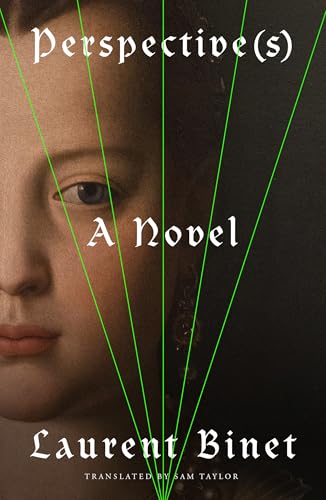
PERSPECTIVE(S): A Novel, Laurent Binet being his most sibylline self


PERSPECTIVE(S): A Novel
LAURENT BINET (tr. Sam Taylor)
FSG (non-affiliate Bookshop.org link)
$18.00 paperback, available now

Rating: 4.5* of five

LONGLISTED for the 2026 Dublin Literary Award...the shortlist of six will be announced on 7 April 2026, the winner(s) in May's festival.

The Publisher Says: A pulse-quickening murder mystery set in Renaissance Florence by the renowned author of HHhH.

As dawn breaks over the city of Florence on New Year’s Day 1557, Jacopo da Pontormo is discovered lying on the floor of a church, stabbed through the heart. Above him are the frescoes he labored over for more than a decade—masterpieces all, rivaling the works of Michelangelo in the Sistine Chapel. When guards search his quarters, they find an obscene painting of Venus and Cupid—with the face of Venus replaced by that of Maria de’ Medici, the Duke of Florence’s oldest daughter. The city erupts in chaos.

Who could have committed these crimes: murder and lèse-majesté? Giorgio Vasari, the great art historian, is picked to lead the investigation. Letters start to fly back and forth—between Maria and her aunt Catherine de’ Medici, the queen of France; between Catherine and the scheming Piero Strozzi; and between Vasari and Michelangelo—carrying news of political plots and speculations about the identity of Pontormo’s killer. The truth, when it comes to light, is as shocking as the bold new artworks that have made Florence the red-hot center of European art and intrigue.

Bursting with characters and historical color, Laurent Binet’s Perspective(s) is a whodunit like no other—a labyrinthine murder mystery that shows us Renaissance Florence as we’ve never seen it before. This is a dark, dazzling, unforgettable read.

I RECEIVED A DRC FROM THE PUBLISHER VIA NETGALLEY. THANK YOU.

My Review
: From the framing device of a trove of discovered letters forward, this book represents the kind of games I most enjoy authors playing. Binet's the son of an historian, and it shows...for good and ill. The good is the playfulness of his choices to focus narrative attention on; the ill is his necessary fictionalizing of real figures of the well-studied past at times slipping into...absurdity, silliness, OTT recherche Proustian locutionary excess?...well, too-muchness, anyhow.

It is, I'll say clearly and now, well worth the effort to accept without engaging too much critical overdrive. (My worst readerly failing.)

Sort out fact from fiction exactly as much as suits you; nothing in your pleasure will change knowing more than you're told on the pages of the story about the people (note I did not say characters) on these pages. The murdered man emerges as we all do from the memories of those around us, as a blurry-edged shadow. It is unclear to me if he was actually guilty of lèse-majesté—and I do not care to establish this. Or any other of the many interesting side-lights Author Binet shines onto Savonarola's Florence. (I'd be a really bad puritan. I've always got a question they don't like, and am absolutely guaranteed to perform every sex act they abominate...in public, to show how they can't tell *me* what to do!)

The character Vasari is, in a word, adroit. No matter what he's asked to do, or be, or fix, he's got it, understands the assignment and the subtext, has a guy who knows a guy on his side. It's always good to know a Vasari because he might be oily but he's effective. People in power love Vasari-type guys. If you're the guy he knows who's got the connections he can use, you will never get public credit—that's all his—but he won't forget you. Until he does.

No, not a bestie to rely on, but a great guy to read about, and a top-notch sleuth.

As the pages flew by I realized I was in that reading flow state that's ever elusive. I was deep into Author Binet's imagination (Michelangelo as gossipy old queen, Marie de'Medici as old queen in political hot water) and unaware of the ever-advancing hour. When I closed the cover at two-thirty, I was sad to see it all end. I'm not sure why the very slightly repetitious recaps Binet's Vasari offers the reader to explain the resolution of the killing didn't weigh more heavily on my pleasure in the read...my conclusion is that I like Vasari's very natural-feeling shifts in tone. These do, however, slow the story's roll a but more than I myownself would prefer (that missing half-star above). Vasari is, as mentioned before, an operator, so he's bound to have different conversational registers for different people. In an epistolary novel that's both easy to present and easy to explain. No one in this collection of invented letters has an overview of the situation, just one corner of the composition, so everyone's responding to events as honestly as they feel safe doing; but they're all watching their tone because this was a dangerous time (see link to Savonarola above). It's similar to the effect of my doted-on The Case of Cem.

I'm delighted with this read. I'm recommending it to most all y'all because it's fun to see an author summon the attitudes of people long-dead in this honest, ambivalent way. I don't think the readers averse to history will be that tempted, though I hope one or two will try it out.

Monday, June 17, 2024

NICKED, fun and games holy-relic heist comedy


NICKED
M.T. ANDERSON

Pantheon Books
$28.00 hardcover, preorder for delivery on 23 July 2024

Rating: 4.75* of five

The Publisher Says: From the award-winning and bestselling author of Feed comes a raucous and slyly funny adult fiction debut, about the quest to steal the mystical bones of a long-dead saint

The year is 1087, and a pox is sweeping through the Italian port city of Bari. When a lowly monk is visited by Saint Nicholas in his dreams, he interprets the vision as a call to action. But his superiors, and the power brokers they serve, have different plans for the tender-hearted Brother Nicephorus.

Enter Tyun, a charismatic treasure hunter renowned for “liberating” holy relics from their tombs. The seven-hundred-year-old bones of Saint Nicholas rest in distant Myra, Tyun explains, and they’re rumored to weep a mysterious liquid that can heal the sick. For the humble price of a small fortune, Tyun will steal the bones and deliver them to Bari, curing the plague and restoring glory to the fallen city. And Nicephorus, the “dreamer,” will be his guide.

What follows is a heist for the ages, as Nicephorus is swept away on strange tides—and alongside even stranger bedfellows—to commit an act of sacrilege. Based on real historical accounts, Nicked is a wildly imaginative, genre-defying, and delightfully queer adventure, full of romance, intrigue, and wide-eyed wonder at the world that awaits beyond our own borders.

I RECEIVED A DRC FROM THE PUBLISHER VIA NETGALLEY. THANK YOU.

My Review
: I seem to be on an historical-queerness religion-themed heist novels jag. Remember RECITAL OF THE DARK VERSES?...now this fascinating, also ripped-from-the-history-books tale of Saint Nicholas of Myra's hajj to Bari, Italy. Y'know, the Chamber of Commerce never really changes, "bring on the punters and their gelt!" is their mantra no matter the language or the time period. "King Arthur" at Glastonbury? Heck, they needed a new roof and GoFundMe wasn't a thing yet. Now add the attraction of Octavian Nothing's author writing for adults for the first time, and I'm gaffed through the gills.

I loved the Octavian Nothing duology, so it wasn't like I had some hill of ignorance, or resistance, to climb. Author Anderson's got a deft way with words and a sharp eye for the telling detail (the dog-headed man who's actually dog-headed is a great start). The seamless way he weaves the medieval world-view into the actions and conversations of the characters; the unstressed way they assume things like miracles and visions are remarkable but unsurprising; the effectively limned but never foregrounded way the quest to steal the saint's relics gets justified, all make perfect sense despite being quite mad.

By twenty-first century standards.

Sexuality is part of the picture so limned, but there's no sex to speak of. It wouldn't have added a thing to the story. It's not glued on awkwardly to tick a box, and it does have a bearing on how the innocent and quite trusting Brother Nicephorus deals with the way his vision is, erm, repurposed by the roguish dashing thief Tyun, but it is not made up out of nothing. I like thngs like this to make sense, and it does. Our Brother, who sets the plot in motion, rides the waves of others' needs and actions. He changes, he learns about his god-given nature, and he changes those he must surround himself with. And it is, for a wonder, all really fun and funny to read.

The wonders of comedy applied to matters of great religious import are many...the idea of a miracle is, inherently to me anyway, funny. The nature of the "pox" afflicting Bari, and the purported miraculous excretions from Saint Nicholas's bones intended to cure it...well, comedy gold! Resurrection, which we see, just...well...I've had surgeries enough to know that there's a lot involved in resurrection and none of it is supernatural. People can and do wake up when it's supposedly impossible. The way Author Anderson does it is, honestly, so affirming, and so full of the joy of being alive inside a body, that I nearly cried several times. "Never forget that your life is a wonder...Never forget that there are miracles everywhere, and you are only present in this world to see them once." This is exactly true, though the miracles aren't religious in nature.

I'd be remiss if I didn't point out how much fun with wordplay there is. Start with the title: Nick (as in Nicephorus, "bringer of victory"), to nick, Old Nick, Saint Nick...you can find more. These grace notes and the general vocabulary Author Anderson uses all flavor the read with an old-fashioned, yeasty head of foam on this draft of literary ale.

Delighted me; will delight anyone who liked Our Flag Means Death, the Locked Tomb series, and Ocean's Eight and its sequels.

Monday, May 20, 2024

THE GUNCLE ABROAD, sequel...with a knowing wink...to a surprise hit


THE GUNCLE ABROAD
STEVEN ROWLEY

G.P. Putnam's Sons
$29.00 hardcover, available tomorrow

Rating: 4* of five

The Publisher Says: From the nationally bestselling author of The Guncle comes the much-anticipated sequel, in which Patrick O’Hara is called back to his guncle duties…at a big, family wedding in Lake Como, Italy.

Patrick O’Hara is finally in a league of his own…professionally. Inspired by his stint as Grant and Maisie’s caretaker after their mother’s passing, Patrick has "un-stalled" his acting career with sit-com, Guncle Knows Best. Still, some things have had to take a back seat. Looking down both barrels at fifty, Patrick is single and lonely after breaking things off with Emory. But at least he has family, right?

When his brother Greg announces his big, second wedding in Lake Como, Italy, Patrick feels pulled toward Grant and Maisie and flies to Europe to attend the lavish event, only to butt heads with a newfound Launt (Lesbian Aunt), curb his sister Clara from flirting with guests, and desperately restore himself to the favored relative status in the eyes of the kids, as they struggle to adjust to a new normal. But is it Patrick’s job to save the day? Or is simply celebrating love enough to quell the family chaos?

Gracing the page with his signature blend of humor and heart, Steven Rowley delivers the long-awaited sequel to a beloved story, all about the complicated bonds of family, love, and what it takes to rediscover yourself, even at the ripe age of fifty.

I RECEIVED A DRC FROM THE PUBLISHER VIA NETGALLEY. THANK YOU.

My Review
: Teenagers. Yikes! Maisie's dad is getting remarried to a Very Glamourous Italian, which is NOT a way to a bookish teen girl's heart. Grant is eleven, doesn't really have a lot of interest in the wedding parts, but will—he thinks—definitely prefer his life without an Italian marchesa for a stepmom, since Maisie's churned those waters. The gruesome twosome turn to their truly belovèd Guncle Patrick, their Dad's big brother, for help stopping what they see as impending disaster.

Guncle ("gay uncle" if you need a refresher) has, in agreeing to "help" them, got a plan. The issue with plans is that teenagers, with their fully adult-strength emotions and complete absence of perspective, most often see through plans and get...stroppy...when they feel manipulated.

Clever Guncle...take the kids on a European tour, since he's already finishing up a film role in London, and talk to them...remember "Guncle Rules"? now they're "Love Languages"...while working through their fears about their Dad moving on from their Mom's early death. It will, not coincidentally, help him move on from his recent breakup with Emory, whom I feel sure we've all forgotten from The Guncle. At any rate, it's a welcome distraction from the entertainment business for a successful...again...sitcom...again...star, and a man about to turn the Big Five-Oh. Yep, the guy who found being loudly reminded by his loving niece that he was forty-three tantamount to a hate crime is a half-century old.

Does his wiliness now exceed his willingness to be there for his family? Close-run thing if you ask me.

Well, Rowley's still got his humor vein open. I loved this bit:
“Sequels are either too bloated, too stuffed with B-team actors or characters or Ewoks—things that weren’t good enough for the original. A cash grab to profit off something that was probably a fluke in the first place.”

Cassie glanced at the surrounding patrons, perhaps wishing she could dine with one of them.

“The only time it maybe works—and I mean the only time—is when there wasn’t an ending that was entirely happy, when not everything was tied up in a neat little bow. Otherwise you have to undo someone’s happy ending to create more drama for your characters, and no one likes a happy ending undone. And what stories these days don’t have happy endings?”

Thus Patrick to his long-suffering agent...and Author Rowley tipping his hat to the audience. It's not the first time I've been here, so pay me the respect of telling me you're aware of that fact. I appreciated it, and was simultaneously amused by it. It joins the host of amusing moments that this whirlwind tour of Europe that must be completed in time for the destination wedding on Lake Como...shades of Patrick Dennis and Around the World with Auntie Mame, another sequel that has to undo a happy ending...and you get a fun, funny summertime escape in book form. That is a wonderful lot.

Of course, this is not the first time we've met these characters, so there's a lost sparkle that can't be recreated no matter what one does. In its place is a luster, the warm burnished glow from a fine silver samovar, one that always spills its tea warmed to perfection into your perfectly prepared cup. Sweet...the return and humanization of oldest sister Clara in her latest reinvention of self...bitter, Patrick's jealousy of the marchesa's lesbian sister who woos her way into Maisie and Grant's affections...fun, the comical nightmare rehearsal dinner like something from The Philadelphia Story, only...um...earthier, and honestly de trop. Tropes. Well polished, gleaming tropes that most story-loving readers want to read because they are familiar and dear and relatable. What story about a wedding that deserves one's attention at all doesn't feature some concatenation of mishaps?

The utter charm of how the world rights itself in romantic fiction is a source of delight.

Come be delighted. (But dear GOD, the w-verbing has got to stop!)

Thursday, January 5, 2023

THE VILLA, subtle, fun, and in the end, more than it says on the tin


THE VILLA
RACHEL HAWKINS

St. Martin' s Press
$28.99 hardcover, available now

Rating: 4* of five

NOW $2.99 on KINDLE

The Publisher Says: The bestselling author of The Wife Upstairs returns with a brilliant new gothic suspense set at an Italian villa with a dark history.

As kids, Emily and Chess were inseparable. But by their 30s, their bond has been strained by the demands of their adult lives. So when Chess suggests a girls trip to Italy, Emily jumps at the chance to reconnect with her best friend.

Villa Aestas in Orvieto is a high-end holiday home now, but in 1974, it was known as Villa Rosato, and rented for the summer by a notorious rock star, Noel Gordon. In an attempt to reignite his creative spark, Noel invites up-and-coming musician, Pierce Sheldon to join him, as well as Pierce’s girlfriend, Mari, and her stepsister, Lara. But he also sets in motion a chain of events that leads to Mari writing one of the greatest horror novels of all time, Lara composing a platinum album—and ends in Pierce’s brutal murder.

As Emily digs into the villa’s complicated history, she begins to think there might be more to the story of that fateful summer in 1974. That perhaps Pierce’s murder wasn’t just a tale of sex, drugs, and rock & roll gone wrong, but that something more sinister might have occurred—and that there might be clues hidden in the now-iconic works that Mari and Lara left behind.

Yet the closer that Emily gets to the truth, the more tension she feels developing between her and Chess. As secrets from the past come to light, equally dangerous betrayals from the present also emerge—and it begins to look like the villa will claim another victim before the summer ends.

Inspired by Fleetwood Mac, the Manson murders, and the infamous summer Percy and Mary Shelley spent with Lord Byron at a Lake Geneva castle—the birthplace of Frankenstein—The Villa welcomes you into its deadly legacy.

I RECEIVED A DRC FROM THE PUBLISHER VIA NETGALLEY. THANK YOU.

My Review
: What fun it is to sit, or lie in bed, with a read leaning/sitting/suspended above you by your boytoy at your preferred angle, and just submerge into a story. It must needs be a hefty stew, a thick and savory amalgam of tastes powerful and subtle, to get through the fog of quotidian tedium we're all settling back into in the wintry northern hemisphere. Remember it for August reading, global southerners!

Rachel Hawkins delivers a big, full bowl of it all. The middle-escent quondam besties who, in the present, are surprising themselves when they decide to spend girl-time together at one of those fabulously gorgeous rentable family seats in gloriously scenic Italy. Each woman, trying to gin up something to fulfill a publishing contract, is finding that she just is not feeling the love for anything she's got at that moment. The mystery writer's cozy series is sour for her now that her soon-to-be-ex husband is suing her for a chunk of her future royalties because she, in a moment of candor, told an interviewer that her series' most beloved character was based on him. The self-help writer's having an existential crisis because she's been fleecing desperate people by ladling out craptastic nostrums knowing full well that a trip to the Hallmark card shop would give them the same level of help and insight into their problems.

Oh dear! Silly me, saying what I really think about things again. Strike that! Of course, she's simply seeking something to afford her fresh insights and, well, what better than a friend in the middle of a rancorous divorce? (I don't in all honesty see how that's better but I'm not here to judge.) (Well, only the story I'm being told, not the realities of publishing.)

Em and Chess, in the present day, are going through the middle-escent crisis of "is this it?" and need to make their eyes see past the same-old same-old surfaces. At their gorgeous holiday Villa Aestas, they learn to listen to themselves more carefully as the delicious herbal remedy of being in Italy brings up things neither was ever planning to work through, or even acknowledge...admit. That stew has tough cuts of meat that just about break your jaw muscles to chew....

Their motivation to do that tough work is the fifty-years-gone history of Villa Aestas. Golden-boy rocker, two teenaged girls in love with his fame and poetry, a Svengali older man...all of twenty-six!...who guides the group into a Byron-and-Shelley creative ferment that he uses to elicit full-body responses to the sexual tensions inevitable in this situation. Tell me how any writer of anything at all could resist poking this spiritual sore tooth! And the existence of a memoir-by-novel about it, telling a story so soppily romantic that you just know a teenager wrote it. Should they, and we, trust the story we're told here, the story in front of us? Emily, she of the murder-mystery instincts, doesn't seem to question Mari's published version of the 1974 events until present-day events make her think carefully for once in a long, foggy, unhappy time.

But writers, you know, writers aren't simple little souls ready to take dictation from their imaginary friends the voices. Writers (of murder mysteries, of books about changing your life) need to be ruthless and "kill their darlings." Success can breed jealousy as always, but so can a lifetime of coming up short when comparing yourself to someone else...and poets (as songwriters insist they are) are doubly susceptible to this. Add in a hefty libido and a sense of entitlement and, well....

What Author Hawkins does is not something unexpected. But what she accomplishes by bringing all the strands...the two parties visiting Villa Aestas and the book that Mari, the central voice in 1974's strands, writes...into one bundle is to scrape away the grease she's been applying to the ropes of the plot so they won't rub too hard together and weaken each other. The bare ropes of the meanings and emotions scrape and snarl and burn each other as they are suddenly and forcefully made to change the story's velocity and angle. No tangles, some fraying...I think Mari's book got just a hair (heh) more time in the spotlight than it merited...but supporting structure of the thriller parts of the story suspend their scenery and allow you to scrape your stew-bowl clean without feeling like you need to rush before it all comes crashing down. I heard some creaking from behind the scenes but, crucially, felt that this was not the ropes complaining as they got overworked in moving the parts. It was a quiet invitation from Author Hawkins to consider the thriller you've seen in its intended configuration and perspective.

And question if, just maybe, there had not been a last-minute change of plans, well laid to achieve one result, to achieve instead another result entirely.

This elevated a solid three-and-a-half stars entertainment to a four-star puzzle (despite some eye-rolling but period-appropriate homophobia). Definitely recommended to thriller fans and to the small corps of remaining lovers still thrilling to the wonderful Cary Grant did-he-or-didn't-he films of the 1940s.

Tuesday, November 8, 2022

THE GIANRICO CAROFIGLIO PAGE: THE COLD SUMMER, new mystery series from the author & THE MEASURE OF TIME, sixth Guido Guerrieri procedural


THE MEASURE OF TIME
GIANRICO CAROFIGLIO
(tr. Howard Curtis)
Bitter Lemon Press (non-affiliate Amazon link)
$9.99 Kindle edition, available now

Rating: 4.25* of five

The Publisher Says: The latest in the Guido Guerrieri series.

The setting is Bari in Southern Italy. Against his own instincts, defence attorney Guerrieri takes on an appeal against what looks like an unassailable murder conviction. The alleged perpetrator is the son of a former lover. A taught legal thriller and a meditation about the ravages of time.

One spring afternoon, defence attorney Guerrieri is confronted with an unexpected spectre from his past. In her youth, Lorenza had been a beautiful and unpredictable girl with dazzling charm. A changed woman faces him in his office that day. The ensuing years have ravaged her appearance and embittered her mind. As if that weren’t enough, her son Jacopo, a small-time delinquent, stands convicted of the first-degree murder of a local drug dealer. Her trial lawyer has died, so, for the appeal, she turns to Guerrieri as her last hope.

Guido is not convinced of the innocence of Lorenza’s son, nor does he have fond memories of the way their relationship ended two decades earlier. Nevertheless, he accepts the case; perhaps to pay a melancholy homage to the ghosts of his youth. His old friend Carmelo Tancredi, a retired police inspector, and his girlfriend, the charming investigator Annapaola Doria are once again by his side.

A masterful, compassionate novel, striking a balance between a straightforward trial story—some say the purest distillation of human experience—and the sad notes of time as it passes and exhausts itself.

I RECEIVED A DRC FROM THE PUBLISHER VIA EDELWEISS+. THANK YOU.

Book One reviewBook Two reviewBook Three reviewBook Four reviewBook Five review

My Review
: Last time we met Avv. Guerrieri, he was feeling his age and feeling Time's Arrow poking him between the shoulders. I think he, and Author Carofiglio, are winding down their association. That feeling is stronger having read this latest entry in the series.

As Guido reacquaints himself with the lyrics of "What a Fool Believes," he works his dogged best to ignore the ancient and life-changing on his side relationship he had with Lorenza while her son languishes in prison for a crime he swears he's innocent of. The trouble is he simply can't. I don't guess we ever can. Meeting someone special from long ago is inevitable, I suppose, but more often than not unsatisfying. It's Lorenza's son's bad luck to have a mother his new lawyer can't get over.

Yet get over her Guido does...it takes a lot out of an old-flamehood to go painstakingly over the present's ugly realities with her. And, lest you forget, Guido's feeling his age in many ways these days. When one does something, even does it well, for a long time there creeps in a staleness and a tedium to make the world just a bit darker all around. That's where Avv. Guerrieri is in his life, doing his dead-level best for Lorenza's sake and to satisfy his bone-deep conviction that everyone deserves the best representation possible. He knows young Iacopo did not get that. But...is he, after all, guilty? Could this just be time-serving, motion-going-through? It's an unnerving truth that Guido doesn't know. He just does not know.

Scary place for a defense lawyer to be.

At any rate, the story is told in vintage Carofiglio style...we are there, we are never kept in the dark about the developments that Guido himself isn't kept in the dark about. I am on record as liking this style of telling a procedural story, especially one that's set in a legal system very unlike the one I'm accustomed to by six decades' reading of mysteries. It's also interesting to me that Author Carofiglio (a lawyer by trade before becoming a writer and a Senator) goes through Avv. Guerrieri's speeches to the judges and, in real-time, gives us his second-guessing internal monologue. That is very much to my taste, and it's still in evidence (!) in this entry in the series.

Where I wasn't quite so enthused, though, was in the number of Lorenza flashbacks Guido indulges in. This woman was extremely formative for his life and his outlook on gender relations! I get it, the need to process that old baggage is deep. I felt, though, that it got in the way of my seeing Lorenza the mother of the accused, as well as Iacopo the accused himself. It was, I suppose the best way to say it is, both overdone and underpresented.

It wasn't a fatal blow to my pleasure in the read since I gave the book four and a quarter stars. I think it was effective at one of its jobs, to wit: Demonstrating Avv. Guido Guerrieri's increasing longing to retire, to find a life outside his living. He's worn a groove in his spirit doing this important, and satisfying, job. This case...its links to a past he doesn't want to dredge up but won't fail to look in the eyes...its unsurprising results...its ending that we saw coming because of course...it's all just another turn of the wheel.

Stopping and alighting are, I suspect, the next things Avv. Guido Guerrieri will do. If so, I'll miss him. But I completely understand.

++++++++++++++++++++++++++++++++++++++++++++++++++++++++++++++++


THE COLD SUMMER
GIANRICO CAROFIGLIO
(tr. Howard Curtis)
Bitter Lemon Press
$7.99 Kindle edition, available now

Rating: 4.75* of five

The Publisher Says: The summer of 1992 had been exceptionally cold in southern Italy. But that’s not the reason why it is still remembered.

On May 23, 1992, a roadside explosion killed the Palermo judge Giovanni Falcone, his wife and three police officers. A few weeks later judge Paolo Borsellino and five police officers were killed in the center of Palermo. These anti-mafia judges became heroes but the violence spread to the region of Bari in Puglia, where we meet a new, memorable character, Maresciallo Pietro Fenoglio, an officer of the Italian Carabinieri. Fenoglio, recently abandoned by his wife, must simultaneously deal with his personal crisis and the new gang wars raging around Bari.

The police are stymied until a gang member, accused of killing a child, decides to collaborate, revealing the inner workings and the rules governing organised crime in the area. The story is narrated through the actual testimony of the informant, a trope reminiscent of verbatim theatre which Carofiglio, an ex-anti-mafia judge himself, uses to great effect.

The gangs are stopped but the mystery of the boy’s murder must still be solved, leading Fenoglio into a world of deep moral ambiguity, where the prosecutors are hard to distinguish from the prosecuted.

I RECEIVED A DRC FROM THE PUBLISHER VIA EDELWEISS+. THANK YOU.

My Review
: The cold summer indeed...very cold for those whose Earthly remains could, thanks to massive bombs killing them, be measured in teaspoons. Author Carofiglio was, during that memorable summer that turned the tide against the Sicilian Mafia and its other regional affiliates, a working prosecutor fairly early in his career. His story, as told here, is one that truly feels like it happened exactly this way despite its being fiction. When one knows the author's history, it does inform the experience of reading the author's words. In this case, I've been on Team Carofiglio since I first discovered the Guerrieri series a decade-plus ago.

In this book's case, it's the second Fenoglio novel written but the first translated into English. In Italian, the first one's called Una mutevole verità or literally "A Changing Truth" but I'd probably call it "Slippery Facts" or something similarly indicative of dishonesty. It's a much shorter work and isn't about Fenoglio so much as about how a man in his position...a "foreigner" to the Barese he works with since he's from Piedmont-Savoy (basically France to the Southern Italians)...can see but not get what he's seeing. This outing, being about a gigantic trauma that shook Italy to its core, makes more sense to have come out first in the series.

The set-up for the story is Author Carofiglio's usual quiet, meandering walk through the detective's days as the crime is committed and he begins to look into the causes and results of it. About midway through, a huge shift happens. In this story, the shift is a break in the wall of silence around organized crime's activities. All it takes is one lousy creep afraid of getting punished for a particularly unpopular crime (child harm is a death sentence in most prisons around the world) to blow open the stalled cases he knows about.

Structurally, the way Author Carofiglio manages the case-breaking event in this book is to spend several chapters on the scumbag's interrogation. This isn't flash-fast, as I imagine you're thinking it might be. Italian crime fighting moves at a different pace and to a different rhythm than the US version. The cast of characters is different because the legal system is organized very differenly, with responsibilities split in different directions. That, for my dollar, is one of the selling points of these books. I am absolutely enrapt in the cast of legal characters and eager to hear more about what they do and why they do it...I suspect Translator Curtis, having worked on a half-dozen or more Carofiglio novels in several series (as well as no series at all), is responsible for the ways some characters discourse explanatorily...as it sharpens the pleasure of being swept up in a very different world. That being something I look for, and forward to, in my reads, I'm happy as Larry while it's going on. YMMV, of course, so don't forget to account for your own tolerance for exposition when choosing these reads.

The reason I'm fond of Fenoglio, and I suspect I'd be fond of Author Carofiglio, is the way his policemen philosophize:
“I like finding out what happened. In so far as it’s possible. I like that people trust me and decide to tell me what they know, even in the most unexpected situations. I like it when what I do – and it does happen – gives a little dignity back to those who’ve lost it. It gives meaning to chaos.”

–and–

The problem is that we like to control everything: a stupid, pointless, unhealthy idea. We need to have the opposite attitude, accept the fact that nobody really has any control over his or her own life: that was what the barman Nicola, from the Caffè Bohème, had said to him once.

One day at a time. He had also added that it’s a good rule not to take anything personally. We think that everything revolves around us: both what other people do and what they don’t do. It’s almost never true. Things happen and that’s it; most other people are uninterested in us, for good or ill.

The quiet musings of Pietro Fenoglio, an intelligent man, as he works his way through the complexities of human venality and evil, demanding a reckoning for those not able to demand one for themselves. I like this pace, this path, and this person's journey. I will say that I found the bad actors all a bit interchangeable. I can't for the life of me remember one's name without looking it up to be sure I'm not misassigning another one's name to him. Nothing made by human hands can ever be perfect, can it. But very damned good, this one's got locked down.

Saturday, January 23, 2021

THE ROAD TO URBINO, or let's go to Italy and commit art theft!

THE ROAD TO URBINO
ROMA TEARNE

Gallic Books
$15.95 trade paper, available now

Rating: 3.5* of five

The Publisher Says: A story of obsession, love and art set in Tuscany, Sri Lanka and London.

Ras, a Sri Lankan who fled his country as a child following the violent death of his mother and his father's disappearance, has committed a crime. Dogged by his past and unable to come to terms with the killing of his mother, he struggles to make a new life for himself in the UK. Alex has loved Dee since he was 19 but failed to realise that it was a love he wouldn't find again. After Dee's marriage, he too struggles to build a meaningful life for himself. But when Ras' and Alex's lives connect, each man takes a new path culminating for Ras in the theft of a della Franceso painting, while Alex comes ever closer to Dee through tragedy in her life.

Beautifully written, with a strong narrative, The Road to Urbino is the story of two very different men and their love for the women in their lives, set against the backdrop of the heartbreaking horrors of the long-running conflict in Sri Lanka.

I RECEIVED AN ARC FROM THE PUBLISHER. THANK YOU.

My Review
: Similar to Donna Tartt's The Goldfinch in initial conditions...an art crime reverberates through the characters' lives, the painting that's stolen has resonances in the story's structure that only reveal themselves the deeper you get...Roma Tearne did not decide to re-write someone else's idea by any means.

When Ras, one of our main characters, escapes his war-torn country after terrible losses, he looks at the UK with the hungry eyes of a victim in search of a savior. The trouble with that, Ras, is that no external being can save you from yourself. He does experience the blessing of a peaceful country's many opportunities, and he takes advantage of them. Job as a museum curator, marriage, a family, a life...all the good stuff. The issue for Ras is, of course, the unhealed horrors of genocide live in his brain. His wife gives him a daughter, as he sees it, and he dotes on the child. Not so much on the mother. Lavish loving attention but nothing for Mama? The inevitable occurs, and the illusion of normal life is ripped apart again.

Lola, his daughter, is a case study in "when bad children happen to loving fathers." Spoiled by his undivided attention and by nature selfish, she is a Hot Mess. Listening to Daddy's stories of the Old Country is a way to get what she wants, but not in the least a way to feel connected to him or to the weird foreign place he originates. Ras isn't a reflective person, at least not at first, but he pips to his essential trapped loneliness at last. What does he do, go to a shrink? No. He goes to Italy! He will tour the countryside and Look At Art.

He does this, all right. He looks at Piero della Francesca's The Flagellation of Christ a bit wrong.
via Wikimedia
Reader, he steals the damned thing. A small-enough painting by religious standards, no more than three feet in any dimension, but...WHAT?! A museum curator steals another museum's painting?!

The shock I felt was slightly cushioned by my delight in Author Tearne's paean to Italy's sheer physical glory. It is no wonder so much great art has come from there, it is so beautiful. As I turned the pages for this second read, I was submerged in a soft golden afternoon's light and gently lapped by the waves of desire anticipating the meal I knew would come soon. (In Italy, a meal will always come soon.) This was the most delightful sensation while I'm trapped inside by COVID. I was even inclined to be forgiving of the absolutely bewildering break from reality that Ras's theft represents.

But that theft is the frame of the story, not the story. Ras, in jail in the UK, begins to speak to his solicitor Elizabeth with the intimacy and urgency of a shrink. Please, he begs, please re-connect me with my daughter! I want her to know her father is not a terrorist! A museum curator, fifty, is being called a terrorist...because he's South Asian. A white man in that cell for that crime would be a troubled citizen, count on it.

Speaking of white men...now enters the story a chap called Alex, the ex-lover of a museum colleague of Ras's. Why he's here you'll have to ask the author, I can't really see what his place is in this story. The only possible excuse I can find for Alex to exist is that he reinforces the idea that middle-aged men long for a woman. And this is where something important (leaving aside its overwhelming heteronormativity) hit me.

A talented woman writing a novel about men in crisis gives one unpleasant woman, Lola, all the ladies' speaking parts; from Elizabeth we hear stage prompts, meant to cue a dried-up actor to resume his speech. The middle-aged man at the center of it all is South Asian, at least, but honestly I can't imagine a book less likely to pass the Bechdel test. I don't think any woman speaks to another woman at all, let alone not about a man, but that's not something I was carefully looking out for.

I've mentioned before that I need to feel a character's trajectory has changed for a reading experience to fully satisfy me. This story's characters are all in mid-trajectory when we leave them, so I was a bit grumpus about that; I did finally settle myself because the fact is they're all launched in new directions. Not at all sure they'll stay on them, but they're set into motion and that's good enough for me.

In general terms, I'm not inclined to pick up books like this. I got it during my COVID infection and couldn't really focus on it. Since my backlog of unreviewed books is shocking, I needed to give it a bit of a brush-up to remind myself of the story's tenor and the characters' affects. The sneakily critical of racism nature of the story was a definite plus. The somewhat flat crime that is committed is only so because there's really just no conceivable reason for it to have happened. If I read this as a news report, I'd be eaten alive with curiosity to now WHY it occurred, probably to the point of calling the news outlet and demanding they assign an investigative reporter to ferret out the goodies.

Sadly, that doesn't occur and thus I'm left with a two-and-a-half star read that earns itself an extra star for its blissful evocation of Italy's delights. I enjoyed the read enough to review it; I'd recommend borrowing, not buying, the book if you are tempted.

Wednesday, August 5, 2020

A FINE LINE, fifth Guido Guerrieri procedural set in Bari, Italy


A FINE LINE
GIANRICO CAROFIGLIO
(Guido Gerrieri #5) {tr. Howard Curtis}
Bitter Lemon Press
$9.99 Kindle edition, available now

Rating: 4.25* of five

The Publisher Says: The fifth in the best-selling Guido Guerrieri series.

When Judge Larocca is accused of corruption, Guerrieri goes against his better instincts and takes the case. Helped by Annapaola Doria, a motorbike-riding bisexual private detective who keeps a baseball bat on hand for sticky situations, he discovers that the judge has links to the mafia. Larocca is blind to the immorality of his actions but Annapaola makes sure that justice is done, perhaps not in the most orthodox way. Of course Guerrieri cannot stop himself from falling for Annapaola's exotic charms.

The novel is a suspenseful legal thriller but it is also much more. It is the story of a judge who, to quote Dostoevsky, "lies to himself and listens to his own lies, so gets to the point where he can no longer distinguish the truth, either in himself or around himself."

Book One reviewBook Two reviewBook Three reviewBook Four review

THIS BOOK WAS BORROWED VIA INTERLIBRARY LOAN. SUPPORT YOUR LIBRARY!

My Review
: As you know by now, this is not the usual legal thriller. I found it just lovely to read, and for someone who's closer to 70 than to 40 I think that will hold true; but I'm sorry to say I do not think it will be of very wide appeal. The author's Italian-Mafia-prosecutor background has given us lots of good moments in the Italian legal system. Believe me, US citizens, it needs the kind of explication that will bore Grisham readers stupid.

Even I wanted things to get moving already, in fact several times flipped ahead two pages to get away from verbosity. So not my highest recommendation...but the pleasures of reading the book are there for the patient and the curious. Whatever you do, do NOT start here! Start at the beginning with Involuntary Witness and get to know Guido. He ages more or less in real time, unlike many (if not most) US series-mystery leads. This makes the Guido of this novel significantly more seasoned, and less approachable if you will, than his earlier self. Don't waver because of that...he's not surly! He's simply...feeling Time's Arrow nudging between his shoulder-blades.

But the pleasures of reading these stories are quite clear, very evident, eg:
Jurists, with rare exceptions, are unconsciously and tenaciously averse to clarity and brevity.
It is worth remembering what the author's career is...trial lawyer...when reading that quote. He's got the insider dope, alrighty all right, and is sharing it with us. In more ways than one, and some are unconscious and unintentional....

This quote should be engraved on the rocks we throw at 45 after he's impeached, convicted, and is being transported to his forever home in prison:
Power – any form of power – is acceptable only if it’s transparent and clean, if it’s exercised in a way that is equal for everybody.
Don't guess that needs belaboring.

Occasionally Author Carofiglio lapses into some sort of brain seizure, a strange and sad misalignment of synapses that produces these odd statements of unnecessary-to-refute error:
The situation had got out of hand, particularly because of the books. Apart from those on the shelves, there were books everywhere. On the floor, on the tables, on the sofas, in the bathroom, in the kitchen—and let's be honest, not all of them were indispensable.
Poor man. So sad, those delusions of...of...well, beats me what you call it, but it's the syndrome when some Satanic imp uses your brain to bring *shudder* book-desacralization disorder into the world. Imagine thinking some books are dispensible! It is to laugh!

TEMPORARY PERFECTIONS, fourth Guido Guerrieri procedural set in Bari, Italy


TEMPORARY PERFECTIONS
GIANRICO CAROFIGLIO
(Guido Guerrieri #4) {tr. Anthony Shugaar}
Rizzoli USA
$11.99 Kindle edition, available now

Rating: 4.5* of five

The Publisher Says: The electrifying best-selling crime thriller from Italy, available for the first time in English. An instant sensation and number-one best seller since its publication, Temporary Perfections is the fourth crime novel by former Italian prosecutor Gianrico Carofiglio to feature Guido Guerrieri. A lawyer practicing in Bari, in southwest Italy, Guido Guerrieri is hired by an old colleague to work a missing-persons case that the police have failed to solve. Manuela Ferraro disappeared six months ago after spending a September weekend at a beach resort; as Guerrieri digs deep into her life and activities, he stumbles into a sinister drug ring and the real truth about why Ferraro vanished.

Simultaneously thoughtful and suspenseful, this is crime fiction at its best.

Book One reviewBook Two reviewBook Three reviewBook Five review

THIS BOOK WAS BORROWED VIA INTERLIBRARY LOAN. SUPPORT YOUR LIBRARY!

My Review
: Fourth in the Guido Guerrieri series of Italian legal thrillers, this entry is not a procedural but a traditional private eye investigation. It is a true noir, set in Bari...a weirdly San Franciscan venue, and my how well its noirness is invoked.

Counselor Guerrieri, as the new translator calls him, is mid-flow on one of his usual if not terribly interesting workdays. He's had to move his law practice into new, American-ish offices because his former secretary has passed the bar and is now of counsel, and the adopted Peruvian daughter of some old friends is in there with him too. Plus a new secretary inherited from a deceased colleague. What was once snug became claustrophobic. So now Guido looks around himself, hating the slickness and the newness, and feeling all at sixes and sevens with his solitary life.

In walks an old colleague, with the zombified parents of a six-months-missing daughter. The Carabinieri, sort of a cross between the sheriffs and the FBI, must have missed something, Guido; you find people, you solve cases, Guido; please, my clients will pay you just to look over the file, Guido, please help them, look at them, they can't function, help them!

What co-dependent with a savior complex could resist such a plea? Not our Guido! No matter that he's a lawyer, not a PI, and no matter that the cop min charge of the case when it was opened is a friend of his, a man he respects, whose investigatory talents he trusts. Someone Needs Guido! And we're off, talking to the friends of vanished Manuela already interviewed, chasing down leads that have grown cold, being seduced and boinked by gorgeous, curvaceous young suspects...all the noir PI tropes are here, and well deployed.

In the end, Counselor Guerrieri solves the tawdry case, as everyone knows he will, but the fact that a Sherlock Holmes short story is the trigger that presents the solution to him is a touch I treasure. That the crime is solved and the guilty punished is a reason to read any fictional mystery, since real life seldom offers such order and satisfaction.

But then there are the dissatisfactions of this outing in the series. It is not a legal procedural thriller. There is no doubt in the mind of anyone at all that the vanished girl is dead from the get-go, so the suspense is only moderate. I am no fan of the sudden sea change in the direction, for all that I like noirs. I want my legal procedural fix!

And then there's the weirdness of the book being published by Rizzoli. ..!!.. That's right, the pretty-pictures people! It's a nice job, and it's not like they printed the book on 100-pound glossy paper and used overly ornamental dingbats on every page, but it's...unsettling...sort of like finding gay porn in your mama's nightstand. Error 404: File Not Found.

So why give it 4.5 stars, if I hate it? I don't hate it, it's quite well written, if translated in a way I'm less happy with that the previous two-book translator Howard Curtis did the job. But the main reason I've rated the book so highly is the portrayal of the bereaved parents.

I've mentioned before that I lost my son when he was two. No worse thing can happen to a person. Manuela's father, heartbreakingly, goes to the train station and waits for his girl to get off the train. He walks up and down the train searching the faces of the arriving passengers, praying hoping believing that one will be his daughter. Guido, who witnesses this, is so powerfully moved that one can feel him suffering for, suffering with, truly having compassion for the mad father. This brief, perfectly imagined, beautifully underplayed scene is worth four stars on its own.

Recommended.

Tuesday, August 4, 2020

INVOLUNTARY WITNESS, first Guido Guerrieri procedural set in Bari, Italy


INVOLUNTARY WITNESS
GIANRICO CAROFIGLIO
(Guido Guerrieri #1) {tr. Patrick Creagh}
Bitter Lemon Press
$13.95, available now

Rating: 4.9* of five

The Publisher Says: The first in the Guido Guerrieri series.

A nine-year-old boy is found murdered at the bottom of a well near a popular beach resort in southern Italy. In what looks like a hopeless case for Guido Guerrieri, counsel for the defense, a Senegalese peddler is accused of the crime. Faced with small-town racism fuelled by the recent immigration from Africa, Guido attempts to exploit the esoteric workings of the Italian courts.

More than a perfectly paced legal thriller, this relentless suspense novel transcends the genre. A powerful attack on racism and a fascinating insight into the Italian judicial process, it is also an affectionate portrait of a deeply humane hero.

"Carofiglio writes crisp, ironical novels that are as much love stories and philosophical treatises as they are legal thrillers."—The New Yorker

"Raises the standard for crime fiction. Carofiglio's deft touch has given us a story that is both literary and gritty—and one that speeds along like the best legal thrillers. His insights into human nature—good and bad—are breathtaking." —Jeffery Deaver

Book Two reviewBook Three reviewBook Four reviewBook Five review

THIS BOOK WAS BORROWED VIA INTERLIBRARY LOAN. SUPPORT YOUR LIBRARY!

My Review:
Avvocato Guido Guerrieri, lawyer of Bari on Italy's southeastern coast, is fast approaching forty, newly separated from his wife of ten lost, bored years, and in the grips of the worst constellation of anxiety symptoms since Mr. Monk on the TV. He's moved into an apartment that he couldn't describe if you held a gun to his head, and he's absolutely unable to muster even a fake interest in his clients' problems. He sits, smiles, nods, files paperwork by rote, and in short lives on autopilot.

And then in walks a woman with a case. No money, but a case.

Non-European citizen Abajaje, Egyptian by birth, wants Guido to defend her...her...co-continental? boyfriend? fellow sufferer from race bias?...Abdou, a Senegalese immigrant and fake handbag selling beach vendor, against charges that he, a multilingual schoolteacher in Africa, with a love for children, did willfully restrain and cause harm to a child. The police are sure he did it; the few witnesses are sure it was him they saw acting strangely and cruising around the beach at the relevant time; what's the big deal here, anyway, he's just a black dude who talked to the kid, must be him who killed little Ciccio.

Except he was in Naples at the time. Guerrieri, in spite of himself, is intrigued by what the case doesn't have, proof, and what it does have, the defendant's improbable, unprovable, but true, alibi. Is truth capable of beating out prejudice in an Italian justice system not known for its love of Veracity, but more for her sister Verisimilitude?

Hmmm.

For 137pp, Carofiglio sets the stage with Guerrieri's craziness, his lackadaisical work habits, his depressed past and anxious present. It's all very nicely written, eg:
"You are intelligent, Avvocato. I have always thought of myself as more intelligent than other people. This is not a lucky thing, but it is hard to understand that.If you think yourself more intelligent than others, you fail to understand a lot of things, until they are suddenly brought home to you. And then it's too late."
Thus Abdou the Non-European citizen to his lawyer in the prison's meeting room. I was regularly able to pause and appreciate the euphony and the accuracy of Carofiglio's writing. It shines through the book that he was a judge, in fact one of the judges who very bravely brought in guilty verdicts against Mafia defendants in the 90s trials that revolutionized the Mezzogiorno (Italy's southern region)'s social structure.

So it's no surprise to anyone that, in the last ~130pp, Carofiglio delivers the best, most complete, court trial I've read between book covers. It's a gem. It's pitch-perfect, and it's so nicely built that I hate to reveal it in detail. It's different than the standard American courtroom drama, because it's about the words, not the deeds, of the players. It's like listening to a fine old radio drama after watching an episode of "Starsky and Hutch" on AntennaTV.

It's a pleasure. I'm delighted to have found Sig. Carofiglio and Avv. Guerrieri at last.

Wednesday, April 24, 2013

Okay, I lied. Review of COOKING WITH FERNET BRANCA


COOKING WITH FERNET BRANCA
JAMES HAMILTON-PATERSON

Europa Editions
$18.00 trade paper, $10.99 ebook platforms, reissue available now

COOKING WITH FERNET BRANCA also appears in Literary Fiction & Story Collections

I was reminded of this review of a 2019 reissue by a stray comment, and I loved the book so much I decided to tart up the review and post it here. I so so wish someone would go get John Barrowman by the sleeve and gently but firmly make him understand that a movie of this book starring his beautiful self would be dynamite!

Rating: 3.75* of five

The Publisher Says: Gerald Samper, an effete English snob, has his own private hilltop in Tuscany, where he wiles away his time working as a ghostwriter for celebrities and inventing wholly original culinary concoctions-including ice cream made with garlic and the bitter, herb-based liqueur of the book's title. Gerald's idyll is shattered by the arrival of Marta, on the run from a crime-riddled former Soviet republic. A series of hilarious misunderstandings brings this odd couple into ever closer and more disastrous proximity.

James Hamilton-Paterson's first novel, Gerontius, won the Whitbread Award. He is an acclaimed author of nonfiction books, including Seven-Tenths, Three Miles Down, and Playing with Water, He currently lives in Italy.

My Review: Cooking With Fernet Branca is part of oddball publisher Europa Editions's sinister plot to make Murrikins like me aware of the strange and sinister world of lit'rachoor published beyond our shores. Muriel Barbery owes her Murrikin presence to them, too. We all know how *that* turned out....

Well, before moving any farther along in this review process, let me send out the call: Does anyone know how to get hold of (wicked double entendre optional) actor John Barrowman? You know, Captain Jack Harkness of Torchwood fame? He is literally missing the key to Murrikin stardom by not reading, optioning, and making this book into a Netflix movie. It suits every single national prejudice we have: Eastern Europeans as sinister lawbreaking peasants who eat strangely shaped, colored, and named things and call them foods (like Twinkies, Cheetos, and Mountain Dew are *normal*); Englishmen as dudis (you'll have to read the book for that translation) who do eccentric off-the-wall things with food that are repulsively named and gruesomely concocted (spotted dick? bubble-and-squeak?); and Italians as supercilious effete cognoscenti of world culture, who possess the strangest *need* for vulgarity.

The characters in this hilarious romp are the most dysfunctional group of misfits and ignoramuses and stereotypes ever deployed by an English-language author. They do predictable things, yet Hamilton-Paterson's deftly ironic, cruelly flensing eye and word processor cause readerly glee instead of readerly ennui to ensue. The whole bizarre crew...the lumpenproletariat ex-Soviet composer, the Italian superdirector long past his prime, the English snob who refers to Tuscany's glory as "Chiantishire" and "Tuscminster"...gyrates and shudders and clumps towards a completely foreseeable climactic explosion (heeheehee). And all the time, snarking and judging and learning to depend on each other. In the end, the end is nigh for all the established relationships and the dim, Fernet Branca-hangover-hazed outlines of the new configurations are, well, the English say it best...dire.

Read it. Really, do. And I dare you not to laugh at these idiots! Don't be put off by the sheer hideousness of the American edition's cover, in all its shades-of-purple garish grisliness. The charm of reading the book is that one needn't look at that...that...illustration...on the cover, but inflict it on those not yet In The Know enough to be reading it themselves.

And seriously...John Barrowman needs to know about this. Pass it on!

Saturday, April 13, 2013

REASONABLE DOUBTS, third Guido Guerrieri procedural set in Bari, Italy


REASONABLE DOUBTS
GIANRICO CAROFIGLIO
(Guido Guerrieri #3) {tr. Howard Curtis}
Bitter Lemon Press
$9.99 Kindle edition, available now

Rating: 4.9* of five

The Publisher Says: Lawyer Guerrieri is asked to handle the appeal of Fabio Paolicelli, sentenced to sixteen years for smuggling drugs into Italy. Everything seems stacked against the accused, not least because he initially confessed to the crime. His past as a neo-fascist thug also adds credence to the case against him. Only the intervention of Paolicelli’s beautiful half-Japanese wife finally overcomes Guerrieri’s reluctance. Matters get more complicated when Guerrieri ends up in bed with her. Gianrico Carofiglio, born in 1961, is a judge and anti-Mafia prosecutor in the southern Italian city of Bari. Bitter Lemon Press introduced him to English-speaking readers with his best-selling debut novel, Involuntary Witness.

Book One reviewBook Two reviewBook Four reviewBook Five review

THIS BOOK WAS BORROWED VIA INTERLIBRARY LOAN. SUPPORT YOUR LIBRARY!

My Review:
Third in the Guido Guerrieri Italian legal procedural thrillers, this outing finds Avv. Guerrieri tilting at windmills again, with a twist: He's running an investigation into the client's story. He's taken the case of an imprisoned drug courier who insists he's innocent of knowingly transporting 40 kilos of cocaine from Montenegro back to Bari in the car carrying himself, his wife, and their small daughter. He was a small-time crook before, yes, and (unknown to the client) was even a nasty Fascist gang-bully in the 1970s who beat young Guido up in the street. But to imperil his own wife and daughter by doing something so stupid as to run a hundred pounds of cocaine across international borders?! Never!

But word in the prison-yard is that Avv. Guerrieri is a good one, a lawyer who does the job he's hired for, and makes the case work for the client. This time, though, Guido faces something a little bit tougher than just a client probably guilty and just denying it out of embarrassment at involving his family, or even the long-ago beating he got at the client's hands (which the client's clearly forgotten): Don Quixote de Guerrieri has met his Dulcinea, the client's beautiful half-Japanese wife Natsu.

And here Guido Guerrieri is, single and everything, since Margherita left for New York and a new life (the rat!). And here Natsu is, unsure of her husband's innocence, unsure of her future, unsure of how to tell her daughter that Papa's not coming home from his business trip until 2025...what can you expect a woman to do when a handsome older gent with sad eyes and a penchant for reading strange books, a sophisticated palate that can really appreciate her cooking, and a way with soothing her deeply unhappy daughter's nightmares falls into her lap?

In the end, as always, Guido sees justice served, and sees his services amply rewarded in the process by solidifying his excellent reputation among the criminal classes, with the local narcotics officers, and the Italian judiciary, all at the same time. Not for the first time, Carofiglio weaves a believable resolution to a plot he seems to have set in motion specifically to challenge the clockwork universe into crushing our Don Quixote hero with the windmill blades.

At the end of the last book, Guido and Margherita were celebrating Christmas together! He'd even jumped out of a plane to impress her! And in one short passage at the very beginning of this book, Carofiglio dispatches her to the same place that all happy-making things go in the lives of hard-boiled sleuths. I was a little bit surprised at first, then I remembered the cardinal rule of noir: No one is happy for long.

A doomed affair with a client's wife is a great noir touch, too. No one even moderately sentient can doubt for a second that, once Natsu appears, Guido's going to succumb to her and that she's going to offer up the goods. All progresses apace, and the expected complications ensue; and perhaps that's why this installment isn't quite so thrilling to me as the previous two. I suspect that the far greater emphasis on the investigative parts of the case as opposed to the actual court arguments and examinations might contribute to my lack of superhappy. But the elements are there, just in smaller proportion to previous outings. All I can hope is that the series doesn't become all PI instead of procedural.

I really like the translations of these books, I must say, since they give me credit for being intelligent enough to need the occasional reinforcement of the book's Italian setting by using actual Italian in some non-critical but very practical ways. My favorite example is the characters calling each other, when culturally necessary for them to do so, by their job titles, eg Guido being called "Avvocato" or "Lawyer-man" in professional contexts, exactly as they would in Italy. Grace notes like this are very important to my sense of pleasure in a book, and greatly enhance my willingness to read more of the series.

I continue to enjoy these books, and wait eagerly for the next installment. That's saying something from a man whose "to be read" shelf has over 1000 titles on it.

Wednesday, April 10, 2013

A WALK IN THE DARK, second Guido Guerrieri procedural set in Bari, Italy


A WALK IN THE DARK
GIANRICO CAROFIGLIO
(Guido Guerrieri #2) {tr. Howard Curtis}
Bitter Lemon Press
$9.99 Kindle edition, available now

Rating: 4.9* of five

The Publisher Says: When Martina accuses her ex-boyfriend—the son of a powerful local judge—of assault and battery, no witnesses can be persuaded to testify on her behalf, and one lawyer after another refuses to represent her. Guido Guerrieri knows the case could bring his legal career to a messy end, but he cannot resist the appeal of a hopeless cause. Nor can he deny an attraction to Sister Claudia, the young woman in charge of the shelter where Martina is living, who shares his love of martial arts and his virulent hatred of injustice.

Book One reviewBook Three reviewBook Four reviewBook Five review

THIS BOOK WAS BORROWED VIA INTERLIBRARY LOAN. SUPPORT YOUR LIBRARY!

My Review
: In the second installment of the Avv. Guido Guerrieri legal thriller series, Our Hero has accepted the case of an abused woman who wants to bring civil suit against her battering, stalking ex-lover. Who just happens to be the son of the most powerful criminal judge in the city of Bari. And he didn't get that way by passing out Christmas hams to the needy, if you get my drift. Martina, at considerable risk to herself, wishes to put an end to the charm in her ex's charmed life by making him face publically the harm he's done her; he isn't, unsurprisingly, prepared to let this happen, and he retains the meanest, most sick-making kind of silk-upholstered shit-sack of a lawyer one can imagine. (The author being a judge, I suspect this character is a sarcastic payback on someone or someones he's dealt with in his anti-Mafia trials.)

Cue Guido's Don Quixote music! Saddle up, Sancho Reader, we're going for a tilt at the windmill of privilege, social and societal. Guido hears about the case with aplomb...she's gotta be kidding, so he slapped her around, this isn't a criminal case, c'mon! stalking? what, a man can't walk down a street?...until a combination of a feminist martial artist/nun, a female public prosecutor, and the head of the local deviant crimes unit all singing the same song makes him listen, and re-evaluate. Then they tell him who is alleged to have committed the crime.

Whoa Nelly! Career suicide help line, my name is don't do it, please tell me everything...and by god, Guido does the amazing and the improbable: He learns to accept that male privilege is a mindset, and society doesn't even notice it. (I'd add straight privilege if it was relevant, which it's not here, but it's equally virulent.) He's already sure he wants to take down the son of the local bought judge because he's an old leftist. (Old, hell, he's a puppy of forty.)

And Guido works his most sneaky, ju-jitsu-inspired magic in the trial that ensues. He really gives it a twist this time. So does the author. SUCH a twist, with nuns and cops and lawyers and sleazeballs all enmeshed in a fracas that had me, no exaggeration, gasping and jumping up and down.

In a paltry 215pp, I lived through the entire range of my emotional reactions to violence. Each of them. In turn, simultaneously, in order of virulence, and finally in catharsis.

I am not a subscriber to the Woman is Saintly Victim school of thought. I do not believe that men are abusers and women victims by nature, despite the crap that infests our fictional bookosphere. The issue of stalking, and its nastier ancillary complexes, is a very real one and a very scary one. The world has mean, nasty, horrible people in it, and by all that's holy, they need to be put away, stopped, found out and exposed. This novel satiated my strong need for that to happen, and it did a brilliant job of it.

The ending, while emotionally intense and not entirely pleasant, came close to being perfect. Close, so close...one event did not happen, and that is my one cavil with the whole thing.

I'm a big fan of the less prurient, more procedural style Carofiglio uses in these books, compared to the confessional, almost pornographic closeness to the dramatis personae most American procedurals use. Don't be surprised if your take on the style changes...from con to pro, but possibly the reverse...in this installment. It's a balancing act, as it always must be, to decide what details to present, what relationships to flesh out, what to suggest and what to explain. Carofiglio makes the most use of suggestion of any crime writer I've found.

Me likey. A lot.