Pages
- Home
- Mystery Series
- Bizarro, Fantasy & SF
- QUILTBAG...all genres
- Kindle Originals...all genres
- Politics & Social Issues
- Thrillers & True Crime
- Young Adult Books
- Poetry, Classics, Essays, Non-Fiction
- Science, Dinosaurs & Environmental Issues
- Literary Fiction & Short Story Collections
- Sookie Stackhouse/Southern Vampire Books & True Blood
- Books About Books, Authors & Biblioholism
Showing posts with label M.T. Anderson. Show all posts
Monday, June 17, 2024
NICKED, fun and games holy-relic heist comedy
NICKED
M.T. ANDERSON
Pantheon Books
$28.00 hardcover, preorder for delivery on 23 July 2024
Rating: 4.75* of five
The Publisher Says: From the award-winning and bestselling author of Feed comes a raucous and slyly funny adult fiction debut, about the quest to steal the mystical bones of a long-dead saint
The year is 1087, and a pox is sweeping through the Italian port city of Bari. When a lowly monk is visited by Saint Nicholas in his dreams, he interprets the vision as a call to action. But his superiors, and the power brokers they serve, have different plans for the tender-hearted Brother Nicephorus.
Enter Tyun, a charismatic treasure hunter renowned for “liberating” holy relics from their tombs. The seven-hundred-year-old bones of Saint Nicholas rest in distant Myra, Tyun explains, and they’re rumored to weep a mysterious liquid that can heal the sick. For the humble price of a small fortune, Tyun will steal the bones and deliver them to Bari, curing the plague and restoring glory to the fallen city. And Nicephorus, the “dreamer,” will be his guide.
What follows is a heist for the ages, as Nicephorus is swept away on strange tides—and alongside even stranger bedfellows—to commit an act of sacrilege. Based on real historical accounts, Nicked is a wildly imaginative, genre-defying, and delightfully queer adventure, full of romance, intrigue, and wide-eyed wonder at the world that awaits beyond our own borders.
I RECEIVED A DRC FROM THE PUBLISHER VIA NETGALLEY. THANK YOU.
My Review: I seem to be on an historical-queerness religion-themed heist novels jag. Remember RECITAL OF THE DARK VERSES?...now this fascinating, also ripped-from-the-history-books tale of Saint Nicholas of Myra's hajj to Bari, Italy. Y'know, the Chamber of Commerce never really changes, "bring on the punters and their gelt!" is their mantra no matter the language or the time period. "King Arthur" at Glastonbury? Heck, they needed a new roof and GoFundMe wasn't a thing yet. Now add the attraction of Octavian Nothing's author writing for adults for the first time, and I'm gaffed through the gills.
I loved the Octavian Nothing duology, so it wasn't like I had some hill of ignorance, or resistance, to climb. Author Anderson's got a deft way with words and a sharp eye for the telling detail (the dog-headed man who's actually dog-headed is a great start). The seamless way he weaves the medieval world-view into the actions and conversations of the characters; the unstressed way they assume things like miracles and visions are remarkable but unsurprising; the effectively limned but never foregrounded way the quest to steal the saint's relics gets justified, all make perfect sense despite being quite mad.
By twenty-first century standards.
Sexuality is part of the picture so limned, but there's no sex to speak of. It wouldn't have added a thing to the story. It's not glued on awkwardly to tick a box, and it does have a bearing on how the innocent and quite trusting Brother Nicephorus deals with the way his vision is, erm, repurposed by the roguish dashing thief Tyun, but it is not made up out of nothing. I like thngs like this to make sense, and it does. Our Brother, who sets the plot in motion, rides the waves of others' needs and actions. He changes, he learns about his god-given nature, and he changes those he must surround himself with. And it is, for a wonder, all really fun and funny to read.
The wonders of comedy applied to matters of great religious import are many...the idea of a miracle is, inherently to me anyway, funny. The nature of the "pox" afflicting Bari, and the purported miraculous excretions from Saint Nicholas's bones intended to cure it...well, comedy gold! Resurrection, which we see, just...well...I've had surgeries enough to know that there's a lot involved in resurrection and none of it is supernatural. People can and do wake up when it's supposedly impossible. The way Author Anderson does it is, honestly, so affirming, and so full of the joy of being alive inside a body, that I nearly cried several times. "Never forget that your life is a wonder...Never forget that there are miracles everywhere, and you are only present in this world to see them once." This is exactly true, though the miracles aren't religious in nature.
I'd be remiss if I didn't point out how much fun with wordplay there is. Start with the title: Nick (as in Nicephorus, "bringer of victory"), to nick, Old Nick, Saint Nick...you can find more. These grace notes and the general vocabulary Author Anderson uses all flavor the read with an old-fashioned, yeasty head of foam on this draft of literary ale.
Delighted me; will delight anyone who liked Our Flag Means Death, the Locked Tomb series, and Ocean's Eight and its sequels.
Thursday, August 13, 2020
THE ASTONISHING LIFE OF OCTAVIAN NOTHING, two YA novels dealing with the morality of slavery beautifully
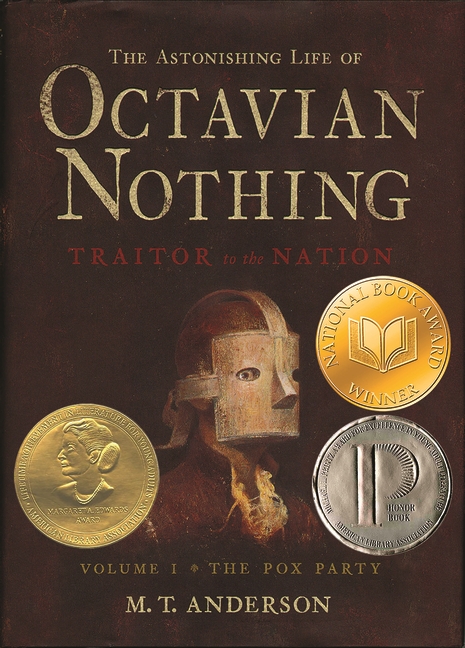
THE POX PARTY (The Astonishing Life of Octavian Nothing, Traitor to the Nation #1)
M.T. Anderson
Candlewick Press
$17.99 hardcover, available now
Rating: 4.5* of five
The Publisher Says: It sounds like a fairy tale. He is a boy dressed in silks and white wigs and given the finest of classical educations. Raised by a group of rational philosophers known only by numbers, the boy and his mother — a princess in exile from a faraway land — are the only persons in their household assigned names. As the boy's regal mother, Cassiopeia, entertains the house scholars with her beauty and wit, young Octavian begins to question the purpose behind his guardians' fanatical studies. Only after he dares to open a forbidden door does he learn the hideous nature of their experiments — and his own chilling role in them.
Set against the disquiet of Revolutionary Boston, M. T. Anderson's extraordinary novel takes place at a time when American Patriots rioted and battled to win liberty while African slaves were entreated to risk their lives for a freedom they would never claim. The first of two parts, this deeply provocative novel reimagines the past as an eerie place that has startling resonance for readers today.
My Review: I am always up for history, especially if it's presented from an unusual viewpoint or in a fresh manner. I thought this would be a fairly conventional and thus mildly tedious slave-comes-of-age, resists-tyranny thing. But there was that raver...surely someone who bothers to come to LT won't be that impressed by the usual thing....
So I got it, and I am so glad I did. The author recapitulates the bizarre upbringing of Octavian in a place called "The College of Lucidity" which is located in Boston (which is how you know it's fiction, Boston being the least lucid place I've ever been) in the faintly modernized voice of the youth himself looking back on the experience.
It's troubling, to put it mildly. It's flat creepy. But it's all he knew as a childhood, though life has taught him it's not what others knew as a childhood. He even quotes his mother saying he's never been a child. (He, Octavian, our narrator...these are interchangeable references in this review.) His very...well, ummm, inputs and throughputs are weighed and measured and logged for reference. His education is that of the most privileged, enlighted prince of his age. He stresses in presenting us with these facts that he felt no strangeness or otherness to his life. He was, so far as he knew, the object of no untoward interference or unusual interest.
The object speaks. It is a very unsettling reading experience.
As the story progresses and our narrator recalls his budding awareness and emotional growth as regards self and others, it becomes evident that Octvian and his mother are gilded captives. It's a realization that doesn't gall...yet...on him, but the author's subtlety with his emotional flensing knife is such that the older narrator's awareness of his feelings presages quietly the events at the end of the book. (No spoilers...but look carefully at the disturbing jacket illustration.)
Anderson's stated aim in writing this book is that he wished it had been around when he was a young reader. I wish it had, too. It's wonderful writing, no matter it's supposed to be "for" YAs. From p96 of the hardcover edition:
Our narrator...a youth, a stripling...so beautifully educated that he can create sentences like these! Such a huge bar is set for the youth reading this, but not one that's so far above and beyond comprehension that it's discouragingly impossible to meet. It's a nice sight to see the lack of condescenscion in this type of writing.
So how do the adults fare? Not too well, from the foolish and clueless Mr. Gitney to the aptly named and evil Mr. Sharpe, whose words from p338 (hardcover) I reproduce here that he may damn himself from his own lips:
So sayeth the free man to the slave. The prosecution rests. Recommended, and most highly.
+++++++++++++++++++++++++++++++++++++++++++++++++++++++++++++++++
THE KINGDOM OF THE WAVES (The Astonishing Life of Octavian Nothing, Traitor to the Nation #2)
Candlewick Press
$14.00 trade paper, available now
Rating: 3.5* of five
The Publisher Says: Fearing a death sentence, Octavian and his tutor, Dr. Trefusis, escape through rising tides and pouring rain to find shelter in British-occupied Boston. Sundered from all he knows — the College of Lucidity, the rebel cause — Octavian hopes to find safe harbor. Instead, he is soon to learn of Lord Dunmore's proclamation offering freedom to slaves who join the counterrevolutionary forces.
In Volume II of his unparalleled masterwork, M. T. Anderson recounts Octavian's experiences as the Revolutionary War explodes around him, thrusting him into intense battles and tantalizing him with elusive visions of liberty. Ultimately, this astonishing narrative escalates to a startling, deeply satisfying climax, while reexamining our national origins in a singularly provocative light.
My Review: Well, second books often don't rise to the level of the first in inventiveness and freshness. This one is typical of the syndrome.
Beginning where the extraordinary and original The Pox Party left off, The Kingdom on the Waves makes the adventures of Octavian Nothing complete. His best efforts are thwarted, his noblest desires unfulfilled, his quest for justice failed. All very true to history, but all very easy to predict. It's not that this is a bad book; it's a very good book. It's not clear to me why Anderson took 561pp to tell this story. I think the book sags a bit under the weight of its tale. It could easily have clocked in under 400pp and led us the same place.
I *love* that this is a YA book, written in so challenging and uncondescending a voice. Octavian is a very erudite narrator. I loved the structure of the book as a reader; it's in tasty-morsel-sized chapters. It's a very good book, and I recommend it.
I am firmly on record in many places as disliking the obesity of modern literary production. It's not that all books should be short in my opinion; it's that there is no reason for many, if not most, books to be as bloated with redundant and sometimes pointless verbiage as they are *stares pointedly at the Outlander books*. This book takes as its canvas a richly colored (no slur intended) part of American history. It's trying to fit a giant Technicolor extravagaza into a TV show. I think the editor would have done better to focus the author's obvious familiarity with the period on fewer episodes and left it at that.
But still, better a flawed and oversized story than none at all. The pleasures of the tale are many and savory, and I really hope you'll venture into YAdom to find this book soon.
M.T. Anderson
Candlewick Press
$17.99 hardcover, available now
Rating: 4.5* of five
The Publisher Says: It sounds like a fairy tale. He is a boy dressed in silks and white wigs and given the finest of classical educations. Raised by a group of rational philosophers known only by numbers, the boy and his mother — a princess in exile from a faraway land — are the only persons in their household assigned names. As the boy's regal mother, Cassiopeia, entertains the house scholars with her beauty and wit, young Octavian begins to question the purpose behind his guardians' fanatical studies. Only after he dares to open a forbidden door does he learn the hideous nature of their experiments — and his own chilling role in them.
Set against the disquiet of Revolutionary Boston, M. T. Anderson's extraordinary novel takes place at a time when American Patriots rioted and battled to win liberty while African slaves were entreated to risk their lives for a freedom they would never claim. The first of two parts, this deeply provocative novel reimagines the past as an eerie place that has startling resonance for readers today.
My Review: I am always up for history, especially if it's presented from an unusual viewpoint or in a fresh manner. I thought this would be a fairly conventional and thus mildly tedious slave-comes-of-age, resists-tyranny thing. But there was that raver...surely someone who bothers to come to LT won't be that impressed by the usual thing....
So I got it, and I am so glad I did. The author recapitulates the bizarre upbringing of Octavian in a place called "The College of Lucidity" which is located in Boston (which is how you know it's fiction, Boston being the least lucid place I've ever been) in the faintly modernized voice of the youth himself looking back on the experience.
It's troubling, to put it mildly. It's flat creepy. But it's all he knew as a childhood, though life has taught him it's not what others knew as a childhood. He even quotes his mother saying he's never been a child. (He, Octavian, our narrator...these are interchangeable references in this review.) His very...well, ummm, inputs and throughputs are weighed and measured and logged for reference. His education is that of the most privileged, enlighted prince of his age. He stresses in presenting us with these facts that he felt no strangeness or otherness to his life. He was, so far as he knew, the object of no untoward interference or unusual interest.
The object speaks. It is a very unsettling reading experience.
As the story progresses and our narrator recalls his budding awareness and emotional growth as regards self and others, it becomes evident that Octvian and his mother are gilded captives. It's a realization that doesn't gall...yet...on him, but the author's subtlety with his emotional flensing knife is such that the older narrator's awareness of his feelings presages quietly the events at the end of the book. (No spoilers...but look carefully at the disturbing jacket illustration.)
Anderson's stated aim in writing this book is that he wished it had been around when he was a young reader. I wish it had, too. It's wonderful writing, no matter it's supposed to be "for" YAs. From p96 of the hardcover edition:
Shortly after two o'clock on June 3rd, 1769, Venus descended into the plane of the ecliptic and came between the Earth and the sun. It is with awe that I treat of the event -- so minute, so silent here upon the Earth -- but there -- one can scarce imagine the roaring of that vast orb through those frigid depths, tumbling, flung through the plane of our orbit; the glaring heat, the searing glare of Sol -- and the gargantuan prodigiality of that body, consuming its own substance ceaselessly while planets whirled like houris, veiled and ecstatic around the throne of some blast-turbaned, light-drunken king.
Our narrator...a youth, a stripling...so beautifully educated that he can create sentences like these! Such a huge bar is set for the youth reading this, but not one that's so far above and beyond comprehension that it's discouragingly impossible to meet. It's a nice sight to see the lack of condescenscion in this type of writing.
So how do the adults fare? Not too well, from the foolish and clueless Mr. Gitney to the aptly named and evil Mr. Sharpe, whose words from p338 (hardcover) I reproduce here that he may damn himself from his own lips:
We have labored too long under a government that has sought to curtail exchange; such interference is unnatural. We shall see a brave new day, Octavian, when the rights of liberty and property are exercised, and when all men are free to operate in their own self-interest. And as each individual expresses his self-interested will, so does the democratical voice speak, the will of the common people, not kings and ministers; and when the self-interest of every citizen speaks together, then and only then does benevolence arise.
So sayeth the free man to the slave. The prosecution rests. Recommended, and most highly.
+++++++++++++++++++++++++++++++++++++++++++++++++++++++++++++++++
THE KINGDOM OF THE WAVES (The Astonishing Life of Octavian Nothing, Traitor to the Nation #2)
Candlewick Press
$14.00 trade paper, available now
Rating: 3.5* of five
The Publisher Says: Fearing a death sentence, Octavian and his tutor, Dr. Trefusis, escape through rising tides and pouring rain to find shelter in British-occupied Boston. Sundered from all he knows — the College of Lucidity, the rebel cause — Octavian hopes to find safe harbor. Instead, he is soon to learn of Lord Dunmore's proclamation offering freedom to slaves who join the counterrevolutionary forces.
In Volume II of his unparalleled masterwork, M. T. Anderson recounts Octavian's experiences as the Revolutionary War explodes around him, thrusting him into intense battles and tantalizing him with elusive visions of liberty. Ultimately, this astonishing narrative escalates to a startling, deeply satisfying climax, while reexamining our national origins in a singularly provocative light.
My Review: Well, second books often don't rise to the level of the first in inventiveness and freshness. This one is typical of the syndrome.
Beginning where the extraordinary and original The Pox Party left off, The Kingdom on the Waves makes the adventures of Octavian Nothing complete. His best efforts are thwarted, his noblest desires unfulfilled, his quest for justice failed. All very true to history, but all very easy to predict. It's not that this is a bad book; it's a very good book. It's not clear to me why Anderson took 561pp to tell this story. I think the book sags a bit under the weight of its tale. It could easily have clocked in under 400pp and led us the same place.
I *love* that this is a YA book, written in so challenging and uncondescending a voice. Octavian is a very erudite narrator. I loved the structure of the book as a reader; it's in tasty-morsel-sized chapters. It's a very good book, and I recommend it.
I am firmly on record in many places as disliking the obesity of modern literary production. It's not that all books should be short in my opinion; it's that there is no reason for many, if not most, books to be as bloated with redundant and sometimes pointless verbiage as they are *stares pointedly at the Outlander books*. This book takes as its canvas a richly colored (no slur intended) part of American history. It's trying to fit a giant Technicolor extravagaza into a TV show. I think the editor would have done better to focus the author's obvious familiarity with the period on fewer episodes and left it at that.
But still, better a flawed and oversized story than none at all. The pleasures of the tale are many and savory, and I really hope you'll venture into YAdom to find this book soon.
Subscribe to:
Posts (Atom)