Showing posts with label CW: anti-semitism. Show all posts

Friday, April 11, 2025

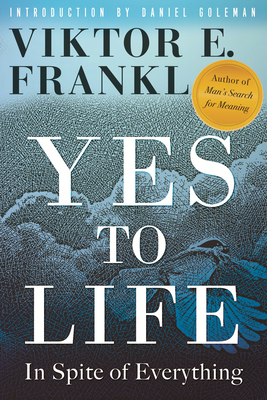
YES TO LIFE: In Spite of Everything, words and concepts I'd very much prefer to continued doomscrolling


YES TO LIFE: In Spite of Everything
VIKTOR E. FRANKL
(tr. Joelle Young, intro. Daniel Goleman)
Beacon Press (non-affiliate Amazon link)
$9.99 ebook, available now

Rating: 5* of five

The Publisher Says: Find hope even in these dark times with this rediscovered masterpiece, a companion to his international bestseller Man’s Search for Meaning.

Eleven months after he was liberated from the Nazi concentration camps, Viktor E. Frankl held a series of public lectures in Vienna. The psychiatrist, who would soon become world famous, explained his central thoughts on meaning, resilience, and the importance of embracing life even in the face of great adversity.

Published here for the very first time in English, Frankl’s words resonate as strongly today—as the world faces a coronavirus pandemic, social isolation, and great economic uncertainty—as they did in 1946. He offers an insightful exploration of the maxim “Live as if you were living for the second time,” and he unfolds his basic conviction that every crisis contains opportunity. Despite the unspeakable horrors of the camps, Frankl learned from the strength of his fellow inmates that it is always possible to “say yes to life”—a profound and timeless lesson for us all.

I RECEIVED A DRC FROM THE PUBLISHER VIA EDELWEISS+. THANK YOU.

My Review
: I had a copy of Man’s Search for Meaning in my house all my life. I first read it in one or another of the 1970s, though I can't recall which one; it was at a time of abject misery in my youth. It is a book about healing, and about perspective as the path to healing, messages that resonated deeply with me and still do. One always has the right to choose one's response to troubles and imposed suffering.

The 1946 lecures in this present book are not quite precursors to his larger, later work. They are shorter stems, less fully grown and un-espaliered on his carefully developed walls of philosophy; they're certainly grown on the same rootstock, however. That's how this gem arose to my grateful eyes: "Our perspective on life's events—what we make of them—matters as much or more than what actually befalls us. 'Fate' is what happens to us beyond our control. But we each are responsible for how we relate to those events."

I read this book, which came out early in the pandemic, after seeing Will of The Brothers Gwynne encounter Frankl and his bracing philosophy of using one's trauma for positive growth this month. It was a nudge for me to dig this book out, having shelved it during COVID while watching literal dozens of the people who live in my facility die hacking for breath that was not ever coming back because...honestly because I had the privilege of living and the luxury of only the most minor of symptoms when I caught the disease. It felt too on the nose in 2020, and I just forgot I had it until I saw the young man speaking on YouTube, and then reading his review on Goodreads about how he felt changed by Man’s Search for Meaning after reading it.

I was prompted by young Gwynne's reaction to seek out a similar one. I found several things that were of great value to me in my dotage, and weren't exactly mirrored in the Frankl quotes in my commonplace book, eg: "To say yes to life is not only meaningful under all circumstances—because life itself is—but it is also possible under all circumstances." What a mind to come up with this statement after being in Auschwitz!

Viktor Frankl is more than an inspiration. He argued in the face of people who wanted to exterminate him, like Daleks or Borg want to exterminate because they can, all those they Othered and deprived of essential humanity, that everyone, even his oppressors and wannabe murderers, are worthy of dignity and able to find meaning and value in this bizarre thing we call life.

Viktor Frankl is as close as we will see to holy man. He lived for fifty years after his liberation from Auschwitz. His simple continued existence would be inspiring enough. He never stopped, in his long life,espousing his belief in "logotherapy", something that was controversially developed *before* Frankl went to the camps for being Jewish...and while working for a Nazi-affiliated Austrian organization.

Does this make his story a lie? Some very nasty people, who never met Frankl or even conducted primary archival research on their allegations against him, claim he greatly exaggerated his peril as a Jew. Some extremely religious Jews claim he was a monstrous collaborator with the Nazis.

Judging him by his works, I believe they are the exaggerators, and quite possibly the liars. I say this without having done any serious research into the facts they allege to have discovered, only using for them the standard I've used for Frankl: Their works speak loudly. And in my opinion, point to darkness and ugliness in their motivations.

I remain inspired and uplifted by the works and words of Viktor E. Frankel. Thank you, young Mr. Gwynne, for saying the right thing at the right time, thereby reminding me of a good role model for the best use of perspective.

Monday, April 15, 2024

HENRY HENRY, unlikable people are so much more interesting to read about, aren't they?


HENRY HENRY
ALLEN BRATTON

The Unnamed Press
$29.00 hardcover, available now

Rating: 4.5* of five

WINNER OF THE 37TH Lambda Literary Awards for Gay Fiction!

The Publisher Says: Henry Henry is a queer reimagining of Shakespeare's Henriad, transposing the legend of Henry V's wayward youth into 21st-century Britain in the years leading up to the Brexit referendum.

Henry Henry follows Hal Lancaster—22, gay, Catholic—as he spends his first years out of Oxford floating between internships, drinking with his actor friends, struggling through awkward hook-ups, and occasionally going to confession to be absolved of his sins.

When a grouse shooting accident—funny in retrospect—makes a romance out of Hal's rivalry with fumblingly leftist family friend Harry Percy, Hal finds that he wants, for the first time, to be himself. But his father Henry is an Englishman: he will not let his son escape tradition. To save himself, Hal must reckon not only with grief and shame but with the wounds of his family's past.

I RECEIVED A DRC FROM THE PUBLISHER VIA NETGALLEY. THANK YOU.

My Review
: So, the plot's not a big mystery...Shakespeare did the set-up half a millennium ago, if you haven't read it that's on you and your life choices...but brings the subtect of queerness into full textual focus.

This will make some homophobic numskulls very angry. Good.

I was sexually abused by my mother the way Hal was by his father. The many shamings and abuses, the cruel holdings-up to those gone by, of Hal as a person by his father; and maybe more importantly as a sexual being by the idiocy of religion; and the nastiness of steadily belittling him, all poured acid into my eyes. The playbook of controlling mechanisms are all right here: These awful things happened to me, too, Hal, and I really, really want to hug you while murderering your father. The ugly shadow, dirty smudgy tobacco-smoky brown-grey, that will always separate you from your deeply belovèd Percy who can, in the miraculous way of one truly and purely loved, make Hal clean again, can't be banished. Not with his abuser and the filthy miasma of their god suspended in Hal's breath and between the red blood cells in his veins.

What worked best, then, was the reality of a psychologically abused son in the grip of a sexually jealous and sociopathic parent who expresses their power by coercing the child into sexual servitude and then blaming the child for not being strong enough to live a normal life. What was not necessarily so easy was the mapping of the story onto Shakespeare's "Henriad." It's been a while since my Shakespeare days, but the whole point of the Henriad wasn't to map out Prince Hal's survivorhood, was it? It was meant to explain how, after his rebellious rageful youth, he snaps into focus when he hears the strumpet shriek of Power. Of course, if you don't know the outline of the Henriad, none of this matters because it will sail past you. Suffice to say that book-Hal is a nasty piece of work (though for a reason), and play-Hal is a nasty piece of work too (though for different ones). The father/son conflicts, the verbal cruelties each inflicts, are all in the plays. The thing that isn't in the plays is Hal's self-awarness, or so I recall. Play-Hal is nasty and abusive to kinder people than he deserves to have around him and then, when he attains Power, he changes; book-Hal is more reflective, more aware that he is in fact wrestling with demons that have warped him and could kill him if he does not get the upper hand.

What that meant to my reading of the story was that I half-hoped there would be some mercy for the lost and the left behind. What it actually meant was the book ended before I got a sense that the story was over and all the threads dangled.

Not my favorite kind of ending. Appropriate to the subject matter. Truthful and completely honest. Just...dissatisfying, a lot like the life it limns for Hal. He is not satisfied; he cannot be satisfied; he can only dimly conjure any awareness that satisfaction could exist but can in no way craft any kind of response to those around him that would result in anyone feeling satisfied. It is, as a novel, bitter and hateful and cruel; but it is beautifully said and spoken in clear, unhistrionic tones.

A very big ask, this read. Go in with your Shakespeare goggles on and come away shocked at what a new generation of response to him has uncovered. Go in unaware of the Henriad and the dangling ends might bother you more. Shakespeare took three plays (four, if we're stuffy about it) to resolve the Lancastrian dynasty's fate. Author Bratton tried to squeeze it into less than four hundred pages so no wonder he wasn't all the way successful.

Fully successful or not, the clarity and honesty about the pain that abuse and hateful religiosity of Hal's world make it a highly rewarding read.

Monday, September 18, 2023

THE PECULIARITIES, flawed but fun


THE PECULIARITIES
DAVID LISS

Tachyon Publications
$17.95 tradepaper, available now

Rating: 3.75* of five

The Publisher Says: From popular historical alternate history author David Liss (A Conspiracy of Paper) comes the tale of a clueless young man embroiled in a deadly supernatural mystery in London. Rooted in strange conspiracies and secret societies, this absurdist comedic romp combines strange bedfellows with murderous creatures, resulting in an unexpectedly delightful consequences.

All of his life, Thomas Thresher has been free of obligation and responsibility, but that is over now. He is a twenty-three-year-old man whose best days are behind him. Thomas's older brother Walter has trapped him in a tedious clerical job at the family bank in London, and Thomas is expected to wed a wealthy young woman in whom he has no interest.

But Thomas has more serious problems than those of a disaffected young man. There are irregularities at the bank he cannot explain. His childhood friend has mysteriously turned up dead. Worse, a verdant skin malady has infected him: leaves have begun sprouting on his skin. Thomas must conclude that it is due to the long-rumored Peculiarities. London's famous grey fog has been concealing a rash of unnatural afflictions—and worse, the murderous Elegants.

As Thomas grows leafier, the conspiracies surrounding him become more apparent. He cannot determine whom to trust: his own family; his banking co-workers and superiors; the beautiful widow of his companion; the woman he is to marry. Or perhaps a lycanthropic medium; the members of a secret occult society...or even Aleister Crowley.

I RECEIVED A DRC FROM THE PUBLISHER VIA NETGALLEY. THANK YOU.

My Review
: Clueless whiny nepo baby Thomas Thresher, clerking at his family's London bank and living a really cushy life, starts to grow leaves from his body. Promising start to a David Liss story. We've got London, though in the early twentieth century not the eighteenth, we've got business shenanigans at the bank, and a world in which there are children with lobster claws, women giving birth to rabbits, killer fogs of supernatural origin, and a werewolf psychic. Oh, and Aleister Crowley.

Why does Walter, Thomas's brother, have such wood for Thomas's marriage to Esther, a Jewish woman with pots of money? What is driving the oddball events in the bank (seriously dodgy loans and very odd property acquisitions) that aren't in service of making money? And, last but not least, what the hell are all these leaves doing on Thomas's body?

The way Thomas sets about trying to make sense of the Peculiarities, the way he simply rolls up his sleeves, picks a few leaves off, and starts looking around for information that could help him...these are positives. They do lead, quite naturally, to a slightly off-putting disconnected style, episodes instead of one smooth narrative. That wasn't entirely to my personal liking but I got accustomed to it.

What I very much didn't get used to was Esther's being the butt of so many nasty, mean-spirited jokes not least from Thomas...the man she's set to marry. It made me very uncomfortable and was absolutely never addressed...Esther end the way she began, a one-note anti-Jewish joke. I couldn't figure out why she was so awful, compared to Thomas's suddenly acquired love interest who was a cypher.

That, and a really cringey sexual assault scene, are the source of my lower-than-expected rating.

I was very taken by the Peculiarities themselves. The fact that we don't find out what the hell's going on here isn't a major issue for me because the verve of Author Liss's tellings of the supernatural events was the actual point. There's no need to explain strange doings if the point of them is to be strange. What Author Liss does overexplain is the world of 1899 London and its many and various restrictions on women and Others. That's really overdone.

Something that might be overdone for some readers is the pseudo-Victorian locutions of Thomas's narration. I myownself found it fun and just on the good side of stilted, but others might feel differently. If you opt to read a sample of the Kindle edition, you'll know right away if this is for you or not. What nearly scuppered my interest, and greatly slowed my reading, was the chest-pokey second-person narration parts.

I must say that, with the different historical luminaries swirling through the story, I was a little bit let down that none of them played a big role in the solution to the strange issues in the book. (Well, except Aleister Crowley.)

Not a perfect read, but a good one; a lot of stuff gets wrapped up in the last ten percent of the book but not, by any means, even close to everything. That is, for me, perfectly okay because very few things in life are wrapped up in tidy little bows. The Peculiarities remain peculiar. And most enjoyably so.