Showing posts with label existential crisis. Show all posts

Friday, April 11, 2025

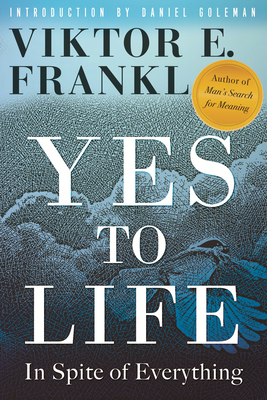
YES TO LIFE: In Spite of Everything, words and concepts I'd very much prefer to continued doomscrolling


YES TO LIFE: In Spite of Everything
VIKTOR E. FRANKL
(tr. Joelle Young, intro. Daniel Goleman)
Beacon Press (non-affiliate Amazon link)
$9.99 ebook, available now

Rating: 5* of five

The Publisher Says: Find hope even in these dark times with this rediscovered masterpiece, a companion to his international bestseller Man’s Search for Meaning.

Eleven months after he was liberated from the Nazi concentration camps, Viktor E. Frankl held a series of public lectures in Vienna. The psychiatrist, who would soon become world famous, explained his central thoughts on meaning, resilience, and the importance of embracing life even in the face of great adversity.

Published here for the very first time in English, Frankl’s words resonate as strongly today—as the world faces a coronavirus pandemic, social isolation, and great economic uncertainty—as they did in 1946. He offers an insightful exploration of the maxim “Live as if you were living for the second time,” and he unfolds his basic conviction that every crisis contains opportunity. Despite the unspeakable horrors of the camps, Frankl learned from the strength of his fellow inmates that it is always possible to “say yes to life”—a profound and timeless lesson for us all.

I RECEIVED A DRC FROM THE PUBLISHER VIA EDELWEISS+. THANK YOU.

My Review
: I had a copy of Man’s Search for Meaning in my house all my life. I first read it in one or another of the 1970s, though I can't recall which one; it was at a time of abject misery in my youth. It is a book about healing, and about perspective as the path to healing, messages that resonated deeply with me and still do. One always has the right to choose one's response to troubles and imposed suffering.

The 1946 lecures in this present book are not quite precursors to his larger, later work. They are shorter stems, less fully grown and un-espaliered on his carefully developed walls of philosophy; they're certainly grown on the same rootstock, however. That's how this gem arose to my grateful eyes: "Our perspective on life's events—what we make of them—matters as much or more than what actually befalls us. 'Fate' is what happens to us beyond our control. But we each are responsible for how we relate to those events."

I read this book, which came out early in the pandemic, after seeing Will of The Brothers Gwynne encounter Frankl and his bracing philosophy of using one's trauma for positive growth this month. It was a nudge for me to dig this book out, having shelved it during COVID while watching literal dozens of the people who live in my facility die hacking for breath that was not ever coming back because...honestly because I had the privilege of living and the luxury of only the most minor of symptoms when I caught the disease. It felt too on the nose in 2020, and I just forgot I had it until I saw the young man speaking on YouTube, and then reading his review on Goodreads about how he felt changed by Man’s Search for Meaning after reading it.

I was prompted by young Gwynne's reaction to seek out a similar one. I found several things that were of great value to me in my dotage, and weren't exactly mirrored in the Frankl quotes in my commonplace book, eg: "To say yes to life is not only meaningful under all circumstances—because life itself is—but it is also possible under all circumstances." What a mind to come up with this statement after being in Auschwitz!

Viktor Frankl is more than an inspiration. He argued in the face of people who wanted to exterminate him, like Daleks or Borg want to exterminate because they can, all those they Othered and deprived of essential humanity, that everyone, even his oppressors and wannabe murderers, are worthy of dignity and able to find meaning and value in this bizarre thing we call life.

Viktor Frankl is as close as we will see to holy man. He lived for fifty years after his liberation from Auschwitz. His simple continued existence would be inspiring enough. He never stopped, in his long life,espousing his belief in "logotherapy", something that was controversially developed *before* Frankl went to the camps for being Jewish...and while working for a Nazi-affiliated Austrian organization.

Does this make his story a lie? Some very nasty people, who never met Frankl or even conducted primary archival research on their allegations against him, claim he greatly exaggerated his peril as a Jew. Some extremely religious Jews claim he was a monstrous collaborator with the Nazis.

Judging him by his works, I believe they are the exaggerators, and quite possibly the liars. I say this without having done any serious research into the facts they allege to have discovered, only using for them the standard I've used for Frankl: Their works speak loudly. And in my opinion, point to darkness and ugliness in their motivations.

I remain inspired and uplifted by the works and words of Viktor E. Frankel. Thank you, young Mr. Gwynne, for saying the right thing at the right time, thereby reminding me of a good role model for the best use of perspective.

Monday, December 2, 2024

DREAM CITY: A Novel, sharp-eyed skewering of a culture of excess


DREAM CITY: A Novel
DOUGLAS UNGER

University of Nevada Press
$29.95 hardcover, available now

Rating: 4* of five

The Publisher Says: In this unconventional tale of Las Vegas during the two delirious boom decades before the bust of the Great Recession, failed actor “C. D.” Reinhart, who has launched a new career in hotel marketing, is gradually losing his moral and existential compass. Working on The Strip during an era when Sin City’s population growth was outpacing any other place in America, C. D. climbs the industry ladder while modeling himself after a Pyramid Resorts top executive, Lance Sheperd. C. D.’s professional choices lead him down a tumultuous road, as Sheperd, a complex and, at times, visionary figure, pilots his ventures through the tangled wheeling and dealing of finance and corporate politics straight into catastrophe.

As the story progresses, C. D. comes to understand how his personal losses and the losses of his cohort of hard driving executives on the make—especially the tragic life of his work partner, Greta Olsson, the only woman to break through into their male dominated world—are a result of the make-believe environment he has helped to create, a world where representation replaces reality. Hoping to piece together his faltering marriage and family relationships, C. D. must find a new path as he struggles to hold onto his dreams.

In this fictionalized version of the city of glittering lights, author Douglas Unger pits the ideologies of marketing and consumerism in the casino economy of America against the erosion of individual and humane values that success in that world demands. Unger reveals the hard truth that Las Vegas, a blue-collar town considered by many to be “the most honest city,” can be a temple for self-deceptions, emblematic of a service economy that knows the price of everything and too often the value of little else. Dream City becomes both a love song and an elegy for Las Vegas that sets it apart from any other literary novel previously written about this global entertainment attraction that in so many ways represents postmodern America. Sooner or later, the challenge that faces everyone is to discover what matters most, and to learn how to bet on the better angels of our natures.

I RECEIVED A DRC FROM THE PUBLISHER VIA NETGALLEY. THANK YOU.

My Review
: Deserts frighten me. I live in a beach town for a reason. My trips to Las Vegas weren't numerous, but are very memorable—for good and ill. Here's a story, then, that's set in a place I do not love or admire, featuring a man in Act Three of his life having failed at his other lives, and failing again.

Paging Updike and Cheever, your territory's being encroached.

And most effectively. Author Unger is working in a long tradition of male-centered stories, prioritizing an idea of success that capitalism likes to valorize and that relegates anything other than work to peripheral significance...only to flip the script and show the hollowness and lack of fulfillment and connection inherent in this cultutally approved rat race.

Critiques are most effective when they come from within. This detailed, almost obsessive, chronicling of one man's descent from the pinnacle he dreamed of reaching into the real-world uses of the talents he never had the luck to exploit to their fullest, is inside the house. The astonishing world of wealth is detailed, excess by excess, without a trace of overt judgment. Like the eternal anticapitalist novel Babbitt, it uses a steady unblinking gaze to do what polemics fail to do: Indict the system that rewards conformist capitulation with material comforts. The problem with this reward system is, and always has been, it is conditional. It can all be taken away from the recipient at any time, either through anonymous "market forces" or malevolent, targeted manipulations of law and economics.

In personalizing the details of one man, in one city, as he rises and falls, Author Unger joins the crew of midcentury modern men in quietly unpicking the system's built-in failures. He uses the main man's wife as a sort of moral Cassandra, constantly questioning—while continuing to enjoy—the fruits of his enviable rise from the ashes of ruined ambition. It's here that I lost a star. Women as Moral Centers, however compromised, irk the snot out of me. Like she condescended to hitch herself to this sad, lost little boy (who's given her a life of comfort) to Guide and Sustain him...gross. She's complicit, she's also culpable for not doing it her damnself. The trope of the little woman who stays home is really the relams of fantasy in this day and time. It's unusual enough that it's now fodder for highly-rated prurient TV shows about the wealthiest capitalists in the hypercapitalist world we exist in.

Why I recommend it to you is simple: Updike, Cheever, Sloan Wilson, and company are dreadfully old-fashioned. Their row still needs hoeing in the world we live in. Author Unger is uniquely placed to tell this generation about its golden calfs. Seen in this light even the repugnant gender politics are a sharp critique of the aspirations that Las Vegas, glittering gambling capital, represents.

Castles built in the air always fall. Gravity, it pays every one of us to foreground in our awareness, is a law that can not be repealed. Flouting it temporarily carries costs that accrue terrible interest surcharges.

Author Unger, without beating you up, reminds you of this.