Showing posts with label Ohio setting. Show all posts

Thursday, November 7, 2024

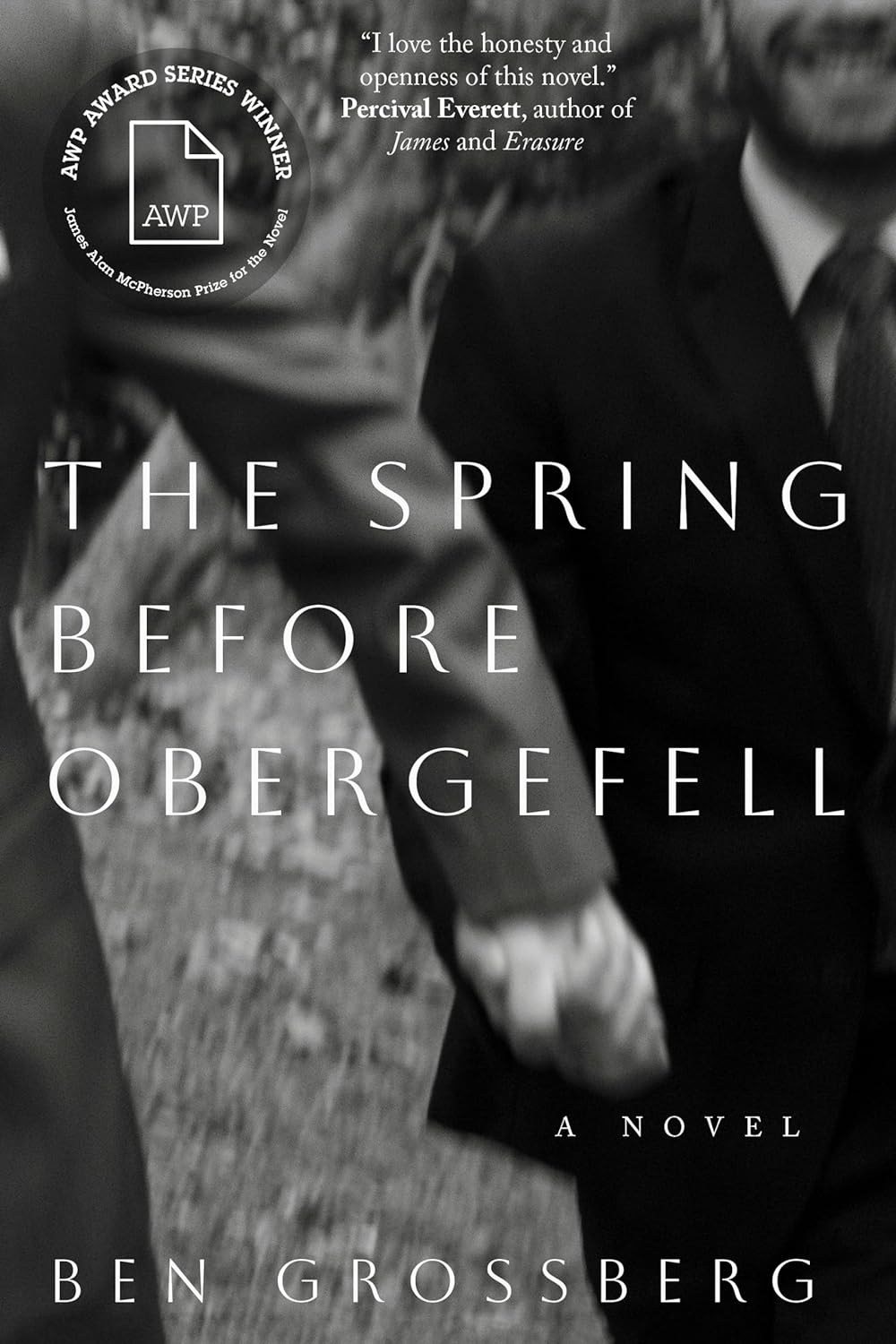
THE SPRING BEFORE OBERGEFELL, hope in dark times...aimed directly at older gay men


THE SPRING BEFORE OBERGEFELL
BENJAMIN S. GROSSBERG

University of Nebraska Press (non-affiliate Amazon link)
$20.85 Kindle edition, available now

WINNER OF THE 37TH Lambda Literary Awards for Gay Romance!

Rating: 4.5* of five

The Publisher Says: It’s not easy for anyone to find love, let alone a middle-aged gay man in small-town America. Mike Breck works multiple part-time jobs and bickers constantly with his father, an angry conservative who moved in after Mike’s mother died. When he’s not working or avoiding his father, Mike burns time on hookup apps, not looking for anything more. Then he meets a local guy, Dave, just as lonely as he is, and starts to think that maybe he doesn’t have to be alone. Mike falls hard, and in a moment of intimacy, his pent-up hopes for a relationship rush out, leading him to look more honestly at himself and his future.

Winner of the James Alan McPherson Prize for the Novel, Ben Grossberg’s The Spring Before Obergefell is about real guys who have real problems, yet still manage to find connection. Funny, serious, meditative, and hopeful, The Spring Before Obergefell is a romance—but not a fairytale.

I RECEIVED A DRC FROM THE PUBLISHER VIA NETGALLEY. THANK YOU.

My Review
: I so relate to Matteo, Mike's first RL shot at Love. Catalyzes something good and big; doesn't get to participate, too acerbic and just Too Much.

It's a curse, unless of course it's not. It felt very very good to read Dave and Mike's borning relationship.

A story set ten years ago about the challenges of forming relationships as gay men in homophobic Murrika. There has never been a moment where this subject, treated with hope, has been more welcome. We're now looking into the maw of Project 2025. *horripilation*

Nothing in this book leads me to believe the author was predicting the future as he wrote it. It's still a welcome moment of hope in a bleak landscape. Part of keeping hope alive is to feed it. The Spring Before Obergefell offers readers, gay men in particular, and older gay men for sure, a story that deals with the reality of family in this new age of darkness. There is always hope. It feels like there is not sometimes. Mike and his world...well...hope is what he found. That message trumps all the noise and chaos of the world.

Monday, June 5, 2023

PEDRO & DANIEL, when home is not The Safe Place it should be


PEDRO & DANIEL
FEDERICO EREBIA
(illus. Julie Kwon)
Levine Querido
$19.99 hardcover, available 20 June 2023

Rating: 4* of five, doubtless the full five or even more for its target audience

The Publisher Says: Pedro and Daniel are Mexican American brothers growing up in 1970s Ohio. Their mother resents that Pedro is a spitting image of their darker-skinned father; that Daniel likes dolls; that neither boy plays sports. Both are gay and neurodivergent. They are alike, but they are dissimilar in their struggles, their dreams, their approach to life.

Pedro & Daniel is a sweeping and deeply personal novel that spans from childhood, through their teen years, and into adulthood. Theirs is a bond that won’t be broken. Together they endure an abusive home life, coming out, first loves, first jobs, and the AIDS pandemic, in a coming-of-age story unlike any other.

Despite everything, there is much joy in the stories in the book. Their resilience and special bond help the boys face one evil after another. While Pedro suffers more at home, Daniel is particularly susceptible to the malevolence of the outside world.

They are similar: gay, neurodivergent Latinos in love with all things Mexico.

Son tal para cual.
They are cut from the same cloth.

They are different: Pedro is darker-skinned, oppressed, repressed, introverted, and agnostic. Daniel is precocious, carefree, mischievous, religious, and unguarded.


Mismo perro, distinto collar.
Same dog, different collar.

CW: References to domestic violence, child abuse, homophobia, colorism, racism, clergy abuse, suicidality, sex, and death.

I RECEIVED A DRC FROM THE PUBLISHER VIA EDELWEISS+. THANK YOU.

My Review
: The survivor always writes the history. Pedro, the in-book pseudonym for Dr. Federico Erebia, a retired physician, who is also an artist, a woodworker, an author, and an illustrator, here tells the story of the horrifying, abusive family life led by himself and his late brother Daniel. Their boyhood having roughly coincided with my own, and their immigrant parents being much like the immigrant parents I knew in South Texas, the dichos and the interspersed poetry with prose, the cultural touchstones were all bone-deep familiar. What added to my sense of coming home was the young men's comings-out, internal and public, between themselves quietly and subtly; being gay in a deeply religious and brutally homophobic culture, during the peak terror of the AIDS crisis, only added to my anxious sense of identification with them.

What makes this story ideal for its youthful intended market is the absolute honesty and clarity of Author Erebia's prose; he couldn't tell a lie in these words, or even invent too much, because the ring of truth is absent when he does. He also never softens any blow, or pretends what hurt wasn't that bad, or helped grow him up, as other authos have in pursuing similar themes. He never takes the tack that it will all turn out okay; his belovèd brother dies of AIDS.

Love does not conquer all. What Love does is help one bear all that misery hateful bigots heap on you from before you know why they hate you. This is honest and it is helpful to young people to be told the truth. Things can hurt so bad in the moment that no one is surprised that you would consider ending your life. No one who's experienced hatred and rejection, however it's presented, is at all ever going to judge you for that. I do enjoy a story that tells young gay boys and girls all that, as well as implicitly supports the knowledge of no you aren't imagining it; yes, they do mean it; but crucially importantly you can and are wanted by others you haven't met to survive all of it. This story says loud and clear the truth: IT DOES GET BETTER.

Why I only rated it 4 stars of five is I found myself almost chanting the metrical dichos and poetic snippets, in that read-aloud to infants cadence. I don't enjoy that sensation. It's not aimed at me, so I present this as a reason, not an excuse. Others have other ideas about this facet of storytelling, and it works in the rap/hiphop/modern spoken word generation a treat. For me and those of my tastes, exercise caution in your consumption.

Friday, November 23, 2018

WHISKEY KILLS, second Top Shelf mystery, delivers cozy smiles and puzzle-solving thrills


WHISKEY KILLS
LOLLI POWELL
(Top Shelf Mysteries #2)
Kindle original
$3.99 Kindle, $13.95 trade paper, available now

Rating: 4* of five

The Publisher Says: Big cities are known to be dangerous, but former New Yorker and bar owner Ricki Fontaine is finding the small town of Waterton, Ohio, is proving to be the murder capital of the world—well, at least her world.

The new Top Shelf is open for business, but business as usual for Ricki and the Shelf translates to another dead guy. Ricki’s friend, Ruby Fogarty, is charged with murdering her boyfriend by clubbing him to death with a bottle of whiskey. The police consider the case closed, but Ricki is convinced Ruby is innocent and sets out to find the real murderer. Although Waterton police detective Gabriel Russell is crazy about Ricki, he isn’t too crazy about her trying to do his job.

The killer’s not too happy about it either.

MY YOUNG GENTLEMAN CALLER GAVE ME THIS BOOK. THANK YOU, DEARHEART.

My Review: Here's another dose of Ricki-love. I read this earlier this year, right after The Body on the Barstool, and can't quite believe I didn't warble my fool head off about it then. But here it is, time to think about Yule gifting, and what better gift (or self-gift) than a charming, satisfying trip down the fantastical amateur sleuth trail. It's a welcome respite from reality's challenges and stresses to read a mystery.

We all know that real amateur sleuths would be firmly and unkindly squashed by the real police. We also know that a real-world case of murder wouldn't be a safe, or even sane, place to insert your amateur self. That makes these fantasy outings safe ways to get our ma'at needs met. We all love to think Right is always served, that justice being done doesn't go unrealized by the law's wiggle room for miscreants. That is a need commonly unmet by real life. I suspect that isn't a surprise to anyone what can read this blog, eh? So stories, as ever and always they do, fulfill this deep and abiding need for us. We are Ricki the accidental bar-owner-sleuth for the time it takes to read the story. We are alluring to the handsome, long-ago crush object/enemy Gabriel...working out another normally unmet need to get the one that got away.

Frank, the murder victim, is just nasty enough to trigger another ma'at need: Clear out the drain of selfish, self-centered people that sink to the lower level of our lives. Ruby, a good-hearted good-time gal, is the archetypal sympathetic screw-up friend we want to rescue. The stakes, being accused of Frank's murder, are the highest most of us can imagine facing. Ricki faces the troubles despite thinking Ruby's better off without Frank and if that means he's dead...well...eggs, omelettes....

Adam, Ricki's...geez...family relationships are complicated and words for the relationships that begin within the modern iteration of family haven't been invented yet, so the explanatory labels are unwieldy: Ricki's ex-husband's husband...is used in the series as the invaluable practical ally/trusted support character. He's also a wonderful way to show that Ricki is a certain kind of person, a real menschy kind of gal, who looks past what in a lesser person would be a great excuse for a grudge against someone in order to see and care about them. Her mother and stepfather play a big enough role in this book for me to feel the gravity of parental love that Ricki really thinks she wants to escape. Events show her otherwise, as expected; but she also makes a key discovery about the way the past creates the problems of the present via this evergreen conflict of mothers versus daughters.

There are plenty of threads woven through this plot that attach to past events. That's really what I enjoy most about series mysteries. The present, the crime-solving bit, develops over time and relationships come and go, like real life; but the past, in a series, is a character of its own and comes to the fore as the sleuth moves farther from it. Well, in the series mysteries that I read, this is the case or I bail on them. In this book, Ricki (already shown to be someone whose past is part of her present, see: Adam) learns a lot about her love interest Gabe, and about the uncle whose death landed her in Ohio to begin with. It isn't all good, and in Ricki fashion she sees that it isn't all bad either. Events she had no part in are left for her to resolve. Like we all wish we could, she resolves them as best she can and in a positive way. That's a strong through-line in this series of books: Positive change. Managing what you start with to be better when you're done.

I will note that one subplot bothered me: The evangelist megachurch founders are way too caricature for me, and I'm as anti-christian as it's possible to be.
Everett Forman burst into one of the phoniest laughs I'd ever heard, while his wife tittered in a very ladylike fashion. I'm not much of a prayer, but I wondered if I should ask the Lord to keep me from barfing during dinner. If the reverend didn't improve his act, I was afraid I wouldn't be able to hold it in.
All's well that ends well, I suppose, but their twirling-mustachio "I'll get you, my pretty" OTT evillenesse detracted from my otherwise spotless love for the story.

Final Note: One entire star off for four uses of the hideous, cheesy, trashy w-bomb. AUTHORS OF THE WORLD: NONE OF THIS
EVER EVER EVER IT'S CHEESY AND CREEPY AND GROSS

Monday, April 2, 2018

THE BODY ON THE BARSTOOL, a charming cozy murder mystery


THE BODY ON THE BARSTOOL
LOLLI POWELL
(Top Shelf Mysteries #1)
Kindle original (non-affiliate Amazon link)
$3.99 available now

Rating: Solid 4 stars of five

The (Self-)Publisher Says: New Yorker Erica "Ricki" Fontaine's ne'er-do-well uncle has dropped dead and left her a dive bar in a small Ohio River town. With a lousy apartment, less-than-promising job prospects, and even worse romantic ones, the inheritance comes at just the right time. Ricki packs up her cat and heads for the Buckeye State.

Now she's trying to change the Top Shelf from a bar known for its Friday night fights into the kind of drinking establishment where you can bring your granny. But finding her ex-husband dead on a barstool at opening time one morning just might put a kink in those plans.

2016 WISHING SHELF INDEPENDENT BOOK AWARDS BRONZE WINNER...congratulations!

WHISKEY KILLS, Top Shelf #2, is here!

My Review
: I knew this series was for me when I read that the author lived with three or four dogs. I feel a little betrayed that the c-a-t in these books is presented in a favorable light, but one can't have everything. I'm not quite sure why that should be, but there it is.

When Ricki returns to (fictional) Waterton, Ohio, after a stint there as a child in the middle 1990s, she does so as a woman of property, a caryatid of the community, her late uncle's heiress and new owner of a dive bar called The Top Shelf. It's run-down, it's crappy, the police know it by heart, but it's all hers. She's thrilled because her life in New York City was stale as hell. Her college romance drifted into marriage that, sadly, proved not to be right for either of them...her ex-husband Michael remarried after the divorce, tastelessly quickly, to his secretary the Hot Scot. Andy the Hot Scot. So yeah, not really right for the first spouse.

After landing up in Waterton, Michael and Ricki stayed friends and even continued to talk. So it was a huge surprise to Ricki when Michael shows up unannounced at the Top Shelf. Especially since he's dead. Inside her closed and locked bar. With one of her food service steak knives in his side.

Don't you hate when that happens?

Lolli Powell's rollicking ride to resolving this mystery, and the even deeper and scarier mystery at the heart of the murder, is full of surprises and chuckles and relatable moments, just like you want a cozy to be:
I enjoy a good horse race from time to time, but team sports make me yawn. Probably has something to do with the fact that I'm about as coordinated as a legless pig and was psychologically traumatized by always being picked last for teams in gym class.
Also present are the requisite cast of oddballs and eccentrics one requires to be cozy and the employed good-looking heterosexual single men (ha! as if) in this one-stoplight town required for it to be chick lit.

There are a few inevitable holes in the quilt. The characters are numerous so some have little screen time. The red herrings piled up a bit high, though the fishy smell was never quite overwhelming. There's a timely Act of God that did cause my eyes to roll just a widge. The aforementioned Limb of Satan is not dead by the end of the book or there'd be fractionally more stars here. But none of these minor infelicities are remotely big enough to be deal-breakers.

We know the tropes are present. This is good. We know the murder has layers, we know the herrings are red and copious, we know the setting is exotic. (Ohio? There are people there?) We know, in short, all the elements of a satisfying read are present. And having just read the book, I vouch for the satisfactions of the read. I appreciate the chance to look at the world from a front porch once in a while. That's the secret of cozies, they afford a sense of community and connection not always readily available in the real world. Mysteries in general offer a reinforcement of the frequently absent sense that Justice will prevail.

Doesn't sound like your cuppa? Pass on. The world will keep spinning. But I say take a side trip and visit the Top Shelf for a refreshing Jim Beam and soda.

Monday, September 25, 2017

THE TURTLE BOY, horror on several levels


THE TURTLE BOY
KEALAN PATRICK BURKE
(Timmy Quinn #1)
Kindle edition –or– Kobo in Canada
FREE!!

Rating: 4* of five

The Publisher Says: School is out and summer has begun. For eleven year old Timmy Quinn and his best friend Pete Marshall, the dreary town of Delaware, Ohio, becomes a place of magic, hidden treasure and discovery.

But on the day they encounter a strange young boy sitting on the bank of Myers Pond, a pond playground rumor says may hide turtles the size of Buicks, everything changes.

For it soon becomes apparent that dark secrets abound in the little community, secrets which come cupped in the hands of the dead, and in a heartbeat, Timmy and Pete's summer of wonder becomes a season of terror, betrayal and murder.

***DISCLAIMER***I know the author via social media. He didn't ask me to read or review the book.

My Review: Horror isn't my usual stomping grounds. I don't read much of it because I'm so seldom horrified, so often amused to the point of laughing out loud. For real laughing out loud. Not this time.

My longtime Goodreads friend Dan reviewed this book some time back and that convinced me to Kindle it up. I liked it fine. I even got goosebumps twice.

What horrified me in the intended fashion was the relationship between Pete and his father. The supernatural goins-on I could see why the adults dismissed as imaginitive kidness. I did myself. But no one who's ever raised, been around, or even been a subteen could ignore the horror of what happens to Pete. His father Wayne was a monster from the second we meet Pete. The scariest kind of monster: the unfightable one. There's nothing an adult can do, really, when a situation like Pete's comes to light. Report to the overstretched child protective services? Would that help or hurt? No right answer. No good answer. That right there defines horror in real life.

There are supernatural elements in this tale as well. These were not my favorite moments, as anyone who knows me might guess. But the way Author Burke handles them won my skeptical heart over in the end. The reason he adduces to the apparition we see makes sense to me. I can suspend my immediate eyeroll reflex for the idea of psychic sensitivity as opposed to Manifestations Of EVIL *cue horror movie laugh* which, well, c'mon they're just silly aren't they? I mean really.

But then there's Author Burke's way with words. This novella, in roundabout 80pp, transported me to a place I've never been (and am in no rush to go to). I like atmosphere in my reading, and here's a sample of Burke's:
In the field beyond, high grass flowed beneath the gentle caress of the slightest of breezes. The land was framed by dying walnut trees, rotten arms severed by lightning long gone, poking up into the sky as if vying for the attention of a deity who could save them.
And just like that I'm there.

But even more important to me is the sense that the childhood of one Timmy Quinn is now over. It took one touch of the supernatural to change the boy into a manchild. It is irrevocable, this change, and it happens to all of us; usually it's not this moment of connection to the numinous realms, but the moment itself is universal:
The Turtle Boy's words returned to him again and again, nagging at him and begging to be decoded: You don't know who did it. When you do, remember what you saw and let it change you. Maybe he deserves to die.
Yes lawd! I been there, I witness, I testify. It's one of the first before-and-after moments that almost everyone remembers. We have them fairly frequently in the course of childhood, but they're just part of the scenery. This one is, for most people I've ever known, memorable enough to stick in the front of one's mind. Timmy Quinn's is especially memorable, I think we can agree, and it bids fair to stick in the front of *my* mind!

The reason to read the book is, though, that one enjoys the experience of the writer writing his best stuff for you. I liked the ideas, the insights, the writer's imagination coming to the fore and leaving me with a few surprises:
He sat so close to the water they could almost hear gravity groaning from the strain of keeping him from falling in.
It's free, forevermore. Download the darn thing and make it part of your mental furniture for that reason alone! But there are many more pleasures to be had for them as wants 'em.

Monday, June 13, 2016

KNOCKEMSTIFF by Donald Ray Pollock...reposting 5-star 2010 review


KNOCKEMSTIFF
Donald Ray Pollock

Anchor Books
$16.95 trade paper, $5.99 Kindle edition, available now

Rating: 5* of five

The Publisher Says: In this unforgettable work of fiction, Donald Ray Pollock peers into the soul of a tough Midwestern American town to reveal the sad, stunted but resilient lives of its residents. Knockemstiff is a genuine entry into the literature of place.Spanning a period from the mid-sixties to the late nineties, the linked stories that comprise Knockemstiff feature a cast of recurring characters who are irresistibly, undeniably real. A father pumps his son full of steroids so he can vicariously relive his days as a perpetual runner-up body builder. A psychotic rural recluse comes upon two siblings committing incest and feels compelled to take action. Donald Ray Pollock presents his characters and the sordid goings-on with a stern intelligence, a bracing absence of value judgments, and a refreshingly dark sense of bottom-dog humor.

My Review: Published in 2008, this collection of eighteen interwoven stories about the lives of the men and women and children caught in rural poverty is the first work by Donald Ray Pollock. He lived in Knockemstiff, a real, honest-to-goodness place. He escaped, sort of, by working for thirty years in a nearby town's papermill.

I don't remember who introduced me to the term “hillbilly noir.” Authors like Bonnie Jo Campbell of American Salvage fame as well as Pollock fall into this category of writers who mine the vein of American underclass misery worked so brilliantly by John Steinbeck and Erskine Caldwell. Noir it certainly is, thematically and in its laconic, almost kabuki play-like, emphasis on grotesque surfaces, implying that every action and every gesture is born out of unfathomable darkness and unbearable pain. The Publishers Weekly review of this collection compares Pollock's work to Winesburg, Ohio. I agree, from a structural point of view, but Sherwood Anderson's grim stories are the comedy stylings of P.G. Wodehouse compared to this collection.

Pollock is brilliantly successful at portraying the...no. Scratch that.

Donald Ray Pollock is brilliant.

I've been bitch-slapped by this writer's ten-inch dick of the imagination. The stories treated me the way those hillbillies treated Ned Beatty in Deliverance. No part of my brain will ever again be clean and unviolated.

There is one story in this collection that, in my humble (!) opinion, doesn't measure up and doesn't belong: “I Start Over,” about a trip through the Dairy Queen drive-through, would be the star turn of any other writer's collection of stories, but here it merely fills up page count and takes the book over 200pp. Left out, no one would notice or feel a lack.

There are two stand-out stories for me, two that should be in high-school literature anthologies and passed from reader to reader with whispered injunctions just to read it, read it: “Schott's Bridge” is the bleak and horrifying story of a young gay man and his fate in this grim, grim world; and “Bactine,” the shortest story in the collection, a quick hit of despair and decline, as two young men escape the present into a futureless fog. They are, in simplest terms, heart-stopping.

But the story that made me hurt the most, though it's not the finest structurally or stylistically, was “Knockemstiff.” Two strangers in a Cadillac convertible, husband and wife, pull into Maude's store for gas, and for the wife to take photos of the “Welcome to Knockemstiff” sign. The husband makes small talk with the clerk, commenting that “[i]t's hard to believe there's people that poor living in this country.” Their condescending words and actions are invisible to them. It's simply inconceivable to these privileged people that others are not, well, envious but impressed by them. They're blind to their cruelty.

I am that California goon, insensitive lout that he is. I've driven through countless places like Knockemstiff in my expensive car, looked out my window, and thought, “No way. This is a movie set. No one lives here, lives like this.” I've stopped for gas, bought a bag of chips, made inconsequential chat with the clerk, wondering the while how he drags himself out of bed to face another day in that kind of place.

I don't want to believe it's true, you see, and I don't like to think that it's not the subject of outrage and outreach and action.

It isn't. Donald Ray Pollock is their voice, these people in the hollers, shouting at us to look, to look, to see the cost of indifference. He's singing an old song. He's doing it well. He's making art, and seducing the susceptible into seeing the invisible, the ignored, the ignoble and unrefined. His artistry is superior. His eye is unerring. His ear is emotional sonar.

Donald Ray Pollock is brilliant.