Showing posts with label Seoul setting. Show all posts

Wednesday, July 15, 2026

HAPPY LIFE, not a buck-up-bucko book despite the title


HAPPY LIFE
DAVID FOENKINOS
(tr. Sam Taylor)
Pushkin Press (non-affiliate Bookshop.org link)
$13.99 ebook, available now

Rating: 4* of five

The Publisher Says: A tender and wistfully satirical novel about the desire to change your life by bestselling French author David Foenkinos

"Foenkinos's surreal yet relatable novel…considers life in our age of anxiety, when other people's picture-perfect lives make our own seem drab in comparison." —Washington Post

Everyone, at some point in their lives, wants to be someone else.

Eric Kherson—40, divorced, distracted—is spiraling. He has devoted his life to a successful career as the marketing director of a leading sports brand. But when family disaster rocks him to his core, he finds himself adrift from his family and questioning all his choices.

That is, until an acquaintance from his schooldays offers him a high-powered government position. Desperate for escape, he throws himself into her enigmatic world of high-risk deals and endless networking, doing anything it takes to get a contract signed.

But on a business trip to Seoul, Eric starts feeling worse than ever. Wandering the city's streets, he comes across Happy Life, a store that offers its customers something that could change their lives: a fake funeral. Happy Life will write your eulogy, arrange the flowers, and allow you to lie inside your own coffin. Why? They believe the experience will help you reinvent yourself.

But above all for Eric, Happy Life sparks a business venture of his own that might do just that…

A celebrated French bestseller, Happy Life is a life-affirming story of hope and recovery, perfect for fans of Matt Haig and Nathan Hill.

I RECEIVED A DRC FROM THE PUBLISHER VIA EDELWEISS+. THANK YOU.

My Review
: I am on record as a David Foenkinos fanboy. I have not (yet, anyway) rated any of his books I've read under four stars. I'm pickin' up what he's puttin' down because he's willing to take a classically realist setting and stitch some strangeness onto it. It's never a huge dissonance, it doesn't feel as though some clumsy editor from a different decade bookhorned a bad idea into the story...it's happened to other authors. I'm always *sure* this story of his I'm reading right then will be Foenkinos' breakout hit, and all y'all will see how Right I am about his humor, delicate honesty, and how very deftly Sam Taylor captures it in English!

To date, not so much. I persevere. I'm shocked that y'all read Solvej Balle's riff on Groundhog Day in your tens of thousands and shun a more fun version of the "things fall apart, emotions have entropy, no one gets outta here alive" story. There are over a thousand reviews of this book on Goodreads, average high three stars. Given the quotidian subject matter...there must be more than this...that strikes me as decent.

Happy Life, the business, is a very interesting conceit. Pretend you're dead. Read your obituary. Lie in your future coffin. Now, when you get up, think "is this good enough?" I'll bet most people look at life without depth until confronted with Death, the Reaper, the dirt nap, whatever euphemism tickles your fancy, whose cold grasp is very strongly focusing to everyone who feels it. Eric, our PoV character, is middle-aged, mid-career, peaking in power. He's miserable in the depressed person's way, shrouded in grey fog and honestly unable to see why that's even a problem anymore.

That's the true danger point, when a new challenge (his new job as a trade representative for France in this case) only points up the essential sameness of Life and futility of hope. On a mission to Seoul, Eric discovers Happy Life and its weird conceit of fake-deathing yourself to shed the fog, pull off the shroud of sameness, rise from the coffin renewed and revitalized. It works. And if it worked for Eric, unhappy and unable to think *why* he should be when he's got money, power, and purpose, then it probably will for other wealthy French people.

Can money buy happiness after all?

A mean little stereotype says literary fiction needs to be depressing. A cultural insult says French fiction's full ashtrays and empty lives must end stories in ennui. Both might've been true in the 1970s or 1980s but even then it was books written for the haute bourgeoisie, the people who had too much of everything so did not need anything; that's a soul-killer, that is, any era or country. Look at the billionaires today, they're purposeless and useless so they frivol away their substance on useless stuff while real problems need solving.

Eric brings Happy Life to France in order to jolt people into the same sense of purpose, of wanting something more important and rewarding than "more." Spoiler: Eric is a helluva salesman, as his entire career has shown.

Author Foenkinos is not writing for Literati. He's writing to tell people who like stories a story about a man who faces endings by casting about until he finds a new beginning. I like that story; it's not one we see in upper-echelon-aimed books but it's honestly all the better for it. It doesn't do that American thing of chirping five easy steps at you, just do *this* and you're all set MLM happy-clappy horseshit. It's a story that starts from "sad man doesn't want to be sad" and moves on from there through the steps of doing whatever comes his way to setting out with intention and purpose when one shows up worth his while.

It's not experimental literary or boundary-pushing shenanigans. It's a French guy writing a story he figures will resonate with French people of the 2020s. Is it also critiquing the PTB and their greed? Yeah, that's in there, but it's not what thee and me will see first. It's not yelling at you. It's on the next barstool over talking on the phone to someone who needs the same commonsensical splash of water you need.

I liked it, didn't fall madly in love with it, and think we need more like it from countries all over the world to show us how common this malaise really is. Better than floundering in the dark foggy corners wondering if we're alone in our befuddlement.

Monday, November 7, 2022

THE PLOTTERS, Korean alt-Seoul murderfest & DEATH ON THE PIER, debut QUILTBAG mystery set in the Golden Age


DEATH ON THE PIER
JAMIE WEST

Brabinger Publishing (non-affiliate Amazon link)
$4.52 (?!) Kindle edition, available now

Rating: 4.5* of five

The Publisher Says: A murder mystery playwright turns real-life detective when, during one of his plays, an actress is shot and killed, while an unsuspecting audience watches on.

This theatrical murder mystery debut from Jamie West introduces Bertie Carroll, one of the most successful playwrights of the 1930s, and his old school friend Chief Detective Inspector Hugh Chapman. Together they team up to see if they can solve the mystery.

During the performance, the audience watches former Hollywood star, Celia Hamilton, as she is shot onstage, unaware that a real murder is taking place. It’s only when the curtain falls that the cast realise that something has gone horribly wrong.

Did someone swap the bullets in the prop gun for real ones, without anyone noticing? The actress who fired the gun doesn't seem to have any reason for wanting her dead, but is she hiding something?

Together, Bertie and Hugh must unravel the clues as they interview their suspects. As they do, their own friendship is rekindled. But is there something from their own past that needs to be uncovered? Why did Hugh want to meet up after all these years apart?

The story is set in and around The Palace Pier Theatre in Brighton, which no longer exists. This "lost" theatre has been lovingly recreated in the pages of this book.

I RECEIVED A DRC FROM THE PUBLISHER VIA NETGALLEY. THANK YOU.

My Review
: I do love Golden Age mysteries. This one, a modern author's take on one of the best tropes for a murder mystery set in 1933 I know of, satisfied me in almost all ways.

The play as the scene of a crime trope is one I genuinely love. All Star Cast, a Golden-Age mystery I read via the Internet Archive, uses the same plot with a few embellishments that, frankly, this book didn't need and doesn't miss. I was enchanted by Bertie, our PoV character, being so absolutely down-to-Earth and commonsensical...I think playwrights absolutely must be both those things or they simply can not do the complex and complicated job of telling a story while moving people around the stage without feeling clanky-creaky-affected. There's so much of that delight present here, even in the descriptions of the action.

What I also loved was Hugh's evident pleasure in Bertie's company. He's a senior policeman...he knows what's at stake in dropping as many hairpins as he does for Bertie to notice! But he still does it, and he still affords Bertie's insights and insider knowledge of the play (which he wrote) and the players (with whom he's acquainted) and theater's many strange, invisible-to-outsiders customs and crotchets that explain how the murder was accomplished.

I believe with all my heart that we'll see these two together in some fashion at a later date. (Especially after Hugh engineers that swim. He clearly wanted a look!)

Why the murder was accomplished, now, that was pure Golden Age stuff. I thought there was nothing left to surprise me in Mysteryland...but there certainly was. The motive for the murder was straight out of Ngaio Marsh! I loved it, because I was reading (by that time) as though I was in 1933. It's just delightful to get that level of buy-in out of an old, tired grouch like me. And to have a real Golden Age detective who is One of Us, a Friend of Dorothy's, a queer gent...appropriately discreet but unmistakably gay, as minor character Teddy proves in his bluff, blokey-jokey way.

I so delighted in this experience. The author's evident love for theater, and his perfectly achieved evocation of a theater in Brighton long gone, came clearly through. It felt as though I was not only in that vanished theater, but in 1933, and among actors exactly like the ones in the story. Murder at the Matinee can't come early enough in 2023 for me!

++++++++++++++++++++++++++++++++++++++++++++++++++++++++++++++++


THE PLOTTERS
KIM UN-SU
(tr. Sora Kim-Russell)
Doubleday & Co.
$9.99 Kindle edition, available now

Rating: 4.5* of five

The Publisher Says: From the novelist dubbed "the Korean Henning Mankell" (The Guardian) comes a fantastical crime novel set in an alternate Seoul where assassination guilds compete for market dominance. Perfect for fans of Han Kang and Patrick deWitt.

Behind every assassination, there is an anonymous mastermind—a plotter—working in the shadows. Plotters quietly dictate the moves of the city's most dangerous criminals, but their existence is little more than legend. Just who are the plotters? And more important, what do they want?

Reseng is an assassin. Raised by a cantankerous killer named Old Raccoon in the crime headquarters "The Library," Reseng never questioned anything: where to go, who to kill, or why his home was filled with books that no one ever read. But one day, Reseng steps out of line on a job, toppling a set of carefully calibrated plans. And when he uncovers an extraordinary scheme set into motion by an eccentric trio of young women—a convenience store clerk, her wheelchair-bound sister, and a cross-eyed librarian—Reseng will have to decide if he will remain a pawn or finally take control of the plot.

Crackling with action and filled with unforgettable characters, The Plotters is a deeply entertaining thriller that soars with the soul, wit, and lyricism of real literary craft.

I RECEIVED A DRC FROM THE PUBLISHER VIA NETGALLEY. THANK YOU.

My Review
: Oh, you're gonna love this:
As if it wasn’t ironic enough that the country’s top assassination provider was brazenly running his business in a building owned by an international insurance company; the same assassination provider was also simultaneously managing a bodyguard firm and a security firm. But just as a vaccine company facing bankruptcy will ultimately survive not by making the world's greatest vaccine but, rather, the world's worst virus, so, too, did bodyguard and security firms need the world's most evil terrorists in order to prosper, not the greatest security experts. That was capitalism, Hanja understood how the world could curl around and bite its own tail like the uroboros serpent. And he knew how to translate that into business and extract the maximum revenue. There was no better business model than owning both the virus and the vaccine. With one hand you parceled out fear and instability, and with the other you guaranteed safety and peace. A business like that would never go under.

–and–

“People think villains like me are going to hell. But that’s not true. Villains are already in hell. Living every moment in darkness without so much as a single ray of light in your heart, that’s hell. Shivering in terror, wondering when you’ll become a target when the assassins will appear. True hell is living in a constant state of fear without even knowing that you’re in hell.”

Witty, trenchant, and true. I would go so far as to say tendentious. The wonder of meeting Reseng is that his existence is so extreme, committing murders for a living, and yet so extremely simple. Show up at this place at that time and do your job...kill. Like working at a meat-packing plant or a fish cannery. People aren't in any significant way more important than cattle or catfish. In this hypercapitalist alt-Seoul, there's little enough difference paid to any even notional difference between them, when it comes to one of the Plotters making a meticulous and scrupulously untraceable plan to off the person they're being paid to murder.

Make no mistake, these are murders, and they are violent. Author Kim does not stint on the violence. What makes it different from all those ghastly Stieg Larsson clones is that it's not sexual violence. There's a modicum of sex, and even a brief interlude where Reseng, having gotten himself in the crosshairs of nasty competing assassins because his boss (and sole parent figure since he was orphaned) is getting shoved out of the business, explores domesticity. It's...bizarre. To him as well, which is why it doesn't last.

The whole novel unfolds at the strangest pace. If you've watched Squid Game or Parasite, you'll see it here: the off-kilter way pacing is handled for us calibrated to US norms. It serves the plot in all of these cases, and it makes this story's universe really *feel* genuine, lived-in, and solid. I think that's a major plus compared to most of the violent thrillers I've read.

What caused me to give the read four stars in place of another half was, in fact, the mismatch between the violence of Reseng's profession, his philosophical musings about it (I chose one illustrating what I'm talking about above), and the cool remove of his actions and reactions. These things don't work together as well as it seems to me others believe they do. It's like watching a Godard film with a boy you want to bonk and then not getting any after you've invested unrecoverable hours trying to figure out what the hell is going on.

For all that, this here's a terrific entertaining read. Alienation, outrage, warped filial devotion, blood and gore...all present and accounted for. It's a weird trip and I'm glad I took it.

Wednesday, April 13, 2022

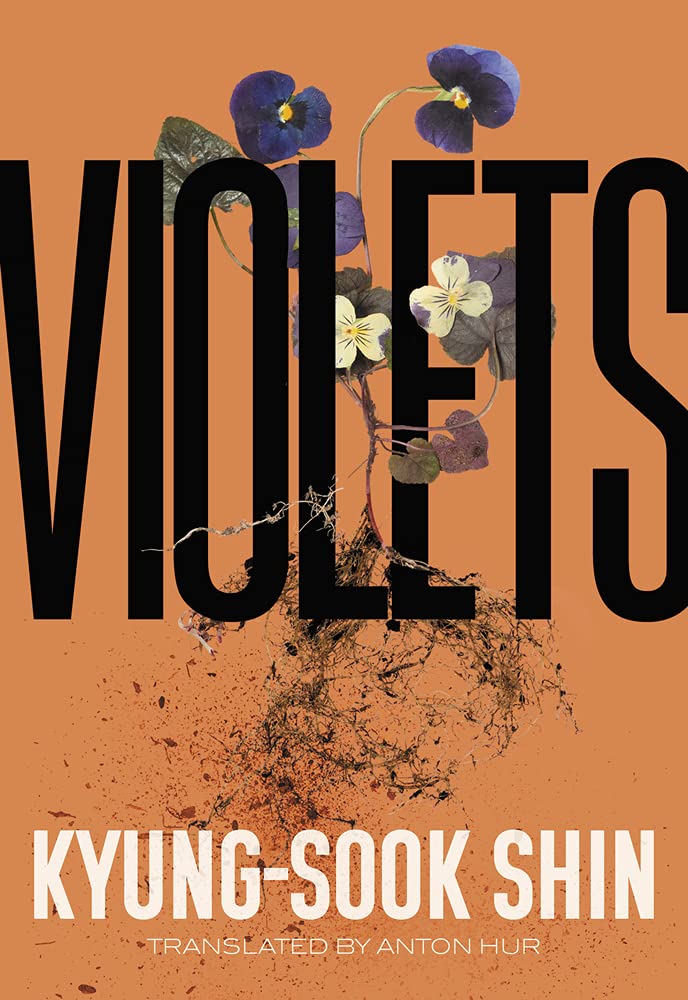
VIOLETS, a brutally sad and deeply poignant story of being Other in your homeland


VIOLETS
SHIN KYUNG-SOOK
(tr. Anton Hur)
The Feminist Press
$15.95 trade paper, available now

One of NPR's Best Books of 2022!

Rating: 4.5* of five

The Publisher Says: We join San in 1970s rural South Korea, a young girl ostracised from her community. She meets a girl called Namae, and they become friends until one afternoon changes everything. Following a moment of physical intimacy in a minari field, Namae violently rejects San, setting her on a troubling path of quashed desire and isolation.

We next meet San, aged twenty-two, as she starts a job in a flower shop. There, we are introduced to a colourful cast of characters, including the shop's mute owner, the other florist Su-ae, and the customers that include a sexually aggressive businessman and a photographer, who San develops an obsession for. Throughout, San's moment with Namae lingers in the back of her mind.

A story of desire and violence about a young woman who everyone forgot, VIOLETS is a captivating and sensual read, full of tragedy and beauty.

I RECEIVED MY DRC FROM THE PUBLISHER VIA EDELWEISS+. THANK YOU.

My Review
: This translation from the Korean joins a widening stream of Korean-culture transplants...Squid Game, Minari, this author's previously translated novel Please Look After Mom...making their roots into American pop-cultural soil.

If you've yet to explore the trickle, start now before it's a flood. I think it's wonderful because English-language monoglot culture gets stale and boring and all alike if we don't seek out fresh infusions of talent and stories. And, like all the best translations, this story's timelessness is rendered in prose that could very easily have been first created in English...none of the occasional signals of awkwardly trying to explicate something that one word in the translated language would convey whole and entire. That is a fine achievement indeed, probably helped along by the fact that things like "minari" aren't quite as furrin as they would've been in 2011, when Please Look After Mom was published.

What happens in this story is not particularly new or unusual. A girl is born to unfit parents:
In a house with shut doors, a mother closes her eyes as the baby’s grandmother offers her the newborn. The mother knows what will happen now. An uncelebrated girl. The infant accepts her mother’s closed eyes in lieu of a loving caress, perhaps having intuited her fate from the womb, and does not bother crying. The sound of the monsoon fills the house. Underneath the porch, a dog curls its legs into itself. Can the baby hear the sound of the rain? She’s about to fall asleep in her grandmother’s hands. That same night, her father gives his daughter’s face only a cursory glance.

Thus does another unwanted girl enter the world that won't ever bother to see her, really even to look at her. She's just...there. Her father never bothers to return; her mother never bothers with her at all, constantly seeking a man to care for her. (To be fair, an ordinary Korean woman's opportunities a generation ago weren't plentiful, and San's mother wasn't exceptional.)
Her mother. San thinks about her from time to time.

If she had begged her to stay, in front of that carefully prepared food, would she have listened? Why had San never once tried to hold her back? Wherever it was that her mother went, she never forgot to send her daughter money for school until San graduated.

The last time San had seen her mother was when she was a freshman in high school.

Children of addicts, the world over, tell versions of this same story. In this case, San's mother is addicted to men. She can't live without a man taking care of her, and she sacrifices the daughter she didn't want to get what she does want.

Author Shin isn't solely criticizing the mother. She is critiquing the social organization, the patriarchy, that privileges men and their desires over women and their needs so completely, so thoroughly, that the women are hollow and meaningless without a man. It is repulsive and it is reprehensible, and much abuse and violence simply are borne by the women because what option do they have? What other choice can they make? In San's case, she is so hollowed out by the complete absence of love from her mother (or anyone else) that she enacts the form of love she knows: rejection follows violence, as it must.

There is nothing forgiving in San. She forgives nothing, she is forgiven nothing, throughout the book. She is alone, she feels lonely of it (or so we infer...I don't know that she would be able to articulate the unmoored, disconnected reality that lonely people all share). For this, among other, reasons, this is a hard story to read. If you have ever been truly, down-to-the-bone lonely, this might be a triggering read for you. I haven't run across too many reads with this hyperconcentrated focus on loneliness, or too many with more success in rendering an emotional state into prose.
A stranger to every single person in the crowd, San finds herself blocking the sidewalk as people swerve to avoid her. Even if a carnival were to break out around her, the vacant expression on her face looks entrenched enough to persist.

Because she knows nothing of love, loving, being loved, San sees nothing except the one moment when everything changed, when the one love she thought she had was denied and made nothing. Not even attempting to find her former home nets San anything, she sees not the fields of minari she grew up among, where her life irrevocably emptied out and flowed away from her, but careful rectilinear plots of...something not minari. She has no roots. She feels no kinship.
Nothing happened this past summer. Only that, in the hot sun from time to time, a brief thought would appear and disappear around me. That thought was closer to me than any of the flowers in the shop. Even as I tried to capture the thought on paper, the heat would exhaust me and I'd give up. There were plenty of things I gave up, using the heat as an excuse. Which means I spent this past summer repeatedly deciding to do things and then giving up on them. As if my life were an exhibition of how good I am at giving up. It was that kind of summer.

It was that kind of life. It won't end well, it didn't begin well or go on well; that much we know. There's nothing hopeful in this story. Women like San aren't ever anyone's focus...her job in the flower shop working with and for Su-ae notwithstanding. She receives the desperate, genuine love of Su-ae as...nothing. San is fixated on emptiness...her only friend abandoned her!...and on men she does not want. She needs their love. She doesn't want it. She decided long ago that love wasn't something she could have, feel, receive, give. And so when it's offered to her she...doesn't see it. She does see the want of one man, she feels the desperate pull of another man on her attention, and gets nothing but unwanted results.
Every attempt to resist is met with his greater strength. In a moment, her head begins to droop.

She's released onto the street.
Her mind is completely taken over, her body a husk. No one seems to take note of the loneliness she carries. Just some woman in the crowd, unaware that her top is undone. A more observant person might have noticed her cheek slightly swollen from having been punched, the thin lines of her face a touch asymmetrical because of it. Someone might see her pale face and think, How could anyone ever look so pale....

A life of being unwanted, invisible, and it comes down to a final indignity. San is raped. Her hollowness filled at last with the violence that is all she can accept. It isn't in her to accept the reality of her situation, being unloved and unwanted, then seek out change. That's simply impossible. She leaves safety, courts rejection, and seeks oblivion.

Leaving behind only the tiniest of wakes...the end of the story of Oh San is a poignant piece of mythologizing that fit so poorly onto the rest of the story that I was forced by honest anger and sincere disdain for its sentimentality to whack a star off my rating. After a night's sleep where I dreamed of the photographer and San:
Violets. They bloom everywhere, making them seem more like weeds than proper flowers. San takes a closer look at them. Their little green leaves are small, their purple blossoms tiny. Before she came to the flower shop, she knew them as swallow flowers. Memories of entangling two swallow flower stems together and pulling them apart— one side was bound to snap. Whoever’s stem didn’t was the winner. She forgot what the prizes were, but she’d played the game many times. They did it with broadleaf plantains; they did it with foxtails.

The man keeps pressing the shutter and mumbling something discontentedly. “What’s so pretty about these flowers? Such nonsense.” His disappointment is so palpable, it makes her apologetic.

...I realized that his arc needed an end, too. I might not like that end, but I would've felt cheated (if not right away, then after my irritation with the whole ending subsided) had it not been there. So back came a half-star, though I confess with some grumbling on my part.

I think this small, powerful story deserves your eyeblinks. I think we should all resolve to notice the Oh Sans of this world, to extend a welcome to the table of them, to recognize their living presence instead of making them ghosts before they die.