Showing posts with label pandemic essay. Show all posts

Thursday, March 6, 2025

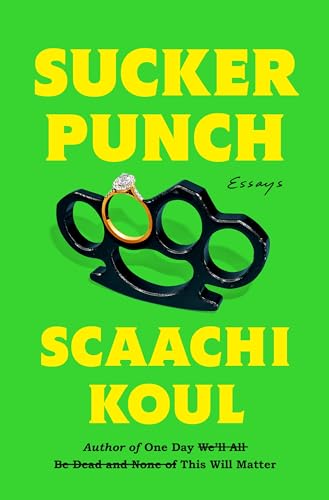
SUCKER PUNCH: Essays, apt title...on several levels


SUCKER PUNCH: Essays
SCAACHI KOUL

St. Martin's Press (non-affiliate Amazon link)
$14.99 ebook edition, available now

Rating: 3* of five

The Publisher Says: The long-awaited follow-up from one of the most original and hilarious voices writing today.

Scaachi Koul’s first book was a collection of raw, perceptive, and hilarious essays reckoning with the issues of race, body image, love, friendship, and growing up the daughter of immigrants. When the time came to start writing her next book, Scaachi assumed she’d be updating her story with essays about her elaborate four-day wedding, settling down to domestic bliss, and continuing her never-ending arguments with her parents. Instead, the Covid pandemic hit, the world went into lockdown, Scaachi’s marriage fell apart, she lost her job, and her mother was diagnosed with cancer.

Sucker Punch is about what happens when the life you thought you’d be living radically changes course, everything you thought you knew about the world and yourself has tilted on its axis, and you have to start forging a new path forward. Scaachi employs her signature humor and fierce intelligence to interrogate her previous belief that fighting is the most effective tool for progress. She examines the fights she’s had—with her parents, her ex-husband, her friends, online strangers, and herself—all in an attempt to understand when a fight is worth having, and when it's better to walk away.

I RECEIVED A DRC FROM THE PUBLISHER VIA NETGALLEY. THANK YOU.

My Review
: Author Koul's funny. Not innocently amusing, funny. She's written before this (One Day We’ll All Be Dead and None of This Will Matter) about her immigrant-to-Canada parents and her ongoing battles with their traditional expectations versus her Canadian ones. She had, then, a bit about her elaborate wedding...now it's about her pandemic experience, her mother's health crisis, the collapse of her marriage after that astonishing wedding...and something that's never been dealt with in her life, let alone her prose, before: she was sexually assaulted.

I do not know, or know of, a single solitary woman who does not have a story about her body being at the minimum threatened with sexual violence. Reading about it is, it seems, a means of creating solidarity and permission to say out loud that it's happened to you, like the very public #MeToo movement that's been bringing crimes to light that men are just as glad to have swept under the rug.

A proper millennial, Author Koul does her level-best to spin these facts of her life as...not funny, really, but sources or wry humor as she goes about coping with her wounds from them. I think a lot of women love to read these stories as a way to get perspective on the pain in their own lives. I'm aware of the reality and the awfulness of abuse in intimate relationships. It's not fun, and I myownself am not a fan of it as a topic for humorous coping.

Her other coping mechanism is rage. Full-throated, loudly expressed rage. That one I know from the inside; I do not think it is beneficial, nor appropriate, to valorize is as Author Koul does, while using humor to defuse its painful and destructive consequences on everyone...literally everyone...around her.

This is from my own experience: Go get counseling. Stay in counseling the rest of your life. Nothing will remove the rage. Work towards ways to minimize its footprint in your life, and the lives of those around you.

Three stars because it's trenchant and timely.

Saturday, April 30, 2022

Anyone else?


“Old age arrives like the first days of fall. One afternoon you look up, or smell something in the air, and know instinctively things have changed.”
Jonathan Carroll, The Marriage of Sticks
The Publisher Says, of this book I have never read but feel the need to now: Miranda marches into her high school reunion with the confidence of a professional at the top of her field. But inside she is lost, disenchanted with her career, and as alone as a person can possibly be. As a teenager in Crane’s View, she fell in love with unrepentant bad boy James Stillman, and though they never slept together, he thrilled her as no man has since. She returns to her hometown hoping to reconnect with him, but learns at the reunion that he was killed in a car crash years ago. In the weeks that follow, Miranda is haunted by visions of the past. First she sees James, alive and healthy, and more chilling hallucinations follow. Seeking distraction, she dives into an ill-advised love affair that turns darker than she could ever imagine. To find peace, Miranda must learn to walk the razor-thin line that separates this world from the one that follows.

I am glad someone else felt it and described it for me. Something changed when the pandemic hit and here I am: Old. Just...inarguably old. Funny thing is it's not as bad as I thought it would be. I'm tired in a different way, one that sleep really doesn't fix. I'm also really weary of drama and bullshit. I don't imagine I'll say this too many more times because either this realization rings you like a bell or you are thinking, "...do what now...?"

Honestly, it's okay to be old, to see "The End" without a lovely, comforting horizon-line between you and it. Things get old and wear out; one's body is a thing. One's soul isn't. (And no, religious nuts, I didn't find Jesus in my Special K with Red Berries.) I don't really expect anyone to get my post, but I felt my pandemic-battered heart lift at this quote swimming past me. The author's ~73. He wrote this book twenty-five years ago, give or take. I wonder if he looked at this quote some time in the past decade and thought, as I did, "yes yes yes!" with a little lift in his emotional altitude. It is *good* to be old. It feels a bit bodily crummy from time to time(as what does not?), but I never smoked and stopped doing drugs and drinking when the wear and tear did painful things to my body. I'm way better off than most in this part of their sixties.

So why write a post about it? the less tolerant or more judgmental are snorting about now.

Starting with "because it's my blog," and moving quickly to "there are a few hundred readers who, statistically, are likely to be older than the current US median age of 38.1 years who could use a word of happy futures ahead." It *is* happy to get old. It's a privilege denied to most ever born. Pandemics kill in their millions...ten million-plus in this one...and, if you're reading this, you ain't one of 'em. Neither am I. That is a great way to get old: not dying of a nasty plague.

Happy spring, happy May Day, joyful hugs for my living friends. Things have changed...that quote is very acutely true...but we're here to figure out what comes next. For me it's making an ever-bigger dent in my TBR and writing more thoughts and feelings about those reads. I hope I'll see all y'all there.


Friday, October 15, 2021

A TERRIBLE, HORRIBLE, NO GOOD YEAR: Hundreds of Stories on the Pandemic by Teachers, Students & Parents by Six-Word Memoirs


A TERRIBLE, HORRIBLE, NO GOOD YEAR: Hundreds of Stories on the Pandemic by Teachers, Students & Parents by Six-Word Memoirs
LARRY SMITH, ed.

Six-Word Memoir (non-affiliate Amazon link)
$13.99 tree book, $2.99 ebook editions, available 15 October 2021

Rating: 5* of five

The Publisher Says: The tenth book in the Six-Word Memoir series tells the story of a world we never expected to be in and can’t stop talking about. Told through the lens of students, teachers, and parents around the world, A Terrible, Horrible, No Good Year offers hundreds of inspirational, playful, and profound takes on life during the pandemic. For some, this book will be a window. For others, a mirror of their own experience. For all of us, A Terrible, Horrible, No Good Year is a time capsule to be read, shared, and discussed and is certain to prompt friends, family, and neighbors to ask each other: “What’s your six-word pandemic story?”

I RECEIVED A DRC FROM THE PUBLISHER VIA NETGALLEY. THANK YOU.

My Review
: November 2006...a date that should live in...whatever the opposite of "infamy" is...that's when Larry Smith started SixWordMemoir.com, and unleashed the haiku poet in every English-speaker's soul. My own first one: "Not quite what I had planned" submitted on Twitter in 2013.

Six words doesn't leave room for prolixity and overdramatization. It's what makes the idea so irresistible. It's what makes the original challenge, issued legendarily to Ernest Hemingway, to tell a six-word story (his, if you need refreshing, was "For sale: Baby shoes, never worn") so deeply memorable. We're creatures of story and we love to immerse ourselves in language. When we take a short, sharp plunge into the Otherness of others, we're happy, happy souls. As witness to this truth, the collection I'm reviewing is the tenth brought into print! This is like that delicious, anonymous, yet public confessional, PostSecret. It's similarly public, it's more concise, and it's possibly even more revealing...but it's all part of the same urge, the need I know so many feel to unburden themselves, to celebrate their milestones, and to be seen and heard where it feels safe, especially when it doesn't feel safe to be any of those things in their community.

So here we are in a pandemic. Over a year without anything like normalcy. I guess it's no surprise to anyone that there were some feelings that needed to be bled out, and SixWordMemoir was exactly the right tool to lance the thing. The choice to direct this collection at educators, students, and parents trapped in the nightmare of too much togetherness plus too little social contact was inevitable and also genius. I read these wondering how the hell I would even begin to cope with kids, job, spouse, house, and the free-floating anxiety of not knowing what the hell was happening and how soon it would kill someone I love!

For a measly $2.99 on your Kindle, get one for yourself. But if you want to give a paper copy to someone special, ORDER NOW! (And the tree book would be great because illustrations are just *better* on a paper page.)

Some SixWordMemoirs to show you what I mean:

Six feet never felt so far. — Ava Russ, 15
A young woman whose entire adolescence was interrupted by this awful event makes her private pain part of a national conversation. I admire her. I know many, many young people will relate to her.
It goes over your nose, pal. — Stina Perkins
Yes. Yes, it does.
Getting handle on pandemic. Need lid. — Krystyna Fedosejevs
Budding philosopher. Also comedian. Needs job.
For sale: prom dress, never worn. — Caroline Richardson, 19
Extra poignance points for emulating the Hemingway original. Brava. Now go get your MFA.
How can emptiness feel so heavy? — Lincoln H.
Turning friends to strangers...all alone. — Chelsea P.
Not happy. Not sad. Just empty. — Tristan N.

These are all culled from the same elementary school. No one ever gets to tell me how kids aren't ready for the way the real world works, or that they don't have the skills to process the adult world. This gives those lies their brightest exit sign.


I was very touched by the essays written by teachers and other education professionals. They're not long, maybe 500 words at most, but they pack a wallop in their palpable grief and frustration at not being able to do what they love doing. One librarian here in New York shared that their students were able to come together to have Zoom sessions (and may I just say that Zoom has earned my undying gratitude for keeping me in touch with my Young Gentleman Caller on the regular?) with writers and poets after reading their work. One such writer was Luke Dani Blue, whose story about a trans person crossing the country (Canada, one presumes, as they're based in Alberta) by Greyhound bus elicited this question from a student:
"You and your characters seem to thrive and dream of uncertain circumstances because they hold so much possibility, yet very often in life we are disappointed and miscalculate the trajectory of our new paths. What would you say is your margin of error when it comes to dream versus actual trajectory?"
Blue was so stunned by the question, all they could say was, "Woah, I feel so seen by that question. I'm going to have to think about that one."

Yes, "seen" is the right word for it. Seen, seen through, seen off, seen! Seen indeed. Teenagers are, and we forget this at our societal peril, adults without perspective or impulse control. Their intelligence will never be sharper. Their training in how to use it is all we have left to offer them...and this goddamned plague means we can not offer it to them in the same, personal way. But, and this is the reason I bring it up, permaybehaps this new, screen-intermediated way will offer the young learners some advantages. I doubt that question would've come out of the asker's mouth with that level of fluency. A chance to think about it, try different ways of phrasing it, probably made that the best question it could possibly be.

So there's a hopeful side to this misery after all....
Now I'm a barber. Who knew? — John Tehan
Golden lining. Career opportunity? Probably not.
Masks protect us from farts, too! — Ruby Bryan
Special Ed teacher whose kids are profoundly disabled. But still kids...farts are hilarious to kids.
Numbers rose, but SUN did too. — Paloma Lenz
Yes. It did indeed. And it rose a little higher for me today. Thanks, Paloma, although we'll never meet you've made an old, disabled stranger a lot happier than he was before he read your words.


That, in a nutshell, is the magic of the internet.

Wednesday, August 25, 2021

IF YOU EXIST, probably a better question than answer


IF YOU EXIST: In Search of a Reader Deep in the Future
LILLIAN MOATS

Three Arts Press (non-affiliate Amazon link)
$5.99 Kindle edition, available now

Rating: what? rate this how exactly?

The Publisher Says: If You Exist is a personal message written to one of our human progeny who might find it many generations in the future. The narrator, like others in her generation, faces her own mortality at the same time she faces the possibility of thousands more species, including her own, becoming extinct.

As a private heartfelt message to someone who may never exist, the writer likens her missive to “a note in a bottle set to sea in hopes of reaching you, if you exist in the future on some unfathomable shore.” The narrator shares her personal take on where humanity is now and where we might be heading depending on what choices we will make. She writes about climate change and such topics as human migration, racism, the pandemic, as well as her projected concerns about the possibilities of unbridled technical advancement and human redesign.

After offering her perspective on where hope could lie, the writer ends her note with “the stuff of fairy tales,” her positive fantasy in the final chapter called, “If We Could Meet.”

I RECEIVED A DRC FROM THE PUBLISHER VIA NETGALLEY. THANK YOU.

My Review
: First, read this:
The impulse to hunt takes aim instead, to separate, conquer or eradicate whatever may be defined by some group as less than human. With the future of the planet now so much in doubt, I think it's a rare person who does not, at least unconsciously, align hopes for the survival of this world with either gathering or hunting.
–and–
What it means to be human is quite a different question from "What is human nature?" for which we finally realize there can be no answer except to include what any human culture has done or felt.

For me, the question of what it means to be human is more pressing than ever, though my own answers reside in recollected incidents, not in academic definitions.

Published to coincide with the author's seventy-fifth birthday on Monday, the twenty-third, this compact meditation on what the world is, what our role as humans in the world is, and why that urgently needs to change is the topic of the book. "Has the stranger been gathered in, or hunted down?" is quite probably the clearest statement of purpose any book could have, and it comes exactly on time as the catastrophic exit of US troops from Afghanistan unfolds.
Just as with refugees today, the pattern of slavery has always been that the darker skinned peoples were owned and abused by the lighter skinned. There were notable exceptions, such as ancient Africa where emperors of dark nations owned dark slaves from different tribes. Slavery was never just about color, but about power and wealth. ... Today, prejudice and brutality by many police in the U.S. have outlived legal slavery by more than a hundred and fifty years.

So you're reading this review and wondering what the point of my telling you about this small book written by someone who isn't a Big Name, hasn't written think pieces and hefty reports and the like, is? Because you have a vaccine-resisting climate-change denying (or at the least skeptical) aunt, or mother, or church elder. No one is talking to her. They're talking to Greta Thunberg (who comes in for some quiet praise here) and her mom. They're marshaling innumerable facts about chemistry and computing that say absolutely nothing to that friend, relative, elder.

I think she deserves the respect of someone sitting down and speaking to her, peer-to-peer, reminding her of *why* she made those decades of sacrifices and plans and worked so hard to bring about what she hoped would be a better world. And so did Lillian Moats...here, she's written the book she hoped to read and thus engage with a wider world of people who, like her, haven't been mindfully included in the world they made as it decides its future.

Yuletide is coming. Maybe a birthday before that. Try talking to the people you'd like to mobilize the way they need to hear you.