Showing posts with label rural drug culture. Show all posts

Saturday, July 25, 2026

WISDOM CORNER, second Virgil Wounded Horse thriller


WISDOM CORNER
DAVID HESKA WANBLI WEIDEN

Ecco (non-affiliate Bookshop.org link)
$14.99 ebook, available now

Rating: 4.25* of five

The Publisher Says: From the award-winning author of Winter Counts comes a new thriller about life—and death—on the Rosebud Indian Reservation.

Virgil Wounded Horse is desperately trying to escape his past as a hired vigilante on the Rosebud Indian Reservation. But when a legendary figure from the reservation is murdered, he’s forced to return to the job. Making matters more complicated, threats are coming from the Pine Ridge 705—a street gang from a neighboring reservation who want to expand their reach into Rosebud—and Mitch Gagnon, a shady politician who will stop at nothing to gain more power.

With a heated tribal council election looming, as well as new revelations regarding past injustices at the local Native boarding school, the stakes grow even higher. Will Virgil find the justice he’s seeking before it’s too late?

I RECEIVED A DRC FROM THE PUBLISHER VIA NETGALLEY. THANK YOU.

My Review
: Coming to terms with harms and wrongs you've done, even when you thought you were right to do them, is a tough passage of adulthood. It's necessary to face up, and if necessary 'fess up, in order to move past your own guilt and self-trauma. Of course, that leaves all the nightmares of trauma caused from without...but starting within is always sound policy and strategy.

Picking up where Winter Counts left off is this story of Virgil Wounded Horse doing his damnedest to keep his homeplace from succumbing to the depredations of the worst, most amoral forces from without and those within who care little for humane results and lots for power and the money that flows along side it. Virgil knows from the inside the seductive nature of power, enforcing criminals' will isn't a lot different from enforcing The Law℠ in its particulars only in its motivations (hopefully its results too). Challenging Virgil's sense of rightness is the death by murder of Jerome Iron Shell. Beloved by many for his warmth and wisdom and stock of lore, whatever led someone to kill him makes Virgil angry as well as woriied for his inamorata Marie Little Bear. Her deepening involvement in politics on Rosebud Reservation is clearly not safe sonve politics is almost certainly what got Jerome killed...how to make your former-gang-enforcer boyfried edgy and worried for you was never easier for Marie. She's the one whose request for him to staighten up, work the sunny side of the street, thus not add to her hurdles getting into government to start cleaning up generations of greed and indifference, has Virgil in knots. To her credit, Marie Little Bear is very much on the side of Justice and Fairness so as Virgil discovers corruption and greed, Marie stands shoulder-to-shoulder damn the consequences.

I really like the couple dynamic between Virgil and Marie. As the vileness and ugliness that Jerome was aware of, and trying to get acknowledged, intertwines with the appalling greed that land development supports and rewards, Virgil...and Marie...learn even the lowest acts they know happen now aren't a patch on those committed in the not-distant past. It serves to make them both, together and individually, more determined to be forces for improvement and restoration.

The series is definitely one I recommend to y'all who're needing more than polite white ladies looking into polite little family deaths. Cozies are like pineapple: tasty, tangy, but not healthy when they're the only thing on the dessert menu. Switch it up with a trip to South Dakota.

Wednesday, December 15, 2021

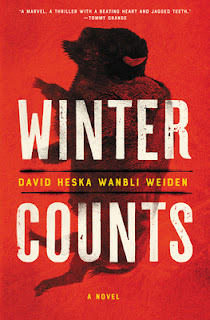
WINTER COUNTS, Native American #OwnVoices thriller


WINTER COUNTS
DAVID HESKA WANBLI WEIDEN

Ecco
$16.99 trade paper, available now

WINNER OF THE BEST FIRST NOVEL ANTHONY AWARD FOR 2021! Virtual Bouchercon award ceremonies linked to at the above.

WINNER OF THE BEST INDIGENOUS WRITER at the 2021 High Plains Book Awards.

On The Guardian’s Best Thrillers of 2021 list

Rating: 4.75* of five

The Publisher Says: A groundbreaking thriller about a vigilante on a Native American reservation who embarks on a dangerous mission to track down the source of a heroin influx.

Virgil Wounded Horse is the local enforcer on the Rosebud Indian Reservation in South Dakota. When justice is denied by the American legal system or the tribal council, Virgil is hired to deliver his own punishment, the kind that’s hard to forget. But when heroin makes its way into the reservation and finds Virgil’s nephew, his vigilantism suddenly becomes personal. He enlists the help of his ex-girlfriend and sets out to learn where the drugs are coming from, and how to make them stop.

They follow a lead to Denver and find that drug cartels are rapidly expanding and forming new and terrifying alliances. And back on the reservation, a new tribal council initiative raises uncomfortable questions about money and power. As Virgil starts to link the pieces together, he must face his own demons and reclaim his Native identity. He realizes that being a Native American in the twenty-first century comes at an incredible cost.

I RECEIVED A DRC FROM THE PUBLISHER VIA NETGALLEY. THANK YOU.

My Review
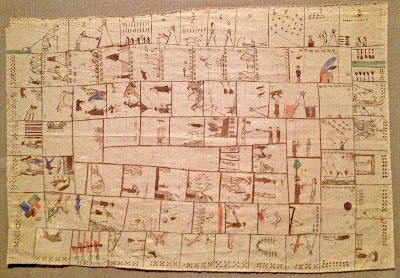
: This is a Brulé Lakota Winter Count:
This cultural tradition, extremely briefly summarized in a Wikipedia article, organizes this novel’s ideas. Virgil Wounded Horse, our aptly and prophetically named vigilante-cum-enforcer hero in this thriller, touches on this fascinating piece of (half) his ancestry’s sense of time and place often enough to make the title of the book emerge organically in the reader’s mind. Virgil muses at one point, “Winter counts were the calendar system used by the Lakota, but they weren't like modern ones. I'd loved the little pictures in the calendars, each image showing the most significant event from the past year.” He muses again, at a later point, “Winter counts. This was the winter of my sorrow, one I had tried to elude but which had come for me with a terrible cruelty.” I think both are ideas of how he, his world, and his sense of self, are in motion at all times. It makes his entire life spent in action make sense…he’s not a Lakota insider, like ex-girlfriend Marie Short Bear, whose ancestry is flawlessly pureblood and perfectly in tune with the power structure within the Rosebud Reservation. He’s not an insider in the white world, either, being a mixed-race outcast from its racist system. It’s been a blessing in that any curse can be turned into an advantage if you’re looking for a way to do it. He’s got a place enforcing justice outside white and Native American legal systems, as required.

What this means is that the character is perfect for a thriller that needs telling to get people to care about the problems heaped on Outsiders, Othered people, by all systems of government. The tribal justice system (arguably distorted by its necessary accommodation to white codes) as much as any other. Virgil is outside, and that is the perfect place to be when the upper echelon needs something done that won’t “look good.” The value of face, of taking things at face value, is something white people with our media obsession have raised to virtual apotheosis; it’s far from untrue of other cultures, however. Marie Little Bear’s tribal leadership position means he can’t directly do the effective thing against the drug cartels hooking Native kids on heroin, with the well-known tragic consequences.

Had the plague not touched Virgil’s nephew, hard, he wouldn’t have agreed to take on the violent and greedy and frankly evil people. But when it’s family, things look different, don’t they. What happens on the reservation has its roots in the not-distant city of Denver. Marie and Virgil set out to confront the ills of their corner of the world by going outside that corner, by bearding the lion in his den, and they are not surprisingly at some disadvantages there. It is as revealing to consider their troubles and issues within the white world of Denver as to examine the world of the reservation in promotion, tolerance, and perpetuation of toxic social maladjustment.

I’m impressed by the way this thriller uses its author’s straddled worlds…he’s Lakota and teaches Native American Studies at the Metropolitan State College of Denver, so clearly he’s quite adept at code-switching…as a full and integrated world for Virgil Wounded Horse. We’re not expected to see Virgil as a man out of place in two worlds, we’re expected to see a man discovering his place in his own world. It is a fine distinction, but an important one. Virgil is an outsider in each of those large, obvious social constructs. He is making his own world, one in which he is the norm, as in the end that is what we all must do to “fit in.” Where the world doesn’t have a place for you, make one.

That is the gift of this read to the reader. Join Virgil Wounded Horse in his thrilling world.
+++++++++++++++++++++++++++++++++++++++++++++++++++++++++++++++++
This post is the 1,000th on my blog! I’ve written many thousands of book reviews over the years of many truly enjoyable books. I’m very happy that, after eight and a half years, I’ve reached this milestone blog post with a review of a book I’m happy to recommend that you read as a Booksgiving treat to yourself.

Tuesday, June 14, 2016

BROWN BOTTLE: A NOVEL by Sheldon Lee Compton, honed like a knife & wielded without mercy

BROWN BOTTLE: A Novel
SHELDON LEE COMPTON

Bottom Dog Press
$17.00 trade paper, OR $8.00 Kindle, available now

Rating: 4.75* of five

The Publisher Says: Wade “Brown Bottle” Taylor is an alcoholic trying to protect his nephew Nick from the hardness of their region, Eastern Kentucky, and the world in general. He must end Nick's involvement with drugs and drug dealers in the area, and, fueled by his love for his nephew, Brown knows he must be the one to intervene to save him. But in order to save Nick, Brown must first save himself, overcoming a lifetime spent convinced he was unworthy. Brown Bottle's journey is one of selflessness and love, redemption and sacrifice, if only for a time.

My Review: When I saw that Donald Ray Pollock, of KNOCKEMSTIFF fame, called the author of this novel "a hillbilly Bukowski," that was it. I asked Bottom Dog Press for a review copy and was blessed with one. And let me say this right up front: Pollock's assessment is spot-on.

"Brown Bottle" is the unkind-yet-accurate nickname given to Wade Taylor, co-centerpiece of the story's arc with Stan Collins. Brown is an alcoholic and a Vietnam vet. Stan is a plain, common-or-garden alcoholic. They live in Portville, Port County, the farthest eastern stretch of Kentucky. Coal was king until the 1970s, and now opiods and meth are the kings. Sadly, the two alcoholic tough men (who don't indulge in drug use) each have a beloved relative involved with drugs. Brown's nephew Nick, abandoned by his mother when at the most annoying rebellious stage of adolescence, is a drug user and petty thief; Stan's little brother Tuck is the picture of the repulsive little guy who deals to feel big:
Tuck had always been made smaller made than Stan. Narrow shoulders, tiny hands and short fingers. Even as a young man his brown eyes were always watering like he'd been crying and his face never took hair well. What he had instead were four or five patches of hair that looked like a cluster of bee stingers popping straight out from his cheeks.
It's not tough to work out the conflict that inevitably will arise between the strong protectors of these weak men. Nick is the North Star in Brown's sky, the one decent thing he thinks that's ever come out of Port County Taylors. He felt that way about Mary, Nick's mama, until she walked away and left Brown in charge (or not, it didn't seem to matter to her as she skedaddled to Ohio with some kind of snake-oil sellin' preacher) of Nick's arrival into manhood.

And here's Stan, living across the highway from Tuck's trailer, watching the streams of vehicles come, park, and go in minutes flat. He hates that this crazy business has made his brother a prisoner of drug suppliers and users, skittering from pillar to post in order to balance supply and demand. He himself is a disabled miner, a man of no use to anyone except his wife Hen (short for Henry, don't know why she's named that) and wanting to save Tuck. This being the Appalachians with the culture of self-reliance and clannishness that is native to hardscrabble places the world over, Stan doesn't figure on calling in the troopers unless forced to. He figured without Brown's iron determination to cut Nick off at the supply end of his drug habit.

So what's a protective uncle to do? Scare the living daylights out of Tuck, that's what. Bust in the trailer door, shake the little rat around some, make sure he thinks twice and doesn't sell Nick another snort. Good plan. But Hen, though she's not Tuck's biggest fan, also has a reason to keep the scrawny little shit alive: Stan's disability and her joblessness don't make ends meet, but when Hen sells some opiods on the side for Tuck the books balance. Like most American households, the wife is the paymaster, so Stan's oblivious to the source of their continued (relative) comfort. Hen sees Brown breaking in the trailer door, fears the worst, and calls the cops.

Now cops aren't, public opinion aside, blind, deaf, and dum-dums. The local deputy, Dan, knows there's mischief being made in Tuck's trailer. He has reason to worry because his only daughter is dating Brown's nephew Nick, and that can't be good for her sobriety. Since Dan's local aristocracy (used to run the local IGA Foodliner, inherited from his daddy), he takes it as a personal affront on all levels that he can't quite prove the reality of illegality going on under his nose. He can, and does, have the place under surveillance, so when Hen's 911 call is radioed out, the response is swift. Not so good for Brown, caught in the act of smacking Tuck around. But no one in Port County doesn't know Brown was a babykiller in Vietnam so they're all scared of him; he's a drunk, so they're scared he'll wow out while sloshed; and his crusade to save his nephew isn't news, either. Sentenced to AA meetings, big whoop.

Nick and Ashley, Dan's daughter, are late to the party at the trailer, finding Tuck gone and the place empty. They decide it's time for them to be big kids about their habit and break into the trailer to steal some supplies. It turns out the supplies are very, very abundant. The plan changes from steal some and use to steal all and set up as dealers. It's Tuck's way of buying really nice stuff for his crappy trailer and they have plans to set up house and get married when they get some money....

What they don't know is that Brown used the AA meeting to make some discoveries and now has Tuck all trussed up in his hunting camp, a place full of Brown's past:
{T}here hung that mirror still. Splotches like mold or something had collected from the corners toward the middle, but Brown was able to see enough of himself in it to feel a fair amount of disgust. No more than the usual amount. He scratched at his chin growth. Did a rat eat your razors? That's what his daddy would say. He wished his chin jutted out more like Clint Eastwood or James Dean or whotheheckever. Instead, you could barely see his chin, it hid so far back against his neck.
The wheels of tragedy are now set in motion. Self-loathing, the need to redeem something from a painfully wasted life, and the sheer revulsion of the strong for the weak cause Brown to plan Tuck's carefully hidden demise. Sadly, Tuck's victims Nick and Ashley have also concluded that Tuck needs taking out; it's sad because, unlike Brown, these two can't bring themselves to do the deed personally, so they turn to Port County's resident no-fail contract killer:
There were a lot of botched kills throughout the eastern part of Kentucky when the work fell outside his control. Six or seven years ago, a man from Perry County was shot point blank in the head and left for dead in the middle of downtown. Problem was, the bullet had traveled between the man's scalp and his skull halfway across his head and exited the same way it had entered on the other side. The whole thing had left him with only fingernail-sized contusions on both sides of his head. He identified the guy who shot him and saw him arrested and convicted of attempted murder.
Now, it's true that a situation like that was a rare one, but part of doing a job right was minimizing the chance for something to go wrong.
The callousness of this internal monologue is courtesy of Fay, an Ulsterman and killer for his side in Ireland. He's known to everyone in the area, and they're more scared of him than of Brown or the law. Good reason to be, after all, since he lives quite nicely on no visible means of support and there's no shortage of disappeared, presumed dead, enemies in Port County. Nick and Ashley decide to hire him to eliminate Tuck while making the mistake of telling Fay how they plan to get the money to pay him.

All hell breaks loose.

Stan's hunting for Tuck. Brown's hunting for Nick and Ashley. Fay's abusing Ashley's mother to get the name of her supplier, Hen. Hen's trying to stop everything from spinning out of control. Dan's sure that if he gets hold of one of these people, he'll unravel the whole mess without any noticeable bloodshed (maybe Tuck dies, oh dear oh well). Fay and Stan and Hen and Brown and Tuck...it's a helluva ride, there are deaths good and bad, and in the end the price owed to the law is paid by Nick and Ashley, who go to prison for possession with the intent to deal narcotics since they stole Tuck's stock.

In the end, Brown's is the one purpose served. Nick comes out of prison early, sober at last. He knows to whom he owes his thanks, the thanks he's too late to deliver:
He's on the school bus and Uncle Wade is standing outside the window. The bus hasn't pulled out yet and Uncle Wade is punching the air and ducking his head and giving him a thumbs up sign and then a big smile. The big smile says do not worry. It says you can do this. ... His smile says a lot and so do his punching hands and his hooked thumbs, and before everything else it can possibly say, it says the thing Nick needs most. The big smile says I love you.
Too late, too late; a job well done by a man ill-used from every quarter.

Sheldon Lee Compton jumps onto my must-buy list with this dizzyingly fast-paced, beautifully choreographed, blood-soaked book. And will someone please tell Norman Reedus that his Oscar-winning role's right here in this book?