Pages
- Home
- Mystery Series
- Bizarro, Fantasy & SF
- QUILTBAG...all genres
- Kindle Originals...all genres
- Politics & Social Issues
- Thrillers & True Crime
- Young Adult Books
- Poetry, Classics, Essays, Non-Fiction
- Science, Dinosaurs & Environmental Issues
- Literary Fiction & Short Story Collections
- Sookie Stackhouse/Southern Vampire Books & True Blood
- Books About Books, Authors & Biblioholism
Showing posts with label addiction. Show all posts
Wednesday, December 15, 2021
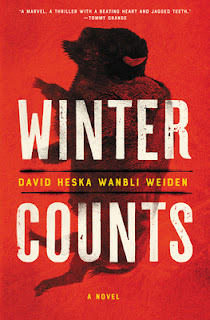
WINTER COUNTS, Native American #OwnVoices thriller
WINTER COUNTS
DAVID HESKA WANBLI WEIDEN
Ecco
$16.99 trade paper, available now
WINNER OF THE BEST FIRST NOVEL ANTHONY AWARD FOR 2021! Virtual Bouchercon award ceremonies linked to at the above.
WINNER OF THE BEST INDIGENOUS WRITER at the 2021 High Plains Book Awards.
On The Guardian’s Best Thrillers of 2021 list
Rating: 4.75* of five
The Publisher Says: A groundbreaking thriller about a vigilante on a Native American reservation who embarks on a dangerous mission to track down the source of a heroin influx.
Virgil Wounded Horse is the local enforcer on the Rosebud Indian Reservation in South Dakota. When justice is denied by the American legal system or the tribal council, Virgil is hired to deliver his own punishment, the kind that’s hard to forget. But when heroin makes its way into the reservation and finds Virgil’s nephew, his vigilantism suddenly becomes personal. He enlists the help of his ex-girlfriend and sets out to learn where the drugs are coming from, and how to make them stop.
They follow a lead to Denver and find that drug cartels are rapidly expanding and forming new and terrifying alliances. And back on the reservation, a new tribal council initiative raises uncomfortable questions about money and power. As Virgil starts to link the pieces together, he must face his own demons and reclaim his Native identity. He realizes that being a Native American in the twenty-first century comes at an incredible cost.
I RECEIVED A DRC FROM THE PUBLISHER VIA NETGALLEY. THANK YOU.
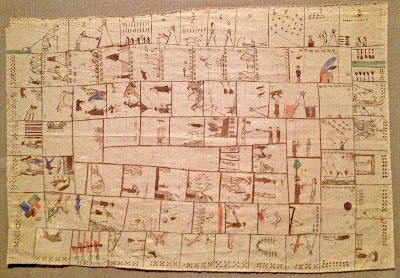
My Review: This is a Brulé Lakota Winter Count:
This cultural tradition, extremely briefly summarized in a Wikipedia article, organizes this novel’s ideas. Virgil Wounded Horse, our aptly and prophetically named vigilante-cum-enforcer hero in this thriller, touches on this fascinating piece of (half) his ancestry’s sense of time and place often enough to make the title of the book emerge organically in the reader’s mind. Virgil muses at one point, “Winter counts were the calendar system used by the Lakota, but they weren't like modern ones. I'd loved the little pictures in the calendars, each image showing the most significant event from the past year.” He muses again, at a later point, “Winter counts. This was the winter of my sorrow, one I had tried to elude but which had come for me with a terrible cruelty.” I think both are ideas of how he, his world, and his sense of self, are in motion at all times. It makes his entire life spent in action make sense…he’s not a Lakota insider, like ex-girlfriend Marie Short Bear, whose ancestry is flawlessly pureblood and perfectly in tune with the power structure within the Rosebud Reservation. He’s not an insider in the white world, either, being a mixed-race outcast from its racist system. It’s been a blessing in that any curse can be turned into an advantage if you’re looking for a way to do it. He’s got a place enforcing justice outside white and Native American legal systems, as required.
What this means is that the character is perfect for a thriller that needs telling to get people to care about the problems heaped on Outsiders, Othered people, by all systems of government. The tribal justice system (arguably distorted by its necessary accommodation to white codes) as much as any other. Virgil is outside, and that is the perfect place to be when the upper echelon needs something done that won’t “look good.” The value of face, of taking things at face value, is something white people with our media obsession have raised to virtual apotheosis; it’s far from untrue of other cultures, however. Marie Little Bear’s tribal leadership position means he can’t directly do the effective thing against the drug cartels hooking Native kids on heroin, with the well-known tragic consequences.
Had the plague not touched Virgil’s nephew, hard, he wouldn’t have agreed to take on the violent and greedy and frankly evil people. But when it’s family, things look different, don’t they. What happens on the reservation has its roots in the not-distant city of Denver. Marie and Virgil set out to confront the ills of their corner of the world by going outside that corner, by bearding the lion in his den, and they are not surprisingly at some disadvantages there. It is as revealing to consider their troubles and issues within the white world of Denver as to examine the world of the reservation in promotion, tolerance, and perpetuation of toxic social maladjustment.
I’m impressed by the way this thriller uses its author’s straddled worlds…he’s Lakota and teaches Native American Studies at the Metropolitan State College of Denver, so clearly he’s quite adept at code-switching…as a full and integrated world for Virgil Wounded Horse. We’re not expected to see Virgil as a man out of place in two worlds, we’re expected to see a man discovering his place in his own world. It is a fine distinction, but an important one. Virgil is an outsider in each of those large, obvious social constructs. He is making his own world, one in which he is the norm, as in the end that is what we all must do to “fit in.” Where the world doesn’t have a place for you, make one.
That is the gift of this read to the reader. Join Virgil Wounded Horse in his thrilling world.
+++++++++++++++++++++++++++++++++++++++++++++++++++++++++++++++++
This post is the 1,000th on my blog! I’ve written many thousands of book reviews over the years of many truly enjoyable books. I’m very happy that, after eight and a half years, I’ve reached this milestone blog post with a review of a book I’m happy to recommend that you read as a Booksgiving treat to yourself.
Friday, June 25, 2021
THREE MEMOIRS OF GAY HUSTLING, all with happy endings...not THAT kind
ASSUMING THE POSITION: A Memoir of Hustling
RICK WHITAKER
Out of print (non-affiliate Amazon link)
Various prices from different vendors
Rating: 3.75* of five
The Publisher Says: Rick Whitaker divulges the complex reasons that drove him to prostitution and reflects on the cost of a life of half-truths and emotional lies. With an unsentimental eye, Whitaker chronicles his descent and eventual resolution.
My Review: That's a pretty sparse description for a pretty intense book. It's a short thing, pared down to its essential points, and purged of prurient detail. (Darn it.)
Whitaker was the editorial assistant to publishing legend Gordon Lish. You know, Raymond Carver? Richard Ford? The one who edited, or quite possibly more than edited, their best stuff. He was, apparently, absorbing a lot from Lish (not a double entendre that I know of) because he wastes no words here describing his descent from broke publishing minion to crack-addled sex worker AND broke publishing minion.
It's amazingly easy to understand and sympathize with Whitaker. He's not some rotten-souled vile being who expresses himself by Doing Shocking Things. He's a guy who needs a center to his life, needs a sense of belonging and of mattering. I speak from experience here: If one needs those things, NEW YORK IS NOT THE PLACE TO LIVE. I watched it eat people alive, make others miserable, and all because the one thing those folks needed was the one thing the city does not reward. Either arrive already centered, focused, or understand that you are driven by a goal...or the city will have you for breakfast with a side of bacon.
Whitaker sold access to his body for drug money, for the momentary illusion of power, and for the sheer hell of it. He ended up not wanting what he found, and got out, and told his story so all the experience would not go to waste.
I like the book, where lots didn't much. I respect sex workers for the sheer magnitude of their performance capability. I admire their generosity of spirit (how many pretty people do you imagine subcontract their sex lives? Lots of old, lonely, ugly, fat folks do). I've had some very good friends (without benefits, thank you for asking) who did this demanding and difficult job. Whitaker's was a story I've heard with variations for years. It's not something I'd suggest one read for titillation, but any moralists who have accidentally stumbled into reading my reviews (you must feel so lost, poor lambs) should give it a whirl, as should those inclined to judge and find wanting all those billions and billions of people not precisely like themselves. (There is overlap in the categories, but they aren't all the same people.)
Empathy can be learned. Try this and see if you can't find some for a man searching for acceptance.
+++++++++++++++++++++++++++++++++++++++++++++++++++++++++++++++++
SECRETS OF A GAY MARINE PORN STAR
RICH MERRITT
Citadel Press (non-affiliate Amazon link)
$9.99 Kindle edition, available now
Rating: 3.75* of five
The Publisher Says: Here’s the story of Rich Merritt—the good son, teacher’s pet, Southern gentleman, model Christian student at Bob Jones University, Marine officer, and the not-so-anonymous poster boy for a New York Times Magazine article on gays in the military—whose complicated sexual past caused an international scandal when The Advocate “outed” him as “The Marine Who Did Gay Porn,” putting his life in a tailspin.
It’s the compelling, poignant story of how a boy who never listened to pop music, never cursed, and didn’t have his first drink until he was eighteen exploded into a life of drugs, alcohol, promiscuity, prostitution, and pornography. And above all, it’s a triumphant story of self-forgiveness and identity, of a man who refused to allow himself to be defined by the standards of anyone else—gay or straight. Along the way, Rich Merritt writes with humor, compassion, insight and naked truth about:
• What it’s really like growing up behind the “Fortress of Fundamentalism” and how he ultimately came to despise their views
• The harsh realities of military life under the “Don’t ask, don’t tell” Clinton policy
• A real insider’s experience of working in the male porn industry—the good, the bad, and the extremely hot
• Why he chose not to reveal his porn past to the New York Times journalist
• What it felt like to be the most notorious marine in the world and what it took to come through the fire
By turns harrowing and heartbreaking, angry and affirming, Secrets of a Gay Marine Porn Star is that rarest of memoirs—a fascinating slice of life that reads like the most absorbing fiction, but is all true.
My Review: Gay guys who become porn stars are very interesting to me. Their stories, I suppose, are all very much alike, and very much like the stories that drive women to pornography...low self-esteem, a sense of failure in one's life, a desire to capitalize on physical beauty while it lasts, greed, the usual. But those driving forces aren't unique to these people, they're common to all of us in some degree or another. Why do these folks do this (to me) very scary and risky job?
Start with a damn-near fatal upbringing in the grasp of an Evangelical family; proceed to the Bob Jones-ing of his entire education, all the way from kindergarten (there is no link to the non-University of Bob Jones due to, um, controversies shall we say) to time in seminary; waking up and realizing he can not pray the gay away, subsequent substance abuse, two deliberate decisions to end his life.
This author pilots us through his decisions made...he didn't have sex with anyone until he was twenty-three! and he was sexually repressed to the point that his first sexual encounter predates the first time he ever masturbated!...and accepted; this with a degree of skill and a commendable lack of embarrassment that surprised me. I was expecting a defensive tone to creep in to the reports. He instead simply informs the reader of his choices and seems, while not endorsing them with hindsight, not to disavow the life he lived, either. The sense I get is of a guy I'd enjoy kickin' back with a beer, some nachos, and a bunch of good jazz CDs on shuffle with.
Plus he's really so very pretty to look at.
+++++++++++++++++++++++++++++++++++++++++++++++++++++++++++++++++
YOUNG MAN FROM THE PROVINCES: A Gay Life Before Stonewall
ALAN HELMS
University of Minnesota Press (non-affiliate Amazon link)
$16.95 trade paper, available now
Rating: 3.5* of five
The Publisher Says: Young, intelligent, and handsome, Alan Helms left a brutal midwestern childhood for New York City in 1955. Denied a Rhodes scholarship because of his sexual orientation, he soon became an object of desire in a gay underground scene frequented by, among many others, Noel Coward, Leonard Bernstein, and Marlene Dietrich. In this unusually vivid and sensitive account, Helms describes the business of being a sex object and its psychological and physical toll.
My Review: Beloved Boston cultural institution Alan Helms had a wildly exciting past! See the film! Admire his art collection, appreciate his cultured and elegant way of speaking, his breadth of cultural knowledge, and his charming sweetness.
What does a young, abused man from flyover country do the moment he realizes he's queer? RUN! Get to New York City as soon as possible. He got to Columbia University in 1955, leaving behind a life in Indianapolis, Indiana, that could charitably be described as "uncongenial." A father who thought his son was a bitter disappointment...how many of us queer boys can relate to that...a mother whose situation wasn't a lot better than his, a younger brother whose close brush with death was the single moment in his childhood when peace reigned. None of this is a recipe for a healthy adulthood...and add in the author's understandable, if off-putting, self-absorption and you get a difficult-to-empathize-with narrator.
But he was So. Beautiful. Look at that face on the cover! Hoo-ee!
And the awfulness of that...wow...to be so pretty and so readily available and so snobby, who can claim to be surprised that he wasn't a pleasant person? His sexual awakening came at the price of being raped. His family life prepared him for a life of abuse. He dived into it in the glamorous world of high-class hetaira-dom in closeted gay life pre-Stonewall. Pretty, sexually available, intelligent boys found innumerable lovers, and the author wasn't about to say no. (I totally relate to this and would've done precisely the same in his shoes. Damn the bad luck of not being pretty!) So a decade and a half passed in what I imagine was a golden haze...this book's largest part. It's a bit less charming to me than it might be to a younger reader. I look at the wreckage he glosses over and think, "there's the real story."
Yes, sleeping with famous Hollywood stars and titled Eurotrash is all very well. But the people you stood up, the ones whose parties weren't quite glam enough that you said you'd attend, and so on and so forth? How did you sleep, look in the mirror, launch yourself at the next big fish in your hifalutin' pond without thinking about them?
The Fall took place when he was thirtyish, and some semblance of human feeling broke the ice he'd cultivated to keep his agony at bay and under the surface of a freezing cold lake he called his heart. Escape to Boston and the tender mercies of a shrink who began the process of waking the author up from his frozen state. Then it happened: His body aged. He wasn't the hot young muffin anymore; he wasn't even visible to the hot young muffins. That had to be a bad, bad day.
Now, let me not try to hide my glee here. This event has occurred in my life, too. I can not imagine how much worse it was for a formerly gorgeous creature, feted and celebrated and wined and dined, to be cut off from that gushing geyser of distractions. Luckily for his sanity, Helms had a brain and a deep love of the life of the mind that he'd never left behind or neglected. While learning what he'd never known, that feelings are best felt in the moment and not in retrospect, I'm sure he left more carnage behind in his wake. But the fact that no one ever killed him means that he learned enough to at leas fake his way through professional, if not personal, relationships. So hope still shines for him to pull his head out of his ass and recognize that, in his swan-paddle through youth, he got into some ugly emotional habits that would be wise for him to shed before he's patted in the face with a shovel and 120 cubic feet of dirt dropped on him.
I guess it shows that I don't like the man I got to know from reading this book too terribly much. Yes, part of it is envy: I would've LOVED to live among those glittering parties and glamorous people, and I'm jealous that he won nature's looks lottery. But more of it is the sense that grew and grew as I read his (ampersand-laden) memoir that he wasn't sharing his journey with me.
He was bragging that it happened.
I suppose I would too, and that is a disappointing self-revelation that elicits deep sadness in my shallows. Read the book, o ye queer boys over 50 to relive a lovely, dead time when we were few but fabulous; QUILTBAG youth, especially young and pretty ones, definitely think about your history; y'all straight folks, umm, on balance I'd say not unless your Gay BFF approves it for your personal tastes.
Monday, August 6, 2018
METHLAND: The Death and Life of American Small Town, votes have consequences and not all good!
METHLAND: The Death and Life of an American Small Town
NICK REDING
Bloomsbury USA
$17.00 trade paper, available now
Rating: 4.5* of five
The Publisher Says: The dramatic story of the methamphetamine epidemic as it sweeps the American heartland a timely, moving, very human account of one community s attempt to battle its way to a brighter future.
Crystal methamphetamine is widely considered to be the most dangerous drug in the world, and nowhere is that more true than in the small towns of the American heartland. Methland tells the story of Oelwein, Iowa (pop. 6,159), which, like thousands of other small towns across the country, has been left in the dust by the consolidation of the agricultural industry, a depressed local economy, and an out-migration of people. As if this weren t enough to deal with, an incredibly cheap, longlasting, and highly addictive drug has rolled into town.
Over a period of four years, journalist Nick Reding brings us into the heart of Oelwein through a cast of intimately drawn characters, including: Clay Hallburg, the town doctor, who fights meth even as he struggles with his own alcoholism; Nathan Lein, the town prosecutor, whose caseload is filled almost exclusively with meth-related crime; and Jeff Rohrick, a meth addict, still trying to kick the habit after twenty years. Tracing the connections between the lives touched by the drug and the global forces that set the stage for the epidemic, Methland offers a vital and unique perspective on a pressing contemporary tragedy.
My Review: The major take-away of this book, for me at least, was to explain something I've been at a complete loss to comprehend: The virulent, violent hatred of Immigrants by the Trumpanzees. Racism makes no sense to me...I hate a person, not A People...but its prevalence in what I don't accept as the Heartland, more flyover country, attests to its power. But why?
It's not their skin color, or their accent, those are things that familiarity will wear down to nubs in a remarkably short time. Say a generation. My father still made fun of Italians and Poles; I can't pick an Italian-American or Polish-American out of a lineup.
It's not that they're taking our jobs. That's misdirected class warfare, and can almost always be redirected against the vile perpetrators of the crime of job theft after a few months of patient and factual discussion.
It's the lawlessness of the Mexican Drug Trafficking Organizations and their enforcers. All Mexican. All brown skinned and all Spanish speaking. The roundups and the crimes and the staggering cost of the drugs' prevalence in an area of little to no economic opportunity, coupled with the lack of other, countervailing examples of good, law-abiding, tax-paying people of the same ethnicity and skin color and language family, make the only experiences the Trumpanzees have negative to cataclysmically horrible ones.
During Prohibition, the wine-drinking Italians became bootleggers as the idiotic and useless Volstead Act drove demand for the high of alcohol underground. Others were in the game as well, of course, but the Italians used their cultural priority of family-before-others to create and run a lucrative industry supplying Americans with their hooch. Bathtub gin blinded people. Straight-up wood alcohol killed people, despite being cut with water and flavored with gawd-knows-what. People still got high because the Depression was on and the world was horrible and this guinea down the road could hook you up with some oblivion for a dime.
A few minor modifications to that and you have the Irish moonshiners of the 19th century, the Black crack dealers of the mid-20th century, or the Mexican meth dealers of the 21st.
Does a pattern become apparent here? People want, maybe even need, to get high. There's always a way, and there's always a law against it. Which makes satisfying the need profitable, which attracts the disenfranchised (often immigrants), which leads to stigmatization then outright calumniation and scapegoating.
Methland lays the case against stigmatizing the fulfillers of the need and directs our attention to the creators of the need. It's done without hysteria or shrillness, no finger-pointing orgy of shame. It's a rational, reasoned discussion of the costs and the causes of a scourge that won't stop scourging our backs until we look up and see it clear and plain:
Corporate capitalism.
Thursday, September 4, 2014
ROOSEVELT'S BEAST, damn near perfect father-and-son novel
ROOSEVELT'S BEAST
LOUIS BAYARD
St. Martin's Griffin
$22.99 trade paper, available now
Rating: 4.5* of five
The Publisher Says: 1914. Brazil’s Rio da Dúvida, the River of Doubt. Plagued by hunger and suffering the lingering effects of malaria, Theodore Roosevelt, his son Kermit, and the other members of the now-ravaged Roosevelt-Rondon scientific expedition are traveling deeper and deeper into the jungle. When Kermit and Teddy are kidnapped by a never-before-seen Amazonian tribe, the great hunters are asked one thing in exchange for their freedom: find and kill a beast that leaves no tracks and that no member of the tribe has ever seen. But what are the origins of this beast, and how do they escape its brutal wrath?
Roosevelt's Beast is a story of the impossible things that become possible when civilization is miles away, when the mind plays tricks on itself, and when old family secrets refuse to stay buried. With his characteristically rich storytelling and a touch of old-fashioned horror, the bestselling and critically acclaimed Louis Bayard turns the story of the well-known Roosevelt-Rondon expedition on its head and dares to ask: Are the beasts among us more frightening than the beasts within?
I RECEIVED THIS BOOK FROM THE PUBLISHER AS PART OF LIBRARY THING'S EARLY REVIEWERS PROGRAM
My Review: Listen to this:
Kermit tells us about this factual trip in moderate detail, enough to make the facts of the journey come across as lived, not reported. That's a frequent issue I have with historical fiction, the author's telling of the tale sounds like a highly embellished report and not a novel. Enough is here to make the atmosphere come humidly to life; not so much as to feel ponderous. Here, like this, listen:
And then on an overnight stop, Kermit and TR are kidnapped by a previously uncontacted native group (I do so loathe the locution "undiscovered tribe"—and who, might one inquire, determined that being contacted was being discovered, like their lives before Europeans showed up weren't real?). Their freedom can only be bought by ridding these people of their monster, a killer of Grendel-ish horrific-ness. Two days the men seek and revoltingly find the Beast's results, and only when they are living out a nightmare of misery and a cleansing, purifying agony of memory and rage do they really encounter the Beast...within, as always.
Both are shattered and neither is ever the same after this trip. (Factual again, after the invented Beast interlude.) Kermit succumbs slowly to the depression and addiction that killed his paternal uncle, and TR himself gives up, defeated for the only time in his life...and by himself, as in the end are we all. TR can't face the even the notion that anyone will ever so much as hear a whisper of his ordeal (oh, and Kermit's, but you know whose rep is foremost on TR's mind):
And that's about the best compliment I can give a writer, that one there.
LOUIS BAYARD
St. Martin's Griffin
$22.99 trade paper, available now
Rating: 4.5* of five
The Publisher Says: 1914. Brazil’s Rio da Dúvida, the River of Doubt. Plagued by hunger and suffering the lingering effects of malaria, Theodore Roosevelt, his son Kermit, and the other members of the now-ravaged Roosevelt-Rondon scientific expedition are traveling deeper and deeper into the jungle. When Kermit and Teddy are kidnapped by a never-before-seen Amazonian tribe, the great hunters are asked one thing in exchange for their freedom: find and kill a beast that leaves no tracks and that no member of the tribe has ever seen. But what are the origins of this beast, and how do they escape its brutal wrath?
Roosevelt's Beast is a story of the impossible things that become possible when civilization is miles away, when the mind plays tricks on itself, and when old family secrets refuse to stay buried. With his characteristically rich storytelling and a touch of old-fashioned horror, the bestselling and critically acclaimed Louis Bayard turns the story of the well-known Roosevelt-Rondon expedition on its head and dares to ask: Are the beasts among us more frightening than the beasts within?
I RECEIVED THIS BOOK FROM THE PUBLISHER AS PART OF LIBRARY THING'S EARLY REVIEWERS PROGRAM
My Review: Listen to this:
After all these years, his best friend is malaria.And we're off, down the River of Doubt with Kermit Roosevelt and his famous father (of whom Kermit's eldest half-sister, Alice, said, "Father wanted to be the bride at every wedding and the corpse at every funeral") and somebody scientific who, frankly, interested me not at all.
Even on the brink of an Alaska summer, it comes calling: a bone-deep chill one night, a ministry of sweat the next. Calling him back to old battles.
Kermit tells us about this factual trip in moderate detail, enough to make the facts of the journey come across as lived, not reported. That's a frequent issue I have with historical fiction, the author's telling of the tale sounds like a highly embellished report and not a novel. Enough is here to make the atmosphere come humidly to life; not so much as to feel ponderous. Here, like this, listen:
Here was the thing about traveling down an uncharted river: You could only say how long you'd been traveling; you could never say how long it would be.It's the precise sort of thing I'd expect the clever son of an overwhelmingly larger-than-life father to say, to focus on distances and travels and quotidian concerns because his giant of a father (Roosevelt was maybe 5'8" in body but 12'12" in spirit) has sucked up the glory-hounding until he's simply got nothing else to think about.
And then on an overnight stop, Kermit and TR are kidnapped by a previously uncontacted native group (I do so loathe the locution "undiscovered tribe"—and who, might one inquire, determined that being contacted was being discovered, like their lives before Europeans showed up weren't real?). Their freedom can only be bought by ridding these people of their monster, a killer of Grendel-ish horrific-ness. Two days the men seek and revoltingly find the Beast's results, and only when they are living out a nightmare of misery and a cleansing, purifying agony of memory and rage do they really encounter the Beast...within, as always.
Both are shattered and neither is ever the same after this trip. (Factual again, after the invented Beast interlude.) Kermit succumbs slowly to the depression and addiction that killed his paternal uncle, and TR himself gives up, defeated for the only time in his life...and by himself, as in the end are we all. TR can't face the even the notion that anyone will ever so much as hear a whisper of his ordeal (oh, and Kermit's, but you know whose rep is foremost on TR's mind):
“You are asking us to lie, Colonel?"A novel of fathers and sons, of myths and monsters, and of identity and fate. It's written in Bayard's accustomed voluptuous prose, and it's got the usual peaks and valley in plotting. I myownself wish that the Beast had been nailed down, shown to be either real or a projection of mass psychosis or a deeply experienced malaria dream. Nonetheless, I'm sure many will find this blurring of borders exactly to their taste, and even those among us for whom that's not the draw to the story needn't let it cause us too much pain. Simply decide for yourself what interpretation you want to put on it, and do so. Bayard's story will support it.
"I am asking you to omit. Surely, amidst the...the infinite gradations of human venality, that particular sin ranks low." The old man kneaded the folds of his throat. "What happened out there belongs out there. The jungle has it; let the jungle keep it...”
And that's about the best compliment I can give a writer, that one there.
Subscribe to:
Posts (Atom)