Showing posts with label July meme. Show all posts

Thursday, July 31, 2014

Book-A-Day #31: THE DAYS OF ANNA MADRIGAL, a book reminding me of someone special


THE DAYS OF ANNA MADRIGAL (Tales of the City #9)
ARMISTEAD MAUPIN

Harper
$26.99 hardcover, available now

Rating: 4.8* of five

The Publisher Says: Suspenseful, comic, and touching, the ninth and final novel in Armistead Maupin's bestselling Tales of the City series follows one of modern literature's most unforgettable and enduring characters—Anna Madrigal, the legendary transgender landlady of 28 Barbary Lane—on a road trip that will take her deep in her past.

Now a fragile ninety-two years old and committed to the notion of "leaving like a lady," Anna Madrigal has seemingly found peace in the bosom of her "logical family" in San Francisco: her devoted young caretaker, Jake Greenleaf; her former tenant Brian Hawkins; Brian's daughter Shawna; and Michael Tolliver and Mary Ann Singleton, who have known and loved Anna for nearly four decades.

Some members of Anna's family are bound for the otherworldly landscape of Burning Man, the art festival in the Black Rock Desert of Nevada where sixty thousand revelers build a temporary city (Michael calls it "a Fellini carnival on Mars") designed to last only one week. Anna herself has another Nevada destination in mind: a lonely stretch of road outside of Winnemucca where the sixteen-year-old boy she used to be ran away from the whorehouse he then called home. With Brian and his beat-up RV, she journeys into the dusty, troubled heart of her Depression-era childhood, where she begins to unearth a lifetime of secrets and dreams, and to attend to unfinished business she has long avoided.

My Review: The Doubleday UK meme, a book a day for July 2014, is the goad I'm using to get through my snit-based unwritten reviews. Today's prompt, the thirty-first and (blessedly) last, is a book that reminds you of someone special.
It took so long to find you...and now I don't want it to change. I want it all set in amber. I want us and nobody else in the most selfish way you can imagine. I can't help it--I'm old-fashioned. I believe marriage is between a man and a man.
My Gentleman Caller. My own dear love.

A series of novels spanning 40 years (give or take) is bound to cope with the facts of aging, exactly as the author himself is. The dealing is by doing, as it is in every other facet of life. At least, of a life that one would want to live.

Doing something has always been Mrs. Madrigal's way. It takes some doing to change one's body from male to female. It takes some doing to create a life that doesn't simply pass by. It takes a lot of doing to love anyone on the surface of the earth, doing and doing and doing. Anna Madrigal has never not done her part.

Endings frightened me for many years. They never, ever seem to look the way I want them to. I can't fathom why it took me so very long to learn that endings aren't real. The story never ends, it never begins either, it simply is. So this final installment in a series of novels I've never not set store by should have me shaking in my boots.

I'm so happy I've left the party. I'm content to be right here, right now. Anna Madrigal helped me see that more clearly than any actual physical person I've ever known: Here is where you are, so be here.

It helps to know, like Mrs. Madrigal, that all times are now, and all places are here, it's just perspective that causes things to look so different.

I've loved growing up with these books, seeing them in different ways at different times in my life, loving and hating and understanding the complex people that weave in and out of the tales. Forgiving them. Becoming so much like them that it scares me sometimes. And now, aspiring to be Mrs. Madrigal after years as Mary Ann, Mouse, Brian, and *shudder* feeling like Norman.

None of which will make even a little bit of sense to the uninitiated. Never mind, loves, it's all still there. If and when you want to find it, Barbary Lane will be there, a Brigadoon of deeply felt and nourishingly offered drafts from the Well of Loneliness.
It was like school spirit back in high school. He didn’t have it then, and he didn’t have it now. To him, the biggest advantage of being queer was being queer.
We're all queer in our own ways. Drink it down and savor it. Try not to piss it away.

Creative Commons License
This work is licensed under a Creative Commons Attribution-NonCommercial-ShareAlike 3.0 Unported License.

Wednesday, July 30, 2014

Book-A-Day #30: VILLAGE BOOKS by Craig McLay


VILLAGE BOOKS
CRAIG McLAY

Kindle Original
$3.99, available now
Rating: 3.5* of five

The Publisher Says: Village Books is a local institution…which is good, because most of the staff probably belong in one.

There’s the manager, Dante Andolini, who’s hiding more than just his hypochondria from his overbearing mother…Sebastian Donleavy, whose hedonistic lifestyle is two rails short of being on the rails…Aldous Swinghammer, whose philosophical eccentricities have not been the biggest hit with the ladies…Ebeneezer Chipping, whose crotchety exterior hides a burning passion for the Spanish émigré next door…Mina Bovary, whose crazy husband may have just gone AWOL with an arsenal of fragmentary explosive devices…and the store’s long-suffering assistant manager, who is spinning his wheels in retail while he waits for something better to come along.

That something better may be new assistant manager Leah Dashwood, an aspiring actress with an ambitious plan to transform the store and its staff in a way that will turn their carefully disordered world on its head. Will the store survive? Will it be bought over by its evil corporate competition? All questions will be answered (but not necessarily in that order) in this hilarious debut novel.

My Review: The Doubleday UK meme, a book a day for July 2014, is the goad I'm using to get through my snit-based unwritten reviews. Today's prompt, the thirtieth, was a "double-dip" and frankly I don't care what they picked, I was ready for this game to be over last week.

This is a first novel, and it's not too awful terrible well-constructed on a plot level. Too many things are dropped, then re-appear; too many people are shuffled from pillar to post and then needed back at pillar so whoopsie-daisy there they are. Motivations are, to put it mildly, unclear.

But you know what? I liked the characters. I liked the crazy bookstore people. I laughed out loud several times:
Trying to make her angry is like trying to find a corner on a bowling ball.
***
He went to India to "find himself" last year, but evidently he wasn't there, and he came back empty-handed.
Most of the humor isn't pull-quotable because it requires some familiarity with the situation. No matter, it was amusing, and several things rang very true. The Irish publican who served a drink called "the Englishman's Tits" to people he doesn't like. It's a shuddersome decoction. It involves beets.

So I meandered through the plot holes, I skipped over the male fantasy-fulfillment stuff, I sighed in mild annoyance at the pat ending. And I enjoyed a few hours of uncomplicated pleasantries exchanged among people I thought needed a swift kick. I'm not going to tell you to break your thumbs one-clicking it, but believe me it's got a little something extra to reward the tired, smile-hunting Kindle reader.

Creative Commons License
This work is licensed under a Creative Commons Attribution-NonCommercial-ShareAlike 3.0 Unported License.
Tuesday, July 29, 2014

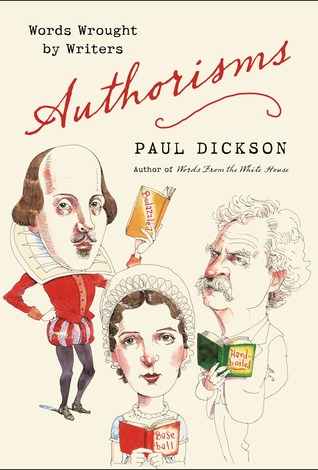
Book-A-Day #29: AUTHORISMS: Words Wrought by Writers


AUTHORISMS: Words Wrought by Writers
PAUL DICKSON

Bloomsbury USA
$18.00 hardcover, available now

Rating: 3.8* of five

The Publisher Says: William Shakespeare’s written vocabulary consisted of 17,245 words, including hundreds that were coined or popularized by him. Some of the words never went further than their appearance in his plays, but others—like bedazzled, hurry, critical, and anchovy—are essential parts of our standard vocabulary today.

Many other famous and lesser-known writers have contributed to the popular lexicon. According to the Oxford English Dictionary, Sir Walter Scott ranks second to Shakespeare in first uses of words and giving a new and distinct meaning to already existing words (Free Lances for freelancers). John Milton minted such terms as earthshaking, lovelorn, by hook or crook, and all Hell broke loose, and was responsible for introducing some 630 words.

Gifted lexicographer Paul Dickson deftly sorts through neologisms by Chaucer (a ha), Jane Austen (base ball), Louisa May Alcott (co-ed), Mark Twain (hard-boiled), Kurt Vonnegut (granfalloon), John le Carrè (mole), William Gibson (cyberspace), and many others. Presenting stories behind each word and phrase, Dickson enriches our appreciation of the English language in a book as entertaining as it is enlightening.

My Review: The Doubleday UK meme, a book a day for July 2014, is the goad I'm using to get through my snit-based unwritten reviews. Today's prompt, the 28th, is to identify the most endearing villain in a book.

That has me stumped. So I'm ignoring it! Haha, take THAT you silly meme!

Authorisms could, I suppose, be about a villain, if you personify the English language. It's fiendishly difficult to learn, and native speakers are almost to a being woefully (or blissfully, depending on whether you're a teacher or a speaker) ignorant of the rules of proper usage, grammar, syntax, punctuation...you know, the basics.

Whatevs, the book is BIG fun and, being arranged as a dictionary, is set up for easy browsing. Dickson gives a very satisfying cross-section of author-invented words, and with great care distinguishes the nonce words from the lasting contributions to the lexicon. Goalless, for example, is an Emily Dickinson-coined nonce word...one that only appears in reference to her or her work, and hasn't been absorbed into the language...versus babbitt and its kin babbitty et alii, Sinclair Lewis's invaluable eponym for a provincial, boosterish, snobby little nobody with delusions of adequacy.

Dickson himself coined the useful and well-used demonym, personal identifier with a place such as Angeleno or Cockney. I quite enjoyed this word-book, as I do almost all word-books, and I'd recommend it to the more wordophile of my pals.

Creative Commons License
This work is licensed under a Creative Commons Attribution-NonCommercial-ShareAlike 3.0 Unported License.

Friday, July 25, 2014

Book-A-Day #25: THE DINOSAUR FEATHER, a guilty pleasure read

THE DINOSAUR FEATHER
SISSEL-JO GAZAN
(tr. CHARLOTTE BARSLUND)
Quercus Books (non-affiliate Amazon link)
$3.99 Kindle edition, available now

Rating: 3.75* of five

The Publisher Says: How could one man inspire such hatred?

Professor Lars Helland is found at his desk with his tongue lying in his lap. A violent fit has caused him to bite through it in his death throes. A sad but simple end. Until the autopsy results come through.

The true cause of his death - the slow, systematic and terrible destruction of a man - leaves the police at a loss. And when a second member of Helland's department disappears, their attention turns to a postgraduate student named Anna. She's a single mother, angry with the world, desperate to finish her degree. Would she really jeopardise everything by killing her supervisor?

As the police investigate the most brutal and calculated case they've ever known, Anna must fight her own demons, prove her innocence and avoid becoming the killer's next victim.

The Dinosaur Feather is the most fascinating, complex and unusual Scandinavian crime novel since Smilla's Sense of Snow.

My Review: The Doubleday UK meme, a book a day for July 2014, is the goad I'm using to get through my snit-based unwritten reviews. Today's prompt is the twenty-fifth, a book that's a guilty pleasure.

Scandicrime has, apart from Jussi Adler-Olson, eluded me. I'm not hooked, I'm not repelled, I'm simply bemused by the warbles and hoots of addicted rapture. I gave up on Arnaldur's books because grim, I disliked that Swedish guy's rape victim trilogy deeply, I can't read books starring a person named Harry Hole. I simply can't. So me and the Scandis, we're not besties.

I do, however, really really like this book. It's got a background—and ONLY a background, no sciencey stuff need slow you down—of one of the most fascinating paleontological issues around, that is the dinosaurian origins of birds. It features a detective with angst. (Hoo BOY does he have angst.) The suspect is a single mom in search of a degree to build a good life for herself and her baby. And as a bonus the victim badly needed killing, and was dispatched in a way that still fills all the nooks and crannies of my soul with schadenfreude.

So why call this almost-four-star read a guilty pleasure? Because it's relentlessly downbeat. Yes, the crime is solved, but honestly I wish it hadn't been. The dick who died? Yeah, well, pity about that, please pass the jelly. The secrets that erupt into unforgettable daylight? Better for everyone if they'd just stayed secret and life had percolated along with shiny surfaces and unpocked skin.

And I thoroughly, completely reveled in the nastiness. Shame on me! #sorrynotsorry

Thursday, July 24, 2014

Book-A-Day #24: A book that reminds you of your English teacher


THE INFERNO OF DANTE
DANTE ALIGHIERI
translator: ROBERT PINSKY

Farrar, Straus, and Giroux
$21.00 trade paper, available now

Rating: 4* of five

The Publisher Says: This widely praised version of Dante's masterpiece, which won the Los Angeles Times Book Prize and the Harold Morton Landon Translation Award of the Academy of American Poets, is more idiomatic and approachable than its many predecessors. Former U.S. Poet Laureate Pinsky employs slant rhyme and near rhyme to preserve Dante's terza rima form without distorting the flow of English idiom. The result is a clear and vigorous translation that is also unique, student-friendly, and faithful to the original: "A brilliant success," as Bernard Knox wrote in The New York Review of Books.

My Review: The Doubleday UK meme, a book a day for July 2014, is the goad I'm using to get through my snit-based unwritten reviews. Today's prompt is the twenty-fourth, a book that reminds you of your English teacher.

Ninth grade, or freshman high school year, was The Odyssey, and tenth was The Inferno. We used, in 1974, the then-newish Ciardi translation, made in 1954; it was quite an event, since Ciardi (a poet of some renown) translated it as poetry instead of as Italian-to-English words.

Pinsky's translation attempts the damn-near impossible feat of preserving the terza rima (aba, bcb, cdc, etc.) rhyme scheme invented by Dante for this cycle of poems. The result is a noble experiment, one marked by many successes. There are some weird things like quotes flowing over multiple stanzas, and there are some...odd...rhymes. But hell, the man tried a damned near impossible feat! Italian is a language in which it's harder *not* to rhyme than otherwise, and English resists rhyme with all its might and main.

So what is any reviewer to say about a 700-year-old poem? Nothing hasn't been said by now. I am anti-christian. The theology behind the entire Divine Comedy appalls and repulses me. I speak rudimentary Italian. Pinsky's efforts to reproduce terza rima are, to my ears, clunky and unnecessary. But in the end, rating a book like this is about what the take-away is for the reader. I take away a sense of Dante as an intelligent, desperately lonely man, attempting to make a Universe in which his existence matters and is of some moment. I stand in awed amazement at his gloriously baroque imagination. I am gobsmacked by the sheer audacity of a medieval poet writing in the vernacular. If Dante was alive today, he'd be writing raps.

Ugh. Horrible thought.

But nonetheless, I am wowed at a root level by the joyous, exuberant viciousness and the unapologetic cruelty of Dante's score-settling fates for his enemies. What a guy! Those raps he'd be writing today? They'd inspire Wes Craven to make movies and Clive Barker to write gore-fests!

Try this exercise: Imagine a beat-box under the terza rima stanzas. Read a piece aloud imagining hand-claps at the end of each stanza. This is what I think we, in this relativistic age, should strive for: to interpret the classics of literature and poetry by standards relevant to today, in addition to the standards that we know were applied at the time of the work's creation.

Many more layers to this work that way. After all, a literary classic is a work that's never finished saying what it has to say.

And here one is.

Creative Commons License
This work is licensed under a Creative Commons Attribution-NonCommercial-ShareAlike 3.0 Unported License.

Wednesday, July 23, 2014

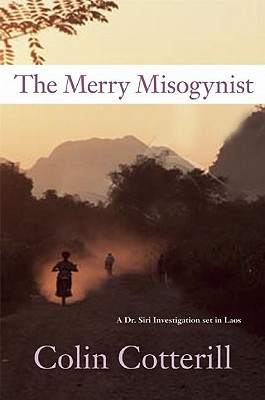
Book-A-Day #22: A novel with an exotic setting, THE MERRY MISOGYNIST


THE MERRY MISOGYNIST (Dr. Siri Paiboun #6)
COLIN COTTERILL

Soho Crime
$24.00 hardcover, available now

Rating: 4* of five

The Publisher Says: In poverty-stricken 1978 Laos, a man with a truck from the city was "somebody," a catch for even the prettiest village virgin. The corpse of one of these bucolic beauties turns up in Dr. Siri's morgue and his curiosity is piqued. The victim was tied to a tree and strangled but she had not, as the doctor had expected, been raped, although her flesh had been torn. And though the victim had clear, pale skin over most of her body, her hands and feet were gnarled, callused, and blistered.
On a trip to the hinterlands, Siri discovers that the beautiful female corpse bound to a tree has already risen to the status of a rural myth. This has happened many times before. He sets out to investigate this unprecedented phenomenon--a serial killer in peaceful Buddhist Laos--only to discover when he has identified the murderer that not only pretty maidens are at risk. Seventy-three-year-old coroners can be victims, too.

My Review: The Doubleday UK meme, a book a day for July 2014, is the goad I'm using to get through my snit-based unwritten reviews. Today's prompt is the twenty-third, favorite novel with an exotic background.

Laos in 1978 counts as exotic to me. I'm not sure the Laotians would agree, probably thinking of Long Island suburbia as exotic. It's all where you stand.

I love the series mystery world for its orderliness and its assurance that Right will be done. In this sixth Dr. Siri mystery, Right is indeed done and just in the nick of time. There's a secondary plot that I wasn't sure was needed, concerning Crazy Rajid the naked Indian who hangs with Dr. Siri, Comrade Civilai, and Inspector Phosy down by the Mekong. It doesn't seem necessary to me, but then why the hell not, it was fun.

The crimes and the punishment are well-handled here, and the believability of the situation created was up to snuff. But the star of the series, pace Dr. Siri, is Laos in all its tropical glory. I thoroughly enjoy my trips there, which I most emphatically would NOT if the trips were physical. As I huddle in front of the air conditioner, cursing temperatures that make me sweat and suffer but which would seem almost wintry to the Laotians, I visit the beauty of the jungle...without the bugs or the sweat.

I love that. Thanks for taking me there, Colin Cotterill!

Creative Commons License
This work is licensed under a Creative Commons Attribution-NonCommercial-ShareAlike 3.0 Unported License.
Monday, July 21, 2014

Book-A-Day #21: A CONSTELLATION OF VITAL PHENOMENA, a book I loved but expected to hate


A CONSTELLATION OF VITAL PHENOMENA
ANTHONY MARRA

The Hogarth Press
$18.00 trade paper, available now

Rating: 4.5* of five

The Publisher Says: In a small rural village in Chechnya, eight-year-old Havaa watches from the woods as Russian soldiers abduct her father in the middle of the night and then set fire to her home. When their lifelong neighbor Akhmed finds Havaa hiding in the forest with a strange blue suitcase, he makes a decision that will forever change their lives. He will seek refuge at the abandoned hospital where the sole remaining doctor, Sonja Rabina, treats the wounded.

For Sonja, the arrival of Akhmed and Havaa is an unwelcome surprise. Weary and overburdened, she has no desire to take on additional risk and responsibility. But over the course of five extraordinary days, Sonja’s world will shift on its axis and reveal the intricate pattern of connections that weaves together the pasts of these three unlikely companions and unexpectedly decides their fate. A story of the transcendent power of love in wartime, A Constellation of Vital Phenomena is a work of sweeping breadth, profound compassion, and lasting significance.

My Review: The Doubleday UK meme, a book a day for July 2014, is the goad I'm using to get through my snit-based unwritten reviews. Today's prompt is the twenty-first, discuss a book you expected to hate but ended up loving.
Life: a constellation of vital phenomena—organization, irritability, movement, growth, reproduction, adaptation.
Yes.

Now, there is always a matter of taste when it comes to appreciating or otherwise a given writer's work. Do the writer's words ring you like a bell? Do they smack you in the chops? Do they slither into your ears emitting glassy slime like a hagfish? That's the chief factor in determining your ultimate response to a work. I think some writers are equivalent of chocolatiers, making bonbon after truffle upon caramel. Lovely taken one at a time; urpsome in bulk. I think Marra is a chocolatier of a writer in this book.
There is something miraculous in the way the years wash away your evidence, first you, then your friends and family, then the descendants who remember your face, until you aren’t even a memory, you’re only carbon, no greater than your atoms, and time will divide them as well.
Mmmmm. Yum. Sing it, Brother Anthony, sing it.
Invader and invaded held on to their fistfuls of earth, but in the end, the earth outlived the hands that held it.
Yes. I concur. A bit baroque, permabehaps, but yes.
For their entire lives, even before they met you, your mother and father held their love for you inside their hearts like an acorn holds an oak tree.
Oh gag me! A milk chocolate strawberry creme-filled emetic-level Whitman's Sampler spitback!

So here I was, alternately uplifted and revolted, and still...this story made me stop what I was thinking and attend to it, and that's no mean feat. The horror of stories about war is, for me, only partially touched by the battles and the soldiers and the wounds they inflict on themselves and each other. The people whose lives are utterly upended by wars fought in their name and on their land are so often simply disappeared in toponymic abstraction (eg, the Mexican-American War). This novel doesn't look so much at the war as at the warred-over place and its inhabitants.

Marra's gift is in making images of the place vivid:
The trees they passed repeated on and on into the woods. None was remarkable when compared to the next, but each was individual in some small regard: the number of limbs, the girth of trunk, the circumference of shed leaves encircling the base. No more than minor peculiarities, but minor particularities were what transformed two eyes, a nose, and a mouth into a face.
And the people who live in the violated, wounded place:
As someone whose days were defined by the ten thousand ways a human can hurt, she needed, now and then, to remember that the nervous system didn't exist exclusively to feel pain.
It's a very well-made book, it's got a helluva wallop of a message, and it's fun to read. I was expecting nothing more than a flashy MFA-from-Iowa-Writers'-Workshop meretricious bauble. Some parts of the book are, in fact, that very thing. One's own taste determines where the balance point lies. Are there more surprisingly good moments than there are expectedly Shiny-Brite ones?
Entire years had passed when he was rich enough in time to disregard the loose change of a minute, but now he obsessed over each one, this minute, the next minute, the one following, all of which were different terms for the same illusion.
And there I say yes. Yes, this is more beautiful than brummagem.

Sunday, July 20, 2014

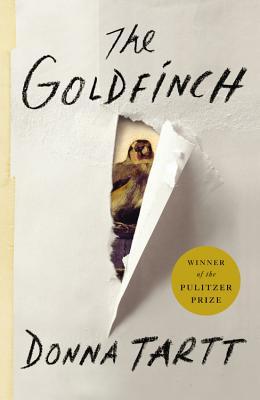
Book-A-Day #20: Desert Island Read, THE GOLDFINCH


THE GOLDFINCH
DONNA TARTT

Little, Brown
$30.00 hardcover, available now

Rating: 4* of five

The Publisher Says: It begins with a boy. Theo Decker, a thirteen-year-old New Yorker, miraculously survives an accident that kills his mother. Abandoned by his father, Theo is taken in by the family of a wealthy friend. Bewildered by his strange new home on Park Avenue, disturbed by schoolmates who don't know how to talk to him, and tormented above all by his unbearable longing for his mother, he clings to one thing that reminds him of her: a small, mysteriously captivating painting that ultimately draws Theo into the underworld of art.

As an adult, Theo moves silkily between the drawing rooms of the rich and the dusty labyrinth of an antiques store where he works. He is alienated and in love-and at the center of a narrowing, ever more dangerous circle.

The Goldfinch is a novel of shocking narrative energy and power. It combines unforgettably vivid characters, mesmerizing language, and breathtaking suspense, while plumbing with a philosopher's calm the deepest mysteries of love, identity, and art. It is a beautiful, stay-up-all-night and tell-all-your-friends triumph, an old-fashioned story of loss and obsession, survival and self-invention, and the ruthless machinations of fate.

My Review: The Doubleday UK meme, a book a day for July 2014, is the goad I'm using to get through my snit-based unwritten reviews. Today's prompt is to identify the book one would take to a desert island.

It was between this book and The Luminaries, a more artistically successful and more culturally enriching book; a book with grace and beauty and charm; a rich feast that says things to me even yet, months after reading it.

I chose this book.
I look at the blanked-out faces of the other passengers--hoisting their briefcases, their backpacks, shuffling to disembark--and I think of what Hobie said: beauty alters the grain of reality. And I keep thinking too of the more conventional wisdom: namely, that the pursuit of pure beauty is a trap, a fast track to bitterness and sorrow, that beauty has to be wedded to something more meaningful.

Only what is that thing? Why am I made the way I am? Why do I care about all the wrong things, and nothing at all for the right ones? Or, to tip it another way: how can I see so clearly that everything I love or care about is illusion, and yet--for me, anyway--all that's worth living for lies in that charm?

A great sorrow, and one that I am only beginning to understand: we don't get to choose our own hearts. We can't make ourselves want what's good for us or what's good for other people. We don't get to choose the people we are.
It's not Art, but it's a good, solid, real moment. I bought into Theo, I cared about the dumbass, I found him the kind of kid I'd try to fix and straighten out so he wouldn't flounder so messily as he looked for the path through the thicket.

Then there's traife like this: "'When you feel homesick,' he said, ‘just look up. Because the moon is the same wherever you go.'” Gag me. That's so Disney-movie pseudoprofound I could unswallow all over the book.

But then...
Whatever teaches us to talk to ourselves is important: whatever teaches us to sing ourselves out of despair. But the painting has also taught me that we can speak to each other across time. And I feel I have something very serious and urgent to say to you, my non-existent reader, and I feel I should say it as urgently as if I were standing in the room with you. That life—whatever else it is—is short. That fate is cruel but maybe not random. That Nature (meaning Death) always wins but that doesn’t mean we have to bow and grovel to it. That maybe even if we’re not always so glad to be here, it’s our task to immerse ourselves anyway: wade straight through it, right through the cesspool, while keeping eyes and hearts open. And in the midst of our dying, as we rise from the organic and sink back ignominiously into the organic, it is a glory and a privilege to love what Death doesn’t touch.
Sadly, it goes on after that to bury the well-made point and the well-turned phrase in verbiage.

Donna Tartt won a Pulitzer Prize for Fiction in recognition of this novel. I am not equipped with the information the judges of that prize use to make their decision. I can only say that, from my perspective as a reader, this is a good, solid read that should've been 600pp not 771pp, with many lovely phrases and a lot of good, well-incorporated action, but not especially prize-worthy. It's a thumping good read, as my friend Suz says.

And for that reason, I'd take it to a desert island, and I'd cuss and fume and fret about its shortcomings after I finished each read wet-eyed about Theo and his travails. Sometimes Theo acts so damned clueless I wanted to give him a bloody box of chocolates and a bench and plant a Barnaby Rudgely raven called Grip on his damn shoulder. And then:
You could study the connections for years and never work it out--it was all about things coming together, things falling apart, time warp, my mother standing out in front of the museum when time flickered and the light went funny, uncertainties hovering on the edge of a vast brightness, the stray chance that might, or might not, change everything.
So, yeah, this is the one that makes the desert island trip. Sorry, Eleanor Catton, your gorgeous and so very deserving tome will wait for me safe on my shelf.

Creative Commons License
This work is licensed under a Creative Commons Attribution-NonCommercial-ShareAlike 3.0 Unported License.

Saturday, July 19, 2014

Book-A-Day #19: THE MURDER OF ROGER ACKROYD, best twist EVER

THE MURDER OF ROGER ACKROYD (Hercule Poirot #4)
AGATHA CHRISTIE

William Morrow
$6.99 Kindle edition, available now

Rating: 4* of five **THIS REVIEW IS FOR THE AGATHA CHRISTIE'S POIROT EPISODE AS WELL AS THE BOOK**

The Publisher Says: In the village of King's Abbot, a widow's sudden suicide sparks rumors that she murdered her first husband, was being blackmailed, and was carrying on a secret affair with the wealthy Roger Ackroyd. The following evening, Ackroyd is murdered in his locked study--but not before receiving a letter identifying the widow's blackmailer. King's Abbot is crawling with suspects, including a nervous butler, Ackroyd's wayward stepson, and his sister-in-law, Mrs. Cecil Ackroyd, who has taken up residence in the victim's home. It's now up to the famous detective Hercule Poirot, who has retired to King's Abbot to garden, to solve the case of who killed Roger Ackroyd--a task in which he is aided by the village doctor and narrator, James Sheppard, and by Sheppard's ingenious sister, Caroline.

The Murder of Roger Ackroyd is the book that made Agatha Christie a household name and launched her career as a perennial bestseller. Originally published in 1926, it is a landmark in the mystery genre. It was in the vanguard of a new class of popular detective fiction that ushered in the modern era of mystery novels.

My Review: The Doubleday UK meme, a book a day for July 2014, is the goad I'm using to get through my snit-based unwritten reviews. Today's prompt, number 19 in the series, is to reveal the book with the best plot twist. Ummmm....

Undoubtedly the most famous novel written by Dame Agatha. It is well-known even among non-mystery readers, poor benighted sods, and has been cited by scholars as a turning point in the history of the mystery genre as a literary force. An English professor, [[Pierre Bayard]], has even delved deeply into the text to propose, from the book that Dame Agatha wrote, an alternative (and very interesting) ending!

I'm not going to spoiler the ending's Big Twist because the ten or twelve literate-in-English people who have never read it will come screaming in from the Internet to call me unpleasant names, and I'm done with that. It is indeed a Big Twist, it makes the entire experience of the book far more interesting than it otherwise would be, and it's just flat fun to come to, that first time, all unknowing.

So that said, when I first read this novel in 1973, I was all unknowing and was I gobsmacked! My oldest sister had a copy of it in her house, where I was visiting her, and she was deriving major amusement from my responses as the pages turned. It was a great way to spend a summer weekend.

Then after what, maybe 35 years, they make a Poirot TV episode out of the story. The vast bulk of you, having read the book, are now looking bemused, befuddled, or annoyed. How, you're asking yourself, can the Big Twist be preserved? How can the essential frisson-granting narrative device translate onto film, for pity's sake?!

Not all that well.

It's still a stylish and entertaining film, and I liked watching it, but it was NOT the equal of the book. For one thing, Inspector Japp appears out of nowhere and assumes his usual role as Poirot's foil-cum-sidekick. WTF? I screamed at the screen, WTF IS THIS HOOPLA?! (I used a dirtier word, but I am attempting to portray myself as a sweet and mild-mannered old man.) (Stop laughing.) Japp appeareth not in the novel! Not even close. It is but one of many shifts required to bring the story to the screen.

And for the only time in the entire history of the series Agatha Christie's Poirot, I wished they had just left the book alone and unfilmed. So why four stars? Because the book is five, and the film is three. Do the math. But don't bother with the show unless you're a completist.

Creative Commons License
This work is licensed under a Creative Commons Attribution-NonCommercial-ShareAlike 3.0 Unported License.
Friday, July 18, 2014

Book-A-Day #18: Favorite Crime Novel, BLACK IRISH


BLACK IRISH
STEPHAN TALTY

Ballantine Books
$6.99 ebook editions, available now

Rating: 4* of five

The Publisher Says: In this explosive debut thriller by the New York Times bestselling author of Empire of Blue Water, a brilliant homicide detective returns home, where she confronts a city’s dark demons and her own past while pursuing a brutal serial killer on a vengeful rampage.

Absalom “Abbie” Kearney grew up an outsider in her own hometown. Even being the adopted daughter of a revered cop couldn’t keep Abbie’s troubled past from making her a misfit in the working-class Irish American enclave of South Buffalo. And now, despite a Harvard degree and a police detective’s badge, she still struggles to earn the respect and trust of those she’s sworn to protect. But all that may change, once the killing starts.

When Jimmy Ryan’s mangled corpse is found in a local church basement, this sadistic sacrilege sends a bone-deep chill through the winter-whipped city. It also seems to send a message—one that Abbie believes only the fiercely secretive citizens of the neighborhood known as “the County” understand. But in a town ruled by an old-world code of silence and secrecy, her search for answers is stonewalled at every turn, even by fellow cops. Only when Abbie finds a lead at the Gaelic Club, where war stories, gossip, and confidences flow as freely as the drink, do tongues begin to wag—with desperate warnings and dire threats. And when the killer’s mysterious calling card appears on her own doorstep, the hunt takes a shocking twist into her own family’s past. As the grisly murders and grim revelations multiply, Abbie wages a chilling battle of wits with a maniac who sees into her soul, and she swears to expose the County’s hidden history—one bloody body at a time.

My Review: The Doubleday UK meme, a book a day for July 2014, is the goad I'm using to get through my snit-based unwritten reviews. Today's prompt is to discuss one's favorite crime novel, in honor of some British crime-novel beano.

Despite there being naggingly annoying lapses in continuity at three or four points, I was sucked into the violent and rage-filled vortex of this book from the get-go. The story, a standard one, is told at a breathless pace in direct, unpretentious language. The setting is seared into my memory. I feel as if I could find the park, drive the streets, point to the places I'd read about. I'm sure as hell not stopping for the cops there, Absalom/Abbie excepted.

The family secrets, the community guilt, the larger and wider implications of the vicious and bloody killings, make this procedural far more than an afternoon's entertainment. It's not Art, it's excitement! It's brutal and tough and doesn't give a flying fuck if your girlie-girl feelies are all bent. It's too busy setting you up for the next bashing!

I liked the hell out of it. It's good, every now and then, to sluice the nicey-nice from one's brain with a bracing dose of mean as fuck because I wanna be. There is NO oxytocin released in the reading of this book. Adrenaline, yes; androgen, oh my yes. We won't go into the testosterone release figures. Post-menopausal women are cautioned that they might find themselves assuming male secondary characteristics.

The sensitive members of the party are STRONGLY cautioned not to so much as handle this book. Don't do it, don't even contemplate it. Not for yinz.

Fans of the 87th Precinct, we found you a new writer to follow!

Wednesday, July 16, 2014

Book-A-Day #16: THE GAUGUIN CONNECTION, a good beach read


THE GAUGUIN CONNECTION (Genevieve Lenard Art Crimes #1)
ESTELLE RYAN

Kindle original edition (non-affiliate Amazon link)
FREE! what are you waiting for?!

Rating: 3.5* of five

The Publisher Says: Murdered artists. Masterful forgeries.
Art crime at its worst.

A straightforward murder investigation quickly turns into a quagmire of stolen Eurocorps weapons, a money-laundering charity, forged art and high-ranking EU officials abusing their power.

As an insurance investigator and world renowned expert in nonverbal communication, Dr Genevieve Lenard faces the daily challenge of living a successful, independent life. Particularly because she has to deal with her high functioning Autism. Nothing - not her studies, her high IQ or her astounding analytical skills - prepared her for the changes about to take place in her life.

It started as a favour to help her boss' acerbic friend look into the murder of a young artist, but soon it proves to be far more complex. Forced out of her predictable routines, safe environment and limited social interaction, Genevieve is thrown into exploring the meaning of friendship, expanding her social definitions, and for the first time in her life be part of a team in a race to stop more artists from being murdered.

My Review: The Doubleday UK meme, a book a day for July 2014, is the goad I'm using to get through my snit-based unwritten reviews. Today's prompt is to discuss a beach read, a novel perfect for an afternoon under a beach umbrella sipping drinks with silly names brought by hotties clad in as few clothes as local law allows.

Ahem. Well. Isn't that how everyone spends a day at the beach?

The Gauguin Connection has many sterling qualities, like a wonderful main character, and a completely beguiling cast of supporting characters. (I convinced my Gentleman Caller to read this by saying he reminded me of Vinnie. To my relief, he found that touching and endearing, "worth reading a stupid mystery novel for.")

What makes this such a good beach read is simply that: The interplay of the characters. Dr Lenard isn't consistently drawn, the art-crime plot seems very slapdash to me, and so on and so on. All those quibbles aside, I loved these characters and wanted to sit quietly in the room while they did what they do. Which is mostly sit around computers in different rooms and bicker amusingly.

I mean to tell you, though, if savoring the interplay of high-level snark with pomposity, the collision of wit with literal-mindedness, doesn't sound compelling to you, horseman, pass on. I found it deeply funny at times, and snortingly amusing all the time. So download it onto your Kindle for free, put the Kindle in a quart-sized Ziploc, seal it, and head for the sand. Tip the hottie well, and in advance, for the best drinks service. Relax into bliss with the wacky crew of Strasbourg (!)-based art crime solvers.

Tuesday, July 15, 2014

A Book-A-Day #15: SCIENCE FAIR, a YA novel I'd rather drink Drano than read


SCIENCE FAIR
RIDLEY PEARSON & DAVE BARRY

Kindle Special
$1.99, available now

Rating: 2.5* of five

The Publisher Says: Grdankl the Strong, president of Kprshtskan, is plotting to take over the American government. His plan is to infiltrate the science fair at Hubble Middle School, located in a Maryland suburb just outside Washington. The rich kids at Hubble cheat by buying their projects every year, and Grdankl's cronies should have no problem selling them his government-corrupting software. But this year, Toby Harbinger, a regular kid with Discount Warehouse shoes, is determined to win the $5,000 prize—even if he has to go up against terrorists to do it. With the help of his best friends, Tamara and Micah, Toby takes on Assistant Principal Paul Parmit, aka "The Armpit", a laser-eyed stuffed owl, and two eBay buyers named Darth and the Wookiee who seem to think that the Harrison-Ford-signed BlasTech DL-44 blaster Toby sold them is a counterfeit. What transpires is a hilarious adventure filled with mystery, suspense, and levitating frogs.

My Review: The Doubleday UK meme, a book a day for July 2014, is the goad I'm using to get through my snit-based unwritten reviews. Today's prompt for the 15th is a choose-you-own day! Wheee, right?

Naw. I hadda go an' eff it all up by making this my Drano book of the month. (You know, the one I read because I'd really rather drink Drano than read this author/genre/what's-it.)

So as expected I hated it. It's a middle-school market book. I didn't like middle-schoolers when I was one, and I like them less now. Vicious little bastards. They're hateful and spiteful and brimful of stupid. Yuck.

It doesn't help that the fake country the co-authors invent, Krpshtskan, is something straight out of Borat. (Remember that movie? Ye gawds.) It also doesn't help that the entire plot is such that Spy Kids begins to resemble Strindberg.

But you're not the audience, comes the cry. No indeed I am not. I am an adult with forty-six years of obsessive reading behind me! And yet others have tutted and tsked because there are those of us who don't want to read YA novels. So this random example, a Kindle special today, got the nod as my test subject. I have a Zilpha Keatly Snyder novel cued up to see if it's just humor that doesn't play well to an older audience. I need a respite before I wade into that one. This could easily be the most wonderful thing a kid could find, so I'm not raggin' on it as itself. It's just so extremely ridiculously grotesquely overblown and overplayed and after all, that's how kids like 'em.

But really, moms and dads, read this before giving kids access to it. Every adult is malevolent or stupid or both. Every authority is deaf, every honest person is reviled by all and sundry. Serious question here: Do you want your kid absorbing this message? That s/he's alone against an uncaring-to-hostile world, with parents that won't listen, teachers that smell bad, take bribes, and collude with enemies of the state?

This isn't good. It panders to an invidious set of stereotypes that reinforce a helpless, whadda-ya-gonna-do passivity and does so with "humor" so it slides down their gullets easier.

This bothers the hell out of me.

Creative Commons License
This work is licensed under a Creative Commons Attribution-NonCommercial-ShareAlike 3.0 Unported License.

Monday, July 14, 2014

Book-A-Day #14: Favorite roman de France, A FAR BETTER REST


A FAR BETTER REST
SUSANNE ALLEYN

Kindle edition
$2.99 (cheap at twice the price!), available now

Rating: 4* of five

The Publisher Says: A Tale of Two Cities is the story of Charles Darnay and Lucie Manette, but Sydney Carton is the hero who makes the ultimate sacrifice for love. Sydney disappears from the novel in London and turns up years later in Paris to bring the story to its heartbreaking end. A Far Better Rest imagines his missing personal history and makes him the center of this tragic tale. Born in England of an unloving father and a French mother, Sydney is sent to college in Paris, where he meets Charles Darnay and the other students who will have enormous influence on his life and alter the course of French history -- Robespierre and Camille Desmoulins among them. The beauty and kindness of Charles's wife, Lucie Manette, affects Sydney so deeply that he secretly devotes his life to her happiness.

Sydney becomes a major participant in the formation of the French Republic at the end of the eighteenth century and a witness to one of the most gruesome periods in history, as the significant people in his life fall to the guillotine. A Far Better Rest is a novel of passion, identity, and history that stands fully on its own.

My Review: The Doubleday UK meme, a book a day for July 2014, is the goad I'm using to get through my snit-based unwritten reviews. Today's prompt, in honor of Bastille Day, is to select your favorite novel set in or about France.

Okay. I know this will come as a surprise to y'all, being as how I've kept it such a closely guarded secret, but I have to say this right up front: I don't much care for the novels of Mr. Charles Dickens.

I know, I know, pick your jaws up from the floor, I'm sure you'll recover from the shock soon.

Now, with that bombshell out of the way, consider this: I am rating a book based on Mr. Dickens' dreary, interminable, turgid, jelly-bodied clunking clanking gawdawful sentimental absurdly overblown....

*ahem*

I am rating this novel, even factoring in its source, at four stars. And wanna know a secret? I've read all Alley's Aristide Ravel mysteries, set in Revolutionary Paris. And her novel The Executioner's Heir. And her short fiction, Masquerade. And her non-fiction Medieval UNderpants (I mean, how could one not read something titled Medieval Underpants?).

So absorb for a moment the improbability of a man with the discernment and good taste to loathe Dickens picking up this novel in the first place; reading a snatch of it and getting hooked; buying the Soho Press hardcover at retail; and becoming such a fan that he's read what there is to read by the author.

So I'd say that makes this my favorite novel set in and or about France. Why? Because I've read a lot of books, and unlike most historical fiction, this book reads like it was written by a person from that time who simply, inexplicably, happens to be alive now. The same is true of her Ravel mysteries. I don't know how she does it, exactly, but Alleyn handwaves away the 225 years between the Revolution and today. Forget you're reading a hardcover that did not cost you a month's wages. Or a Kindle whose mere existence would be a marvel to the people you're reading about. And you know what? You *will* forget those things.

I love immersive reads. I love to lose myself in a time and a place not here and not now. And Susanne Alleyn has done that for me again, and again, and never failed to make me happy I've spent time in her company.

Best of all? The Kindle edition of this book is a whopping $2.99. Please go buy it. This author deserves our support!

Sunday, July 13, 2014

Another Beautiful Title: THE OPTIMIST'S DAUGHTER


THE OPTIMIST'S DAUGHTER
EUDORA WELTY

Vintage Books
$13.95 trade paper, available now

Rating: 3.5* of five

The Publisher Says: The Optimist's Daughter is the story of Laurel McKelva Hand, a young woman who has left the South and returns, years later, to New Orleans, where her father is dying. After his death, she and her silly young stepmother go back still farther, to the small Mississippi town where she grew up. Alone in the old house, Laurel finally comes to an understanding of the past, herself, and her parents.

My Review: This is the novel that won Miss Eudora a Pulitzer Prize. She deserved all the awards going, but to select this one of her novels for an overdue honor...? Not that it's bad or anything, it's just...well...beautiful writing telling an ordinary woman's ordinary experience of coping with, understanding, death and aging. Evergreen themes to be sure, and again I stress the beautiful writing bit:
“Up home we loved a good storm coming, we’d fly outdoors and run up and down to meet it,” her mother used to say. “We children would run as fast as we could go along the top of that mountain when the wind was blowing, holding our arms right open. The wilder it blew the better we liked it.”
Yes. All of me knows that's true, and my inward ear rejoices in the music of it. But why it comes where it does, well, it's to make or re-make a point that's made.

Fine in shorter fiction. Gets tedious in longer fiction. This is *barely* over novella length and it coulda been shorter. Maybe even shoulda been.

But then there's, “At the sting in her eyes, she remembered for him that there must be no tears in his.” Oh. My. GOODNESS. Or this piece of gorgeousness, a tossaway line: “She was sent to sleep under a velvety cloak of words, richly patterned and stitched with gold, straight out of a fairy tale, while they went reading on into her dreams.” I could faint right now, saying it over and over, absorbing the *exactly*perfect* choice of words, savoring the rhythm, the heartbeat of it.

But the most frequent cry I hear against Miss Eudora's work is, "But NOTHING happens!" That's nonsense. Things happen, things that as we grow older we see clearer, things that don't involve fires and floods, or car, plane, boat trips to places near and far. Things that change the bone and meat of you, not the skin:
And perhaps it didn't matter to them, not always, what they read aloud; it was the breath of life flowing between them, and the words of the moment riding on it that held them in delight. Between some two people every word is beautiful, or might as well be beautiful.
And that, that right there, is my personal definition of what a marriage should be. I'd say "don't settle for less!" but there'd be more single people than there are places to house them.

So yes, things happen, yes, things and people change and grow and learn, but it takes a quiet and reserved readerly touch to see it, find it, winkle it out from the words. Action? Little. Characterization? Lots, maybe too much for some characters' ability to sustain our interest (Fay!). Discovery? Well.
At their very feet had been the river. The boat came breasting out of the mist, and in they stepped. All new things in life were meant to come like that.
In you step, now, and mind the gap.

Creative Commons License
This work is licensed under a Creative Commons Attribution-NonCommercial-ShareAlike 3.0 Unported License.

Book-A-Day #13: A great novel title, HILL WILLIAM

HILL WILLIAM
SCOTT MCCLANAHAN

Tyrant Books
$15.00 trade paper, available now

Rating: 4* of five

The Publisher Says: Beginning to read Hill William is like tuning into a blues station at 4:00 a.m. while driving down the highway. Scott McClanahan's work soars with a brisk and lively plainsong, offering a boisterous peek into a place often passed over in fiction: West Virginia, where coal and heartbreak reign supreme. Hill William testifies to the way place creates and sometimes stifles one's ability to hope. It reads like a Homeric hymn to adventure, to the human comedy's upsets and small downfalls, and revels in its whispers of victory. So grab coffee, beer—whatever gets you through the night—and join Scott around the hearth. Lend him your ear, but be warned: you might not want it back.

My Review: The Doubleday UK meme, a book a day for July 2014, is the goad I'm using to get through my snit-based unwritten reviews. Today's prompt, lucky number 13, asks us to discuss a novel with the best title. I think this is about it.

Now surely y'all remember my review of Crapalachia: A Biography of Place from 2013, right? How I warbled myself hoarse over its 4.5-star glory? Sure! Okay then, go take a quick peek at it and get back in the head of appreciating hillbilly noir or hick lit or whatever we've decided to call it.

And here he is again, Scott McClanahan, to make the fat and oblivious mainstream look, really look, at life among those who don't have much, and that includes hope. This time it's explicitly labeled fiction, so no one's going to run up to McClanahan on stage at a reading and demand to know if Event X happened and when.

Yeah, right.

The reason that's still going to happen is simple: Scott McClanahan inhabits this book the way a djinn inhabits a lamp. He's on your bookshelf. He's lookin' paper-pale, somebody feed the boy some vitamin D-for-decoding! We vivify the writer as we read the writing.
I couldn't stop. I couldn't stop because it felt good.

Just like right now I find myself getting ready to do it.

I hit myself.

I feel the blood surging to my head.

I hit myself.

I feel my jaw tightening.

I hit myself.

It feels like a prayer.

I hit myself.

It feels like something strange.

I hit myself.

It feels like something beautiful.
And that's before the page count gets to double digits. Now, some several of you aren't liking this too terrible much. It's not your favorite thing, it's not going somewhere you're interested in going...yes yes, I get it, it's challenging your definition of entertainment. It did mine, too.

Go on the trip. Yes, it's off your route, past your exit, beyond your slip. Fiction, fact-ion, roman à clef, metafiction, whatever tidy label you need to smack on the package, smack it on and open it up and settle in for an afternoon with someone who doesn't speak Cultured like a native because he isn't.

In a world that celebrates the bland venality of getting and spending, a moment like this...a scant two, maybe three hours' read for most of us serious bookheads...is uncommon and worthy of note and celebration. This isn't bland, and it's less venal than venereal. It won't lull or cosset you, but Hill William (isn't that a great title?) will not send you to bed wondering what you read that day. If anything.

Saturday, July 12, 2014

Book-A-Day meme #12: OUTERBOROUGH BLUES, a book that gives me a sense of place


OUTERBOROUGH BLUES
ANDREW COTTO

Ig Publishing (non-affiliate Amazon link)
$11.99 Kindle edition, available now

Rating: 3.9* of five

The Publisher Says: A beautiful young French girl walks into a bar, nervously lights a cigarette, and begs the bartender for help in finding her missing artist brother. In a moment of weakness, the bartender—a lone wolf named Caesar Stiles with a chip on his shoulder and a Sicilian family curse hanging over him—agrees. What follows is a stylish literary mystery set in Brooklyn on the dawn of gentrification.

While Caesar is initially trying to earn an honest living at the neighborhood watering hole, his world quickly unravels. In addition to being haunted by his past, including a brother who is intent on settling an old family score, Caesar is being hunted down by a mysterious nemesis known as The Orange Man. Adding to this combustible mix, Caesar is a white man living in a deep-rooted African American community with decidedly mixed feelings about his presence. In the course of his search for the French girl's missing brother, Caesar tumbles headlong into the shadowy depths of his newly adopted neighborhood, where he ultimately uncovers some of its most sinister secrets.

Taking place over the course of a single week, Outerborough Blues is a tightly paced and gritty urban noir saturated with the rough and tumble atmosphere of early 1990s Brooklyn.

My Review: The Doubleday UK meme, a book a day for July 2014, is the goad I'm using to get through my snit-based unwritten reviews. Today's prompt, number 12 in the series, is to discuss the book that gave you the best sense of place.

I moved to Manhattan in the 1980s, when it was still dirty, stinky, vice-ridden, and a boat-load of fun. Now it's clean and sanitary and there's a damn Disney store where there used to be hookers, drugs, and other useful things. Yuck.

Anyway, the same thing happened to Brooklyn about ten years later. This development is called "gentrification" and it's a double-edged sword. Nicer middle-class neighborhoods, no place for the poor to live...well, can't make an omelette....

Cotto's reluctant sleuth, Caesar, came to be in this country because of his great-grandmother:
My mother's mother came to this country in the usual way--she got on a boat with other immigrants and sailed from Sicily. She wasn't one of them, however: neither tired nor poor or part of any huddled mass. Instead, she traveled alone, with her money in one sock and a knife in the other, coming to the new world with an old world motive--to murder the man that had left her for America.
Such a fine, upstanding family! Things don't get a lot better in succeeding generations, and Caesar is running at top speed to get the blood-feuding nightmare of his family away behind him. So why does he agree to help the waifish French lassie, Colette, find her brother Jean-Baptist (sic)?

Because he wants some. Because the bar where he works is closing in on him. Because. He starts to search for the boy, an artist, and he gets himself tangled with some people who are where they are because it's where they want to be:
The lady in the liquor store sold me a fifth of whiskey and the landlord’s name without taking her eyes off the book she was reading.
It's clear that Cotto knows his folks well, and has their collective number. It's also clear that Caesar is walking streets deeply familiar to Cotto:
In the open sky above the hushed streets, the moon was a porcelain plate on a black table as I walked home. A breeze raised the collar of my jeans jacket as I sliced through the silvery silence, past unlit buildings and quivering trees and cars idle by the curb. The air felt like glass. I crossed empty corners under the mauve light of overhead lamps.
A more perfect, more poignant recreation of a fall night's walk in the seaport of New York I haven't read. Something that people who live here forget is that this is a seaside place, it was a port for centuries, it is spang doodle on the Atlantic Ocean, and that means the seaside is all around:
The full moon rose above the harbor as brightly lit tour boats skimmed along the black water, the brilliant cluster of lower Manhattan piled like stacks of coins from a treasure chest in the distance. Up the river, bridges arched across the wide water all the way up the east side, while the Brooklyn side was marked by soft, round lights, like a string of pearls.
I've stopped for that view any number of times in the past, and it never failed (or fails) to render me immobile with a blazing bolt of homecoming joy.

So, Caesar and his quest kick into high gear, several associates of his prove to be more than what they seem, and the more questions he asks about Jean-Baptist (sic) the more trouble he gets into. Beatings. Threats. Some sex. Memories blast our guy at every turn, all the crap he's wanted to escape from bubbles up as he searches the druggier parts of Brooklyn for Colette's foolish artist wannabe brother:
Gypsy cabs jostled and honked...Dollar vans lined the sidewalk and people piled in and out. As I walked down the slope, the buildings grew smaller and squalid. Trees vanished...and the heat picked up. Beyond the brick wall of the Navy Yard, the silver skyline of Manhattan glimmered in the distance like a mirage. The industrial remains of the flats were low and decrepit and mostly abandoned, though a few beeping forklifts unloaded trucks here and there. The storefronts were shuttered except for a bank busy with Orthodox Jews. The funk of a chicken processing plant contaminated the air.

I walked along the high brick wall that separated the Navy Yard from the street, frequently stepping over pulverized vials that sparkled like jewels on the sidewalk. There was no shade. I blinked away the dust.
Yep, been there. The Navy Yard, by the mid-1990s, was a cheap warehousing area, and the publisher whose office work I did had his books stored there. Not a super-nice place to walk at night. Fascinating history, and very different now, but this passage nails the sensation of blasting heat and stinking blight that permeated the place then.

More stuff about the search for Colette's brother turns up nasty secrets involving everyone Caesar knows, information that he uses to get a ghost from his own past laid to rest, and then *clap clap* the mystery's solved.

This made me mad. I don't like being taken on a ride and then dumped outside town, told I'm there, and left.

But you know what? Homecoming means more than how you traveled to get there. I liked the people I met on the trip. I liked the evocative landscape descriptons. I liked the sense of Caesar's working through so much about his past wasn't going to Make Shit Better, because landing him in more trouble later means more of this:
Past the projects, the land opened up and water came into view. The breeze carried rain and salt. Jetties and barrier walls supported the shore, which was stacked with crumbling brick warehouses. Out in the channel, the Statue of Liberty stood alone on her little island, her corroding flame held high in the air as the sun set over the industrial shoreline and skyways of New Jersey. Across the narrows, the bluffs of Staten Island wavered in the smoky light of dusk that turned the Verrazano into bronze. Faint light burnished water into busy with freighters and tug boats. A lone sail boat flitted in the distance. On the near shore, on a slip of water between a jetty and the land, a blood red barge bobbed on the tide.
And that, laddies and gentlewomen, is good.

Friday, July 11, 2014

LET HIM GO, eleventh Book-A-Day meme read


LET HIM GO: A Novel
LARRY WATSON

Milkweed Editions
$9.99 ebook editions, available now

2020 UPDATE The 6 November 2020 film has a really intense trailer!

Rating: 4.9* of five

The Publisher Says: "With you or without you," Margaret insists, and at these words George knows his only choice is to follow her.

It’s September 1951: years since George and Margaret Blackledge lost their son James when he was thrown from a horse; months since James’s widow Lorna took off and remarried that thug Donnie Weboy. Now Margaret is steadfast, resolved to find and retrieve her grandson Jimmy—the one person in this world keeping her son’s memory alive—while George, a retired sheriff, is none too eager to stir up trouble with Donnie Weboy. Unable to sway his wife from her mission, George takes to the road with Margaret by his side, traveling through the Dakota badlands to Bentrock, Montana, in unstoppable pursuit. When Margaret tries to convince Lorna to return home to North Dakota, bringing little Jimmy with her, the Blackledges find themselves mixed up with the entire Weboy clan, a fearsome family determined not to give the boy up without a fight.

With gutsy characters and suspense-filled prose, Let Him Go speaks to the extraordinary measures we take for family and the overpowering instinct to protect those we love. From the award-winning author who gave us Montana 1948, Justice, and American Boy, Larry Watson is at his storytelling finest in this unforgettable return to the American West.

My Review: The Doubleday UK meme, a book a day for July 2014, is the goad I'm using to get through my snit-based unwritten reviews. Today's prompt is the eleventh in the series, discuss a book that made you cry.

Um.
Long past the moment when her neck begins to stiffen and ache, she continues to stare into the darkness, even though none of the human secrets she needs to know are to be found in the stars but rather closer to the earth her boots stand upon.
So, yeah. This book's plot is readily available to anyone who can read. You know that Margaret Blackledge lost her only son, her no-count trollop of a daughter-in-law found her a pretty face on top of a hard body and lit out for the fleshpots of Montana. Good riddance, Margaret would think, were it not for the fact that her one remaining treasure, her grandson, got swept away in the leaving. And the life that boy will be living will be full of no-count people who are no better than the law requires, and most of the time not even that. No. Margaret will not have that, not after all she went through to raise her boy up right. She has to have his son back, so she can do it all again.
A four-year-old has so little past, and he remembers almost none of it, neither the father he once had nor the house where he once lived. But he can feel the absences – and feel them as sensation, like a texture that was once at his fingers every day but now is gone and no matter how he gropes or reaches his hand he cannot touch what’s no longer there.
And those textures, those memories, they're going to be of her and her husband George, not some petty, small-time criminals like his mama fell in with.

Margaret Blackledge is a force of nature. She is a tall woman with no give to her, and believe you me, she has never given anything. She suits her country beautifully. Margaret just flat hates summer, she went a little crazy one summer from it and...well, that's a piece of story you'll find out. Summer makes a person crazy, and so Margaret waits to pack the Hudson full of her life's stuff and then tell George he's comin' or goin' but the time is now until it's September:
Autumn has come to northeast Montana. The vapor of one’s breath, the clarity of the stars, the smell of wood smoke, the stones underfoot that even a full day of sunlight won’t warm- these all say there will be no more days that can be mistaken for summer.
And I don't blame her one itty bit.

George now, he's been a sheriff for Dalton, North Dakota, and he's had to win elections before...in spite of a little drinkin' problem, in spite of being reserved, in spite of never slittin' a lip unless it was necessary:
The limitless, lowering sky, the long stretches of motionless empty prairie, the silence, complete right down to the absence of birdsong -- who knows what decides a man to leave most of his words unspoken?
But when we meet George, he's no lawman anymore, he holds boards for other men to hammer. He's done. He's been more than he wanted to be, and he's done. George has been Margaret's husband for a long time, and he's done right by her and their twin kids (Janie, the other twin, features in this story only in her absence). But now, with this trip, George is done:
Now no sign, no scorch or char, marks the place where George built the fire. Remarkable, earth's strength to restore itself and erase human effort. But memory, stronger still, can send flames as high as the roof, and shift the wind and choke George and sting his eyes with smoke...
Memories might consume him, but no one outside his skin will ever know which ones, or what he thinks of 'em. He does not give anything away, not after running a ranch he inherited from his father and mother, not after making a life in the hardscrabble grab it from the earth way of the American West, and not as long as Margaret is beside him making do, wearing out, mending up, doing without.

I think he loves Margaret, and I think he knows that his only way to show her she's loved is to do for her. So he does. And the story is George, lawman and drunk and closed-up shop, doing his all for the woman who gave him his life. It had its price, this life, but it was theirs, and they're looking at the end:
When night comes on in a room lit by kerosene, any flicker of the flame can give the sense that darkness is about to triumph.
And that's the story's unspoken edge. These two people are coming to the end, and they...she more than he...want to put something into their grandson that his soft, vapid, pointless mama won't and can't. They want to give him a sense of purpose, a purposeful life-path that won't shame him or his own kids.

Suffice it to say that the conflict between these rock-ribbed, self-contained, competent people and their shiftless opponents isn't going to play out slowly. The end comes, in fact, a bit abruptly and with a B-movie full-circleness that is *exactly* what I wanted.

But in that satisfaction comes the disappointment of getting what you want handed to you, no questions, no effort required. This beautiful story and its handsomely carved characters never launched into the glorious orbit of Montana 1948, and never plumbed the deep-downs of White Crosses. It is excellent, and it is beautiful. It should be on your shelf. It should also break into the myriad frighteningly sharp shards here:
A gust of wind doesn't suddenly bang a door open. A clock doesn't chime. The phone doesn't ring. Yet in the next instant the stillness breaks as if it is crystal.
That it never quite does makes me cry.

Thursday, July 10, 2014

Tenth BOOK-A-DAY prompt..PICNICS?! Uh oh


THE FLY TRAP: A Book About Summer, Islands and the Freedom of Limits
FREDRIK SJÖBERG

Particular Books (non-affiliate Amazon link)
Out of print; various prices

Rating: 4* of five

The Publisher Says: Warm, funny and insightful, The Fly Trap is a meditation on collecting; be it hoverflies or fine art. A fascinating web of associations, it begins with Sjöberg’s own tranquil experience as an entomologist on a remote island in Sweden, and takes in heroic historical expeditions to Burma and the wilderness of Kamchatka. Along the way, Sjoberg pauses to reflect on a range of ideas – slowness, art, freedom, – drawing other great writers, like D.H Lawrence and Bruce Chatwin, into dialogue. From the everyday to the exotic, The Fly Trap revels in the wonder of the natural world and leaves a trail of memorable images and stories.

My Review: The Doubleday UK meme, a book a day for July 2014, is the goad I'm using to get through my snit-based unwritten reviews. Today's prompt, tenth in the series, is to choose a book with a memorable picnic in honor of some ridiculous teddy bear thing.

Now seriously. Anyone who's known me ten minutes can be excused from the room for a laugh break. A picnic! The clambake on the beach in Professor Diggins' Dragons, a chapter book I read in 1967 or so, then the famous allusion to a picnic in Lolita...was there some talk of a picnic in a Hardy Boys or Nancy Drew book? Can't remember...anyway, I am not the sort of hairpin of a guy who reads books with picnics in. And I need to keep the pace going with this meme! What to do, what to do....

Then it hit me: Picnics are outdoors customarily, aren't they, so a book about the outdoors will work! And I just read a doozy: The Fly Trap, a Swedish weirdo's reminiscences (some would say maunderings) of his life in the cutthroat world of hoverfly expertise.

Since I had no idea what the hell a hoverfly was, I wiki'd it up and spent a good half-hour marveling at gems like, "About 6,000 species in 200 genera have been described." Described! Dear and glorious physician, someone down through the ages has always not had a life, of course, but the amount of wasted drinking, reading, and screwing time that describing "about 6,000 species in 200 genera" represents just boggles my mind.

And this guy's a nice-enough looking man, he doesn't appear to have any cognitive defects, and he's Swedish, so getting dates can't have presented that much of a problem for him that he had to give up and start collecting flies. He explains why he chose to write his memoir, and a bit of why he's in the fly game at all:
The hoverflies are only props. No, not only, but to some extent. Here and there, my story is about something else. Some days I tell myself that my mission is to say something about the art and sometimes the bliss of limitation. And the legibility of landscape. Other days are more dismal. As if I were standing on queue in the rain outside confessional literature’s nudist colony, mirrors everywhere, blue with cold.
So I get it, Mr. Man, you're not Eric Northman and you'd like folks to pay you some attention. Check! Do it in art. Write lovely sentences, people will pay attention to you. Chalk up a win for the fly guy!

And then there's the stuff he finds out as fly-hunting takes over his world. There was, apparently, a Swedish guy named René Malaise (!) whose wildlife-hunting expeditions to places like Kamchatka, on the Pacific fringe of Russia, led to his invention of the Malaise Fly Trap. (This is not a goof, I looked it up.) A piece of this book reads like a failed start on a biography of Malaise (what a horrible name! "Reborn Misery" yuck), which was really very intriguing. Emulating this monadnock of the fly-guy world, Our Hero takes off and travels around the world to see what he can see. The important part of his bring-back was this:
When the days are numbered, everything seems clearer, as if the time between preparation and departure possessed a particular magic. The endless stretch of time on the other side always struck me as evasive and treacherous. But the very limited period between now and then held a liberating peace and quiet. This allotment of time was an island. And the island became, later, a measurable moment. For a long time, this discovery was the only truly unclouded dividend that I took from my travels.
I think I was the only person in the USA who watched the film The Adventures of Buckaroo Banzai, but I did and I loved more than anything the line Peter Weller speaks as Buckaroo: "No matter where you go, there you are." Sjöberg clearly gets that, and decides to come home to the place where everybody speaks his language. No more wandering for him...he'll settle down in Sweden, near Stockholm, on an island!

Now there is very little in this world that is better at focusing one's attention on the practical realities of life than living on an island. I live on a really big one, but part of living here is knowing how and when to get off the island. And if one can't, what are the options? I meditate on these matters, always coming back to the realization that island = Atlantic Ocean, and that's a BIG piece of water, and there are storms out there pretty much all the time...
It’s said to be the same all over the world, in all seven seas. Islands are matriarchies of a kind seldom seen on land. The men – as Iceland’s president Vigdís Finnbogadóttir remarked on one occasion when the subject arose – the men flee to their own preferred landscape, which is the sea.
Interesting. I'd never really noticed before that all the world over the word for "person who goes out into the water and brings back fish" is male in gendered languages, and not even the most ardent gender-equality advocate has yet proposed an alternative to "fisherman." There appears to be no need for it.

So what does this have to do with flies? Got me. But it's in Sjöberg's book, like so much else that isn't instantly obviously contained within the title The Fly Trap. And that's why I enjoyed the book so much. I dislike summer because summer, and I am not a huge fan of outdoorsy life because mosquitoes, but I am always up for a stroll with an interesting companion whose passion and joy is shared eloquently and elegantly with me, allowing me to make a mental shift in my own ever-narrowing scope of activity. Tomas Tranströmer, Nobel Laureate poet, blurbed this book in large part (I believe) because of moments, lovely limerant moments like this one:
Every summer there are a number of nights, not many, but a number, when everything is perfect. The light, the warmth, the smells, the mist, the birdsong – the moths. Who can sleep? Who wants to?

Creative Commons License
This work is licensed under a Creative Commons Attribution-NonCommercial-ShareAlike 3.0 Unported License.

Wednesday, July 9, 2014

Book-A-Day meme #9, a character you love to hate: DELTA WEDDING

DELTA WEDDING
EUDORA WELTY

Houghton Mifflin Harcourt
$15.99 trade paper, available now

Rating: 3.75* of five

The Publisher Says: A vivid and charming portrait of a large southern family, the Fairchilds, who live on a plantation in the Mississippi delta. The story, set in 1923, is exquisitely woven from the ordinary events of family life, centered around the visit of a young relative, Laura McRaven, and the family’s preparations for her cousin Dabney’s wedding.

My Review: The Doubleday UK meme, a book a day for July 2014, is the goad I'm using to get through my snit-based unwritten reviews. Today's prompt, the ninth, is to discuss your favorite character in a novel to hate.

Dabney. Hands down, Dabney. What a self-centered nightmare of a spoiled brat! She's marryin' 'neath her, that no-count Troy is just scramblin' for a place in the Fairchilds! But Dabney, she knows:
"I will never give up anything!" Dabney thought, bending forward and laying her head against the soft neck. "Never! Never! For I am happy, and to give up nothing will prove it. I will never give up anything, never give up Troy - or to Troy!" She thought smilingly of Troy, coming slowly, this was the last day, slowly plodding and figuring....
And still, there's something deeply Southern in Dabney's greed, something that life in the lush heat of the land down by the water just puts in you, makes you part of it:
The eagerness with which she was now going to Marmion, entering her real life there with Troy, told her enough - all the cotton in the world was not worth one moment of life! It made her know that nothing could ever defy her enough to make her leave it. How sweet life was, and how well she could hold it, pluck it, eat it, lay her cheek to it - oh, no one else knew. The juice of life and the hot, delighting taste and the fragrance and warmth to the cheek, the mouth....
Dabney's complete inability to see the other person as real makes her a monster, that familiar monster, The Southern Belle. She hasn't got room for anyone but herself in the movie of her life:
Life was not ever inviolate. Dabney, poor sister and bride, shed tears this morning (though belatedly) because she had broken the Fairchild night light the aunts had given her; it seemed so unavoidable to Dabney, that was why she cried, as if she had felt it was part of her being married that this cherished little bit of other peoples' lives should be shattered now.
Things, the stuff that surrounds people like the Fairchilds from cradle to grave (and they'd take it on as grave goods if only people still did that), *those* evoke tears and memories. Not the people, not the little damn-near stranger in the Fairchild midst, little motherless Laura whose presence is unwished for but accepted because she is Family.

And in the end, that's where we end up in this novel, in the Family. Like every family, the Fairchilds have codes and shortcuts in their communication that seem designed to exclude others. That includes the reader of the novel, in fact. But it's not that the Fairchilds don't want you to understand them, or that Miss Eudora failed to give you the keys to a roman à clef. It's this very experience that's the point of the novel. Either you like that experience, or you don't, but this is the point:
Indeed the Fairchilds took you in circles, whirling delightedly about, she thought, stirring up confusions, hopefully working themselves up. But they did not really want anything they got - and nothing, really, nothing really so very much, happened!
Now that said, what makes this book fall short of four stars for me, an ardent Eudoraist? Novels aren't like short stories in that the introduction of a character or inclusion of a detail must be part of the essential nature of the book. There are about a squillion voices in this chorus, and that's just way too many. WAY too many. So there isn't a long-term investment in the current carrying us to...to...wherever it is we're going and we don't quite get to. Miss Eudora could've pruned the voices to Dabney, Uncle George, and Laura, and been able to tell the same big, noisy story. But this is a novel, and writing novels was not Miss Eudora's métier. That was the short story, a form of which she was a mistress.

In the end, as much as I loved to hate Dabney and her cut-rate Scarlett-ness, I was only slightly less appalled by the sheer feckless ridiculousness of George, Dabney's uncle and the Fairchild Golden Boy, and the cult surrounding him. His morganatic marriage to Robbie is summed up by Aunt Ellen, one of his groupies:
t seemed to Ellen at moments that George regarded them, and regarded things - just things, in the outside world - with a passion which held him so still that it resembled indifference. Perhaps it was indifference - as though they, having given him this astonishing feeling, might for a time float away and he not care. It was not love or passion itself that stirred him, necessarily, she felt - for instance, Dabney's marriage seemed not to have affected him greatly, or Robbie's anguish. But little Ranny, a flower, a horse running, a color, a terrible story listened to in the store in Fairchilds, or a common song, and yes, shock, physical danger, as Robbie had discovered, roused something in him that was immense contemplation, motionless pity, indifference...Then, he would come forward all smiles as if in greeting - come out of his intensity and give some child a spank or a present. Ellen had always felt this about George and now there was something of surprising kinship in the feeling.
That gets to the heart of my dislike and discomfort with George. He's so spoiled, so cossetted and babied, that only a severe adrenaline jolt (at someone else's expense) will do to fetch him up among the living.

It's not hard for me to appreciate this novel for what it is, but it's not at all the beau ideal of a novelist's art. I like it, I understand why others don't, but goodness me give me the lush, rich, deeply felt beauty of Welty's prose any old way it comes.

Tuesday, July 8, 2014

Book-A-Day #8: REGENERATION, my favorite Great War novel


REGENERATION
PAT BARKER

Plume Books
$16.00 trade paper, available now

Rating: 5* of five

The Publisher Says: Regeneration, one in Pat Barker's series of novels confronting the psychological effects of World War I, focuses on treatment methods during the war and the story of a decorated English officer sent to a military hospital after publicly declaring he will no longer fight. Yet the novel is much more. Written in sparse prose that is shockingly clear -- the descriptions of electronic treatments are particularly harrowing -- it combines real-life characters and events with fictional ones in a work that examines the insanity of war like no other. Barker also weaves in issues of class and politics in this compactly powerful book. Other books in the series include The Eye in the Door and the Booker Award-winner The Ghost Road.

My Review: The Doubleday UK meme, a book a day for July 2014, is the goad I'm using to get through my snit-based unwritten reviews. Today's prompt is to discuss the Great War novel you loved best.

This was *hard* because there have been several, two in the past year!, Great War-themed novels that I really love. I spent a sleepless night thinking about this. I re-read portions of both my recent reads that suit the prompt, and as much as I was enwrapt in [The Daughters of Mars], feeling the swirl and ebb of tidal feeling, I was utterly immersed in [Regeneration], I felt I was *there* and I was simply, unaccountably, invisible to the characters and so not remarked upon.

I know that Ms. Barker was born in 1943...imagine! 1943! Were there *people* then?...and so could not have witnessed the events that so utterly traumatized Wilfred Owen and Siegfried Sassoon and so many thousands of other men, but you couldn't prove it by this:
Sometimes, in the trenches, you get the sense of something, ancient. One trench we held, it had skulls in the side, embedded, like mushrooms. It was actually easier to believe they were men from Marlborough's army, than to think they'd been alive a year ago. It was as if all the other wars had distilled themselves into this war, and that made it something you almost can't challenge. It's like a very deep voice, saying: 'Run along, little man, be glad you've survived'.
If that doesn't sound exactly like something a survivor would think, I don't know what does. And yet she's 25 years younger than Armistice Day! Channeling? Spirit possession? Filing clerk for the Akashic Records Office?

That last sounds about right...anyway, there we are mise en scene with the survivors, the ones confronting a world that feels empowered to judge them for their responses to stimuli unknown to mere civilians:
The way I see it, when you put the uniform on, in effect you sign a contract. And you don't back out of a contract merely because you've changed your mind. You can still speak up for your principles, you can still argue against the ones you're being made to fight for, but in the end you do the job.
Doesn't that sound like someone who hasn't had to do the job issuing a pronunciamento? An armchair warrior speaking from the privileged place of one who is defended, not one who defends. It was ever thus.

What a horror, then, to be trapped between a world that you fought to save, and that world's utter inability and complete unwillingness to learn what you lived:
This reinforced Rivers’s view that it was prolonged strain, immobility and helplessness that did the damage, and not the sudden shocks or bizarre horrors that the patients themselves were inclined to point to as the explanation for their condition. That would help to account for the greater prevalence of anxiety neuroses and hysterical disorders in women in peacetime, since their relatively more confined lives gave them fewer opportunities of reacting to stress in active and constructive ways. Any explanation of war neurosis must account for the fact that this apparently intensely masculine life of war and danger and hardship produced in men the same disorders that women suffered from in peace.
That kind of knowledge would devastate Society! Undermine the Divinely Ordained Rules! Heresy!! It must be the case that these damaged men were weak, weak I say, unmanly and unworthy! It cannot be that what they lived through damaged them by its nature, or else codified gender (and skin-color) inequality is Wrong. And we all know that it is Right!

Ugh. But blessedly, the Great War began a process of (wrenching, painful) psychic change that the Ruling Elite has been resisting, beating back, discrediting at every opportunity, and with increasing success, for 95 years:
It was... the Great White God de-throned, I suppose. Because we did, we quite unselfconsciously assumed we were the measure of all things. That was how we approached them. And suddenly I saw that we weren't the measure of all things, but that there was no measure.
Look at the returned Iraq War and Afghan War veterans...disillusioned, mutilated in body and in soul even when bodies are whole, record numbers of veteran suicides stand to our national, human discredit, exactly as they did then, and all because:
You know you're walking around with a mask on, and you desperately want to take it off and you can't because everybody else thinks it's your face.

If that sentence does not make you weep actual physical tears of helpless sadness and empathetic misery, you are wanting in basic human kindness.

In the end, the reason I selected this book as my favorite Great War novel ahead of all others, is this simple distillation of the pointlessness of war in the face of its costs:
And as soon as you accepted that the man’s breakdown was a consequence of his war experience rather than his own innate weakness, then inevitably the war became the issue. And the therapy was a test, not only of the genuineness of the individual’s symptoms, but also of the validity of the demands the war was making on him. Rivers had survived partly by suppressing his awareness of this. But then along came Sassoon and made the justifiability of the war a matter for constant, open debate, and that suppression was no longer possible.

Creative Commons License
This work is licensed under a Creative Commons Attribution-NonCommercial-ShareAlike 3.0 Unported License.