Showing posts with label Swedish author. Show all posts

Monday, February 2, 2026

THE SECRET OF SNOW, cozy, sentimental Swedishness


THE SECRET OF SNOW
TINA HARNESK
(tr. Alice Menzies)
Atria Books (non-affiliate Bookshop.org link)
$14.99 ebook, available now

Rating: 3.75* of five

The Publisher Says: This lyrical runaway Swedish hit follows a reclusive, elderly couple who cross paths with a pair of twentysomething newcomers in a small mountain town, revealing an unexpected, shared history and the reclamation of a nearly extinct culture.

Meet Máriddja: eccentric, eighty-five years old, and facing a cancer diagnosis. She’s determined to keep the truth about her illness from her husband Biera, while also finding someone who can take care of him once she’s gone.

Meet Kaj: a new transplant to the village, recently engaged to Mimmi, and mourning the death of his mother. One day, when Kaj unexpectedly finds a box of Sámi—the indigenous people of Scandinavia—handicrafts belonging to his mother, he unlocks something he never anticipated, something that will change his life for years to come.

A “brilliant debut” (Aftonbladet Söndag, Sweden) full of humor and heartbreak, The Secrets of Snow movingly grapples with grief, love, and the power of history.

I RECEIVED A DRC FROM THE PUBLISHER VIA NETGALLEY. THANK YOU.

My Review
: As with most bestsellers, this story is pitched right down the middle. Take one old (straight, natch) couple facing end of life issues of varying but intense urgency. Add one young (straight, natch) couple facing relationship teething pains and life traumas. Connect them by geography in a place small enough to breed affinity through enforced proximity. Add a glaze of native cultural issues. Give the old woman an iPhone and have her repurpose Siri as a confidant for comic relief. Serve.

It's fine if this is dessert after a hearty substantial meal. This is presented as the meal. If these were the concluding chapters of a much longer book that dug into Kaj's relationship with his mother and dialed down the awkward obvious coincidence that's telegraphed early and often, and the roots of Mári's anguished love for Biera (though who wouldn't be mad for someone who thinks his wife "was generous with everything, including her dignity" when everyone else thinks she's a madwoman!), I'd be wadding up the Kleenex with the rest of y'all.

It's a debut novel, and as I've said many times I grade on a curve for debut novelists, or I'd be a lot less tactful in expressing my dissatisfaction. I now turn your attention to the marvelous, evocative writing. Particularly effective, probably even moreso in Swedish, is the evocation of Sámi culture...the indigenous folk of the Arctic are about as well-presented in Sweden as First Nations people are in Canada, and only Black people are presented worse than Native Americans in the US. Author Harnesk does not stint on her vocabulary. Menzies, our translator, has worked hard and successfully to render the tone of the original. I don't speak Swedish, but there's a feel, an aura around a really well-made work of prose that comes through in the very best translations. It came through here.

While understanding why this became a bestseller does not add to my desire to praise it, I predict all y'all would love the read if you gave it a try. The Fredrik Backman bus, the Shelby van Pelt posse, the Sally Hepworth squad, should bypass the library hold list and put your credit cards on the line. This book is aimed right at you. Any reader wanting a lingering look at love, grief, and a lifetime of being true to your lights finally being rewarded should get it from the library. Request it if you don't see it in the catalog.

It's built to make you feel the warm glow of goodness.

Friday, July 30, 2021

AMATKA, Karin Tidbeck's truly disorienting & disturbing Swedish SF


AMATKA
KARIN TIDBECK
(tr. by the author)
Vintage Books
$16.00 trade paper, available now

Rating: 4* of five

The Publisher Says: Vanja, a government worker, leaves her home city of Essre for the austere, wintry colony of Amatka on a research assignment. It takes some adjusting: people act differently in Amatka, and citizens are monitored for signs of subversion.

Intending to stay just a short while, Vanja finds herself falling in love with her housemate, Nina, and decides to stick around. But when she stumbles on evidence of a growing threat to the colony and a cover-up by its administration, she begins an investigation that puts her at tremendous risk.

In Karin Tidbeck's dystopic imagining, language has the power to shape reality. Unless objects, buildings, and the surrounding landscape are repeatedly named, and named properly, everything will fall apart. Trapped in the repressive colony, Vanja dreams of using language to break free, but her individualism may well threaten the very fabric of reality. Amatka is a beguiling and wholly original novel about freedom, love, and artistic creation by an idiosyncratic new voice.

THIS PURCHASE WAS INSPIRED BY THE WICKED, WICKED SF BOOK-BLOGGER, RACHEL CORDASCO. GO FOLLOW HER...WHY SHOULD I GO BROKE ALONE.

My Review
: I was inspired to write this review by the book's selection for a group read in Goodreads's Speculative Fiction in Translation group. The power of group reads is not to be treated lightly, authors...court them!

This is a weird, weird tale. Vanja, a government functionary in a brutally planned-to-a-fare-thee-well society, is sent to an outlying community in her colonial world of, um, psychically manipulable fungi. Sort of. I am floundering a bit for a way to present the world because Author Tidbeck uses the ever-useful in medias res technique to keep your defenses down. I've seen readers unable to decide whether it's all a fable, a magical-realist condemnation of the supposed grey horrors of socialism, or a real secondary world that the colonists have traveled to in some poorly-explained way. I myownself plump for the latter because "colonists" means little on today's quite crowded Earth.

Also it pays for readers to attend to, then recall, that the book mentions the first colonists discovered buildings "not for human standards" which is all but a slamming shut of that case for me. Other readers may find other ways to interpret the story, of course; I don't think it's giving enough credit to a story to say that one and only one interpretation uses The Right Lens.

It was, however, this point that convinced me this was not Earth whether past or future. The sun being missing, or *a* sun being missing, I took to mean that the planet's skies were totally overcast at all times. How else but via a thick atmosphere of some kind could a fungal habitat keep itself from desiccation? And that also went along with the colonists' arrival by non-chemically-propelled means, as their arrival isn't accompanied by any sense of A Journey.

Vanja's life in this peculiar totalitarian society was what kept my interest the most. Her inability and/or unwillingness to be integrated anywhere made her fascinating to me. Nina, her love interest, is another more-or-less misfit. It seems to me their attraction is peculiarly one-sided. How can anyone be attracted to the point of falling in love with Vanja? She's the embodiment of the society she lives in...stop naming her and she will simply slide back into fungal goop.

This presents my basic problem with the book: It stops. It slips back into the primordial goop of story-stuff. I'm sure the ambiguity of the ending is deliberate, is a choice and a declaration of stylistic intent. Looked at from that angle, it "works" inasmuch as I am unable to finish my relationship with this story...I keep needing to name it: "Amatka has ended...Amatka is over..." but note that I need to use "to be" verbs, there isn't even a gerund I can whomp up out of the story-stuff I'm given.

It's not like this is a fatal flaw. It is, however, a self-inflicted wound on what might have been a hugely more popular seller...and I get the impression, reading about a rigid settler society that never appears to question WHY this fungal paradise of infinite, if ephemeral, possibility even exists or what happens to those who...vanish, that this is entirely okay with the author. If not the reason she wrote the story in the first place.

I found myself chuckling at the knee-jerk responses to this story to the world of socialist economic austerity. In fact, it seems to me a bitterly outraged condemnation of the eternal horror of capitalism's consume-or-die ethos, its ephemeral products designed to fail to ensure they need to be replaced, the supposed inexhaustibility of the planet's resources tied to an endless need to rename...recycle, reform, reuse...the very substance of reality. Because it's gray and hopeless, it must be about Them, not us...well folks, your privilege is showing. The view from the bottom is very much in line with Author Tidbeck's retelling of it.

What I want is for hundreds of thousands of you to be overwhelmed by a sudden desire to make your inner world richer with a flattened, attenuated emotional landscape. By contrast, even the new plague-fighting restrictions impinging on our daily lives must seem positively vibrant with possibility.

All in all, a wonderful story to read, and then re-read, for its layered and beautifully textured use of, and celebration f the uses of, language. I have seldom read a self-translated work that was this exacting in its craft, so fully and unsparingly rendered as its own self. Many are the echoes of Solaris, for example, in the protean fungal goop; but never by word or deed do the characters echo the positions or words of Lem's ancestral work.

Bravo, Author Tidbeck. Well crafted on all counts, in all metrics.


Friday, May 21, 2021

THE WOLF AND THE WATCHMAN, grim and deeply disturbing, but unputdownable

THE WOLF AND THE WATCHMAN
NIKLAS NATT OCH DAG
(tr. Ebba Segerberg)
Atria Books
$17.00 trade paper, available now

Rating: 4* of five

The Publisher Says: One morning in the autumn of 1793, watchman Mikel Cardell is awakened from his drunken slumber with reports of a body seen floating in the Larder, once a pristine lake on Stockholm’s Southern Isle, now a rancid bog. Efforts to identify the bizarrely mutilated corpse are entrusted to incorruptible lawyer Cecil Winge, who enlists Cardell’s help to solve the case. But time is short: Winge’s health is failing, the monarchy is in shambles, and whispered conspiracies and paranoia abound.

Winge and Cardell become immersed in a brutal world of guttersnipes and thieves, mercenaries and madams. From a farmer’s son who is lead down a treacherous path when he seeks his fortune in the capital to an orphan girl consigned to the workhouse by a pitiless parish priest, their investigation peels back layer upon layer of the city’s labyrinthine society. The rich and the poor, the pious and the fallen, the living and the dead—all collide and interconnect with the body pulled from the lake.

Breathtakingly bold and intricately constructed, The Wolf and the Watchman brings to life the crowded streets, gilded palaces, and dark corners of late-eighteenth-century Stockholm, offering a startling vision of the crimes we commit in the name of justice, and the sacrifices we make in order to survive.

I RECEIVED A DRC FROM THE PUBLISHER VIA NETGALLEY. THANK YOU.

My Review
: First, read this:
Under the skin, broken blood vessels wallow like a pack of leeches.
–and–
"You are indeed a wolf after all. I’ve seen enough to know, and even if I am wrong, you will soon become one. No one can run with the wolf pack without accepting its terms. You have both the fangs and the glint of the predator in your eye. You deny the blood thirst, but it rises around you like a stench. One day your teeth will be stained red and then you’ll know with certainty how right I was. Your bite will be deep.”
–and–
"Even sweat smells differently in the face of death, did you know that? Mix it all with gun smoke and you end up with the devil's own perfume."
–and–
The dead man whispered lipless accusations, his voice seething with worms.
"You were to bring me justice but you failed. The other has atoned with his life. You'll be next."

There is a darn sight more body horror, and psychological twists and turns, to this read than you're probably expecting from a series mystery. I do not think this is a typical book in any way, though, so I appreciate the publisher's dilemma in categorizing the book for B&N and Amazon.

It's not unrelievedly grim reading, though:
It is funny how everyone seems to want to help those who need none, while they will take long paths to avoid the need that is evident.
–and–
Those who are not able to make themselves understood simply repeat themselves at a higher volume.

I don't know if this is unique, but it's uncommon: These lines are definitely reflective of Author Natt och Dag's writing style in Swedish because he translated the book himself. CORRECTION! The book was translated by Ebba Segerberg, an able and prolific translator from Swedish to English. I apologize for my error. I do not know if or when the next book in this milieu will come out, but it's entitled 1794. It *has* been two years since it came out in Swedish, though.

Don't so much as twitch toward this book if you're not able to breeze through Stieg Larsson's horrible rape- and gore-filled tomes or Henning Mankell's more violent books about Wallander. In every line and on every page you're going to be challenged, and hard; rape, torture, murder, and a twisted vision of the upper-class privilege corrupting Sweden in its early Enlightenment days. As brutal as any Scandinoir, as evocatively written as Mantel's Sir Thomas More novels, and worth every flinch, gasp, and slamming shut in horror.

Sunday, March 18, 2018

STILL WATERS, cozy Swedish Scandicrime debut novel & CLOSED CIRCLES, its decent follow-up


STILL WATERS
VIVECA STEN
(tr. Marlaine Delargy; Sandhamn Murders #1)
AmazonCrossing
$2.49 Kindle edition, available now

Rating: 3.5* of five

The Publisher Says: On a hot July morning on Sweden’s idyllic vacation island of Sandhamn, a man takes his dog for a walk and makes a gruesome discovery: a body, tangled in a fishing net, has washed ashore.

Police detective Thomas Andreasson is the first to arrive on the scene. Before long, he has identified the deceased as Krister Berggren, a bachelor from the mainland who has been missing for months. All signs point to an accident—until another brutalized corpse is found at the local bed-and-breakfast. But this time it is Berggren’s cousin, whom Thomas interviewed in Stockholm just days before.

As the island’s residents reel from the news, Thomas turns to his childhood friend, local lawyer Nora Linde. Together, they attempt to unravel the riddles left behind by these two mysterious outsiders—while trying to make sense of the difficult twists their own lives have taken since the shared summer days of their youth.

My Review: I downloaded this onto my Kindle when it was a Kindle First offering about three years ago. It finally snagged my attention. I think it finally got me because, when I opened it, I read this:
The department’s coffeemaker produced a liquid that was positively toxic. How Margit could knock it back in such quantities was a mystery. Thomas had switched to drinking tea for the first time in his life because of it.
THOMAS!! RUN!! Run fast and run far, no good can ever come from a place where the coffee is so bad that *retch* tea *shudder* is a better beverage option!

*glowers Blightyward* Y'all got nothin' to say here, Brits, you gave the world chattel slavery, John Bull, and cricket, and kept National Health Service, Cornwall, and Prince Harry!

Thomas Andreasson is from Harö in the Stockholm archipelago's unfashionable bit, or at least it wasn't fashionable when he was a lad. His world has been upended in so many ways in recent months, his life as a husband and father is over without warning or any desire for it to be so, his best friend Nora is suddenly among murderers on their shared childhood home of Sandhamn, and he's got no clues to solve the suspicious death followed by sure and certain murder, followed by *very* suspicious death and bring the killer to justice.

So he plods along, doing responsible policework, following leads that don't lead, until he is weary of the routine as well as of the whole enterprise of staying alive. We switch PoV characters a good bit in this book, but Thomas is the policeman so he gets most of the tedious legwork in the story. His senior partner, Margit, is dying to spend the short, sweet Swedish summer with her husband and teenaged daughters somewhere south. This case is foiling her desire to get away. Interestingly, Thomas has no issue with Margit being the lead in the case; he's never once shown being resentful of her authority, but once feels a bit downhearted when she corrects an error he's made...because he made the error, not because a woman corrected him. This was refreshing.

One lead, found by Thomas' lovely young colleague (and clearly intended to be love interest) Carina, takes him and Margit to a self-made man's home on Sandhamn. Thomas' past on the island makes the appearance of the house grating to him, and Margit's social conscience shows up for a pleasant interlude:
Apart from the white eaves and steps, every last piece of timber was nauseatingly green. Without the eaves and steps you could easily have imagined you were standing in front of a giant marzipan cake. Only the rose was missing.

"I’ve never seen such a fine example of nouveau riche." (said Margit)
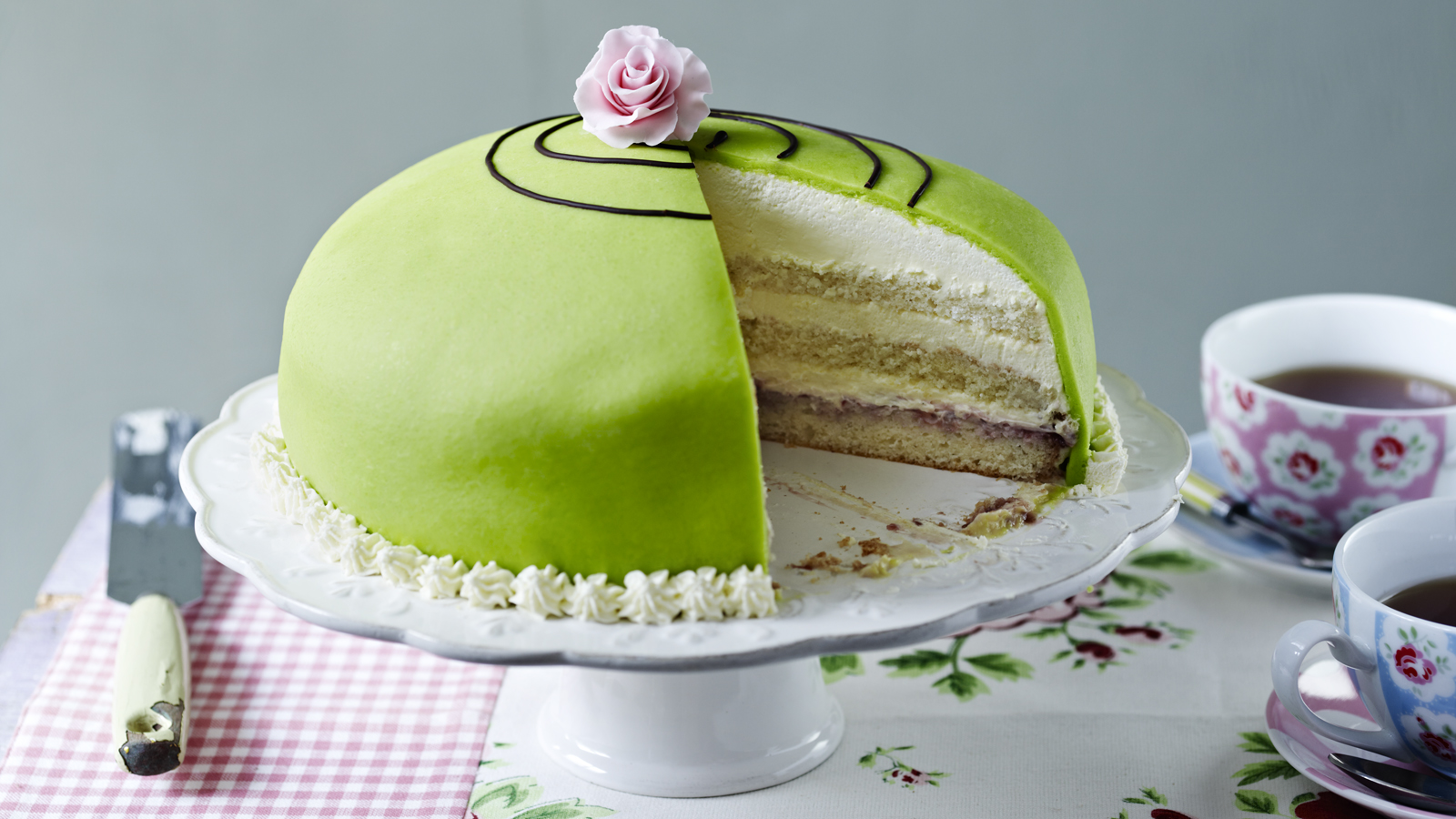
      
This is a Swedish Prinsesstårta, which is what Author Sten referred to in the original Swedish text.
We see that a lot on the South Shore of Long Island. It's the arrivistes buying old cottages and slapping down out-of-proportion McMansions onto their zero-lot-line dreams of seaside living. Drearily familiar to anyone living by a water feature. Thomas doesn't like the house and really doesn't like the man in it...there is something *wrong* with a person who moves to a strong, distinctive community like Sandhamn and flouts every tradition and norm that makes the place itself!

But then there's Nora, whose roots on Sandhamn go way back before even Thomas' do. She doesn't like this new reality at all, and doesn't like the cultural shift it represents. She feels it as an affront to her core principles, as we're told directly:
It gave Nora the unpleasant feeling that everything was for sale. Everything could be bought or sold.
Sandhamn is more than a place to Nora, it's a life and a lifestyle she feels is hers down to her very core. These values agree with mine. I approve of them and wish there were more Noras in the world.

So what the hell drew her to the insensitive clod of a scion of the booboisie that she married?!
Henrik just didn’t get it. He was blind and deaf to any hint that his mother might not be the best mother-in-law in the world. Nora gave in.

Now she had been offered her dream job, and he didn’t even seem to want to discuss it. It wasn’t fair.

Why challenge Henrik, instead of paying attention to the clear signals he had given her?
I found this infuriating. Which is it, Author Sten, Nora's a modern woman or a housewife? She started their marriage with compromises on where they'd live, what he'd be expected to do as a parent, and somehow thought he'd magically divine that she was seriously convinced he'd do the same for her?! Why?! How?! Begin as you mean to go on, Nora. Was it Mary Poppins who said that first, or just most famously? Anyway, there was absolutely no reason to think Henrik would ever be anything but his parents' son, since he never made a single solitary peep of dissatisfaction with them and the way they live(d) their lives. Oh! Oh! And then there's her best friend, Thomas, whose reaction to Henrik should've made Nora run screaming:
There was an underlying distance between the two men that never quite disappeared in spite of the fact that they had known each other for a long time. Henrik’s upper-middle-class background and deeply conservative values didn’t exactly improve matters.
There's no way in hell that didn't show in Thomas' responses to Henrik over the years. So lay off the shockhorror about the way the reactionary poltroon responds to your desire to do something for yourself, lady, he's never been different and expecting him to change will only make both of you and your kids angry and upset and end up in divorce. Skip the middle bit: Get the divorce, start the new life, and make sure the kids know *why* mommy left daddy without rancorous vituperative invective flowing from you. Him, you can't affect. As should be obvious to you by now.

The two sleuths are close friends and each has made a hash of their personal life. This isn't familiar at all, is it. But it's an evergreen for a reason, since it gives the author a great line of attack to keep series readers reading. Nora's marriage is doomed, Thomas' relationship with Carina is doomed, the whole island of Sandhamn...faithless to the crime statistics for Nordic countries...will soon be hip deep in dead bodies, much more will be made of Nora's diabetes (which figures in the action but not the resolution of this book), and if there is a just and merciful gawd Nora's mother-in-law will be savagely torn to bits by ravening wild dogs on live television.

Translator Delargy, based in the UK, uses some tricks to keep the prose feeling uniquely Sten's own. One is the use of a nonstandard form of the verb "to get hold (of)", viz. "ahold." In spoken words I'm not averse to this formulation of the verb, but it abounds in this book and I found it irksome after the sixth or seventh usage. It's purely a personal twitch, no knock on the skills Delargy brought to bear on the Englishing of the book. I am on record many places as despising the unnecessary and ungainly "u"ification of perfectly simple words like "valor" and "honor" so I needn't go into why that made me flinch every time I ran across it. Delargy does a creditable job making Sten's words readable in English, and that's no mean feat, so kudos to you Madam.

The world has lots and lots of gritty Scandicrime. You can hardly open your Kindle without being offered some more gritty Scandicrime. What the world doesn't have is cozy Scandicrime. Sten's involving debut novel is both pine-scented Scandi and cozy, sense-of-place crime. I like that about it and it's what will cause me to seek out the next book in the series.

So switch your mental gears to Swedish cozy. Step out of the Vauxhall and into the Volvo station wagon. ++++++++++++++++++++++++++++++++++++++++++++++++++++++++++++++++
REVIEW OF BOOKS 3 & 4 HERE
REVIEW OF BOOKS 5 & 6 HERE
REVIEW OF BOOKS 7 & 8 HERE
++++++++++++++++++++++++++++++++++++++++++++++++++++++++++++++++

CLOSED CIRCLES (Sandhamn Murders #2)
VIVECA STEN (tr. Marlaine Delargy)
AmazonCrosing
$2.49 Kindle edition, available now

Rating: 3.5* of five

The Publisher Says: It’s a beautiful day for a regatta—until one of Sandhamn Island’s most prestigious residents is killed aboard his sailing yacht.

Oscar Juliander was a rich lawyer and deputy chairman of the prestigious Royal Swedish Yacht Club. While at first his death seems like a tragic accident, there is evidence of foul play. Police detective Thomas Andreasson teams up with local lawyer Nora Linde to investigate. As they work to uncover clues, they face resistance from an elite world where nothing but appearance matters.

When the rich and powerful inhabitants of Sweden’s idyllic island getaway come under scrutiny, Thomas and Nora must work closely and secretively to seek justice.

I CHECKED THIS BOOK OUT FROM THE PRIME LENDING SERVICE. USE THEM OFTEN, THEY PAY AUTHORS FOR OUR USE.

My Review
: Ya know what's frustrating? Like lips moving from Heaven to flapping at you frustrating? NOT BEING ABLE TO TELL YOU WHY THIS ISN'T A 4-STAR REVIEW. Because major, major spoilers would be required for me to do that. And y'all're some seriously spoilerphobic readers.

So I'm left in a bad position...I can't get into much detail...but I can, and herewith will, offer some thoughts.

Minor irks: Carina and Thomas, as a couple, are brought up and dropped in the space of a few sentences. I'd like more of that please. The partial resolution of Nora's marital woes is a good start, but this entry has next to no Nora-and-Thomas time and I missed it. The Eva subplot's resolution doesn't seem finished, somehow. It seems unlikely to be complete as it stands and it itches for that reason.

What keeps me coming back is also what makes me a little impatient. Something about these books and their lutefisk-and-cardamom atmosphere makes me crave a jalapeño cheeseburger. I guess that's an index of how very Swedish they are. And how cozy are they? So cozy I want to cruise the piers (I'd have to learn to time-travel back to 1980s Manhattan, but that's just an added bonus) to recover from the wholesome.

That's a Scandicozy strength, like a nicer-neighborhood version of the immersiveness of Nordic Noir. Wholesome isn't bleached into blankness; it's the juxtaposition of Nora's and Thomas's friendship to their deeply unhappy marriages (over, in Thomas's case; needs to be over in Nora's). Thomas's police career is spent with a partner we don't see all that much of in this book; but she's got enough screen time to get her name in the credits, so to speak.

The mystery here is one that I found myself nodding along to, by which I mean the dead'un just needed killin' as we say in the US South. What Thomas, in his official capacity, has to do with the case is pretty peripheral. Mostly we're among Nora's husband-the-doctor's scummy social set of unpleasant, entitled (in the US sense, not as in "having titles") friends. Why she stays with this creep...well, kids. Plus stubborn, maybe, unwilling to admit to herself she's made an awful mistake. But it's the spoiler subject that annoys me the most. Once this happens, call it a day. And yes, it's about Nora.

There's a Swedish-language TV show that does away with some of the canon here, but is visually stunning. It's available to US audiences via the MHz Network.

Thursday, July 10, 2014

Tenth BOOK-A-DAY prompt..PICNICS?! Uh oh


THE FLY TRAP: A Book About Summer, Islands and the Freedom of Limits
FREDRIK SJÖBERG

Particular Books (non-affiliate Amazon link)
Out of print; various prices

Rating: 4* of five

The Publisher Says: Warm, funny and insightful, The Fly Trap is a meditation on collecting; be it hoverflies or fine art. A fascinating web of associations, it begins with Sjöberg’s own tranquil experience as an entomologist on a remote island in Sweden, and takes in heroic historical expeditions to Burma and the wilderness of Kamchatka. Along the way, Sjoberg pauses to reflect on a range of ideas – slowness, art, freedom, – drawing other great writers, like D.H Lawrence and Bruce Chatwin, into dialogue. From the everyday to the exotic, The Fly Trap revels in the wonder of the natural world and leaves a trail of memorable images and stories.

My Review: The Doubleday UK meme, a book a day for July 2014, is the goad I'm using to get through my snit-based unwritten reviews. Today's prompt, tenth in the series, is to choose a book with a memorable picnic in honor of some ridiculous teddy bear thing.

Now seriously. Anyone who's known me ten minutes can be excused from the room for a laugh break. A picnic! The clambake on the beach in Professor Diggins' Dragons, a chapter book I read in 1967 or so, then the famous allusion to a picnic in Lolita...was there some talk of a picnic in a Hardy Boys or Nancy Drew book? Can't remember...anyway, I am not the sort of hairpin of a guy who reads books with picnics in. And I need to keep the pace going with this meme! What to do, what to do....

Then it hit me: Picnics are outdoors customarily, aren't they, so a book about the outdoors will work! And I just read a doozy: The Fly Trap, a Swedish weirdo's reminiscences (some would say maunderings) of his life in the cutthroat world of hoverfly expertise.

Since I had no idea what the hell a hoverfly was, I wiki'd it up and spent a good half-hour marveling at gems like, "About 6,000 species in 200 genera have been described." Described! Dear and glorious physician, someone down through the ages has always not had a life, of course, but the amount of wasted drinking, reading, and screwing time that describing "about 6,000 species in 200 genera" represents just boggles my mind.

And this guy's a nice-enough looking man, he doesn't appear to have any cognitive defects, and he's Swedish, so getting dates can't have presented that much of a problem for him that he had to give up and start collecting flies. He explains why he chose to write his memoir, and a bit of why he's in the fly game at all:
The hoverflies are only props. No, not only, but to some extent. Here and there, my story is about something else. Some days I tell myself that my mission is to say something about the art and sometimes the bliss of limitation. And the legibility of landscape. Other days are more dismal. As if I were standing on queue in the rain outside confessional literature’s nudist colony, mirrors everywhere, blue with cold.
So I get it, Mr. Man, you're not Eric Northman and you'd like folks to pay you some attention. Check! Do it in art. Write lovely sentences, people will pay attention to you. Chalk up a win for the fly guy!

And then there's the stuff he finds out as fly-hunting takes over his world. There was, apparently, a Swedish guy named René Malaise (!) whose wildlife-hunting expeditions to places like Kamchatka, on the Pacific fringe of Russia, led to his invention of the Malaise Fly Trap. (This is not a goof, I looked it up.) A piece of this book reads like a failed start on a biography of Malaise (what a horrible name! "Reborn Misery" yuck), which was really very intriguing. Emulating this monadnock of the fly-guy world, Our Hero takes off and travels around the world to see what he can see. The important part of his bring-back was this:
When the days are numbered, everything seems clearer, as if the time between preparation and departure possessed a particular magic. The endless stretch of time on the other side always struck me as evasive and treacherous. But the very limited period between now and then held a liberating peace and quiet. This allotment of time was an island. And the island became, later, a measurable moment. For a long time, this discovery was the only truly unclouded dividend that I took from my travels.
I think I was the only person in the USA who watched the film The Adventures of Buckaroo Banzai, but I did and I loved more than anything the line Peter Weller speaks as Buckaroo: "No matter where you go, there you are." Sjöberg clearly gets that, and decides to come home to the place where everybody speaks his language. No more wandering for him...he'll settle down in Sweden, near Stockholm, on an island!

Now there is very little in this world that is better at focusing one's attention on the practical realities of life than living on an island. I live on a really big one, but part of living here is knowing how and when to get off the island. And if one can't, what are the options? I meditate on these matters, always coming back to the realization that island = Atlantic Ocean, and that's a BIG piece of water, and there are storms out there pretty much all the time...
It’s said to be the same all over the world, in all seven seas. Islands are matriarchies of a kind seldom seen on land. The men – as Iceland’s president Vigdís Finnbogadóttir remarked on one occasion when the subject arose – the men flee to their own preferred landscape, which is the sea.
Interesting. I'd never really noticed before that all the world over the word for "person who goes out into the water and brings back fish" is male in gendered languages, and not even the most ardent gender-equality advocate has yet proposed an alternative to "fisherman." There appears to be no need for it.

So what does this have to do with flies? Got me. But it's in Sjöberg's book, like so much else that isn't instantly obviously contained within the title The Fly Trap. And that's why I enjoyed the book so much. I dislike summer because summer, and I am not a huge fan of outdoorsy life because mosquitoes, but I am always up for a stroll with an interesting companion whose passion and joy is shared eloquently and elegantly with me, allowing me to make a mental shift in my own ever-narrowing scope of activity. Tomas Tranströmer, Nobel Laureate poet, blurbed this book in large part (I believe) because of moments, lovely limerant moments like this one:
Every summer there are a number of nights, not many, but a number, when everything is perfect. The light, the warmth, the smells, the mist, the birdsong – the moths. Who can sleep? Who wants to?

Creative Commons License
This work is licensed under a Creative Commons Attribution-NonCommercial-ShareAlike 3.0 Unported License.