Showing posts with label 1960s technology. Show all posts

Sunday, December 7, 2025

THE COMPLETE BOOK OF SPACECRAFT: Rockets, Shuttles, Satellites, and Space Stations, tech history


THE COMPLETE BOOK OF SPACECRAFT: Rockets, Shuttles, Satellites, and Space Stations
MICHAEL H. GORN
(Text & Illus. Giuseppe De Chiara, tr. Davide Sivolella)
Motorbooks International (non-affiliate Bookshop.org link)
$40.00 all editions, available noe

Rating: 5* of five

The Publisher Says: Marvel at the history of space exploration through its daring vehicles, exhaustively chronicled in this authoritative volume featuring more than 250 artworks.

In 1957, the world looked on with both uncertainty and amazement as the Soviet Union launched Sputnik 1, the first man-made orbiter. Sputnik 1 would spend three months circling Earth every 98 minutes and cover 71 million miles in the process. The world's space programs have traveled far (literally and figuratively) since then, and the spacecraft they have developed and deployed represent almost unthinkable advances for such a relatively short period.

In Spacecraft, illustrator and aerospace professional Giuseppe De Chiara teams up with aerospace historian Michael Gorn to present a huge, profusely illustrated aerospace history profiling and depicting spacecraft from Sputnik 1 through the International Space Station and everything in between, including concepts that have yet to actually venture outside the Earth's atmosphere.

This updated and revised edition includes:
  • Expertly written profiles depicting and describing the design, development, and deployment of manned and unmanned spacecraft from around the world, including satellites, capsules, spaceplanes, rockets, and space stations—now updated with the latest models
  • Vivid scale illustrations of the many international spacecraft in multiple-view, sometimes cross-section, and in many cases shown in archival period photography to provide further historical context
  • Earthbound and spaceborne data and intel chronicling every technological leap, engineering challenge, and monumental achievement, from troubleshooting the lunar landers of the '60s to engineering solar-driven sails to propel futuristic craft to Mars and beyond
  • A look ahead to an era of privatized space travel and even plans for lunar and Martian space stations and settlement
  • Dividing the book by era, De Chiara and Gorn feature spacecraft not only from the United States and Soviet Union/Russia, but also from the European Space Agency and China. The mind-blowing machines examined in this volume include the rockets Energia, Falcon 9, and VEGA; the Hubble Space Telescope; the Cassini space probe; and the Mars rovers, Opportunity, and Curiosity. For anyone who has marveled at humankind's attempts and advances in leaving Earth, Spacecraft: The Complete Guide to the Rockets, Satellites, Capsules, Shuttles, and Stations That Put Us in Space is the definitive reference.

    I RECEIVED A DRC FROM THE PUBLISHER VIA EDELWEISS+. THANK YOU.

    My Review
    : It's amazing to me the Moon landing was 56 years ago. It's amazing to me the Space Shuttle, that miracle of my teens, hasn't flown in over ten years. Technology becomes history, too.
    it all feels like yesterday

    The author and author/illustrator get really into details, the illustrations are so detailed as well that they'd have been classified back in the day. The point of a book like this is its blend of fascinating explanation and really cool images, complemented by concept-explaining illustrations:
    the poles of the idea

    I'm fascinated by space exploration. I grew up with Walter Cronkite explaining how Gemini and Apollo worked, celebrating the advances in technology each launch represented, mourning the loss we suffered through in 1967.

    No progress can ever be made without losses, important ones, but the lessons those losses teach can carry through the decades. What else matters in this world but learning to do better, to be better, to expand our enormous reach safely and positively?
    the poles of the Space Race: US vs USSR

    Many hours of pleasure in this gift book for the recipient who loves rockets, space flight, engineering, all the modern miracles humans have created to expand our understanding of the universe.

    You'll know which eager-eyed soul needs to see this on present-opening day. Indulgent it is, pricey, beautiful, and a luxury...but that's the best gift described, no?

    Monday, October 5, 2020

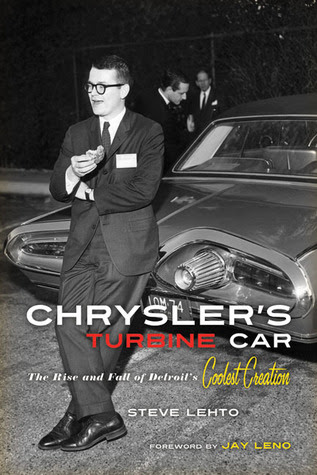
    CHRYSLER'S TURBINE CAR, a history of squandered opportunities to reduce carbon emissions

    CHRYSLER'S TURBINE CAR: The Rise and Fall of Detroit's Coolest Creation 
    STEVE LEHTO 
    $9.99 ebook editions, available now 

     Rating: 3.5* of five 

      The Publisher Says: The fascinating story of an almost-forgotten automotive phenomenon 

     In 1964, Chrysler gave the world a glimpse of the future. They built a fleet of turbine cars—automobiles with jet engines—and loaned them out to members of the public. 

    The fleet logged over a million miles; the exercise was a raging success. These turbine engines would run on any flammable liquid—tequila, heating oil, Chanel #5, diesel, alcohol, kerosene. If the cars had been mass produced, we might have cars today that do not require petroleum-derived fuels. The engine was also much simpler than the piston engine—it contained one-fifth the number of moving parts and required much less maintenance. The cars had no radiators or fan belts and never needed oil changes. 

     Yet Chrysler crushed and burned most of the cars two years later; the jet car's brief glory was over. Where did it all go wrong? Controversy still follows the program, and questions about how and why it was killed have never been satisfactorily answered. 

     Steve Lehto has interviewed all the surviving members of the turbine car program--from the metallurgist who created the exotic metals for the interior of the engine to the test driver who drove it at Chrysler’s proving grounds for days on end. Lehto takes these first-hand accounts and weaves them into a great story about the coolest car Detroit ever produced. 

    I BORROWED THIS BOOK FROM MY LOCAL LIBRARY. SUPPORT YOUR LIBRARY, FOLKS! 

     My Review: A short, concise history of the very thing the title declares: The coolest creation ever to come out of Detroit!
    Oh wow! Oh cool! Oh my GOD why didn't they make this?!
    Well, after reading this book, I know why: It was too far ahead of its time, and when its time came, the company was on the ropes. 

    The author spoke to everyone he could find still living who participated in the most amazing PR campaign of all time: Chrysler made 50 of these babies and, over the course of 1964-1966, lent them out to 203 drivers for 90 days apiece. The 50 cars racked up over 1 million miles of travel, and had less than 1% downtime in all of that driving. Reliability was clearly not a huge issue. But what *was* a huge issue was the way the turbines needed to be manufactured, basically each one by hand. There was, in that pre-computer-control era, no way to automate the process of making the engine parts. 

    But then the what-if machine kicks in: The cars didn't need to use gasoline, or even petroleum products...they ran one car on tequila, and another on peanut oil. Had manufacture gone ahead, perhaps advances in technology would've speeded up computer-aided design and production. This kind of technology could've reduced carbon emissions....

    Imagine a world where the car smells like a deep fryer and sounds like a jet, leaving water as its exhaust. Lost chances. The very source of all good fiction. *turns on private bubble machine*