Showing posts with label Mary Robinette Kowal. Show all posts

Saturday, March 29, 2025

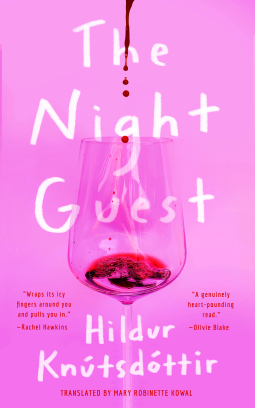
THE NIGHT GUEST, deeply unnerving psychological domestic horror novella centers misogyny


THE NIGHT GUEST
HILDUR KNÚTADÓTTIR
(tr. Mary Robinette Kowal)
Tor Nightfire (non-affiliate Amazon link)
$11.99 ebook, available now

Rating: 3.5* of five

The Publisher Says: Hildur Knutsdottir's The Night Guest is an eerie and ensnaring story set in contemporary Reykjavík that’s sure to keep you awake at night.

Iðunn is in yet another doctor's office. She knows her constant fatigue is a sign that something's not right, but practitioners dismiss her symptoms and blood tests haven't revealed any cause.

When she talks to friends and family about it, the refrain is the same ― have you tried eating better? exercising more? establishing a nighttime routine? She tries to follow their advice, buying everything from vitamins to sleeping pills to a step-counting watch. Nothing helps.

Until one night Iðunn falls asleep with the watch on, and wakes up to find she’s walked over 40,000 steps in the night . . .

What is happening when she’s asleep? Why is she waking up with increasingly disturbing injuries? And why won’t anyone believe her?

I RECEIVED A DRC FROM THE PUBLISHER VIA NETGALLEY. THANK YOU.

My Review
: I'm always down for a psychological horror read. This one has a strong message about misogyny at its core. I think that is what powered me past my disappointing reading experience.

Iðunn's world is a very familiar, quotidian one of tedious work, unfulfilling relationships, and family pressures that might or might not be external. Like so many, maybe every, female of my acquaintance, she's a poor sleeper. This has multiple negative effects on a person's life. Iðunn tries to make changes in her sleeping deficits with a fancy new kind of wearable multiple-axes tracking device.

The promised data on her sleeping patterns tells a story that does not make sleep come any easier. If anything the data scares her more; and the device itself seems to be making her life, not only her sleep deficit, much worse.

Iðunn's sense of crushing responsibility for every single thing in her life is not unfamiliar to me. It's just not something I think is always an external pressure as Iðunn thinks it is. No matter; her responses to the world are the story, so putting aside my sense of her emotional immaturity, I travel down the unhappy trail with her. Why is she, for want of another term, sleepwalking? Why does her body acquire wounds during her unconsciousness? If it isn't sleep, what is this state and why is it part of her nightly experience that is unavailable to her daylight mind?

I was ready to quit the read when animal harm entered the chat. I was perfectly happy to follow the deteriorating sense of control over her body and mind; it seems to me to be an excellent metaphor for being a woman in a misogyny-drenched world. I'm very much not down with harming creatures that can not adequately defend themselves, when it's done for cruelty's sake most especially. In this case it did nit feel to me to be more than an intensifying trope; it did not come from something within Iðunn that was just bursting out of her in a horrible way...see The Wasp Factory for an example of what I mean by that.

I decided to trust the eminent Mary Robinette Kowal, a personal favorite creative talent, whose translation of the text felt very smooth and organic and unlike I was reading a story at an extra remove. That often happens to me, even in excellent translations. This story isn't ever going to be a five-star read to me, thought I, but it's way better than average.

Then...the ending.

Three and a half stars. No more, no less.

Saturday, August 6, 2016

THE LADY ASTRONAUT OF MARS, Mary Robinette Kowal's Hugo-winning novelette


THE LADY ASTRONAUT OF MARS
MARY ROBINETTE KOWAL

Tor.com
Free online read, or 99¢ on Kindle

Rating: 4* of five

The Publisher Says: Thirty years ago, Elma York led the expedition that paved the way to life on Mars. For years she's been longing to go back up there, to once more explore the stars. But there are few opportunities for an aging astronaut, even the famous Lady Astronaut of Mars. When her chance finally comes, it may be too late. Elma must decide whether to stay with her sickening husband in what will surely be the final years of his life, or to have her final adventure and plunge deeper into the well of space.

My Review: No wonder this story won the 2014 Hugo Award for Best Novelette. Kowal, comme d'habitude, presents her Lady Astronaut with a life-choice that will reverberate down the ages no matter how she decides it; and makes it clear that this is not the first time Elma has faced such life-choices, but is at last old enough to really *get* what she's deciding.

It's a theme in my reading here lately. This is the same vein worked by Blake Crouch in his exciting and engrossing novel DARK MATTER. It's an evergreen in all manner of fiction from Jack Finney's romantic obsession novel TIME AFTER TIME to the entire genre of alternate (sic) history worked famously by Harry Turtledove and Eric Flint. It speaks to something deep inside us, a common core of regrets seething or simmering in each human breast. It's impossible to exist in the material world without creating this core, and I'm beginning to think that it's the source of our human condition: malaise, misery, morbidity. We're all weighed down to one life of the infinity of possibilities by the gravity of our regrets.

Elma and Nathaniel have lived a happy life. They're married many years, they're still in love with each other, but they're childless and they're aging (she more gracefully than he) on Mars. Their work in the space program, here turbocharged by a celestial accident much discussed in modern space science: asteroid impact, made the Martian colony possible when politics made it imperative.

As she levels up in her life experience, Elma isn't clear on the correctness of her decisions already made which gives her pause in facing this latest one. Her husband's life is ending, both inevitably and painfully. Her misery is deftly portrayed, without melodrama or self-pity. When her life-changing decision arrives, she's sure of her course. Nathaniel, however, has other ideas. He does, out of love, a self-sacrificing thing to enable his beloved Elma to do the only job she's ever had, the only one she loves. The no-correct-way ending feels so deeply true and right that it brought me to tears. I identify with Nathaniel and Elma, probably because I'm about Elma's age, and because my life circumstances are, like theirs, constrained by decisions made long ago.

Like them, I don't regret my decisions so much as question them. Stories like this enable me to go through my own life's process again. So far, I don't regret much that I did and didn't decide to do; but the ones I regret, I regret completely, forcefully. Which tells me that I did life right: I'm still not obsessed with trivialities!