Showing posts with label CW:incest. Show all posts

Thursday, April 3, 2025

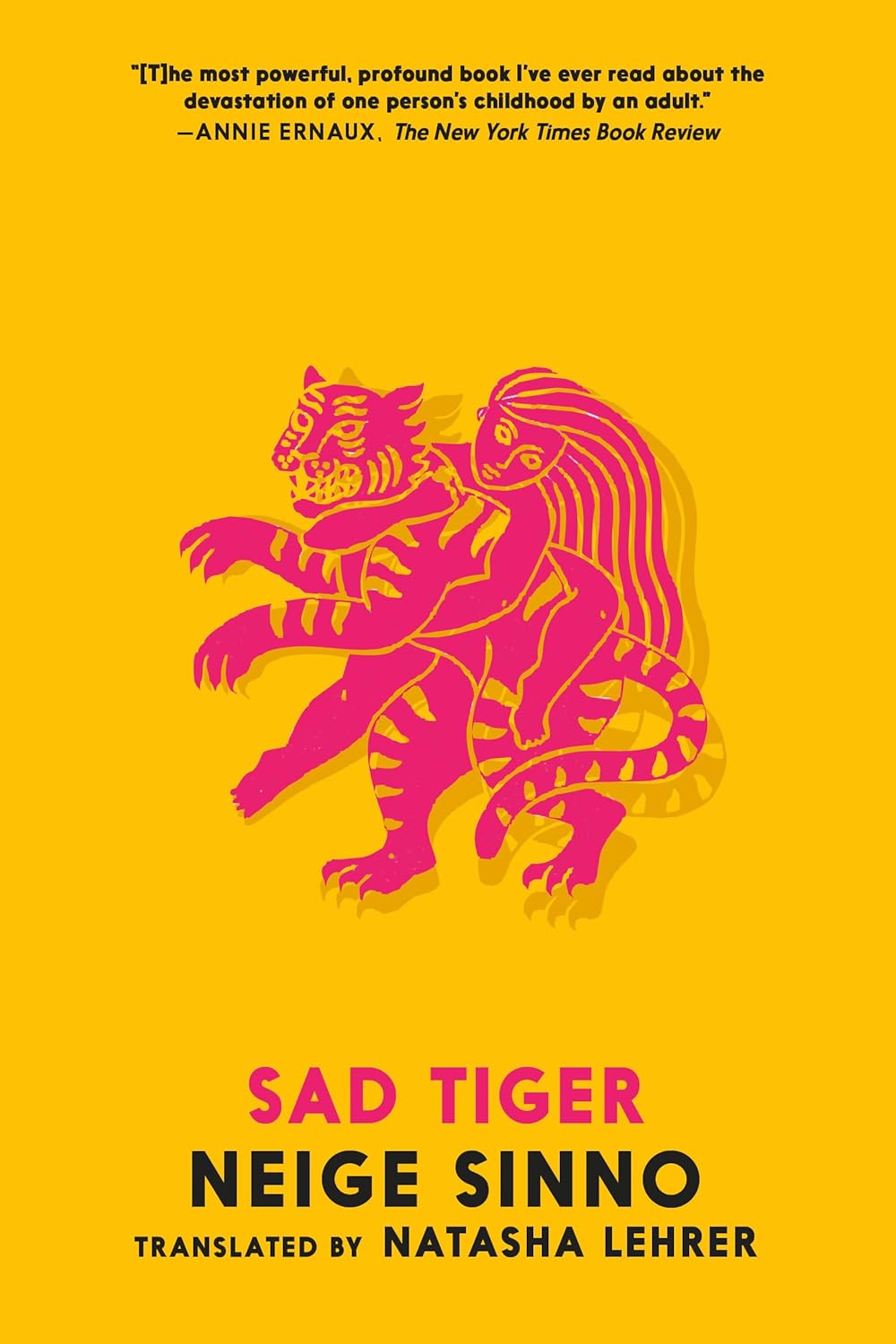
SAD TIGER, French-Mexican author NEIGE SINNO begins a society-wide conversation


SAD TIGER
NEIGE SINNO
(tr. Natasha Lehrer)
Seven Stories Press (non-affiliate Amazon link)
$12.99 ebook, available now

One of Lit Hub’s 43 Favorite Books of 2025!

2025 National Book Critics Circle Award WINNER of the BARRIOS BOOK IN TRANSLATION PRIZE!

Rating: ???

Read this fascinating interview with Author Sinno!

The Publisher Says: Winner of multiple prizes, Neige Sinno has created a powerful literary form with Sad Tiger, a book that took France by storm and is an international phenomenon.

Sad Tiger is built on the facts of a series of devastating events. Neige Sinno was seven years old when her stepfather started sexually abusing her. At 19, she decided to break the silence that is so common in all cultures around sexual violence. This led to a public trial and prison for her stepfather and Sinno started a new life in Mexico.

Through the construction of a fragmented narrative, Sinno explores the different facets of memory—her own, her mother’s, as well as her abusive stepfather’s; and of abuse itself in all its monstrosity and banality. Her account is woven together with a close reading of literary works by Vladimir Nabokov, Virginia Woolf, Toni Morrison, Christine Angot, and Virginie Despentes among others.

Sad Tiger—the title inspired by William Blake’s poem “The Tyger”—is a literary exploration into how to speak about the unspeakable. In this extraordinary book there is an abiding concern: how to protect others from what the author herself endured? In the midst of so much darkness, an answer reads crystal clear: by speaking up and asking questions. A striking, shocking, and necessary masterpiece.

I RECEIVED A DRC FROM THE PUBLISHER VIA EDELWEISS+. THANK YOU.

My Review
: Reading this story was hellish. Like Sinno, I was sexually abused and gaslighted...by my mother. Her actions to isolate me, to define reality and acceptability and maintain her power over me were appalling. Adult me, in his sixties, has never had a moment of life without this disgusting stain leaching through every act, thought, relationship; it is impossible to describe the utter life-changing (blighting, really) miasma the incest survivor exists under. Again like Sinno, I started a new life far away...in New York, not *quite* as far as Mexico is from France.

Like Sinno, I experienced the isolation of the victim in the cage of silence...doubled by the fact that I'm male, and my abuser female. In an incest-survivors' group I sought out (at my stepmother's urging, she knew the signs from experience) in 1980s New York City, the women who greeted me with great hostility for simply being male also accused me of lying..."no woman would do that!"...so more years were lost to silent rage and pain.

I think it's very telling that #MeToo never included incest survivors in its public faces. Sinno relates the probable reasons in a section she calls "Reasons for not wanting to write this book," all of which made me nod along.

Like Sinno, people I told about my mother's rape of me were appalled...and immediately wondered what made my mother do this awful thing (her father did it to her, her older brother told me). No one ever seemed to think much about how I was handling my emotional responses. I learned, not for the first time, that women do not want to talk about feelings and emotions OF men, only about theirs AT men. Listen to me complain but don't say a word about yourself, you self-centered abuser. This is a paraphrase, but it is a valid one.

Decades of therapy later, I view everything connected to incest very differently than I did while women were emotionally abusing or simply ignoring my scarred, scared trauma survivorhood. It became second nature to deflect or avoid emotional contact with any others, especially women. Friends kept at a distance, lovers reduced to objects...all of this is part of my incest survival strategy. Sinno and her book could, if the culture allows it and if those of us who know the costs of silence speak in support of it, make a substantive change for the better in later survivors' experiences.

This is me speaking in support of this necessary, awful read. Most especially for those who say "it's horrifying, I can't read that" to themselves or out loud.

Your failure of empathy speaks louder than any words.

Friday, August 23, 2024

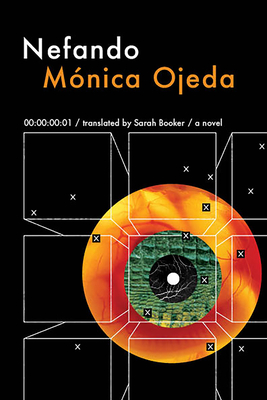
NEFANDO, if you have a trigger, do not read this book


NEFANDO
MÓNICA OJEDA
(tr. Sarah Booker)
Coffee House Press
$17.95 trade paper, available now

Rating: 4* of five

The Publisher Says: A techno-horror portrait of the fears and desires of six young artists whose lives are upended by a controversial video game, from National Book Award finalist Mónica Ojeda.

Six young artists share an apartment in Kiki Ortega, a researcher writing a pornographic novel; Iván Herrera, a writer whose prose reveals a deeply conflicted relationship with his body; three siblings, Irene, Emilio, and Cecilia, who quietly search for ways to transcend their abuse as children; and El Cuco Martínez, a video-game designer whose creations push beneath the substrate of the digital world. All of them are connected in different ways to Nefando, a controversial cult video game whose purpose remains a mystery.

In the parallel reality of the game, players found relief from the pain of past trauma and present shame, but also a frighteningly elastic sense of self and ethics. Is Nefando a game for horror enthusiasts, a challenge to players' morals, or a poetic exercise? What happens in a virtual world that admits every taboo?

Unsparing, addictive, and perverse, Nefando takes us to the darkest corners of the web, revealing the inevitable entanglement of digital and physical worlds, and of technology and horror.

I RECEIVED A DRC FROM THE PUBLISHER VIA EDELWEISS+. THANK YOU.

My Review
: If you have a trigger, do not read this book.

I can't recommend this read to you. I can tell you it challenged my every shibboleth, saying out loud things I'm reluctant to confront, because that means acknowledging them. Unlike Jawbone, this book doesn't burst onto the scene pointing Horror's attention onto girls and women as perpetrators and planners of Evil for the first time...well, not literally THE FIRST time but definitely early on...but treads that path with zeal and a ghoulish delight.

I'm always impressed when a writer can genuinely shock me. I was routinely shocked by the game Nefando, genuinely repulsed and affronted by things within it. As the sales copy above says, this is an unsparing story, deeply deeply perverse, and discomfitingly addictive. I didn't much want to keep reading. I had to. I was not going to be able to keep these images from ruining my sleep until I gave the story closure. The last time I felt this way about a psychological horror story was the Japanese version of Ring, which...well, no, not going into it except to say this story has similarly deeply embedded awful triggers for me.

If I felt any kind of way about the translation, it was deeply impressed. Translator Booker made this nightmarish trip down...all the way down...into the pit an utterly unmissable trip. That takes mad skills. She has those, and clearly also has a deep affinity for psychological horror, the kind that blends pervasive unease with jump scares. If there is ever a horror translators' award, it should be called "The Sarah Booker Slap."

Author Ojeda...I hope this paper exorcism of your personal demons did you all the good in the world. It's set my therapy sessions back at least five years.

*shudder*

Wednesday, May 15, 2024

MY DARLING DREADFUL THING, sapphic Dutch Gothic horror...my first such...please not last, though


MY DARLING DREADFUL THING
JOHANNA van VEEN

Poisoned Pen Press
$17.99 trade paperback, available now

Rating: 4* of five

The Publisher Says: In a world where the dead can wake and walk among us, what is truly real?

Roos Beckman has a spirit companion only she can see. Ruth—strange, corpse-like, and dead for centuries—is the only good thing in Roos’ life, which is filled with sordid backroom séances organized by her mother. That is, until wealthy young widow Agnes Knoop attends one of these séances and asks Roos to come live with her at the crumbling estate she inherited upon the death of her husband. The manor is unsettling, but the attraction between Roos and Agnes is palpable. So how does someone end up dead?

Roos is caught red-handed, but she claims a spirit is the culprit. Doctor Montague, a psychologist tasked with finding out whether Roos can be considered mentally fit to stand trial, suspects she’s created an elaborate fantasy to protect her from what really happened. But Roos knows spirits are real; she's loved one of them. She'll have to prove her innocence and her sanity, or lose everything.

I RECEIVED A DRC FROM THE PUBLISHER VIA NETGALLEY. THANK YOU.

My Review
: Satisfying sapphic romantic story of a woman who uses legit psychic powers in service of a horrible, harridanly charlatan. Or the story of an impressionable mentally ill young woman in thrall to a horrible, harridanly charlatan who grabs hold of sapphic love to effect her escape from abuse.

Either one fits. Both take us down the very dark, quite chilling paths that Author Johanna ushers the reader down. Roos, our PoV, has never experienced a normal life. It's the second culturally Dutch novel I've read this month that paints a very bleak picture of Dutch life after WWII, though I suppose that isn't exactly a shock is it. What does surprise me is the deeply homophopbic atmosphere Author Johanna portrays...I suppose the patriarchal horror of the world she's limned before our utterly appalled eyes is a big part of that, as the homophobia in question is directed at sapphic lovers.

If I'm to offer you one inducement to exceed all the others to get this book into y'all's hands, I'm going with: Dutch Author Johanna wrote this book in English, about lesbian survivors of a horrifying war in the Netherlands, because she's Dutch, because she's lesbian, and because she's clearly not quite right. How many people can accrete so many out-of-mainstream identities, write a story directly centered in them all, and get it published in the insular US market? And then, topping the high-calorie literary sundae with its obligatory gorgeously red cherry, create the undead/zombie character that twangs your readerly heartstrings with her fullness and pathos? Sweet, dead Ruth...my favorite zombie!

There are no others, just this one.

You can read, and there's a synopsis above this, so you know what's going on. I'm here to tell you if I think Author Johanna did the job of convincing me to invest in her world: Yes. Did she make me think long and hard about how the transactional world cheapens, while defining, human relationships: Better than the Southern Gothics. Roos is a classic Tennessee Williams character, a Blanche Dubois plus agency, with the psychic fragility and serious Love problems; Ruth puts me in mind of a gender-flipped Darl Bundren, articulate, doomed. Did her writing cause me to sit quiet for long moments, committing parts to memory: once, which is once more than most books I read. (It's a spoiler, so I daren't share; the Spoiler Stasi are ever vigilant and quick with their truncheons.)

The unique quality I literally never expect from horror, especially Gothic horror, novels is, here, the pervasive Dutchness of the story. It could not be reset in the US, or England, without losing the special something that kept luring me past my usual guardrails against con-artist faux psychics and fantastical stories of spirit lovers. These are usually the tropes I use as reminders that I have compararively few eyeblinks left and don't want to waste them. Author Johanna, in using postwar, post-Occupation Netherlandish settings, convinced me not to pre-judge these characters. Their long national trauma, their dark personal traumas, their battles faught against real cultural horrors, all formed a gestalt of world and people that convinced me to set my usual intolerance for these ideas aside and consider them as real...to the characters, thus opening the door to my belief as well.

That's a huge achievement for an author I'm unfamiliar with. I'm really pleased to say that I felt the ending was indeed a payoff commensurate with my investment of care and attention.

Brava, Johanna van Veen. Clearly your genesis as the odd-triplet-out was predictive of your sui generis selfhood. I'm eager for more from you.