Showing posts with label romantic gay fiction. Show all posts

Saturday, July 12, 2025

HE'S TO DIE FOR, fun, entertaining gay rom-com/mystery with good opposites attract energy


HE'S TO DIE FOR
ERIN DUNN

Minotaur Books (non-affiliate Bookshop.org link)
$18.00 trade paper, available now

Rating: 4* of five

The Publisher Says: Brooklyn 99 meets The Charm Offensive in this sparkling romantic murder it's murder cute in the first degree when a detective finds himself falling for the lead suspect in a career-making case.

At 29, Detective Rav Trivedi is the youngest member of the NYPD’s homicide squad, and his future looks bright. He may be a bit of an outsider in the department—an ivy-league educated gay Brit with a weakness for designer suits—but his meteoric rise and solve rate prove he belongs.

So when his CO assigns him lead on the high-profile murder of a record executive, Rav is ready for action. He won’t be distracted by TV crews, tabloids, or what’s trending on social media, nor by the ridiculously hot rock star with a clear motive and no alibi.

This is it, his shot, and he is not going to screw it up—certainly not by falling in love with his number one suspect…

I RECEIVED A DRC FROM THE PUBLISHER VIA NETGALLEY. THANK YOU.

My Review
: Told in third person from Rav's PoV, this story of opposites attracting is the exact kind of cuteness booster-shot of a story I've been needing as my world darkens. You'll note the link above to my review of The Charm Offensive, which was a good story well-told, much the way this one is.

What makes it a half-star less of a good read than that one is really simple: Switching the PoV from the anxiety-suffering character to the neurotypical character lessens the impact of anxiety into the (ironically) anxiety-inducing "this is a burden" feeling that all anxiety-suffering people I've ever known dread.

I'll also mention the mystery plot was...underwhelming...though not in any way substandard. Given how much time it took up, it was as thorough as it could be in being a mystery; it's akin to a mystery short story, though, and those are never top of the heap for me. I'll also bring up the low-steam aspect of the romance, to be fully informative. It was fine for me because it was one strand of the story among several.

It sounds as though I didn't like the story, and I promise I did! I loved the way these two really different men learned to talk to, not at or past, each other. I liked the moments of sweet sharing, bringing each other into the other man's thought processes and history. I battened on the sense that they were building something for each other, out of themselves, as a loving demonstration of need. That it was done using both humor and flirtatious silliness was the way it made me invest in it not simply roll my eyes.

It's in that context that Rav and Jack connected most deeply...their struggles to be able/allowed to exercise their strengths to really satisfying degrees. Rav's very pretty, very posh, and very much expected to glide through his job while making the department look good. Doing actual detective work? Not really in the cards. Like Jack, he's supposed to do and keep doing what others want. Unlike Jack, Rav doesn't get panic attacks that are used against him.

All told a really enjoyable summer's afternoon of reading. I hope to see more from Author Dunn, and might even pick up a book two of these men if one appeared.

Wednesday, May 15, 2024

MY DARLING DREADFUL THING, sapphic Dutch Gothic horror...my first such...please not last, though


MY DARLING DREADFUL THING
JOHANNA van VEEN

Poisoned Pen Press
$17.99 trade paperback, available now

Rating: 4* of five

The Publisher Says: In a world where the dead can wake and walk among us, what is truly real?

Roos Beckman has a spirit companion only she can see. Ruth—strange, corpse-like, and dead for centuries—is the only good thing in Roos’ life, which is filled with sordid backroom séances organized by her mother. That is, until wealthy young widow Agnes Knoop attends one of these séances and asks Roos to come live with her at the crumbling estate she inherited upon the death of her husband. The manor is unsettling, but the attraction between Roos and Agnes is palpable. So how does someone end up dead?

Roos is caught red-handed, but she claims a spirit is the culprit. Doctor Montague, a psychologist tasked with finding out whether Roos can be considered mentally fit to stand trial, suspects she’s created an elaborate fantasy to protect her from what really happened. But Roos knows spirits are real; she's loved one of them. She'll have to prove her innocence and her sanity, or lose everything.

I RECEIVED A DRC FROM THE PUBLISHER VIA NETGALLEY. THANK YOU.

My Review
: Satisfying sapphic romantic story of a woman who uses legit psychic powers in service of a horrible, harridanly charlatan. Or the story of an impressionable mentally ill young woman in thrall to a horrible, harridanly charlatan who grabs hold of sapphic love to effect her escape from abuse.

Either one fits. Both take us down the very dark, quite chilling paths that Author Johanna ushers the reader down. Roos, our PoV, has never experienced a normal life. It's the second culturally Dutch novel I've read this month that paints a very bleak picture of Dutch life after WWII, though I suppose that isn't exactly a shock is it. What does surprise me is the deeply homophopbic atmosphere Author Johanna portrays...I suppose the patriarchal horror of the world she's limned before our utterly appalled eyes is a big part of that, as the homophobia in question is directed at sapphic lovers.

If I'm to offer you one inducement to exceed all the others to get this book into y'all's hands, I'm going with: Dutch Author Johanna wrote this book in English, about lesbian survivors of a horrifying war in the Netherlands, because she's Dutch, because she's lesbian, and because she's clearly not quite right. How many people can accrete so many out-of-mainstream identities, write a story directly centered in them all, and get it published in the insular US market? And then, topping the high-calorie literary sundae with its obligatory gorgeously red cherry, create the undead/zombie character that twangs your readerly heartstrings with her fullness and pathos? Sweet, dead Ruth...my favorite zombie!

There are no others, just this one.

You can read, and there's a synopsis above this, so you know what's going on. I'm here to tell you if I think Author Johanna did the job of convincing me to invest in her world: Yes. Did she make me think long and hard about how the transactional world cheapens, while defining, human relationships: Better than the Southern Gothics. Roos is a classic Tennessee Williams character, a Blanche Dubois plus agency, with the psychic fragility and serious Love problems; Ruth puts me in mind of a gender-flipped Darl Bundren, articulate, doomed. Did her writing cause me to sit quiet for long moments, committing parts to memory: once, which is once more than most books I read. (It's a spoiler, so I daren't share; the Spoiler Stasi are ever vigilant and quick with their truncheons.)

The unique quality I literally never expect from horror, especially Gothic horror, novels is, here, the pervasive Dutchness of the story. It could not be reset in the US, or England, without losing the special something that kept luring me past my usual guardrails against con-artist faux psychics and fantastical stories of spirit lovers. These are usually the tropes I use as reminders that I have compararively few eyeblinks left and don't want to waste them. Author Johanna, in using postwar, post-Occupation Netherlandish settings, convinced me not to pre-judge these characters. Their long national trauma, their dark personal traumas, their battles faught against real cultural horrors, all formed a gestalt of world and people that convinced me to set my usual intolerance for these ideas aside and consider them as real...to the characters, thus opening the door to my belief as well.

That's a huge achievement for an author I'm unfamiliar with. I'm really pleased to say that I felt the ending was indeed a payoff commensurate with my investment of care and attention.

Brava, Johanna van Veen. Clearly your genesis as the odd-triplet-out was predictive of your sui generis selfhood. I'm eager for more from you.

Thursday, March 15, 2018

UNNATURAL, fourth in the Enlightenment series of Joanna Chambers' Late-Regency novels


UNNATURAL
JOANNA CHAMBERS
(Enlightenment #4)
Kindle original (non-affiliate Amazon link)
$4.99 available now

Rating: 4.5* of five

The Publisher Says: Captain Iain Sinclair has looks, charm, military honours—even the favour of the king himself. He has everything—everything, that is, except the friendship of the one man whose good opinion he has ever cared for, scientist, James Hart.

James has loved Iain all his life, but after the last disastrous encounter between them, he vowed to accept no more crumbs from Iain’s table. If Iain cannot be the lover James wants, then James will have no more to do with him.

Disenchanted with his career, and miserable without James in his life, Iain decides to leave military service and embark upon a new career in India. Before he leaves England behind, though, he is determined to try one last time to reconcile with his dearest friend.

An invitation to a country house party from James’s sister provides the perfect opportunity to pin James down and force him to finally listen to Iain’s apology. But when Iain discovers that an apology is not enough—that James is not willing settle for less than a lover—he is forced to reconsider everything: his life, his future career, and most of all, his feelings for James.

My Review: A series that ends with a secondary character's starring role in a series novel is a very strong series indeed. This book takes a character from book 2 of the main series, Enlightenment, and gives him a star turn. Captain Iain Sinclair is King George IV's aide-de-camp, responsible to the newly enthroned Prinny for managing the flow of people seeking his attention all the while serving his army masters as a spy on His Pathetic Majesty's private life and thoughts.

Characteristically for the charismatic and unprincipled Iain, it's the tedium and not the moral questionability of his job that drives him to resign his commission in His Majesty's Army. Dealing with the Royal Twit's sulks, tantrums, and crotchets makes Iain crazy. He does it for three years because he's ashamed to let go of the army career that has enabled him to feel his father's mildest, most conditional affection every once in a way.

You see, Iain had the bad taste to be gay. He's a younger son, so there aren't dynastic consequences. But his father, already disappointed in his own life, puts extra weight on Iain and feels he was sorely let down by him on a horrible occasion back before discovering the lad's gayness. He speaks awful, hateful words to his son, and essentially does his dead-level best to be hateful and terrible to him as often as possible. This is made easier for "Father" Dear as his personal and familial disappointments are constantly laved in the (un-)balm of alcohol. Iain is only slightly redeemed by his Army commission and his tales of derring-do in battle.

But then the Napoleonic Wars end. Being an aide-de-camp to the King...well...not quite so exciting as battlefield stuff, though goddesses know that most fathers of that era would be kvelling over their son's closeness to the Royal Person. Not Iain's, no indeed. Where does Iain turn for his affections to be returned?

His best friend, the younger but more intelligent James Hart. Jamie has hero-worshipped his dashing, sophisticated older friend most of his life. Their mothers and older sisters are fast friends. Their proximity and their mutual admiration lead the usual places for young gay boys in the country with no other objects of desire. But only after the older Iain has some experience under his belt, having been away in the Army and all. And James gets a first-hand look at what Iain has learned! Mind=blown.

So what if Iain isn't the marrying kind and his country mouse is?

When we meet Iain in the series universe it is as a fellow debauchee of starchy David Lauriston's rakehell true love, Lord Murdo Balfour. The King's Scottish tour was organized to keep the fat old fool busy while the *real* governing class gets on with drawing a plan to keep peace and foster stability in all of Europe. (It was remarkably successful.) The fool's progress through Scotland was Iain's worst nightmare and his resignation came shortly after it was over. Iain is still hurting from James' inability to be just friends with the man he loves and idolizes. After one truly gorgeous lovemaking session, a romantic and loving scene described by Author Chambers in her trademark spare and evocative style, Iain has severe collywobbles and runs away, comme d'habitude. James is...done, through, out of patience with his beloved's assholish behavior, both at that moment and later when James runs Iain to ground to have it out with him in fashionable London's bordello of choice for sodomites. (Doubly funny since the sin of the Sodomites was lack of hospitality to strangers, and what could *possibly* be more hospitable than a bordello?! That lack of the hospitable spirit's why ol' Yhwh rained fire and brimstone down on 'em. Look it up! It's right there in that Bible the homophobes beat us up with.)

This novel's structure shifts points of view between the men as well as time-shifts between past and present. That can feel a little seasick at times. There is one section of the men at a fight that I skimmed...I don't like boxing...plus it went on a bit long. But in the moments that make the series of novels work, the quiet and private moments of two young men flouting every tradition and every custom they've been raised to uphold and revere, Author Chambers delivers the goods and then some.

There is a love nest scene...the young men coming into a prepared love nest for the first time...that made me smile as wide as anything I've ever read. There was an al fresco scene that caused a mild attack of the vapours. There was a moment between two siblings that made me sadly aware that very few gay people in this country, and in this world, have real families. There were deeply affecting scenes in almost every chapter (every if you're more boxing tolerant than I am). This is an historical novel with gay main characters, though, and make no mistake. Romantic yes, romance no. It's closer to a romance than the main trilogy, which I'd call a long historical novel, is, but still not enough of the beats of a genre romance are there for that subset of readers.

I went into the read expecting that to be the case so I was not jolted by the lacks and absences. If you'll set aside romance novel ideation and think of the books as historical novels, I suspect you'll thoroughly enjoy the reads.

ENLIGHTENED, third Joanna Chambers historical novel in the Enlightenment series


ENLIGHTENED
JOANNA CHAMBERS
(Enlightenment #3)
Kindle original (non-affiliate Amazon link)
$4.99 available now

Rating: 4.5* of five

The Publisher Says: David Lauriston has been recuperating at Lord Murdo Balfour’s Laverock estate for the last five months. At Laverock, he has regained his health and confidence and has found—with Murdo—more happiness and contentment than he has never known before.

David is all too aware that some day soon he will have to leave Laverock—and Murdo—and return to his legal practice in Edinburgh, just as Murdo will have to return to his life in London. But when David’s mentor, Patrick Chalmers, asks David to return to Edinburgh to visit him on his deathbed, it seems that day has come sooner than either David or Murdo would have wished.

Chalmers begs David to undertake one last piece of business for him: to secure the future of Chalmers’s daughter Elizabeth. But to carry out his old mentor’s wishes, David must travel to London, with Murdo.

No sooner have the two men arrived in the capital than they encounter Murdo’s ruthlessly manipulative father, who reveals a shocking secret that rocks David to his foundations. What’s more, when David discovers Elizabeth is facing far greater danger than even her father feared, he is determined to help her, no matter the cost to his own safety.

As the stakes rise, it is Murdo who must choose what he is prepared to sacrifice to keep David at his side, and ask whether there is any possibility of lasting happiness for men like them.

My Review: Yes indeed, this is the way to end a series/long book. A completely satisfying and inevitable ending that managed to come about in a logical and challenging way.

The lead-up to the ending ain't half bad, either, but it's this ending...won't spoiler it for y'all, the Antispoilerization Brigade gets downright violent...that explains why I connected with this series of just-post-Regency-set books.

How to explain without giving the show away...geez...this is as rough as explaining what the fuss about non-masturbatory orgasms is to one who has never had one...okay, lemme see here, you know how your intimate loved one has this set of things you know they do and do well? Your Lovely Other, as a Kiwi friend of mine refers to her partner, operates in this expected way and you're happy with that (or you're the Remodeler and should be excoriated and shunned, if you don't like the house don't buy it), even proud of the high end of the range of behaviors.

Then comes the day when there's a lot at stake, the high end of the range that you love in them isn't going to solve all the problems but hey, pobody's nerfect, and...

...

...they come ripping through good enough and fly up to jaw-dropping otherworldly excellence-cum-terrifying gut-wrenching omigawd-we're-gonna-die recklessness...

...

...and there you are arms outstretched to catch them when the inevitable fall comes, praying you're strong enough to keep them at least alive...

...

...and they land light as a feather next to you, take your hand, smile and say, "shall we go home now, dear?"

And that, my friends, is that. You will never, ever look at another human being without thinking, "you poor miserable sod, My Very Own Love doesn't know you're alive but can't wait to get home to *me*," with a smug, superior smirk on your nasty little unfairly-lucky-rotter face.

Fortunately we have fiction to take us there. It's not the most common IRL experience, is it. This series/fairly long novel gave me that experience. Read the three main novels and it's just possible it might give you the same one. I encourage you to try at least volume 1, Provoked.

*cue evil cackle and commence addictive reading in 3...2...1...*

Wednesday, March 14, 2018

BEGUILED, second Enlightenment novel by Joanna Chambers


BEGUILED
JOANNA CHAMBERS
(Enlightenment #2)
Kindle original (non-affiliate Amazon link)
$4.99 available now

Rating: 4* of five

The Publisher Says: Two years after his last encounter with cynical nobleman Lord Murdo Balfour, David Lauriston accidentally meets him again in the heart of Edinburgh.

King George IV is about to make his first visit to Edinburgh and Murdo has been sent North by his politician father to represent his aristocratic family at the celebrations.

David and Murdo’s last parting was painful—and on Murdo’s part, bitter—but Murdo’s feelings seem to have mellowed in the intervening years. So much so, that he suggests to David that they enjoy each other’s company during Murdo’s stay in the capital.
Despite his initial reservations, David cannot put Murdo’s proposal from his mind, and soon find himself at Murdo’s door—and in his arms.

But other figures from David’s past are converging on the city, and as the pomp and ceremony of the King’s visit unfolds around them, David is drawn into a chain of events that will threaten everything: his career, his wellbeing, and the fragile bond that, despite David’s best intentions, is growing between him and Murdo.

My Review: One quote to rule the book:
A man will fight for hate for a long time, but he will fight for love to the death.

Every single moment of this entry into the series is about Murdo's hate for the way his world wants him to behave, and his love for David, which is (he very much fears) unreciprocated.

It is also about how deeply David detests his weakness of character that forbids him to turn his face to his true love and say, simply and directly, "I love you, Murdo."

These men fight like wounded Spartans at Thermopylae for the victory of love...for others, straight others at that...and end up with a situation neither could've planned, predicted, laid a course for, and that perfectly suits their almost desperate hunger for space and time to revel in the love they share but can't quite figure out how to make manifest.

And can't admit they share because Rules and Reasons. Well, as you'd expect in a romantic novel, the Rules go right out the door and the Reasons fly out the window behind them. The plot device for this to happen is quite bittersweet, involving loss and pain for starchy little prig David, whose quite fragile heart is at odds with his armor-clad and spike-encrusted Sense of Honour. Murdo is, as always, staunch in his defense of David's well-being even when it hurts him quite deeply to privilege the twerp's sense of ma'at over his own desperate needs. They are, after all, of different classes and from radically (!) different kinds of families. Dynastic and political pressures apply to Murdo that simply pass lower-class David's ken. But one thing we all know: In books, Love Conquers All.

Eventually.

The historical aspects of the series please me, the characters are limned economically if, at times, a bit repetitively...one more of Murdo's "fractional relaxation"s and Imma cut a bitch....and the timelessness of men's cowardliness in the face of vulnerability makes volume 3 a must-read. Goodreads reviewer Heather_k described the series as one long novel. I concur. Start at the beginning, read to the end; it's also got a short fiction entry, Seasons Pass, which is best read for free before reading this book. It explains in detail the way Murdo ends up in Edinburgh at the Royal Tour.

It also sets up the fourth book of the trilogy, much like The Hitchhiker's Guide to the Galaxy trilogy of five books, which I hope you'll get hooked enough to want to read.

Tuesday, March 13, 2018

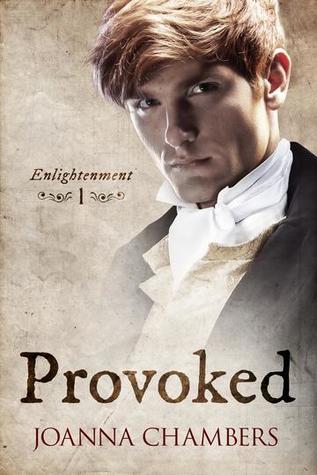
PROVOKED, first in the Enlightenment series of historical novels featuring David Lauriston and Lord Murdo Balfour


PROVOKED
JOANNA CHAMBERS
(Enlightened #1)
Kindle original (non-affiliate Amazon link)
$4.99 available now

Rating: 4* of five

The Publisher Says: Tormented by his forbidden desires for other men and the painful memories of the childhood friend he once loved, lawyer David Lauriston tries to maintain a celibate existence while he forges his reputation in Edinburgh’s privileged legal world.

But then, into his repressed and orderly life, bursts Lord Murdo Balfour.

Cynical, hedonistic and utterly unapologetic, Murdo could not be less like David. And as appalled as David is by Murdo’s unrepentant self-interest, he cannot resist the man’s sway. Murdo tempts and provokes David in equal measure, forcing him to acknowledge his physical desires.

But Murdo is not the only man distracting David from his work. Euan MacLennan, the brother of a convicted radical David once represented, approaches David to beg him for help. Euan is searching for the government agent who sent his brother to Australia on a convict ship, and other radicals to the gallows. Despite knowing it may damage his career, David cannot turn Euan away.

As their search progresses, it begins to look as though the trail may lead to none other than Lord Murdo Balfour, and David has to wonder whether it’s possible Murdo could be more than he seems. Is he really just a bored aristocrat, amusing himself at David’s expense, or could he be the agent provocateur responsible for the fate of Peter MacLennan and the other radicals?

My Review: I'd rate this lower if I hadn't been prepared for the modest sexual content. What there was the author did well and it wasn't gratuitous or inorganic. I was sure the story needed to be in that place at that moment; I was sure the characters were true to their established motivations; in the end, it wasn't about dissatisfaction that I've read from a few other reviewers. I suspect the issues arose from what I was inclined to see as "instaluuuv" between men of radically (!) different stations in Regency life.

That mattered a great deal more then than it does now. Not that it doesn't now, it definitely does, but then it was an issue front and center in every act of daily life. How Balfour comes on to David is completely believable. How David responds, and how he feels, is also completely believable.

That Murdo Balfour argues for the pragmatic accommodation of self to society is unremarkably in character; that David starchily stands for conformity to the harshest possible code of actions while suffering for it is also unremarkably in character for his Presbyterian upbringing. A sect that preached predestination...your soul's salvation was not earned or even earnable since God decided the identity of the 144,000 saved at the beginning of time....wasn't likely to produce anything but the most craven sorts of lickspittles.

What made the read pleasurable for me was the sense that the men were genuinely, if ineptly and obtusely, falling for the person wearing the pretty face that neither could quite unsee. David's red hair, Balfour's dark eyes, David's slightness and Balfour's height and heft...timelessly, opposites do indeed attract. But the characters, the bits that have to fit if a passion is to alter its bell curve towards love's more complex shapes, do match. The men are motivated by their respective and surprisingly similar sense of honor.

It's just a pity that David's sense of humor is so impaired at the expense of that sense of honor.

Not for the squeamishly heterosexual.

Monday, February 20, 2017

BLUE STEEL CHAIN, an edgy, triggery entry into a charming series of romantic suspense novels


BLUE STEEL CHAIN
ALEX BEECROFT
Trowchester Blues, #3
Riptide Publishing
$17.99 trade paper, available now

Rating: 4* of five

The Publisher Says: At sixteen, Aidan Swift was swept off his feet by a rich older man who promised to take care of him for the rest of his life. But eight years later, his sugar daddy has turned from a prince into a beast. Trapped and terrified, Aidan snatches an hour’s respite at the Trowchester Museum.

Local archaeologist James Summers is in a failing long distance relationship with a rock star, and Aidan—nervous, bruised, and clearly in need of a champion—brings out all his white knight tendencies. When everything falls apart for Aidan, James saves him from certain death . . . and discovers a skeleton of another boy who wasn’t so lucky.

As Aidan recovers, James falls desperately in love. But though Aidan acts like an adoring boyfriend, he doesn’t seem to feel any sexual attraction at all. Meanwhile there are two angry exes on the horizon, one coming after them with the press and the other with a butcher’s knife. To be together, Aidan and James must conquer death, sex, and everyone’s preconceptions about the right way to love—even their own.

NOTE: The Trowchester Blues series features stand-alone titles that can be read in any order.

My Review: The stakes in this darker, more violent entry in the Trowchester Blues series could not possibly be higher. Aidan's life is in danger from the instant we meet him. His horrifying experiences as Piers's sex slave have reached crisis point. Pain and humiliation and viciousness are pale miseries compared to the violent escalation that Aidan precipitates by finding his very own friend unconnected to Piers in James the Trowchester archaeologist, familiar to us from his brief appearances in both previous novels. And there is no doubt whatever that Piers, the violent pedophile abuser, will make good on his ongoing threats to Aidan's life: No spoiler here, he's done it before. See publisher's synopsis.

James's own failing relationship is with self-absorbed rock musician Dave, a complete and utter bounder but not a murderous monster. James faces down the embarrassment of Dave's very uninterested and unloving attitude towards him with his accustomed acceptance. He finds he doesn't care much, is really only putting up with this nonsense on borrowed time. After all, the man he loves is being threatened with murderous intent by a stone-cold upper-class killer. That ain't a joke. Anything short of death threats? Pshaw! James will ride to the rescue! Blessedly, he does; he even leaves his dearly beloved entirely alone to find his way through a new world, one without rage and beatings, for himself. The fact that Aidan's new employer is James's bestie and a member of Finn's book club (now held at Finn and Michael's house on the canal) who willingly keeps James in the loop about Aidan's progress in his new life is making it easier, I'm sure. But it also keeps each man in a separate sphere of Romantic Self-Abnegation: I Shall Be Noble And Avoid My One True Love So That He May Find Himself/Get On With His Life.

And then it's time for reality. The harsh glare of terror dims down to the quotidian glow of spring sunshine and mellows into the lovely eternal tea-time of summer. Aidan discovers he's asexual. James discovers he has fallen head-over-heels in love for what seems to me to be the first time. And therein a significant rub: Party of the first part has only ever experienced sex as violence and party of the second part has only ever experienced love as sex.

I must pause here for an admission: I'm a bog-standard guy when it comes to sex. My sexual preference is more, and my orientation is towards whatever man I happen to be involved with, and asexual persons are not within my area of expertise. I do not get it. I don't have to, obviously, but I'm left utterly at sea as to how someone can have no sexual desire. I felt so sad for Aidan, and shouldn't have because he isn't broken or flawed or wrong, he's just not like me. And yet I am who I am: It makes me so sad that someone doesn't have the joy I experience in a strong, healthy sexual connection to my partner. Anyway, that's out of the way, on with the review bearing my inability to relate to the character's core identity in mind.

Aidan's life takes so many wonderful turns at this point...his newfound ability to relate to people, his new and exciting ability to support himself and to live as he pleases...that he decides to include James in his happiness. James is perfectly happy to have him there, since he's fallen hard for the man. Aidan, in his own way, is right there with James in the feeling realm:
Today James looked almost like a normal human being. He wore a tweed suit that should have looked ridiculous but in fact only cemented his resemblance to an absent-minded professor and resulted in a touching bohemianism. He had attempted to flatten out his hair with some kind of hair product, but fortunately it had fought back and was as distressed as ever. The day's heat had caused him to take his tie and jacket off and roll up his white sleeves, and the shape of his forearms seemed poetic to Aidan. His fingers itched to re-create the shape in art, to try to demonstrate to the world why James was so desperately important—why his existence said something that could not be said in any other way. Something everyone ought to hear.
That is, by anyone's standards, a man in love. Asexual maybe but a lover and a besotted one. Aidan has a wonderful eye for men, as does James. The men are having themselves a time there at the folk music festival; we see Billy and Martin, from Blue Eyed Stranger, on stage dancing their reconstructed Viking dances, James pointing them out as mates from the book club; there is such genuine joy in James now that he's there with Aidan that even though Aidan really doesn't much like the whole scene, he loves James and will learn not to hate it for his sake.

Another hiccup in their borning love comes when James, on taking Aidan home to his own place, expresses his love and gratitude for the evening that Aidan planned and executed for him with a kiss. Not a good idea. Spontaneous sexual gestures are complete triggers for Aidan. He has a massive meltdown on his front step, his protective housemates send James away with a flea in his ear, and things go from bad to worse when James gets home only to deal with a surprise of his own. Dave, whom James had thought well and truly thrown out never to return, has returned with his entourage, his new lover, and expects James to make his usual lifestyle adjustments to the whole insane clown posse.

The next day is the make-or-break point for the men. They have to clean up the messes of the lives they have never actually led but simply allowed to occur around them. They are each motivated to fix things up so they can get to the real fixing they want to do: Fix the other man into his own life, become the couple they cannot imagine not being. The major event that brings them together I won't reveal, but it was very satisfying. They fight their way into life together. They fight for their oddly assorted love. They come into a true and loving and satisfying life together, complete with strange corners and odd angles and the eternally unknowable alchemy of couplehood.

I am sad to see this series over. I don't know if Beecroft and Riptide plan to publish more of them, but I hope so. Trowchester could become the gay Barsetshire, and I for one would welcome it. There hasn't been an English setting as rich as Barsetshire since Mrs. Thirkell died in 1961. The time is ripe for one, and there couldn't be a better modern spin on the concept than one focused on gay men, lesbians (are we calling them gay women yet? I heard that was going to be the new thing), asexuals, transgender people, immigrants, and the whole lot whirling in a set of orbits that would make an astrophysicist dizzy.

Mrs Beecroft, I salute you for making in Aidan someone so powerful and amazingly appealing that even I, utterly alien to the concept of asexuality, could fall for him. Many many thanks for the hours of pleasure your books have already given me. Many more happy and creative years to you.

Tuesday, February 14, 2017

BLUE EYED STRANGER, another Trowchester Blues novel


BLUE EYED STRANGER
ALEX BEECROFT
Trowchester Blues, #2
Riptide Publishing
$17.99 trade paper, available now

Rating: 4.5* of five

The Publisher Says: Billy Wright has a problem: he’s only visible when he’s wearing a mask. That’s fine when he’s performing at country fairs with the rest of his morris dancing troupe. But when he takes the paint off, his life is lonely and empty, and he struggles with crippling depression.

Martin Deng stands out from the crowd. After all, there aren’t that many black Vikings on the living history circuit. But as the founder of a fledgling historical re-enactment society, he’s lonely and harried. His boss doesn’t like his weekend activities, his warriors seem to expect him to run everything single-handedly, and it’s stressful enough being one minority without telling the hard men of his group he’s also gay.

When Billy’s and Martin’s societies are double-booked at a packed county show, they know at once they are kindred spirits, united by a deep feeling of connectedness to their history and culture. But they’re also both hiding in their different ways, and they need each other to be brave enough to take their masks off and still be seen.

NOTE: The Trowchester Blues series features stand-alone titles that can be read in any order.

My Review: Unstoppable force, this is immovable object. Advise your trajectory can now continue unimpeded.

History geek Martin meets morris dancer Billy. Each is hella hot for the other. Problem 1: Martin's a half-Sudanese/half-Yorkshireman Viking warrior re-enactor. Not exactly the best candidate for romantic kissy-face, more the hot sweaty sex type, oh and shelve that hand-holding lark. Problem 2: Billy suffers the agonizing, debilitating curse of depression. It's all he can do most days to haul himself out of bed and there are times even that isn't on. Problem 3: They can't reach around their barriers to get at each other consistently despite a near-desperate need for the other man's being.

Add in the immigrant parent with impossibly high expectations, the hostile work environment, and the curse of trying to lift words out of the stygian gloom of broken souls...well. It's all I can do to put the book down long enough to tell you to go get it and read it and defy you not to fall in love with these marvelous men before re-reading it.

Yep. Thass right. I, the arch-advocate of "too many new pretties, don't bother me with that re-reading thing" am going to re-read this book as soon as I close my computer because I absolutely can. not. WAIT. to re-experience the ending of this book.

Yep. Thass right. I, the ever-whinging arch-complainer about the unsatisfactoriness of endings that either tie things up tight with Honey Boo-Boo bows or leave so many threads dangling that they resemble old-fashioned fringed vests (waistcoats to y'all Brits) am going to re-savor the beautiful, beautiful ending Ma Beecroft has imagined for this book.

Oh, and that missing half-star? It's the same place that the missing thirty thousand or so words dedicated to Martin's family, Billy's morris dancing side, and the gents' mutual projects are. I'd glower about it some but I'd be fronting. I love what's here enough to demand more. Brevity might well be the soul of lingerie, but it's not on when you're immersed in a deeply satisfying read.

Oh, and the book club crossover is on that list as well. Better pump the MIA count up to thirty-five thou.

Monday, February 13, 2017

TROWCHESTER BLUES, a tale of the rightness of love shared


TROWCHESTER BLUES
ALEX BEECROFT
(Trowchester Blues, #1)
Riptide Publishing
$17.99 trade paper, available now

Rating: 4.5* of five

The Publisher Says: Michael May is losing it. Long ago, he joined the Metropolitan Police to escape his father’s tyranny and protect people like himself. Now his father is dead, and he’s been fired for punching a suspect. Afraid of his own rage, he returns to Trowchester—and to his childhood home, with all its old fears and memories. When he meets a charming, bohemian bookshop owner who seems to like him, he clings tight.

Fintan Hulme is an honest man now. Five years ago, he retired from his work as a high class London fence and opened a bookshop. Then an old client brings him a stolen book too precious to turn away, and suddenly he’s dealing with arson and kidnapping, to say nothing of all the lies he has to tell his friends. Falling in love with an ex-cop with anger management issues is the last thing he should be doing.

Finn thinks Michael is incredibly sexy. Michael knows Finn is the only thing that still makes him smile. But in a relationship where cops and robbers are natural enemies, that might not be enough to save them.

NOTE: The Trowchester Blues series features stand-alone titles that can be read in any order.

My Review: Dear Mrs Beecroft,

A long time ago I bought a Christmas tree from a fireman. He carried the tree to the car, put it in the trunk, tied the lid down with some twine, and before he was through making the last knot (four in total...I said I was traveling a half mile, wasn't that enough knots already?) he asked for my phone number.

It was a wonderful few months.

I mentioned what happened next in my earlier review of your book CAPTAIN'S SURRENDER. Frank was shaken, changed, by the honesty, the clarity, the truth that you told in that book's most perfect (to me, of course) moment: Peter's coming out as a lover of men, a man, to himself and to his god. I still give people who need it copies of CAPTAIN'S SURRENDER. It hasn't failed me yet. That specific facet of your story has comforted four more hurting souls after Frank's response proved to me that there is healing in being seen and being loved.

I hope that fact fills you with pride and happiness. It does me. That it was your second novel amazed me then and amazes me now. I am happy to say that the pleasures of reading your novels has only increased as time has gone by and you've written steadily and well.

I've come to expect from you that gift of seeing the moment when depth is too deep, and when gloss is too glib; your ability to balance them is one of the unteachable gifts that you possess. I recommend your books to people based on that fine balance. But then there's the thing that I don't tell them. I just leave the lucky sods to discover it for themselves:
Shame was perhaps ninety percent of the weight lodged under May's breastbone where a heart should be, but he had enough experience of the stuff to know the shame was only a sugar coating on something more insidious, so deep, so hollow he often wondered why he didn't just implode. Take himself out of existence, like a soap bubble with all the air sucked out. Right at this moment, he'd welcome it. Stop thinking. Stop hurting. Stop being him. That would be fantastic.
I can't guess how you know with such intimacy the exact experience of toxic shame. I can say that your finely honed words that are both funny and horribly painful, encapsulate fully the experience as I know it. And again I say that there is healing in being seen, being loved...being created as your character Michael May was in your accepting imagination.

May returning to Trowchester, where he never drew a happy breath, makes a lot of sense in the context of a man hollowed out by a rough life seeing the least and the lowest in constant action. He's down near the bottom of the well already and there's nothing to lose by going to a place that taught him the worthlessness of happiness and the falseness of hope:
When [Jenny, his best friend] signed off, the place felt emptier, lonelier, a million miles away from anywhere. The boat looked bare and the bed cold. He tried sitting on it, but in the small space the curving walls seemed to be clenching around him, crushing him. He wondered how long it would take before whatever it was that was gnawing away at his insides would finally swallow them and let him die.
I think we're all, those of us broken and hollow and stinging with the pain of a parent's emotional abuse, familiar with the no-space-can-be-big-enough problem. You put it so well...the cold bed, the clenched walls, the apparatus of protection being made the mechanism of abuse...is any act more cruel than depriving another soul of the ability to find comfort in the place that we must all return to, our home? If there is, I don't know about it, and I don't want to.

But May isn't the only one whose life you're excavating to such good effect. Finn the ever-so-slightly bent boy-man whose long dark night of the soul came from the darker paths that his love of beauty led him down. Yes, like Michael's, his life was deeply and unnervingly flawed by his inability to resist the lure of the object even when its provenance was clearly tainted. His cultured soul recoils only from ugliness, brutality, not from legal niceties that mean nothing when matched against a palette of perfect beauty and the unique historical presence of objects. Finn will do anything to possess a perfect object, because he is imperfect. Criminality? Pfui. Pettifogging bureaucratic nonsense.

Until the day he loses more than his illusions can support. Again, I can't guess how you know with such intimacy what happens when one loses a partner. Far as I'm aware your husband is hale and hearty and bids fair to see your grandchildren married. But wherever it comes from, your knowledge of that loss's effects on the entire rest of a man's life is spot-on. After Finn loses his illicit career as well as his beautiful love Tom and runs away to Trowchester, you leave him alone for five whole years. That feels so familiar. Finn won't rush into anything serious because, well, there can't be anything worse than the disappointment of let-down, can there? You said it so well, in this moment after Finn, in short order, suffers many body-blows to his hard-won peace, not to mention an attempt on his life that damages his bookshop, and all without his Michael to protect him:
Bathing and dressing in clean clothes did a little to alleviate his mood, but not even eating bacon and eggs, toast and marmalade and coffee did anything to fill the hollow inside him, where everything that he was had drawn itself deep inside, retreated, squeezing itself together in a singularity of soul so buried he couldn't tell if he was angry or sad or calm.
There's really nothing much to say after that, is there, except "however it is that you know that sensation so intimately, I am sorry."

Finn has depths he doesn't visit too terribly often, depths of deeply sentimental and shockingly sincere lovingkindness. His is the kind of smiling, bright face that no one thinks to wonder what propels the wattage out, they just bask in the warmth and dread the flares. He quite simply can't not help when his help is necessary. He somehow knew that a shadowy lurker around his home was a soul in need, and he's been leaving a meal for the shadow without ever knowing the lost soul's identity. His grace is knowing when to poke and pry and when not to. His ghost has, in the whirl of events, vanished...but his concern has not:
"And you used to put dinner out on the table most nights, when you was eating yours." Her smile wavered and crumpled. Her eyes filled with tears all of a sudden. "And I used to eat it, and I'd look up, and I'd see you sometimes in the window. And it would be...It would be like I wasn't alone."

She raised her hands to her face, made a sound like a laugh until it escalated into racking sobs. Finn's own eyes watered in response.

"You're my ghost?" He didn't stop to think, just stepped forward and threw his arms around her. She stiffened briefly and then turned into him, burying her head in his shoulder, as she wept. "You're my ghost! I've been so worried. When you stopped coming I thought something bad had happened to you. I didn't know—" He looked up over her shoulder to Michael who was looking stunned and suspiciously glossy-eyed behind her.

"I can't believe it." He had a good cry himself, for joy mostly. His eyes were closed when Michael slipped his arms around them both and briefly held them both up. Then there was embarrassment and overly bright, overly cheerful voices as he passed Sarah his handkerchief, and Jenny picked the spilled coats off the floor, and insisted on a hug of her own.
I see what you did there: You made a family from the detritus of unmet needs and unwanted feelings. I am as sentimental a sod as they make 'em, and that just about perfectly met my need for the pieces to be picked up and made into a work of kintsugi by a mistress of the art.

There is a rightness to a story deeply felt, properly told, and burnished to a soft gleaming imperfect warmth. It lets me in, lets me inhabit the characters as I wish and as my needs demand. It isn't a common effect in any field of writing. It is a sensation that I have come to expect when reading your books...and I'm pretty much all caught up on your to-date output...and that is the reason I come back for more. Moments like this:
Michael had risen to his feet before it occurred to him that he should not be taking orders from Finn. He had a bizarre flash of mythology, the thought that if he was a fucking animal at times, maybe together, with Finn's controlling hand on the reins, they could be a centaur.
Well. That's me destroyed. You, kind lady, you reached southwestward from your northerly latitudes and delicately flensed from my hiding place the secret of my joy. I wonder if my cynical wounded self will have another Michael, be another Finn; it's almost enough to have your enfolding generous imagination include me in the world.

Oh dear, that was rather earnestly American of me, wasn't it. You will simply have to dig deep under your proper lady's reserve and forgive a heartfelt statement of admiration from,

Your fanboy,

Richard

PS if you're wondering where the missing half-star on this review is, it's the same place as the missing twenty thousand or so words dedicated to the Lis, to Sarah, to the book club boys are. (Yes, I know, James is coming, but it's not enough!) And while I, book magistrate, have determined that you have no case to answer, I strongly caution you that old American fanboys deprived of a return visit from Michael, Finn, Jenny, Sarah, and the rest of this cast could result in unwished-for squatter tents in your front garden. Complete with curmudgeonly glowers.

Sunday, February 12, 2017

THE SONG OF ACHILLES, Patroclus tells The Iliad


THE SONG OF ACHILLES
Madeline Miller

Ecco Press
$16.99 trade paperback, $10.49 ereader platforms, available now

Rating: 6* of five read of 2013, when the blog launched

The Publisher Says: Greece in the age of Heroes. Patroclus, an awkward young prince, has been exiled to the kingdom of Phthia. Here he is nobody, just another unwanted boy living in the shadow of King Peleus and his golden son, Achilles.

Achilles, 'best of all the Greeks', is everything Patroclus is not — strong, beautiful, the child of a goddess — and by all rights their paths should never cross. Yet one day, Achilles takes the shamed prince under his wing and soon their tentative companionship gives way to a steadfast friendship. As they grow into young men skilled in the arts of war and medicine, their bond blossoms into something far deeper — despite the displeasure of Achilles's mother Thetis, a cruel and deathly pale sea goddess with a hatred of mortals.

Fate is never far from the heels of Achilles. When word comes that Helen of Sparta has been kidnapped, the men of Greece are called upon to lay siege to Troy in her name. Seduced by the promise of a glorious destiny, Achilles joins their cause. Torn between love and fear for his friend, Patroclus follows Achilles into war, little knowing that the years that follow will test everything they have learned, everything they hold dear. And that, before he is ready, he will be forced to surrender his friend to the hands of Fate.

Profoundly moving and breathtakingly original, this rendering of the epic Trojan War is a dazzling feat of the imagination, a devastating love story, and an almighty battle between gods and kings, peace and glory, immortal fame and the human heart.

My Review: Here I am faced with a conundrum: What new thought can I give? This is The Iliad, told from Patroclus's point of view. Miller starts the story with Patroclus's memories of his father, King Menoitius, whose unloving, unforgiving horridness blighted Patroclus's childhood. When Patroclus causes the death of a bully who happens to be a powerful noble's son, the boy's family gives the king what he wants: An excuse to rid himself of unpromising Patroclus. He is exiled (a nine year old boy) to Phthia, and the court of King Peleus.

Father of Achilles. Born to the sea-nymph Thetis. Best of all the Greeks...Aristos Achaion...in each and every thing, yet mortal and so consigned to our world.

Patroclus and Achilles find each other, and Achilles chooses the unassuming boy to be his companion. Peleus says, when the choice is made, are you sure about this, son? This boy will add nothing to your lustre. Achilles responds, without rancor or boastfulness, “I don't need him to.” This being self-evident and inarguable, Peleus shrugs and life goes on. The boys spend a golden childhood as best friends, a golden adolescence as lovers, and, after being outed by Odysseus in Scyros where Thetis was trying to hide her son Achilles from the Trojan War where he is fated to die, a long (for the times) manhood as husbands. Everyone in Greece, and Troy, knows what time it is. No one says boo about it, except Thetis who LOATHES Patroclus because he's not good enough for her little boy...or is she just jealous of an interloper commanding her son's love? Who would dare? Achilles is a killing machine. He is the Aristos Achaion, the Finest Among the Greeks, for a reason.

And now we rejoin the mainstream of The Iliad for the remainder of the plot, with only a slight change in angle of view.

I think I wrote three heart-felt appreciations of this book. It is strong, and beautiful, and passionate. It is tough, and cruel, and inevitably sad. It is tender, and loving, and generous. It is indeed the Song of Achilles, sung by Patroclus, and it is a fitting funerary offering to them both.

But let me get out of the story's way. It speaks for itself.

”I will go,” he said. “I will go to Troy.”
The rosy gleam of his lip, the fevered green of his eyes. There was not a line anywhere on his face, nothing creased or graying; all crisp. He was spring, golden and bright. Envious death would drink his blood, and grow young again.
He was watching me, his eyes as deep as earth.
“Will you come with me?” he asked.
The never-ending ache of love and sorrow. Perhaps in some other life I could have refused, could have torn my hair and screamed, and made him face his choice alone. But not in this one. He would sail to Troy and I would follow, even into death. “Yes,” I whipsered. “Yes.
Relief broke in his face, and he reached for me. I let him hold me, let him press us length to length so close that nothing might fit between us.
Tears came, and fell. Above us, the constellations spun and the moon paced her weary course. We lay stricken and sleepless as the hours passed.


I can't make any stronger a case for the book than this. I hope you will read it.

Monday, July 25, 2016

A SCARLET PANSY, 84-year-old call for tolerance by emulation


A SCARLET PANSY
ROBERT SCULLY

Fordham University Press
$19.95 paper, available now

Rating: 4 quizzical stars of five

The Publisher Says: First published in 1932, A Scarlet Pansy is an extraordinarily vivid and richly textured depiction of American queer life in the early twentieth century, tracing the coming of age of androgynous Fay Etrange.

Born in small-town Pennsylvania and struggling with her difference, Fay eventually accepts her gender and sexual nonconformity and immerses herself in the fairy subculture of New York City.

A self-proclaimed "oncer" - never tricking with same man twice - she immerses herself in the nightclubs, theatres, and street life of the city, cavorting with kindred spirits including female impersonators, streetwalkers, and hustlers as well as other fairies and connoisseurs of rough trade.

While reveling in these exploits she becomes a successful banker and later attends medical school, where she receives training in obstetrics. There she also develops her life's ambition to find a cure for gonorrhea, a disease supposedly "fastened on mankind as a penalty for enjoying love."

A Scarlet Pansy stands apart from similar fiction of its time -- as well as the ensuing decades -- by celebrating rather than pathologizing its effeminate and sexually adventurous protagonist. In this edition, republished for the first time in its original unexpurgated form, Robert J. Corber examines the way in which it flew in the face of other literature of the time in its treatment of gender expression and same-sex desire. He places the novel squarely within its social and cultural context of a century ago while taking into account the book's checkered publication history as well as the question of the novel's unknown author.

Much more than cultural artifact, A Scarlet Pansy remains a uniquely delightful and penetrating work of literature, resonating as much with present-day culture as it is illuminating of our understanding of queer history, and challenging our notions of what makes a man a woman, and vice versa.

THE PUBLISHER APPROVED MY NETGALLEY REQUEST IN EXCHANGE FOR AN HONEST REVIEW Thank you to the press and to NetGalley!

My Review: I am gobsmacked by several facts about this book: That it was *published* in 1932! and that it remains pretty much unique in literature as being told, unapologetically, from the PoV of a real flamer, a pansy, a nancy-boy...that is to say, an effeminate man. So much emphasis...so very, very much emphasis!...is placed in today's mainstreamed gay world on "passing" or being a "straight-acting" gay man! Our leaders are preaching tolerance, acceptance, inclusion, and the rank-and-file put up sex ads for "straight-acting" sex objects. What in the world does this convey except internalized homophobia? Is mainstreaming to blame for this? No. But believe you me, the disappearance of the gay ghetto, or at least its depopulation, is down to the mainstreaming efforts of the past 30 years. That makes the world a little bit *ironically quirked eyebrow* less safe for the effeminate men and the butch women in our community.

Fay Etrange would be no more welcome in a public panel on Gay Issues now than she would have been in a medical school lecture hall in the 19th century. Very much a queen, her passage through the world as presented by "Robert Scully" was a busy one, bestowing royal favors on a grateful American manhood:
This first meeting with a strange man was almost prophetic. For the rest of her life she was to meet his kind, wherever and whenever she travelled--always seeking her and the favors she could bestow.
This set-up makes sense to me, since I've never lacked for the company of "regular guys" in my own transit of gay life. It's been my design, willingly subscribed to by the parties of the second part, to educate and inform the unimaginative males of the USA of their other options. Sometimes the teachings took, sometimes not so much. But in all the attendant mishegas, I did my dead-level best not to make assumptions but let the situation teach me as much as it did him. Fay is the most unusual kind of character in non-romantic gay fiction, in that she practices this behavior as well. In a strange way it was a relief to me to have the intimate details of Fay's affairs left to the imagination. It's not that I'm squeamish, perish forbid!, but the fact that Fay isn't in first-person narration would make any detailed description of the various acts and positions feel peculiarly and unpleasantly prurient.

Fay arrives at this sort of thinking by attending to her own inner moral compass, and educating herself broadly though never at the expense of delving deeply into topics that fascinate her:
Electing to take religion as one of her college courses, she had obtained a wide knowledge of the teachings of the East. Practically all began with assumptions of infallibility, which, though unproven, the disciples then proceeded to teach as basic facts. Their leader, she found, ignored the selfish reasons which led them on and caused them to set aside reason and endeavor to inculcate blind faith. She had no faith. She could see no reason to have faith. She was happier without it. Nothing was explained ultimately; why accept puny, childish explanations?
Soul sister! I know from several deep conversations with my gay uncle, a sailor as it happens, that people aren't products of their times and stations unless they choose to be. Even in what we view as unenlightened, hag-ridden by gawd, times there were mental and even social non-conformists. The past is made up of once-living people; history is indeed (sometimes lamentably completely) his story; we're really not unique in our deepest selves as we're all human. This is always a welcome reminder for me, find it where I may.

Of course it's one thing to remember that people been people forever, that our own "unique" needs and desires are only unique in our limited experience:
The avenue seemed full of gay people these days, persons as happy as she. At intervals were stationed the mounted traffic police. Their splendid figures, their neat, well-fitting uniforms, their highly polished puttees protecting perfectly formed legs, the thigh outlined by pressure against the horse's side, all combined to make a picture which she found irresistibly appealing. She found herself looking for the mounted police. She formed preferences for one or the other. She thought of the Aztecs with their idea that men astride of horses were some kind of god,and she smiled to think that her poetic sense was interpreting these horsemen in the same light. She liked especially to view the officers from the back, the torso, the carriage, the outline of the leg all accentuated.
...hmmm? What was that? Oh sorry, I went to mental Bermuda for a moment there. Yes, well, do you need any further evidence that we're all sisters under the skin? Some details tweaked, or twerked, and this statement of admiring desire fits in the mind of any one of us bald bonobos. The slightly namby-pamby modern mantra "love is love" is a short and punchy reminder that we're all sexual creatures. Desire, love, need, any and all of these things, are organizing principles in our own little lives, and we're well advised to protect others in their exercise of them if we wish to be protected in our turn. I think this statement would be whole-heartedly seconded by Fay Letrange, and the pseudonymous "Robert Scully" who created her.

With this realization comes a further revelation of the commonality of human experience, that of the honest and fearless and searching moral inventory. Know yourself as you really are, not as you and others would like you to be (or insist that you are):
"Perhaps it's natural to them; what is natural to them may not be natural to another. Imagine them married. What would their offspring be? Probably even more erratic. Perhaps they are fulfilling their destiny by not marrying. Did you ever consider that? I often think that people who do not wish to have children should not be criticized, for brobably there is some basic instinct which prompts them not to be parents. Perhaps they are really not fit to be parents."
Amen! That this conversation was put into the mouth of a person created by a Victorian writer, and set in the very earliest years of the twentieth century, was a small shock of surprised recognition to me. I've always kicked hard against the Cult of the Mother, the ascription to all females, ladies, womyn, uterus-havers of an innate and all-powerful desire to give birth to and nurture young. I applaud those with the self-knowledge to say "no, thanks" and the strength to stick to it. It isn't easy to swim against the tide, which makes most of us leery of doing it. How much more difficult, we think, it must have been for those poor benighted children who came before us! Stuff and nonsense. Reading this transgressive book from the past is listening to a voice shouting reason and reasonability. That it feels as transgressive today as it would have 84 years ago is more a statement of human nature's irreducible commonness throughout history: Bow to the Vox Populi, speak only the Norma Loquendi, or be marked out as Strange. But don't kid yourself that it was harder, easier, whatever then or now.
"You are sure you mean bliss?"

"Yes, an island or some place where we could all live or go to easily whenever we pleased and do all the things we wish to do without thought of the narrow-mindedness of others."

"You are asking too much. Oh, for the Isle of Crete! You are wishing a return to the good old Pagai times when all honor was paid even to prostitutes."

"No, not asking too much, just asking for a natural morality, a thing which varies with each bird, beast, and human and for which due allowance is not made in lawmaking."
We all long for Paradise. Some are willing to allow others into it with them. I like those of the latter opinion the best of all.

It seems as if the world considers a climate of tolerance to be asking too much these days as well as in those days. I don't need to give examples of events springing from the external pressure imposed by intolerance, or of the personal price paid by those subjected to it. I'm equally sure I don't need to give examples of those expressing their internal conflicts by mismatched rhetoric and inner monologue. I think this passage pretty much sums up the disconnect:
The professor would describe all sorts of aberrant types, their prominent, wild eyes, their too thick or too narrow chests or hips and their too thin or too heavy leg muscles; he would illustrate the swagger of the feminine type and the mincing short-stepped swaying gait of the masculine, the fluttering, so called; he would tell of their nocturnal amusements and occupations, and when he had finished he had so enthused his entire class that they were ready to go down town and start a laboratory course at once.
Heteronormative locker-room raillery, complete with ill-willed imitation, as medical school education. Charming. The response of the students isn't unusual, which is in and of itself unusual. Things really have changed little if this passage still speaks to the ordinary experience of the different. But then again, compared to fifty years ago, the intolerance of such a scenario is worth remarking on because it isn't simply the "oh well" resignation of the narrator but his sharp-eyed attention to the eagerness of the audience to go find some action for themselves that's a ray of hope. Soon dashed, of course, as is the way of things in an imperfect world:
"Have a sense of humor. Remember, Gawd must have his little jokes on the human species."

"I feel bitter, bitter against the half-men who make our laws. Come on, let's legislate against the tides too."

"Be practical," suggested Miss Bull-Mawgan. "The only recourse is to see that every ecclesiastical student is properly seduced, and thus liberalized. The pulpit, after all, makes the laws in this country."
I'm happy that I live in a state where marriage equality is law. I am sad to live in a world where that equality of access to the law's protections, duties, and rights is so controversial that such a protection is necessary. I can barely imagine what the gay men of 100 years ago would think of such a protection! Impossible dream! And now that it's a given in some places I wonder how it was ever not. The scary monsters are out in the open, and whaddaya know! They're the neighbors.

Not everyone is comfortable with that. The neighbors are supposed to be much like us, after all, that's why we elect to live in certain places and not others. I can see that. After all, not everyone can hold up their end in the stereotypically gay witty, dirty badinage:
"Aunty Beach-Bütsch, control yourself! I shall lend him out to friends and near relations. We are coming back in two years."

"And I shall have drunk myself to death by that time," wailed old Aunty Beach-Bütsch. "But Mason, we shall be friends to the end."

Another opportunity for Miss Savoy. "Which end? I didn't know you loved Mason so much, Aunty Beach-Bütsch!"

"Love him? I love every inch of him, from the ends of his hairs to the tips of his toenails. Why I love his very guts!"

"That's a very vulgar but adequate description of the depths of your passion, Aunty Beach-Bütsch!"
Need I mention that the female monikers are hung on males? Mason, on the other hand, is a man, and a newly married one, being bartered off by his blushing bride Marjorie, née Dike, as she is known from that moment on. It sounds like ordinary conversation to me, but the people I tried it out on were flustered and taken aback. No wonder straight people fear the gays buying the house next door! They speak Camp, and there's nothing scarier than having the neighbors speak a different language from yours, right?

But in the end, we all succumb to a common malady, that of falling in love. She's been a "oncer," a one-fuck-and-bye bye gal, since her earliest years. But that changes because the pressures of going to war, being under fire, trying to do her duty as a doctor in service of men shattered by modern munitions. It's grueling work, most often sad in its outcomes; watching a generation of men vanish before her eyes makes Fay susceptible to a sentimental attachment that she would have rejected only a short time before. Her medical studies having taken her to Berlin, her first true love is a German officer; after his tragic death in her arms, Fay falls head over heels for a soldier boy on his way to the front in France's trenches.
His body was sweet and clean smelling. As she finished [massaging his dislocated shoulder], Fay bent and gently kissed him on the neck, that part where the skin is so soft abd sensitive, midway between the angle of the jaw and the hair line at the back of the neck. He opened his eyes, startled, then smiled as he murmured, "Oh! It's you. That's all right." He folded his arms about her, bringing her head close to his, then like a contented child sank into a deep sleep. His clean body odor gave her keenest delight. She hesitated to attempt to alter their relationship, and possibly lose him entirely. He had accepted her as a pal, that she would be.
Some variation on this sentiment is familiar to everyone who is an adult. It's amazing to me that anyone could grudge this simple rapture to another soul. Because that's what homophobia is, denial of the commonality of the experience of love, loving, cherishing someone for their inner being while reveling in the sensory pleasures of their outer being. How is that a good thing in anyone's mind? Shouldn't we all be promoting anything, anything at all, that can stitch us tighter into the social contract of being alive and a player in the world's arena?

Here's an eighty-four-year-old reminder that this should indeed be our goal. How amazing to find such validation for a "modern" world-view here. It's also a bit sad to need this reminder in the twenty-first century. We are all as Heaven made us, the Confucian quip goes. Let's aspire to be that commonsensical in our dealings with the Others who make up our entire world.

Sunday, June 26, 2016

CAPTAIN'S SURRENDER by the inimitable Alex Beecroft


CAPTAIN'S SURRENDER
Alex Beecroft

Pronoun Publishing
$3.99 eBook (all formats), available now

Rating: 4* of five

The Publisher Says: Ambitious and handsome, Joshua Andrews has always valued his life too much to take unnecessary risks. Then he lays eyes on the elegant picture of perfection that is Peter Kenyon. Soon to be promoted to captain, Peter Kenyon is the darling of the Bermuda garrison. With a string of successes behind him and a suitable bride lined up to share his future, Peter seems completely out of reach to Joshua. But when the two men are thrown together to serve during a long voyage under a sadistic commander with a mutinous crew, they discover unexpected friendship. As the tension on board their vessel heats up, the closeness they feel for one another intensifies and both officers find themselves unable to rein in their passion. Let yourself be transported back to a time when love between two men in the British Navy was punishable by death, and to a story about love, about honor, but most of all, about a Captain's Surrender.

My Review: I gave this book to my friend Frank the Fireman, since like the main character, Peter Kenyon, he is an adult out-comer. I wanted him to, in particular, notice the last chapter wherein Peter goes through the long, dark night of the soul as he struggles between the lifelong conditioning he's heir to...the societal and legal issues surrounding being queer in the Royal Navy of the 18th century...and his love for Joshua Andrews, his best friend, former ship-mate, and one true love.

I didn't mention that I wanted him to notice that chapter, I just sat and hoped. I was rewarded by a phone call. Frank was shaken, saying he'd done almost the precise same minuet of fear, anger, doubt, fear, rage, lust and...in the end...honest peace.

I told him the author was a woman. He didn't say anything for a minute. "Lesbian?" he asked. "No. Married with kids." "That is one lucky man," was Frank's response.

I concur.

This book fulfills a long-felt absence in my reading life. It's an historical sea-novel, with nicely handled battle scenes and an authentic-feeling atmosphere of male camaraderie. Its flaws include a rather cavalier approach to time, as in there is no indication that the characters have to wait the extended periods they would really have been forced to endure for news, for travel, for anything. Also bothersome are some absences...backstory mostly, but also some characters have unresolved storylines, and I don't mean opening-for-sequel unresolved, I mean holes. The antagonist of Peter and Joshua is the first one who springs to mind, since he's presented in one dimension and never seen to have reasons for his actions beyond moving the plot along.

I make this point because the book is getting a four-star rating. It's not perfect, I'd really really like to see more of the men's backgrounds even if in flashback for example, but it's a beautifully realized love story with excellent atmospherics and a happy ending...and a Happy Ending, too. Well done, Mrs Beecroft, and do it again soon.

Tuesday, September 9, 2014

THE BIBLE BOYS, charming gay coming (!) of age novella


THE BIBLE BOYS
DAN SKINNER

Cerberus Inc.
$2.99 Kindle original, available now

Rating: 3.5* of five

The Publisher Says: A Sin. An Abomination. Teenagers Caleb and Matthew had been told by the radical fundamentalist church that dominated their families' lives that a love like theirs—between two boys—was unnatural and forbidden. That it would damn them forever. The religion controlled their families like puppets, watched their every move, made keeping a secret almost impossible. They had only one chance to be together...and it would be a daring one right under the noses of the very people who would condemn them...

My Review: How charming this was! How wonderful the breaking-free fantasy is for all of us who don't have Golden Boy stamped on our lives the instant we're born. (Which is to say "all of us.")

But really. "I wanted to know what it felt like to be joined to you!" Spoken by a 20-year-old in the throes of passionate virginal lovemaking with his 18-year-old lover? Hell, ANYone experiencing passionate lovemaking even NOT for the first time who can be that articulate? Please. If you can focus long enough to emit a sentence like that, someone's doing something wrong.

So there's that. And then there's the religion thing, which anyone who's ever read anything I've ever posted since I got a personal ISP account in 1993 can tell you is right up my alley. Yes, religious people are unkind to those who are different, and young religious people are very unkind to everyone like all other young people. But these pantomime villains! The creepy youth pastor wantin' to nosh on some chicken! Wee bit overstated.

So it sounds like I'm going to make this a bad 3-and-a-half star review. But that's not my purpose. Mr. Skinner sets a beautiful scene with his descriptions of the Clare farm, the over-barn apartment, the flowers and the corn and the stock tank. The horse Perseus. The fireflies and the shooting stars. Just lovely, all of it.

But the stars are all for this, an essential and a true and a beautiful expression of an eternal reality we grope blindly for then so often drop and shatter when we find:
Love does not make cowards. It creates heroes.
Yes.

Wednesday, August 7, 2013

Gay Male SF AT LAST

New Review! One big issue I have with science fiction is its relative absence of gayness. Today I read an excellent short science fiction story WHEN YOU WERE PIXELS by Julio-Alexi Genao. It's a kind of gay male Fifty First Dates set in a Bladerunner-y dystopic future. This is what I've been looking for! Try it out.

I so often find that the SFnal setting in more-or-less romantic fiction is pretty lame. Not this time. It's got depth and it's got breadth. I am so so pleased! It helps that I'm Goodreads friends with the author, since I got to hear about the book that way. It's free to all comers, though, so I'm not unique!