Showing posts with label gallows humor. Show all posts

Monday, August 4, 2014

August Book-A-Day #4: GAHAN WILSON SUNDAY COMICS, 5-star hilarity


GAHAN WILSON SUNDAY COMICS
GAHAN WILSON

Fantagraphics
$29.99 hardcover, available now

Rating: however many stars there are

The Publisher Says: Gahan Wilson is probably best known for his macabre Playboy cartoons, filled with charming monsters, goofy mad scientists, and melting victims, and his cutting-edge work in the National Lampoon, but he’s also one of the most versatile cartoonists alive whose work has appeared in a wide range of media venues. Gahan Wilson Sunday Comics is Wilson’s assault from within: His little-known syndicated strip that appeared in America’s newspapers between 1974 an 1976. Readers must have been startled to find Wilson’s freaks, geeks, and weirdos nestled among family, funny-animal, and soap opera offerings. (The term “zombie strip” — a strip that has long outlived its original creator — takes on a whole new meaning in Wilson’s hands.)

While each strip, at first glance, appears to be a standard, color Sunday strip (albeit without panel borders), each Sunday Comic is a collection of one-panel gag cartoons, delineated in Wilson’s brilliantly controlled wiggly-but-sophisticated pen line. The last gag cartoon on each Sunday is part of a recurring series, either “Future Funnies” or “The Creep.” Some Sundays are a freewheeling mélange of board meetings, monsters, and cavemen (with cameos by Wilson’s Kid character from Nuts, his gimlet-eyed view of childhood, collected last year by Fantagraphics), while others riff on a topic or subject (clocks, plants, wallpaper, etc.). As is his wont, Wilson mines the blackest of black comedy in the banal horror of human nature. Gahan Wilson Sunday Comics collects, for the first time, each and every one of these strips, luxuriating across a 12” x 6” landscape format, with Fantagraphics’ trademark high production values, innovative design, and succinct historical commentary.

My Review: The UK Book-A-Day meme, a book a day for August 2014, is the goad I'm using to get through my snit-based unwritten SF-book reviews. Today's prompt, the fourth, is meant to be about a favorite comic book. I mean, oh goodness me, I mean "graphic novel." *snort* That's like asking me who my favorite female porn star is. So instead here I am with this magically delicious collection of forty-year-old hilarity. Wilson's art is a perfect accompaniment to his very darkly twisted humor. I adore it.


What else need be said? It's Gahan Wilson, and it's either your kind of thing or it's not. It's very much my kind of thing.


I feel like these sofa-sitters about most of modern life. I don't get it. I feel like I have sixteen thumbs, mostly on my feet, and color-sensing seismographs instead of ears, in the rap-infested, reality-show-obsessed, Fox-as-news world I'm in. I don't fit, and I don't want to.


Goodness knows, there is no reason to assume it ever will, at least for very long. I keep slugging. Books like this, humor from 40 years ago, show me that there is in fact nothing new under the sun. Some people have always felt, as I do, that the world makes no sense, that up is in fact down, and the best we can do is cope.


I paint what I see.

Friday, July 4, 2014

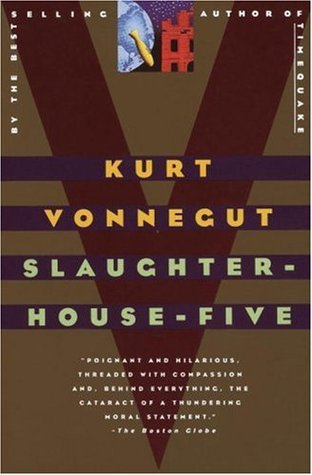
SLAUGHTERHOUSE-FIVE, ironic choice for Independence Day


SLAUGHTERHOUSE-FIVE]
KURT VONNEGUT

The Dial Press
$15.00 trade paper, available since 1969

Rating: 4.5* of five

The Publisher Says: Kurt Vonnegut's absurdist classic Slaughterhouse-Five introduces us to Billy Pilgrim, a man who becomes unstuck in time after he is abducted by aliens from the planet Tralfamadore. In a plot-scrambling display of virtuosity, we follow Pilgrim simultaneously through all phases of his life, concentrating on his (and Vonnegut's) shattering experience as an American prisoner of war who witnesses the firebombing of Dresden.

Don't let the ease of reading fool you - Vonnegut's isn't a conventional, or simple, novel. He writes, "There are almost no characters in this story, and almost no dramatic confrontations, because most of the people in it are so sick, and so much the listless playthings of enormous forces. One of the main effects of war, after all, is that people are discouraged from being characters."

Slaughterhouse-Five is not only Vonnegut's most powerful book, it is also as important as any written since 1945. Like Catch- 22, it fashions the author's experiences in the Second World War into an eloquent and deeply funny plea against butchery in the service of authority. Slaughterhouse-Five boasts the same imagination, humanity, and gleeful appreciation of the absurd found in Vonnegut's other works, but the book's basis in rock-hard, tragic fact gives it a unique poignancy - and humor.

My Review: The Doubleday UK meme, a book a day for July 2014, is the goad I'm using to get through my snit-based unwritten reviews. Today's prompt is to select your very favorite American novel in honor of the Fourth of July. Well! That would take a few zillion hours of internal debate, creation of endless lists, rebellious actions like breaking things down into genre lists, muttering over who counts as American (Teju Cole is, but Henry James isn't: Discuss), etc. etc.

Decision made for me, in this case, by the fact that I'm trying to strong-arm myself into making a dent in the embarrassingly long list of things I've read, re-read, or abandoned since I got all grumpus. And here we are!

If anyone has not read this book, and is under the age of 90 while over the age of 17/senior year of high school, go immediately forth, procure this book, and read it.

Why? Beacuse:
“America is the wealthiest nation on Earth, but its people are mainly poor, and poor Americans are urged to hate themselves. To quote the American humorist Kin Hubbard, 'It ain’t no disgrace to be poor, but it might as well be.' It is in fact a crime for an American to be poor, even though America is a nation of poor. Every other nation has folk traditions of men who were poor but extremely wise and virtuous, and therefore more estimable than anyone with power and gold. No such tales are told by the American poor. They mock themselves and glorify their betters. The meanest eating or drinking establishment, owned by a man who is himself poor, is very likely to have a sign on its wall asking this cruel question: 'if you’re so smart, why ain’t you rich?' There will also be an American flag no larger than a child’s hand – glued to a lollipop stick and flying from the cash register.

Americans, like human beings everywhere, believe many things that are obviously untrue. Their most destructive untruth is that it is very easy for any American to make money. They will not acknowledge how in fact hard money is to come by, and, therefore, those who have no money blame and blame and blame themselves. This inward blame has been a treasure for the rich and powerful, who have had to do less for their poor, publicly and privately, than any other ruling class since, say Napoleonic times. Many novelties have come from America. The most startling of these, a thing without precedent, is a mass of undignified poor. They do not love one another because they do not love themselves.”
That is all.

Creative Commons License
This work is licensed under a Creative Commons Attribution-NonCommercial-ShareAlike 3.0 Unported License.