Showing posts with label beautiful sentences. Show all posts

Sunday, October 20, 2019

FLAMES, Tasmanian debut author Robbie Arnott's full-tilt dive into magical realism, is a must-read!


FLAMES
ROBBIE ARNOTT

Text Publishing (non-affiliate Amazon link)
$9.99 ebook platforms, $15.95 trade paper, available now

Rating: 5* of five

The Publisher Says: ‘A strange and joyous marvel.’ Richard Flanagan

A young man named Levi McAllister decides to build a coffin for his twenty-three-year-old sister, Charlotte—who promptly runs for her life. A water rat swims upriver in quest of the cloud god. A fisherman named Karl hunts for tuna in partnership with a seal. And a father takes form from fire.

The answers to these riddles are to be found in this tale of grief and love and the bonds of family, tracing a journey across the southern island that takes us full circle.

Flames sings out with joy and sadness. Utterly original in conception, spellbinding in its descriptions of nature and its celebration of the power of language, it announces the arrival of a thrilling new voice in contemporary fiction.

Robbie Arnott was born in Launceston in 1989. His writing has appeared in Island, the Lifted Brow, Kill Your Darlings and the 2017 anthology Seven Stories. He won the 2015 Tasmanian Young Writers’ Fellowship and the 2014 Scribe Nonfiction Prize for Young Writers. Robbie lives in Hobart and is an advertising copywriter.

My Review: I'm sure anyone reading my reviews knows of The Guardian's marvelous ten-year-old "Not-the-Booker" crowd-sourced literary prize. I learned of Flames's existence from the ginormous user-generated longlist for this year's jousting match. It looked intriguing, but the contest review sold me, being by Guardian reading-group, literary-link curator Sam Jordison...who also happens to be the co-director of Galley Beggar Press, the 2019 Booker Prize-unwinner Ducks, Newburyport's original publisher. So he's got strong literary chi. I trusted him; I took a leap of faith; I was amply rewarded.

This lovely debut novel from a small-yet-mighty Australian publishing house was a delight to me from the moment I met Karl and his seal. Karl fishes off the northern coast of Tasmania, that deep-southern island state of Australia, the last significant spot of land between Antarctica and the world. His seal, like Lyra's daemon in His Dark Materials, is connected to Karl's very essence and forms a large part of Karl's self—both image and awareness. Their "Oneblood tuna" prey, the giant and preternaturally perfect piscine predators found only in the Bass Strait (this is never stated but is implicit in the constant Japanese tuna-buyers' presence), bring in huge amounts of money from sushi-mad Japanese consumers through their local Tasmanian agents. Karl supports his family, his seal included, on the proceeds of their hunts. His bond with his seal is, however, the source of his undoing. His seal, being but a seal, is not immortal and falls to a hungry orca before Karl's appalled and helpless eyes and ears:
Karl tried to forget that clicking sound. But it was lodged in a hole between his ears, a backdrop to his days that he feared and hated but could not escape. He was reminded of it constantly: when a light switch was flicked, when Louise clicked her fingers, when his leaping daughters clicked their heels, when Sharon at the fish-and-chip shop clicked her tongue against the roof of her mouth as she waited for the oil in the deep fryer to heat up.
There is no magical cure here. Not even for the cruel soulkiller PTSD.

Already, in the first twenty-five pages of the book, the magic of Tasmania's lands and waters bears the reader's weight. "How does a fisherman become the partner of his competitor the seal?" wonders the Western materialist tapping the touchscreen to deliver the next jolt of story-junk to his addict's brain. In these first pages, we're tossed into a magical world where dying mothers (if they're McAllisters) are cremated, return to life as themselves melded with ferny forest glens before recombusting, which thereafter somehow gives the grieving son the clarity to think, "Everyone dies, even when they’re reincarnated;" where the son, who is also a brother, encounters the maimed soul of Karl for a prelude to one of the novel's truly bizarre, and bizarrely perfect, themes, death as an almost-silent character in the weird, winding path the Tasmanian humans tread:
Levi. And then, as if his surname was an afterthought: McAllister. He...ran his hand through his hair. Everything’s fine.
Righto.
The name bumped around between Karl’s ears where the clicks usually lived. I’m sorry.
(Be aware that this story is dialogue-light, and such dialogue as there is is italicized as well as unattributed; this could present a problem for some traditionally inclined readers.) This is a crucial moment, but how is the reader to know it? Trusting the newb of an author to put this scene, with its awkward Manly Emotions Inadequately Expressed, in this precise place at this exact juncture is a big ask. I sat a moment after reading this, aware that the expression of sympathy in "I'm sorry" wasn't connected to anything in Levi's head, and the idea of a McAllister wasn't connected to anything in Karl's head (yet); and yet this is a deep and important scene in the book, said my spidey senses. What, why, how?

I love that. Author Arnott didn't tell me! No rookie mistake of hand-holding me through the significance of Levi's peculiar purpose...gathering driftwood for a coffin, a wooden receptacle for much of the meaning in this book...and Karl's peculiar and solitary presence on this beach at this moment. I am left with the deeply experienced reader's tingle in the presence of Momentousness; I am left with a king-sized curiosity bump itching like mad; but I am left and the story moves on.

Levi wants something. (More than the proverbial glass of water, for sure.) He can't really be anything other than an authorial self-portrait because no one else would receive an assessment as cruel as, "Tweaky voice, even though his words were smooth. Like his private-school manners were paved over something that had cracked," unless it was a self-assessment. He wants to control a world he can not comprehend. Levi wants to make the world behave, be orderly, not abandon him as he feels his father did, as he now feels his recombusted mother did; as his sister, whose death will result in her resurrection and recombustion because she's a McAllister woman, has when she discovered Levi was making her a coffin. He loves them all; they all leave him; where's the love in that?
Levi is reminding himself of his resolve: to show Charlotte that she wasn’t condemned to rise again, changed and ghastly, after she died. That her life needn’t end twice. That she needn’t suffer the same fate as their mother. That he had sourced this calming coffin for her and her alone; that in the face of their sorrow he had gone to great lengths to have it built; that he couldn’t go another day knowing she was in such pain; that he cared for her this much; that he loved her more than he could ever show with words; that the coffin represented all this.
Levi is not well. Levi is not realising: he could have just spoken to her. In a mind like his, grand acts will always trump honest words.
Levi is, I fear, the very saddest and least likely to be redeemed of the people in the story. Or so we're led carefully to believe.

Now meet Allen, the wombat tenant-farmer, decades among the wombats protecting and caring for them, that they might be turned into pelts. (This somewhat odd-to-non-Tasmanians idea is more suggested than explained.) Allen is a true lover of the deepest South this southernmost tip of Australia has to offer. His helpless adoration for the land is the occasion of some truly lush description:
I cannot bear the thought of being taken away from the farm.... If the wombats are my family, then this place is my home. Its undulating moorlands of peat and buttongrass; the glints of white quartzite that blink on the mountain caps; the cold, clean welcome of its unbroken sky; the harsh cliffs and tea-coloured waters; the gathering sense of wild solitude that breathes out of every crack in the land. I cannot go back to the flat brown farms of the Midlands, or the over lush dairy pastures of the northwest.
The source of his reverie is anxiety, however, a deep and well-grounded fear that the farm owner will dispense with him when he finally builds up the nerve to describe to her the horrible fate that's begun to befall the wombats in his decades-long care. He's no longer caring for them alone, though.

Karl's daughter Nicola, training as a veterinarian, has come to the farm for work experience; she has established herself with Allen, a taciturn man, as trustworthy and useful. Now Charlotte McAllister arrives, aflutter with the fear of her brother the coffin-procuring weirdo following and finding her. The women are deeply affected by the mysterious wombat deaths, as one would expect. Allen is affected as well, though with time his need for the women's help and his desire to husband the wombats as a farmer is curdling, changing him into a fearsome figure and an angry old man:
Each morning I march off, gun in hand and knife in belt, as their eyes follow me filled with what looks more and more like fear. It is futile, feminine softness, and nothing more.
***
I watched {the wombats} lumber towards her, four-legged lumps of uselessness made flesh, and realised that I hated them, that I must always have hated them, that I had been lying to myself for all the long years I have been trapped in this barren southern hell.
Action is required; the women take it. Events swirl out of control, Allen transmogrifies into an avatar of rage and hatred unique to this one place in the world. His final acts of fury and aggression cause a shocking change to come over Charlotte: She finds in herself her mother's fierce power to burn. Only she finds it before she dies, and she finds it as a defensive weapon against old Allen.

This is the beginning of the most intense, most magical passage in the novel: The search of Charlotte for control over her power to burn. Nicola is the only person who can quench Charlotte's fire. She gentles the rage and softens the heat in her friend (not feeling it as unusual that she has this heat...maybe because of her own father Karl's seal-mate?), and takes Charlotte to a place where she cannot cause accidental damage to the world around her. She drives them to the Northern mountains, a beautiful snowy stony world where her father's Japanese tuna-buying friend has a stone-built home. Perfect! It's too cold for vacationing friends to want to be there; Australian snow-tourists aren't going to know where it is. Of course they have all the comforts...the flammable comforts...of home:
Nicola turned back to Charlotte, looking harder through the darkness, and saw a thin blue trail worming out of her ear. It had reached the cushion beside her head—a wispy, plasticky stream of it, rising up into the cabin. As Nicola scrambled towards Charlotte the smoking patch of cushion erupted into a small blue flame. With one hand she smacked it out, and with the other she rested a palm on Charlotte’s hot cheek.
Through her palm she again felt the pulse of flame from within Charlotte’s body. Again she felt it flicker out. She felt the burn in her stomach, hot and red, and knew she’d doused the fire. Again she didn’t want to let go.
Charlotte learns slowly to control the flames of her combustive power. Nicola continues to gentle her rage and bank her fires; they become (inevitably) lovers. And it is at this point that the novel shows how much it is a first novel, one by a man.

Women connected in intimacy must, of course, be sexually involved. If/then, right? No. Not that cut-and-dried, but that is where men go with it. To be fair, that's where men go with it among their own kind as well. I can think of few truly intimate friendships between men in male-authored stories. More often than not they are hidden rivalries or become sexual relationships. Still, it's not as though the issue is handled pruriently. We're not treated to much more than a kiss and some hand-holdings between the ladies.

Also not very deft is the handling of the female private detective whose presence in the narrative is to give us a reason to go on the road while she tries to find Charlotte. She's the device used to deal with an unwoven plot thread about another of Tasmania's many nature gods. A human causes the death of the animal-formed Esk God in his own river. That certainly can't go unanswered. The tough-as-nails prick-teasing ball-buster P.I. stereotype is launched to give these two strands a fast stitch. Her own story of having a strong physical sixth sense is shorted, as it must be unless the book is to be as long as the Bible. Suffice to say she serves her dual purpose, then goes quietly away. In fact, she was underused. Her role, larger and less broad-stroked, could've bridged the super- and the natural worlds. Missed opportunity, that.

It is also at this point in the narrative, the point where Charlotte and Nicola are together and dealing with the weirdness of Tasmania's hyperaware supernatural world, when we discover Charlotte's ancestral connection to fire. I won't spoil it. It's one of the lyrical joys of the book. At last we bring all the narrative strands together. Charlotte and Levi each learn how to speak their truths to each other; Nicola learns that her life's bonds are strong enough to bear the weight of multitudes; Levi, in a unexpected and amazing volte-face, learns his rudderless life's purpose. And it is Karl, at Nicola's behest, who weaves this into another strand between Charlotte's McAllister firey world and Nicola's seas and snows. It is exactly right.

The few issues above set aside, I'm left delighting in the sheer beauty of the language and the vigorous imagination that gave the magic of Tasmania a voice at last. This is what makes Flames a full five-star read. Earlier I mentioned the moment I knew when the threads of these disparate stories began to merge, that initial knowledge of Momentous Doings taking place. The full fruition of that sense came when the supernatural and natural worlds collided with all the force and all the passion of the stories told up to now; the resolution was revealed, the purpose of these journeys was enunciated:
A cloud’s sorrow: you cannot imagine it. But you can feel it, whenever a storm hits the world with uncommon force. When mountains crack and forests flood. When rivers surge and oceans bloat. When there is no true shelter left in the world. For the hardest storms are made of sorrow.
Sadness and sorrow powered the trip. The destination, left a bit in shadow, is as simple and as difficult as:
It had something to do with attraction...and kindness and care and devotion. A true kind of love was in itself a version of what he knew best: it was a purpose.

Monday, July 11, 2016

MAGIC BITTER, MAGIC SWEET is an unusual fantasy novel, but not for the usual reasons


MAGIC BITTER, MAGIC SWEET
CHARLIE N. HOLMBERG

47North
$4.99 Kindle edition, available now

MAY 2021 UPDATE! $1.99 ON KINDLE!
Rating: 3.5* of five

The Publisher Says: Maire is a baker with an extraordinary gift: she can infuse her treats with emotions and abilities, which are then passed on to those who eat them. She doesn’t know why she can do this and remembers nothing of who she is or where she came from.

When marauders raid her town, Maire is captured and sold to the eccentric Allemas, who enslaves her and demands that she produce sinister confections, including a witch’s gingerbread cottage, a living cookie boy, and size-altering cakes.

During her captivity, Maire is visited by Fyel, a ghostly being who is reluctant to reveal his connection to her. The more often they meet, the more her memories return, and she begins to piece together who and what she really is—as well as past mistakes that yield cosmic consequences.

From the author of The Paper Magician series comes a haunting and otherworldly tale of folly and consequence, forgiveness and redemption.

My Review: I have not one single clue how this book came to be on my Kindle. It's not via NetGalley or Edelweiss, I checked my accounts there. It's not an author I follow's work, as I'd never heard of her before encountering this title. I'm *extremely* unlikely to have wishlisted it, or bought it for its full price. It's a puzzlement.

Anyway, I read it, and it was an entertaining take on Christian mythology mixed with Buddhist/Hindu influences by way of Like Water for Chocolate and The Peculiar Sadness of Lemon Cake.

Maire endures much in this story. She is as close to a blank slate as it's possible to be when she, a mere child, is found by the kind and wonderful Arrice to be brought into young womanhood in Arrice and her husband Franc's home. We meet Maire on the eve of disaster, of course, since stories need action. It's a disaster for all in her life, and that disaster burrows its roots into the loam of the Platts, where Maire came to awareness of herself, grows a sturdy, spiny stem during her captivity by the essentially *wrong* Allemas during which her uniqueness is trained into some very nasty shapes, and unfolds its scraggly, weedy petals to pollinate the air in the Epilogue.

Much ado in the Amazon reviews about the style and quality of the writing, deservedly so, and here's my obligatory papaw grumble: Kindles are not quote-finding friendly. Way more work than grabbing a Book Dart and slipping onto the page, then using the Book Dart as a tab later to browse the possible quotes to use in your review. If I could seamlessly and effortlessly find the quotes, or better yet ship them to "My Quotes" on Goodreads, I'd belt up and use the damn thing for reviewing books more. Anyway, since none of the above is happening, you'll just have to trust me: This child got the word-licks down. Lovely and sonorous, sometimes a bit too much so (think Mormon Tabernacle Choir at a Bat Mitzvah), but more often than not the stops on her magnificently carved pipe organ are set appropriately.

So what's the fuss...I mentioned Christian mythology, more accurately Biblical mythology, above. The character of Maire is a steal from the Bible's earlier books concerning the inhabitants of Heaven and their essential difference from the inhabitants of earth. Then we meet the character Fyel and we're off to the Book of Mormon for the quantum entanglement portion of our tale; then into the realms of the Indian subcontinent's two major religious gifts to the world for the idea and description of the realm between. No caps, no itals, just a simple declarative sentence identifying where certain scenes were set. I cannot express adequately in words how exquisitely happy those absences made me feel. It is, in my never-humble opinion, a sign that the author trusts her (in this case) readers to follow the breadcrumbs without painting yum-yum yellow neon stripes for them to follow. (Yum-yum yellow was the name sailors gave to the color of their lifesaving gear in the Navy, erroneously thinking it acted more as a come-on to sharks than an aid to finding shipwreck survivors. I know this from my Navyman father. All seagoing emergency equipment is the more effective shade of orange these days, which fact poked at me until I circled back and added this absurdly long parenthesis for the edification of the Younger Set.) (See what I did there?) I wish more fantasy writers would emulate the young lady's confidence in her audience, or get OVER that damn Tolkien stuff, or whateverthehell is biting them. Trust me. I'm gonna figure out what you want me to Know Without Caps. Or itals! Or exclams, for that matter.

That this is, in the ultimate analysis, a damsel-in-distress tale with obligatory male rescue doesn't blunt its traumas to the psyche of the reader. I would love to see this young lioness come forth with more work in different veins and styles. She has It, the je ne sais quoi, the star quality that gets refined by time and change but never worn away. The trick is not to let her know we know she has It, or she'll bloat up like a toadfrog the way other writers fantastical have and emit upon us a rain of billion-page nonillionologies. I'd hate that.

Sunday, May 1, 2016

FRA KEELER, a novel to be savored slowly and completely


FRA KEELER
AZAREEN VAN der VLIET OLOOMI

Dorothy, a publishing project
$16 trade paper, available now

Rating: 3.5* of five

The Publisher Says: Fiction. A man purchases a house, the house of Fra Keeler, moves in, and begins investigating the circumstances of the latter's death. Yet the investigation quickly turns inward, and the reality it seeks to unravel seems only to grow more strange, as the narrator pursues not leads but lines of thought, most often to hideous conclusions.
BLURBS: "Obsessive. Surreal. Darkly comic. Chilling."--Robert Coover (!!!!!)
"Obsessive/delightful, FRA KEELER subtly elaborates on life's details, its ordinary lunacies. Azareen Van der Vliet Oloomi's observations are droll and often hilarious. Her novel's incidents pile up and on, tilting and shifting under the weight of language's bizarre disturbances. FRA KEELER is wonderfully imaginative, the work of a terrific young writer."--Lynne Tillman
"Azareen Van der Vliet Oloomi is the descendent of writers as brilliant and disparate as Max Frisch, Alain Robbe-Grillet and Per Petterson. FRA KEELER is a compelling and humorously associative meditation on how 'one lives against one's dying, ' and how that living will be in contra-distinction to all that explains that death on paper after its fact. Would that more book groups read books of this complexity and intelligence; discussion would reach on into the wee hours!"--Michelle Latiolais
"In FRA KEELER a mind churns on itself, while reality--if it is reality--comes rushing at it with a strange stutter, everything a bit lost, a bit off, and ready to be ground up further by the uncertain perception of the narrator. This is a book by turns funny and strange, but always entertaining."--Brian Evenson

My Review: You will never see an endcap at your local Buns and Nubile featuring, or even including, this weird little bagatelle. It won't be piled in pyramids at the Costco. I'd even be surprised if it was among the Staff Picks at BookPeople, Austin's excellent indie megastore.

It's too weird to be a commercial force. It's a short work, so it's not likely to be used by the hoity-toity to display their Good Taste and Erudition. (Cloud Atlas, 1Q84, I'm lookin' at you.) So who will buy and read this book?

Beats me all hollow, and I suspect the reason it was published by small-but-mighty Dorothy, a publishing project, is right there. Who's the audience for this piece? Me? I got it from one of my rich county's libraries. (I am consistently astounded and delighted by the sheer variety and quantity of oddball stuff at least ONE library in the county system will buy. Often two or three. It's a pleasure to hit the catalog and request a weirdo book like this one, and three days later go and fetch it.) I don't know if I'd have the courage to pick it up if I hadn't read some reviews, if it came to my wallet opening.

But back to this weird little item. It's an interesting way to tell a mystery story via the stream of consciousness of a fractured identity apparently having occasional psychotic breaks. The mailman's hand turns into a lobster, the previous owner of a home has a magically shifting death certificate from two widely separated countries in Europe where it would seem we are not, the dust on the skylight comes in for some heavy narrative scrutiny....

Doesn't that sound like a corking way to spend an afternoon?

Strangely enough it is. Van der Vliet Oloomi—now it's time for me to confess that I got this book at all because the author's name makes me laugh until my sides hurt, and I love saying it out loud to unsuspecting housies, the dog, the librarian even and I go out of my way to avoid talking to the sourpusses at my library—is a young Iranian-American MFA-havin' writer whose sinuous sentences are a pleasure to slither alongside, and a more surprising and unexpected compliment I have yet to give.

ROBERT COOVER yes that's right ROBERT COOVER, he who created the uberbrilliant book The Public Burning which if you haven't read don't confess your turpitude to me just go fix it by reading it, praises the book! A writer I had never heard of compares Van der Vliet Oloomi (heh) to Max Frisch...I can't even pronounce “Latiolais” and had never heard of her either, so I ordered up her collection of short fiction Widow: Stories and must say that I owe Van der Vliet Oloomi a huge debt of gratitude for introducing me to this terrific talent...he of the awful, misogynistic novel Montauk and the impenetrably ironic, archly “comic” I Am Not Stiller, which would cause me personally to go find this Latiolais person and belt her one if it were MY book she was insulting that way.

So the blurbs kinda-sorta made me do it. Tillman, Evenson, okay okay I'll read it I'll read it already. And I'm glad that I did, because now I'll be on the lookout for whatever Van der Vliet Oloomi comes out with next. She's got something to say. That makes her interesting to me. I hope to you, too.

But $16? I know that it's not that much money in the cosmic scheme of things, but as I'm not made of money (I appear to be made of anti-money judging by my bank balance which I don't have as I don't have enough money to keep in a bank according to the banks), I would not have made a purchase. Should I recommend that you make the purchase?

Yes. Yes, I should; rare is the discovery of a unique voice. The pleasures that await you within are worth the investment.

Monday, September 1, 2014

THE KENTUCKY STORIES, beautifully crafted and gorgeously wrought

THE KENTUCKY STORIES
JOE ASHBY PORTER

Johns Hopkins University Press
Out of print; available used at Amazon

Rating: 4.5* of five

The Publisher Says: In these eight stories, the state of Kentucky becomes a state of mind—a semi-mythical realm of the heart's fidelities and predelictions, of violence, fear, and love. It is a land where the commonplace takes on a new and marvelous glow as quixotic individuals explore the enduring puzzles of human existence.

Joe Ashby Porter brings a distinctive freshness to universal themes: the commerce of love and abandonment, the sometimes mysterious influence of a place on events, the relationship between pride, humility, and justice, and the rewards of allegiance and persistence. His characters—innocents all—resolutely pursue their life's goals through picaresque tales that are continually unfolding from surprise to surprise. From the urbane twins of "In the Mind's Eye" to the isolated mountain family of "A Child of the Heart," Porter's protagonists share a stubborn optimism and trust and a readiness to see things through to their conclusion.

In Porter's half-lost and half-remembered Kentucky, only fiction is true. I beckons the reader with all the promised adventure and exhilaration that drew Daniel Boone to a similarly unexplored land two centuries ago.

My Review: Clearly Porter heard and absorbed the maxim, "Begin as you mean to go on." Eight stories in the collection, and all of them are juicy. Faithful to the Bryce Method, I'll offer a small hit on each one of the stories.

Bowling Green offers a practical country woman's take on the nature of expectations and the role of hope in life. "She was practically a virgin—she'd only had to do with her brothers." The narrator offers this on page three. 4.75 stars

Murder at the Sweet Varsity is a fifty-year-old memory of a violent crime resulting from sordid criminality, told from the viewpoint of the unjustly accused. It's a taut twenty-page murder mystery, and darn good too. 4.5 stars

A Child of the Heart is about the sad endings that follow happy beginnings. "Only a fool will deny that an abundance of flowers can quicken a woman's blood, and that continuing sun can burn years off a man's back. The poverty of life here augments the power of those influences. We lose our vision, and move like wooden toys: one year we wash the curtains, the next we plant a row of cabbages behind the house; and then comes a summer like that one, with grass soft as rabbit fur, and flowers." Of course a price must be paid for abundance and glory. 5 stars

The Vacation takes us into the heart of the human condition: It is human nature to hate those whom we have injured. Tacitus said it two thousand years ago. It's never not been true. 4 stars

Nadine, The Supermarket, The Story Ends purports to be three interconnected shorter pieces about the end of the world...in many ways eerily prescient, as with Ebola and numerous limited wars spreading and metastasizing, and in others a product of the 1970s/80s in which it was written...but in the end not coming together as a satisfying whole, and not strong enough in its parts to reach the heights surrounding it. 3 stars

In the Mind's Eye completely wigged me out...twins raised by a very loosely wrapped widow, sharing one name and one identity, not learning any sense of time because they were each Victor for only one day, then switch, then switch, then...you know, it makes my head hurt to think about it. Sort of a less horrible, less plausible version of Room. I don't know if I've absorbed its real and total implications, or ever can expect to. 4 stars

Bright Glances recounts the simple events of a calm life spent unhurriedly. Vale, Margaret Rideout Utley Kercheval Smoot. I will remember you. Thanks for wishing me well. 4 stars

Yours is a charming valedictory to a quiet journey, and to a little loved companion, and to a time and a place that aren't conceivable in the Internet age. 4 stars

Seek this collection of small gems out and bask in its lovely words, its truthsome stories, and its vanished people.

Wednesday, March 5, 2014

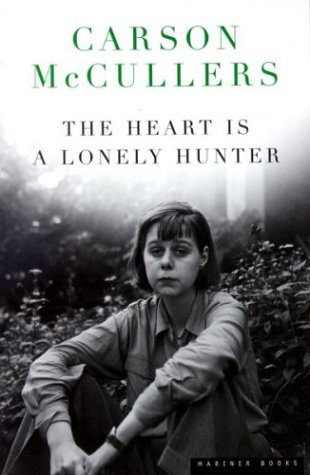
THE HEART IS A LONELY HUNTER by Carson McCullers...Amazing. Beautiful. Necessary.


THE HEART IS A LONELY HUNTER
CARSON McCULLERS

Mariner Books
$13.95 trade paper, available now

Rating: 4.99* of five

The Publisher Says: With the publication of her first novel, The Heart Is a Lonely Hunter, Carson McCullers, all of twenty-three, became a literary sensation. With its profound sense of moral isolation and its compassionate glimpses into its characters' inner lives, the novel is considered McCullers' finest work, and an enduring masterpiece.

At its center is the deaf-mute John Singer, who becomes the confidant for various types of misfits in a Georgia mill town during the 1930s. Each one yearns for escape from small-town life. When Singer's mute companion goes insane, Singer moves into the Kelly house, where Mick Kelly, the book's heroine (loosely based on McCullers), finds solace in her music. Brilliantly attuned to the spiritual isolation that underlies the human condition, and with a deft sense for racial tensions in the South, McCullers spins a haunting, unforgettable story that gives voice to the rejected, the forgotten, and the mistreated--and, through Mick Kelly, to the quiet, intensely personal search for beauty.

My Review: Oh, how I loved reading The Heart is a Lonely Hunter. Oh how very beautiful the writing in this book is! How much intense and careful observation went into the creation of these characters, each of whom...especially the Kelly family...I felt I could look up in the phone book and call for a chat.

The author was a whopping *twenty-two* when this book was published. TWENTY-TWO!! A person should barely be able to find a rathole and figure out how to pound sand down it at that age! And here McCullers is, creating archetypal characters that define a certain cultural space.

I feel like such a schmuck. Until I contemplate the extremely high cost of her genius...alcoholism, suicide attempts, relationships that ker-flooey-ed in spectacular ways...I am envious of her gift. But I am deeply grateful that she left as much work behind as she did in a short fifty years.

Well, that's all, really. It's amazing and it's beautiful and it's necessary, the way all fine, fine art is.

Monday, March 3, 2014

Revisiting ONE WRITER'S BEGINNINGS, Eudora Welty's Charming Memoir


ONE WRITER'S BEGINNINGS
EUDORA WELTY

Harvard University Press
$18.00 trade paper, available now

Rating: 4.5* of five

The Publisher Says: Eudora Welty was born in 1909 in Jackson, Mississippi. In a "continuous thread of revelation" she sketches her autobiography and tells us how her family and her surroundings contributed to the shaping not only of her personality but of her writing. Homely and commonplace sights, sounds, and objects resonate with the emotions of recollection: the striking clocks, the Victrola, her orphaned father's coverless little book saved since boyhood, the tall mountains of the West Virginia back country that become a metaphor for her mother's sturdy independence, Eudora's earliest box camera that suspended a moment forever and taught her that every feeling awaits a gesture. She has recreated this vanished world with the same subtlety and insight that mark her fiction.

Even if Eudora Welty were not a major writer, her description of growing up in the South--of the interplay between black and white, between town and countryside, between dedicated schoolteachers and the public they taught--would he notable. That she is a splendid writer of fiction gives her own experience a family likeness to others in the generation of young Southerners that produced a literary renaissance. Until publication of this book, she had discouraged biographical investigations. It undoubtedly was not easy for this shy and reticent lady to undertake her own literary biography, to relive her own memories (painful as well as pleasant), to go through letters and photographs of her parents and grandparents. But we are in her debt, for the distillation of experience she offers us is a rare pleasure for her admirers, a treat to everyone who loves good writing and anyone who is interested in the seeds of creativity.

My Review: The unassuming, delight-filled, unsparingly un-self-indulgent prose of Miss Eudora's fiction is surpassed in this expansion and revision of her Massey Lecture in the History of American Civilization, delivered at Harvard in 1983. For anyone unacquainted with Miss Eudora's literary output, I recommend starting with short fiction ("The Bride of the Innisfallen" is a good starter, followed by "Why I Live at the P.O."), moving on to her chef d'ouevre, the novel The Ponder Heart; this memoir, all 104pp of it, should come after one knows whether one is able to appreciate the particularities and glories of Miss Eudora's work. While I think she would appeal to any able-minded reader, I know from experience that her beautiful sentences sound like preciosity to some readers: eg, "Over a stronghold of a face, the blue hat of the lady in the raincoat was settled on like an Indian bonnet, or, rather, like an old hat, which it was." (from "The Bride of the Innisfallen")

This, to me, is equalled in English by Nabokov's terse clarity, and by little else; but it has been cited to me several times as unendurably cutesy or simply overwritten. I so completely disagree that it's hard to credit the opinion-havers with a shred of taste; however, there are tastes, and there are tastes, so I move on from my digression.

One Writer's Beginnings is told in a narrative voice much like her fiction; it is constructed like the linear tale that a life is when it is reflected on at leisure; and there are so many things in her history, from 1909 and her birth until her last entry in the lecture, a trip by train to New York during the Great Depression as a WPA junior publicity agent, that clearly formed a consciousness of time and place and rightness of things that she uses to such telling effect in her stories. An anecdote early in the book of her parents' morning routine of whistling and humming back and forth up and down the stairs phrases from "The Merry Widow Waltz" illuminates for me the means by which this shy, never-married lady "got" the signals of relationship that are so necessary to the parties in happiness. Another moment, the discovery of two nickels preserved in a hidden box, teaches me that Miss Eudora never felt any unmixed emotion (I won't tell that story, it must be read to be understood) and that is why The Ponder Heart is such a landmark in Southern ficiton.

The death of Miss Eudora's beloved father in 1931 is simply too painful for her to go into; she elides the details and leaves us to infer her pain. It fits with her lifelong lack of interest in talking about herself, but it leaves the reader without an anchor in what had to be a turbulent passage in her life. I can't fault the lady for her reticence, but in this as in several other areas, it would have behooved Miss Eudora to have let others guide her in preparing these talks so as to answer more questions.

Well, and therein the rub: It was the last thing she ever wanted to do, answer questions, and it's also why she wrote such marvelous stories, to answer them all unasked.

Miss Eudora Welty, thank you for all of it, and a safe journey into the future for your gifts to us who follow along behind you.

Creative Commons License
This work is licensed under a Creative Commons Attribution-NonCommercial-ShareAlike 3.0 Unported License.