Pages
- Home
- Mystery Series
- Bizarro, Fantasy & SF
- QUILTBAG...all genres
- Kindle Originals...all genres
- Politics & Social Issues
- Thrillers & True Crime
- Young Adult Books
- Poetry, Classics, Essays, Non-Fiction
- Science, Dinosaurs & Environmental Issues
- Literary Fiction & Short Story Collections
- Sookie Stackhouse/Southern Vampire Books & True Blood
- Books About Books, Authors & Biblioholism
Showing posts with label literary grotesques. Show all posts
Saturday, December 30, 2023
THE ARREST, cozy catastrophe from a monadnock of literary SF
THE ARREST
JONATHAN LETHEM
Ecco
$16.99 trade paper, available now
Rating: 3* of five
The Publisher Says: The Arrest isn't post-apocalypse. It isn't a dystopia. It isn't a utopia. It's just what happens when much of what we take for granted—cars, guns, computers, and airplanes, for starters—stops working... Before the Arrest, Sandy Duplessis had a reasonably good life as a screenwriter in L.A. An old college friend and writing partner, the charismatic and malicious Peter Todbaum, had become one of the most powerful men in Hollywood. That didn't hurt.
Now, post-Arrest, nothing is what it was. Sandy, who calls himself Journeyman, has landed in rural Maine. There he assists the butcher and delivers the food grown by his sister, Maddy, at her organic farm. But then Todbaum shows up in an extraordinary a retrofitted tunnel-digger powered by a nuclear reactor. Todbaum has spent the Arrest smashing his way across a fragmented and phantasmagorical United States, trailing enmities all the way. Plopping back into the siblings' life with his usual odious panache, his motives are entirely unclear. Can it be that Todbaum wants to produce one more extravaganza? Whatever he's up to, it may fall to Journeyman to stop him. Written with unrepentant joy and shot through with just the right amount of contemporary dread, The Arrest is speculative fiction at its absolute finest.
I RECEIVED A DRC FROM THE PUBLISHER VIA NETGALLEY. THANK YOU.
My Review: I should've read this in 2020. It would've suited the mood of that plague-stopped world perfectly.
Since I didn't, I read the book without any frisson whatsoever. As always with Lethem's writing, the sentences pass with their unshowy but tremendously high level of craftsmanship causing them to slide directly into your brain. This, despite every character being pretty much...average. They don't stand out; they aren't meant to. This is a cozy catastrophe, not a Hero's Journey. I don't know if that was Author Lethem's intent but it's what we got.
The most vivid presence, the one truly blaringly alive character, isn't the blah "Journeyman"...an ycleture entirely self-generated as no one addresses or refers to the main character by that name...but Todbaum (literally "death tree") the thinly-veiled satirical caricature of 45. Plowing through the landscape, crushing all remaining shelter and destroying the livelihoods of all unlucky enough to be in his way, his nuclear-powered engine of destruction was made before the catastrophe of The Arrest so is the only surviving example of technology that Lethem posits destroyed us. Now, in the post-Arrest world, people are clueless and helpless. Then here comes Todbaum to destroy them anew with his sociopathic indifference and hoarded tech.
Pretty on-the-nose as a caricature of 45, but equally applicable to the billionaire class and their survival bunkers as a whole.
What would've worked better for me, personally, in 2020 was the laying-bare of the then-president's sociopathy before January 6th, 2021, rendered fiction about his toxicity irrelevant to the point of becoming distasteful. I was mildly amused, and always entertained, by the story. I was never inside it, or moved to want more of it. I read the book and appreciated the author's skill. I didn't invest in anyone inside the story but watched passively as events happened to and around them.
In a way I suppose this is as close as I can get to the experience of people who consume stories by staring at them on TV. I accepted what I was shown. I never once thought about whys, or hows, or what-ifs. What's here is all there is. This is not my preference, to be honest; it leaves me outside and while I expect that was the point, I didn't enjoy it much.
For me, this was a case of wishy meets washy in a beige future world that's too much and not enough like the present for it to work as allegory, satire, or parable. I'd be angry and upset with it, except that it's too well-made, too craftsmanlike, to truly disappoint that much. While it delivers what it promises it will, it doesn't delight the way Author Lethem most assuredly can.
Wednesday, March 5, 2014
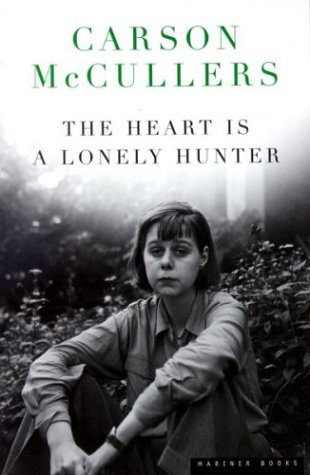
THE HEART IS A LONELY HUNTER by Carson McCullers...Amazing. Beautiful. Necessary.

THE HEART IS A LONELY HUNTER
CARSON McCULLERS
Mariner Books
$13.95 trade paper, available now
Rating: 4.99* of five
The Publisher Says: With the publication of her first novel, The Heart Is a Lonely Hunter, Carson McCullers, all of twenty-three, became a literary sensation. With its profound sense of moral isolation and its compassionate glimpses into its characters' inner lives, the novel is considered McCullers' finest work, and an enduring masterpiece.
At its center is the deaf-mute John Singer, who becomes the confidant for various types of misfits in a Georgia mill town during the 1930s. Each one yearns for escape from small-town life. When Singer's mute companion goes insane, Singer moves into the Kelly house, where Mick Kelly, the book's heroine (loosely based on McCullers), finds solace in her music. Brilliantly attuned to the spiritual isolation that underlies the human condition, and with a deft sense for racial tensions in the South, McCullers spins a haunting, unforgettable story that gives voice to the rejected, the forgotten, and the mistreated--and, through Mick Kelly, to the quiet, intensely personal search for beauty.
My Review: Oh, how I loved reading The Heart is a Lonely Hunter. Oh how very beautiful the writing in this book is! How much intense and careful observation went into the creation of these characters, each of whom...especially the Kelly family...I felt I could look up in the phone book and call for a chat.
The author was a whopping *twenty-two* when this book was published. TWENTY-TWO!! A person should barely be able to find a rathole and figure out how to pound sand down it at that age! And here McCullers is, creating archetypal characters that define a certain cultural space.
I feel like such a schmuck. Until I contemplate the extremely high cost of her genius...alcoholism, suicide attempts, relationships that ker-flooey-ed in spectacular ways...I am envious of her gift. But I am deeply grateful that she left as much work behind as she did in a short fifty years.
Well, that's all, really. It's amazing and it's beautiful and it's necessary, the way all fine, fine art is.
Thursday, August 1, 2013
THE WASP FACTORY: An Appreciative Review
The late, great Iain (M.) Banks's passing inspired a number of group reads of his books in different Internetty places. I joined one for THE WASP FACTORY over on LibraryThing. A lot of people had ewww-ick responses; my response is here.
This is one great, as in LOLITA-type great, book. It will long, long outlive most (maybe even all) other books published in 1984.
REPOSTING REVIEW 6 FEBRUARY 2017

THE WASP FACTORY
IAIN BANKS
Simon & Schuster
$16.00 trade paper, available now
Rating: 5* of five
The Publisher Says: Frank--no ordinary sixteen-year-old--lives with his father outside a remote Scottish village. Their life is, to say the least, unconventional. Frank's mother abandoned them years ago: his elder brother Eric is confined to a psychiatric hospital; & his father measures out his eccentricities on an imperial scale. Frank has turned to strange acts of violence to vent his frustrations. In the bizarre daily rituals there is some solace. But when news comes of Eric's escape from the hospital Frank has to prepare the ground for his brother's inevitable return--an event that explodes the mysteries of the past & changes Frank utterly.
My Review: Much has been said in disgust and even anger about this polarizing book. Some have called for it to be banned. Others have written the equivalent of a silent finger-down-the-throat mime.
You are all entitled to your opinion. Here is mine: This book is brilliant. It will be remembered long long after the pleasant entertainments of the day are more forgotten than Restoration drama. (Hands up anyone who knows who Colley Cibber is. And don't front. Or use Wikipedia.)
I'm also an ardent partisan of Lolita, that deeply disturbing and very beautiful book by a pedophile about his pursuit of the perfect lover. I loved Mrs. Dalloway, the chilling, near-perfect narrative of a wealthy woman's desperation and crushing ennui.
So here's the deal: Frank, and his brother Eric, aren't role models, aren't people you'd want to be around, aren't amusing compadres for a jaunt along the path to the Banal Canal. They are, like Hum and Lo and Clarissa and Septimus, avatars (in the pre-Internet sense) of the raw, bleeding, agonic (unangled, in this use) purposelessness of life. They are the proof that salvation is a cruel ruse. These characters rip your fears from the base of your brain and move them, puppetlike, eerily masterful withal, into your worst nightmares.
And all without resorting to the supernatural.
Humanity comes off badly in this book. The truth of what made Frank the person he is will leave you more chilled than any silly evocation of a devil in a religious text. Frank's very being is an ambulatory evil act. But the reason for it, the motivating factor, is the absolute worst horror this book contains. All the animal-torture stuff is unpleasant, I agree. It's not as though it's lovingly and lingeringly described. And it pales in comparison to Frank's raison d'etre.
So yes, this book is strong meat. It's got deeply twisted characters enacting their damage before us, the safely removed audience. It's making a serious point about human nature. And it's doing all of that in quite beautifully wrought prose, without so much as one wasted word.
But it's essentially a warning to the reader: Don't go there. Don't do the pale, weak-kneed versions of the rage-and-hate fueled horrors inflicted on Frank, and even on Eric. Pay attention, be mindful of the many ways we as lazy moral actors condone the creation of Erics and Franks in our world.
Pay attention.
This is one great, as in LOLITA-type great, book. It will long, long outlive most (maybe even all) other books published in 1984.
REPOSTING REVIEW 6 FEBRUARY 2017

THE WASP FACTORY
IAIN BANKS
Simon & Schuster
$16.00 trade paper, available now
Rating: 5* of five
The Publisher Says: Frank--no ordinary sixteen-year-old--lives with his father outside a remote Scottish village. Their life is, to say the least, unconventional. Frank's mother abandoned them years ago: his elder brother Eric is confined to a psychiatric hospital; & his father measures out his eccentricities on an imperial scale. Frank has turned to strange acts of violence to vent his frustrations. In the bizarre daily rituals there is some solace. But when news comes of Eric's escape from the hospital Frank has to prepare the ground for his brother's inevitable return--an event that explodes the mysteries of the past & changes Frank utterly.
My Review: Much has been said in disgust and even anger about this polarizing book. Some have called for it to be banned. Others have written the equivalent of a silent finger-down-the-throat mime.
You are all entitled to your opinion. Here is mine: This book is brilliant. It will be remembered long long after the pleasant entertainments of the day are more forgotten than Restoration drama. (Hands up anyone who knows who Colley Cibber is. And don't front. Or use Wikipedia.)
I'm also an ardent partisan of Lolita, that deeply disturbing and very beautiful book by a pedophile about his pursuit of the perfect lover. I loved Mrs. Dalloway, the chilling, near-perfect narrative of a wealthy woman's desperation and crushing ennui.
So here's the deal: Frank, and his brother Eric, aren't role models, aren't people you'd want to be around, aren't amusing compadres for a jaunt along the path to the Banal Canal. They are, like Hum and Lo and Clarissa and Septimus, avatars (in the pre-Internet sense) of the raw, bleeding, agonic (unangled, in this use) purposelessness of life. They are the proof that salvation is a cruel ruse. These characters rip your fears from the base of your brain and move them, puppetlike, eerily masterful withal, into your worst nightmares.
And all without resorting to the supernatural.
Humanity comes off badly in this book. The truth of what made Frank the person he is will leave you more chilled than any silly evocation of a devil in a religious text. Frank's very being is an ambulatory evil act. But the reason for it, the motivating factor, is the absolute worst horror this book contains. All the animal-torture stuff is unpleasant, I agree. It's not as though it's lovingly and lingeringly described. And it pales in comparison to Frank's raison d'etre.
So yes, this book is strong meat. It's got deeply twisted characters enacting their damage before us, the safely removed audience. It's making a serious point about human nature. And it's doing all of that in quite beautifully wrought prose, without so much as one wasted word.
But it's essentially a warning to the reader: Don't go there. Don't do the pale, weak-kneed versions of the rage-and-hate fueled horrors inflicted on Frank, and even on Eric. Pay attention, be mindful of the many ways we as lazy moral actors condone the creation of Erics and Franks in our world.
Pay attention.
Subscribe to:
Posts (Atom)