Pages
- Home
- Mystery Series
- Bizarro, Fantasy & SF
- QUILTBAG...all genres
- Kindle Originals...all genres
- Politics & Social Issues
- Thrillers & True Crime
- Young Adult Books
- Poetry, Classics, Essays, Non-Fiction
- Science, Dinosaurs & Environmental Issues
- Literary Fiction & Short Story Collections
- Sookie Stackhouse/Southern Vampire Books & True Blood
- Books About Books, Authors & Biblioholism
Showing posts with label satire. Show all posts
Tuesday, August 12, 2025
PROFESSOR SCHIFF'S GUILT, humor is hard, but better when hard-edged
PROFESSOR SCHIFF'S GUILT
AGUR SCHIFF (tr. Jessica Cohen)
New Vessel Press (non-affiliate Bookshop.org link)
$17.95 all editions, available now
Rating: 4* of five
The Publisher Says: A stellar novel rendered into a darkly comic, unforgettable narrative by Booker International Prize winning translator Jessica Cohen.
An Israeli professor travels to a fictitious West African nation to trace a slave-trading ancestor, only to be imprisoned under a new law barring successive generations from profiting off the proceeds of slavery. But before departing from Tel Aviv, the protagonist falls in love with Lucile, a mysterious African migrant worker who cleans his house.
Entertaining and thought-provoking, this satire of contemporary attitudes toward racism and the legacy of colonialism examines economic inequality and the global refugee crisis, as well as the memory of transatlantic chattel slavery and the Holocaust. Is the professor’s passion for Africa merely a fashionable pose and the book he's secretly writing about his experience there nothing but a modern version of the slave trade?
I RECEIVED A DRC FROM THE PUBLISHER VIA EDELWEISS+. THANK YOU.
My Review: I'm willing to bet that most people squirm just reading the synopsis. It's a reckoning with the long shadow of chattel slavery and its ties to Jewish merchants.
I think the best choice Author Schiff made was to tell the story in a comedic register, relying on farcical coincidences of crime and punishment to acknowledge past harms while lampooning present ones caused by some clumsy, bureaucratic attempt at balancing cosmic scales.
The far more interesting point Author Schiff makes, to me at least, is the sheer ubiquity of the mental construct of Africa as lesser, as broken and needing "us" to fix it. The way Professor Schiff approaches his putative project in the narrative begs the question "why are you doing this?"
As a meditation on white guilt versus White Guilt, I think it's a great contribution to necessary conversations about Jewish complicity in the crimes of chattel slavery. As a novel about an individual man's coming to self-awareness, it felt...off.
The parallels drawn between Ancestor Schiff and his appropriation of the slavegirl, and Storyteller Schiff and his relationship to his cleaner, weren't that successful in my reading eyes. They felt as performative as the arrest and legal proceedings of Storyteller Schiff did, without the sharp edge of satire to make them cut my tough hide of willful ignorance. As a result, I was more squicked out than I was challenged to contemplate the real meaning of these sexual crimes. In fact I felt less sympathy for Ancestor Schiff before Storyteller Schiff's peccadillo was brought in. I think the opposite was intended.
I know that could really be a "me" thing, but I bring it up to alert readers who find sexual exploitation deeply unpleasant that this could decrease their reading pleasure.
I'm not as delighted by the read as others were but I am happy to have read a reckoning with an underrepresented crime of historical complicity.
Wednesday, June 19, 2024
GAY SCIENCE: The Totally Scientific Examination of LGBTQ+ Culture, Myths, and Stereotypes, fun froth for the train to Babylon
GAY SCIENCE: The Totally Scientific Examination of LGBTQ+ Culture, Myths, and Stereotypes
ROB ANDERSON
DK Books
$25.00 hardcover, available now
KINDLE SALE! $2.99! (NON-AFFILIATE Amazon link)
Rating: 3.75* of five
The Publisher Says: New York Times Bestseller
Comedian Rob Anderson examines queer stereotypes and LGBTQ+ culture with humorous explanations borrowed from real principles across multiple fields of science.
Class is in session, babe! Discover the inner workings of the LGBTQ+ community with this humorous and informative book. Author and comedian Rob Anderson borrows the familiar science textbook format to skewer ridiculous queer stereotypes with his own version of science.
Using the principles of natural, social, and formal sciences, Rob answers extremely serious questions Why can’t gays sit in a chair properly? Why don’t lesbians have electricity in their movies? Are colleges turning people bisexual? How does gaydar work? Will bottoms survive the apocalypse?
You’ll read about the three subtypes of the gay uncle species, examine the Periodic Table of LGBTQ+ Elements, understand gay crime and punishment, and get educated on the types of bacteria and viruses that exclusively affect the LGBTQs, like the state of Florida.
Inspired by his viral “Gay Science” series, Rob recreates some of his most popular episodes in a literary format, and also tackles completely fresh subjects, presenting them with super empirical and totally evidence-based homosexual data.
Gay Science
Coverage of 60 topics across 29 fields of science including biology, chemistry, physics, genetics, botany, nutrition, astronomy, anthropology, oceanography, sociology, criminology, engineering, computer science, and more!Informative sidebars including Get PrePared, The Tea, Serving Conclusions, The Gloss, Yas or Naur, Fagtoids, and A Lesbian Explains.Diagrams, charts, illustrations, and maps to explain the gayest concepts.
Rob Anderson is course-correcting decades of educational shortcomings by explaining the scientific reasonings behind every aspect of LGBTQ+ life. If you’re looking for a fun book that will probably be banned (if it isn’t already), add Gay Science to your personal lesson plan.
I RECEIVED THIS BOOK AS PART OF A PROMOTION. THANK YOU.
My Review: Do you remember the science textbooks from seventh grade? You will soon...you will forcefully recall the graphic design, the placement of information, the snippets and bullet points and images you sometimes wondered where they came from. It's deja vu only not scary...you're still sitting there book/device in hand, not out-of-body wondering how to escape the nightmare.
Comedy = misery plus time was never more well-aimed. The way we learn how to be queer is often bound up with laughter. Joking, clowning, being the butt of the joke, being laughed at...it's all laughter and all fuel for the deep wells of humor in gay culture. And notice I'm using "gay" not the more inclusive words. If this gigglemaker of a book has a flaw it's that it us very much for, by, and about the gay male. Being one of those I don't find that troubling. I find it more indicative of marketing segmentation than a product of innate malice or even unexamined bias. Go watch his YouTube channel; decide if you think the man's being insensitive or telling his own truth, not trying to generalize his experience into spurious universality.
Of course, as humor, it will inevitably fail to "hit" with some; I am not among them. I got good laughs and lots of snorts and a few eye-streaming fits. My Rob was a little scared by my call during one of those! He thought I was having another, weirder, stroke. He was far more muted in his responses to Mr. Anderson, possibly because I introduced him as "the hot comedian"—might've been a tad prejudicial.
The stereotypes and archetypes Anderson takes on are real, so there will be some butthurt among the people. Laugh at yourself, get over the idea that respect = praise, and most of all take in the scene...get some perspective on how you actually look from the outside. It very much helps everyone when we all do that.
So let me urge the gay guys to listen to this call from inside the house. Let me urge the eww-ick homophobes to splash out for a sale Kindlebook. Let's look at the reality of gay identity in its weird and wonderful strangeness, its wildly obsessive focuses, its deeply human flawed glorious fun-seeking.
And laugh. Together.
Saturday, December 30, 2023
THE ARREST, cozy catastrophe from a monadnock of literary SF
THE ARREST
JONATHAN LETHEM
Ecco
$16.99 trade paper, available now
Rating: 3* of five
The Publisher Says: The Arrest isn't post-apocalypse. It isn't a dystopia. It isn't a utopia. It's just what happens when much of what we take for granted—cars, guns, computers, and airplanes, for starters—stops working... Before the Arrest, Sandy Duplessis had a reasonably good life as a screenwriter in L.A. An old college friend and writing partner, the charismatic and malicious Peter Todbaum, had become one of the most powerful men in Hollywood. That didn't hurt.
Now, post-Arrest, nothing is what it was. Sandy, who calls himself Journeyman, has landed in rural Maine. There he assists the butcher and delivers the food grown by his sister, Maddy, at her organic farm. But then Todbaum shows up in an extraordinary a retrofitted tunnel-digger powered by a nuclear reactor. Todbaum has spent the Arrest smashing his way across a fragmented and phantasmagorical United States, trailing enmities all the way. Plopping back into the siblings' life with his usual odious panache, his motives are entirely unclear. Can it be that Todbaum wants to produce one more extravaganza? Whatever he's up to, it may fall to Journeyman to stop him. Written with unrepentant joy and shot through with just the right amount of contemporary dread, The Arrest is speculative fiction at its absolute finest.
I RECEIVED A DRC FROM THE PUBLISHER VIA NETGALLEY. THANK YOU.
My Review: I should've read this in 2020. It would've suited the mood of that plague-stopped world perfectly.
Since I didn't, I read the book without any frisson whatsoever. As always with Lethem's writing, the sentences pass with their unshowy but tremendously high level of craftsmanship causing them to slide directly into your brain. This, despite every character being pretty much...average. They don't stand out; they aren't meant to. This is a cozy catastrophe, not a Hero's Journey. I don't know if that was Author Lethem's intent but it's what we got.
The most vivid presence, the one truly blaringly alive character, isn't the blah "Journeyman"...an ycleture entirely self-generated as no one addresses or refers to the main character by that name...but Todbaum (literally "death tree") the thinly-veiled satirical caricature of 45. Plowing through the landscape, crushing all remaining shelter and destroying the livelihoods of all unlucky enough to be in his way, his nuclear-powered engine of destruction was made before the catastrophe of The Arrest so is the only surviving example of technology that Lethem posits destroyed us. Now, in the post-Arrest world, people are clueless and helpless. Then here comes Todbaum to destroy them anew with his sociopathic indifference and hoarded tech.
Pretty on-the-nose as a caricature of 45, but equally applicable to the billionaire class and their survival bunkers as a whole.
What would've worked better for me, personally, in 2020 was the laying-bare of the then-president's sociopathy before January 6th, 2021, rendered fiction about his toxicity irrelevant to the point of becoming distasteful. I was mildly amused, and always entertained, by the story. I was never inside it, or moved to want more of it. I read the book and appreciated the author's skill. I didn't invest in anyone inside the story but watched passively as events happened to and around them.
In a way I suppose this is as close as I can get to the experience of people who consume stories by staring at them on TV. I accepted what I was shown. I never once thought about whys, or hows, or what-ifs. What's here is all there is. This is not my preference, to be honest; it leaves me outside and while I expect that was the point, I didn't enjoy it much.
For me, this was a case of wishy meets washy in a beige future world that's too much and not enough like the present for it to work as allegory, satire, or parable. I'd be angry and upset with it, except that it's too well-made, too craftsmanlike, to truly disappoint that much. While it delivers what it promises it will, it doesn't delight the way Author Lethem most assuredly can.
Thursday, September 21, 2023
KILL FOR LOVE, is Tiffany the new Patrick Bateman?
KILL FOR LOVE
LAURA PICKLESIMER
The Unnamed Press
$28.00 hardcover, available now
Rating: 4* of five
The Publisher Says: The boys on the row are only after one thing, but that bullshit’s for pledges. Tiffany’s on the hunt for something more.
Kill for Love is a searing satirical thriller about Tiffany, a privileged Los Angeles sorority sister who is struggling to keep her sadistic impulses—and haunting nightmares of fire and destruction—at bay. After a frat party hookup devolves into a bloody, fatal affair, Tiffany realizes something within her has awoken: the insatiable desire to kill attractive young men.
As Tiffany’s bloodlust deepens and the bodies pile up, she must contend with mounting legal scrutiny, social media-fueled competing murders, and her growing relationship with Weston, who she thinks could be the perfect boyfriend. A female-driven, modern-day American Psycho, Kill for Love exposes modern toxic plasticity with dark comedy and propulsive plot.
I RECEIVED A DRC FROM THE PUBLISHER VIA EDELWEISS+. THANK YOU.
My Review: If you have a trigger, this book will trip it. Shop elsewhere.
Is the best way to satirize something to stand it on its head, replicating beat-for-beat its abuses on those usually perpetrating them?
By my definition of "best," this time the answer's yes. Like the 2019 delight that was Oyinkan Braithwaite's My Sister, the Serial Killer, this book posits a vicious and cruel woman enacting sexual violence on the men...pretty, vapid young men in this case...who irritate her. We're in Tiffany's head this time, unlike Braithwaite's story of an appalled sister's responses to the aftermath of violence. It's a much more awful place to be. Not that she's unjusified in targeting her victims, you understand. It's just the glorious release and the bloody reveling in her newfound freedom to be the perpetrator, not the victim, of violence is...a bit unpleasant. A lot like the experience of reading the very accurate publisher's comp title American Psycho is. Being inside an unhinged person's head as they perpetrate unspeakable sexualized violence for their own gratification is very, very unsettling...to me at least. Thank goodness it is, or I'd be worried about myself.
What Author Picklesimer does that wasn't done in American Psycho is leave her character on the surfaces of things, people, thoughts...she has, and sees, and needs no depth in, to, of anything. Her world is flat and glossy with a few stark shadows and fewer ideas. Patrick Bateman reveled in what he was doing but had pseudoprofound thoughts about it. Tiffany is utterly without nuance. It works much better than some out-of-character philosophizing would have done to poke a satirical finger in the chest of the rampant blatant ever-uglier misogyny in the use of sexualized violence against women as entertainment. Women are victims and foils, you say? asks Author Picklesimer. What drove this man to do all these awful things to women, as though that was the important part because, one is led to understand, *HE* is then the main character, not his victim.
Her response to this sexist, misogynistic bullshit is to give the world Tiffany, pretty, shallow, privileged Tiffany. She revels in her bloody dispatchings of men because it feels good...no woman on a mission, no abused-become-abuser mealymouthing. She gets off on it.
It's probably more unsettling to me that she finds Weston so lovable than that she commits the awful acts she does. The randomness of her choice, the indistinguishability of Weston from the victims, is so completely arbitrary that it gives me the heebie-jeebies when I contemplate how much of my own continued existence is down to not meeting a Tiffany when their bloodlust was up.
There were problems in the read for me. One was Tiffany's peculiarly empathetic response to her roommate, whom she professes to dislike, experiencing rape. Why would Tiffany care? She's got no empathy in her or the oceans of awfulness wouldn't happen. I wasn't entirely sure that California, where we set our scene, was meant to be satirical or reportorial. Its wasteland-of-violence presentation was deadpan enough that it didn't read as exaggerated for effect to me. That meant I was left wondering how this has only now created a Tiffany...and how it is that Authority in such a hellscape overlooked her as a potential perpetrator without her using a whole lot of effort to mislead them. I suppose that's a commentary on sexism's immensely stupidifying effect on men.
Even Tiffany has a family, though you'd barely know it. Her sister is window-dressed into one scene I can remember, which means there was either no need for her at all or there's a missed opportunity here. Weston's bestie, Dean, had a tiny role that I'd've liked more of, but the bit he was in certainly ramped up the tension so read that as a bleat of dissatisfaction not a criticism.
I've got this to say about the read: It suited me down to the ground for what I wanted it to do. It entertained me as I thought of the thousands of hours of girls (term used advisedly) breasting boobily across stage, page, and screen to titillate with their sexuality before being punished in violent awful ways for it.
How's it feel when the tables are turned, gents?
Sunday, January 1, 2017
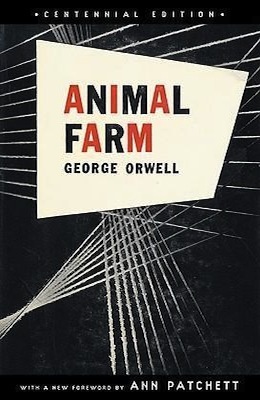
ANIMAL FARM, the 20th century's best, most biting political satire

ANIMAL FARM
GEORGE ORWELL
Everyman's Library
$20 hardcover, available now
Rating: 5* of five
The Publisher Says: Signet Classics 1996 edition:
A farm is taken over by its overworked, mistreated animals. With flaming idealism and stirring slogans, they set out to create a paradise of progress, justice, and equality. Thus the stage is set for one of the most telling satiric fables ever penned –a razor-edged fairy tale for grown-ups that records the evolution from revolution against tyranny to a totalitarianism just as terrible.
When Animal Farm was first published, Stalinist Russia was seen as its target. Today it is devastatingly clear that wherever and whenever freedom is attacked, under whatever banner, the cutting clarity and savage comedy of George Orwell’s masterpiece have a meaning and message still ferociously fresh.
Penguin Classics 2000 edition:
'It is the history of a revolution that went wrong – and of the excellent excuses that were forthcoming at every step for the perversion of the original doctrine,' wrote Orwell for the first edition of Animal Farm in 1945. Orwell wrote the novel at the end of 1943, but it almost remained unpublished. Its savage attack on Stalin, at that time Britain's ally, led to the book being refused by publisher after publisher. Orwell's simple, tragic fable, telling what happens when the animals drive out Mr Jones and attempt to run the farm themselves, has since become a world famous classic.
NAL 2003 edition:
"All animals are equal. But some animals are more equal than others."
One night on an English farm, Major the boar recounts his vision of a utopia where his fellow creatures own the land along with the means of production and are no longer the slaves of humans.
Before long his dream comes true, and for a short while all animals really are equal. But the clever pigs educate themselves and soon learn how to extend their own power, inevitably at the expense of the rest of the community.
This well-loved tale is, of course, a satire on the Soviet Communist system that still remains a powerful warning despite the changes in world politics since "Animal Farm" was first published.
Everyman's Library 1993 edition:
Animal Farm is the most famous by far of all twentieth-century political allegories. Its account of a group of barnyard animals who revolt against their vicious human master, only to submit to a tyranny erected by their own kind, can fairly be said to have become a universal drama. Orwell is one of the very few modern satirists comparable to Jonathan Swift in power, artistry, and moral authority; in animal farm his spare prose and the logic of his dark comedy brilliantly highlight his stark message.
Taking as his starting point the betrayed promise of the Russian Revolution, Orwell lays out a vision that, in its bitter wisdom, gives us the clearest understanding we possess of the possible consequences of our social and political acts.
My Review: What on earth is the point of reviewing this book? Why should I ask you to read a review of something that, in all likelihood, you're already familiar with and have a strong memory of and opinion about? Italo Calvino said it for me: "A classic is a book that has never finished saying what it has to say." And therefore a classic is a book about which the serious lover of reading should never stop talking or thinking about, or re-evaluating, re-reading, re-responding to.
I did not remember this passage from the first chapter:
I merely repeat, remember always your duty of enmity towards Man and all his ways. Whatever goes upon two legs is an enemy. Whatever goes upon four legs, or has wings, is a friend. And remember also that in fighting against Man, we must not come to resemble him. Even when you have conquered him, do not adopt his vices. No animal must ever live in a house, or sleep in a bed, or wear clothes, or drink alcohol, or smoke tobacco, or touch money, or engage in trade. All the habits of Man are evil. And, above all, no animal must ever tyrannise over his own kind. Weak or strong, clever or simple, we are all brothers. No animal must ever kill any other animal. All animals are equal.Old Major the boar addresses the assembled animals of Jones's Farm thus; he's had a long life and over four hundred children, a lot of time to think, and thus has earned the right to instruct the younger, the less able (like poor old Boxer the workhorse).
Life has a new zest for the animals after Farmer Jones and his henchmen are driven off the farm. The incontestable truth that the fruits of one's labor are sweeter than any others is brought home to the hardworking animals:
The animals were happy as they had never conceived it possible to be. Every mouthful of food was an acute positive pleasure, now that it was truly their own food, produced by themselves and for themselves, not doled out to them by a grudging master. With the worthless parasitical human beings gone, there was more for everyone to eat. There was more leisure too, inexperienced though the animals were.Tomatoes one grows one's own self are always sweeter than store-bought; food made with one's own hands is tastier than fast food can ever be. Of course, all the animals do the work together, so of course they eat the fruits of their labor together, equally. Of course! Why would you imagine that it would ever be any other way?
The early apples were now ripening, and the grass of the orchard was littered with windfalls. The animals had assumed as a matter of course that these would be shared out equally; one day, however, the order went forth that all the windfalls were to be collected and brought to the harness-room for the use of the pigs. At this some of the other animals murmured, but it was no use. All the pigs were in full agreement on this point, even Snowball and Napoleon. Squealer was sent to make the necessary explanations to the others.Of course.
“Comrades!” he cried. “You do not imagine, I hope, that we pigs are doing this in a spirit of selfishness and privilege? Many of us actually dislike milk and apples. I dislike them myself. Our sole object in taking these things is to preserve our health. Milk and apples (this has been proved by Science, comrades) contain substances absolutely necessary to the well-being of a pig. We pigs are brainworkers. The whole management and organisation of this farm depend on us. Day and night we are watching over your welfare. It is for YOUR sake that we drink that milk and eat those apples. Do you know what would happen if we pigs failed in our duty? Jones would come back! Yes, Jones would come back! Surely, comrades,” cried Squealer almost pleadingly, skipping from side to side and whisking his tail, “surely there is no one among you who wants to see Jones come back?”
Now if there was one thing that the animals were completely certain of, it was that they did not want Jones back. When it was put to them in this light, they had no more to say. The importance of keeping the pigs in good health was all too obvious. So it was agreed without further argument that the milk and the windfall apples (and also the main crop of apples when they ripened) should be reserved for the pigs alone.
But nothing ever stays the same, does it? The animals have no reason to complain, surely! The work they do is rewarded with food...not apples or milk, it's true, but food...and they're all pulling together and doing their work together and deciding what the farm will produce together! Of course the pigs, the cleverest animals, are thinking the hardest and making the proposals for plans. That's natural, isn't it, the cleverest do the brain-work and think through the problems for the best solutions. And the cleverest pigs, Snowball and Napoleon, are always planning and thinking and exhorting the other animals. The trouble is that they almost never have the same plan. Snowball talks the animals around, but Napoleon always makes the last decision. Animals discuss the problem, the pigs compromise, but the situation just won't change.
But just at this moment Napoleon stood up and, casting a peculiar sidelong look at Snowball, uttered a high-pitched whimper of a kind no one had ever heard him utter before.Things change when the boss says they change. Then they change how the boss wants them to change. It's the single clearest hallmark of authoritarian government, and it's coming disturbingly close to US reality. Surely things won't, can't, get worse!
At this there was a terrible baying sound outside, and nine enormous dogs wearing brass-studded collars came bounding into the barn. They dashed straight for Snowball, who only sprang from his place just in time to escape their snapping jaws. In a moment he was out of the door and they were after him. Too amazed and frightened to speak, all the animals crowded through the door to watch the chase. Snowball was racing across the long pasture that led to the road. He was running as only a pig can run, but the dogs were close on his heels. Suddenly he slipped and it seemed certain that they had him. Then he was up again, running faster than ever, then the dogs were gaining on him again. One of them all but closed his jaws on Snowball’s tail, but Snowball whisked it free just in time. Then he put on an extra spurt and, with a few inches to spare, slipped through a hole in the hedge and was seen no more.
And then...
Napoleon, with the dogs following him, now mounted on to the raised portion of the floor where Major had previously stood to deliver his speech. He announced that from now on the Sunday-morning Meetings would come to an end. They were unnecessary, he said, and wasted time. In future all questions relating to the working of the farm would be settled by a special committee of pigs, presided over by himself. These would meet in private and afterwards communicate their decisions to the others. The animals would still assemble on Sunday mornings to salute the flag, sing ‘Beasts of England’, and receive their orders for the week; but there would be no more debates.Sounds familiar, doesn't it? The growling of the dogs set to protect the pig-in-chief at any cost, the unquestioning loyalty of the pack for its alpha. Disturbingly reminiscent of our president elect's command of a Twitter propaganda force, a CNN flying squad of apologists and face-timers. It's been so frequently seen that it's not even remarked upon in any way except to disagree with what's being spread around. The fact of it is...how I hate to say this...normal. Familiar, so normal.
In spite of the shock that Snowball’s expulsion had given them, the animals were dismayed by this announcement. Several of them would have protested if they could have found the right arguments. Even Boxer was vaguely troubled. He set his ears back, shook his forelock several times, and tried hard to marshal his thoughts; but in the end he could not think of anything to say. Some of the pigs themselves, however, were more articulate. Four young porkers in the front row uttered shrill squeals of disapproval, and all four of them sprang to their feet and began speaking at once. But suddenly the dogs sitting round Napoleon let out deep, menacing growls, and the pigs fell silent and sat down again. Then the sheep broke out into a tremendous bleating of “Four legs good, two legs bad!” which went on for nearly a quarter of an hour and put an end to any chance of discussion.
Far more upsettingly familiar is the pronouncement of anathema upon the expelled Snowball:
“Comrades,” [Napoleon] said quietly, “do you know who is responsible for this? Do you know the enemy who has come in the night and overthrown our windmill? SNOWBALL!” he suddenly roared in a voice of thunder. “Snowball has done this thing! In sheer malignity, thinking to set back our plans and avenge himself for his ignominious expulsion, this traitor has crept here under cover of night and destroyed our work of nearly a year. Comrades, here and now I pronounce the death sentence upon Snowball. ‘Animal Hero, Second Class,’ and half a bushel of apples to any animal who brings him to justice. A full bushel to anyone who captures him alive!”Julian Assange. Edward Snowden. Chelsea Manning. Put any of these names in Snowball's place. You won't notice a difference. Speaking out is treason. People who do are traitors and are directly and personally responsible for all the ills they spoke out against.
Some few of us are old. We have a memory of how things once were that isn't dependent on the pronunciamentos of the Powers That Be. It upsets the old folk to look at the way things are and compare them to the way we remember them to be, to remember how we wanted things to be for our children and grandchildren after us:
As Clover looked down the hillside her eyes filled with tears. If she could have spoken her thoughts, it would have been to say that this was not what they had aimed at when they had set themselves years ago to work for the overthrow of the human race. These scenes of terror and slaughter were not what they had looked forward to on that night when old Major first stirred them to rebellion. If she herself had had any picture of the future, it had been of a society of animals set free from hunger and the whip, all equal, each working according to his capacity, the strong protecting the weak, as she had protected the lost brood of ducklings with her foreleg on the night of Major’s speech. Instead — she did not know why — they had come to a time when no one dared speak his mind, when fierce, growling dogs roamed everywhere, and when you had to watch your comrades torn to pieces after confessing to shocking crimes. There was no thought of rebellion or disobedience in her mind. She knew that, even as things were, they were far better off than they had been in the days of Jones, and that before all else it was needful to prevent the return of the human beings. Whatever happened she would remain faithful, work hard, carry out the orders that were given to her, and accept the leadership of Napoleon.The rise of an ever-more authoritarian governmental structure in response to the economic depredations of the banksters is, if not inevitable, then more and more likely. This sensation of loss and the theft of the dream we invested our labor into realizing is acute, painful, and miserable. The mere notion of this Orwellian outcome of this latest presidential election is nauseating.
The simple distillation of the novella's point is almost too painful to read:
Somehow it seemed as though the farm had grown richer without making the animals themselves any richer-except, of course, for the pigs and the dogs. Perhaps this was partly because there were so many pigs and so many dogs. It was not that these creatures did not work, after their fashion. There was, as Squealer was never tired of explaining, endless work in the supervision and organisation of the farm. Much of this work was of a kind that the other animals were too ignorant to understand. For example, Squealer told them that the pigs had to expend enormous labours every day upon mysterious things called “files,” “reports,” “minutes,” and “memoranda”. These were large sheets of paper which had to be closely covered with writing, and as soon as they were so covered, they were burnt in the furnace. This was of the highest importance for the welfare of the farm, Squealer said. But still, neither pigs nor dogs produced any food by their own labour; and there were very many of them, and their appetites were always good.Those who produce nothing are taking everything. It is happening now. Banksters and fraudsters and capitalists care nothing for anyone or anything that doesn't fill their feed-bag with more, more, more. There is no such thing as enough for these people. When the place a spirit should be is empty, the entire earth doesn't have enough substance to plug the hole.
He had only one criticism, he said, to make of Mr. Pilkington’s excellent and neighbourly speech. Mr. Pilkington had referred throughout to “Animal Farm.” He could not of course know — for he, Napoleon, was only now for the first time announcing it — that the name “Animal Farm” had been abolished. Henceforward the farm was to be known as “The Manor Farm”— which, he believed, was its correct and original name.
Thursday, March 24, 2016
THE BARON IN THE TREES by Italo Calvino, one of the best books I've ever read

THE BARON IN THE TREES
ITALO CALVINO translated by Archibald Colquhoun
Mariner Books
$13.95 trade paper, available now
Rating: 4* of five
The Publisher Says: Cosimo, a young eighteenth-century Italian nobleman, rebels by climbing into the trees to remain there for the rest of his life. He adapts efficiently to an arboreal existence and even has love affairs.
My Review: This being a famous and well-studied book, I suppose the publisher didn't feel the need to do a sell-job on it. That little squib is barely a log-line!
I read this book first in ~1974, because it had a cool-looking jacket. It also had an Italian author, which was also cool. But the reading of it was a revelation because the titular Baron was the perfect rebel, firm of purpose and adamant of spirit. And all over what seems, at first anyway, such a ridiculous cause: Refusing to eat snails. I'd never had snails offered to me at that point, and I was in full agreement with the Baron. But as the pages flipped on, I could see what was really at stake was the right to set one's own boundaries, to establish a core identity by and for one's own self.
All adolescents resonate to that theme, I think, and that's why I'm surprised that this book isn't required reading until college. It would serve well in junior or senior year of high school. Anything that deals with the process and price of becoming and being an individual seems to me to be a good fit for that age. Plus it's beautifully translated, so it's easy to read.
And for the record, I ate snails the first time they were offered to me. They were delicious.
Monday, September 1, 2014
FANDEMONIUM, a satire with serious bite

FANDEMONIUM
RICK SCHINDLER
Wattle Publishing
$9.99 Kindle edition, available now
Rating: 3.5* of five
The Publisher Says: Fandemonium by Rick Schindler uses the colorful world of comics and fantasy as a microcosm and metaphor for media consolidation and the excesses of global mass culture. It is at once a hilarious satire of business and society, a portrait of an artist no longer young, and a sometimes poignant look at a universal challenge: to grow up, face the world, and put away childish things.
Ray Sirico used to have it all. Once, he was the brilliant and outrageous Clown Prince of Comics, who reinvented the venerable superhero Skylord, and ranted and rollicked everywhere from TV talk shows to Hollywood premieres.
But that was in the ’70s and ’80s. Now it’s 1993, and Sirico is a drunken has-been. His wife has left him, his movie flopped, and his comics’ publisher is doing so poorly that its new corporate parent has come up with a radical marketing stunt: the Death of Skylord.
Still, Sirico has one last chance to recapture the limelight: Fandemonium, the nation’s biggest fantasy convention. But others are coming to the con too: Harmony Storm, the sex-crazed actress who broke up Ray’s marriage; his former collaborator Tad Carlyle, who now has his own company, and a troubled relationship; Fred D’Auria, a fanboy fleeing adolescent traumas, and corporate conspirators who are plotting to sacrifice Sirico’s greatest creation for motives deeper than even his fevered imagination could conceive.
The publisher offered this book to me hoping for a kind, but asking for an honest, review
My Review: The author's bio says he has 11,000 comic books and a wife. I thought that having one of those things precluded the other. *rimshot*
I'm not a comic book person, and I'm not always sure that satire is a good choice for a whole novel. I'm cynical about fandoms in general. And first novelists are well advised to don protective gear when presenting me with their darlings, as my spleen needs regular venting.
And here I am giving this book over three stars. Will wonders never cease.
I like the novel, hate the characters, and want to shake the writer. The novel is presented in chapters that read like panels in a comic book, interspersed with screenplay bits, transcripts, etc etc. It makes the tedious trudge through the heads and lives of Harm (short for Harmony, and a good nickname for her it is) the horrid harridan, hefty humpster Ray the nebbishy loser, Taffy Poppenberg (how I **ADORE** minor non-character Taffy!) the news lady, so much less onerous. I don't get bogged down in any one PoV for long enough to lose steam. And besides I'm an old Moby-Dick fan, and this technique was superbly used in that book. Set up happy memory resonances for me. (We will NOT be discussing Tristram Shandy thenkewveddymahch.)
The characters are all well known to any follower of pop culture, business culture, or geekdom. As San Diego Comic Con has attained mainstream visibility, geekdom is less and less what it once was, a ghetto for off-kilter fen to celebrate their abnormality safely. I, an oldster without an anime-worshipping bone in my body, know what a furry is, and follow Sailor Moon refs. This is proof that there are no more hiding places for geekdom. The novel doesn't break any new ground limning the characters. It also doesn't miss a single trick damning them. I'm simultaneously aware that I'm being herded into a set of responses and reactions by the character choice and situational comedy, and amused by all the above. I'm outside the story and experiencing my responses as reactions, but then again that's the way satire works in my experience.
I do very deeply want to shake Rick Schindler. What are you doing here?! Why the hell is this book set in 1993?! To avoid the Internet? Yes yes, I was around for the comic-book publishing debacles of the era...I met the guy who started Broadway Comics...and you know what? 1993 wasn't integral to the stories you've chosen to tell and your points are still valid today, which is a damned good thing because nothing on this earth is duller than obsolete satire. Also, dig deeper! Many situations, most notably Sirico the Stout's disintegration, could have been more keenly pointedly stabbed into the reader's heart. It's possible to do this and maintain humor, see Candide for Cunégonde's marriage to Candide. (I refuse to spoiler-tag a 250-year-old book's plot points.) And not least: Really? C'mon. Really?
All that said, all my grumbles aside, there is much to take pleasure in presented here. The quiet and unobtrusive view of fans as owners versus fans as consumers of stories and characters is very relevant to today's world. The vicious and back-stabby corporate culture that exists is never a bad choice of target for skewering. The book is, in the end, about the experience of reading it, and that was a net positive use of my time. Considering the number of ways and times that could have turned out worse, this book deserves any and all praise it earns and gets my recommendation to read. Readers not comics geeks are especially encouraged to give it a whirl.
This work is licensed under a Creative Commons Attribution-NonCommercial-ShareAlike 3.0 Unported License.
Saturday, August 30, 2014
WHY ARE YOU SO SAD?, or Updike's Rabbit in the 21st century
WHY ARE YOU SO SAD?
JASON PORTER
Plume Books
$4.99 ebook platforms, available now
Rating: 3.5* of five
The Publisher Says: Have we all sunken into a species-wide bout of clinical depression?
Porter’s uproarious, intelligent debut centers on Raymond Champs, an illustrator of assembly manuals for a home furnishings corporation, who is charged with a huge task: To determine whether or not the world needs saving. It comes to him in the midst of a losing battle with insomnia — everybody he knows, and maybe everybody on the planet, is suffering from severe clinical depression. He’s nearly certain something has gone wrong. A virus perhaps. It’s in the water, or it’s in the mosquitoes, or maybe in the ranch flavored snack foods. And what if we are all too sad and dispirited to do anything about it? Obsessed as he becomes, Raymond composes an anonymous survey to submit to his unsuspecting coworkers — “Are you who you want to be?”, “Do you believe in life after death?”, “Is today better than yesterday?” — because what Raymond needs is data. He needs to know if it can be proven. It’s a big responsibility. People might not believe him. People, like his wife and his boss, might think he is losing his mind. But only because they are also losing their minds. Or are they?
Reminiscent of Gary Shteyngart, George Saunders, Douglas Coupland and Jennifer Egan, Porter’s debut is an acutely perceptive and sharply funny meditation on what makes people tick.
I RECEIVED THIS BOOK FROM LIBRARY THING'S EARLY REVIEWERS PROGRAM
My Review: Reading this book is like watching Jim Carrey play Rabbit Angstrom in a shelved TV pilot of Rabbit, Run. It's like reading John Updike's hitherto-unknown draft of a spec script called Eternal Sunshine of the Spotless Mind. It's quite similar to a lost Seinfeld episode in which George and Kramer get drunk and fool around...or was that an ayahuasca-fueled nightmare...?
I'm not quite sure why the publisher labeled this satire. It's black comedy, and quite dryly amusing in many spots. It's satirizing...what? Modern Society? Permaybehaps I'm no longer With It and don't get the satire. That's more than a little possible.
Porter has an MFA (ruh-roh, Raggy) from Hunter College and is blurbed by my dote Colum McCann. I entered these portals an eager acolyte in the making. I exited the service entrance wondering just how the hell I got onto the loading dock. The not-really-an-ending felt like I was here at the business end of the edifice but there wasn't a delivery truck in sight.
But two things have stuck with me, two contributions to my ever-smaller stock of Stuff I Want to Remember:
1) The image of happiness, complete and sincere and freshly made happiness, as like the feeling of putting new socks on clean feet. Can't pull the quote without spoilers. But the image is instantly relatable and also fresh (pun optional).
2) The Fearless and Searching Moral Inventory (how twelve-steppy I'm feeling today!) that Ray passes around in questionnaire form. I love it!
My life may not be changed by the book, but my smile muscles are exercised and my chuckle-box got wound up a time or three. I call that a win.
JASON PORTER
Plume Books
$4.99 ebook platforms, available now
Rating: 3.5* of five
The Publisher Says: Have we all sunken into a species-wide bout of clinical depression?
Porter’s uproarious, intelligent debut centers on Raymond Champs, an illustrator of assembly manuals for a home furnishings corporation, who is charged with a huge task: To determine whether or not the world needs saving. It comes to him in the midst of a losing battle with insomnia — everybody he knows, and maybe everybody on the planet, is suffering from severe clinical depression. He’s nearly certain something has gone wrong. A virus perhaps. It’s in the water, or it’s in the mosquitoes, or maybe in the ranch flavored snack foods. And what if we are all too sad and dispirited to do anything about it? Obsessed as he becomes, Raymond composes an anonymous survey to submit to his unsuspecting coworkers — “Are you who you want to be?”, “Do you believe in life after death?”, “Is today better than yesterday?” — because what Raymond needs is data. He needs to know if it can be proven. It’s a big responsibility. People might not believe him. People, like his wife and his boss, might think he is losing his mind. But only because they are also losing their minds. Or are they?
Reminiscent of Gary Shteyngart, George Saunders, Douglas Coupland and Jennifer Egan, Porter’s debut is an acutely perceptive and sharply funny meditation on what makes people tick.
I RECEIVED THIS BOOK FROM LIBRARY THING'S EARLY REVIEWERS PROGRAM
My Review: Reading this book is like watching Jim Carrey play Rabbit Angstrom in a shelved TV pilot of Rabbit, Run. It's like reading John Updike's hitherto-unknown draft of a spec script called Eternal Sunshine of the Spotless Mind. It's quite similar to a lost Seinfeld episode in which George and Kramer get drunk and fool around...or was that an ayahuasca-fueled nightmare...?
I'm not quite sure why the publisher labeled this satire. It's black comedy, and quite dryly amusing in many spots. It's satirizing...what? Modern Society? Permaybehaps I'm no longer With It and don't get the satire. That's more than a little possible.
Porter has an MFA (ruh-roh, Raggy) from Hunter College and is blurbed by my dote Colum McCann. I entered these portals an eager acolyte in the making. I exited the service entrance wondering just how the hell I got onto the loading dock. The not-really-an-ending felt like I was here at the business end of the edifice but there wasn't a delivery truck in sight.
But two things have stuck with me, two contributions to my ever-smaller stock of Stuff I Want to Remember:
1) The image of happiness, complete and sincere and freshly made happiness, as like the feeling of putting new socks on clean feet. Can't pull the quote without spoilers. But the image is instantly relatable and also fresh (pun optional).
2) The Fearless and Searching Moral Inventory (how twelve-steppy I'm feeling today!) that Ray passes around in questionnaire form. I love it!
Why are you so sad?It's like a sociology class exercise designed by someone who's drunk and lonely. I was bemused that this questionnaire was a central organizing device of the sort novel. It took up a lot of space that would have been more satisfactorily used in traditional means of character development, either of Ray himself, or the people answering his trippy survey. But it made me smile, of itself and as a shortcut to the purpose of making readers invest in the lovable loon that is Ray.
Are you single?
Are you having an affair?
Are you who you want to be?
Would you prefer to be someone else?
Are you similar to the "you" you thought you would become when as a child you imagined your future self?
When was the last time you felt happy?
Was it a true, pure happy or a relative happy?
What does it feel like to get out of bed in the morning?
Do you realize you have an average of 11,000 to 18,250 mornings of looking in the mirror and wondering if people will find you attractive?
Do you think people will remember you after you die?
For how long after you die?
Do you believe in life after death?
Do you believe in life after God?
Are you for the chemical elimination of all things painful?
Do you think we need more sports?
Have you ever fallen in love?
If yes, were you surprised that it, like all other things, faded over time?
Do you hear voices?
My life may not be changed by the book, but my smile muscles are exercised and my chuckle-box got wound up a time or three. I call that a win.
Sunday, August 17, 2014
THE MADONNA AND THE STARSHIP, laugh-it-up lark
THE MADONNA AND THE STARSHIP
JAMES MORROW
Tachyon Publications
$3.99 ebook editions, available now
Rating: 4.4* of five
The Publisher Says: In the golden era of sci-fi TV, why were alien crustaceans so darned literal? Beloved 1950's star Uncle Wonder must create the ultimately irreverent television show — or crayfish from outer space will inflict their death-ray on an unsuspecting viewership.
It is New York City, 1953. The new medium of live television has been kind to young pulp-fiction writer Kurt Jastrow. Not only does he enjoy scripting a popular children’s space opera, Brock Barton and His Rocket Rangers, he also plays an eccentric tinkerer on Uncle Wonder’s Attic.
But Kurt’s world is thrown into disarray when two extraterrestrial crayfish-like creatures arrive at the studio. Certain that the audience for a religious program program represents "a hive of irrationalist vermin,” the crustaceans scheme to vaporize its two million viewers. Kurt and his co-writer have a mere forty hours to write and produce an explicitly rational and utterly absurd script that will somehow deter the aliens from their diabolical scheme.
My Review: What a lark! (And I don't mean either the cigarette
Anyone born in, say, 1965 or later, well now...come try the waters of your elders' Glorious Pools. It is a shocking amount of fun to see every shibboleth twisted in the mouths of desperate, deranged people attempting to avert catastrophe...to no avail, and yet no catastrophe ensues. And the reason it doesn't will, if you have an irony bone at all, leave you wryly pursing your mouthparts. Religion takes its licks...there is nothing on this Earth so satisfying as the mental picture of Jesus arguing that playing god is a bad idea on a show called Not By Bread Alone...but so does rationalism by way of a surrealist romp of acid-trip proportions. Eight-foot-tall blue lobster-women wearing the statue of Prometheus from Rockefeller Center as a necklace tend to fall on the surreal end of my personal story-telling spectrum, don't know about you.
What prevents this from achieving full five-star glory for me is the frenetic pace and unwieldy cast. Too many faces, too little screen time. There was a lot to do, and I enjoyed seeing it done; but a bit more book or a few fewer folks would've served the tale being told better. The Qualimosans were so incredible that they would simply lose yet more credibility with more face-time; it's the secondary characters, Saul Silver the editor of Andromeda magazine, Walter Spalding the producer, a few others...who needed a bit more room to make their deeply funny and still very believable quirks more than Thespian masks.
This is a minor grumble, however, hidden in a major guffaw. The fun that I had reading this delectable morsel of mash-up gumbo made this trim volume a sterling value.
Saturday, July 26, 2014
THE MIDAS PLAGUE, Frederik Pohl's 60-year-old novelette of consumerism
THE MIDAS PLAGUE
FREDERIK POHL
Out of print
Various prices and sellers, starting at about $6
Rating: 3* of five
The Publisher Says: Although the three part serial beginning in the June 1952 issue in collaboration with Cyril Kornbluth had established Frederik Pohl as a formidable contributor, this novelette in the April 1954 issue was his first solo contribution and marked him as an important addition to the growing roster of social satirists enlisted by Horace Gold, the editor of GALAXY magazine.
The audacious and patchwork concept underlying this story (the richer you are the less you are forced to consume; the greatest poverty is involved with the aggregation of goods) was Horace Gold’s and according to Pohl he had offered it to almost all of his regular contributors, asking for a story centered on the idea. The idea lacks all credibility, everyone (including Pohl) told him and everyone refused to write something so patently unbelievable until, according to Pohl, Horace browbeat him into an attempt and Pohl decided that it was less trouble to deliver something than continue to resist.
To his utter shock, the story was received by Gold and his readership with great glee, was among the most popular GALAXY ever published (or Pohl) and one of the most anthologized. Whether this demonstrated the audacity and scope of Gold’s unreason or whether it confirmed Gold’s genius (or both) Pohl was utterly unable to decide. The sculpted consumer-obsessed society was used again by Pohl a few years later in the novelette THE MAN WHO ATE THE WORLD which was far more credible (consumption-obsession as a kind of personal tyranny) and, perhaps for that very reason, much less successful, barely remembered.
My Review: Rather entertaining, in a simple way. But as I read on, I had this chill of terror...after all, in a world where there are "old" Kindles and iPhones and Galaxy tablets made in 2012, how far are we from the dystopia of this tale?
Thanks to LibraryThing Fred, I read this antique, sixty-year-old tale of consumerism's most appalling subtext writ large. It's hard not to see how this 12,000 or so word novelette would benefit from either more or less space. It would, in hands more skilled, have been side-splittingly funny. Pohl wasn't really up to it in 1954. But honestly, it was an hour spent smiling and frowning at the same time, as I processed the implications of the fact that people saw what was happening in the wake of consumerism in 1954...and did nothing.
That chilled me.
At $6-ish and an hour or so of time, this felt like a break-even investment. I was hoping for a positive return of laughs, and got the smiles instead. But overall I'd say it's a good way to spend an afternoon. Very worthwhile for the Unlimited folks, less so for the money-spenders.
Saturday, November 2, 2013
THE TELEPORTATION ACCIDENT review
THE TELEPORTATION ACCIDENT
NED BEAUMAN
Bloomsbury USA
$25.00 hardcover, available now
Rating: 4.8* of five
The Publisher Says: HISTORY HAPPENED WHILE YOU WERE HUNGOVER.
When you haven't had sex in a long time, it feels like the worst thing that is happening to anyone anywhere. If you're living in Germany in the 1930s, it probably isn't.
But that's no consolation to Egon Loeser, whose carnal misfortunes will push him from the experimental theatres of Berlin to the absinthe bars of Paris to the physics laboratories of Los Angeles, trying all the while to solve two mysteries: whether it was really a deal with Satan that claimed the life of his hero, the great Renaissance stage designer Adriano Lavicini; and why a handsome, clever, charming, modest guy like him can't, just once in a while, get himself laid.
From the author of the acclaimed Boxer, Beetle comes an historical novel that doesn't know what year it is; a noir novel that turns all the lights on; a romance novel that arrives drunk to dinner; a science fiction novel that can't remember what 'isotope' means; a stunningly inventive, exceptionally funny, dangerously unsteady and (largely) coherent novel about sex, violence, space, time, and how the best way to deal with history is to ignore it.
LET'S HOPE THE PARTY WAS WORTH IT.
My Review: My review, if I was up for it, would be nothing but retyping the entire novel in this space. You don't need to read my yodels of praise and warbles of inducement to buy the book, you need to read the book.
Is the book funny, as is claimed for it in so many "real" review sources? Here's something I marked on page 7:
Klugweil, meanwhile, was a twenty-four-year-old so languid as to be almost liquid, except when he went on stage and broke open some inner asylum of shrieks and contortions, wild eyes and bared teeth—which made him perfectly suited to Expressionist acting and almost useless for any other type. He'd been at university with Loesser, who had always wondered what he was like during sex but had never quite had the cheek to make an enquiry with his dull girlfriend.Page seven and I'm chuckling, building to a snorting laugh. This is my kind of humor, this droll and dry as a good martini sort of language making ironic-verging-on-facetious observations of all those about the main character...and which observations comment quietly on the main character himself.
What about the romance mentioned so prominently in the book's sales materials, and in "mainstream" reviews? Loesser pursues the elusive, rich, and utterly madcap Adele Hitler (no relation) across continents, despite this exchange from page 54:
"You'll fuck the man who brings your coffee just because he's handsome, and yet I chase you for two years and --"Well, all righty then! That's him told. Loesser's anguished suspicion that Adele is right wars with his indignation at being evaluated, pigeonholed, and relegated to a non-starter position before he can make so much as a move. This propels the rest of the novel.
She waved her hand as if to swat him away. "Oh, please let's not get into that again. 'Love is the foolish overestimation of the difference between one sexual object and another.'"
"Who said that?"
"I saw it on the wall at a party."
"Oh, so it must be true! And all my devotion means nothing?"
"I'm flattered, but there'd be no point in us even trying. You're the sort of man who couldn't stand it if I were unfaithful, but you're also the sort of man I couldn't help but be unfaithful to. You're that type. You're an apprentice cuckold."
For noir tropes, we have Loesser's falling in with one Dr. Voronoff, famous in the demi-monde of Paris for his impotence cure: Insert the testicle of a monkey between a man's own testicles and let its nature suffuse the aging roué with unquenchable virility. For madame, there is a similar cure for the debilities of aging: Skin cream made from the foreskins of newly circumcised babies. Fresh, innocent skin cells from a body part famed for its stretchiness...well, what could possibly make more sense? A can't-fail nostrum for wrinkles and crow's feet! And Loesser, plus an accomplice-cum-con man called Scramsfield (who promises Loesser that he will reunite him with Adele, already vanished to Los Angeles), will happily liberate wealthy, stupid American women from their desperately needed money in order to survive the Great Depression.
After a spectacular failure in the quackery trade makes Paris too hot for Loesser, he continues his pursuit of Adele to Los Angeles, and here the story becomes an extremely strange (even stranger, I suppose) send-up of Golden Age science fiction tropes, decadent capitalist stereotypes, rumors of Hollywood loucheness, all of which so deeply informed the interwar popular culture's storytelling.
Teleportation. Actual physical teleportation. Research and development for same. It's almost incalculably difficult to imagine how this could be done on a macro scale in today's scientific universe, but thankfully Beauman hasn't set his story in our world but in 1935 (as it now is in the story). And here we come to a place in the narrative where, although there is no diminution of the chuckle-inducing phrasemaking or the wince-cringe-and-giggle observation that's characterized the book until now, the window-dressing is just that, decoration.
The heart of this book is yearning. Everyone in the book yearns for something, be it a person, a state of feeling, a quantum of knowledge, a passed opportunity, a deed desperately regretted that's in need of recall; yearning and searching for the way to fill the void left by the object yearned for. Adele, that object of Loesser's yearning, seeks to fill her own void by assisting in the creation of an actual, physical teleportation device, being the amanuensis and magician's assistant to Professor Bailey of the currently rechristened California Institute of Technology. The Professor has the most yearning of anyone in the entire book, stretching back to a time in Los Angeles history when what was then the Throop College of Technology welcomed a Midwestern boy called Bailey....
I don't believe anyone would thank me for the spoiler that completes that sentence. It's worth the trip to discover it yourself.
This novel was longlisted for the 2012 Booker Prize, and I see why. Beauman's linguistic playfulness and inventive use of tropes in ways both satirical and satisfying to trope fans is amazing when one considers his revolting youth. (He is under thirty, which I consider an affront to God. No one born after Man left the Moon for the final time to date should understand the world Beauman builds with deft and dextrous motions. Ain't natural.)
I left this reading experience amused, satisfied, and to my own surprise, quite moved. I liked the process of getting to the end of the story. I liked the scenery painted for me along the way. I liked the moral, or to give it less gravitas, the point of Beauman's engrossing, enfolding, bemusing narrative. I really want to know what happens next in Beauman's career. I hope I can keep all my buttons in the proper buttonholes until he finishes his ideas' fermentation.
I've rated the book under five stars, which all of the foregoing would seem to support, because I wasn't catapulted to a new level of spiritual awareness or aesthetic ecstasy (0.1 off), and because the dust jacket of the hardcover edition is coated in some sort of spoodge that has the hand-feel of the years-old bacon grease that coats the interior of a none-too-clean greasy spoon's range hood (0.1 off, after an entire star disappeared; seemed unfair to Beauman, since *he* didn't choose this icky stuff. If I come to find out he *did* choose it, another star off, and no mistake).
Wednesday, September 25, 2013
ELLA MINNOW PEA, Mark Dunn's progressively lipogrammatic send-up of rigidity
ELLA MINNOW PEA
MARK DUNN
Anchor Books
$15.95 trade paper, available now
Rating: 4.9* of five
The Publisher Says: There are two book descriptions, both good; this first is for the hardcover, published by MacAdam/Cage, that I read years ago:
The second is for Anchor's trade paper edition, which seems to me to give a better flavor of the book:
My Review: This novel is about the unintended bad, and ridiculous, consequences of a very good idea. Nollop, an island off the American mainland, is a society rational and reasonable in its organization and actions. Its usage of the English language rests on the existence of the pangram, "The quick brown fox jumps over the lazy dog." The founder of Nollop invested the pangram with great significance.
And now, in Ella's time, the letters of the pangram start falling off the founder's statue! And the leaders say, "It's a sign! A sign! Whatever letters have fallen may no longer be used, in writing or in speech! An omen, a sign!"
And the people nodded, smiled, and did nothing to stop the madness. After all, it's the leaders' job to lead, right? And why would the leaders want bad things for us? After all, we all want the best and the brightest to flourish, right?
Of course! Now, take your Soma. Dr. Orwell will be along soon.
Delight. Dialogue, description, the lot. It's fun to read the book because the story is so very absurd. Imagine an entire country that's established around the veneration of a weirdo who invented a sentence to exercise your typing skills with! And imagine further the populace of such a place, held in thrall to language, ruled by a council of puritans who do their damnedest to make sure the entire island respects the gift of the English language...to the exclusion of all other considerations, personal, practical, political.
The book was published in 2001. That was, for those of failing memory, the year (in my never-humble opinion) Shrub Bush stole the presidential election for the first time. It was clear to anyone not conservative and/or christian that there was a bad set of rapids ahead, and a lot of it would turn on public and private discourse, its nature and its tenor. The novel foretold the increasing gag effect imposed from Above on reporting and discussing the various wars, the various and nefarious doings in and around the Oval Office, and on and on. Dunn could see it coming, and he pointed and hollered the best way he could, via a highbrow high-concept novel that would fly above heads and under radars.
I lapped it up like it was the dust on the mirror and began begging people I knew to read it, even buying several of them copies. (I had a good job in those days.) And to my increasing despair, not ONE of them so much as read it until poked; after reading it, not one of them was even lukewarm.
Ella and her family living like Anne Frank and her family, Ella making the discovery of a new pangram, Ella obeying the lipogrammatic tyranny of the Council in her letters to those who have left, escaped, the madness engulfing Nollop...this was sunshine and I was heliotropic in following it wherever it led. And not one soul to keep me company.
And now, eleven years on, someone reviews it, and I am all back in the fray. Please, do everyone involved a favor and get a copy so you can revel in the pleasures of an honorable woman telling a surreal, Dali-and-Kafka-have-a-baby kind of story and, in the end, revel with her in the joy of open and free speech.
MARK DUNN
Anchor Books
$15.95 trade paper, available now
Rating: 4.9* of five
The Publisher Says: There are two book descriptions, both good; this first is for the hardcover, published by MacAdam/Cage, that I read years ago:
Ella Minnow Pea is an epistolary novel set in the fictional island of Nollop situated off the coast of South Carolina and home to the inventor of the pangram The Quick Brown Fox Jumps Over The Lazy Dog. Now deceased, the islanders have erected a monument to honor their hero, but one day a tile with the letter �z� falls from the statue. The leaders interpret the falling tile as a message from beyond the grave and the letter is banned from use. On an island where the residents pride themselves on their love of language, this is seen as a tragedy. They are still reeling from the shock, when another tile falls and then another.... Mark Dunn takes us on a journey against time through the eyes of Ella Minnow Pea and her family as they race to find another phrase containing all the letters of the alphabet to save them from being unable to communicate. Eventually, the only letters remaining are LMNOP, when Ella finally discovers the phrase that will save their language.
The second is for Anchor's trade paper edition, which seems to me to give a better flavor of the book:
Ella Minnow Pea is a girl living happily on the fictional island of Nollop off the coast of South Carolina. Nollop was named after Nevin Nollop, author of the immortal pangram,* “The quick brown fox jumps over the lazy dog.” Now Ella finds herself acting to save her friends, family, and fellow citizens from the encroaching totalitarianism of the island’s Council, which has banned the use of certain letters of the alphabet as they fall from a memorial statue of Nevin Nollop. As the letters progressively drop from the statue they also disappear from the novel. The result is both a hilarious and moving story of one girl’s fight for freedom of expression, as well as a linguistic tour de force sure to delight word lovers everywhere.
*pangram: a sentence or phrase that includes all the letters of the alphabet
My Review: This novel is about the unintended bad, and ridiculous, consequences of a very good idea. Nollop, an island off the American mainland, is a society rational and reasonable in its organization and actions. Its usage of the English language rests on the existence of the pangram, "The quick brown fox jumps over the lazy dog." The founder of Nollop invested the pangram with great significance.
And now, in Ella's time, the letters of the pangram start falling off the founder's statue! And the leaders say, "It's a sign! A sign! Whatever letters have fallen may no longer be used, in writing or in speech! An omen, a sign!"
And the people nodded, smiled, and did nothing to stop the madness. After all, it's the leaders' job to lead, right? And why would the leaders want bad things for us? After all, we all want the best and the brightest to flourish, right?
Of course! Now, take your Soma. Dr. Orwell will be along soon.
Delight. Dialogue, description, the lot. It's fun to read the book because the story is so very absurd. Imagine an entire country that's established around the veneration of a weirdo who invented a sentence to exercise your typing skills with! And imagine further the populace of such a place, held in thrall to language, ruled by a council of puritans who do their damnedest to make sure the entire island respects the gift of the English language...to the exclusion of all other considerations, personal, practical, political.
The book was published in 2001. That was, for those of failing memory, the year (in my never-humble opinion) Shrub Bush stole the presidential election for the first time. It was clear to anyone not conservative and/or christian that there was a bad set of rapids ahead, and a lot of it would turn on public and private discourse, its nature and its tenor. The novel foretold the increasing gag effect imposed from Above on reporting and discussing the various wars, the various and nefarious doings in and around the Oval Office, and on and on. Dunn could see it coming, and he pointed and hollered the best way he could, via a highbrow high-concept novel that would fly above heads and under radars.
I lapped it up like it was the dust on the mirror and began begging people I knew to read it, even buying several of them copies. (I had a good job in those days.) And to my increasing despair, not ONE of them so much as read it until poked; after reading it, not one of them was even lukewarm.
Ella and her family living like Anne Frank and her family, Ella making the discovery of a new pangram, Ella obeying the lipogrammatic tyranny of the Council in her letters to those who have left, escaped, the madness engulfing Nollop...this was sunshine and I was heliotropic in following it wherever it led. And not one soul to keep me company.
And now, eleven years on, someone reviews it, and I am all back in the fray. Please, do everyone involved a favor and get a copy so you can revel in the pleasures of an honorable woman telling a surreal, Dali-and-Kafka-have-a-baby kind of story and, in the end, revel with her in the joy of open and free speech.
Subscribe to:
Posts (Atom)


