Pages
- Home
- Mystery Series
- Bizarro, Fantasy & SF
- QUILTBAG...all genres
- Kindle Originals...all genres
- Politics & Social Issues
- Thrillers & True Crime
- Young Adult Books
- Poetry, Classics, Essays, Non-Fiction
- Science, Dinosaurs & Environmental Issues
- Literary Fiction & Short Story Collections
- Sookie Stackhouse/Southern Vampire Books & True Blood
- Books About Books, Authors & Biblioholism
Thursday, September 3, 2026
UNTAMED COAST, historical mystery set in Alaska
UNTAMED COAST
KEVIN C. MORRIS
Ballantine Books (non-affiliate Bookshop.org link)
$13.99 ebook, available now
Rating: 4* of five
The Publisher Says: A late-night mayday call drives a grieving man to embark on an unexpected journey along the wild Alaskan coast, unraveling a decades-old mystery of stolen gold, missing women, and murder in this atmospheric and propulsive debut novel.
After the loss of his wife, Marconi Franco is content drifting alone on his boat through the isolated waters of Southeast Alaska with no real destination in mind. But when a mysterious distress signal cuts through the static on his radio one sleepless night, Marco feels an overwhelming pull to help the woman whose plea he heard—a pull he can't explain or ignore.
His search for the missing woman draws him to Radioville, an abandoned 1930s communication outpost now decaying on an uninhabited island off the coast of Alaska. There, Marco begins uncovering fragments of a story long a Depression-era theft, a shattered marriage, and a disturbing pattern of disappearances. As he sifts through the past, his own grief starts to mirror the tragedies that echo across decades, and his search draws the attention of someone determined to keep the truth buried.
Told across three evocative timelines—a radio operator in 1938 collecting more than just telegrams, a young woman in the 1980s fighting to survive her abusive husband, and Marco in the present day searching for a voice in the static—Untamed Coast is a story of fierce determination, missed signals, loneliness and connection, and the unseen ripples that reverberate across generations, standing the test of time and the tides.
I RECEIVED A DRC FROM THE PUBLISHER VIA NETGALLEY. THANK YOU.
My Review: "Marconi Franco" is one of the most nominative-determinist monikers I've run across in fiction. I think Author Morris took a big swing with it, making Marconi the center of the 2017 timeline, and could've whiffed on it very badly...and didn't. That's skill, sure, but even more luck as he's a debut author. I can readily see ten ways he could've fumbled such a "joke" but Marco never becomes a one-liner in a narrative that splits among grieving Marco who misses his late wife Michelle; Anya from 1982, struggling to survive marital abuse in a remote, isolated life fishing with her husbeast; and in 1938, there's gold-struck Joe Baxter in Radioville, a communication outpost who helps isolated prospectors stay alive while scheming how to get rich.
Yes, it's the radio that connects them all. As that oddness in the spacetime continuum plays out, though, Author Morris evokes immersively the bleak, spare beauty of maritime Southern Alaska, allowing readers to really *get* what it is that binds these characters to the life they've each chosen in harsh, unstable conditions.
The mystery of what connects the lives of each character is well-handled. It's always a danger to think in "supernatural" terms, and never moreso than when characters exist in separate timelines. In maritime Southern Alaska, there are a lot of details to survival in a really complicated dance of detailed actions, dangerous situations that have changed very very little in a long time, and thus things in concrete reality that have commonality among Marco, Anya, and Joe. I wouldn't call this a thriller, though there are moments throughout the stories that do indeed cause intense responses; I'd say it's a suspense novel because even in the not-thrilling moments, there are deeply drawn scenes of uneasy peace that feels unlike rest, there are oddball, off-kilter moments that point your attention irresistible *there* and away from *here*...lots of thought went into how to keep your reading finger turning pages.
If no one gives this book to Alan Ritchson's first-look company (he must have one, Reacher's such a success) to develop into a limited series for Prime, it will be a shame. He'd *slay* as Marco. Or Joe, if he prefers. (Not Anya, though.)
Wednesday, September 2, 2026
FRUITS OF OUR LABOR, very trenchant, very loudly thinking about taboo topics
FRUITS OF OUR LABOR
IAN PATTERSON
Shiraki Press (non-affiliate Bookshop.org link)
$9.99 ebook, available now
Rating: 4* of five
The Publisher Says: A new world is emerging, one parthenogenetic birth at a time.
In a near-future America where women have just achieved asexual reproduction, Samara yearns for freedom from her dying relationship, and a child of her own—fully her own.
As parthenogenetic birth takes hold and the role of men in the survival of the species diminishes, protest and outcry sweep across the nation. Sierra, one of the first “partho babies”, is bullied relentlessly as she grows up and seeks her place in this new pressure cooker of changing gender roles and norms.
And in the aftermath of the “Days of Horror”, a period of violent backlash from displaced men, a professor of history looks back on the rise of PG birth in an attempt to understand the impact of this era of upheaval on the world.
Together, these three converging perspectives tell the story of a profound societal transformation that asks who gets to have autonomy, who gets to write the future, and who that future is for.
I RECEIVED A DRC FROM THE PUBLISHER VIA NETGALLEY. THANK YOU.
My Review: What fresh hell is this, Dorothy Parker famously (sort of) said. It's probably a situation that sounds perfect to some, reproducing only yourself; it eliminates some troublesome, destructive friction in society.
Does it? Would it? Could it?
"Maybe it’s evolution, maybe it’s divine influence, but at the end of the day, does it matter? I’ll let you in on a secret: I don’t think I’m special at all. I’m just the first woman to figure out she didn’t need a man to have a baby. I bet you we’re all capable of it, of self-birth. And if every woman out there focused on it like I did, I think we’d find our true power. And it would change everything."It's a novella, under 160pp, and it's told in multiple timelines; pay attention, or who is speaking to you could easily slip away from your awareness. It's well-paced and well-designed to make its points with facts (parthenogenesis is seen in all other lineages, but not mammals, so it's not a stretch to see how it might develop) and conjectures (the Manosphere would have hysterics over this and it's not hard to see how violent the response would likely be to this). As an exploration of an idea this is fascinating. As a summation of the awful state of gender politics, it's chilling. And as a meditation on what is invisible to those in the binary mindset, it's...essentialist. No one transmasc has a viewpoint at all; I'm not surprised, because we're talking about exalting Woman, after all. No one transfem is in the book, either; are these oversights or just biases that permeate culture so deeply they're invisible in this Brave New World of all women?
Can't get to a perfect five, but I can definitely say I think more about these issues of sex-essentialism and gendered violence in this framework. I'm fascinated by every twist and turn in the compact story, and hope y'all will be too.
PRECIOUS CHILDREN...to whom? why?...questions with more answers than I expected
PRECIOUS CHILDREN
MARY G. THOMPSON
Tachyon Publications (non-affiliate Bookshop.org link)
$16.95 paperback, available now
Rating: 4.8* of five
The Publisher Says: A wealthy family trying to cheat death is overmatched—by a stubborn teenager hiding in a body that looks just like their son. In this taut tale of genetics and entitlement, nature vs. nurture goes horrifically wrong.
Dina Blake’s fourteen-year-old son, Geoff, has just died for the second time. But everything will be okay. The Blake family’s wealth has bought them thousands of clones of each of their children. These children are farmed out to loving families, but with the caveat that the bodies are always available to the Blakes.
After Geoff dies, the Blakes upload their son’s memories into Nathan, who is an unwilling host, desperate to stay with the family who loved him.
Dina’s younger daughter, Di, is terrified because she knows something her parents don’t—the memory transfer doesn’t always go as planned. The Geoff who’s been living with them since his first death isn’t the person her mother thinks he is, and the families of the bodies the Blakes steal aren’t all innocent.
When Geoff returns to life in Nathan’s body, he has to contend with Nathan’s frustrating desire to live and his unexpected ability to fight for his life. For some children to live, others must die. Dina must decide how far she’ll go to protect her children, and Geoff must find out if, and who, he’s willing to kill.
I RECEIVED A DRC FROM THE PUBLISHER VIA EDELWEISS+. THANK YOU.
My Review: A scathing, unnerving judgment rendered on the Cult of Mother, the repellent entitlement of wealthy people, the absence of ethical consideration in fertility treatment's grey areas...a very modern set of concerns not that often addressed in either fiction or public debate.
There's no guts'n'gore, nothing supernatural, none of the usual markers of horror that do not appeal to me; instead we're immersed in a world where the privileged are able to command the use of the underprivileged as breeding stock for their own children at the expense of children of their own. A take on the same story as Never Let Me Go, the horror of it is more pointed as it's brought to a conflict point the Ishiguro novel never sought...the struggle of one person to survive at the cost of explicit death for another character in the same body.
Dina's one relatable trait is the single, vague qualm she sort-of has about killing an actual person to have her piece-of-work son back. It's sad that it was permitted by Authority to come to this, the entire practice should never have been permitted at all, but at least her repulsive entitlement took a slight ding at this appalling practice at last.
I'm not sure this is the lesson I was meant to take away from the read but it's the one I internalized: There is no way in which privilege does not warp the privileged in very ugly ways. Dina's ambivalence about her willingness to kill someone else's child to get her own back is too little too late for my tolerance; and this is less speculative than it's pretending to be, more prediction of things to come.
Deeply unsettling meditation on the repugnant greed that dominates our world. A read that's stuck in the corners of my mind.
THE EYE OF GOLIATH, Argentine Jekyll-and-Hyde take after the Great War
THE EYE OF GOLIATH
DIEGO MUZZIO (tr. Rahul Bery)
Pushkin Press (non-affiliate Bookshop.org link)
$13.99 ebook, available now
Rating: 4.5* of five
The Publisher Says: A dark, propulsive literary gothic novel that puts a modern twist on Stevenson and Poe, from a thrilling new voice in Latin American horror.
“Impossible to stop reading. It has all the fascinating tension of great literature.” — Mariana EnrĂquez, author of Our Share of Night
In this deliriously inventive twist on The Strange Case of Dr. Jekyll and Mr. Hyde, Argentine powerhouse Diego Muzzio conjures a haunting story of shattering war trauma and the disturbing proximity of sanity and madness in his English-language debut.
In 1920s Edinburgh, war veteran Dr. Edward Pierce develops experimental therapies to treat mentally ill patients whose cases have been rejected by conventional psychiatry. One night, he receives a visitor who asks him to take on an unusual new patient: David Bradley, an engineer who was sent to inspect the conditions of a lighthouse on a remote island in southern Argentina. The sojourn was a disaster, and he returned completely mute, his body overwhelmed by a single compulsion: to swim and swim, in any environment, to the point of total exhaustion.
Bradley’s fragmentary diary reveals how this rational, disciplined man became the deranged individual brought to the sanatorium. Full of bizarre details and echoes of macabre events, it guides Pierce in his studies of his patients, propelling him into scientific terrain that grows increasingly grotesque.
With an ingenious structure that creates doubling and uncertainty at every turn, The Eye of Goliath is a masterfully tense novel that unites classic gothic atmospheres with disturbingly modern psychological horror.
I RECEIVED A DRC FROM THE PUBLISHER VIA EDELWEISS+. THANK YOU.
My Review: A lot like seeing the narrative's events in the sweeping beam of the lighthouse that figures so heavily in poor David Bradley's utter unwinding. Pierce tries to tug the strips of anxiety back into overlapping armor-plate relationship as the are in most of us. Pierce's major problem with that technique has been, until now, the Great War's soulless killing machine dehumanizing men in battle.
David Bradley's issue is not the same though his condition, a mind unraveled by inputs beyond the owner's capacity to process and respond to in any adaptive manner, is the same. Compulsions to repetitive action are present in the men not able to build mental spaces that can contain their horror very often resort to obsessive actions to create rituals of safety. Spurious safety is still preferable to the events that left their minds in wreckage. We're vouchsafed access to the diaries Bradley kept at the lighthouse where...something...destroyed his psychological equilibrium; yet neither we nor Pierce, tasked with reversing this damage, know what the heck it was even *with* the diaries.
It's a very good thing the novel is short because that would be really tough to sustain over an Ann Radcliffe-length novel. We're definitely in gothic horror territory here, particularly given Pierce's own responses to everything, but not so deep into it there are ghosties and ghoulies and other accoutrements of gothicness.
It says here.
Ambiguity is always your friend in writing and reading good gothic fiction; don't pin too terribly much of the story to recognizable territory and the reader will do the work for you, will in fact make your story "better" because you love this trope and the author does not so doesn't explicitly use it so your mind fills it in where ambiguity is left. I wish more horror writers saw the utility of that! If you, o writer, are not as weird and twisted as Clive Barker, do what Author Muzzio did: keep it short, leave room for we-the-reader to people the events to our scare levels, and off you go...and so will your readers.
I'm only down a half-star because I found Pierce's entry into the gothic felt forced, felt incompletely integrated into the way the men he's treating's mindset. I don't think my pleasure in the read would've increased had his own psychotic break been more completely explored. It would've added page count without necessarily improving my eerie experience.
Which was, as said above, eerie and satisfying; it was the flipside of the model story's splitting the personality on purpose. It was a very involving, fast read. Psychological-disturbace avoiders, go to the next book on the shelf! Eerie creepy weirdness fanciers, come sit with me by the fireplace.
Maybe we can light a fire.
Monday, August 31, 2026
CROSSING THE WINE-DARK SEA: Journeys Through Ancient Literature, non-fiction from the translation giantess
CROSSING THE WINE-DARK SEA: Journeys Through Ancient Literature
EMILY WILSON
Liveright (non-affiliate Bookshop.org link)
$18.99 ebook, available now
Rating: 4.5* of five
The Publisher Says: "An enthralling and profoundly relevant book." —Salman Rushdie
"I adored reading these joyful, illuminating, and engrossing journeys through ancient literature." —Madeline Miller
From the most celebrated translator of our time comes a visionary exploration of how translation reshapes and enriches our understanding of the ancient world.
In this sharp and often entertaining tour through antiquity, Emily Wilson—whose renditions of Homer’s Odyssey and Iliad have captured a generation’s imagination—explores the complicated terrain of reading and writing about the ancient past. Drawing on twenty years of scholarship and teaching, Wilson explores the difficult choices that translators must make, the pleasures of finding new solutions to old problems, and the inevitable frustrations of never fully capturing what is in the original work.
Across chapters that range from the politics of Helen of Troy to the obscenities of Aristophanes, from Roman imitation of Greek models to contemporary debates over “foreignizing” and “domesticizing” styles, Wilson examines how modern norms of gender, sexuality, violence, humor, and power complicate our readings of ancient works, and how translation always risks denaturing what is unique and strange about the ancient world.
Brilliant, erudite, and yet accessible to readers with no classical background, Crossing the Wine-Dark Sea is at once an introduction to the wonders of Greek and Roman literature, a manifesto for the value of translation in a rapidly changing world, and an invitation to encounter ancient cultures anew.
I RECEIVED A DRC FROM THE PUBLISHER VIA EDELWEISS+. THANK YOU.
My Review: What I expected was more jabbing at Christopher Nolan for his 3.25/4 master's thesis on the subject of "How The Odyssey Reflects the 21st Century's Everlasting Love for Homeric Misogyny." I did not get that. What I did NOT expect was her comparing Aristophanes in translation to Megan Thee Stallion and Cardi B in their "WAP" music video by saying "...his linguistic effects depend, like theirs, on the artful manipulation of rhythm and sound in words and imagery."
I seriously doubt her father, eminent Victorianist A.N. Wilson, would approve of his first-born child even knowing what any of that meant...I was, I confess, the mildest bit shocked. (I sat with flycatcher-mouth for five minutes.)
So, well, Author Emily Wilson does not travel by any more conventional a route here, discussing the weird and wonderful (except Lucretius, Satanic forefather of poetical obscurantism *ptooptoo*sign of the horns*) world of ancient imaginations as recorded in their stories than she did when she asked "tell me about a complicated man." And that decision has honestly received far, far more attention that it merited, mostly because it dares to be clear and to express an accurate assessment of the story that follows. I think her honesty in choosing the use of the word "slave" throughout her translation alone gives an excellent reason for the existence of this book.
The ancient world whose literature has made Author Emily's career was so incredibly unlike our own world that it seems to me the term "translation" is too mild, almost dismissive, when applied to the task of explanation and explication it masks. No basic assumptions are shared; no ideas about humanity, about the manner in which the world goes about its work, remains in common. What does remain in common is human nature, human emotions, humanness itself. Language and culture are not the same but the creatures creating them are.
I found the reading experience very illuminating. I will say that someone from the intellectual background, with the education, and leading the professorial life she has, is not going to come across as just folks or someone you'd meet in the canned food aisle of the Walmart. I would be shocked to see her in Walmart, given the scolding she dished out to Nolan for filming his beautiful-looking but brovian story in Western Sahara. Intersectionality is very much on ortholefty lines. I'm not knocking her! I too am more ortholefty than centrist, so yay...but it really shows. Not everyone will like it.
Not everyone should. I want Author Emily's brave new world with its people who are open to seeing the strangeness of the past clearly and honestly and still not Revering, not at all rejecting, its truth, to come to pass. Now I need to read Iliad to see what she does with Achilles and Patroclus.
I have high hopes. Among my higher hopes are that you'll pick up this tendentious work of recontextualization, recentering, and renewal of our human roots.
THE DISAPPEARERS, deeply angering and saddening Booker Prize longlistee
THE DISAPPEARERS
MARLON JAMES
Riverhead Books (non-affiliate Bookshop.org link)
$13.99 ebook, available now
Rating: 5* of five
The Publisher Says: From Marlon James, author of the Booker Prize–winning A Brief History of Seven Killings: a propulsive novel about the murder of a gay man in 1980s Jamaica and its tragic consequences.
In 1988, eight men in Kingston, Jamaica begin rehearsals for a play. Though strangers to one another, they share an inescapable truth: All of them are gay. And they live in a world that refuses to accept them.
One night the men are savagely beaten and one of them is killed. As their bodies heal, the survivors begin to face the hatred and contempt that the violence laid bare. Some try to ignore what happened. Others double down on retribution. Some disappear completely.
In The Disappearers, Marlon James has written a riveting and deeply human story of men forced to make compromises to survive what the society they live in demands. It is both a dramatic page-turner and an unflinching exploration of queer life in Jamaica during the 1980s and 1990s.
I RECEIVED A DRC FROM THE PUBLISHER VIA NETGALLEY. THANK YOU.
My Review: Y'all do not know what it means to be at risk of your life for what you do in your bedroom. It's okay with church ladies, sports stars, politicians, dumb fucks on street corners, to insult, threaten, jeer at, and...if there are enough of them...chase and beat you, often enough to death, because of what you do in your bedroom.
It's the reality of being yourself as a queer person. It's not different in the US, only for the most part quieter.
So these 640 pages will come as a illusion-threatening denial-generating surprise to the majority of you. It will cause knee-jerk "no, it's not *that* bad." Yes. It is.
Yes. It is.
This story is based on real events. It should shame every one of you who's made a homophobic joke, laughed at stories with lisping queens, or any of the other minstrel-show-with-fags stuff you've seen and heard, because it Others and thus aids in desensitizing murderous idiots. Maybe you didn't mean it to, but it did and it does. I don't think any of you will read this book, so let me tell you what happens:
A bunch of gay guys get together to put on a play that no one is forcing anyone to watch. A gang of those guys who make the jokes you laugh at decide they don't like the fact they're doing this, so they go to the place the rehearsals...not even a public performance...take place, and beat the actors for daring to address the feelings and concerns of people like them before, I remind you, the play that no one is forced to watch unless they choose to so severely one loses his sight.
And one dies.
The remaining six are traumatized.
Because y'all hate people. Who do not ask you to participate in sex, celebrate Otherness, or even make yourselves aware of individual acts of entertainment's existence. "*I* didn't do that" no, but did you ever stop a joke to deride a bigot to interrupt a hate-filled sermon?
No. You did not.
So these eight men lost lives they weren't through living, altered or ended, because no one ever stood up and said "what you do to these men you do also to me" and stood in solidarity at a grocery store, in a meeting, at a dinner party, and said "stop."
Sleep tight.
Sunday, August 30, 2026
August 2026's Burgoine and Pearl-Rule reviews
Author 'Nathan Burgoine posted this simple, direct method of not getting paralyzed by the prospect of having to write reviews. The Three-Sentence Review is, as he notes, very helpful and also simple to achieve. I get completely unmanned at the idea of saying something trenchant about each book I read, when there often just isn't that much to say...now I can use this structure to say what I think is the most important idea I took away from the read and not try to dig for more.
Think about using it yourselves!
++++++++++++++++++++++++++++++++++++++++++++++++++++++++++++++++
++++++++++++++++++++++++++++++++++++++++++++++++++++++++++++++++
The Women in White by Sarah Pekkanen
Rating: 2.5* of five
The Publisher Says: The next thriller from #1 bestselling author Sarah Pekkanen combines a decades-old mystery with spine-tingling paranormal elements in this twisty novel of the seen and unseen.
Extrasensory perception.
The Gift.
A Sixth Sense.
Or something else…
In 1964, four remarkable young women at a prestigious university became the subjects of parapsychology experiments by a visionary scientist. On the cusp of a historic breakthrough, the women mysteriously vanished and the program was erased from history.
Decades later, Riley Bell, newly divorced and desperate for a fresh start, accepts a caretaker job for an elderly widow named Betty. Riley steps into a home that is frozen in another era—no microwave, television, or cell phones, and Betty has never heard of the internet.
Why has Betty lived in such profound isolation for so many years, and why does she need Riley now? As the story unfolds across two timelines—Betty’s 1960s era of 5 o’clock martinis and high-stakes experiments, and Riley’s quest to uncover the truth about the missing women—old secrets rise to the surface. And the only way to survive is to confront the mystery that has lingered for sixty years.
I RECEIVED A DRC FROM THE PUBLISHER VIA NETGALLEY. THANK YOU.
My Review: It's not you, book, it's me...I am allergic to storylines about parapsychology now. I had no idea this would happen; I've enjoyed stories in this vein fairly recently. I'm really disappointed.
So my rating is only for me, I need to remind muself not to ask for ESP/parapsychology tales anymore ::sad trombone::
St. Martin's Press (non-affiliate Bookshop.org link) will gladly accept $14.99 from you to get the ebook onto your Kindle. I say do it, though without fervor.
++++++++++++++++++++++++++++++++++++++++++++++++++++++++++++++++
Dislocations by Sylvia Molloy (tr. Jennifer Croft)
Rating: 3.5* of five
The Publisher Says: How do you keep a friendship intact, when Alzheimer's has stolen the common ground of language, memory, and experience, that unites you?
In brief, sharply drawn moments, Sylvia Molloy’s Dislocations records the gradual loss of a beloved friend, M.L., a disappearance in ways expected (forgotten names, forgotten moments) and painfully surprising (the reversion to a formal, proper Spanish from their previous shared vernacular). There are occasions of wonder, too—M.L. can no longer find the words to say she is dizzy, but can translate that message from Spanish to English, when it's passed along by a friend.
This loss holds Molloy’s sense of herself too—the person she is in relation to M.L. fades as her friend’s memory does. But the writer remains: 'I’m not writing to patch up holes and make people (or myself) think that there’s nothing to see here, but rather to bear witness to unintelligibilities and breaches and silences. That is my continuity, that of the scribe.' In 2007, at New York University, she created the MFA in Creative Writing in Spanish, which was the first programme of its kind in the United States.
I RECEIVED A DRC FROM THE PUBLISHER VIA EDELWEISS+. THANK YOU.
My Review: In under 100pp, the terrifying journey that is dementia is not possible to plumb...only to evoke. It's a quick hit of a terrible drug whose side effects are agonizing.
I did not feel I was particularly drawn in as a short story can do; nor was I afforded insight; nor was I entertained; it was fine sentence-by-sentence writing and image-making but not storytelling.
Charco Press (non-affiliate Bookshop.org link) wants $15.95 for an ebook. Ask the library to get one.
++++++++++++++++++++++++++++++++++++++++++++++++++++++++++++++++
This is Amiko, Do You Copy? by Natsuko Imamura (tr. Hitomi Yoshio)
Rating: 3.5* of five
The Publisher Says: Other people don’t seem to understand Amiko. Whether eating curry rice with her hands at school or peeking through the sliding doors at her mother’s calligraphy class, her curious, exuberant nature mostly meets with confusion.
When her stepmother falls into a depression and her brother begins spending all his time with a motorcycle gang, Amiko is left increasingly alone to navigate a world where she doesn’t quite fit.
Subtle, tender and moving, This is Amiko shows us life through the eyes of a unique, irrepressible, neurodivergent young character.
I RECEIVED A DRC FROM THE PUBLISHER VIA EDELWEISS+. THANK YOU.
My Review: Very interesting look at Japanese culture through the eyes of a young, naïve girl who is also neurodivergent. It is very much her book, in the manner of the French récit; but I know so little about Japanese culture that much flew above my head.
I can't tell if that is my problem really perceiving Amiko's affect on others, or if it is her naïveté that presents the obstacles to her success communicating with others.
Pushkin Press (non-affiliate Bookshop.org link) needs $11.99 for you to legally access the ebook. An afternoon's involving if slight reading so do it if you're in that mood.
++++++++++++++++++++++++++++++++++++++++++++++++++++++++++++++++
January by Sara Gallardo (tr. Frances Riddle, and Maureen Shaughnessy)
Rating: 3.5* of five
The Publisher Says: A revelatory, pioneering masterpiece about the life, rape, and abortion of a 16-year-old Argentine farmworker—now in English for the very first time
With echoes of Edith Wharton’s Summer, this radical feminist novel broke the silence around abortion to reshape the way women’s bodies and rights were perceived in 20th-century Argentina.
Perfect for readers of Tove Ditlevsen, Annie Ernaux’s Happening, and Claudia Piñeiro’s Elana Knows.
In the sweltering Argentine pampas, all things bow to Nefer. Reeds nod when she digs her heels into her horse, unripe peaches snap and fall as she gallops past. Sickly-sweet air bends, churns in Nefer’s throat.
Nefer measures the distance between her body and the table, and feels something filling her up, turning against her. Her belly swells.
Desperate, Nefer visits a local medicine woman who is known to perform abortions but Nefer becomes too afraid to explain why she is truly there.
She attends confession at church but cannot confide in the priest. During a fierce argument with her mother, she finally blurts out her secret.
A radical feminist text, January was the first Argentine novel to represent rape from the survivor’s perspective and to explore the life-threatening risks pregnancy posed, in a society where abortion was both outlawed and taboo.
With a narcotic musicality and voice scorched through with honesty, Gallardo hangs before us an experience that has been lived and ignored a thousand times over. Nefer closes her eyes. We careen to her and we see.
I RECEIVED A DRC FROM THE PUBLISHER VIA EDELWEISS+. THANK YOU.
My Review: I quibble with "has been lived and ignored a thousand times over" and would put "billion" in that place. I have not read the Spanish version; I can say the English one might be more...flattened out, unmusical...to me as a man who has a pretty simple idea of how to fix rape: Teach your fucking son to keep it in his pants. "No" means no, "stop" means stop. Do it anyway and we lock you in a room with her family and a baseball bat, whatever's left of you raping bastard after five minutes we arrest or bury as appropriate. No further questions.
Abortion is healthcare, healthcare is a human right.
Archipelago (non-affiliate Bookshop.org link) charges $13.99 for an ebook.
++++++++++++++++++++++++++++++++++++++++++++++++++++++++++++++++
Black Box: The Memoir That Sparked Japan’s #MeToo Movement by Shiori Ito (tr. Allison Markin Powell)
Rating: 5* of five
The Publisher Says: The internationally recognized sexual assault memoir that revolutionized a feminist movement around rape, stigma, and silence in Japan.
In 2015, an aspiring young journalist named Shiori Ito charged prominent reporter Noriyuki Yamaguchi with rape. After meeting up for drinks and networking, Ito remembers regaining consciousness in a hotel room whilst being assaulted. But when she went to the police, Ito was told that her case was a "black box"—untouchable and unprosecutable.
Upon publication in 2017, Ito’s searing account foregrounded the #MeToo movement in Japan and became the center of an urgent cultural and legal shift around recognizing sexual assault and gender-based violence. As international outlets covered every step of her story—even documenting it in the BBC film Japan’s Secret Shame—this book launched a societal reckoning. At the end of 2019, Ito won a civil case against Yamaguchi.
With careful and quiet fury, Black Box recounts a broken system of repression and violence—but it also heralds the beginning of a new solidarity movement seeking a more equitable path toward justice.
I RECEIVED A DRC FROM THE PUBLISHER VIA EDELWEISS+. THANK YOU.
My Review: Rape is a disgusting criminal act of bodily and psychological violation; it is the world's most common crime; it's also, for its frequency of occurrence, the least prosecuted because no one wants to believe the victim.
No one believed my mother was raping me, so I relate, Ms. Ito; but your courage while rage-fueled was ultimately what changed the game in Japan. I hope your example continues to inspire victims of rape to come forward in their legions to seek, and receive, justice.
Feminist Press (non-affiliate Bookshop.org link) wants a pretty hefty $17.95 for any edition. Be prepared for graphic, horrifying words evoking graphic, horrifying acts.
++++++++++++++++++++++++++++++++++++++++++++++++++++++++++++++++
Variations on the Body by MarĂa Ospina Pizano (tr. Heather Cleary)
Rating: 3.75* of five
The Publisher Says: A constellation of short stories illustrate the intersecting lives of women on various peripheries of society in and around Bogotá, Colombia.
In six subtly connected stories, Variations on the Body explores the obsessions, desires, and idiosyncrasies of women and girls from different strata of Colombian society. A former FARC guerilla fighter adjusts to urban life and faces the new violence of an editor co-opting her experiences. A woman adrift in the city she left as a child looks for someone to care for, even if it has to be by force, while another documents a flea infestation with a catalog of the marks on her flesh. A little girl copes with her anxiety about the adult world by exacting revenge on her nanny, who she thinks belongs to her.
Combining humor, heartbreak, and unexpected violence, Ospina constructs a keen reflection on the body as a simultaneous vehicle of connection and alienation in vibrant, gleaming prose.
I RECEIVED A DRC FROM THE PUBLISHER VIA VIA EDELWEISS+. THANK YOU.
My Review: Six stories in ~127pp that came across like weirdly semi-autonomous chapters in a surreal novel, not quite different enough to be full stories but instead feeling to me as though Author Ospina is re-writing the same idea from different angles.
"When she reached that age of abstract yearnings that concentrate in and cloud the body, not long after she moved to the United States with her parents, Aurora used to scrape the bottom of her yogurt cup in desperation, ashamed of her desire for so much more when it was clear there was nothing left, sensing that her distress meant something else, something wretched and essential she couldn't put into words." It's finely wrought but seemingly undifferentiated from the others. I hope we see more, and more developed, other ideas soon.
Coffee House Press (non-affiliate Bookshop.org link) asks for $16.95 for any edition. Need a short read to get into in fits and starts? It's perfect for you.
++++++++++++++++++++++++++++++++++++++++++++++++++++++++++++++++
So We Look to the Sky: A Novel by Misumi Kubo (tr. Polly Barton)
Rating: 3.5* of five
The Publisher Says: This shocking, boisterous novel was a runaway bestseller and award winner in Japan
Searingly honest and sexually explicit, So We Look to the Sky is a novel told in five linked stories that begin with an affair between a student, Takumi, and a woman ten years his senior. Their scandalous liaison, which the woman's husband makes public by posting a secretly taped video online, frames all of the stories, each exploring different aspects of the passages of life and the hardships ordinary people face.
A teenager experimenting with sex and then, perhaps, experiencing love and loss; a young, anime-obsessed wife bullied by her mother-in-law to produce the child she and her husband cannot conceive; a high school girl, spurned by Takumi, realizing that being cute and fertile is all others expect of her; Takumi's best friend, who lives in the projects and is left alone to support and care for his voracious, senile grandmother; and Takumi's mother, a divorced single parent and midwife, who guides women bringing new life into this world and must rescue her son, crushed by the twin blows of public humiliation and loss, from giving up on his own.
Narrating each story in the distinctive voice of its protagonist, Misumi Kubo weaves themes including sex, love, the female body, gossip, and the bullying that leaves young people feeling burdened and helpless into a profoundly original novel that stays with you for its affirmation of the raw, unstoppable force of life.
I RECEIVED A DRC FROM THE PUBLISHER VIA EDELWEISS+. THANK YOU.
My Review: I feel a bit dimwitted because I did not get how these stories cohered into a novel at all. Braided stories don't usually flummox me like this; the framing device did not relate to the other stories enough for my old queer's brain to follow its story logic.
However heterosexual I'm not, I did get involved in the events herein and recommend the read to straight people.
Arcade (non-affiliate Bookshop.org link) ants what I find a pretty steep $17.95 for the ebook.
++++++++++++++++++++++++++++++++++++++++++++++++++++++++++++++++
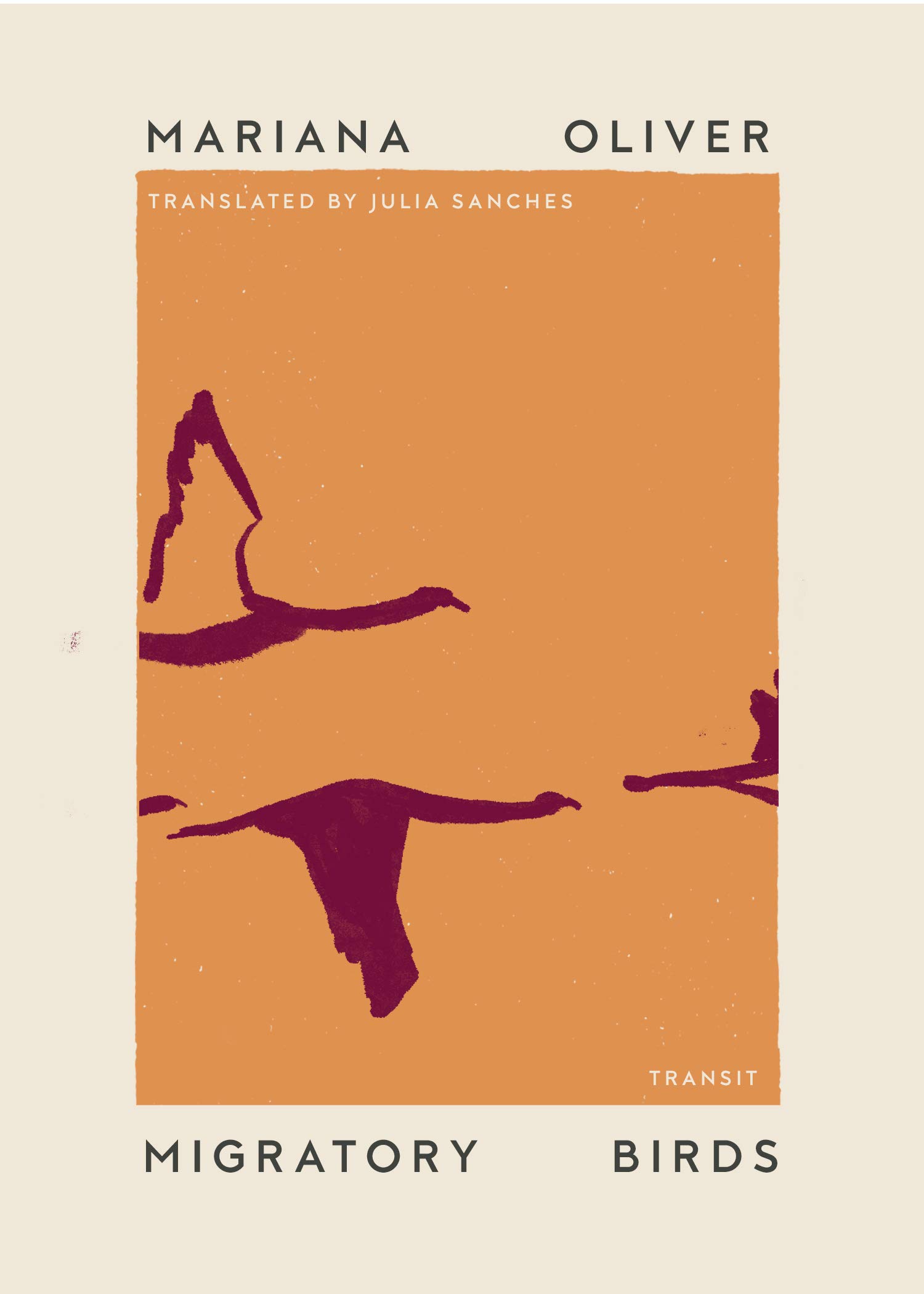
Migratory Birds (Undelivered Lectures series) by Mariana Oliver (tr. Julia Sanches)
Rating: 3.5* of five
The Publisher Says: A sensitive, stunning debut on movement, migration, and loss, in the vein of Valeria Luiselli’s Sidewalks.
In her prize-winning debut, Mexican essayist Mariana Oliver trains her gaze on migration in its many forms, moving between real cities and other more inaccessible territories: language, memory, pain, desire, and the body. With an abiding curiosity and poetic ease, Oliver leads us through the underground city of Cappadocia, explores the vicissitudes of a Berlin marked by historical fracture, recalls a shocking childhood exodus, and recreates the intimacy of the spaces we inhabit. Blending criticism, reportage, and a travel writing all her own, Oliver presents a brilliant collection of essays that asks us what it means to leave the familiar behind and make the unfamiliar our own.
I RECEIVED A DRC FROM THE PUBLISHER VIA VIA EDELWEISS+. THANK YOU.
My Review:
"A place at once empty and full, Cappadocia inspires bewilderment. Which is why it is useless to try and take in the landscape with only your eyes. Trees are few and far between and sunlight pours mercilessly onto your skin, drenching it." –and–
A man pilots a yellow ultralight across the sky. His name, Bill, Bill, Bill, is the last thing he hears before his feet take wing. All liftoffs are the same, he thinks, a ritual by which we become birds. As the body rises, the mind blots out all sounds and refashions them one by one, as if they existed in isolation. First heartbeat, then breath, then saliva moistening the throat; then the whoosh of air as the ultralight’s wings break it into a white trail.
Prose like this is...fine. In small doses. I hit my maximum dose before the book was over.
Transit Books (non-affiliate Bookshop.org link) charges you $14.99 for the ebook. I might not be thrilled with it, you might be; at least it's not wasted money.
++++++++++++++++++++++++++++++++++++++++++++++++++++++++++++++++
In Bad Company (Sandhamn Murders #9) by Viveca Sten (tr. Marlaine Delargy)
Rating: 2.5* of five
The Publisher Says: Sandhamn Island’s archipelago is a beautiful place to visit. For a mother on the run, it’s the only place to hide in a novel of escalating suspense by Viveca Sten, bestselling author of Still Waters.
Building a case against Andreis KovaÄŤ is a risky strategy for prosecutor Nora Linde. A violent key player in Stockholm’s drug trade and untouchable when it comes to financial crimes, he has the best defense money can buy. To topple Andreis’s empire, Nora’s working a different angle. It’s personal. Nora’s critical witness is Andreis’s wife, Mina—if she’ll testify.
Mina has suffered her husband’s rage too long. It’s nearly cost her her life. Still carrying the traumas of the Bosnian War, Andreis can be triggered like an explosive. He must be taken down. And as the trial looms, Mina and her infant son must disappear. The police have found her a safe place to hide on Runmarö Island in Sandhamn’s archipelago. But there’s no shelter from a man as powerful and merciless as Andreis. Especially when he’s being crossed.
His campaign of terror has just begun. He’s prepared to crush anyone who stands in his way: Mina, Nora, and everyone they know and love. Andreis is coming for them. This time, Nora is on the defense.
I RECEIVED A DRC FROM THE PUBLISHER VIA NETGALLEY. THANK YOU.
My Review: It's time I left the series behind. I was not involved in this one at all, and after finishing it felt no relief, no regret, nothing at all.
It could be comparison bias after The Camino, it could be Bosnian-War criminal fatigue, it could be I'm just tired of Nora...but poke me with a fork, I'm done.
Amazon Crossing (non-affiliate Bookshop.org link) requests and requires $14.95 for a paperback.
++++++++++++++++++++++++++++++++++++++++++++++++++++++++++++++++
++++++++++++++++++++++++++++++++++++++++++++++++++++++++++++++++
This space is dedicated to Nancy Pearl's Rule of 50, or "the Pearl Rule" as I've always called it. After realizing five times in December 2021 alone that I'd already Pearl-Ruled a book I picked up on a whim, I realized how close my Half-heimer's is getting to the full-on article. Hence my decision to track my Pearls!
As she says:
People frequently ask me how many pages they should give a book before they give up on it. In response to that question, I came up with my “rule of fifty,” which is based on the shortness of time and the immensity of the world of books. If you’re fifty years of age or younger, give a book fifty pages before you decide to commit to reading it or give it up. If you’re over fifty, which is when time gets even shorter, subtract your age from 100—the result is the number of pages you should read before making your decision to stay with it or quit.
So this space will be each month's listing of Pearl-Ruled books. Earlier Pearl-Rule posts will be linked below the current month's crop.
++++++++++++++++++++++++++++++++++++++++++++++++++++++++++++++++
++++++++++++++++++++++++++++++++++++++++++++++++++++++++++++++++
An Ordinary Violence: A Novel (58%) by Adriana Chartrand
Rating: 2.5* of five
The Publisher Says: Terrible things happen side by side with the ordinary.
Dawn hasn't spoken to her brother, Cody, since he was sent to prison for a violent crime seven years ago. But when Dawn's seemingly perfect life in the big city implodes, she is forced to return to her childhood home and the prairie city that still holds so much pain for her and her fractured family. Cody is released from prison with a mysterious new friend by his side, and Dawn must follow increasingly sinister leads to uncover their nefarious plans to access a dangerous supernatural network.
As the lines between right and wrong blur and dissolve, Dawn reckons with trauma and violence, loss and reclamation in an unsettling world where spirit realms entwine with the living—and where it is humans who carry out the truly monstrous acts.
I RECEIVED A DRC FROM THE PUBLISHER VIA EDELWEISS+. THANK YOU.
My Review: "Maybe that's why Violet talks to her, why she can feel a buzzing sometimes, an insistent mechanical whine from somewhere distant that, if she listened hard enough, might turn ou to be the sound of her name, hissing through a hundred thousand alien throats."
I made it all the way to that line before my experiment with #Summerween blew up. Maybe I need actual fall, leaf-changing pumpkin-carving fall, short-day clock-turning fall, to put me in the mood for spooky shenanigans.
Or maybe this just isn't great and I'm done.
Spiderline/House of Anansi Press (non-affiliate Bookshop.org link) asks $18.99 for a paperback.
++++++++++++++++++++++++++++++++++++++++++++++++++++++++++++++++
Accidental Genius: An Oral History of The Room (32%) edited by Andrew J. Rausch
Rating: 2* of five
The Publisher Says: Accidental Genius features intimate and laugh-out-loud commentary from The Room cast and crew, including interviews from its star Greg Sestero.
What a story indeed! A rollicking recollection of experiences from the legendary “so bad it's good” film. This comprehensively chronicled book offers a fascinating glimpse into the cultural phenomenon that brings together die-hard fans and newcomers alike.
Everything you could have possibly wondered about The Room all in one book!
Take a look at Tommy Wiseau's infamous 2003 release through the eyes of the people who made it. Get the low-down on bizarre audition calls, film set antics, and accounts from the very first fans who experienced The Room at its earliest screenings. Also including interviews focusing on the aftermath of the movie: Sestero’s The Disaster Artist, where are they now, and its lasting legacy.
Here you will get a glimpse of how it all began, why it remains popular, and just what audiences still get out of this unusual film that people love to hate.
I RECEIVED A DRC FROM THE PUBLISHER VIA EDELWEISS+. THANK YOU.
My Review: I thought these were essays on the OTHER bad movie, from 2015, but that one's just called Room. The 2003 excrescence these snippets are about was too ghastly to watch so I really didn't...I heckled and jeered. That was kinda fun, I guess, but not enough to read about the reeking shitpile I've tried to forget seeing.
CLASH Books (non-affiliate Bookshop.org link)
has the effrontery to ask you to PAY for this! $18.95 no less...any edition...I'd laugh if I wasn't so pissed off at being pissed on by that Wiseau...person.
Subscribe to:
Posts (Atom)


