Showing posts with label Kosuke Kindaichi series. Show all posts

Monday, September 30, 2024

THE SEISHI YOKOMIZO PAGE (3): THE LITTLE SPARROW MURDERS & THE DEVIL'S FLUTE MURDERS, fifth and sixth of the Kindaichi series translated into English


THE LITTLE SPARROW MURDERS
SEISHI YOKIMIZO
(Kosuke Kindaichi #6; tr. Bryan Karetnyk)
Pushkin Vertigo (non-affiliate Amazon link)
$16.95 trade paper, available now

Rating: 4* of five

The Publisher Says: An old friend of Kosuke Kindaichi's invites the scruffy detective to visit the remote mountain village of Onikobe in order to look into a twenty-year-old murder case. But no sooner has Kindaichi arrived than a new series of murders strikes the village - several bodies are discovered staged in bizarre poses, and it soon becomes clear that the victims are being killed using methods that match the lyrics of an old local children's song...

The legendary sleuth investigates, but soon realises must unravel the dark and tangled history of the village, as well as that of its rival families, to get to the truth.

PAGE ONE IS HEREPAGE TWO IS HERE
PAGE THREE IS HERE
I RECEIVED A DRC FROM THE PUBLISHER VIA EDELWEISS+. THANK YOU.

My Review
: An interesting cross between Kawabata's masterwork Snow Country and a sideways take on Dame Agatha's lesser work Hickory Dickory Dock mixed with her absolute chef d'œuvre The Murder of Roger Ackroyd, only in 1950s Japan.

One factor that must be attended to by Anglophone readers of this series is that in Japan they are historical fiction. Japanese readers will be as "at sea" as any Anglophone reader would be; the story is sixty-five years old, and was about a bygone way of life even then. So there's a layer of anachronism baked into the modern reading experience irrespective of language it's read in. That doesn't mean it's not a good read. It is indeed a fun story to follow. Don't expect fair play in modern mystery terms, and all will be well. Read it for atmosphere, read it for the trip to the past...you'll enjoy it more that way.

Dysfunctional family dynamics are crime-fiction evergreens. The rage and hatred needed to work a person up to killing someone build in that pressure cooker. This story has a corker of a horrible family in it. The murder Kindaichi investigates took place twenty years before the present...remembering that present is 1959...and the victim is one of those folks who just need killin' in the old US Southern idiom. Mysteries exist because we, as a society, need to see ma'at maintained in our fiction because it seems so unmaintained in the world. The zeitgeist of 1950s Japan would reasonably suggest itself as a similarly traumatized one. I suspect the Kosuke Kindaichi series serves much the same function as the Poirot series did post-Great War...a superior intellect comes along and apportions blame for the guilt of tearing the already fragile fabric of a society in flux.

Letting the reader in on all the clues, all the information the superior intellect possesses, isn't the playbook for the crime stories of this period. I'm sure some sociology thesis treats this topic, but I don't have access to such material. I suspect it goes along with the social norms of trusting experts, even...especially...if they know more than The Authorities...which seems almost quaint in this day and time.

It's a series I get a lot from reading. I enjoy the historical aspects on several levels, within the story told and the storytelling itself. It feels, in these translations at any rate, like work that could have come from the same era as the original Japanese work.

That's a compliment. Four stars for solid enjoyment of a fun-to-read story.

++++++++++++++++++++++++++++++++++++++++++++++++++++++++++++++++


THE DEVIL'S FLUTE MURDERS
SEISHI YOKIMIZO
(Kosuke Kindaichi #5; tr. Jim Rion)
Pushkin Vertigo (non-affiliate Amazon link)
$9.99 ebook editions, available now

Rating: 4* of five

The Publisher Says: An ingenious and highly atmospheric classic whodunit from Japan’s master of crime.

Amid the rubble of post-war Tokyo, inside the grand Tsubaki house, a once-noble family is in mourning.

The old viscount Tsubaki, a brooding, troubled composer, has been found dead.

When the family gather for a divination to conjure the spirit of their departed patriarch, death visits the house once more, and the brilliant Kosuke Kindaichi is called in to investigate.

But before he can get to the truth Kindaichi must uncover the Tsubakis’ most disturbing secrets, while the gruesome murders continue…

I RECEIVED A DRC FROM THE PUBLISHER VIA NETGALLEY. THANK YOU.

My Review
: A peek at the very immediate aftermath of WWII in bombed-out Tokyo, and the dreadful inconvenience all this war nonsense with its barbaric social leveling brings to The Better Classes.

Deeply dislikable "noble" people doing disreputable things for ignoble motives, aaahhh there's the sweet spot for a story! The supernatural window-dressing was sort of fun. Seances are entertaining silliness in fiction, cynical and sordid manipulations in person. The one in this book is, oddly, both; the fact is the "supernatural" gubbins of the music playing eerily would not work at all in today's world, but was very amusingly handled so flew under my eyeroll threshhold.

Again, and as always in this vintage of Japanese crime novels (based on my limited sample size, anyway), be prepared for the sleuth to know things you do not. You're here to be Dr. Watson, or Inspector Japp, not Hercule or Sherlock. Accept this and enter in the spirit of "what did bombed-out Tokyo look like?" and this read will both entertain and educate you. Kosuke Kindaichi's rumpled Columbo-like presentation of self is a lot more...unusual, noticeable, in Japanese society both then and now. The author's choice to make him rumpled is making a statement about surfaces in a country where they're even more important than they are here in the West.

I land on four stars, per usual in this series, for the fun of being in this very, very dissimilar-to-mine world.

Thursday, December 1, 2022

THE SEISHI YOKOMIZO PAGE (2): First English translations two of four Detective Kosuke Kindaichi novels, THE INUGAMI CURSE & THE VILLAGE OF EIGHT GRAVES


THE INUGAMI CURSE
SEISHI YOKOMIZO
(Kosuke Kindaichi #2; tr. Yumiko Yamakazi)
Pushkin Vertigo
$14.95 trade paper, available now

Rating: 4* of five

The Publisher Says: A fiendish classic murder mystery, from one of Japan’s greatest crime writers.

In 1940s Japan, the wealthy head of the Inugami Clan dies, and his family eagerly await the reading of the will. But no sooner are its strange details revealed than a series of bizarre, gruesome murders begins. Detective Kindaichi must unravel the clan's terrible secrets of forbidden liaisons, monstrous cruelty, and hidden identities to find the murderer, and lift the curse wreaking its bloody revenge on the Inugamis.

The Inugami Curse is a fiendish, intricately plotted classic mystery from a giant of Japanese crime writing, starring the legendary detective Kosuke Kindaichi.

I RECEIVED A DRC FROM THE PUBLISHER VIA EDELWEISS+. THANK YOU.


PAGE ONE IS HEREPAGE TWO IS HERE
PAGE THREE IS HERE
My Review
: Ex post facto narration isn't a trope for me to consume in rapid succession without psychic consequences, it seems.

When elderly Sahei Inugami finally has the grace to die already, he leaves behind the most viciously hateful will I can even conceive of. Much like the way Kindaichi gets into the family ugliness in Death on Gokumon Island via a request from someone who's dead now, the Inugami family lawyer calls on him to referee at the reading of this horrible will. Of course he dies on page three or thereabouts for his temerity.

What follows is a twisting, terribly sad recounting of the endless resonances of privilege in a family's life. Privilege won, in a society like Japan's pre-war was, counted for little...it was at best a grudging thing and this warped Inugami's experience of the prosperous life he wrested from an ill-willed social milieu. The man's surname means "dog god" and, since he was without a family, he had no way to know if it was something they'd have reason to take pride in or simply some long-vanished imaginative spark's cruel jest at him, an orphan.

The Inugamis of the next generations are warped by the curse of wealth, of deference given but grudged, and their lives made purposeless by their patriarch's iron control. His life ended far too late for the family not to be cruelly torqued into self-aggrandizing defensive arrogance. The children of the old man's mistresses, since their disadvantages were somehow socially sanctioned by being obvious, weren't entirely guilty...of more than usual awfulness, anyway.

What made this into a delightful set-up for a killing spree, also made it less than perfect: the presence of a gay couple whose dirty deeds made them unclean and unacceptable...period-appropriate and not exactly unknown as an attitude in present-day Japanese society. What bothered me the most, frankly, was the awful way a seriously disfigured war veteran was treated, described, dealt with; it all made his actions feel more like a man clawing back some dignity...too late and in the wrong way.

Translator Yumiko Yamazaki made some odd-sounding choices for my ears, e.g. choosing to switch between using the proper word kōtō and the oddly off-kilter transliteration "zither"...while the instruments are related they are not identical...despite making quite a palaver about defining a kōtō as a zither, she goes on to use both in the text. If there was some pattern to when and why the different words were used, I couldn't discern it. This played into a kind of story fatigue, an unforgiving hardening of my narrative-transporting arteries.

All in all, though, this survivor from Author Yokomizo's early publications presents a lovely and involving puzzle to solve, with several ancillary riddles on the edges of the main puzzle that were very interesting in themselves. I won't say it's perfect but I will say I've greatly enjoyed more time in Kindaichi-san's company.

++++++++++++++++++++++++++++++++++++++++++++++++++++++++++++++++


THE VILLAGE OF EIGHT GRAVES
SEISHI YOKOMIZO
(Kosuke Kindaichi #3; tr. Bryan Karetnyk)
Pushkin Vertigo
$14.95 trade paper, available now

Rating: 4* of five

The Publisher Says: The third title in Japan’s most popular murder mystery series—after The Honjin Murders and The Inugami Curse—fiendish classics featuring investigator Kosuke Kindaichi.

Nestled deep in the mist-shrouded mountains, The Village of Eight Graves takes its name from a bloody legend: in the Sixteenth Century eight samurais, who had taken refuge there along with a secret treasure, were murdered by the inhabitants, bringing a terrible curse down upon their village.

Centuries later a mysterious young man named Tatsuya arrives in town, bringing a spate of deadly poisonings in his wake. The inimitably scruffy and brilliant Kosuke Kindaichi investigates.

I RECEIVED A DRC FROM THE PUBLISHER VIA EDELWEISS+. THANK YOU.

My Review
: "The Village of Eight Graves" has a terrible history, and a terrible genesis in violence and unchecked greed. The common run of its people are afraid of life; they believe, and thus find evidence for, their manifold misfortunes being rooted in a curse that hangs over their heads from a long-ago unforgivable act. They are thus creating those conditions, interpreting the common misfortunes of life in that context. Superstition is a powerful drug. It allows us to Be Right, and there is absolutely nothing humans like better, need more, will work as hard to attain and maintain, than Being Right.

Bet you're nodding along....

I wanted to Be Right that Author Yokomizo couldn't tell a poorly paced story. I was...Not Right. The issue with this read is that our usual omniscient Watsonesque narrator is not here. Instead we have an irritatingly dimwitted PoV character called Tatsuya, whose chills are very much on a par with Miss Silver's cough in the irritating-authorial-choice derby. He spends our time sort of vaguely bumbling around while stuff happens and people he has reason to kill up and die, and then Kindaichi-san pops up (as we knew he must but, if I'm honest, I couldn't tell you why or how this hard-luck burg caught his attention...it was that little melded into the story). So the killings and deaths, somehow all connected to the village's ancestral curse, will all stop. Right? Right. But this time it's not Kindaichi-san doing detecting. It's the rush of events that Tatsuya has trouble keeping up with that reveals the malefactors. Kindaichi-san is here as window dressing, like a late Poirot novel! *grumble*

I sense a furtive glance up at the rating...yes, that's a "4" in front of the "*". What...the.... Well, it's like this: the translator, Mr. Karetnyk, proved more than capable of exceeding Ms. Yamazaki, the previous book's translator's, occasionally clunky choices. That was a big plus. Then there was the sheer gonzo pace of the murdering that's happening in Tatsuya's orbit. I can't quit a mystery mid-murder spree! I'm not made of stuff that stern. And the spree being so obviously calculated to implicate Tatsuya, who (poor wee lambkin) only now learned that the father who raised him was not only not his real father but knew who that person was...and Tatsuya was really thrown into emotional chaos by the entire unfolding plot to entrap and incriminate him through his parentage's revelation.

Then, while the bodies were piling up and the exsanguination was about ankle-deep, we go on an historical treasure hunt! The awful crime the villagers committed all those years ago was, you see, fruitless; they did not find the treasure they had filled the titular eight graves for. And now that Tetsuya's here, there's a reason to have a treasure hunt! Why? I don't know, whatever, treasure hunt! Does it make sense? Not to me. I am long past suchlike ponderin' when it comes to these stories. The secret to enjoying them is to flow with the river.

In the end, isn't that sort of a life lesson? Flow with the current, don't resist the pulls and changes, be there wholly and let the events unfold...I enjoyed this read's atypical ending a lot. I admit I don't want another Tetsuya narrator any time soon, but there was a reason he had to be the one to tell this story. It wouldn't have worked any other way, hence my seemingly over-generous rating. But do factor the change of focus via narrator into your reading plans.

Now, Pushkin Vertigo, it's on y'all not to dangle us over the pit for too much longer! More soon, please.

Wednesday, November 30, 2022

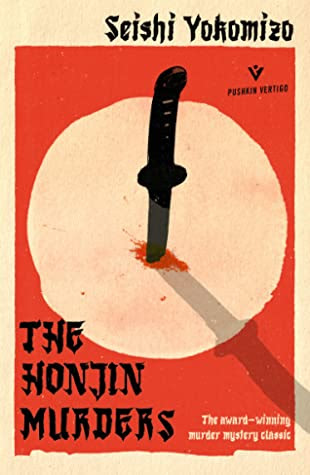
THE SEISHI YOKOMIZO PAGE: First English translations two of four Detective Kosuke Kindaichi novels, THE HONJIN MURDERS & DEATH ON GOKUMON ISLAND


THE HONJIN MURDERS
SEISHI YOKOMIZO
(Kosuke Kindaichi #1; tr. Louise Heal Kawai)
Pushkin Vertigo
$14.95 trade paper, available now

Rating: 4* of five

The Publisher Says: One of Japan's greatest classic murder mysteries, introducing their best loved detective, translated into English for the first time.

In the winter of 1937, the village of Okamura is abuzz with excitement over the forthcoming wedding of a son of the grand Ichiyanagi family. But amid the gossip over the approaching festivities, there is also a worrying rumour - it seems a sinister masked man has been asking questions around the village.

Then, on the night of the wedding, the Ichiyanagi household are woken by a terrible scream, followed by the sound of eerie music. Death has come to Okamura, leaving no trace but a bloody samurai sword, thrust into the pristine snow outside the house. Soon, amateur detective Kosuke Kindaichi is on the scene to investigate what will become a legendary murder case, but can this scruffy sleuth solve a seemingly impossible crime?

PAGE ONE IS HEREPAGE TWO IS HERE
PAGE THREE IS HERE

I RECEIVED A DRC FROM THE PUBLISHER VIA EDELWEISS+. THANK YOU.

My Review
: In a very Sherlock's-Watson fashion, the events of this premarital murder are narrated to us after the fact; we know, by this very technique, that the mystery is one that can be solved if we're game to follow the clues. Which clues? Well, the mystery-writer narrator and I are glad you asked:
When I first heard the story, I immediately racked my brain to think of any similar cases among all the novels I’ve read. The first that came to mind were Gaston Leroux’s The Mystery of the Yellow Room and Maurice Leblanc’s The Teeth of the Tiger; then there’s The Canary Murder Case and The Kennel Murder Case, both by S.S. Van Dine; and finally, Dickson Carr’s The Plague Court Murders. I even considered that variation on the locked room murder theme of Roger Scarlett’s Murder Among the Angells.

You really can't get a lot more fair-play than that, can you, giving the reader the crib sheet from which the author made choices and still, not to make it too easy by telling the reader *what* was cribbed from the Greats of the Golden Age. I found it endearing. I was very amused by the conceit, and by the writer/narrator following in the footsteps of the wildly disheveled amateur detective. Now...keep in mind this is a story written in the late 1940s and set in the 1930s. The idea of a Japanese man presenting himself as less than polished and perfect is damned near heretical. There was no beatnik, or proto-hippie, movement in Japan. It is a culture of Face, something I equate with my mother's endless mantra, "but what will People Think?" It's very, very important not to insult your neighbors, or your betters, by deciding to be different, to wear your Otherness on the outside...so featuring someone who's indifferent to Face in this mystery series is quite a powerful statement of value and intent on the author's part.

What's important for your pleasure in an amateur-sleuth read? An aura of verisimilitude? A relatable cast of characters? An evocation of a place and time? I'd venture to say that no one would behave the way the characters in this mystery do...but I could be wrong...at any rate, the point for me wasn't the verisimilitude (never is with amateur-sleuth mysteries, pace all you true-crime podcasters) but the delicious evocation of the time and the place:
A honjin was a kind of inn in feudal Japan where daimyo lords and other important officials would stay on their way to or from paying attendance on the Shogun in the capital, Edo—the old name for Tokyo. Ordinary members of the public were not permitted to stay at a honjin. A family who owned such a high-class lodging house were also members of the elite, and so it followed that this was a place where the rules of high society were closely adhered to.

The author, or more likely the editor and translator, gives me such a full and satisfying sense of the place with this simple paragraph. I wanted to feel transported and I did...as well as catered to, told a story to, and one that really did leave me guessing until the end. Very satisfying that Anglophone readers are getting this series (it has SEVENTY-SIX MORE VOLUMES!!) at long last...the author's only been dead since 1981. No rush, guys.

The things I wasn't quite so pleased to read were the class-conscious snobberies of the groom's family, presented without apparent or, to my mind, appropriate negativity cast on them. This being a thing that bothers me now, in the 21st century, I can't even try to guess if I'd even have noticed it had I read the book around the time the author died...almost forty years after it appeared. The snobbish tone is grating on old-man me, anyway. And the last chapter, number 18, is such a Golden-Agey thing...the way the guilty party is dealt with, the careful recounting of the places the clues were left...it was both what I wanted, and a hair too much to swallow in one draft.

If your mystery-story shelves are a touch too light, this is a good, solid, entertaining read...my crotchets aside.

++++++++++++++++++++++++++++++++++++++++++++++++++++++++++++++++


DEATH ON GOKUMON ISLAND
SEISHI YOKOMIZO
(Kosuke Kindaichi #4; tr. Louise Heal Kawai)
Pushkin Vertigo
$15.95 trade paper, available now

Rating: 4* of five

The Publisher Says: Kosuke Kindaichi arrives on the remote Gokumon Island bearing tragic news – the son of one of the island’s most important families has died, on a troop transport ship bringing him back home after the Second World War. But Kindaichi has not come merely as a messenger – with his last words, the dying man warned that his three step-sisters’ lives would now be in danger. The scruffy detective is determined to get to the bottom of this mysterious prophesy, and to protect the three women if he can.

As Kosuke Kindaichi attempts to unravel the island’s secrets, a series of gruesome murders begins. He investigates, but soon finds himself in mortal danger from both the unknown killer and the clannish locals, who resent this outsider meddling in their affairs.

Loosely inspired by Agatha Christie’s And Then There Were None, the fiendish Death on Gokumon Island is perhaps the most highly regarded of all the great Seishi Yokomizo’s classic Japanese mysteries.

I RECEIVED A DRC FROM THE PUBLISHER VIA EDELWEISS+. THANK YOU.

My Review
: This 1971 publication is the second case for Kosuke Kindaichi by internal chronology. I'm going by that order because it makes the most sense to do so for my little orderly brain.

But...here we go!...there's a lot wrong with this read. It's a cultural thing, permaybehaps, but any time women are victims of crime by virtue of their femaleness, I check out. I don't like or want that kind of imagery in my head. The way the author presents this heinous tontine by accident of birth as...a puzzle, a problem to solve. He goes about the solution methodically, and of course murder is wrong, but...there's a sort of "well, they were just women, after all" lackadaisicalness to the proceedings that truly got up my nose.

But I kept reading. Because there is a deeply unpleasant truth I must face in reviewing this book: I love a puzzle so much that, when I'm offered it wrapped in enough sweetly seductive mystery, I will just keep reading and ignore my squicked-out "but this is appalling!!" responses to see where we're going.

Ew. True, but ew.

The merest tinge of remorse, it seems to me, was plastered like a too-small figleaf over the fact that the whole crime...the entire murdering spree, ending three innocent women's lives...could easily have been prevented by a simple consultation with a living man's moral compass long before the events became inevitable. As it was, that crucial step now, with their deaths accomplished, the detective suffers agonies of self-reproach...they're still dead, dude. The blame's not really his, in all honesty. It's properly placed on the planner of the crimes and the idiots who blindly follow orders.

It's a solidly atmospheric piece, which I know won't surprise you as it's the fruit of twenty-three years' practice of his craft. The translator's still giving us subtle hints about the cultural context and slyly explaining objects we in the West haven't a single clue about. The temple bell's cultural resonance...the island's peculiar patriarchal culture...the delicately handled, and odd, romantic strand that would've passed by me unremarked without the translator's quiet nudges...all beautifully handled.

Culturally intriguing, nicely constructed puzzle, all get big ol' tick-marks. The last-minute application of regret, even though I think the whole story's revoltingly misogynistic, does at least gesture at some sense of the trope's wrongness. You should make your readerly decisions based on your personal tolerance for unpleasant-to-you subject matter.

I've continued the series, so clearly it's not a deal-breaker for me. I really thought it would be.