Monday, January 2, 2017

SNOWBALL'S CHANCE, the dystopia of ANIMAL FARM gets worse


SNOWBALL'S CHANCE
JOHN REED

The Neversink Library
$15 trade paper, available now

Rating: 5* of five

The Publisher Says: This unauthorized companion to George Orwell’s Animal Farm is a controversial parable about September 11th by one of fiction’s most inventive and provocative writers

Written in 14 days shortly after the September 11th attacks, Snowball’s Chance is an outrageous and unauthorized companion to George Orwell’s Animal Farm, in which exiled pig Snowball returns to the farm, takes charge, and implements a new world order of untrammeled capitalism. Orwell’s “All animals are equal, but some animals are more equal than others” has morphed into the new rallying cry: “All animals are born equal—what they become is their own affair.”

At first Snowball’s regime prospers: heated stalls, running water, and a window for each animal. The farm moves away from its agricultural economy as Snowball and his team of educated Goats recreate Animal Farm as Animal Fair, replete with citizen performers and criminal sideshows.

A brilliant political satire and literary parody, John Reed’s Snowball’s Chance caused an uproar on publication in 2002, denounced by Christopher Hitchens, and barely dodging a lawsuit from the Orwell estate. Now, a decade later, with America in wars on many fronts, readers can judge anew the visionary truth of Reed’s satirical masterpiece.

My Review: Fifteen years on, Snowball's Chance is more relevant than ever. The 9/11 attacks appalled the world, and thereby gave the USA (assuming its leaders had been savvy and swift on the uptake) its single best opportunity to cement cooperation and common cause with our self-serving agenda in recent history.

We all remember how that turned out. Our soldiers are still paying the price for the bad-to-the-point-of-idiocy decisions made by the administration of the day.

But oh my my, it wasn't sold to the sheep—people, I mean—that way! Neigh neigh neigh, as the workhorses of the armed forces emitted. The glory days have begun at last! We'll shock and awe those sand-n-words back to the stone age!
The animals, even the pigs and the dogs, reveled in the song—not only in the group dancing, which was a new experience for all, but to have their voices joined together once again.

Just like the days of the rebellion!

And the thing so nice about it, was that now, with no more than a little song and a side-step, they could feel like this whenever they wanted—even when they were working in the fields!
It was then announced by Snowball, that by the Prize Pig's decree, the Manor Farm would henceforth be known by its proper name—

Animal Farm.
And the strains of the 21st century's first recrudescence of Horst Wessel were heard throughout the land. The Prize Pig squealed it loudest. And behind the Prize Pig stood Snowball, quietly examining the trusting mugs of the great unwashed masses for glimmers of intelligence and signs of dissent. These were bad things, unpatriotic things, to be subdued by every means available to the state. And those means were (and are) considerable, technology having no conscience and technologists little interest in ethics. All that was needed now was some sort of fig leaf to hide the swollen cock butt-fucking the body politic with no grease and not even a pretense at a kiss.

The USA-PATRIOT Act. Mass surveillance, suspended civil liberties, immense extensions of the government's power to act against its citizens if it damned well wanted to...amended, killed, then resurrected as the USA FREEDOM Act in 2015. No government ever gives up a power it has given itself. The names are changed to protect the guilty.
The debate was reported at length in The Daily Trotter, where Minimus, in his sudden November turn-around, proclaimed that the concessions Snowball had made to his various concerns were more than enough to allay any fears. His faith in Snowball was complete—and every animal on the farm should feel exactly the same way. "Forward Ho!" proclaimed The Daily Trotter. In a letter-to-the-editor (penned by an excitable field mouse), it was suggested that Snowball was not forceful enough to capture the character of the visionary, and that perhaps "Snowstorm" would be more appropriate. The next week, Minimus showed up at the Sunday Meeting looking like he had sat on a fretful porcupine. The Trotter reported that he was suffering a case of constipation....

And when the hot water and showers and bathtubs and lights and electric heaters and air-conditioners were turned on—on January 14th—what a glorious day it was! What a glorious winter it was! And what a glorious spring it was! And what a hero Snowball was!
Hot water and air conditioning buy a lot of silence, it would seem; as does the saddling of an entire nation with slave status under the yoke of the banksters. Get stroppy, get fired, get foreclosed on. I know this happens, it happened to me in 2005.

But the fable continues its inexorable course, one that we're familiar with from the 9/11 events but apparently haven't got the mother-wit to recognize happening again in the form of the most recent election's run-up and results. The post-mortems and the mea-culpas will last for years. None of which changes the events:
It would later be argued as to whether the evil-doers had secured preplaced weaponry from a passing peanut cart, or had foiled the bloodhounds by dousing themselves and their arsenal in apple-wood oil, in order to mask any tell-tale odor. But regardless of the method that his treachery had taken, this ferret's time had come....

He had drawn his blade, cut the throat of Arthur the Poodle, and assumed the controls of the Ferris Wheel—and before anyone could understand what was happening (was it part of the ride?) the Ferris Wheel had accelerated to its top speed. Gears ground. Sparks flew. And two pairs of squirrels were dragging paper bags through the ironwork—up to the axle that held the wheel in place. And then, in a moment horrifyingly lucid, the squirrels doused themselves with some greasy liquid, and set themselves on fire. The bags exploded, and the Ferris Wheel was loosed—kicked from its moorings.
From there, the Twin Mills were struck down and the Woodland Creatures exacted their vengeance on the Pig Fair. And the fable ends.

The future doesn't, however. The value of fiction is that it doesn't stop being relevant when its inspiration recedes into memory then fades into myth. To Kill a Mockingbird is still challenged for removal from school curricula and libraries. Young people are, if not encouraged, then allowed to piss and moan about its "relevance" as a means of delegitimizing the book's enduring and invaluable lessons of the costs of Doing the Right Thing even when everyone you know shouts you down. There's no reason to suspect a book that features a flinty, honorable fighter for justice and the daughter who worships his ideals wouldn't be popular with a political elite such as the one we have now, is there?

My review of Animal Farm argues for the continued relevance of a parable of corruption's eternal depredations. The book isn't about Stalinist Soviet times. It's about the time-tested maxim that power corrupts, and absolute power corrupts absolutely. Snowball's Chance tills the same fertile soil. John Reed saw the need for a stern reminder of the eternal verity that people are no damn good, and wisely chose to "stand on the shoulders of a giant," to paraphrase the probably apocryphal utterance attributed to Isaac Newton. George Orwell was no monadnock of probity: he's known to have snitched on leftist friends, expressed privately an anti-Semitism he didn't condone publicly, and was a homophobe. Hardly a role model. Except he was right about the very important fact that Stalin was a monster and the left of his time was willfully ignoring the truth in order to preserve what they saw as a greater good: Socialism was a laudable political path and socialists must needs be lauded.

Hogwash. No more does John Reed accept the moral purity of Snowball, or of Minimus, or of Diso the beaver. He and Orwell jab at the clay feet of the idols that are used to distract the bulk of humanity. The idols fall as they may, and that's a good thing. That's the reason Snowball's Chance needs to land on your TBR. Never miss a chance to topple an idol, even—or especially—one of your own.

Sunday, January 1, 2017

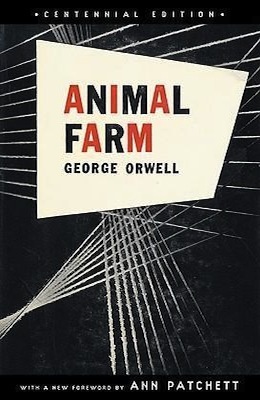
ANIMAL FARM, the 20th century's best, most biting political satire


ANIMAL FARM
GEORGE ORWELL

Everyman's Library
$20 hardcover, available now

Rating: 5* of five

The Publisher Says: Signet Classics 1996 edition:
A farm is taken over by its overworked, mistreated animals. With flaming idealism and stirring slogans, they set out to create a paradise of progress, justice, and equality. Thus the stage is set for one of the most telling satiric fables ever penned –a razor-edged fairy tale for grown-ups that records the evolution from revolution against tyranny to a totalitarianism just as terrible.

When Animal Farm was first published, Stalinist Russia was seen as its target. Today it is devastatingly clear that wherever and whenever freedom is attacked, under whatever banner, the cutting clarity and savage comedy of George Orwell’s masterpiece have a meaning and message still ferociously fresh.
Penguin Classics 2000 edition:
'It is the history of a revolution that went wrong – and of the excellent excuses that were forthcoming at every step for the perversion of the original doctrine,' wrote Orwell for the first edition of Animal Farm in 1945. Orwell wrote the novel at the end of 1943, but it almost remained unpublished. Its savage attack on Stalin, at that time Britain's ally, led to the book being refused by publisher after publisher. Orwell's simple, tragic fable, telling what happens when the animals drive out Mr Jones and attempt to run the farm themselves, has since become a world famous classic.
NAL 2003 edition:
"All animals are equal. But some animals are more equal than others."

One night on an English farm, Major the boar recounts his vision of a utopia where his fellow creatures own the land along with the means of production and are no longer the slaves of humans.

Before long his dream comes true, and for a short while all animals really are equal. But the clever pigs educate themselves and soon learn how to extend their own power, inevitably at the expense of the rest of the community.

This well-loved tale is, of course, a satire on the Soviet Communist system that still remains a powerful warning despite the changes in world politics since "Animal Farm" was first published.
Everyman's Library 1993 edition:
Animal Farm is the most famous by far of all twentieth-century political allegories. Its account of a group of barnyard animals who revolt against their vicious human master, only to submit to a tyranny erected by their own kind, can fairly be said to have become a universal drama. Orwell is one of the very few modern satirists comparable to Jonathan Swift in power, artistry, and moral authority; in animal farm his spare prose and the logic of his dark comedy brilliantly highlight his stark message.

Taking as his starting point the betrayed promise of the Russian Revolution, Orwell lays out a vision that, in its bitter wisdom, gives us the clearest understanding we possess of the possible consequences of our social and political acts.

My Review: What on earth is the point of reviewing this book? Why should I ask you to read a review of something that, in all likelihood, you're already familiar with and have a strong memory of and opinion about? Italo Calvino said it for me: "A classic is a book that has never finished saying what it has to say." And therefore a classic is a book about which the serious lover of reading should never stop talking or thinking about, or re-evaluating, re-reading, re-responding to.

I did not remember this passage from the first chapter:
I merely repeat, remember always your duty of enmity towards Man and all his ways. Whatever goes upon two legs is an enemy. Whatever goes upon four legs, or has wings, is a friend. And remember also that in fighting against Man, we must not come to resemble him. Even when you have conquered him, do not adopt his vices. No animal must ever live in a house, or sleep in a bed, or wear clothes, or drink alcohol, or smoke tobacco, or touch money, or engage in trade. All the habits of Man are evil. And, above all, no animal must ever tyrannise over his own kind. Weak or strong, clever or simple, we are all brothers. No animal must ever kill any other animal. All animals are equal.
Old Major the boar addresses the assembled animals of Jones's Farm thus; he's had a long life and over four hundred children, a lot of time to think, and thus has earned the right to instruct the younger, the less able (like poor old Boxer the workhorse).

Life has a new zest for the animals after Farmer Jones and his henchmen are driven off the farm. The incontestable truth that the fruits of one's labor are sweeter than any others is brought home to the hardworking animals:
The animals were happy as they had never conceived it possible to be. Every mouthful of food was an acute positive pleasure, now that it was truly their own food, produced by themselves and for themselves, not doled out to them by a grudging master. With the worthless parasitical human beings gone, there was more for everyone to eat. There was more leisure too, inexperienced though the animals were.
Tomatoes one grows one's own self are always sweeter than store-bought; food made with one's own hands is tastier than fast food can ever be. Of course, all the animals do the work together, so of course they eat the fruits of their labor together, equally. Of course! Why would you imagine that it would ever be any other way?
The early apples were now ripening, and the grass of the orchard was littered with windfalls. The animals had assumed as a matter of course that these would be shared out equally; one day, however, the order went forth that all the windfalls were to be collected and brought to the harness-room for the use of the pigs. At this some of the other animals murmured, but it was no use. All the pigs were in full agreement on this point, even Snowball and Napoleon. Squealer was sent to make the necessary explanations to the others.

“Comrades!” he cried. “You do not imagine, I hope, that we pigs are doing this in a spirit of selfishness and privilege? Many of us actually dislike milk and apples. I dislike them myself. Our sole object in taking these things is to preserve our health. Milk and apples (this has been proved by Science, comrades) contain substances absolutely necessary to the well-being of a pig. We pigs are brainworkers. The whole management and organisation of this farm depend on us. Day and night we are watching over your welfare. It is for YOUR sake that we drink that milk and eat those apples. Do you know what would happen if we pigs failed in our duty? Jones would come back! Yes, Jones would come back! Surely, comrades,” cried Squealer almost pleadingly, skipping from side to side and whisking his tail, “surely there is no one among you who wants to see Jones come back?”

Now if there was one thing that the animals were completely certain of, it was that they did not want Jones back. When it was put to them in this light, they had no more to say. The importance of keeping the pigs in good health was all too obvious. So it was agreed without further argument that the milk and the windfall apples (and also the main crop of apples when they ripened) should be reserved for the pigs alone.
Of course.

But nothing ever stays the same, does it? The animals have no reason to complain, surely! The work they do is rewarded with food...not apples or milk, it's true, but food...and they're all pulling together and doing their work together and deciding what the farm will produce together! Of course the pigs, the cleverest animals, are thinking the hardest and making the proposals for plans. That's natural, isn't it, the cleverest do the brain-work and think through the problems for the best solutions. And the cleverest pigs, Snowball and Napoleon, are always planning and thinking and exhorting the other animals. The trouble is that they almost never have the same plan. Snowball talks the animals around, but Napoleon always makes the last decision. Animals discuss the problem, the pigs compromise, but the situation just won't change.
But just at this moment Napoleon stood up and, casting a peculiar sidelong look at Snowball, uttered a high-pitched whimper of a kind no one had ever heard him utter before.

At this there was a terrible baying sound outside, and nine enormous dogs wearing brass-studded collars came bounding into the barn. They dashed straight for Snowball, who only sprang from his place just in time to escape their snapping jaws. In a moment he was out of the door and they were after him. Too amazed and frightened to speak, all the animals crowded through the door to watch the chase. Snowball was racing across the long pasture that led to the road. He was running as only a pig can run, but the dogs were close on his heels. Suddenly he slipped and it seemed certain that they had him. Then he was up again, running faster than ever, then the dogs were gaining on him again. One of them all but closed his jaws on Snowball’s tail, but Snowball whisked it free just in time. Then he put on an extra spurt and, with a few inches to spare, slipped through a hole in the hedge and was seen no more.
Things change when the boss says they change. Then they change how the boss wants them to change. It's the single clearest hallmark of authoritarian government, and it's coming disturbingly close to US reality. Surely things won't, can't, get worse!

And then...
Napoleon, with the dogs following him, now mounted on to the raised portion of the floor where Major had previously stood to deliver his speech. He announced that from now on the Sunday-morning Meetings would come to an end. They were unnecessary, he said, and wasted time. In future all questions relating to the working of the farm would be settled by a special committee of pigs, presided over by himself. These would meet in private and afterwards communicate their decisions to the others. The animals would still assemble on Sunday mornings to salute the flag, sing ‘Beasts of England’, and receive their orders for the week; but there would be no more debates.

In spite of the shock that Snowball’s expulsion had given them, the animals were dismayed by this announcement. Several of them would have protested if they could have found the right arguments. Even Boxer was vaguely troubled. He set his ears back, shook his forelock several times, and tried hard to marshal his thoughts; but in the end he could not think of anything to say. Some of the pigs themselves, however, were more articulate. Four young porkers in the front row uttered shrill squeals of disapproval, and all four of them sprang to their feet and began speaking at once. But suddenly the dogs sitting round Napoleon let out deep, menacing growls, and the pigs fell silent and sat down again. Then the sheep broke out into a tremendous bleating of “Four legs good, two legs bad!” which went on for nearly a quarter of an hour and put an end to any chance of discussion.
Sounds familiar, doesn't it? The growling of the dogs set to protect the pig-in-chief at any cost, the unquestioning loyalty of the pack for its alpha. Disturbingly reminiscent of our president elect's command of a Twitter propaganda force, a CNN flying squad of apologists and face-timers. It's been so frequently seen that it's not even remarked upon in any way except to disagree with what's being spread around. The fact of it is...how I hate to say this...normal. Familiar, so normal.

Far more upsettingly familiar is the pronouncement of anathema upon the expelled Snowball:
“Comrades,” [Napoleon] said quietly, “do you know who is responsible for this? Do you know the enemy who has come in the night and overthrown our windmill? SNOWBALL!” he suddenly roared in a voice of thunder. “Snowball has done this thing! In sheer malignity, thinking to set back our plans and avenge himself for his ignominious expulsion, this traitor has crept here under cover of night and destroyed our work of nearly a year. Comrades, here and now I pronounce the death sentence upon Snowball. ‘Animal Hero, Second Class,’ and half a bushel of apples to any animal who brings him to justice. A full bushel to anyone who captures him alive!”
Julian Assange. Edward Snowden. Chelsea Manning. Put any of these names in Snowball's place. You won't notice a difference. Speaking out is treason. People who do are traitors and are directly and personally responsible for all the ills they spoke out against.

Some few of us are old. We have a memory of how things once were that isn't dependent on the pronunciamentos of the Powers That Be. It upsets the old folk to look at the way things are and compare them to the way we remember them to be, to remember how we wanted things to be for our children and grandchildren after us:
As Clover looked down the hillside her eyes filled with tears. If she could have spoken her thoughts, it would have been to say that this was not what they had aimed at when they had set themselves years ago to work for the overthrow of the human race. These scenes of terror and slaughter were not what they had looked forward to on that night when old Major first stirred them to rebellion. If she herself had had any picture of the future, it had been of a society of animals set free from hunger and the whip, all equal, each working according to his capacity, the strong protecting the weak, as she had protected the lost brood of ducklings with her foreleg on the night of Major’s speech. Instead — she did not know why — they had come to a time when no one dared speak his mind, when fierce, growling dogs roamed everywhere, and when you had to watch your comrades torn to pieces after confessing to shocking crimes. There was no thought of rebellion or disobedience in her mind. She knew that, even as things were, they were far better off than they had been in the days of Jones, and that before all else it was needful to prevent the return of the human beings. Whatever happened she would remain faithful, work hard, carry out the orders that were given to her, and accept the leadership of Napoleon.
The rise of an ever-more authoritarian governmental structure in response to the economic depredations of the banksters is, if not inevitable, then more and more likely. This sensation of loss and the theft of the dream we invested our labor into realizing is acute, painful, and miserable. The mere notion of this Orwellian outcome of this latest presidential election is nauseating.

The simple distillation of the novella's point is almost too painful to read:
Somehow it seemed as though the farm had grown richer without making the animals themselves any richer-except, of course, for the pigs and the dogs. Perhaps this was partly because there were so many pigs and so many dogs. It was not that these creatures did not work, after their fashion. There was, as Squealer was never tired of explaining, endless work in the supervision and organisation of the farm. Much of this work was of a kind that the other animals were too ignorant to understand. For example, Squealer told them that the pigs had to expend enormous labours every day upon mysterious things called “files,” “reports,” “minutes,” and “memoranda”. These were large sheets of paper which had to be closely covered with writing, and as soon as they were so covered, they were burnt in the furnace. This was of the highest importance for the welfare of the farm, Squealer said. But still, neither pigs nor dogs produced any food by their own labour; and there were very many of them, and their appetites were always good.
Those who produce nothing are taking everything. It is happening now. Banksters and fraudsters and capitalists care nothing for anyone or anything that doesn't fill their feed-bag with more, more, more. There is no such thing as enough for these people. When the place a spirit should be is empty, the entire earth doesn't have enough substance to plug the hole.
He had only one criticism, he said, to make of Mr. Pilkington’s excellent and neighbourly speech. Mr. Pilkington had referred throughout to “Animal Farm.” He could not of course know — for he, Napoleon, was only now for the first time announcing it — that the name “Animal Farm” had been abolished. Henceforward the farm was to be known as “The Manor Farm”— which, he believed, was its correct and original name.

Saturday, December 31, 2016

LEVIATHAN'S WAKE, first book in a busy series whose Syfy adaptation is better


LEVIATHAN WAKES
JAMES S.A. COREY
(The Expanse, #1)
Orbit Books
$17.00 trade paper, available now

Rating: 2.5* of five

**UPDATE 22 December 2016** This is a mea-culpa of epic proportions. Syfy did a stellar job of making this series. I couldn't have been more wrong about the series, though I still don't like the books. This YouTube video of a Google Talk from 2014 is a terrific proof of why the series works so well. Excellent television! Binge on the series at Prime for the holidays.

**UPDATE 6 September 2013** More Suckass News Dept, from SFSignal: "Variety is reporting that scribes Mark Fergus and Hawk Ostby (Iron Man and Children of Men) will script the pilot of the how called The Expanse, which is based on the series of novels written by Daniel Abraham and Ty Franck under the pseudonym James S.A. Corey.

The book series cosnsists of Leviathan Wakes, Caliban’s War, Abaddon’s Gate and the soon-to-be-released Cibola Burn.

The Expanse will be an hour long SciFi drama “with elements of a detective procedural, centring on a cover-up of the discovery of alien life”.

Not much else is known at this point. Stay tuned!"

Yuck. Couldn't pick a GOOD series. No no no.

The Publisher Says: Humanity has colonized the solar system - Mars, the Moon, the Asteroid Belt and beyond - but the stars are still out of our reach.

Jim Holden is XO of an ice miner making runs from the rings of Saturn to the mining stations of the Belt. When he and his crew stumble upon a derelict ship, The Scopuli, they find themselves in possession of a secret they never wanted. A secret that someone is willing to kill for - and kill on a scale unfathomable to Jim and his crew. War is brewing in the system unless he can find out who left the ship and why.

Detective Miller is looking for a girl. One girl in a system of billions, but her parents have money and money talks. When the trail leads him to The Scopuli and rebel sympathizer Holden, he realizes that this girl may be the key to everything.

Holden and Miller must thread the needle between the Earth government, the Outer Planet revolutionaries, and secretive corporations - and the odds are against them. But out in the Belt, the rules are different, and one small ship can change the fate of the universe.

My Review: Exactly half-way to a five-star world-beating yodel-worthy space opera. An extremely interesting choice of time to explore, sort of late Red Mars-to-early-Green Mars time. A choice group of characters, the standard Hero's Journey plot, and away we go!

Only we don't so much. We stall out on characterization...flat-ish, unsurprising...we hop around in PoV terms until I feel like a flea on a chihuahua that ate some coffee beans and is more manic than usual. We keep events hurtling along, far too many of them in fact, and we mangle our hands in the machinery of alienness.

We did too much, ate too much, played too rough. Our tummy hurts now, and we need a nap.

Plus? I hate the ending so much I want to send the editor a nastygram. THIS COULD HAVE AND SHOULD HAVE BEEN FIXED. It's not for the author to do, this is a collaboration and that means sometimes a referee is needed. This was one of them. No way would I read the next book! And that's sad, because I really really like The Expanse and its cool politics and people.

One thing the show does brilliantly is make the stark divide between haves and have-nots graphic and inescapable. The Economic Royalists of The Expanse are made plain, their motives are plain, and their corruption is inescapable. This series, filmed for me but certainly the books are a great option for others, is must-see, must-read, must-absorb for the world of 2017.

THE BIG NECESSITY, a funny book about an icky subject that's extremely important


THE BIG NECESSITY: The Unmentionable World of Human Waste and Why It Matters
ROSE GEORGE

Metropolitan Books
$18.00 trade paper, available now

Rating: 4.75* of five

The Publisher Says: Produced behind closed doors, disposed of discreetly, and hidden by euphemism, bodily waste is something common to all and as natural as breathing, yet we prefer not to talk about it. But we should—even those of us who take care of our business in pristine, sanitary conditions. For it’s not only in developing countries that human waste is a major public health threat: population growth is taxing even the most advanced sewage systems, and the disease spread by waste kills more people worldwide every year than any other single cause of death. Even in America, 1.95 million people have no access to an indoor toilet. Yet the subject remains unmentionable.

The Big Necessity takes aim at the taboo, revealing everything that matters about how people do—and don’t—deal with their own waste. Moving from the deep underground sewers of Paris, London, and New York—an infrastructure disaster waiting to happen—to an Indian slum where ten toilets are shared by 60,000 people, Rose George stops along the way to explore the potential saviors: China’s five million biogas digesters, which produce energy from waste; the heroes of third world sanitation movements; the inventor of the humble Car Loo; and the U.S. Army’s personal lasers used by soldiers to zap their feces in the field.

With razor-sharp wit and crusading urgency, mixing levity with gravity, Rose George has turned the subject we like to avoid into a cause with the most serious of consequences.

My Review: The crapper. The toilet. The convenience. The Porcelain God. Of them all, it's the last one that's the most correct. We should worship the waste-disposal vessel in every American home, because it and the infrastructure that supports it, invisibly to the end users, make modern life as clean, comfortable, and healthy as possible.

Rose George has done us all the service of surveying the world's various systems and non-systems of waste disposal. She reports from the front lines of poop removal all over the planet, and let me just say that, after reading her reports, I am profoundly grateful to her that I now know what I do, without having to go and see and experience and smell all the things she did.

An entire caste of women exist in India who make a living scooping poop. Not dog poop, either. A whole continent, Africa, has dams and irrigation canals and other water control systems, and vanishingly small numbers of waste-disposal plants; water-borne illnesses, usually code for “fecal bacteria contaminated water”, kill millions there.

Aid donors don't want to pay for sewerage systems. Not glamourous enough. Local authorities don't know what to demand. The populace doesn't know there's another possibility. So generation after generation after generation gets sick, most often dies young, and all for the lack of a few lousy billions spent on treating human waste. Billions, to a country like this one with an annual income in the multi-trillions, ought not to be a big deal. Wouldn't be, either, if we hadn't spent several trillion bombing people who did nothing at all to us. Had to use the Chinese sugar daddy's credit card to do it, too. Now our grandkids will be lucky if they get clean water, since the asshole elite spent all that borrowed money on doing nothing worthwhile.

Oh dear, I'm off on my anti-conservative ranting again. Sorry. This book made me madder'n a swatted wasp. It makes me want to hurl when I read about the idiot Wall Street banks and bankers whimpering about their taxes, and how poorly they're spent on things like roads and bridges and health care and schools. Next up, and I am dead serious about this, next up is clean water. Privatize it, like the English did! Like we did with cable and phones! (How much more do you spend now on your phone than you did 30 years ago? I found an old bill from May 1984...$25. Now, over $200. Inflation doesn't account for but about half that increase.)

So when dysentery carries off your 90-year-old mother or your grandbaby, conservative voters, do not even think about complaining. YOU DID IT.

THE CRASH OF 2016, prescient look ahead from 2013, first 2017 political topic review


THE CRASH OF 2016: The Plot to Destroy America—and What We Can Do to Stop It
THOM HARTMANN

Twelve
$19.99 trade paper, available used

Rating: 4.5* of five

The Publisher Says: The United States is more vulnerable today than ever before-including during the Great Depression and the Civil War-because the pillars of democracy that once supported a booming middle class have been corrupted, and without them, America teeters on the verge of the next Great Crash.

The United States is in the midst of an economic implosion that could make the Great Depression look like child's play. In THE CRASH OF 2016, Thom Hartmann argues that the facade of our once-great United States will soon disintegrate to reveal the rotting core where corporate and billionaire power and greed have replaced democratic infrastructure and governance. Our once-enlightened political and economic systems have been manipulated to ensure the success of only a fraction of the population at the expense of the rest of us.

The result is a "for the rich, by the rich" scheme leading to policies that only benefit the highest bidders. Hartmann outlines the destructive forces-planted by Lewis Powell in 1971 and come to fruition with the "Reagan Revolution"-that have looted our nation over the past decade, and how their actions fit into a cycle of American history that lets such forces rise to power every four generations.

However, a backlash is now palpable against the "economic royalists"-a term coined by FDR to describe those hoarding power and wealth-including the banksters, oligarchs, and politicians who have plunged our nation into economic chaos and social instability.

Although we are in the midst of what could become the most catastrophic economic crash in American History, a way forward is emerging, just as it did in the previous great crashes of the 1760s, 1856, and 1929. The choices we make now will redefine American culture. Before us stands a genuine opportunity to embrace the moral motive over the profit motive-and to rebuild the American economic model that once yielded great success.

Thoroughly researched and passionately argued, THE CRASH OF 2016 is not just a roadmap to redemption in post-Crash America, but a critical wake-up call, challenging us to act. Only if the right reforms are enacted and the moral choices are made, can we avert disaster and make our nation whole again.

My Review: This is not Author Hartmann's first or last venture into alarmism and outrage: Screwed, What Would Jefferson Do?, Cracking the Code all till this same plot; these coupled with his alarmism over the Antropocene Extinction that's underway, eg The Last Hours of Humanity and The Prophet's Way, create a profile of the one-eyed man in the country of the blind.

His eye is relentlessly focused on the Overlords. And that's the half-star deduction from his perfectly-aligned-to-my-own-prejudices arguments. Yes indeed, a vast right-wing conspiracy exists, and most assuredly it is doing filth to the Great Unwashed Masses. This is so obvious that even idiots dimly perceive it, as witness the careers of apologists like Rush Limbaugh or Ann Coulter. But the sheeple consented to this nightmare's construction, even becoming complicit in its horrors and excesses. Labor unions are dying because their greed brought them to their knees and their venality led them to beg for scraps instead of finding the stout, well-watered tree that is their righteous principles and grabbing it, first to aid their new rise and then to wail on the fat, bloated faces of their genuine, factual oppressors. The supine, lazy, table-walking journalist class left its afflict the comfortable, comfort the afflicted principles well behind as the vast right-wing conspiracy's engines, the legal fiction of corporate persons, bought their outlets and fired them for singing Horst Wessel out of key, or worse yet for singing alternative words. Hey, they have families to support, kids to educate, mortgages!

And thus the dream died.

It's a sad fact that things change. Always and invariably, things change. Progress is never straightforward, has not ever been, and the side-paths and detours of history have a pattern and an inevitability only in hindsight. Weimar Germany and its legendary dissipation did not lead, inevitably and unstoppably, to the rise of the lunatic-fringe Nazis. It created a vacuum between the cultured and intelligent and the vast majority of humanity, the ignorant and credulous, in such a public and obvious way that the most prepared faction was able to use the resulting maelstrom to blow themselves into the position of being the stopper and ending the instability. Same was true of late Imperial Rome, same is true now. The educated elite of our time is off in a corner playing with itself over AI and cybernetics and quantum computing, arguing passionately over ethical concerns that have absolutely nothing to do with anything real or grounded: Getting Junior's teeth fixed, making sure all six of the Johnsons are not forced to make a meal out of a $2 can of beans, getting into the leased-never-owned $30,000 Toyota and praying that the airbag doesn't kill you instead of save you and that the repo man didn't look in the garage windows or your trip to minimum-wage, uninsured work (and with the missed day your fast-food-flipping job) will be canceled. (There are many ways in which that gross oversimplification is arguably incorrect, but it isn't in the scope of a paragraph to explore nuance.)

Why was the disavowable Trump elected? Because the calamitous collapse that's well underway needs a fall guy, and he's an easy one. His stupidity is on the level of Warren G. Harding and his telegenics equal to the Great Satan himself, Ronald Wilson Reagan, the first modern political dupe to walk the tables all the way to the big chair. Curse Nancy Davis and her vile father for creating this Frankentraitor, this Manchurian Candidate, the author of record though not in fact of all the woes and miseries afflicting the world of 2016.

But Hartmann's book didn't tell me these things. Hartmann's book lays out an analysis of history that, in its viewpoint and interpretations, illuminates the path that I walked to get to those conclusions. That's what good books do, they give you the light of good scholarship and sound analysis, they point the light at the solid ground of fact they trod on to get to a conclusion that will educate you and/or enlighten you.

The five stair-steps Hartmann has left for us to climb are:

The Economic Royalists and the Corporatist Conspiracy uses Franklin Delano Roosevelt's 1936 acceptance speech on being renominated for the Democratic Party's candidacy to the presidency as an organizing point and a rallying cry. The relevant part of FDR's 1936 acceptance speech and the organizing principle of the book as I see it, is:
For out of this modern civilization economic royalists carved new dynasties. New kingdoms were built upon concentration of control over material things. Through new uses of corporations, banks and securities, new machinery of industry and agriculture, of labor and capital—all undreamed of by the fathers—the whole structure of modern life was impressed into this royal service.

There was no place among this royalty for our many thousands of small business men and merchants who sought to make a worthy use of the American system of initiative and profit. They were no more free than the worker or the farmer. Even honest and progressive-minded men of wealth, aware of their obligation to their generation, could never know just where they fitted into this dynastic scheme of things.

It was natural and perhaps human that the privileged princes of these new economic dynasties, thirsting for power, reached out for control over Government itself. They created a new despotism and wrapped it in the robes of legal sanction. In its service new mercenaries sought to regiment the people, their labor, and their property.
Hartmann takes this lucid, concise statement of the roots of every single generation of humanity's major battle to have a share of the rewards their labor has made possible as a lens to view the state of the current economic and political situation. He reaches back to the United States' moment of genesis and shows the same conditions now prevailing were present then as well:
Many people today think that the Tea Act—which led to the Boston Tea Party—was simply an increase in the taxes on tea paid by the American colonists. That's where the whole "Taxation Without Representation" meme came from.

Instead, the purpose of the Tea Act was to give the East India Company full and unlimited access to the American tea trade and to exempt the company from having to pay taxes to Britain on tea exported to the American colonies. It even gave the company a tax refund on millions of pounds of tea that it was unable to sell and holding in inventory.

In other words, the Tea Act was the largest corporate tax break in the history of the world.
This cogent analysis of the flashpoint of the American Revolution minimizes one, in my opinion crucial, factor: the colonists, the Boston Braves whose "act of corporate vandalism" as Hartmann puts it ignited the shooting war, weren't scholars or lawyers or political mavens whose dislike of and disdain for royalists, those whose authority to grab money from their purses depended on access to Royal Authority, led to their principled action of heaving tea into Boston Harbor; they were tea-drinkers whose bill went up and who resented being plucked for the feathering of nests far, far away. Their issue was practical, not theoretical.

The new country set itself afloat on the ever-choppy seas of history without anything approaching consensus on many issues. That fact is why the country has thrown itself many a crisis, including a little shindig we call the Civil War. Economic crises have been frequent as well. Andrew Jackson, prior to our current president elect the most despised and reviled electee in US history, left the presidency in 1833...four years before the traumatic and appalling Panic of 1837...after destroying the Second Bank of the United States which, in conspiracy-theory terms, caused the monied interests in London to use a transparent and patently absurd excuse to hike their interest rates by 60% and thus squeeze US credit markets. Seven years of horrendous hard times ensued, the PR machine of the day made sure to reach back to Jackson's refusal to accept the banksters' demand for their vig to affix public blame, and on we lurched into Civil War made inevitable by a deepening financial divide between North and South.

After the Civil War's depredations, financed by President Lincoln's decision to follow Treasury Secretary Salmon P. Chase's plan to print a form of Federal paper money-cum-war debt, the banksters punished the still-reeling country with the Panic of 1873, known as the Great Depression until 1929's shivaree took that title away. Grover Cleveland, the only Democratic Party president to be elected between the Civil War and the Panic of 1907 whose aftermath gifted us with the Federal Reserve System, said in his 1888 State of the Union address to Congress:
As we view the achievements of aggregated capital, we discover the existence of trusts, combinations, and monopolies, while the citizen is struggling far in the rear or is trampled to death beneath an iron heel.

Corporations, which should be the carefully constrained creatures of the law and the servants of the people, are fast becoming the people's masters.
Bear in mind that Cleveland was elected in 1884, a bare four years after the Great Depression caused by the Panic of 1873 had eased in the US. Its lessons, of the titanic human cost of speculative bubbles and the inadvisability of government propping-up of "too big to fail" industries, were very fresh in his, and the nation's, consciousness. This roundly ignored reality was reinforced again and again, Teddy Roosevelt's trust-busting activities notwithstanding, and reached a head with the Great Crash of 1929.

Ancient history having been invoked and explained (albeit in no great detail), Hartmann proceeds to dig up the roots of the 2008 crisis.

Why We Crashed again uses, to my mind ironically, Grover Cleveland's 1888 State of the Union address as its foundation, to wit:
Communism is a hateful thing and a menace to peace and organized government, but the communism of combined wealth and capital, the outgrowth of overweening cupidity and selfishness, which insidiously undermines the justice and integrity of free institutions, is not less dangerous than the communism of oppressed poverty and toil, which, exasperated by injustice and discontent, attacks with wild disorder the citadel of rule.
Reagan's war on Communism and its attendant costs being the means by which he and his cronies destroyed the middle class, this seemed to me very amusing. In a dark sort of way.

But why destroy the middle class? What harm was done by the middle class such that its very existence must be snuffed out? Hartmann explains as follows:
As [President Thomas] Jefferson realized, with no government "interference" by setting the rules of the game of business and fair taxation, there could be no broad middle class—maybe a sliver of small businesses and artisans, but the vast majority of us would be the working poor under the yolk [sic] of elites.

The Economic Royalists know this, which gets to the root of why they set out to destroy government's involvement in the economy.

After all, in a middle-class economy, they may have to give up some of their power, and some of the higher end of their wealth may even be "redistributed"—horror of horrors—for schools, parks, libraries, and other things that support a healthy middle-class society but are not needed by the rich....

As Jefferson laid out in an 1816 letter...a totally "free" market, where corporations reign supreme just like the oppressive governments of old, could transform America 'until the bulk of the society is reduced to mere automatons of misery, to have no sensibilities left but for sinning and suffering. Then begins, indeed, the bellum omnium in omnia, which some philosophers observing to be so general in this world, have mistaken it for the natural, instead of the abusive state of man.'
(The Latin phrase is a restatement of one written by Thomas Hobbes, a famously chirpy and upbeat kinda guy.)

The nightmare of Economic Royalism got its clear statement of purpose and its roadmap to success via a man you've never heard of, Jude Wanniski. His 1976 article, "Taxes and a Two-Santa Theory," appeared in The National Review. In a nutshell, Wanniski characterized the Democratic Party's role as Santa Claus to the people, delivering goodies like a minimum wage, Medicare, the Voting Rights Act of 1964, all of which made people better off. The Republican Party screamed about the costs and insisted that the Federal Government balance its budget even at the cost of taking away the goodies given the Santacrats. This made them appear to be Scrooges to the voters, and the Republicans never controlled the House of Representatives...barring one brief, horrible interlude in 1946...from 1932 to 1995. What changed was that, after the Reagan Administration's stuff-of-nightmares tax cuts and the resulting recession, Congressional Republicans had a combination of an economically conservative and deeply politically naive Democrat as president. Clinton was unable to fend off their propaganda onslaught against his character, agreed with their economics, and thus the Republicans became emboldened to take the Santa hat for themselves. They enacted, in Wanniski's words, legislation that enshrined the "...Two-Santa Claus Theory [which] holds that Republicans should concentrate on tax reduction."

Added bonus: "If Republicans, playing Santa Claus on their own, successfully pass their tax cuts...without cutting spending, then the government will be starved of revenue until eventually it can't afford the Democratic Party's social services such as Social Security...and Medicare—all things that Republicans have labeled 'gifts,' yet are fundamental to the survival of a middle class." We're living through that particular issue's logical conclusion right now. As more and more services are cut, more and more people who have paid and paid and paid for them via payroll taxes and the most unfairly distributed tax burdens in the developed world are denied even the simplest, most basic help of all: access to food.

How do we know this is a deliberate act and not a regrettable side effect of well-intentioned politicians' actions?
The year Reagan was sworn into office, 1981, the United States was the largest importer of raw materials in the world and the world's largest exporter of finished, manufactured goods. ... Today, things are totally reversed: We are now the world's mining pit, the largest exporter of raw materials, and the world's largest importer of finished, manufactured goods.

This has resulted in an enormous trade imbalance, one that has grown from a modest $15 billion deficit in 1981 to an enormous $539 billion deficit by 2012.
Deliberate? How could it not be?
In the 1992 presidential debate, third-party candidate Ross Perot famously warned about a 'giant sucking sound' of American jobs going south of the border to low-wage nations once trade protections were dropped.

Perot was right, but no one in our government listened to him.

Tariffs were ditched, and then Bill Clinton moved into the White House...He continued Reagan's trade policies and committed the United States to so-called free-trade agreements such as GATT, NAFTA, and the WTO, thus removing all the protections that had kept our domestic manufacturing industries safe from foreign corporate predators for two centuries.
What kind of jobs are available when manufacturing moves out of an economy? Low-wage service-sector jobs. And when there aren't workers to manage, there is no need for managers...the middle class, in other words.

But along came the Economic Royalists' solution to every problem: A bubble! A lot of money got poured into the burgeoning technology sector of the economy, supposedly recession-proof as it didn't rely on metal-bashing or a large and unionized labor force. What happened? The Dot-Com Bubble that burst in 2000. Much suffering, much money held by struggling middle-class investors wiped out, no public awareness that the wildly unbalanced economy was primed for such an event by its very planned origin in a low-tax environment that favors, by definition, profit-taking over value investing. Then along came Bush with his insane tax cuts on top of tax cuts, his lunatic war in Iraq, and the Economic Royalists' next bout of profit-taking, the one that has directly led to the woes of today, the Housing Bubble.

Remember that? Bet you do. But that wasn't the last act of the comedy! Oh no no no!

"Oppression, Rebellion, Reformation" has as its organizing principle another quote from President Thomas Jefferson:
If this avenue [of periodic political revolution] be shut to the call of sufferance, it will make itself heard through that of force, and we shall go on, as other nations are doing, in the endless circle of oppression, rebellion, reformation; and oppression, rebellion, reformation, again; and so on forever.
Not for nothing is Jefferson revered as a Founding Father. The old man who had been a young revolutionary never lost his acumen. (And he owned slaves, so he wasn't perfect, now is everybody happy?)

Remember when Obama was elected and the bubble burst? Remember how nothing was happening in the Bush White House to cope with the crisis he and his policies had created? The policy initiatives came from something called "the Office of the President Elect," a completely unofficial and legally non-existent entity, and funnily enough no one cared. Something was being done, someone saw the need for action and was filling it, the need for some sort of leadership and vision and the merest whiff of an idea of a path that might maybe lead somewhere that wasn't an alligator-infested swamp. And mercy me, it was a black man was doing the leading! And the deplorables howled their rage, heard by the keen ears of the Economic Royalists whose very political survival was at stake. The Reagan Revolution that had butt-fucked the people, no kiss and no grease, for thirty years was in danger of ending and with it their untrammelled access to the Treasury and the wallets of the hoi polloi. There was even a hushed echo of the tumbrils that had come for the last Ancien Regime.

Clearly they survived. God damn them every single one. As the new President took office, the Economic Royalists hatched their evil conspiracy against the country that gave them their careers and their money: The scorched-earth insurgency that tried to repeal "Obamacare" fifty squazillion times, "investigated" some ridiculous non-scandals centered in Libya and a basement in Chappaqua, and did less than nothing to make life better for the people who elected them. Hartmann says it better than I can:
With the help of prominent media outlets, the Royalists, now a political minority, would engage in a scorched-earth strategy to defeat a coming Progressive Revolution, even if it meant crashing the United States as we know it. If they were going down, then the rest of the nation was going down with them.

Which is exactly what happened.
And the mechanism that these traitors used to destroy their country was particularly despicable. They resurrected the Boston Braves, the anti-corporate vandals whose 1773 Tea Party gave them their name.

As funded by the tobacco industry, the single largest serial killer of human beings on the planet after christianity, the Tea Party's denialism fit perfectly with the social, political, and environmental agenda of the Koch brothers, Charles and David. They have spent hundreds of millions of their own dollars funding economic and social "think tanks" like The Cato Institute and the Mercatus Center at George Mason University. These libertarian (fancy talk for "radical right wing") centers have offered advice, support, and intellectual cover and legitimacy for the Economic Royalists' agendas. The Tea Party movement was the political outgrowth of the generations of libertarian disinformation from the Kochs' various mouthpieces. One result of this massive outpouring of funds into justifications for bad thinking was the radical rightward lurch of the always-wrong Republican Party as a result of the damnable off-the-cuff utterance of a regressive and socially irresponsible former commodities trader and current (!) CNBC journalist named Rick Santelli, who claims to be proud of his role in creating the horror movie we're living through. He should rot in hell.

All of these horrors pale in comparison to Citizens United vs Federal Election Commission decision handed down by the Supreme Court. It enshrines the equation of money with speech in the law, and provides the firmest yet justification for the legal fiction of equal corporate personhood. The oceans of money that in large part resulted in the horrifying results of the 2016 elections came from corporate donors released from the generations-long muzzles preventing them from overtly buying elections for their preferred hench-rats. The equal protections clause of the Fourteenth Amendment to the Constitution of the United States of America reads:
All persons born or naturalized in the United States, and subject to the jurisdiction thereof, are citizens of the United States and of the State wherein they reside. No State shall make or enforce any law which shall abridge the privileges or immunities of citizens of the United States; nor shall any State deprive any person of life, liberty, or property, without due process of law; nor deny to any person within its jurisdiction the equal protection of the laws.
A brilliant nineteenth-century orator named Delphin Delmas had argued before the Supreme Court in a property-tax case against a railroad that corporations are not natural people and are, therefore, not entitled to the protection of the Fourteenth Amendment. The Supreme Court decided the tax case but declined to tackle the issue of natural-versus-artificial beings. Damn them. They clearly agreed that natural people had superior rights to artificial people, based on their proceedings; had they simply said so life in these United States would be very different.

What should keep you up at night is the certainty of the president elect making the nomination that will fill the Supreme Court vacancy the traitorous Senate refused to allow the sitting president to make a nomination to fill.

The Great Crash details the horrors of a collapsed economy. Greece's austerity regime, enforced by the banksters, is a harsh warning of what is to come in the not-very-distant future, contends Author Hartmann. I am in full, horrified, agreement with this assessment.

Out of the Ashes is a fantasia of lovely hopes and pretty dreams that bears no resemblance to the rest of the book and thus, in my opinion, is most likely an artifact of the editorial process: "You can't make people feel like shit for 280 pages and give them no hope!" I don't believe any of the nice pictures he paints in these pages are likely to succeed. I doubt that he does, either. There's only one way to end the rule of the oligarchs: Violent revolution. It's 1959 and the US as a whole is Havana.

Resist.

Tuesday, December 27, 2016

2016...Annus horribilis...a rotten, awful, bad, nasty, vicious passage into---


It's a pause-button moment in the headlong rush of life into the all-too-knowable future. Americans have elected a person of no class, breeding, or discernable positive value into the presidency. They've returned to Congress, in both houses, people of execrable character and horrifying sociopathy. And they've celebrated this concatenation of horror as though it was a positive development.

Those who didn't participate in this comedy of terrors were shouted down, threatened with physical and subjected to psychic violence. A new insult, "cuck," was applied to those who reject the base, low, ignorant attitudes of the low-class, uneducated dupes who enabled this nightmare by their deplorable actions. It's meant to be a devastating assessment of characterlessness. It derives from "cuckold." Notice please how extremely telling that is: An insult based on the antiquated notion of women's independence of action violating a man's property rights over her is made new again.

The stupid, it burns, it burns!

Newron's Third Law describes what is happening now. The rational and modestly positive presidency of America's first black president was so horrifying and so inimical to the loathsome and ignorant radical reactionaries that they had to express their rage and revulsion by hitching their hopes to a serial adultering low-class low-brow pussy-grabbing sack of shit. Not even the cold, self-absorbed first woman president would be enough of a rejection of progress for the idiots. No, had to go all the way and elect the single least qualified, least able individual ever to be nominated by any oligarchic party.

You got the president you deserved, America.

I, however, don't deserve this but I have to live with it. My very existence as a disabled gay man is under threat: Social Security cuts are aimed at people like me, people who have paid payroll taxes on the understanding (since 1983) that they would be invested for us in US sovereign debt and repaid when we needed them to be. My ability to avail myself of rights unquestioned by you breeders will be, if your disgusting bigoted brethren and sistern are left to it, curtailed or eliminated. And you're fine with that. Obviously you are: You elected people who said *out*loud* that this is what they will fight to achieve.

"I didn't vote for them! Don't blame ME! YOU voted for Jill Stein, YOU helped elect this man!"

Invalid argument. If your candidate had done her job, she wouldn't have left almost 50% of registered voters at home and not casting any vote at all. And let's look at one big reason why: Whatever the source of the Wikileaks information, the FACT is that the Democratic National Committee rigged the primary races against the candidate that a clear majority of Democrat voters wanted to run for the presidency. Blame no one but your losing candidate for this horror movie.

And yes, she lost. The popular vote counts for nothing in this country's presidential elections and it never has. Don't like that? Work to change it. But remember this: Your gal lost. She lost or she'd be taking the oath of office on 20 January 2017. No more excuses, no more posturing. Shut up and eat it: Your election-rigging oligarch lost.

How do we all get out of this? First, stop blaming and start working. (Shut your pie hole about this post. I'm blaming you for your failings because I've had it up to my back teeth with being blamed by "friends" for not singing Horst Wessel in Clintonese.) Working means spending your time, which all of us have, and/or your money, which not all of us have, to make sure the deplorables face fights at every level of political engagement. Letters to editors. TURNING OUT FOR LOCAL ELECTIONS! These redneck fucksticks outmaneuvered you by getting school boards packed with creationists. In many states judges are elected...do your research and find out why the reactionaries are winning those elections. Turnouts are so low that a few *dozen* votes can make all the difference. Get up off your ass and educate yourself about the people making laws that directly affect you every time you open your front door. Pay attention to the fact that police departments across the country are buying MILITARY EQUIPMENT. As citizens you have the right to ask public questions about why this should be so. And remember that what goes around comes around. You're not a target today...tomorrow? DO NOT BET AGAINST IT.

Involve yourself, do the work, be a citizen not a resident. Unless you're a conservative in which case sit back, relax, have a drink. Good people need your inaction so we can roll right over you and consign you to the dustbin of history with the ignominy and opprobrium your vile evil actions have earned.

Tuesday, December 20, 2016

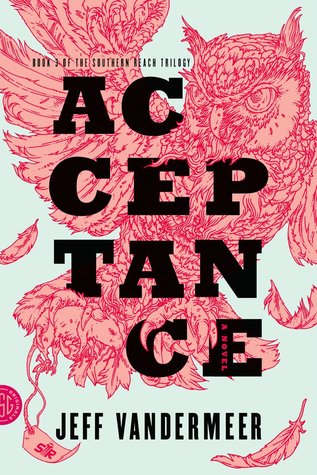
ACCEPTANCE gets more stars than its prequels


ACCEPTANCE
JEFF VANDERMEER
(Southern Reach Trilogy, #3)
FSG Originals
$15.00 trade paper, available now

Rating: 4* of five, mostly for the ending

The Publisher Says: It is winter in Area X, the mysterious wilderness that has defied explanation for thirty years, rebuffing expedition after expedition, refusing to reveal its secrets. As Area X expands, the agency tasked with investigating and overseeing it--the Southern Reach--has collapsed on itself in confusion. Now one last, desperate team crosses the border, determined to reach a remote island that may hold the answers they've been seeking. If they fail, the outer world is in peril.

Meanwhile, Acceptance tunnels ever deeper into the circumstances surrounding the creation of Area X--what initiated this unnatural upheaval? Among the many who have tried, who has gotten close to understanding Area X--and who may have been corrupted by it?

In this last installment of Jeff VanderMeer's Southern Reach trilogy, the mysteries of Area X may be solved, but their consequences and implications are no less profound--or terrifying.

My Review: It's a frustrating thing to wait for a book, a series, an idea to cohere. When it fails to happen, the result is usually a sense of letdown at the very least, and not infrequently outrage and betrayal. And here I am rating this incoherent (in the nice and accurate sense) final volume as the best of the lot.

Wonders will never cease.

The Big Reveal of this series doesn't need to be coherent (again used in the nice and accurate sense). It is big enough, titanic in fact, that any attempt to fit it into a pleasantly proportioned package would merely be absurd. This is a rare case of a resolution needing enough room to encompass the beginning all over again, since there is no conceivable way the results of Area X's existence for the reasons it exists will stop reverberating in each and every iteration of each and every possible future that flows from it.

Was that vague enough for you? See, there's nothing I can be specific about except at the certainty of spoilering every development in each book. That being the modern era's Worst Imaginable Sin, I'm avoiding the lynch mobs that roam freely over the internet. Let me give you a clue that won't be a clue unless you've read the series: The parable that seemed tantalizingly just beyond reach is here full-blown at last. What Area X represents in all its strangeness and its inscrutability can't be made any clearer than it is in the book, even though as you're turning the last few pages you're going to have a raft more questions than you started the book with. And that's a good thing.

Philosophically VanderMeer's point, well one of his points anyway, could not possibly be more timely than it is right now on the cusp of the Arctic's final descent into deglaciation. A piece of the planet is in reality changing before our (appalled) gaze into something that isn't quite set yet. The reasons aren't mysterious, in the case of the Arctic, but the consequences are equally bizarre, unpredictable, random. The planet isn't going to remain the same. The consequences for some, even many, individuals are going to be as condign as they are in the book. The authorities are as nugatory in the face of out planetary changes as they are in the book. The public is as...oblivious? unconcerned? flip?...as is the shadowy, gesturally indicated public of the book.

This series of books isn't a Rubik's cube of a story. It's a Seurat painting of lore. Enjoy that? This is a series for you. What befuddles me is how Alex Garland, the director, plans to make any kind of coherent film out of Annihilation alone. Natalie Portman and Jennifer Jason Leigh will show us, one supposes, when the film is released in 2017. Please dear goddesses, please don't let it be a hugely overlong, incoherent mess like 2012's Cloud Atlas.