Saturday, December 9, 2017

THE LOST SKETCHBOOK OF EDGAR DEGAS, a beautiful novel told in a deeply immersive voice


THE LOST SKETCHBOOK OF EDGAR DEGAS
HARRIET CHESSMAN

Outpost19 (non-affiliate Amazon link)
$9.99 eBook editions, available now

Rating: 5* of five

The Publisher Says: Ten years after Edgar Degas' 1872 visit to New Orleans, a lost sketchbook surfaces. His Creole cousin Tell -- who lost her sight as a young woman -- listens as her former child-servant describes the drawings and reads Degas' enigmatic words. It's both cryptic and revelatory, leading Tell to new understandings of her marriage, her difficult, brilliant cousin Edgar, her daughter Josephine, and herself.

***THE PUBLISHER SENT ME A REVIEW COPY AT MY REQUEST. THANKS JON!***

My Review: In the spirit of full disclosure, Harriet is my social media pal and the best of friends. It's unlikely I'd've published a negative review of the book under those circumstances, but equally unlikely I'd be so disrespectful as to puff up a book I did not enjoy. If you can't say anything nice, say nothing, is the tack I take on reviewing books by friends.

Luckily for the world, I absolutely adored reading this book. I have the good fortune to have seen a number of Degas's works in person, and I am familiar with New Orleans and its culture from years of contact with it and its practitioners. As I was reading the book, I'd come across things that spoke to me of the unique place that New Orleans is.
Honor reads a description of the city of New Orleans. Edgar appears to have written this on the eve of his departure. I almost can't listen, caught and struck as I am by some of the images: the city as a huge sleeping cat, washed and clean, or foul; something about Lake Pontchartrain's beauty. Something "glittering," something "humming." Lemon trees and orange trees. People of all colors. It moves me, in the wake of Edgar's despair, to discover in his own words how much he cherished about this city I love so much, in spite of all. What might have happened if he could have stayed, for a summer, another winter? Could he have felt healed? Could he have found comfort? Maybe even love?
It's not necessary to spell it out in blocks of visual data. In this case, as the narrator has lost her sight, it would be deeply suspect to do so. But what New Orleans is, in the end, is a place of the heart and soul more than a physical entity. New Orleans is either your home or it isn't, and you're aware of the answer from the second you arrive. It is undeniable and it is for life: You're a yat at heart or the magic is lost on you.

The magic is lost on me.

That doesn't mean I don't get it, though. I get what draws people to the place. I think Chessman's words vivify the spell of New Orleans as much as they limn the landscape of art. The narrative device of a lost sketchbook filled with New Orleans's grace and beauty by one of the leading artists of the time read to a blind woman relative of that artist by one of the subjects of his art is delightful. It requires no effort to understand...and that's the highest compliment I can offer a writer irrespective of the genre in which she works. Framing devices are too often part of a Conversation With The Reader. I don't appreciate that kind of story. I want you to lift me out of my comfy reading posture and transport me to your story's locale without making blaring announcements like a train's conductor does.

And that is Harriet Chessman's gift.
Here on my lap is something Edgar held once, and many times, something he opened, often, to record what he saw in our pretty, messy, crowded house. I wonder if Edgar still misses this sketchbook. I wonder what his days are like now. He must have filled dozens, hundreds, more such books since that winter when he was our guest.
In a passage tesserated from simple words, the complex conceit of the book takes shape. Telly, our blind point-of-view character, vivifies the world Chessman creates for us to inhabit. Telly is never obtrusive...she isn't the point of her own story, how typically female...she talks to us like she's across the tea table, she chats with us as she would any friend come to wile away an afternoon. It becomes more and more obvious to the reader that Telly inhabits her time with her cousin Edgar as old people inhabit their past. She is the mother of young people, she is the wife of a good man, and she is blind. She is blind in her eyes and she is blind in her heart and she gropes for understanding at every turn, physical or psychical.

Over the course of these 130-ish pages, I felt myself adjusting my reading speed to expand my pleasure in Telly's company. Odile and Honor came to feel like intruders, not one a beloved child and the other a welcome visitor. I was jealous of the attention they commanded from Telly. How silly, I'd tell myself, as annoyance whipped through me at Telly addressing one or the other. As it happened, Edgar, to whom Telly speaks in her memories of the past, elicited no such response from me. I was, instead, a full participant in Telly's relationship to her glamorous Parisian cousin.

I love reading books where I am that fully engrossed, carried out of the 21st century. It's a pleasure to be made that transparent to one's own eyes. I recommend this read to anyone looking for an immersive experience that won't require an entire month to read but will leave food for thought to keep you ruminating for months to come.

Thursday, December 7, 2017

ATLAS OF CURSED PLACES, a beautifully produced coffee-table reference book


ATLAS OF CURSED PLACES
OLIVIER LE CARRER

Black Dog & Leventhal
$24.99 hardcover, available now

Rating: 5* of five

The Publisher Says: Olivier Le Carrer brings us a fascinating history and armchair journey to the world's most dangerous and frightful places, complete with vintage maps and period illustrations in a handsome volume.

This alluring read includes 40 locations that are rife with disaster, chaos, paranormal activity, and death. The locations gathered here include the dangerous Strait of Messina, home of the mythical sea monsters Scylla and Charybdis; the coal town of Jharia, where the ground burns constantly with fire; Kasanka National Park in Zambia, where 8 million migrating bats darken the skies; the Nevada Triangle in the Sierra Nevada mountains, where hundreds of aircraft have disappeared; and Aokigahara Forest near Mount Fuji in Japan, the world's second most popular suicide location following the Golden Gate Bridge.

THIS BOOK WAS A YULE GIFT TO ME. IT SHOULD BE ON YOUR BOOKSGIVING LIST TOO.

My Review: History, a ruling passion of my reading life, contains so many byways, culs de sac, and dead ends that are fascinating that it's a wonder the "real" history ever gets told. I love the odd and unsettling details that get lost when one reads only The Big Picture. There are very few byways left unexplored by now, wouldn't you think?

You haven't read this book yet.

Start here, in India. Most US citizens have probably heard of Centralia, Pennsylvania, at some point or another...a town that sits atop a coal mine burning out of control since 1962. Now multiply that by about fifty and set it in a country where there isn't any kind or sort of centralized authority charged with keeping people safe from the consequences of profit-driven environmental rape. Oh wait...that'd be 45's Murrikuh, so sorry. Anyway, the image of Hell that is Jharia makes Centralia look like a minor dump fire.

Then let's go back in time to Timur's reign of terror. In the uniformly awful 14th century, Timur (or Tamerlane as the West knows him) was memorably more heinous than his contemporary rulers and more feared than the only slightly more virulent Black Death that killed almost 50% of the world's population. He managed directly to slay over 15 million people of the 300 million alive on Earth at the time he was busily slaughtering entire cities. This ghastly spot is the site of his mausoleum. It bore the inscription, "When I rise from the dead, the world shall tremble." On 22 June 1941, a silly Soviet scientist raided his tomb; mere hours later, the Nazis began the unbelievably costly Operation Barbarossa, which cost over 5 million more lives, and led to the deaths of millions more in its wake.
The moral of this story, kiddies, is DO NOT TAKE CURSES LIGHTLY.

Unlike the unbearably silly Lutz family that bought 112 Ocean Avenue in Amityville, New York, after ghastly Ronnie DeFeo slaughtered his family there the year before. They found out the hard way that there is no such thing as a deal too good to be true, lasting a whopping 28 days before bailing on this buy-of-a-lifetime Dutch Colonial in a desirable neighborhood.
Lots of publicity still attends the case, and the Lutzes have been called liars and profiteers. Amityville's just down the road from here. It's a nice village and nice people live there. I myownself get no evil vibe from it. But I wouldn't spend a night at 112 Ocean Avenue for any damn reason.

For the ghoulish giftee, this book's the best!

Wednesday, December 6, 2017

GLOBES: 400 YEARS OF EXPLORATION NAVIGATION AND POWER


GLOBES: 400 Years of Exploration, Navigation, and Power
SYLVIA SUMIRA

University of Chicago Press
$45.00 hardcover, quantities limited!

Rating: 5* of five

The Publisher Says: The concept of the earth as a sphere has been around for centuries, emerging around the time of Pythagoras in the sixth century BC, and eventually becoming dominant as other thinkers of the ancient world, including Plato and Aristotle, accepted the idea. The first record of an actual globe being made is found in verse, written by the poet Aratus of Soli, who describes a celestial sphere of the stars by Greek astronomer Eudoxus of Cnidus (ca. 408–355 BC). The oldest surviving globe—a celestial globe held up by Atlas’s shoulders—dates back to 150 AD, but in the West, globes were not made again for about a thousand years. It was not until the fifteenth century that terrestrial globes gained importance, culminating when German geographer Martin Behaim created what is thought to be the oldest surviving terrestrial globe. In Globes: 400 Years of Exploration, Navigation, and Power, Sylvia Sumira, beginning with Behaim’s globe, offers a authoritative and striking illustrated history of the subsequent four hundred years of globe making.

Showcasing the impressive collection of globes held by the British Library, Sumira traces the inception and progression of globes during the period in which they were most widely used—from the late fifteenth century to the late nineteenth century—shedding light on their purpose, function, influence, and manufacture, as well as the cartographers, printers, and instrument makers who created them. She takes readers on a chronological journey around the world to examine a wide variety of globes, from those of the Renaissance that demonstrated a renewed interest in classical thinkers; to those of James Wilson, the first successful commercial globe maker in America; to those mass-produced in Boston and New York beginning in the 1800s. Along the way, Sumira not only details the historical significance of each globe, but also pays special attention to their materials and methods of manufacture and how these evolved over the centuries.

A stunning and accessible guide to one of the great tools of human exploration, Globes will appeal to historians, collectors, and anyone who has ever examined this classroom accessory and wondered when, why, and how they came to be made.

My Review: Author Sumira is a conservator of printed paper. Her expertise within that niche is the preservation and restoration of antique globes, whose survival into the present is nigh on miraculous given their inherent fragility. In her introductory chapters, Author Sumira presents us with a distilled historical timeline of the development of globes as a means of conveying information and illuminating concepts that would otherwise be nebulous at best, then gives an even more fascinating (to me at least) précis of how globes have been made through time.

None of this even scratches the surface of Author Sumira's expertise on the matter. It feels to me as though she was tasked with creating a "for Dummies" version of her life's work by her publisher. This is someone whose depth of knowledge is matched by her breadth of viewpoint. In the essays concerning the sixty globes pictured in this gorgeous, oversized coffee-table book, hints of Author Sumira's wide-ranging appreciation for the role, history, and place of each globe illuminate the sheer physical beauty of the artifacts in ways that are meat and drink to geography nerds, photography buffs, history mavens, and whatever one would call globe people.

Let me get out of the way and let you revel in the joys of the globes:


Tuesday, December 5, 2017

YOU'RE ALL JUST JEALOUS OF MY JETPACK, perfect lightener for the po-faced


YOU'RE ALL JUST JEALOUS OF MY JETPACK: Cartoons
TOM GAULD

Drawn & Quarterly
$19.95 hardcover, available now

Rating: 5* of five

The Publisher Says The New York Times Magazine cartoonist Tom Gauld follows up his widely praised graphic novel Goliath with You’re All Just Jealous of My Jetpack, a collection of cartoons made for The Guardian. Over the past eight years, Gauld has produced a weekly cartoon for the Saturday Review section of Britain’s best-regarded newspaper. Only a handful of comics from this huge and hilarious body of work have ever been printed in North America—and these have been available exclusively within the pages of the prestigious Believer magazine.

You’re All Just Jealous of My Jetpack distills perfectly Gauld’s dark humor, impeccable timing, and distinctive style. Arrests by the fiction police and imaginary towns designed by Tom Waits intermingle hilariously with piercing observations about human behavior and whimsical imaginings of the future. Again and again, Gauld reaffirms his position as a first-rank cartoonist, creating work infused with a deep understanding of both literary and cartoon history.

My Review: Tom Gauld brought out this collection in 2013. He is a Serious Intellectual with an Impish Streak, as his 2015 photo attests:


Easy on the eyes, funny to the bone, smart and wry and a lot of fun and game-changingly talented. Gauld has made a solid name for himself by being truthful, unsparing, and wryly willing to play the game he ever-so-Englishly lampoons. Anyone on your gift-giving radar who is a book person, a comics person, or a smart person is very likely to enjoy this book. Most people don't buy themselves books like this, so clearly frivolous and unserious, which means it's perfect as a Yuletide surprise for your favorite po-faced intellectual, your unsmilingly Goth niece, or your own sweet self as a means of escaping the seasonal silliness and brummagem jollification with a fellow eyebrow-raising up-the-sleeve laughing smartypants.


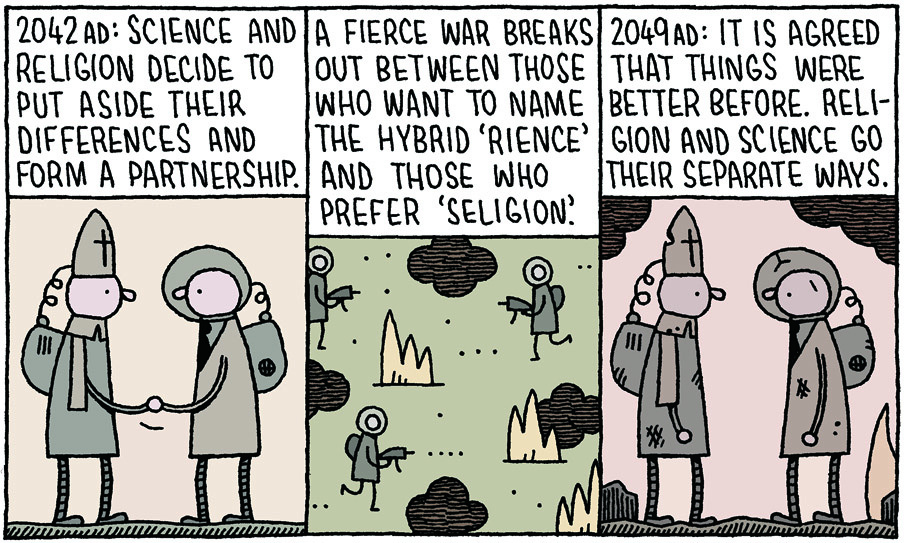
Before Gauld, very little humor and even less comic ink was spilled in such a way about books as cultural objects and not items of celebrity or nonce-memes. If these images did not make you laugh out loud in real time, you should not bother with this book.

Also? Might be a good idea to unfriend me. Tom Gauld makes me guffaw so hard my abdomen cramps.

Sunday, December 3, 2017

MOONCOP, a quiet gentle and uncompromising look at loneliness


MOONCOP
TOM GAULD

Drawn & Quarterly
$19.95 hardcover, available now

Rating: 4* of five


All cops in noir stories eat donuts and drink coffee.


Of course they buy them from the local shop.

Mooncop is 96 pages of Gauld's quiet storytelling. He isn't aiming for humor and he doesn't shy away from silence. It is deeply satisfying to be taken by the hand and led to the place that Gauld wants to go: Human hearts that are quieter than most fiction lets on. What happens between peaks is only a valley by comparison.

Paying $20 for this book would, I admit, make me panther-screechingly furious. The library gets my thanks for having a graphic novel section. I enjoyed this gently sad exploration of endings and their occasional happy discoveries.

Saturday, December 2, 2017

PEPPERS OF THE AMERICAS, the cook's introduction or the coffee table's glory


PEPPERS OF THE AMERICAS
MARICEL E. PRESILLA
10 Speed Press
$35 hardcover, available now

Rating: 5* of five

The Publisher Says: From piquillos and shishitos to padrons and poblanos, the popularity of culinary peppers (and pepper-based condiments, such as Sriracha and the Korean condiment gochujang) continue to grow as more consumers try new varieties and discover the known health benefits of Capsicum, the genus to which all peppers belong. This stunning visual reference to peppers now seen on menus, in markets, and beyond, showcases nearly 200 varieties (with physical description, tasting notes, uses for cooks, and beautiful botanical portraits for each). Following the cook's gallery of varieties, more than 40 on-trend Latin recipes for spice blends, salsas, sauces, salads, vegetables, soups, and main dishes highlight the big flavors and taste-enhancing capabilities of peppers.

My Review: The simple glory of eating peppers is their surprising, underutilized versatility. Nothing is more delicious than a juicy piece of cantaloupe sprinkled with a salt, sugar, dried pepper blend. Oh wait, squeeze some lime juice on it first! The pass out from the pleasure of savoring the sweethottart explosion in your brain.
This beautiful page shows the ingredients for true peppery happiness.

I grew up on the Texas/Mexico border and was indoctrinated early in the ways of hot and spice, to my resolutely Anglo mother's mild horror and refined disgust. (She also disapproved of fried foods, another thing I can't get enough of; her goddesses were Elizabeth David and MFK Fisher, worthy objects of veneration, but not to the exclusion of Madhur Jaffrey and Maria Ninfa Rodriguez Laurenzo.) I was thrilled with the recent rise of the sriracha cult, I am a huge fan of Tabasco, pretty much if it's under 250,000 scovills I'm on board and above that if there's a pitcher of milk nearby.
Here we see the Gates of Heaven, aka dried peppers and how to make them.
This volume is a gorgeously illustrated single-subject encyclopedia. It is history, sociology, mixology, on and on, in an oversized trim and printed so beautifully you won't want to use it in the kitchen. Resist this impulse. Make turkey in mole coloradito (p317) to shake up your Yuletide table with a truly American dish. Besides, it's so delicious it slips under my no-turkey table rule which is a major feat.

Live in a pepper desert? Page 330 has you covered...Author Presilla gives you her online sources for all things pepper. There's a gallery of fresh peppers for the aesthetes, complete with potted histories and good guidance on what to expect from each.

I would give this beautiful item to a coffee-table cook without a second thought. I'd far prefer to give it to someone with a need for heat whose sophistication of palate has gone beyond a squirt of something red from a bottle, whose horizons need broadening, and who can benefit from a thorough, well-organized "Cooking With Peppers" guide to comfortable handling and effective preparation of these magical, savory, versatile fruits.

Friday, December 1, 2017

THE TRADESCANTS' ORCHARD, a spectacular gift book for your garden lover


THE TRADESCANTS' ORCHARD
The Bodleian Library
$65.00 hardcover, available now

Rating: 5* of five

The Publisher Says: In the early seventeenth century, England’s leisured classes took an eager interest in fruits from the Mediterranean and beyond, introducing species from abroad into the kitchen gardens and orchards of grand homes. A charming collection of sixty-six early watercolors showing fecund trees with fruits hanging heavily from their branches, The Tradescants’ Orchard is a testament to these broadening horticultural horizons.

The Tradescants’ Orchard reproduces for the first time the entire manuscript, traditionally associated with the renowned father-and-son nurserymen the John Tradescants. The paintings pose many questions: Who painted them and why? What is the significance of the wildlife—birds, butterflies, frogs, and snails—that appear throughout? Why is there only one depiction of an apple tree despite its popularity? Were there others that have since gone missing?

A visual feast that will appeal to botany and gardening enthusiasts, the book also includes an introduction that maps out the mystery of how and why these enigmatic watercolors were made.

My Review: Visual perfection, this. A gorgeous old book, not a scientific treatise but more likely (or so scholarly opinion has it now) a sort of seed catalogue made to entice the wealthy landowners of its century (the 17th century, we're pretty sure) into planting fashionable gardens and orchards. How can this be a sure analysis of the book's origin? We have many examples of herbals and botanical texts from earlier and contemporary times...this book's charming and attractive artwork isn't scientifically accurate. It's even whimsical at times, and how many whimsical scientists have you ever met? Or even heard of?

Look at this! Just look at the itty-bitty bugs! How totes adorbs are they?!

But they're fantasy bugs, not carefully rendered anatomically observed type models, and those things are present in the academic books produced at and before the time this book was made.

The Bodleian Library, an ancient (to my American eyes) repository of bookish treasures from all ages of England's long, long history of literary greatness, publishes facsimiles like this as well as fascinating and little-known treasures once common, for this generation's curious and cultured to consume. This is God's Work from my point of view. There is no more important duty for a library than to preserve and disseminate the words, ideas, images, thoughts and prayers, of the past to the present. In this sacred trust they are assisted by their US distributor, the University of Chicago Press, which has the Great Chicago Book Sale running. This book was a birthday gift to me from a friend who gave me a gift card. It was only $19 in the book sale! A perfect amount of money to spend on a lavish-looking gift given to your slightly distant but important to remember giftee this Yuletide. And, bookish friends, you won't be able to leave the book sale without acquiring a few treasures for yourownselves. This link takes you to the sale catalog. Use code AD1647 to get the discounted prices when checking out.

Can you resist spending a lousy $20 to get over 100 pages of joy like this image of a cherry varietal?

I though not. You're welcome.