Friday, August 2, 2024

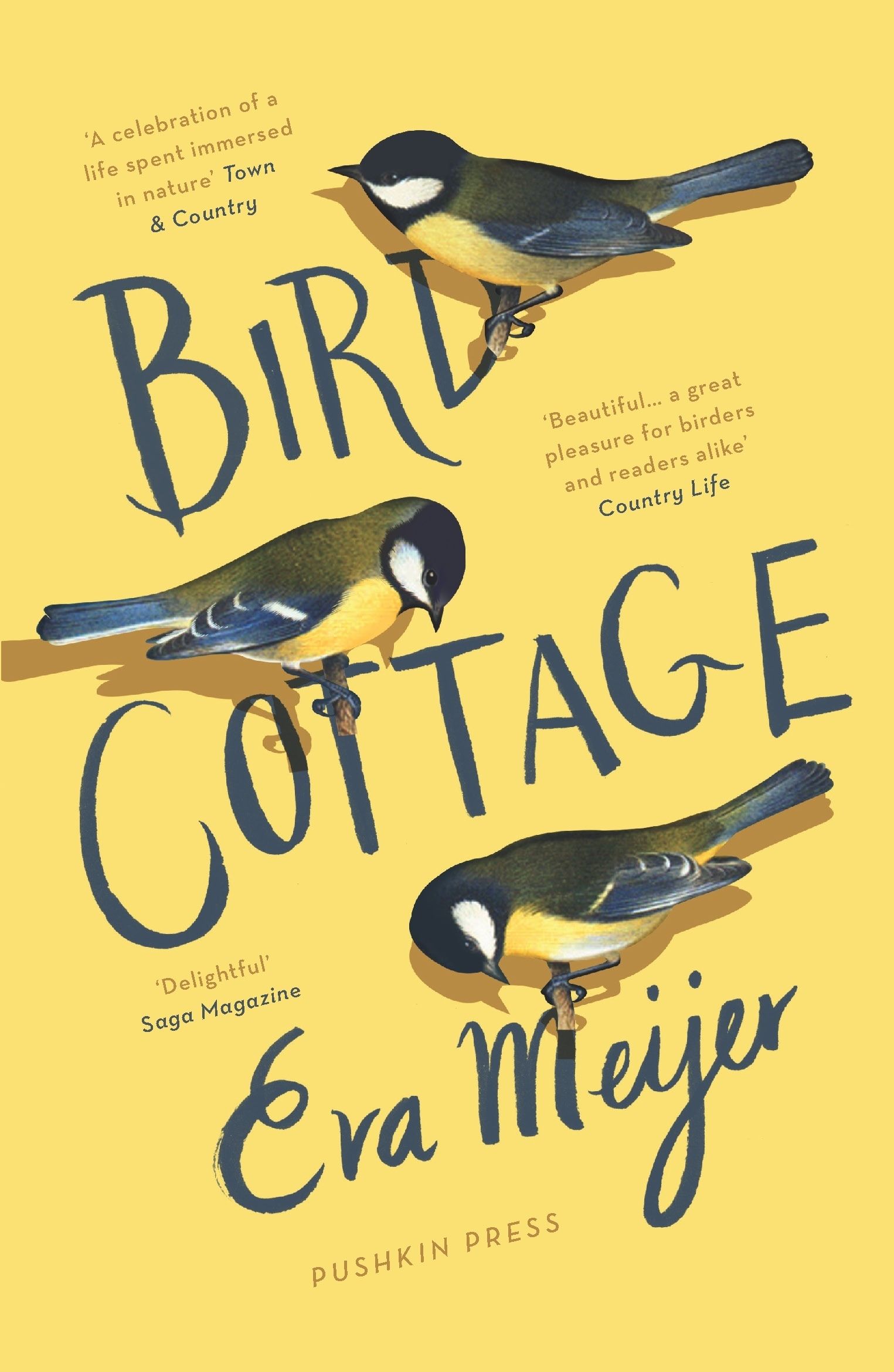
BIRD COTTAGE, perfect holiday read for #WITMonth


BIRD COTTAGE
EVA MEIJER
(tr. Antoinette Fawcett)
Pushkin Press (non-affiliate Amazon link
$14.95 trade paper, available now

Rating: 4* of five

The Publisher Says: I want to find out how they behave when they’re free.

Len Howard was forty years old when she decided to leave her London life and loves behind, retire to the English countryside and devote the rest of her days to her one true passion: birds.

Moving to a small cottage in Sussex, she wrote two bestselling books, astonishing the world with her observations on the tits, robins, sparrows and other birds that lived nearby, flew freely in and out of her windows, and would even perch on her shoulder as she typed.

This moving novel imagines the story of a remarkable woman’s decision to defy society’s expectations, and the joy she drew from her extraordinary relationship with British garden birds.

I RECEIVED A DRC FROM THE PUBLISHER VIA EDELWEISS+. THANK YOU.

My Review
: A non-fiction novel, a fictionalized (more than usual) biography, it's a read that solves the need I feel to derive some kind of new-to-me knowledge from my entertainment. Len Howard was a real woman, and the facts of her life are as presented here.

I don't think that's necessary to know to appreciate this celebratory telling of one woman's remarkable life. It's interesting, and raises the question: Why not go into a full biography of this powerful, if quiet, personality? She would stand out in any era but in her lifetime (1894 to 1973) she was a unicorn! So, from the start, I was inclined to stand a bit apart from the story. When I'm told it's based on a real person's life, but is fiction, I'll never settle in to a naturally flowing response now. The "which is this thing, fact or fiction?" will arise at every turn.

No fifth star for you, book.

That said, the story told...quiet, meditative, filled with Howard's own sense of wonder and awe at the beautiful world...is an enfolding, enriching experience. I'm not deeply interested in les burdies, unlike so many. Howard's decision to stop creating music to pursue a close and deep connection to them was surprising to me, as it was to those very few she was close to. Her desire to see what unthreatened birds would do differently from the ones she saw being "studied" in harrassing ways, as was the norm at the time, made me think she was trying to find a space free of threats, free of unnatural demands, for herself. What she does in this beautiful idyll is make careful observations, meticulously recorded and thoroughly analyzed. This led to two published books, in 1952 and 1957, now seemigly out of print in English, though not in Dutch...for obvious reasons. Author Meijer's deft hand at work, I suppose, though she did not translate the book.

It is the story of a restricted life, told beautifully, and fully. It reveals that even a woman of restrained temperament...nothing in Len's life before or after her assuming residence at the eponymous Bird Cottage suggests she was a repressed soul, just a quiet one...can feel pinched and coerced into a mold not to her liking. Often the quiet souls, uncomplaining and undramatic in their manners and manner, are mimstakenly supposed to be happy or at least contented. Len Howard was neither. She disliked most human interaction. When, at forty-five, she left the social demands of the world behind to be fully in the natural world, she began to achieve things, to see things, that simply would not be seen in the regimes of study then fashionable. She began, I think, to live her life for herself, as herself.

The strength of my own lurid energies makes me think "that can not be a happy life" but the evidence of her writing suggests it was. I'm appalled, fascinated, and very slightly amazed that someone could choose, at any age younger than I am now, a life without sex. Without companionship. Without others. She wasn't the first, or the last, but "really?" is my one thought.

So there's the missing star explained away; the other four represent my glad-hearted, deeply gruntled feelings as I immerse myself into a calm pool of beautifully clear word-water, telling me a satisfying story of a life lived on the terms its subject most wanted. That she was ucky enough to do this for almost half her years on this planet makes her one of the most fortunate and privileged of people.

This beautifully translated novel of an extraordinary woman's life is an excellent seasonal read. It's one that, during a vacation, will allow the reader to submerge into a truly different way of life. Even though I myownself wouldn't want to live Len Howard's life, I'm glad Author Meijer and Translator Fawcett shared it with me.

Thursday, August 1, 2024

OF SAINTS AND MIRACLES, family tragedy that creates a folk hero


OF SAINTS AND MIRACLES
MANUEL ASTUR
(tr. Claire Wadie)
New Vessel Press
$16.95 trade paper, available now

Rating: 4.5* of five

The Publisher Says: This mesmerizing novel opens with a fratricide in a beautiful if impoverished region of northern Spain.

The perpetrator, Marcelino, lives alone in his parental home where he recalls having doted on his baby brother and sought to protect their mother from their father’s drunken rages. Author Manuel Astur’s poetic language and seamless blend of lyricism with the grotesque renders this book a treasure for the reader that includes the mother’s bewitching tales about the sun, the moon, and an invisible horse-drawn carriage of death. Glimpses into other villagers’ lives reveal a community that gathers to slaughter pigs for feasts and to confront a mysterious plague of white worms.

The mountainous green of rural Asturias is as much a character as these residents, from whom Marcelino flees to the wild peaks after his brother’s slaying, becoming a cult hero as he evades authorities. Of Saints and Miracles is a sensuous portrayal of an outcast’s struggle to survive in a chaotic world of both tragedy and magical splendor.

I RECEIVED A DRC FROM THE PUBLISHER VIA EDELWEISS+. THANK YOU.

My Review
: What startled me most was being in medias res, knowing the murderer from the get-go and the inside out. That is a subversion of expectations that made me stick to the tale as it was being told. Normally I read murder-themed stories while looking for clues and hints from the off. I was made to think a different way about this true-life tale.

It worked in this read's favor, as the way the story's written is a joy to read:
When you see a weed in the vegetable plot you pull it out. When you've got more chickens than you need, you wring the neck of one and chuck it in the pot. When some dog mounts your bitch and she gives birth to a litter, you choose the best puppy, put the rest in an old potato sack with some stones and throw the sack in the river. When an apple tree no longer bears fruit, you cut it down and chop it up for firewood. When the grass in your field gets too long, you cut it, gather it up and store it in the hayloft. When a man in a suit comes and shows you some papers and tells you some stuff about mortgages and wants to take away your vegetable plot, your hens, your bitch and your fields, you defend yourself. Even if this man in a suit is your brother. And they can call you a revolutionary and talk about you on TV and in the papers and say who knows what about the oppressed peoples, or the last remaining guerrilla, but the truth is simpler, it's always simpler. And the truth is that you have to do what you have to do.
–and–
(Marcelino/)Leno's mother told him to give the little old lady a kiss. She smelled of cookies, earth, and bleach. Then she gave a toothless smile like a baby magpie and made a gurgling sound as if she had sand in her throat. She gurgled some more and his mother understood, even if he didn't. That was about all he could remember of the old world. The yellow smell of human piss and past lives filled with misery. A white washbowl with a tear shaped chip in its enamel, glowing in the darkness like an apparition. A one-eyed ginger cat asleep at the old woman's feet. A tatty old oil cloth on a rickety table. A few empty hooks, blackened by grease over the years. A handful of dried ears of corn tied up in a piece of cloth. Shadows dancing on the filthy wall. That's about it.

You like it, you don't...I don't think anyone can make much of a case that this isn't a robust storytelling voice. The way the voice comes across in telling this sad, brutal tale of a simple man solving problems he doesn't understand as best he can suited this reader as well as anything could.

The fearsomeness of committing a fratricide is never far from Marcelino's mind.
You see, this wound hurts just as much as yesterday’s wound, which hurt as much as the one before, and the one before the one before that, and as much as the first wound, the original wound that the first man feared. And though this wound is bleeding in the same way as all wounds bleed, and blood has always been the same, this wound thinks itself unique.
–and–
Death is never heroic. Life can be, but not death. Death comes to us all, but we know that if a woman watches over us on our deathbed, we’ll go to heaven.
–and–
All the dead are good because they are no longer alive and can therefore be imagined. As with fools and saints, we can lie about them because they can't defend themselves. They are a tale with countless morals, in illustration of whatever you like, a myth to be molded. The dead don't belong to the dead; the dead are ours.

These are simple thoughts, basic, grounded—even rooted—in the life of a man who has no sophisticated veneer to hide his innocent belief that the world can, and must, be made to make sense. Even or especially when it doesn't. Marcelino, based on a man called Tomasín whose life ended in exactly this concatenation of nightmares, becomes a symbol of the distant and rural province of Asturias's resistance to the rapidly modernizing economy of Spain after Franco's 1975 death. No one who's ever had a credit card or a cellphone contract won't, in some small way, fail to comprehend this desire to see someone stick it to The Man. No one whose family is normal won't, in some small way, recognize the urge to commit murder of a sibling who's just done you dirt.

Author Astur set out to tell us a story of a world, an old one, that is losing its battle to remain as it is. A world that pays attention, not compound interest. A world where Marcelino, salt of the Earth that he is, can be so in tune with Life that it becomes Art before his fulfilled eyes:
Just as a sun-soaked stone radiates heat for a while after nightfall, there is a point on still summer evenings whe objects appear to shine, as if to give back part of the generous daylight they've received. In such moments, Marcelino would stop what he was doing — clod of earth on the hoe, spade sunk deep in the hay, scythe dripping with fresh green blood — to stand up straight, wipe his brow with the back of his hand and contemplate the valley below. Everything would be gleaming, chiming like a bell of golden light. He would let his eyes fill with sky.

And so, as the sun set on that July evening, Marcelino stopped and contemplated. The house, the stilt granary, the cart with its shaft reaching skyward, the dry straw, the ears of corn, the cows in a single spine coming home along the track, the dog’s bowl, the rusty drum among the nettles, the axe in the tree stump, the woodchips and the logs, the sawdust on the ground, even the moss that hugged the stones in the walls of the small vegetable plot, even the trees in the nearby woods and the mountain peaks: everything shimmered, silhouetted against the deep-blue sky, in which a single bright star heralded the coming of a new age. Everything, that is, except the large bloodstain in the sawdust, and his brother’s body, both so dark they seemed to trap the light, as if the black ink that was slowly flooding the valley was seeping directly from them, saturating the sky and drawing the shapes of bats, which began to dance around the yellowish light of Cobre’s lone street lamp.

We go into this read certain murder is Wrong, murderers must be caught and required to suffer punishment; and come out without such a comfortable Certainty. Did Marcelino do wrong by killing his wicked brother? Yeah. Was he Wrong, was his action a rip in the fabric of society?

Dunno about you, but I came out of this read not at all sure. Read it soon, tell me what you thought.

Wednesday, July 31, 2024

August is #WITMonth: Women in Translation will feature all August long


August is W.I.T. Month!

This ten-year-old readfest is described on their website (linked above) as follows:
WITMonth—aka Women in Translation Month—is an annual celebration of women writers from around the world, writing in languages other than English. Started by Meytal Radzinski in 2014, WITMonth has grown to become a staple of the online literary community, as well as a prominent presence in independent bookstores around the world.

Every August, readers from all continents around the world (except Antarctica, but we’ll get those penguins yet!) gather in spirit (and sometimes in person) to read, review, and discuss works by women writers in translation. The idea is to spread the word about the Women in Translation project at large, and promote individual women writers in translation specifically. Follow #WITMonth on Twitter, Instagram, Booktube, and across the world!

The overarching purpose is one I support most of all because it is the opposite of the TERF essentialist and exclusionary mindset. A bit of history about their work, again from their website...
The #womenintranslation project is:

International, intersectional, and built around the notion that all women* (*and transgender and nonbinary and intersex individuals) deserve to have their voices heard. This project is committed to giving space to women* from all countries, all languages, all religions, all ethnicities, all cultures, all sexualities, all marginalized gender identities, all abilities, all bodies, all classes, and all ages.

Due to the stunning gender disparity in non-English language literature, this project will focus on all literature written by women* in any language other than English, regardless of the language in which it is read or discussed. This project shall not discriminate based on literary genre or designation, seeking instead to open as many gates as possible to all readers. This project is open to all readers, from all languages, from all countries, in the hopes that together we may build a better world.

This month I will focus on works written and/or translated into English by *women. My intention is to post twenty-one reviews, not including Burgoines and Pearl-Rules, in the thirty-one days of August. See the previous years' reviews, too.

I encourage all who love reading to join the fun...one book or ten, add some women's writing and translating to your TBR!
***
August is #WITMonth in Review

I wrote twenty-four reviews, Burgoines, and Pearl-Rules in August. I'd planned to make twenty-one full blog posts of #WITMonth reads, and failed, making thirteen full-blown reviews. My excuse is what my LT friend Katie calls "The Rona" bashed me for several days...though that might be a self-misdiagnosis. The pharmacist who shot me up with my vaccines yesterday said the profile I described sounded more like the onset and course of RSV.

Anyway, I'm all jabbed up and really don't want any re/visits from anything, thenkewveddymahch.

My favorite read of the month was, hands down, Hum by Helen Phillips. Excellent, thought-provoking story of how humans will always screw up inhuman systems because what programmers call "edge cases" actually make up the bulk of human life. I was gripped, beginning to end.

The most enjoyed #WITMonth read was the estimable Of Saints and Miracles, translated ably from its Spanish edition by Claire Wadie. I absolutely rang like a newly-founded bell with its story of betrayal for gain. Not the cheeriest story, permaybehaps, but one I think we can all feel in our water.

September will be themeless as I ramp up for #Deathtober and #Booksgiving. It's all the more urgent to me that I not die before those themes are polished and properly posted because my notes say some pretty scathing things and need toning down for public consumption.

SOMEONE LIKE US, a title that says so much more after you've read the book (which you should!)


SOMEONE LIKE US
DINAW MENGESTU

Alfred A. Knopf
$28.00 hardcover, available now

Rating: 4.5* of five

The Publisher Says: After abandoning his once promising career as a journalist in search of a new life in Paris, Mamush meets Helen-a photographer whose way of seeing the world shows him the possibility of finding not only love, but family. Now, five years later, with his marriage to Helen on the verge of collapse, he returns to the close-knit immigrant Ethiopian community of Washington DC that defined his childhood. At its center is Mamush's stoic, implacable mother, and Samuel,the larger-than-life father-figure whose ceaseless charm and humor have always served as cover for a harder, more troubling truth. But on the same day that Mamush arrives home in Washington, Samuel is found dead in his garage.

With Helen and their two-year old son back in Paris, Mamush sets out on an unexpected journey across America in search of answers to questions he'd been told never to ask. As he does so, he begins to understand that perhaps the only chance he has of saving his family and making it back home is to confront not only the unresolved mystery around Samuel's life and death, but his own troubled memories, and the years spent masking them. Breath-taking, commanding, unforgettable work from one of America's most prodigiously gifted novelists.

I RECEIVED A DRC FROM THE PUBLISHER VIA NETGALLEY. THANK YOU.

My Review
: I am a very, very white old man. I experience none of what Mamush does, or expects to, on a daily personal basis. My Young Gentleman Caller is half-black (he prefers lowercase to uppercase "Black"). There are times I am utterly oblivious to what that idiotic blood quantum theory of human identity means because I get none of it. What I *do* get is profiled, when traveling, as an American...some indefinable something about me is ineradicable, and inescapably American. Among anti-semites I am always assumed to be a Jew. (Among Jews as well, which can get awkward.) As a gay man, and an old one, I'm often seen as not queer enough, or just a bit too queer. Can't win for losin'.

So when I read Author Mengestu's books, I am not just pruriently peeping in on his characters' struggles with identity and its ramifications.

The great strength of Author Mengestu is his lovely language. One of my all-time favorite aperçus of his is from How to Read the Air: "There is nothing so easily remade as our definitions of ourselves." (Note to self: Why haven't we reviewed that one?) This book, too, is full of meaty thoughts on identity, on the mutability of selfhood, on the complexity of being alive in an interwoven web of love and fear and distrust, trying to spin new threads as old ones fray, of making the effort to stick yourself to the ones you thought you wanted to escape. The way webs form...from the center outward, directed by a design and made for a purpose...is, however, the opposite of that other great center-driven natural structure: the hurricane. These form when a depression becomes so empty that everything around it is drawn in to fill its vacant space in the atmosphere. Mamush, with the best of intentions, is a hurricane. “You’re like a donut. There’s a hole in the middle, where something solid should be,” says his wife.

He sticks to nothing, nothing sticks to him. His deep and abiding depression formed in his deeply uprooted "family." His mother and father escaped imploding Ethiopia, and in a truly terrible series of bad decisions, engendered their child Mamush. Neither, though they are friends, wants to raise a child with the other. Mamush has the ordinary single-mother experience of childhood with all its spaces and silences and absences. His father would've been absent no matter what because he is a man on a mission to help other Ethiopian immigrants starting a taxi business to employ them in the US. Tgat makes him professionally unrooted, always in motion, at the mercy of those around him, subject to their moods and attitudes in service of making a living. Mamush is his father's son. He abandons a job as a journalist...someone who observes from the sidelines...to run away from the ever-darkening US. It's the way these men live. He starts a family in France, which honestly sounds like one of the worst ideas anyone ever had. That, unsurprisingly, just presses his depression even lower down: his son is disabled, a hard, hard road for the best prepared parent. Predictably, it's a terrible stressor for Mamush. At his mother's summons to come home to DC and help her figure out where his father has got to, he's outta there leaving son and wife to struggle along without him.

It's deeply telling that he misses his plane. It's even more telling that he, on a whim with no forethought, then switches his ticket from DC to Chicago. It wasn't just a whim, really, as his parents had lived with him in Chicago before settling in DC. His unmooring from his plans, from his family, from his career, is all in service of a Quest. Who doesn't love a Quest? He's so turbulent, such a low-pressure spot in his own life, that he's attracting chaos at such a huge rate he must find a way to fill himself from the center outward or succumb to that destructive chaos.

A man in search of a center, a man whose essence is unquiet and kinetic, who now wants something he's never had and has no tools in his kit to create, is a danger to himself and others until he finds the thing that can act as solid ground. Standing still is only possible when there's solid ground under you. Then the hole formed so early in life, made from the same stuff as the edges are, is the small nugget of solidity he can stand on. From this small, awkwardly shaped piece, a center is formed, and the spinning of that web of intent, design, and adhesion can begin.

This is when Mamush says to his father: “There isn’t one story. Things start and end abruptly. Some pages are just a single paragraph. I don’t always understand who’s speaking or what’s happening. If what you’ve written is fact or fiction.”

Homecoming, homegoing, home is now within reach. It is a beautiful moment in a book that, for almost half its length, made me want to slap the hell out of Mamush, out of his parents, and maybe most of all his idiot wife who had a child with this deeply unready man. All comes out well, or at least "well" is finally in sight, for Mamush. Guaranteed? No. Delivered? Not really. But visible at last.

I think Dinaw Mengestu deserves a stonking medal for taking me on this journey that irked and annoyed me, but lured me on with his usual glorious phrasemaking music, then delivered me to an ending I could both believe completely and feel satisfied with. Kudos to you, sir.

Monday, July 29, 2024

BRIGHT OBJECTS, shiny start to a promising new career


BRIGHT OBJECTS
RUBY TODD

Simon & Schuster
$28.99 hardcover, available now

Rating: 4.25* of five

The Publisher Says: A young widow grapples with the arrival of a once-in-a-lifetime comet and its tumultuous consequences, in a debut novel that blends mystery, astronomy, and romance, perfect for fans of Emma Cline’s The Girls and Ottessa Moshfegh’s Death in Her Hands.

Sylvia Knight is losing hope that the person who killed her husband will ever face justice. Since the night of the hit-and-run, her world has been shrouded in hazy darkness—until she meets Theo St. John, the discoverer of a rare comet soon to be visible to the naked eye.

As the comet begins to brighten, Sylvia wonders what the apparition might signify. She is soon drawn into the orbit of local mystic Joseph Evans, who believes the comet’s arrival is nothing short of a divine message. Finding herself caught between two conflicting perspectives of this celestial phenomenon, she struggles to define for herself where the reality lies. As the comet grows in the sky, her town slowly descends further and further into a fervor over its impending apex, and Sylvia’s quest to uncover her husband’s killer will push her and those around her to the furthest reaches of their very lives.

A novel about the search for meaning in a bewildering world, the loyalty of love, and the dangerous lengths people go to in pursuit of obsession, Bright Objects is a luminous, masterfully crafted literary thriller.

I RECEIVED A DRC FROM THE PUBLISHER VIA NETGALLEY. THANK YOU.

My Review
: A debut novel from a very accomplished author, one whose best gift is the deft touch of characterization. I felt very connected to Sylvia from the get-go, her fuddled and bewildered survivor's guilt, her unostentatious revenge-seeking against the one responsible for her loss, and her deep but unwilling fascination with a charismatic local cult leader.

The lovely patterns Author Todd weaves among these strands, spinning her threads from the ever-renewed internal structures of loss, guilt, sadness, and outrage, don't sag or drop. They're sometimes not as harmoniously tinted as a veteran writer might choose...the mother-in-law in particular is rather paler than I'd expected, Theo the astronomer a bit too intense...but these are quibbles. Not a line out of place, not a word (even when a not-American word crops up) wasted or obscured.

The lack of a full fifth star on my rating isn't because of some sense of disappointment. I got what I wanted. The plot...revenge-driven widow struggles to cope with her loss and her survivor guilt will catch me in its web every time...is consistent, is finished with an appropriate, yet unexpected, ending. What bothered me, and this is really a very *me* thing to be tangled up in, was the comet. A comet, one on a path to get this close to Earth, is not going to go undetected for very long. We're motivated, since Shoemaker-Levy 9 smacked Jupiter so very hard in 1994, to go looking for these kinds of objects.

Okay, so that's a half-star lost. A tiny smidgeon of the tarnish on my shiny loving cup of pleasure also traces to Theo and his own warping loss. It's a trope I find painfully Writerly, is the Conjunction of Damaged Souls. Theo's issues were understandably similar to Sylvia's; his response to her darkness was believable. His discovery of her, in Australia, where he happens to be for the confirmation of a career-defining discovery, is what rings false to me. As always I want this kind of other-directed man to exist; I suspect he isn't to be found in a man about to ascend to the heights of his ambitions. I also see the facile characterization of Joseph Evans, and honestly, since he's such a bell-end of a grifter, I just don't care.

Quibbles and crotchets aside, everything Author Todd does in this story fits. The mystery plot, the way it's rooted in the ugliness of revenge, the focus of the two leads on their personal quests, all works as a whole. The manner in which the ending's made manifest felt satisfying to me. I'm struggling with myself not to spoiler it (though I really want to!) because experiencing the event blind is a pleasure enhancer.

Tyro author does a fine job, will most likely do better next time, and very much deserves your treasure and time.

Sunday, July 28, 2024

July 2024's Burgoine and Pearl-Rule reviews


Author 'Nathan Burgoine posted this simple, direct method of not getting paralyzed by the prospect of having to write reviews. The Three-Sentence Review is, as he notes, very helpful and also simple to achieve. I get completely unmanned at the idea of saying something trenchant about each book I read, when there often just isn't that much to say...now I can use this structure to say what I think is the most important idea I took away from the read and not try to dig for more.

Think about using it yourselves!

++++++++++++++++++++++++++++++++++++++++++++++++++++++++++++++++
++++++++++++++++++++++++++++++++++++++++++++++++++++++++++++++++


Navola by Paolo Bacigalupi

Rating: 3.5* of five

The Publisher Says: From the New York Times best-selling author of Wind-Up Girl and The Water Knife comes a sweeping literary fantasy about the young scion from a ruling class family who faces rebellion as he ascends to power.

"You must be as sharp as a stilettotore’s dagger and as subtle as a fish beneath the waters. This is what it is to be Navolese, this is what it is to be di Regulai."

In Navola, a bustling city-state dominated by a handful of influential families, business is power, and power is everything. For generations, the di Regulai family—merchant bankers with a vast empire—has nurtured tendrils that stretch to the farthest reaches of the known world. And though they claim not to be political, their staggering wealth has bought cities and toppled kingdoms. Soon, Davico di Regulai will be expected to take the reins of power from his father and demonstrate his mastery of the games of Navolese knowing who to trust and who to doubt, and how to read what lies hidden behind a smile. But in Navola, strange and ancient undercurrents lurk behind the gilt and grandeur—like the fossilized dragon eye in the family’s possession, a potent symbol of their raw power and a talisman that seems to be summoning Davico to act.

As tensions rise and the events unfold, Davico will be tested to his limits. His fate depends on the eldritch dragon relic and on what lies buried in the heart of his adopted sister, Celia di Balcosi, whose own family was destroyed by Nalova’s twisted politics. With echoes of Renaissance Italy, The Godfather, and Game of Thrones, Navola is a stunning feat of world-building and a mesmerizing depiction of drive and will.

I RECEIVED A DRC FROM THE PUBLISHER VIA NETGALLEY. THANK YOU.

My Review
: Most reading my reviews will know who Author Bacigalupi is, and might have read at least one of his SF novels. If not, they're readily borrowable. They're worth reading because the author has a deft hand at characterization and a solid world-building technique. All of those skills are on display here. He's using them on an Italian-Renaissance fantasy world that feels like historical fiction with fantasy elements lightly sprinkled on.

What works is the eternal verity of identity formation in opposition to one's family's expectations; what doesn't is the great, oversized length.

Knopf offers the ebook at $14.99. I'd borrow it.

++++++++++++++++++++++++++++++++++++++++++++++++++++++++++++++++


Shades of Mercy (Porter Beck #2) by Bruce Borgos

Rating: 3.5* of five

The Publisher Says: In the usually quiet high desert of Nevada, Sheriff Porter Beck faces one of his greatest challenges—a series of unlikely, disturbing and increasingly deadly events of unknown origins.

Porter Beck is the sheriff in the high desert of Nevada, doing the same lawman's job his father once did now that he's returned home after decades away. With his twelve person department, they cover a large area that is usually very quiet, but not of late. One childhood friend is the latest to succumb to a new wave of particularly strong illegal opioids, another childhood friend—now an enormously successful rancher—is targeted by a military drone, hacked and commandeered by an unknown source. The hacker is apparently local—local enough to call out Beck by name—and that means they are Beck's problem.

Beck's investigation leads him to Mercy Vaughn, the one known hacker in the area. The problem is that she's a teenager, locked up with no computer access at the secure juvenile detention center. But there's something Mercy that doesn't sit quite right with Beck. But when Mercy disappears, Beck understands that she's in danger and time is running out for all of them.

I RECEIVED A DRC FROM THE PUBLISHER VIA NETGALLEY. THANK YOU.

My Review
: Like last year's series debut The Bitter Past, this entry in Borgos's Porter Beck mystery/thriller series blends fast action, violence, and a powerful sense of time and place. The times are changing, the threats are evolving, and the guardrails on technology do not match human motivations to evade them in pursuit of selfish goals. Borgos uses all this to fashion a take on the reality of policing to bring the Porter Beck series into closer contact with the thriller genre...so be aware that hot-button issues like cybercrime, drug smuggling, and money laundering feature in this read. One more violent scene and I'd push it out of mystery-series territory entirely!

I recommend reading the series starter first, though it's not crucial. This is great for Cotton Malone or Delta Force fans who want something more personal and intimate that still keeps the pace fast and the emotional pitch furious.

Minotaur Books wants $14.99 in ebook format. Read a sample, or better yet, the first book, before one-clicking.

++++++++++++++++++++++++++++++++++++++++++++++++++++++++++++++++


No Road Home by John Fram

Rating: 3.5* of five

The Publisher Says: A young father must clear his name and protect his queer son when his wealthy new wife’s televangelist grandfather is found murdered in this binge-worthy locked-room thriller from the acclaimed author of The Bright Lands—perfect for fans of Ruth Ware, Paul Tremblay, and Alex North.

For years, single father Toby Tucker has done his best to keep his sensitive young son, Luca, safe from the bigotry of the world. But when Toby marries Alyssa Wright—the granddaughter of a famed televangelist known for his grandiose, Old Testament preaching—he can’t imagine the world of religion, wealth, and hate that he and Luca are about to enter.

A trip to the Wright family’s compound in sun-scorched Texas soon turns hellish when Toby realizes that Alyssa and the rest of her brood might have some very strange plans for Toby and his son. The situation only grows worse when a freak storm cuts off the roads and the family patriarch is found murdered, stabbed through the heart on the roof of the family’s mansion.

Suspicion immediately turns to Toby, but when his son starts describing a spectral figure in a black suit lurking around the house with unfinished business in mind, Toby realizes this family has more than murder to be afraid of. And as the Wrights close in on Luca, no one is prepared for the lengths Toby will go in the fight to clear his name and protect his son.

I RECEIVED A DRC FROM THE PUBLISHER VIA NETGALLEY. THANK YOU.

My Review
: Fun, unbelievable Gothic suspense tale. I liked it best when Dad-mode was engaged, and Toby was fiercely defending Luca and his right to exist from fundy jerks. I was completely appalled that Toby would've gotten himself and his son tangled up with these assholes in the first place. Still, suspension of disbelief and all that...but that's what happened to my fourth and fifth stars.

The half-star I put back is down to the Texas-ness of it: the freak storm resembles one I experienced in my own decades in Texas, the supernatural-adjacent events also rang my atmosphere bells, and Author Fram's characters each have voices I relate to. In fact, I have relatives who sound like Aly's entire clan. I fully delighted in this Dad-beast, protective story's object, too. Luca's predicament is achingly familiar, and I liked the ending.

Atria Books offers an ebook for $14.99. I say that's reasonable.

++++++++++++++++++++++++++++++++++++++++++++++++++++++++++++++++


Boystown Heartbreakers by K.C. Carmichael

Rating: 3.5* of five

The Publisher Says: Chicago hairstylist Bastian Russo has only three things to his name: a pair of $1,200 shears, a Boystown studio apartment, and a list of men's names written on his closet wall. His constant worry that he's not good enough and his chronic inability to trust are what leaves him heartbroken time and again.

After he adds the latest name, he turns to his best friend, Andres Wood, for solace. But instead of treating Bastian to dinner, drinks, and the usual effortless banter, Andres makes an interesting suggestion: that Bastian should get over the breakup by dating ... Andres.

Sure, Andres is successful and attractive, but he also knows everything there is to know about Bastian—including what an insecure pain in the ass he is. Meanwhile, everyone in Bastian's life, from his mother to his co-workers, thinks he's an idiot for not having dated Andres already. So, what could go wrong?

Everything.

Now Bastian has to sort out his inadequacy and trust issues to prove he's worthy of transitioning from Andres' best friend to his lover. Otherwise, it's a matter of time before one or both of them end up on Bastian's list of Boystown Heartbreakers.

I RECEIVED A DRC FROM THE PUBLISHER VIA NETGALLEY. THANK YOU.

My Review
: Fun, frothy summer read about a waffling, anxious gay guy grabbing his balls and manning up to exit the Friend Zone. It was a relatable source of anxiety. My issue about this iteration of that story is how extremely annoying I found Bastian. This could be a mood-driven thing, since the writing's okay, so I'm just not warbling about it instead of slagging it off.

Angst-friendly romance readers likely won't have this issue. Anyone who read and loved Boyfriend Material should at the very least sample it. It's more prolonged angst but it's got the same kind of HFN payoff.

Rising Action Publishing asks you for $16.99...borrow it, says I.

++++++++++++++++++++++++++++++++++++++++++++++++++++++++++++++++
++++++++++++++++++++++++++++++++++++++++++++++++++++++++++++++++


This space is dedicated to Nancy Pearl's Rule of 50, or "the Pearl Rule" as I've always called it. After realizing five times in December 2021 alone that I'd already Pearl-Ruled a book I picked up on a whim, I realized how close my Half-heimer's is getting to the full-on article. Hence my decision to track my Pearls!

As she says:
People frequently ask me how many pages they should give a book before they give up on it. In response to that question, I came up with my “rule of fifty,” which is based on the shortness of time and the immensity of the world of books. If you’re fifty years of age or younger, give a book fifty pages before you decide to commit to reading it or give it up. If you’re over fifty, which is when time gets even shorter, subtract your age from 100—the result is the number of pages you should read before making your decision to stay with it or quit.

So this space will be each month's listing of Pearl-Ruled books. Earlier Pearl-Rule posts will be linked below the current month's crop.

++++++++++++++++++++++++++++++++++++++++++++++++++++++++++++++++
++++++++++++++++++++++++++++++++++++++++++++++++++++++++++++++++


This Ordinary Stardust: A Scientist's Path from Grief to Wonder by Alan Townsend (38%)

Rating: 2* of five

The Publisher Says: A compassionate, vulnerable, and transformative exploration of the nurturing and spiritual power of scientific wonder, as illuminated through the tragic dual cancer diagnoses of author Dr. Alan Townsend’s wife and daughter.

A decade ago, Dr. Alan Townsend’s family received two unthinkable pieces of catastrophic news: his 4-year-old daughter and his brilliant and vivacious wife developed unrelated, life-threatening forms of brain cancer. As he witnessed his young daughter fight during the courageous final months of her mother’s life, Townsend – a lifelong scientist – was indelibly altered. He began to see scientific inquiry as more than a source of answers to a given problem, but also as a a lens on the world that could help him find peace with the painful realities he could not change. Through scientific wonder, he found ways to bring meaning to his darkest period.

At a time when society’s relationship with science is increasingly polarized while threats to human life on earth continue to rise, Townsend offers a balanced, moving perspective on the common ground between science and religion through the spiritual fulfillment he found in his work. Awash in Townsend's electrifying and breathtaking prose, This Ordinary Stardust offers hope that life can carry on even in the face of near-certain annihilation.

I RECEIVED A DRC FROM THE PUBLISHER VIA NETGALLEY. THANK YOU.

My Review
: I very badly want to find books to recommend to those skeptical of science who are religious. This book deals with one man's grief and rage about a truly horrendous dual blow delivered by cancer. He retains his faith and uses his extensive education in science to inform his healing, coping journey.

Since I lost any hope of finding faith (a doomed project, given my rejection of religion dates to 1965...it's older than most people on planet Earth!) watching religious-nut moms coming to their dying AIDS-stricken sons' bedsides (never once saw a dad) to reject them again one last time for the road, all *I* got from this read was disgusted and outraged that the author puts his name among the "faithful" despite being well-educated. I can't tell you if it's well-written or not because my rage-blinders are blocking any clear view of his writing. A look at reviews of those of the opposite persuasion suggests to me that the anecdotal, snippety style that deals very little with science means this isn't the book I was looking for, the one to bridge faith and reason, from inception to execution.

Grand Central Publishing wants $14.99 for its ebook edition.

++++++++++++++++++++++++++++++++++++++++++++++++++++++++++++++++


The Poverty of Growth @ 47% by Olivier De Schutter (foreword by Kate Raworth)

Rating: 3* of five

The Publisher Says: How do we combat poverty and rising inequality? In our age of impending climate catastrophe, the conventional wisdom around GDP and economic growth is no longer fit for purpose; a rising tide sinks all boats.

Oliver De Schutter argues that we must rethink the fight against poverty. The quest for economic growth not only clashes with the need to remain within planetary boundaries, but in fact creates the very social exclusion it is intended to deteriorating human rights, widening the gap between the richest and the poorest, and merely modernising poverty without eliminating it.

The Poverty of Growth makes a clarion call to social movements, trade unions and environmental NGOs alike to forge a new pathway towards a 'post-growth' development, and a narrative of progress that is no longer orientated around wealth and profit.

I RECEIVED A DRC FROM THE PUBLISHER VIA EDELWEISS+. THANK YOU.

My Review
: I reached the end of Part 3, realized I was *dreading* Part 4, and stopped reading.

Well-sourced, tediously written klaxon of warning that was meant to be...and presented as...a clarion call drawing attention to a different approach to the process of running an economy. It does the depressing, and depressingly common, leftist thing of assuming you will agree that this solution is THE solution. That feels like bullying to me, no matter if the arguments and solutions presented make their case or not. (I think a little more "not" in this case.) I do not expect this book to convert even those on the fence, still less those not terribly interested in making changes but aware there's a problem.

You could easily feel differently.

Pluto Press offers the ebook for 1¢ so go get one.
Saturday, July 27, 2024

PREVAILING WIND, Thomas Dolby blinding us with sailing!


PREVAILING WIND
THOMAS DOLBY

Archway Publishing
$5.99 ebook editions, available now

Rating: 3.5* of five

The Publisher Says: On the eve of WW1, amidst the turbulence of the Ludlow Massacre and the Triangle Shirt Factory fire, the young Haskell brothers Davey (16) and Jacob (21) dream of escaping the poverty of their lobsterman life in Deer Isle, Maine. Their sailing talents catch the eye of the powerful New York Yacht Club, with a chance for glory in the prestigious America's Cup race series.

However, the brothers' bond is tested as they both fall for Edith, a captivating Irish maid. Family loyalty is at stake, and now the pursuit of sporting fame threatens to drive them apart. Complicating matters further, someone must stay behind to care for their ailing parents. When a near-fatal accident leaves one brother hospitalized and consumed by revenge, a compassionate Latina nurse helps him heal, showing him a path beyond bitterness. Meanwhile, the millionaire yachtsmen harbor dark secrets. A glamorous concubine is hidden away on a luxury yacht, leading to blackmail and scandal.

As the bachelor heir to the Vanderbilt railroad fortune grapples with his future, preferring the freedom of the sea over his family's wealth, the Haskell brothers must navigate their own choices between love, family, and ambition. Can they overcome the trials that threaten to tear them apart, or will the winds of change leave them stranded in the past?

I RECEIVED A DRC FROM THE PUBLISHER VIA NETGALLEY. THANK YOU.

My Review
: Dolby, whose 1980s music I listened to frequently on and off the radio, decided to tell us a story that compels and entertains; what lies under that hood, like with his music, is clever and quiet social commentary.

When one wishes to comment unfavorably on the accumulation of wealth, one is well advised to create a story of talented underdogs succeeding. That's exactly what this story is. I'm not recapitulating the plot, go read the synopsis abpve, but I will say that every single beat is hit. The straight-people sex is there, though it was never so in-your-face as to cause me to put the book down.

The unsuccessful, in my opinion, facet of the tale is the brotherly rivalry. There's a solid motivation for it. The resolution of their feelings is handled in a way I myownself found facile and oddly dissonant, like a different story was going on that I had not noticed until it popped up at a weird time.

All that said, I'd've felt amply rewarded if I'd picked the book up solely based on the author's name recognition. He knows exactly what he's talking about. He has a clear vision for his plot. He created characters I never doubted were founded in the reality of human experience, not forged on the anvil of plot necessity. I do wish the key change in the brothers's rivalry at its resolution had not rung false in my own ear.

A read I'd recommend to anyone who likes historical novels about rich people and their milieu...from a different angle.