Sunday, April 10, 2016

STILLWELL, an eerie short novel about haunted Long Island


STILLWELL: A HAUNTING ON LONG ISLAND
MICHAEL PHILLIP CASH

Red Feather Publishing
$9.99 trade paper, available now

Rating: 3.25* of five

The Publisher Says: Paul Russo’s wife just died. While trying to get his family’s life back in order, Paul is being tormented by a demon who is holding his wife's spirit hostage on the other side. His fate is intertwined with an old haunted mansion on the north shore of Long Island called Stillwell Manor. Paul must find clues dating back hundreds of years to set his wife's soul free.

My Review: A deeply disturbing book, full of the horror of inconsolable grief. As Paul Russo spirals down into the abyss of loss, he tries to keep enough contact with reality to feed and raise his kids. He gets help, of course, this being an Italian family from Long Island. No one can help him cope with the dream-visions of his late wife being pursued, tormented, by a shaggy beast.

His daughter sees the ghost of her mommy, too, and this supercharges his effort to lay the ghost to rest. His position as a real estate agent allows him access to an unusual house, scene of a murder/suicide. He finds evidence there that locates the source of his nightmares in the past, with a Colonial-era young girl who falls in love with the wrong man. The usual consequences occur, ie she dies nobly; Paul lays her ghost to rest and in the process lays his own burdens down, too.

This was a very quick read, and one I'd recommend especially to fellow Long Islanders. It was a pleasure to meet Mr. Cash. I hope to see more of him.

Saturday, April 9, 2016

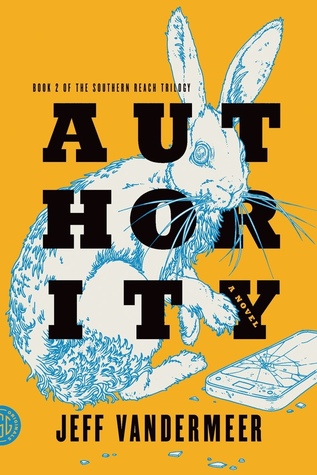
AUTHORITY, Jeff Vandermeer's second Southern Reach novel, slips a little


AUTHORITY
JEFF VANDERMEER
Southern Reach #2
FSG Originals
$15.00 trade paper, available now

Rating: 3.5* of five

The Publisher Says: After thirty years, the only human engagement with Area X--a seemingly malevolent landscape surrounded by an invisible border and mysteriously wiped clean of all signs of civilization--has been a series of expeditions overseen by a government agency so secret it has almost been forgotten: the Southern Reach. Following the tumultuous twelfth expedition chronicled in Annihilation, the agency is in complete disarray.

John Rodrigues (aka "Control") is the Southern Reach's newly appointed head. Working with a distrustful but desperate team, a series of frustrating interrogations, a cache of hidden notes, and hours of profoundly troubling video footage, Control begins to penetrate the secrets of Area X. But with each discovery he must confront disturbing truths about himself and the agency he's pledged to serve.

In Authority, the second volume of Jeff VanderMeer's Southern Reach trilogy, Area X's most disturbing questions are answered . . . but the answers are far from reassuring.

My Review: We're not in Area X anymore, Toto, and therein the problem. Control, our PoV character, is hastily tossed together to provide a camera platform for the bureaucratic machinations and clandestine-agency wars.

It's so frustrating to read a good book that's encased in a less-good book. Like those canned hams from the 1960s, the meat is tasty but who put this weird spoodge all over it?

After much hither-and-thithering, not to mention an amazingly large amount of dithering for an executive, Control runs away from (almost) everything...and the ending makes up for most of the beginning. But really, editor, couldn't a few of those go-nowhere side trips have been pruned? (eg, Whitby's art project, Cheney's existence) It takes such a boatload of attention to track them.

I think the slightly different angle on the same basic story as Annihilation is simply not a strong enough framework to bear the expectations raised by it. The very fact that the main character is known to all and sundry as "Control" is perhaps the single most telling tiny clue: it feels as if Vandermeer wasn't terribly interested in him or in this angle on Area X. Still and all, the sheer...audacity, bravura, something in that family...of the series can't be denied or ignored. Thus a half-star higher rating than I felt the novel qua novel earned.

Friday, April 8, 2016

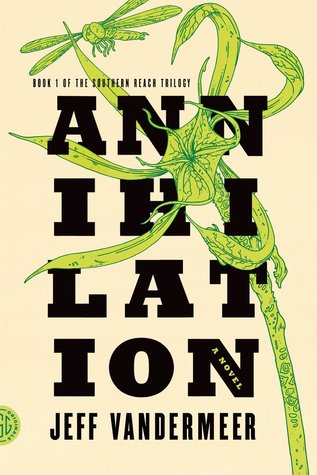
ANNIHILATION, first of three Southern Reach novels, gets a full four stars


ANNIHILATION
JEFF VANDERMEER
Southern Reach #1
FSG Originals
$13.00 trade paper, available now

Rating: 4* of five

The Publisher Says: Area X has been cut off from the rest of the continent for decades. Nature has reclaimed the last vestiges of human civilization. The first expedition returned with reports of a pristine, Edenic landscape; all the members of the second expedition committed suicide; the third expedition died in a hail of gunfire as its members turned on one another; the members of the eleventh expedition returned as shadows of their former selves, and within months of their return, all had died of aggressive cancer.

This is the twelfth expedition.

Their group is made up of four women: an anthropologist; a surveyor; a psychologist, the de facto leader; and our narrator, a biologist. Their mission is to map the terrain and collect specimens; to record all their observations, scientific and otherwise, of their surroundings and of one another; and, above all, to avoid being contaminated by Area X itself.

They arrive expecting the unexpected, and Area X delivers—they discover a massive topographic anomaly and life forms that surpass understanding—but it’s the surprises that came across the border with them, and the secrets the expedition members are keeping from one another, that change everything.

UPDATE DECEMBER 2016 The 2017 film via indie filmmaker Alex Garland looks really intriguing.

My Review: Winner of the 2015 Nebula Award for science fiction novels and the 2014 Shirley Jackson Award for horror novels, this novel earns accolade after award heaped on top of praise for a good reason: It is eerie, atmospheric setting plus glimpsed monsters plus the recrudescence of the inner evil in all humans. And it's very well written.

We're well into this short book before something truly scary happens; before that, it was all spooky suggestions. The first truly scary thing was the discovery of one woman's mutilated, fungus-laden corpse...an intense impact!

One thing I must note about Mr. Vandermeer's work is that he seems inordinately interested in fungi and molds. **shudder** The shroom-o-phobic members of the audience are warned. Everyone else, I recommend the book with mild reservations, but only mild ones, about the SF-resistant ladies. I myownself would say try 50pp, for what that's worth.

Thursday, April 7, 2016

THE PRESIDENT, a non-Inspector Maigret Simenon novel...damn good, too


THE PRESIDENT
GEORGES SIMENON
translated by Daphne Woodward
The Neversink Library
$10.99 trade paper, available now

Rating: 3.8* of five

The Publisher Says: Restored to print for the first time in more than forty years, The President was hailed by the New York Times as a “tour de force.”

At 82, the former premier lives in alert and suspicious retirement—self exile—on the Normandy coast, writing his anxiously anticipated memoirs and receiving visits from statesman and biographers. In his library is the self-condemning, handwritten confession of the premier’s former attaché, Chalamont, hidden between the pages of a sumptuously produced work of privately printed pornography—a confession that the premier himself had dictated and forced Chalamont to sign. Now the long-thwarted Chalamont has been summoned to form a new coalition in the wake of the government’s collapse. The premier alone possesses the secret of Chalamont’s guilt, of his true character—and has publicly vowed: “He’ll never be Premier as long as I’m alive... Nor when I’m dead, either.” Inspired by French Premier Georges Clemenceau, The President is a masterpiece of psychological suspense and a probing account of the decline of power.

My Review: I got a CARE package from one of my old pals from Texas, filled to the brim with Simenon works...but not the Maigret stories, to my relief (read 'em all) and delight (I've never read any of the non-Maigret books)! The President is a delicate and careful autopsy of a once-powerful man's reluctant and relieved laying down his armaments. His life always consisted of public service, unmarried and childless and grasping for the levers of power to make his isolation into welcome solitude.

Simenon's Maigret novels are, as murder mysteries must be, formulaic. Simenon's gift came from creating a rich and satisfying story from these commonly available materials. It's a bit like watching Meryl Streep in a movie: She IS the role, she can't be more than glancingly perceived as the actress who starred in any other movie. Chameleons have that talent...so do cuttlefish...yet to find the gift of remodeling one's self in our smelly, sweaty human selves amazes and delights us every time.

This 152-page tale is a welcome surprise in this era of bloated, dull series books that could and should have been short stories. In my view, the less an author says, the more s/he has to focus and deliver a high-quality experience. Simenon wrote what was necessary to illuminate the long career of the eponymous president and place it in an historical setting. The impact of the actions taken by the president become, by design but still of necessity, quiet bombshells...silent even in their death throes.

This is a book to savor, to sip and ponder the complex flavors mixed in exacting proportions. A simple story, made well, translated carefully, and presented without hype. It is a treat in a literary landscape as pillowy-soft and cloyingly sweet as today's is simply to be told that great hearts still beat faster in pursuit of desired items and outcomes. And they remain great hearts, giving their all and making no excuses.

Sunday, April 3, 2016

EUPHORIA, a rare treat...anthropology, New Guinea, and good reading in one book!


EUPHORIA
LILY KING

Grove Press
$16.00 trade paper, available now

Rating: 4* of five

$1.99 on Kindle today!

The Publisher Says: English anthropologist Andrew Bankson has been alone in the field for several years, studying the Kiona river tribe in the Territory of New Guinea. Haunted by the memory of his brothers’ deaths and increasingly frustrated and isolated by his research, Bankson is on the verge of suicide when a chance encounter with colleagues, the controversial Nell Stone and her wry and mercurial Australian husband Fen, pulls him back from the brink. Nell and Fen have just fled the bloodthirsty Mumbanyo and, in spite of Nell’s poor health, are hungry for a new discovery. When Bankson finds them a new tribe nearby, the artistic, female-dominated Tam, he ignites an intellectual and romantic firestorm between the three of them that burns out of anyone’s control.

My Review: Five stars were well within reach, in fact were more or less guaranteed, but there was a problem. Well, isn't there always. But this is my happy place:
I asked her if she believed you could ever truly understand another culture. I told her the longer I stayed, the more asinine the attempt seemed, and that what I’d become more interested in is how we believed we could be objective in any way at all, we who each came in with our own personal definitions of kindness, strength, masculinity, femininity, God, civilisation, right and wrong.
Yum. And many more like it:
It’s that moment about two months in, when you think you’ve finally got a handle on the place. Suddenly it feels within your grasp. It’s a delusion – you’ve only been there eight weeks – and it’s followed by the complete despair of ever understanding anything. But at the moment the place feels entirely yours. It’s the briefest, purest euphoria.
But the beautiful writing is only part of the story. The plot follows, not overly closely to be sure, the New Guinea experiences of Margaret Mead and her team. But as we draw closer and closer to the end, the setting changes to Australia and becomes pot-boilery, overheated, and unconvincing to me.

It is, however, one of the last passages set in the 1930s that made me shout at the page: The events of the ending made little sense in the context of the story that preceded them. Unworthy of a writer of the caliber Lily King is.

But the ride...the pages flying and the telephone ignored and the dinner gulped...that can't be discounted or devalued by a misstep, no matter how infuriating I found it.

Saturday, April 2, 2016

AGENT 6: a huge disappointment, suspenseless and sloppy


AGENT 6
TOM ROB SMITH
Leo Demidov #3
Grand Central Books
$15.99 trade paper, available now

Rating: 2* of five

The Publisher Says: THREE DECADES.
TWO MURDERS.
ONE CONSPIRACY.

WHO IS AGENT 6?

Tom Rob Smith's debut, Child 44, was an immediate publishing sensation and marked the arrival of a major new talent in contemporary fiction. Named one of top 100 thrillers of all time by NPR, it hit bestseller lists around the world, won the CWA Ian Fleming Steel Dagger Award and the ITW Thriller Award for Best First Novel, and was longlisted for the Man Booker Prize. 
In this spellbinding new novel, Tom Rob Smith probes the tenuous border between love and obsession as Leo Demidov struggles to untangle the threads of a devastating conspiracy that shatters everything he holds dear. Deftly capturing the claustrophobic intensity of the Cold War-era Soviet Union, it's at once a heart-pounding thriller and a richly atmospheric novel of extraordinary depth....

AGENT 6

Leo Demidov is no longer a member of Moscow's secret police. But when his wife, Raisa, and daughters Zoya and Elena are invited on a "Peace Tour" to New York City, he is immediately suspicious.

Forbidden to travel with his family and trapped on the other side of the world, Leo watches helplessly as events in New York unfold and those closest to his heart are pulled into a web of political conspiracy and betrayal-one that will end in tragedy.

In the horrible aftermath, Leo demands only one thing: to investigate the killer who destroyed his family. His request is summarily denied. Crippled by grief and haunted by the need to find out exactly what happened on that night in New York, Leo takes matters into his own hands. It is a quest that will span decades, and take Leo around the world--from Moscow, to the mountains of Soviet-controlled Afghanistan, to the backstreets of New York--in pursuit of the one man who knows the truth: Agent 6.

My Review: Unsuccessful. That's about the size of it. This is an unsuccessful book.

There's not a lot of suspense. There are some tense moments, yes, but they're all in the moment. Suspense is built from wanting to know what is coming, how this knot will part, what secrets will we learn.

Those expectations weren't well met, and weren't well set up. It's an okay novel, a sort of late-Soviet Doctor Zhivago, but it's not thrilling and I stopped caring about what would happen next after the central murder takes place.

The ending is just flat-out terrible and the author and editor should be held up for prolonged public ridicule for having the bad sense and poor sensibilities to foist it on readers who loved Child 44 and liked The Secret Speech.

A poor performance on all parts. The thing I liked best was that I read this in large type, which made a big difference in low-light reading comfort. To be avoided except by completists.

Friday, April 1, 2016

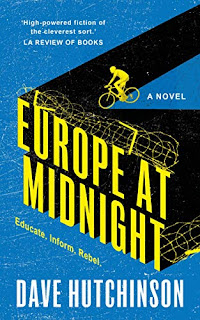
EUROPE AT MIDNIGHT weaves many threads into a glorious tapestry. Thanks Dave Hutchinson!


EUROPE AT MIDNIGHT
DAVE HUTCHINSON
(Fractured Europe Sequence #2)
Solaris Books (non-affiliate Amazon Link)
$6.99 ebook platforms, available now

Rating: 4.5* of five

The Publisher Says: In a fractured Europe, new nations are springing up everywhere, some literally overnight.

For an intelligence officer like Jim it's a nightmare. Every week or so a friendly power spawns a new and unknown national entity which may or may not be friendly to England's interests. It's hard to keep on top of it all.

But things are about to get worse for Jim. A stabbing on a London bus pitches him into a world where his intelligence service is preparing for war with another universe, and a man has appeared who may hold the key to unlocking Europe's most jealously guarded secret...

My Review: I have to disclose that, although I bought this book with my very own United States dollars, I'm pals with the author on social media. Believe me it affected my reading and opinion-making not at all, since an honest review is a better gift than a bunch of hot air. Also note that there are spoilers for EUROPE IN AUTUMN following.

At the very end of AUTUMN, a concept was introduced that's central to this book: The existence of "pocket universes," a modern-day physics concept that boggles my tiny 2-volt brain. It's defined as: "A pocket universe is a concept in inflationary theory, proposed by Alan Guth. It defines a realm like the one that contains the observable universe as only one of many inflationary zones." Wikipedia rocks, and everyone should throw some donations at Jimmy Wales.

So anyway, this pocket universe concept is the source of some really bad-ass events in the world we live in, including a hideous pandemic flu that's done what the Black Death did to 14th-century Europe. The devastation caused much economic misery. But as we all know, money for "black ops" will always flow copiously because there's always a secret to learn, one to protect, and no one dares to reveal it publicly in case The People rise up and shut off the money pipe. So our story threads all center on British Intelligence, the surviving Professor of Intelligence from a pocket universe called "the Campus," and the beloved (to me) Coueruers du Bois we learned so much about in AUTUMN.

All the adventures, the nightmares, the violent justice and injustice meted out are in search of a means to neutralize a threat to whatever place the character's loyalty lies. These people play hard and for keeps. Much bloodshed. All of it for ends that, in my opinion at least, make our world's conflicts seem as foolish as the story's stakes. Why is the mere existence of people your country can't or doesn't control so intolerable as to justify genocidal biowarfare?

EUROPE AT MIDNIGHT doesn't answer this question, raising it and examining it from several sides, but foregoing a simple and pompous jingoistic resolution. The use of pocket universes allows the author to compartmentalize the stories, in best spy-fiction fashion. The twist is that these pockets were created, not discovered, by a family of map-makers. The conflicts, therefore, are engineered and need not ever have happened had the greed and selfishness of one group not taken form in such an unusual way.

Or so it seems in this novel. The pocket countries that litter the near-future Europe after the pandemic, the pocket universes...were they created? Were they discovered and exploited, as the powers that be exploit the fragmentation of today's populations at the hands of venal and manipulative oligarchs?

If I've learned one thing while reading the Fractured Europe sequence, it's that perspective alters everything. I don't for a single second imagine that Hutchinson won't change our perspective on Fractured Europe in EUROPE IN WINTER, forthcoming late this year. Goddesses willing and the crick don't rise.