Showing posts sorted by date for query books about books. Sort by relevance Show all posts

Saturday, September 5, 2026

CHOSEN FAMILY: A Novel, Aussie lesbian-led found-family with all its loving flaws


CHOSEN FAMILY: A Novel
MADELEINE GRAY

Mariner Books (non-affiliate Bookshop.org link)
$14.99 ebook, available now

Rating: 4* of five

The Publisher Says: An exuberant and irreverently funny novel about one gorgeously messy friendship-feud-unrequited-love-affair set in Sydney across eighteen years.

Nell Argall and Eve Bowman are both brilliant, odd, and friendless. When they meet on the brutal battlefield that is their posh all girls’ high school during their first year there, both their lives are changed forever. From school, to university, to careers, Nell and Eve’s relationship is a life raft that is also a poison apple that is also a Medusan stare, frozen in time.

When the passion, guilt, shame, and joy that perpetually twists and turns between them finally implodes, Nell abruptly walks away, leaving Eve alone at the helm of the gloriously unorthodox family they’ve built with their seven-year-old daughter, Lake. Eve finds herself left wondering: Can the wounds of adolescent betrayal ever really heal? Can we ever really understand what’s going on in someone else’s head? And what’s love got to do, got to do with it?

Written with Gray’s characteristic big-heartedness and dark wit, Chosen Family is a queer modern classic that reminds us again and again that sometimes the most fulfilling and life-saving relationships are the ones that are the hardest to define.

I RECEIVED A DRC FROM THE PUBLISHER VIA NETGALLEY. THANK YOU.

My Review
: Who among us did not think "I'll do it right" when imagining parenthood?

No one does it right.

Kids hate their parents because they lack the perspective to understand what comes with the job of parenting, partnering, sustaining all of this all the time under all conditions in all moods with no meaningful support. This is true of all classes—genders—wealth levels.

You as a parent have one thing under your control: What your kids hate you for. Choose wisely.

Sound impossible? Of course it does, because it is, always was, and insofar as I know anything about humanity, always will be. So we read about how badly others fuck it up, or about how they say they didn't. It's all about getting a hit of fellow feeling that SOMEone is getting wronger than you. A book like this one is an excellent source of that schadenfreude. I might be screwing my kids up but it's got to be better than raising a kid with someone you're in love with but can't tell her or make a move on her to show your love's more than of the mind but only if she's willing but she can't do that so neither can you.

Talk about modeling dysfunction!

It's a story that's very much rooted in urban life, no one in small-town Anglophonia is going to do this; it's a very Australian story because the cultural references root it there...which facet of the story I quite enjoyed, though I'll bet Aussies reading it are wondering how dated/anachronistic (set fifteen or so years ago from when it was published and when I'm reading it) references made into the book. It's thus an advantage to read it in the US, a bit like reading Zazie dans le métro in English is appreciating a classic and in French is "they thought this was funny in 1959?"

Eve, one of our PoV moms, is a student making a good go of intellectualizing the queer experience in endless study and reading. "Look over there!" I kept wanting to shout, pointing at Nell. "A queer person to experimentally test your theories on who's DYING for a chance!!" But the thing about theorizing is that it keeps the messy, smelly reality of bodies at bay. The incredibly messy emotional realities of being human aren't susceptible to the keeping-at-bay delusion for long. Our framing device is Eve writing to Nell after a long estrangement, a letter unsent, atonement unsought; Eve's not a great one for introspection so her missed opportunities are legion whether past or present. Moving among the times of the family's life works well enough as a means of getting us to the story's heart; it's not a technique I love for itself, but Author Gray has the skill to use it well enough that I didn't make scoffing noises and slam the Kindle shut.

If you like Sally Rooney's messy stories about messy people whose love problems are lack of honesty with their communication and a *serious* need to see a therapist, only want it queer and Australian, your story awaits. I think most readers of "contemporary/women's fiction" in the Industry's reductive and condescending marketing terminology will enjoy the experience enough to make it worth their time and treasure. I was glad to see the back of Eve, and that seemed to me to be both the problem with and the explanation of my compulsion to finish the story.

People who are hard to love are no less..possibly more...interesting because of it; but interacting with them IRL is more exhausting than reading about them in doses we-the-reader get to set. Let Author Gray do the heavy lifting of living with the family, and enjoy the way it feels to leave without hurt feelings.

Friday, September 4, 2026

THE FIRSTS: A History of French Superheroes, fun and relevant and undemanding


THE FIRSTS: A History of French Superheroes
XABI MOLIA
(tr. Alexander Hertich)
Dalkey Archive (non-affiliate Bookshop.org link)
$9.99 ebook, available now

Rating: 3.75* of five

The Publisher Says: The ugly side of superheroes

What if you suddenly had superpowers? What would you do? How would your friends and family react? What would your obligations to society be?


The superheroes’ first missions—combating terrorists or rescuing disaster victims—are a boon to France. Yet while these actions bring the country pride, unity quickly starts to unravel. These superheroes, ultimately, are human. Paparazzi are everywhere. One has an affair with another’s wife. Another questions following the government’s imperialist agenda. Meanwhile the public carps on social media.

Molia takes our fascination with superheroes and adds a cutting portrayal of contemporary social mores to create an entertaining and disturbing work with deep dystopian underpinnings.

I RECEIVED A DRC FROM THE PUBLISHER VIA EDELWEISS+. THANK YOU.

My Review
: Remember the 1995 one-hit wonder "(What If God Was) One of Us?" It was a monster hit around the world. Its central question was one I think troubles people; it makes us all wonder why her and not me, why is there such an unfair randomness to divinity, what Greeks explained as someone being a demigod like Achilles or Herakles.

What we now call "superheroes."

In the labyrinth of the human soul, the superhero is tucked into a corner along the same stretch of hallway as the demigod. It's about wanting the anthropomorphic Divine to share more substance with us, not seeing the genuinely miraculous, divine acts of creation we interact with daily: my meds, the ones that keep my blood free of oversupplies of uric acid, the ones that keep mmy heart beating in normal rhythm, the computer I'm typing on, the phone you're reading this on, the software, the microchips...all designed by a human, all manufactured by human-designed machines...miracles surround us, the divine in us engendered them. But we use our miracles profligately. The computer and internet that give us access to the immense body of knowledge that's enabled wonders also gave us social media and streaming news.

I think of the first examples as Divine, the last as what we humans do when our reach exceeds our grasp...or demigods those superheroes come to life. Philosophical 3am maunderings aside, the novel The Firsts uses our overreach to explain our grasp to us. The ordinary people with superpowers are observed, as we all are, and reported on, scrutinized as celebrities are as part of their bargain for our attention. It's not the newest wrinkle in the communal brain, the soap operas that are comic books have pulled this idea out every so often. I'm not blaming or running down the book or its author, no idea is totally new or it would be ignored or rejected. Delivering dystopian stories can't really add a burden of novelty onto the already painful message of self-examination's fruits.

Science fiction's used the media-snippets (notably, prize-baitingly The Sheep Look Up, about fifty-five years old) and for centuries before that epistolary novels (Dracula for one) fake that same sense of immediacy and intimacy of perception, for generations. updating it for newly available tech underlines the basic reality of the human desire to share...willingly or not...our fellows' and our betters' deepest depths. As long as they're glowed up, glossy, and either unthreatening or in some way humiliating to them but never to us.

It's not fresh, then, the format of this story's delivery, and it obeys all these rules. It's French so its reactions to two superheroes' scandalous infidelity is more gleeful in tone than the US puritanical moralizing judgment, but really what we have here is not groundbreaking fiction or social observation or advancement in techniques of writing.

But it's a damn fun day or reading as people, ordinary people, grapple with the tweaked superpowers we all factually possess (you read that list-paragraph above, right?); if you go into this read expecting a good time that's not as demanding of your concentration and thinking as most stories from this publisher are, you can enjoy a well-told tale in a format not new or fresh but well-used in the story's service.

Monday, August 31, 2026

THE DISAPPEARERS, deeply angering and saddening Booker Prize longlistee


THE DISAPPEARERS
MARLON JAMES

Riverhead Books (non-affiliate Bookshop.org link)
$13.99 ebook, available now

Rating: 5* of five

The Publisher Says: From Marlon James, author of the Booker Prize–winning A Brief History of Seven Killings: a propulsive novel about the murder of a gay man in 1980s Jamaica and its tragic consequences.

In 1988, eight men in Kingston, Jamaica begin rehearsals for a play. Though strangers to one another, they share an inescapable truth: All of them are gay. And they live in a world that refuses to accept them.

One night the men are savagely beaten and one of them is killed. As their bodies heal, the survivors begin to face the hatred and contempt that the violence laid bare. Some try to ignore what happened. Others double down on retribution. Some disappear completely.

In The Disappearers, Marlon James has written a riveting and deeply human story of men forced to make compromises to survive what the society they live in demands. It is both a dramatic page-turner and an unflinching exploration of queer life in Jamaica during the 1980s and 1990s.

I RECEIVED A DRC FROM THE PUBLISHER VIA NETGALLEY. THANK YOU.

My Review
: Y'all do not know what it means to be at risk of your life for what you do in your bedroom. It's okay with church ladies, sports stars, politicians, dumb fucks on street corners, to insult, threaten, jeer at, and...if there are enough of them...chase and beat you, often enough to death, because of what you do in your bedroom.

It's the reality of being yourself as a queer person. It's not different in the US, only for the most part quieter.

So these 640 pages will come as a illusion-threatening denial-generating surprise to the majority of you. It will cause knee-jerk "no, it's not *that* bad." Yes. It is.

Yes. It is.

This story is based on real events. It should shame every one of you who's made a homophpbic joke, laughed at stories with lisping queens, or any of the other minstrel-sho-with-fags stuff you've seen and heard, because it Others and thus aids in desensitizing murderous idiots. Maybe you didn't mean it to, but it did and it does. I don't think any of you will read this book, so let me tell you what happens:

A bunch of gay guys get together to put on a play that no one is forcing anyone to watch. A gang of those guys who make the jokes you laugh at decide they don't like the fact they're doing this, so they go to the place the rehearsals...not even a public performance...take place, and beat the actors for daring to address the feelings and concerns of people like them before, I remind you, the play that no one is forced to watch unless they choose to so severely one loses his sight.

And one dies.

The remaining six are traumatized.

Because y'all hate people. Who do not ask you to participate in sex, celebrate Otherness, or even make yourselves aware of individual acts of entertainment's existence. "*I* didn't do that" no, but did you ever fail to stop a joke to deride a bigot to interrupt a hate-filled sermon?

No. You did not.

So these eight men lost lives they weren't through living, altered or ended, because no one ever stood up and said "what you do to these men you do also to me" and stood in solidarity at a grocery store, in a meeting, at a dinner party, and said "stop."

Sleep tight.

Sunday, August 30, 2026

August 2026's Burgoine and Pearl-Rule reviews


Author 'Nathan Burgoine posted this simple, direct method of not getting paralyzed by the prospect of having to write reviews. The Three-Sentence Review is, as he notes, very helpful and also simple to achieve. I get completely unmanned at the idea of saying something trenchant about each book I read, when there often just isn't that much to say...now I can use this structure to say what I think is the most important idea I took away from the read and not try to dig for more.

Think about using it yourselves!

++++++++++++++++++++++++++++++++++++++++++++++++++++++++++++++++
++++++++++++++++++++++++++++++++++++++++++++++++++++++++++++++++


The Women in White by Sarah Pekkanen

Rating: 2.5* of five

The Publisher Says: The next thriller from #1 bestselling author Sarah Pekkanen combines a decades-old mystery with spine-tingling paranormal elements in this twisty novel of the seen and unseen.

Extrasensory perception.
The Gift.
A Sixth Sense.
Or something else…


In 1964, four remarkable young women at a prestigious university became the subjects of parapsychology experiments by a visionary scientist. On the cusp of a historic breakthrough, the women mysteriously vanished and the program was erased from history.

Decades later, Riley Bell, newly divorced and desperate for a fresh start, accepts a caretaker job for an elderly widow named Betty. Riley steps into a home that is frozen in another era—no microwave, television, or cell phones, and Betty has never heard of the internet.

Why has Betty lived in such profound isolation for so many years, and why does she need Riley now? As the story unfolds across two timelines—Betty’s 1960s era of 5 o’clock martinis and high-stakes experiments, and Riley’s quest to uncover the truth about the missing women—old secrets rise to the surface. And the only way to survive is to confront the mystery that has lingered for sixty years.

I RECEIVED A DRC FROM THE PUBLISHER VIA NETGALLEY. THANK YOU.

My Review
: It's not you, book, it's me...I am allergic to storylines about parapsychology now. I had no idea this would happen; I've enjoyed stories in this vein fairly recently. I'm really disappointed.

So my rating is only for me, I need to remind muself not to ask for ESP/parapsychology tales anymore ::sad trombone::


St. Martin's Press (non-affiliate Bookshop.org link) will gladly accept $14.99 from you to get the ebook onto your Kindle. I say do it, though without fervor.

++++++++++++++++++++++++++++++++++++++++++++++++++++++++++++++++


Dislocations by Sylvia Molloy (tr. Jennifer Croft)

Rating: 3.5* of five

The Publisher Says: How do you keep a friendship intact, when Alzheimer's has stolen the common ground of language, memory, and experience, that unites you?

In brief, sharply drawn moments, Sylvia Molloy’s Dislocations records the gradual loss of a beloved friend, M.L., a disappearance in ways expected (forgotten names, forgotten moments) and painfully surprising (the reversion to a formal, proper Spanish from their previous shared vernacular). There are occasions of wonder, too—M.L. can no longer find the words to say she is dizzy, but can translate that message from Spanish to English, when it's passed along by a friend.

This loss holds Molloy’s sense of herself too—the person she is in relation to M.L. fades as her friend’s memory does. But the writer remains: 'I’m not writing to patch up holes and make people (or myself) think that there’s nothing to see here, but rather to bear witness to unintelligibilities and breaches and silences. That is my continuity, that of the scribe.' In 2007, at New York University, she created the MFA in Creative Writing in Spanish, which was the first programme of its kind in the United States.

I RECEIVED A DRC FROM THE PUBLISHER VIA EDELWEISS+. THANK YOU.

My Review
: In under 100pp, the terrifying journey that is dementia is not possible to plumb...only to evoke. It's a quick hit of a terrible drug whose side effects are agonizing.

I did not feel I was particularly drawn in as a short story can do; nor was I afforded insight; nor was I entertained; it was fine sentence-by-sentence writing and image-making but not storytelling.

Charco Press (non-affiliate Bookshop.org link) wants $15.95 for an ebook. Ask the library to get one.

++++++++++++++++++++++++++++++++++++++++++++++++++++++++++++++++


This is Amiko, Do You Copy? by Natsuko Imamura (tr. Hitomi Yoshio)

Rating: 3.5* of five

The Publisher Says: Other people don’t seem to understand Amiko. Whether eating curry rice with her hands at school or peeking through the sliding doors at her mother’s calligraphy class, her curious, exuberant nature mostly meets with confusion.

When her stepmother falls into a depression and her brother begins spending all his time with a motorcycle gang, Amiko is left increasingly alone to navigate a world where she doesn’t quite fit.

Subtle, tender and moving, This is Amiko shows us life through the eyes of a unique, irrepressible, neurodivergent young character.

I RECEIVED A DRC FROM THE PUBLISHER VIA EDELWEISS+. THANK YOU.

My Review
: Very interesting look at Japanese culture through the eyes of a young, naïve girl who is also neurodivergent. It is very much her book, in the manner of the French récit; but I know so little about Japanese culture that much flew above my head.

I can't tell if that is my problem really perceiving Amiko's affect on others, or if it is her naïveté that presents the obstacles to her success communicating with others.

Pushkin Press (non-affiliate Bookshop.org link) needs $11.99 for you to legally access the ebook. An afternoon's involving if slight reading so do it if you're in that mood.

++++++++++++++++++++++++++++++++++++++++++++++++++++++++++++++++


January by Sara Gallardo (tr. Frances Riddle, and Maureen Shaughnessy)

Rating: 3.5* of five

The Publisher Says: A revelatory, pioneering masterpiece about the life, rape, and abortion of a 16-year-old Argentine farmworker—now in English for the very first time

With echoes of Edith Wharton’s Summer, this radical feminist novel broke the silence around abortion to reshape the way women’s bodies and rights were perceived in 20th-century Argentina.

Perfect for readers of Tove Ditlevsen, Annie Ernaux’s Happening, and Claudia PiƱeiro’s Elana Knows.

In the sweltering Argentine pampas, all things bow to Nefer. Reeds nod when she digs her heels into her horse, unripe peaches snap and fall as she gallops past. Sickly-sweet air bends, churns in Nefer’s throat.

Nefer measures the distance between her body and the table, and feels something filling her up, turning against her. Her belly swells.

Desperate, Nefer visits a local medicine woman who is known to perform abortions but Nefer becomes too afraid to explain why she is truly there.

She attends confession at church but cannot confide in the priest. During a fierce argument with her mother, she finally blurts out her secret.

A radical feminist text, January was the first Argentine novel to represent rape from the survivor’s perspective and to explore the life-threatening risks pregnancy posed, in a society where abortion was both outlawed and taboo.

With a narcotic musicality and voice scorched through with honesty, Gallardo hangs before us an experience that has been lived and ignored a thousand times over. Nefer closes her eyes. We careen to her and we see.

I RECEIVED A DRC FROM THE PUBLISHER VIA EDELWEISS+. THANK YOU.

My Review
: I quibble with "has been lived and ignored a thousand times over" and would put "billion" in that place. I have not read the Spanish version; I can say the English one might be more...flattened out, unmusical...to me as a man who has a pretty simple idea of how to fix rape: Teach your fucking son to keep it in his pants. "No" means no, "stop" means stop. Do it anyway and we lock you in a room with her family and a baseball bat, whatever's left of you raping bastard after five minutes we arrest or bury as appropriate. No further questions.

Abortion is healthcare, healthcare is a human right.

Archipelago (non-affiliate Bookshop.org link) charges $13.99 for an ebook.

++++++++++++++++++++++++++++++++++++++++++++++++++++++++++++++++


Black Box: The Memoir That Sparked Japan’s #MeToo Movement by Shiori Ito (tr. Allison Markin Powell)

Rating: 5* of five

The Publisher Says: The internationally recognized sexual assault memoir that revolutionized a feminist movement around rape, stigma, and silence in Japan.

In 2015, an aspiring young journalist named Shiori Ito charged prominent reporter Noriyuki Yamaguchi with rape. After meeting up for drinks and networking, Ito remembers regaining consciousness in a hotel room whilst being assaulted. But when she went to the police, Ito was told that her case was a "black box"—untouchable and unprosecutable.

Upon publication in 2017, Ito’s searing account foregrounded the #MeToo movement in Japan and became the center of an urgent cultural and legal shift around recognizing sexual assault and gender-based violence. As international outlets covered every step of her story—even documenting it in the BBC film Japan’s Secret Shame—this book launched a societal reckoning. At the end of 2019, Ito won a civil case against Yamaguchi.

With careful and quiet fury, Black Box recounts a broken system of repression and violence—but it also heralds the beginning of a new solidarity movement seeking a more equitable path toward justice.

I RECEIVED A DRC FROM THE PUBLISHER VIA EDELWEISS+. THANK YOU.

My Review
: Rape is a disgusting criminal act of bodily and psychological violation; it is the world's most common crime; it's also, for its frequency of occurrence, the least prosecuted because no one wants to believe the victim.

No one believed my mother was raping me, so I relate, Ms. Ito; but your courage while rage-fueled was ultimately what changed the game in Japan. I hope your example continues to inspire victims of rape to come forward in their legions to seek, and receive, justice.

Feminist Press (non-affiliate Bookshop.org link) wants a pretty hefty $17.95 for any edition. Be prepared for graphic, horrifying words evoking graphic, horrifying acts.

++++++++++++++++++++++++++++++++++++++++++++++++++++++++++++++++


Variations on the Body by MarĆ­a Ospina Pizano (tr. Heather Cleary)

Rating: 3.75* of five

The Publisher Says: A constellation of short stories illustrate the intersecting lives of women on various peripheries of society in and around BogotĆ”, Colombia.

In six subtly connected stories, Variations on the Body explores the obsessions, desires, and idiosyncrasies of women and girls from different strata of Colombian society. A former FARC guerilla fighter adjusts to urban life and faces the new violence of an editor co-opting her experiences. A woman adrift in the city she left as a child looks for someone to care for, even if it has to be by force, while another documents a flea infestation with a catalog of the marks on her flesh. A little girl copes with her anxiety about the adult world by exacting revenge on her nanny, who she thinks belongs to her.

Combining humor, heartbreak, and unexpected violence, Ospina constructs a keen reflection on the body as a simultaneous vehicle of connection and alienation in vibrant, gleaming prose.

I RECEIVED A DRC FROM THE PUBLISHER VIA VIA EDELWEISS+. THANK YOU.

My Review
: Six stories in ~127pp that came across like weirdly semi-autonomous chapters in a surreal novel, not quite different enough to be full stories but instead feeling to me as though Author Ospina is re-writing the same idea from different angles.

"When she reached that age of abstract yearnings that concentrate in and cloud the body, not long after she moved to the United States with her parents, Aurora used to scrape the bottom of her yogurt cup in desperation, ashamed of her desire for so much more when it was clear there was nothing left, sensing that her distress meant something else, something wretched and essential she couldn't put into words." It's finely wrought but seemingly undifferentiated from the others. I hope we see more, and more developed, other ideas soon.

Coffee House Press (non-affiliate Bookshop.org link) asks for $16.95 for any edition. Need a short read to get into in fits and starts? It's perfect for you.

++++++++++++++++++++++++++++++++++++++++++++++++++++++++++++++++


So We Look to the Sky: A Novel by Misumi Kubo (tr. Polly Barton)

Rating: 3.5* of five

The Publisher Says: This shocking, boisterous novel was a runaway bestseller and award winner in Japan

Searingly honest and sexually explicit, So We Look to the Sky is a novel told in five linked stories that begin with an affair between a student, Takumi, and a woman ten years his senior. Their scandalous liaison, which the woman's husband makes public by posting a secretly taped video online, frames all of the stories, each exploring different aspects of the passages of life and the hardships ordinary people face.

A teenager experimenting with sex and then, perhaps, experiencing love and loss; a young, anime-obsessed wife bullied by her mother-in-law to produce the child she and her husband cannot conceive; a high school girl, spurned by Takumi, realizing that being cute and fertile is all others expect of her; Takumi's best friend, who lives in the projects and is left alone to support and care for his voracious, senile grandmother; and Takumi's mother, a divorced single parent and midwife, who guides women bringing new life into this world and must rescue her son, crushed by the twin blows of public humiliation and loss, from giving up on his own.

Narrating each story in the distinctive voice of its protagonist, Misumi Kubo weaves themes including sex, love, the female body, gossip, and the bullying that leaves young people feeling burdened and helpless into a profoundly original novel that stays with you for its affirmation of the raw, unstoppable force of life.

I RECEIVED A DRC FROM THE PUBLISHER VIA EDELWEISS+. THANK YOU.

My Review
: I feel a bit dimwitted because I did not get how these stories cohered into a novel at all. Braided stories don't usually flummox me like this; the framing device did not relate to the other stories enough for my old queer's brain to follow its story logic.

However heterosexual I'm not, I did get involved in the events herein and recommend the read to straight people.

Arcade (non-affiliate Bookshop.org link) ants what I find a pretty steep $17.95 for the ebook.

++++++++++++++++++++++++++++++++++++++++++++++++++++++++++++++++
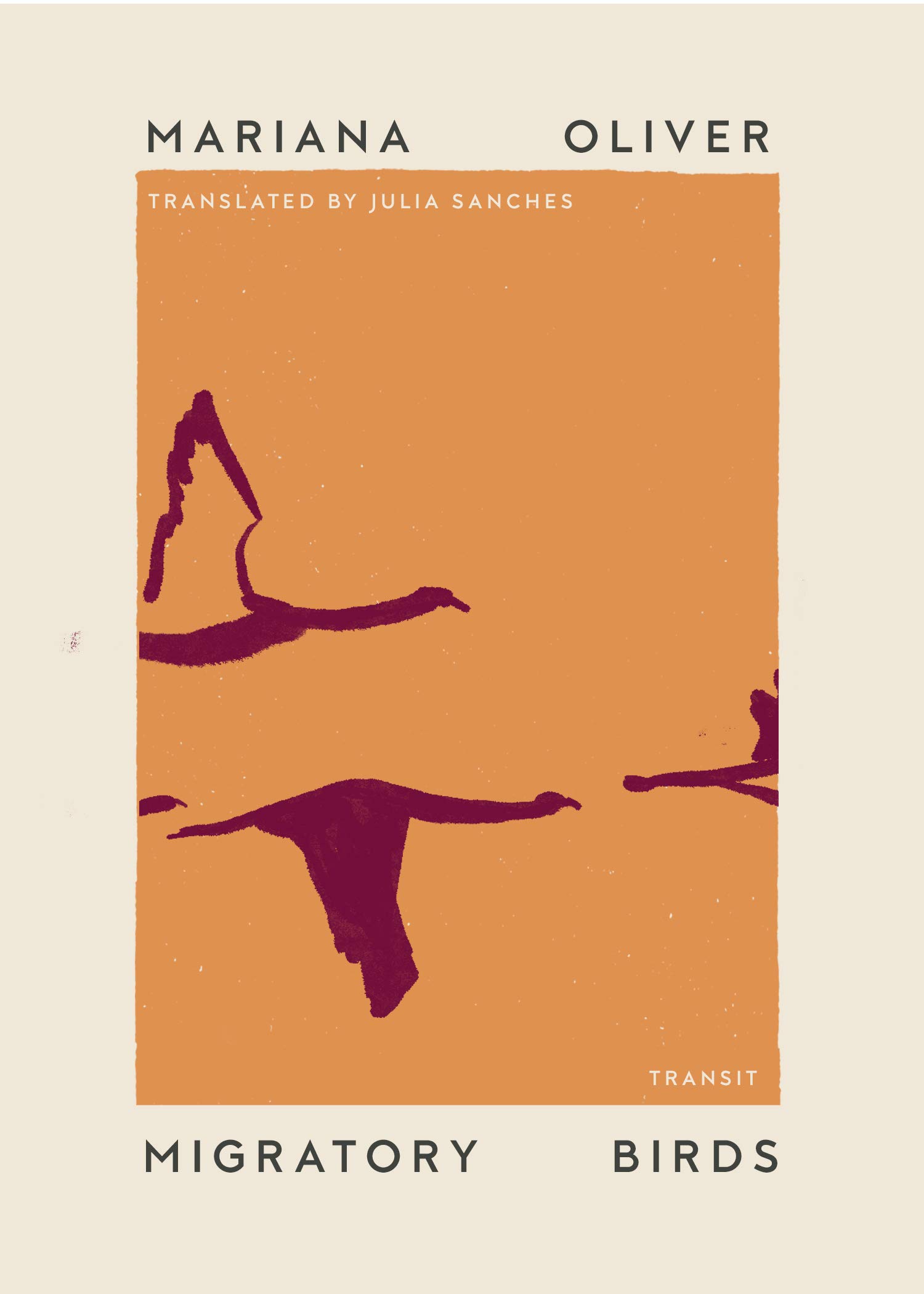

Migratory Birds (Undelivered Lectures series) by Mariana Oliver (tr. Julia Sanches)

Rating: 3.5* of five

The Publisher Says: A sensitive, stunning debut on movement, migration, and loss, in the vein of Valeria Luiselli’s Sidewalks.

In her prize-winning debut, Mexican essayist Mariana Oliver trains her gaze on migration in its many forms, moving between real cities and other more inaccessible territories: language, memory, pain, desire, and the body. With an abiding curiosity and poetic ease, Oliver leads us through the underground city of Cappadocia, explores the vicissitudes of a Berlin marked by historical fracture, recalls a shocking childhood exodus, and recreates the intimacy of the spaces we inhabit. Blending criticism, reportage, and a travel writing all her own, Oliver presents a brilliant collection of essays that asks us what it means to leave the familiar behind and make the unfamiliar our own.

I RECEIVED A DRC FROM THE PUBLISHER VIA VIA EDELWEISS+. THANK YOU.

My Review
:
"A place at once empty and full, Cappadocia inspires bewilderment. Which is why it is useless to try and take in the landscape with only your eyes. Trees are few and far between and sunlight pours mercilessly onto your skin, drenching it." –and–
A man pilots a yellow ultralight across the sky. His name, Bill, Bill, Bill, is the last thing he hears before his feet take wing. All liftoffs are the same, he thinks, a ritual by which we become birds. As the body rises, the mind blots out all sounds and refashions them one by one, as if they existed in isolation. First heartbeat, then breath, then saliva moistening the throat; then the whoosh of air as the ultralight’s wings break it into a white trail.

Prose like this is...fine. In small doses. I hit my maximum dose before the book was over.


Transit Books (non-affiliate Bookshop.org link) charges you $14.99 for the ebook. I might not be thrilled with it, you might be; at least it's not wasted money.

++++++++++++++++++++++++++++++++++++++++++++++++++++++++++++++++


In Bad Company (Sandhamn Murders #9) by Viveca Sten (tr. Marlaine Delargy)

Rating: 2.5* of five

The Publisher Says: Sandhamn Island’s archipelago is a beautiful place to visit. For a mother on the run, it’s the only place to hide in a novel of escalating suspense by Viveca Sten, bestselling author of Still Waters.

Building a case against Andreis Kovač is a risky strategy for prosecutor Nora Linde. A violent key player in Stockholm’s drug trade and untouchable when it comes to financial crimes, he has the best defense money can buy. To topple Andreis’s empire, Nora’s working a different angle. It’s personal. Nora’s critical witness is Andreis’s wife, Mina—if she’ll testify.

Mina has suffered her husband’s rage too long. It’s nearly cost her her life. Still carrying the traumas of the Bosnian War, Andreis can be triggered like an explosive. He must be taken down. And as the trial looms, Mina and her infant son must disappear. The police have found her a safe place to hide on Runmarƶ Island in Sandhamn’s archipelago. But there’s no shelter from a man as powerful and merciless as Andreis. Especially when he’s being crossed.

His campaign of terror has just begun. He’s prepared to crush anyone who stands in his way: Mina, Nora, and everyone they know and love. Andreis is coming for them. This time, Nora is on the defense.

I RECEIVED A DRC FROM THE PUBLISHER VIA NETGALLEY. THANK YOU.

My Review
: It's time I left the series behind. I was not involved in this one at all, and after finishing it felt no relief, no regret, nothing at all.

It could be comparison bias after The Camino, it could be Bosnian-War criminal fatigue, it could be I'm just tired of Nora...but poke me with a fork, I'm done.

Amazon Crossing (non-affiliate Bookshop.org link) requests and requires $14.95 for a paperback.

++++++++++++++++++++++++++++++++++++++++++++++++++++++++++++++++
++++++++++++++++++++++++++++++++++++++++++++++++++++++++++++++++


This space is dedicated to Nancy Pearl's Rule of 50, or "the Pearl Rule" as I've always called it. After realizing five times in December 2021 alone that I'd already Pearl-Ruled a book I picked up on a whim, I realized how close my Half-heimer's is getting to the full-on article. Hence my decision to track my Pearls!

As she says:
People frequently ask me how many pages they should give a book before they give up on it. In response to that question, I came up with my “rule of fifty,” which is based on the shortness of time and the immensity of the world of books. If you’re fifty years of age or younger, give a book fifty pages before you decide to commit to reading it or give it up. If you’re over fifty, which is when time gets even shorter, subtract your age from 100—the result is the number of pages you should read before making your decision to stay with it or quit.

So this space will be each month's listing of Pearl-Ruled books. Earlier Pearl-Rule posts will be linked below the current month's crop.

++++++++++++++++++++++++++++++++++++++++++++++++++++++++++++++++
++++++++++++++++++++++++++++++++++++++++++++++++++++++++++++++++


An Ordinary Violence: A Novel (58%) by Adriana Chartrand

Rating: 2.5* of five

The Publisher Says: Terrible things happen side by side with the ordinary.

Dawn hasn't spoken to her brother, Cody, since he was sent to prison for a violent crime seven years ago. But when Dawn's seemingly perfect life in the big city implodes, she is forced to return to her childhood home and the prairie city that still holds so much pain for her and her fractured family. Cody is released from prison with a mysterious new friend by his side, and Dawn must follow increasingly sinister leads to uncover their nefarious plans to access a dangerous supernatural network.

As the lines between right and wrong blur and dissolve, Dawn reckons with trauma and violence, loss and reclamation in an unsettling world where spirit realms entwine with the living—and where it is humans who carry out the truly monstrous acts.

I RECEIVED A DRC FROM THE PUBLISHER VIA EDELWEISS+. THANK YOU.

My Review
: "Maybe that's why Violet talks to her, why she can feel a buzzing sometimes, an insistent mechanical whine from somewhere distant that, if she listened hard enough, might turn ou to be the sound of her name, hissing through a hundred thousand alien throats."
I made it all the way to that line before my experiment with #Summerween blew up. Maybe I need actual fall, leaf-changing pumpkin-carving fall, short-day clock-turning fall, to put me in the mood for spooky shenanigans.

Or maybe this just isn't great and I'm done.

Spiderline/House of Anansi Press (non-affiliate Bookshop.org link) asks $18.99 for a paperback.

++++++++++++++++++++++++++++++++++++++++++++++++++++++++++++++++


Accidental Genius: An Oral History of The Room (32%) edited by Andrew J. Rausch

Rating: 2* of five

The Publisher Says: Accidental Genius features intimate and laugh-out-loud commentary from The Room cast and crew, including interviews from its star Greg Sestero.

What a story indeed! A rollicking recollection of experiences from the legendary “so bad it's good” film. This comprehensively chronicled book offers a fascinating glimpse into the cultural phenomenon that brings together die-hard fans and newcomers alike.

Everything you could have possibly wondered about The Room all in one book!

Take a look at Tommy Wiseau's infamous 2003 release through the eyes of the people who made it. Get the low-down on bizarre audition calls, film set antics, and accounts from the very first fans who experienced The Room at its earliest screenings. Also including interviews focusing on the aftermath of the movie: Sestero’s The Disaster Artist, where are they now, and its lasting legacy.

Here you will get a glimpse of how it all began, why it remains popular, and just what audiences still get out of this unusual film that people love to hate.

I RECEIVED A DRC FROM THE PUBLISHER VIA EDELWEISS+. THANK YOU.

My Review:
I thought these were essays on the OTHER bad movie, from 2015, but that one's just called Room. The 2003 excrescence these snippets are about was too ghastly to watch so I really didn't...I heckled and jeered. That was kinda fun, I guess, but not enough to read about the reeking shitpile I've tried to forget seeing.

CLASH Books (non-affiliate Bookshop.org link)
has the effrontery to ask you to PAY for this! $18.95 no less...any edition...I'd laugh if I wasn't so pissed off at being pissed on by that Wiseau...person.

Saturday, August 29, 2026

THE CULTURE OF LIES, last collection of essays I have of Dubravka UgreÅ”ić's to review


THE CULTURE OF LIES
DUBRAVKA UGREŠIĆ
(tr. Celia Hawkesworth)
Open Letter Books (non-affiliate Bookshop.org link)
$9.95 ebook, available now

Rating: 4.75* of five

The Publisher Says: The Culture of Lies is one of the most intelligent and lucid accounts of an appalling episode in history. It shows us the banality and brutality of nationalism and the way that nationalistic ideology permeates every pore of life. UgreÅ”ić's acerbic and penetrating essays cover everything from politics to daily routine, from public to private life.

With a diverse and unusual perspective, she writes about memory, soap operas, the destruction of everyday life, kitsch, the conformity of intellectuals, propaganda and censorship, the strategies of human manipulation and the walls of Europe which, she argues, never really did fall.

Shot through with irony and sadness, satirical protest and bitter melancholy, The Culture of Lies is a gesture of intellectual resistance by a writer branded "a traitor" and "a witch" in Croatia.

I RECEIVED A DRC FROM THE PUBLISHER VIA EDELWEISS+. THANK YOU.

My Review
: A collection of very wise, trenchant, and tendentious essays to cap off #WITMonth.

Shifting from Yugoslav nationality to Croatian was not a seamless process for Author Dubravka. A new passport under a new governing entity does not change the passport holder's identity or thought processes or, dangerously, political beliefs. Dissent is even more dangerous in a newly created state struggling to distance itself from the burdensome and ill-fitting imposed identity and ideology. Author Dubravka didn't fit in when Yugoslav was a political state's demonym, but neither did loads of other folk. "Croatian" as a political demonym is new enough that to dissent from the new ruling class is to risk losing the right to use it. This is where Author Dubravka ended up, an ethnic Croat instead of a Croatian citizen.

Labels don't matter much to me in my white US male's privilege. Unless I insist on bringing my Otherness to the fore, I can simply walk around being an "American," a label that makes me wince at its arrogance. Author Dubravka did not exist in that bubble of certainty. Her identity, dissenter, observer, critic, meant her labeling got complicated quickly in the upheavals of Communism's death throes. The wry tone of these works does not foreground a thing I perceive, possibly that I interpolate, the trauma and pain of losing an identity, a building block of selfhood. It's clear the fact of that loss is central to Author Dubravka's work; she does not wallow or lament but rather observes and analyzes. I still feel an edge of strong emotion despite it not being foregrounded.
I know of a writer colleague who claimed to a foreign journalist that he was ‘the victim of repression’ under Yugo-communism, that his books were banned, and that he had been in prison. That colleague was never in prison nor was he ‘the victim of repression’ and all his books were regularly published. I do not believe that he was lying. Exposed to media brainwashing, terror by forgetting and collective compulsion, my colleague had simply forgotten his personal history, he carried out an unconscious mental touching-up, and in the general context the spoken lie became an acceptable truth. And after all, the foreign journalist had come to hear just such a story, in his Westerner’s head he already carried such a stereotype: the story of a repressed writer in the former communist regime and a happy end in the new, democratic one.
It's not a shouted pain, it's a carefully phrased analysis of trauma's aftermath that shows how very painful it was for all to need to re-craft selves when their world ended. New nationalisms, new canons, new ethnic expressions glorified...all processes we undergo in youth and that are painful enough to live through even in that more mentally agile passage of life; as an older, even an old, person...!
I am no one. And everyone. In Croatia I shall be a Serb, in Serbia a Croat, in Bulgaria a Turk, in Turkey a Greek, in Greece a Macedonian, in Macedonia a Bulgarian… Being an ethnic ‘bastard’ or ’schizophrenic’ is my natural choice, I even consider it a sign of mental and moral health. And I know that I am not alone. Violent, stubborn insistence on national identities has provoked a response: today many young citizens of former Yugoslavia, particularly those scattered throughout the world, stubbornly refuse any ethnic labels.

There is a lot to be learned for us in the US on the subject of nationalism and identity in 2026 that a public intellectual from a disintegrating polity can teach us from the 1990s. Author Dubravka felt, though, analyzed, contextualized for us already. I hope more of us will now absorb and appreciate that gift in our own parlous times.

Monday, August 24, 2026

PORTRAIT OF A WITCH UNDONE, charming and fun and amusing


PORTRAIT OF A WITCH UNDONE
K.S. SHAY

Erewhon Books (non-affiliate Bookshop.org link)
$22.95 ebook, available now

The Independent Press Top 40 Bestsellers: Fiction For the week ending September 2, 2026

Rating: 4* of five

The Publisher Says: Thirteen stolen works of art. One haunted marsh.
And a Boston witch willing to risk everything for the friend she’s already failed.


An atmospheric, eerie debut for readers of Starling House and A Discovery of Witches, Isabella Stewart Gardner art heist aficionados, witchy girls, burnt-out former gifted kids, New England history buffs, the coven curious, ride-or-die friends, folklore fanatics, and anyone who’s ever wanted to wander through the looking glass.

Once, Maeve Ryan was the strongest witch of her generation. But Maeve messed up a spell to contact the Lady of the Fens, an eerie Revenant who lures the unwary to their deaths in the brackish marshlands of the North Shore. Maeve destroyed her reputation, hurt her best friend Ash, and tainted herself with unbound, wild magic that transforms witches into insane Revenants.

With unbound power eating away at Maeve’s mind, all she wants is to get rid of her magic. Forever. But Ash’s research into how the spell went awry leads in an unexpected direction: the Isabella Stewart Gardner Museum, and a link between the Lady and a decades-old art theft worth $500 million. When Ash disappears through a stolen painting’s empty frame, Maeve has to follow.

Inside is the Other Marsh, a haunting, deadly realm where only the Lady’s rules apply. Within this half-world lie secrets about North Shore’s history, Maeve’s failure, and the fate of the masterpieces that disappeared over three decades ago. But as Maeve fights toward the truth, she risks her friendship, her coven, and her life against enemies hiding in plain sight.

I RECEIVED A DRC FROM THE PUBLISHER VIA EDELWEISS+. THANK YOU.

My Review
: The hardcover might be preferable to order, y'all:
Are these endsheets to die for or what?

And then there are the seven maps that this bloody program will not let me upload; just know that they'll enhance your reading experience for the mappish among you, like me. They're there because this is an undertaking to explain the long-ago, still unsolved, Isabella Stewart Gardner Museum heist. After almost forty years, I think it's safe to say the solution presented here...it's magic...might as well become the final word. Nothin' else but the death of some powerful people will bust open the truth and maybe not even then, so heck...why not magic?

Maeve, all of twenty-three during this story, is a really interesting magical practitioner. She's filled with insecurity after very publicly failing at an important working that unintentionally hurts her bestie in the Salem coven. This is the woman who still comes to her rescue when the cursed apartment she lives in is overrun by frogs...without harming the frogs. It was refreshing. Not a frog-fancier, me, but I do get the joke about witches who famously use frogs in magical working that don't turn out well for the frogs subverting that silly stereotype. Also subversive of stereotypes is the way these witches actually *fly*on*their*brooms* and still don't play it for a cheap snigger.

There's a male main character. He is Maeve's "love interest." Nothing about this part of the plot adds anything very interesting to the story. I'm moving on. The interplay among the coven members really exemplifies the use...bordering on overuse...of the miscommunication among people who have one big thing in common but little else drawing them together. It's a problem as the mystery of the art heist steadily takes over the coven's activities; the stolen artworks are, like much art, imbued with magical capability of being bridges between worlds. Maeve is forced to do her best magic in the scenes where she's working to focus everyone on the common goal of regaining these stolen portals. May not be all spells but it's for sure magic.

Maeve has the chops innate in her to be a leader, but she's twenty-three. The action spins out of her control as we-the-reader watch, amused and bemused, while the coven attempts solving the heist for their own, not-law-enforcing, purposes. It is clear Maeve could become the focus of a series with her coven as they redress imbalances and resolve mysteries. I hope they all come back soon. I also hope potential future lovely, fun reads will show Maeve grow into her leadership and not rely on the chaos that comes from poor communication again. Magic carries in its basis the wildness and chaos of Life, untrammelled; Maeve can shape that, can form it...if she's written that way.

Debuts seldom come with this much promise. Hope it's pointed in a positive way.

GHOST CITIES: A Novel, the trade of creating illusions at apotheosis


GHOST CITIES: A Novel
SIANG LU

Summit Books (non-affiliate Bookshop.org link)
$14.99 ebook, available now

Rating: 4* of five

The Publisher Says: From an award-winning international rising star, a dazzlingly inventive novel, spanning ancient and modern China, that interweaves stories of romance and showbiz

Inspired by the vacant, uninhabited megacities of China, Ghost Cities follows multiple narratives, including one in which a young man named Xiang is fired from his job as a translator at Sydney's Chinese Consulate after it is discovered he doesn't speak a word of Chinese and has been relying entirely on Google Translate for his work. The incident goes viral under the hashtag #BadChinese and attracts the attention of the eccentric film director Baby Bao, who uses Lu to attract press for his latest film. Bao’s movie, based on ancient legends, is to be filmed in one of China’s “ghost cities”.

How is his relocation to a ghost city connected to a parallel odyssey in which an ancient Emperor creates a thousand doubles of Himself? Or where a horny mountain gains sentience? Where a chess-playing automaton hides a deadly secret? Or a tale in which every book in the known Empire is destroyed—then recreated, page by page and book by book—all in the name of love and art?

I RECEIVED A DRC FROM THE PUBLISHER VIA NETGALLEY. THANK YOU.

My Review
: Xiang Lu...notice the author's first name's first letter is the sole difference in these names...is a man with excellent luck. Blagging his way into a job at the Sydney, Australia, consulate of China based on ethnicity and the ubiquity of Google Translate; getting fired when his incompetence at Chinese-language skills is exposed and then pilloried on social media; thereupon being discovered by a Chinese equivalent to Roger Corman, and getting hired to do the publicity on the guy's new film...no way could that be an unfolding, subtle plan on Xiang Lu's part, too much could go too wrong.

After joining Director "Baby Bao" in Port Man Tou, one of the infamous ghost cities of the title, Xiang Lu and Bao join a cast of thousands, and the spirits of Emperor Lu Huang Du and his willed-into-being alters across the multiverse. (Say the "Chinese" names aloud, more than once and with an approximate Aussie accent. It's a hoot.) The Wikipedia articles I've linked to offer some background will also afford a flattering angle of light on this slightly-too-long story, and should be read as they appear for best results. This story is subtle, is layered with jeux d'esprit, and that's the problem. Humor, satire oh dear oh my, is tough to convince people to read. Tristram Shandy and Candide aren't read as often as they're bought; and this skewering of the overweening egos that, in fact, summon their creators' visions into a weird kind of being is not at that celestial level.

Siang Lu is the 2025 Miles Franklin Award–winning author of this odd confection of past and present, reality as we know it and the self-aggrandizing reality-dismissing fantasies of two powerful creators of images. The Miles Franklin Award resembles the US Pulitzer Prize in that it is "...an annual literary prize awarded to 'a novel which is of the highest literary merit and presents Australian life in any of its phases'." So we know the author is either born or based in Australia; the utter absence of any indication of a translator on this or his first novel, The Whitewash (no US publisher, but available on Ammy's Kindle via the Aussie publisher University of Queensland Press), and the fact he "holds a Master of Letters from the University of Sydney" all rather makes me think he either writes novels directly in English or her self-translates his work. Author Lu also "...has written for television on Malaysia's Astro network. In 2021, {he} won the Glendower Award for an Emerging Queensland Writer for The Whitewash. He is based in Brisbane, Australia, and Kuala Lumpur, Malaysia," (all from his Goodreads bio) so I'm betting he's pretty thoroughly polygot; there's no way in hell this read was made using Google Translate! So the opposite of Xiang Lu he writes in this novel, in other words.

As a story it was fun to read the ever-increasing parallel delusions of Baby Bao and Lu Huang Du, and those delusions' assuming a mirror corporeality and a deeply unsettling unity of purpose. It says so much about the visionaries of the world who dream big and act small and petty. Xiang and Baby Bao's assistant/translator/enabler Yuan (I believe this is a word for cash, get it?) are endlessly discussing how eerie it is that all Portmanteau...I mean Port Man Tou, of course I do!...are so indistinguishable, in their empty expensiveness, chewing over how it takes a powerful mind to snatch low-hanging fruit before others seize it...well, it's all very undergrad-philosophy, very obvious and ye I am absolutely certain that it will zoom over most heads like the starship Enterprise.

Maybe I'm just letting my inner old snob run the show. It made me snerk and chortle and even nod along once in a while. It's a good story, and a fine read. I'm not rating it a full five because I suspect most target readers will feel lost at key moments.
"You know," she {Yuan} says, looking out the window, "I have always had this silly thought that maybe, somehow, every city is the same. So when you go from one place to another, it's simply an illusion of flight. The take-off and landing is a simulation. In reality, you've never left the ground, or maybe you have, but are simply flying around in circles for hours, waiting for the new city to 'load.'"
Either too obvious or too weird or too simplistic, but too-too is likely to be a common response. I'm glad Author Siang made the story and that Simon & Schuster's international-lit imprint brought it out here in the US because it's the kind of story that skewers the pretensions and pretentiousness of people badly in need of it.

I'm so glad this story's coming out now, before the US version of #Jólabókaflóð that we prosaically call "fall new book releases" but are really the Yuletide rush. It could get buried now, of course, but I hope some few of y'all will see the appeal and feel the need to chortle along with Siang Lu and me.

Monday, August 17, 2026

VONNEGUT’S WAR: The Making of Slaughterhouse-Five, fascinating story of a fascinating book's creation


VONNEGUT’S WAR: The Making of Slaughterhouse-Five
SUSAN FARRELL

Bloomsbury Academic (non-affiliate Bookshop.org link)
$27.00 hardcover, available now

Rating: 5* of five

The Publisher Says: Banned, burned, and censored, Kurt Vonnegut's 1969 novel Slaughterhouse-Five is widely regarded as one of the greatest (and most controversial) novels of the twentieth century. Fusing vivid biography with popular history and close textual analysis, Vonnegut's War tells the fascinating story of the making of a modern classic and the writer that created it.

New archival discoveries and recently released oral histories give us the fullest account yet published of Vonnegut's real-life prisoner-of-war experiences at Stalag IV-B and Dresden, which heavily influenced Slaughterhouse-Five. A recently discovered trove of letters introduces us to his first wife, Jane Cox Vonnegut, and her influence on his writing. Along the way, we also encounter UFOs and aliens, grapple with the shadow cast by the Vietnam war, and unearth the stranger-than-fiction tale of David Irving's The Destruction of Dresden, the historical reference behind Vonnegut's writing about the Dresden firebombing.

This book sheds light on one of America's most beloved writers and explores how cultural forces helped to shape a modern masterpiece of storytelling.

Susan Farrell is a professor of American Literature at the College of Charleston. She has published two previous books on Vonnegut and founded the International Kurt Vonnegut Society.

I RECEIVED A DRC FROM THE PUBLISHER VIA NETGALLEY. THANK YOU.

My Review
: Billy Pilgrim shaped many an internal landscape after his appearance in 1969. My older sister encouraged me to read Slaughterhouse-Five when I was fourteen or so; I did, and was genuinely not the same person after the read. I've always been sure war and other kinds of industrial-scale killing were wrong, and tools of oppression and manipulation used by "Them" (the ever-shifting, always-there overclass) to ensure no individual of any class ever truly feels secure for very long. It read to my young self like the bravest kind of art, made to tell ugly truth in carefully crafted images. It was sublime. (I stand by my 2014 review.)

As a middle-aged man I read the story again, on the fortieth anniversary (more or less) of the first read. Same story, different reader, similar conclusion reached...though with nuances like a shocked certainty that Billy Pilgrim was Vonnegut's PTSD personified, that the entire exercise was a therapy session shaped into a narrative of brutal honesty and deep personal exposure underpinning artifice, maybe art, maybe just the complete relatability of honest, truthful self-examination made public.

Twenty more years have passed. I'm not drawn to the text for another read, too few eyeblinks left to me and too much good stuff as yet unread. This book, telling the story of how Slaughterhouse-Five came to be over the course of more than twenty years in the eventful, interesting life of Kurt Vonnegut. It was a long-term, multi-partner effort to shape Vonnegut's trauma into the glittering form we possess now. Access to much material previously off-limits to researchers makes the role of Vonnegut's much-maligned first wife in shaping the narrative more evident. We all, in the twenty-first century, have a very, very different understanding of gender dynamics than was available to any but the most advanced academic thinkers during the years Vonnegut was composing Slaughterhouse-Five. His evident misogyny went well beyond the cultural norms of his era. It's not emphasized in the book nor is it glossed over; this is at heart an academic book, though, so it sticks to its lane more than a purely popular one would. As a factor in the creation of the work in question the reprehensible misogyny and abuse Vonnegut doled out are in the DNA of the story. It's discomfiting to read the clear-eyed portrait of Vonnegut in the throes of creation. Confronting the damage he (knowingly, deliberately) enacts on those around him is unpleasant, as I've grown my mind around the work he's done over the majority of my approaching seventy years on Earth. The older I get the more I realize how little has really changed since the men who wrote the "idol with legs of iron, and feet of clay" quote appearing in the Bible sharpened their styluses.

As Author Farrell's pursuit of the reality behind the making of Slaughterhouse-Five she does the hard work of giving perspective to the acts of its creation in the context of the times. Who was this WWII veteran trying to find perspective on his experiences reading, talking to, using as sounding boards? Could this specific novel have come to be in 1949, 1959, even 1965? I remember the ferment of those years, the way my older-than-most parents were constantly blindsided and upset by the world changing so much so fast...Vonnegut was younger than they were so I realized with a start in reading this book. It adds a piece to my vision of Slaughterhouse-Five that I'd never had. It takes reading a book written about a book getting written to bring perspective to my settled opinion of a story published almost sixty years ago. Do you need a better illustration of why reading, writing about reading, and close and careful analysis of stories are more important than ever in a world getting "AI" shoved down its throat?

What this read did for me it can do for you and for others. No "AI" (properly "LLM") can do what Author Farrell did here. Human brains make connections among data points derived from deep research. They're what creates the synthesis of information that synthetic entities steal to regurgitate to the uncritical as new and insightful ideas. It's true, they are new and insightful; but if you've read the stolen source material, you realize how the scam works. It's new to you, not freshly newly thought up. This is why controlling the world's IP is such an incredibly important part of the scam.

My proof is here, in this well-written, thoroughly researched story of the making of a story that defined the emotional state of a man, and thereafter of a generation.

Friday, August 14, 2026

HENRY TUDOR MUST DIE, feminist historical revenge fantasy about a notable femicidal maniac


HENRY TUDOR MUST DIE
JILLIAN LAINE

Berkley Books (non-affiliate Bookshop.org link)
$14.99 ebook, available now

Rating: 4.5* of five

The Publisher Says: One queen exiled. Another headed for the gallows. Both hungry for revenge. England’s most infamous queens set out to reclaim their story and unite in vengeance against Henry VIII.

Anne Boleyn is going to die, and neither her cleverness nor her witchery can save her. So when her late rival, Catalina de Aragón, miraculously appears in her cell at the Tower of London on the eve of her execution, very much alive and offering a daring escape plan, no one is more surprised than Anne.

Lina doesn’t have Anne’s magic—but she has just as much hate for England’s wretched king. Severed from her daughter and stripped of all her influence, Lina breathes only for the Hellebore Sisterhood, a clandestine and powerful society with a vested interest in keeping both queens alive…and using their particular skills to advance womankind.

Anne and Lina’s old rivalries pale in comparison to a common enemy. One by one, they capture their pawns, infiltrating the court, recruiting the new queens in Henry’s orbit, and eliminating the men who plotted against them. Always inching closer to their true target…

And they want his head.

I RECEIVED A DRC FROM THE PUBLISHER VIA NETGALLEY. THANK YOU.

My Review
: What if the serial-killing society-wrecking lying scumbag H8 had been telling the truth (for once) when he accused Anne Boleyn of being a witch? What if the recently-deceased rightful queen,here called by her proper name Catalina de Aragón, shows up in Anne's cell before her murder as a representative of the Hellebore Sisterhood, a supernatural group determined not to put up with H8's shenanigans against women?

As a fantasia, the musical composition sense applied to fiction, on the awful facts of Tudor England, it struck many a satisfying note. (My biggest quibble is with lesbian Anna of Cleves. It feels silly, but good lord I'm not quibbling about a months-dead Catholic lady from religious-nut Spanish parentage appearing in her adulterous replacement's cell to rescue her from her judicial murder so never bloody mind about that I guess.) H8's reign is one I'm always interested to read disruptions and alterations of because he was such a pill. Because his greed, his arrogance, his utter self-regarding solipsism was so hugely consequential in all the worst ways on England's social fabric that it always makes me smile in schadenfreudic glee when a writer unleashes hell on him.

Unleashing hell is a plan for the Queens in this revenge fantasy. I don't think another ragefest of this type would necessarily fly, or at least it wouldn't with me, absent such a horrific target for the Queens' H8rade punch. It gets pretty, uhhhmmm, vivid so it won't leave you in any doubt about why the subject of their (out)rage is chosen, and thus leading you to who the Hellebore Sisterhood might be. It's a topic I'd love to discuss but one huge spoiler tag might cover it but will also drive potential readers away. I'm here for more Hellebore Sisterhood stories if you choose to write them, Author Jillian.

And that coming from a man, who is not a massive fantasy-readin' lover of the tropes, ought to say a lot. I think as alternate-history stories about these Queens they're no great shakes, failing the believability test at literally every turn; they're not meant to be alternate-history stories but fantasies set in an alternate universe where there are other rules for physics. None of this is going to convince wedded-to-consensus-reality reader to drop their filters, so my purpose is to warn those folks to shop elsewhere. None of this story will work for you.

Author Jillian's debut adult novel is a delight if you'll let go of the slavish adherence to plausibility rules about history retellings. It's easier to write straightforward fantasy where one invents a secondary world with all-new names and no stroppy literalists who Have Opinions about bent, folded, spindled, and mutilated Reality. I myownself greatly prefer Author Jillian's way of engaging with one of History's most fascinating inflection points.

What explains my missing half-star is a certain lesbian. That really did feel like I'd been asked to go a bridge too far. I'm an old grouch, I get to have crotchets just because. I want to draw your attention to the remaining four and a half shiny stars to have my reputation as a discerning judge of quality entertainment validated.

Thursday, August 13, 2026

THE TAKEN GIRLS, Glenn Cooper thriller in his classic mode


THE TAKEN GIRLS
GLENN COOPER

Lascaux Media (non-affiliate Bookshop.org link)
$17.99 paperback, available now

Rating: 3.75* of five

The Publisher Says: From Glenn Cooper, the internationally bestselling author of the Cal Donovan thrillers, comes a gripping thriller of kidnapping, conspiracy, and what powerful men will do to hold on to what they have.

Two little girls vanish from a villa on the Calabrian coast—Victoria, five, and Elizabeth, eight, sisters, the granddaughters of an American billionaire. It looks at first like a kidnapping for ransom.

But no demand ever comes. No ransom means no one wanted money—they wanted the girls.

Years pass. Their grandmother's hair goes white. And then, on an ordinary afternoon, the girls come home. Victoria is still five. Elizabeth is still eight. The same faces, the same small hands—not a day older than the night they disappeared, and dying of something no child should carry.

Everyone wants a story that lets them sleep. The Vatican opens a quiet file on a miracle. The tabloids sell something stranger. But one man keeps pulling the thread everyone wants left alone—until it leads to an old Spanish estate, and to what the powerful will do to hold on to what they have.

Victoria and Elizabeth were not the first children taken. And they are still collecting.

I RECEIVED A DRC FROM THE PUBLISHER VIA NETGALLEY. THANK YOU.

My Review
: It's never aliens. Or god. Never.

Just like the only monsters are people. For something to be SUPERnatural, we'd need to know everything that could ever happen naturally. A glance at the news will tell you we do not know everything that could happen naturally. So reading his very complex puzzle-box of a story was an exercise in seeing if the author could get me to the end without making me feel I'd been treated like a mushroom. (Kept in the dark and fed a lot of shit.)

I've read several of the author's religious-themed stories before, and found them like this one: Pleasantly diverting. I do wish he'd stop writing female characters, or take a sensitivity course...they're ciphers or stereotypes.

The patriarch who hires our omnicompetent investigator grated on my nerves. Marcus, said investigator, doesn't put a foot wrong that does not, in the end, result in the solution being moved forward. It's a bit annoying, but in line with most books in this chase-thriller genre. By the midpoint of the story there was a clutter of problems that were either going to get solved or niggle at me as unfinished business; nothing got left behind but it made the ending a breathless rush. That's fine for me but y'all who prefer endings that peel back layers will not enjoy it because it will feel rushed. I myownself would say it's calculatedly fast-paced, but that'a a poTAYto poTAHto argument I've found is not worth anyone's time getting into.

It was a read that engaged me but gave me no one to root for because the people were believably shitty. It's a good distraction that will never play games with your trust, people you don't like don't suddenly turn out to be sweetness and light playing a role (a trope I abhor) or suddenly doing other about-faces. The story resolves in line with its parameters only not quite so simply as one is led to expect. Nice work on that, Glenn Cooper!

Monday, August 10, 2026

THE SLOW ELEPHANTS OF MILAN, Argentinian strangeness in fragments you make into a mosaic


THE SLOW ELEPHANTS OF MILAN
ƁNGEL BONOMINI
(tr. Jordan Landsman)
Transit Books (non-affiliate Bookshop.org link)
$17.99 ebook, preorder now for delivery 11 August 2026

Rating: 4.5* of five

The Publisher Says: Enigmatic fictions from a lost master of Argentine literature.

A thick fog rolls into Milan as a man watches in astonishment while a procession of elephants crosses the street. A couple wandering through a forest is pointed toward a mysterious city from which they may never return. Two prisoners share a cell in the aftermath of a battle—one finds freedom in writing stories while the other is driven mad with envy.

The Slow Elephants of Milan expands Ɓngel Bonomini’s exploration of the interstitial realms between dream and reality. Originally published in 1978, these surreal and enigmatic fictions are among Bonomini’s finest and most autobiographical, threaded together by an insatiable curiosity about time, memory, art, and the divine.

With delicate precision, The Slow Elephants of Milan deconstructs the scaffolding of our perceptions to reveal what lies beneath: a metaphysical mirror-world that shimmers with haunting familiarity.

I RECEIVED A DRC FROM THE PUBLISHER VIA EDELWEISS+. THANK YOU.

My Review
: I didn't find the individual stories...twelve in all...particularly compelling as stories. Author Bonomini is no Hemingway, no transcendent master of the short-story form. He was an excellent craftsman who took great care to use the short-story form as a means to convey moods, insights, gestalts of incident building life.

The title story is a good example of this. A man sees a truly arresting sight: two elephants being led through the streets of Milan. Author Bonomini reflects on this without sentimentality, without concern for the elephant-ness of their existence; the narrator sees them when he is mid-reflection on the deep, deepening sadness of his life and soul; he sees these elephants multiple times walking almost unremarked through Milan's busy streets and is surprised afresh at how this sight he's captivated by is of little to no apparent interest to others.

Okay. That's the kind of trip we're going on, then, the odd but not impossible thing that carries Meaning and delves into Ideas. I wasn't eager for more but it's under 160pp, so what the hell. "Diary of My Portraits" was so memorable it lifted my impression of the collection above "nice work, not amazing but pleasantly engaging." In this story, the narrator sees a bird come into his apartment, thinks it is the same bird; but each time the bird is a different color. This happens in parallel to the narrator's partner painting his portrait, carefully and attentively creating an image of his face with laborious precision; then, dissatisfied with the likeness she has made, she destroys the portrait and begins afresh the process of capturing the narrator's appearance, his face, the image he shows to the world. Only to destroy it again. It is a lovely, poignant moment realizing that the artist's name...Moira...is a very interestingly resonant from its Greek bits to its resemblance to the Spanish verb form "mira"— "Look!"

To be the subject of this process, to have your likeness never completed, never satisfactory...to her, to the image's creator, no participation from you as the subject...was my key to finding these stories more in sum than they are as pieces. Gestalt formed yet? Everything in this collection of stories examines the image of a thing, the viewable parts changing but never fitting a single view, not even for a single viewer.

Instability and surveillance...seeing from on high...meet uneasily, irreconcilable in their differences of kind and sort of result. Nothing seen from the outside *is* the thing, no matter how much you want to call an elephant walking down a busy Italian street it is not.

It is itself.

Interesting ideas coming from perfectly fine stories will not be to everyone's taste, but I found the read much more than the sum of its parts.

Saturday, August 8, 2026

DANCE ON THE VOLCANO, a HaĆÆtian Revolution epic of deep relatability


DANCE ON THE VOLCANO
MARIE VIEUX-CHAUVET
(tr. Kaiama L Glover)
Archipelago Books (non-affiliate Bookshop.org link)
$13.99 ebook, available now

Rating: 4.25* of five

The Publisher Says: Dance on the Volcano tells the story of two sisters growing up during the Haitian Revolution in a culture that swings heavily between decadence and poverty, sensuality and depravity. One sister, because of her singing ability, is able to enter into the white colonial society otherwise generally off limits to people of color.

Closely examining a society sagging under the white supremacy of the French colonist rulers, Dance on the Volcano is one of only novels to closely depict the seeds and fruition of the Haitian Revolution, tracking an elaborate hierarchy of skin color and class through the experiences of two young women. It is a story about hatred and fear, love and loss, and the complex tensions between colonizer and colonized, masterfully translated by Kaiama L. Glover.

I RECEIVED A DRC FROM THE PUBLISHER VIA EDELWEISS+. THANK YOU.

My Review
: A magisterial telling of the loud echoes of Revolution in the world of the 1790s. Saint-Domingue, as HaĆÆti was called in colonial times, was a society primed to explode. With racial and political tensions reaching peaks guaranteed to end violently, we meet mixed-race Minette. Her singing talent is a wonder. It leads to the bending of many immutable rules. This was only possible during the ferment of the post-1789 world, but Minette really doesn't care...yet...as long as she can sing.

Evoking the colonial reality of Saint-Domingue in careful vignettes elaborated on enough to universalize the suffering they show, Author Vieux-Chauvet goes a bit overboard on description. What makes that work for me-the-reader in this story is the immersion it afforded me in a world I knew not at all. It was a revelation to me that the colonial forces wanted more huane treatment of Blacks, free or enslaved, than the on-the-ground colonist masters. It makes geopolitical sense, when one really looks at it; the government that promulgated the Declaration of the Rights of Man and of the Citizen in 1789 would not have thought to exclude Blacks until the colonial profiteers got hold of the reins again. It is this story that Author Vieux-Chauvet spends close-on 500pp telling through Minette's doomed love story.

As is ever the case, a woman must suffer for falling in love...always with the wrong man, usually with an abusive one, frequently enough a man who belittles her. Jean-Baptiste Lapointe, a free slave-holding Black man, rejects Minette with a lie about being disabled when she asks him to dance with her. I don't know about you but if someone did such a thing to me I'd avoid 'em forever after. Which is, I suppose, why no one will ever write a novel about me....

Minette is not a real person. She is a composite of free mulatto women Author Vieux-Chauvet encountered in her extensive research into the subject of Haïti's past as Saint-Domingue. Minette felt pretty real to me...though my goddesses does she cry a lot. If Kleenex had been in business then, Minette would've filled several landfills with tear-soaked wads of it. She's got plenty of excellent reasons, though. Her own precarious, rule-breaking career as a singer who entertains the white-dominated elite is stressful, her privileged access bringing her into their awful attitudes towards their slaves (who share half Minette's ancestry) means she sees firsthand the horrors of the enslaved's lives. It does not help that Lapointe, though Black, treats his slaves as vilely as the white colonizers do. The Parisians who now politically control Haïti/Saint-Domingue want to curb the brutality in the name of liberté, égalité, fraternité, those most Revolutionary of concepts (though that formulation, the French national motto, is an artifact of the late nineteenth century), leading to internal conflict in Minette's world. She develops as a human being and a political actor in her world over the course of the story. It is good to see this development in her, and in the world; but as we all know it's going to come to a tragic end.

Even in novels there comes Reality's ugly face.

A book written in 1957 and first translated into English in 2017, and since then largely ignored, and here's me guiltily writing up my reading notes for it almost exactly ten years after my own read of the DRC. I was not fired up by the story of a country given hope, then betrayed, in 2017. It's happening to me now. Faithful to the human adage "what's in it for me?" here I am recommending to all y'all you take off the blinders and read about the injustices the untrammelled ruling class always, always perpetrates. Learn how "They" perpetuate systems of exploitation and destruction solely for "Their" benefit. Don't look away. It's too costly to do.

Sunday, August 2, 2026

JEAN GIONO'S PAGE: Fragments of a Paradise & Occupation Journal & Ennemonde


OCCUPATION JOURNAL
JEAN GIONO
(tr. Jody Gladding)
Archipelago Books (non-affiliate Bookshop.org link)
$7.99 ebook, available now

Rating: 4.5* of five

The Publisher Says: A captivating literary and historical record, Jean Giono's Occupation Journal offers a glimpse into life in collaborationist France during the Second World War, as seen through the eyes and thoughts of one of France's greatest and most independent writers.

Written during the years of France's occupation by the Nazis, Jean Giono's Occupation Journal reveals the inner workings of one of France's great literary minds during one of the country's darkest hours. A renowned writer and committed pacifist throughout the 1930s—a conviction that resulted in his imprisonment before and after the Occupation—Giono spent the war in the village of Contadour in Provence, where he wrote, corresponded with other writers, and cared for his consumptive daughter. This journal records his musings on art and literature, his observations of life, his interactions with the machinery of the collaborationist Vichy regime, as well as his forceful political convictions. Giono recounts the details of his life with fierce independence of thought and novelistic attention to character and dialogue.

Occupation Journal is a fascinating historical document as well as a unique window into one of French literature's most voracious and critical minds.

I RECEIVED A DRC FROM THE PUBLISHER VIA EDELWEISS+. THANK YOU.

My Review
: Knowing that these quotidian topics of no great interest are Author Giono's middle-of-WWII maunderings while his pacifist life was under the Vichy apparatus of Nazi occupation's close scrutiny makes them fascinating. It's a universal truth that life goes on, kids need clothes and meals and trips to the doctor. Author Giono navigates his way around every obstacle with his money and his persistence and his connections. Being in the toils of legal proceedings for his well-documented lifelong pacifism meant he was never a serious threat who needed close custody. Left to read and write, though subject to censorship, Author Giono writes unselfconsciously in these journal pages (always intended to remain private) of his process as a writer, his frank assessment of other writers' work, and the people of the village of Contadour.

It reminded me that the evergreen thought experiment "whatever you're doing now is what you'd be doing under Nazi occupation" makes one stop short and think hard for a reason. Author Giono took his privilege as a reason to spread the good fortune around: he never has any cash, and owes the government a pile of money, all because he's supporting his whole family...nine people in total...as well as bankrolling the escapes of those who are at lethal risk from that government he owes so much money to.

Using "their" money to keep "them" from committing murder against people whose morals he shared. Full marks, sir. And he did not stop there. He completed six novels (translated another...oh, there were plays too!) during the German occupation. Author Giono was a truly inspiring example of how to live a morally good life in bad times and under dark circumstances.

++++++++++++++++++++++++++++++++++++++++++++++++++++++++++++++++


FRAGMENTS OF A PARADISE
JEAN GIONO
(tr. Paul Eprile)
Archipelago Books (non-affiliate Bookshop.org link)
$13.99 ebook, available now

Rating: 3.5* of five

The Publisher Says: “Giono’s prose is a singularly fine blend of realism and poetic sensibility.” — The Washington Post Giono’s very own Moby-Dick, a sensational maritime journey that follows a crew inwards on a spiritual tale of evocative sea-glimpses

An allegorical critique of modern civilization and the damages of war, Giono’s oft-overlooked seafaring tale sweeps the reader along a narrative as poetic and undulating as the wind, tacking between the sea’s mysteries and the intricacies of the men’s conversations and inner thoughts as they attempt to grasp the sensory reality around them.

“I no longer have any interest in living under the conditions that this era allows,” writes the Captain of L’Indien, a ship whose radio remains packed in a crate in the hold. The men aboard won’t be needing it; they have no interest in connecting with the world of ordinary men. With enough provisions to last them five years, they set sail in July of 1940 for the South Seas, leaving civilization behind in search of the unknown.

Hastening onwards, Giono’s men steer deeper into themselves, seeking a purpose beyond the “world in upheaval” they left behind—a moving and spiritual work written by one of Europe’s most ardent 20th-century pacifists.

A sensational novel that delves into the unknown reaches of the sea and soul, perfect for readers seeking a poetic escape that challenges the political and social status-quo.

I RECEIVED A DRC FROM THE PUBLISHER VIA EDELWEISS+. THANK YOU.

My Review
: Really, do I even need to say it?

This read was a beacon of psychic coolness in a summer beset by wildfires, smoke particles, and the looming, ugly threat of super-El Niño to come with its heat and its drought. It's beautiful, as one would expect from a writer of Author Giono's stature, sentences making images that endure on the eye the nose the ear of the mind as the men on this sailing ship leave their families and friends behind to fight their war, rebuild their world, however they like.

No one who leaves the world does so without leaving others behind.

It's beautiful until the thought, "you have provisions for FIVE YEARS and you left a literal WAR ZONE to escape into a cosmic search for love, truth, and beauty?!" hits.

Stay there and use that magical power to feed hungry wounded orphaned victims.

Yes yes yes, it's a fable, an unreality meant to instruct and to offer guidance on one's search for Meaning, all very well. Author Giono was a pacifist who was punished for opposing the Vichy regime...see above for his journals in review...but this kind of navel-gazing is for the time leading up to war, in an attempt to forestall the slide; this tale appeared in 1948, as the rebuilding of the continent was gathering steam. That was the moment to support peaceful action not hightailing it off to sea to have cool adventures.

Anyway. Beautiful sentences, we're not rebuilding stuff (though we should be), so read and enjoy.

+++++++++++++++++++++++++++++++++++++++++++++++++++++++++++++++


ENNEMONDE
JEAN GIONO
(tr. Bill Johnston)
Archipelago Books (non-affiliate Bookshop.org link)
$12.99 ebook, available now

Rating: 4* of five

The Publisher Says: One of the final novellas by the acclaimed French writer Jean Giono, Ennemonde is a fierce and jubilant portrait of a life intensely lived

Ennemonde Girard: Obese. Toothless. Razor-sharp. Loving mother and murderous wife: a character like none other in literature. In telling us Ennemonde’s astounding story of undetected crimes, Jean Giono immerses us in the perverse and often lurid lifeways of the people of the High Country, where vengeance is an art form, hearts are superfluous, and only boldness and cunning such as Ennemonde’s can win the day. A gleeful, broad sardonic grin of a novel.

"Roads move cautiously around the High Country..." So begins the story of Ennemonde, but also of her sons, daughters, neighbors, lovers, and enemies, and especially of the mountains that stand guard behind their home in the Camargue. This is a place of stark and terrifying beauty, where violence strikes suddenly, whether from the hand of a neighbor or from the sky itself.

Giono captures every wrinkle, glare, and glance with wry delight, celebrating the uniquely tough people whose eyes sparkle with the cruel majesty of the landscape. Full of delectable detours and startling insights, Ennemonde will take you by the hand for an unforgettable tour of this master novelist's singular world.

I RECEIVED A DRC FROM THE PUBLISHER VIA EDELWEISS+. THANK YOU.

My Review
: Not remotely comfortable reading, Giono using this female body's looks and size as commentary on her character and morality. Perfectly ordinary in its time; sixtyish years ago people said terribly cruel things about those larger than, or in any way divergent from, "average."
The young women, while they're still maidens, possess a fruit-like beauty; then the beauty bursts, and fragments of it can be seen in their children. Truly nothing remains of these women's former state. Some Venuses turn into fearsome monsters; almost all of them have seventeenth-century mouths, toothless or, even worse, with a handful of loose teeth on which they suck. It's pretty ghastly. But their simple-minded appearance shouldn't be taken at face value. Almost all of them are commanding women. With their back to the wall they achieve wonders. People still remember Ennemonde Girard.
It does not hit the same register in 2026 as it did in 1968, when it first appeared. It feels false, hostile, spoken for effect in the #MeToo world.

There's probably a good reason for that: the French are not so terribly far from the US despite their fantasies:
The tool that people around here have most often in their hand is a shotgun, whether it’s for hunting or for, let’s say, philosophical reflection; in either case, there’s no solution without a shot being fired...
–and–
The Protestants of these parts had since time immemorial protested against Protestantism. They’d ended up worshipping anything at all, so long as the anything at all demanded intolerance. Crown of thorns were consumed in every household, at every meal. Religion was a sort of commerce in which discomfort was always preferred to joy, scorn to pleasure, and ultimately vice to virtue.

"These parts" are Author Giono's native Provençal mountains, where he lived his life.

It's not so weird after all, fellow intolerant lefties; humans been MAGAts a long damn time.

I can't claim to love this story, I can't tell if it's because I'm a judgmental old man or I'm just a product of the times that brought this novella (150pp barely) into being, holding its subjects up for a cold-eyed considering examination. Author Giono does not vouchsafe a verdict; I do.

Me no likee.