Wednesday, July 22, 2026

SAVVY SUMMERS AND THE PO'BOY PERILS, second dangerously fattening entry in a delightful, atmospheric series


SAVVY SUMMERS AND THE PO'BOY PERILS (Savvy Summers #2)
SANDRA JACKSON-OPOKU
Minotaur Books (non-affiliate Bookshop.org link)
$14.99 ebook, available now

Rating: 4* of five

The Publisher Says: The next delectable mystery featuring quick-witted, unforgettable Savvy Summers, owner of a soul food café in Chicago.

Savvy has her work cut out when an old friend hires her to cater a company luncheon at a nearby office building on Chicago's South Side. Stepping out of her traditional soul food comfort zone, Savvy whips together a menu of Creole classics, with her own spin, of course—mini po’boys with assorted fillings, sunburst salad, and bread pudding using Great Aunt Essie’s famous buttermilk biscuits.

But when someone is found dead in the company’s conference room, Savvy’s culinary creations are suddenly in the spotlight for all the wrong reasons. While the focus should be on their delicious flavors and inventive techniques, Savvy’s beloved café instead becomes the center of a murder investigation once again.

Caught within a messy web of gossip, miscommunication, and fraught coworker relationships, Savvy will have to settle the confusion to clear her name. Somebody’s hiding something, and with the help of her trusty assistant manager, Penny Lopés, Savvy sets out uncover exactly who is to blame. With familiar faces turning up the heat on her investigation and her café still in hot water, will Savvy be able to save her reputation before it’s too late?

I RECEIVED A DRC FROM THE PUBLISHER VIA NETGALLEY. THANK YOU.

My Review
: I gained fifteen pounds off the bread-pudding description alone. I would *kill* for some right now! I'd kill for some buttermilk biscuits, honestly, but these, and the perfect bread pudding...*drool*

As I said of Author Jackson-Opoku's work before, this series is going to fatten me right up into blimp-sized, belching satiety. Savvy's knack for landing in hot water is still credible to me, seasoned old reader that I am, because it doesn't come from some out-of-character contrivance but from accepting a job her business needs.

It seems clear that the series is going to do a lot of wandering around. It's not my first preference for the way a murder mystery unfolds, but it very much is my preference for a character-driven polyphonic novel of a community that feels real in its tight-knit gossipy love. Even though ugliness is inherent in murder mysteries, death is always a blow to a group, the deep interconnections are strong enough to heal the wound. With time, and as an aftermath to justice being served.

Savvy herself is a fun character to follow around as she talks to people, caring about them, listening to them. Penny is a scene-stealin' sass-dealin' delight as always. It's a hallmark of Author Jackson-Opoku's chops that I felt welcomed back into a charmed circle of lovely friends most of the time during this read. It takes skill to make that a reader's experience of a series story.

Savvy and Fanon (love that name, so resonant for someone born when and where he most likely was) have the kind of chemistry I myownself prefer: hot, but at a simmer that can turn into a boil quickly if there's just a *little* nudge of the thermostat. It's believable these two connected as hard as they did; it's believable they couldn't make it work full-time, but also are so finely attuned to each other that they have an unbreakable connection.

I really enjoyed being invited back into the community, welcomed with a so-enticing spread of delights, and told all the tea while everyone tried to be the one to spill it hardest. Not the greatest shakes on the mystery front...another deeply unlikeable crudbucket dead that not one soul should mourn the loss of...but as a novel, and a way to spend time rewardingly, it's up there for 2026.

THE MULAI, consider the comps given by the publisher as gospel


THE MULAI
MUNIR HACHEMI
(tr. Julia Sanches)
Coach House Books (non-affiliate Bookshop.org link)
$14.99 ebook, available now

Rating: 4.25* of five

The Publisher Says: Interstellar via Invisible Cities: spec-fic translated from Spanish imagines a utopian way of life on another planet.

Years after the climate wars on Earth, the Mulai have settled into their new home on an unnamed planet. Supplies stopped arriving from Earth many years ago, and the Mulai have found a way to live. But now the people of Earth want to know what happened to the settlers, so they send The Archaeologist.

He finds that they have become a different people: uncannily similar to us but with something radically Other about them. Their language has become more about change than stability, and the ways they eat, reproduce, bury their dead, and understand gender have all transformed into something almost unrecognizable. The Archaeologist feels like his trip is one extended misunderstanding.

With fragments from The Archaeologist’s notes and the stories of Flukeh and Faida, who map both their world and their language, The Mulai offers a glimpse of a world adjacent to ours – one that just may be a model for how to better our own.

From one of Granta’s Best Young Spanish-Language Novelists and author of the celebrated Living Things, and translated by the award-winning Julia Sanches, comes a bold new Borgesian reimagining of what ‘civilization’ might look like.

I RECEIVED A DRC FROM THE PUBLISHER VIA EDELWEISS+. THANK YOU.

My Review
: “Only when we encounter the other can we truly see ourselves.”

This is the crux of this story's argument. It is spoken by The Archaeologist, Dr. Cordovero, in an unironic way as he executes the duties of a scholar to interpret the Mulai, a culture not his own. So, a colonizer's PoV...a man whose cultural matrix he's so embedded within that he can't see how it forms...distorts...his picture of Reality. This being a story about how a human culture simply...vanished...without making a ripple in water left behind, it made perfect sense this should be the case. The Archaeologist’s notes are his rigid way of trying to fix an understanding of the Mulai's lifeways into a clear explanation of power structures, kinship patterns, and language architecture.

None of these concepts apply.

Seen from The Archaeologist’s PoV, a Mulai library f/ex is not anything like a library. A bit like Samuel Beckett's splices from late in his life, these places are collecting points for unbound unconnected sheets that do not necessarily tell any kind of cohesive story...just as random pages torn willy-nilly then taped together did not form a deliberate Beckett story, though it was what Beckett intended. The Archaeologist is sure, with typical colonizer arrogance, that these distant cousins of Earth's humans have let him in, have answered his questions as he intended them to not as they intended to. Life lived in translation is always tough. Life lived in denial, blindness, in a fog of culture-bits one does not know is obscuring clear vision...harder still.

That this story about a life lived in (mis)translation is itself a translation is either a step too twee or a layer of hot fudge atop the whipped cream of sociological SF from an earlier literary era wrapping up a rich, dense custard of story. It's a novel that requires you-the-reader to think past the obvious, to dig your spoon under the rich topping of the SFnal setting, through the soothing sweetness of the story's meaning, into the heavy, velvety lushness of Author Hachemi's ideas about how culture, language, and art emulsify into this marvel of delightful idea-sharing.

What actually happens on the page is far less important to this reading experience than what happens inside you as you read it. Did you just read the glossy surface...did you just give the story your attention without turning it over and over as you read, after you finished...or is this a "too hard, turn on the TV" kind of experience? They're all in here.

It's a lot, but it's rewarding no matter where you end up.

Monday, July 20, 2026

UNSAYABLE: A Life in Writing, speaks the unsayable into being


UNSAYABLE: A Life in Writing
MICHAEL CUNNINGHAM

Random House (non-affiliate Bookshop.org link)
$13.99 ebook, available now

Rating: 4.75* of five

The Publisher Says: An intimate memoir portraying a life spent trying to describe the indescribable—from the Pulitzer Prize-winning novelist of The Hours and Day

Go ahead. Try using language to slit the skin of mortality to see what’s on the other side.

At the age of three, Michael Cunningham began obsessively collecting the names of oak, Chevrolet, finch, tulip, Tupperware… Each word rendered the world ever so slightly more understandable, more describable, kicking off a lifelong love affair with language—one that would, eventually, maybe inevitably, lead him to become a writer.

In Unsayable, Cunningham’s memories spill forth, and with them, reflections on the craft of writing. He is fifteen, in a swimming pool at night, gazing at the first boy he ever fell in love with, who is lost in contemplative silence. He is a new college graduate, setting off for nowhere in a Dodge Dart, hoping to pull meaning (and a novel) from the expanse of America. He is on Cape Cod, regaling an elderly couple with invented tales of sexual escapades. He is in an art gallery, unwittingly having the first in a lifetime of conversations with the man he would marry. A thread ties each beautifully-wrought moment to the what is unspoken, what won’t yield to language, what is embellished beyond recognition, what is still left to say.

Luminous, perceptive, and powerful, Unsayable is an ode to literature, a meditation on craft, and an intimate account of a life spent trying to put into words that which resists depiction. This, it turns out, is the lifeblood of the fiction the impossibility of capturing the human experience, and the relentless desire to try.

I RECEIVED A DRC FROM THE PUBLISHER VIA NETGALLEY. THANK YOU.

My Review
: Do you like life?

Really unanswerable, that question. Does it mean your life or just Life, that vast agglomerating thing that doesn't even have a rigorous definition? See...pointless to ask, unable to be pinned down well enough to create an answer.

But asking the question made you think, made you name things to focus thoughts, organize feelings, contemplate so many things no one ordinarily just...turns over deliberately. And all of it was done in words, because you read words, and put your words into combinations they probably havent been in for a long time. Or ever.

This is what Michael Cunningham has done in Unsayable: he has turned over in his mind all the life he's had, looking for words to put around the very odd thing he's organized his life around, being a writer. He loves writing, he loves words, he loves stories, and each anecdote in this memoir reinforces the reader's sense of these facts as rooted in his life. It's a tacit admission of his likely audience, the aspiring writers of the Anglophone world. It's also a generous gift from a seventy-plus year old teacher of the arts of storytelling, because it will survive him as well as his professional career. There are moments of craft advice in the moments of life story, there are even more clues as to how a reader can view the stories they consume so as to get the most pleasure out of the reading. It's just never made sense to me that more readers who don't plan to write fail to see the benefit of reading writing advice. How better to comprehend a story's creator as a person practicing a craft?

It's as deft an exercise of prose-writing as you'd expect. It's a read filled with stories for you to know Michael Cunningham by. It's a powerful tool to create a narrative, whether for your own life, a story you want to write, or empower yourself to create change.

Goodness knows the world needs people of vision to create better, more humane stories to follow in the world itself. Best to learn how from a master practicioner of the storytelling art.

THE WINTER FOLK, a new way to magic up Appalachia


THE WINTER FOLK
JEN JULIAN

Run For It (non-affiliate Bookshop.org link)
$9.99 ebook, available now

Rating: 4.5* of five

The Publisher Says: A woman returns to the mysterious lodge in the woods where she once worked, and to the inscrutable creature that bound her there, in this haunting Appalachian gothic horror from singular voice Jen Julian. Perfect for fans of Alix E. Harrow and T. Kingfisher.

This is the story of Moth, who earned her name working for the Winter Folk.

Every year, the Winter Folk gather at a secret lodge in the Appalachians, a place known as Deerhaven, refuge for the time-worn and weary. As a child, Moth heard warnings from her mother: They are heartless, wild creatures—and they got no concern of us. At twenty-one, Moth is a college dropout, indebted, impoverished, and desperate for better things. She falls instantly for Deerhaven’s beautiful antlered host, the mild-mannered Mr. Oslin. When he offers her a housekeeper’s contract—one wish granted for a winter of service—she signs without question.

But Deerhaven is a dangerous place. Staff must follow strict rules or else face dire consequences, and the guests can be unpredictable and savage. And yet, Moth endures, enticed by a rumor that Mr. Oslin is looking for a protégé. A singular worker who would stay with him forever and be transformed.

Decades later, Moth returns to Appalachia with her husband and teenage daughter. She can't shake the feeling that she needs to return to Deerhaven, which banished her twenty years ago. As she hunts for a way in, her haunting memories and harrowing experiences come roaring back—her friends and rivals, her growing obsession with Mr. Oslin, and her mysterious exile.

A door exists in the dark of the woods. After so long away, what has Deerhaven become?

I RECEIVED A DRC FROM THE PUBLISHER VIA NETGALLEY. THANK YOU.

My Review
: In fiction, one must always have a fine balace between questions answered, questions unanswered, and unanswerable problems. Without something in the story that feels...unfinished, there's no place for the reader to put their own experiences onto the read. If there are unanswered questions, things the author sets up as needing reolution that aren't resolved, they'd best be finely calculated to invite a sequel. My ur-text for doing this balancing act well is Lord of the Rings. Yes, *I* said something noce about a story I really disliked reading. It left the Problem of Evil unresolved, as indeed is reality's unresolved Big Question; but the plot-driving questions? All resolved to varying degrees of finality. It is genius storytelling. (I still hate it, but credit where it's due.)

On the other end is A Song of Ice and Fire. I don't feel the need to elaborate. Trillions of pixels arranged in uncountable patterns are out there reflecting fans' emotional responses to an incomplete story. Fans are still spouting off about the various issues, the creator is not doing much to calm them down, so on the noise goes.

Here's a story, with a fundamentally unresolvable conflict underpinning it, resolvable conflicts skinned over it, and some left-unfinished business that invites a sequel or two, that doesn't quite scale heights of genius but does plant the author's story-flag atop a hill.

The setting is Appalachia, which is US-cultural shorthand for "the Shire," that pre- or de-industrial landscape of natural beauty, peopled by rustics, rife with quaint folk who *indulgent smile* accept magic is real. I find that more than mildly insulting acceped as a storytelling given, but it's there, it works, and it's not factually incorrect just because it's insulting. It is not used condescendingly in Author Jen Julian's hands, so I'm not bristling at her, but at the stereotyping that allows this perception to go unchallenged.

Author Julian's story of Moth's life lived in two mutually exclusive worlds, magical and mundane, is one she could not have told as well absent this stereotype. Moth will always be Moth despite being born Vera. Think a moment about the root of the name "Vera," and her destiny is unlocked. (Go read, I'm going to assume you got the point and move on.) Moth is, and isn't, Vera. Like all those who are transformed by contact with magic, the life Moth leads after her time in Deerhaven is much like the lives lead by post-Garden Adam and Eve. She knows now what it costs to See Beyond (caps very intentional for context) when Vision is...removed, denied, forbidden...after being granted. How she will always, always have Heimweh for a state of being that can only exist in a place that is inaccessible now you've left it.

Don't put too much weight on Vera's last name being "Stoker." It can best be seen as a marker of her otherness and not as an invitation to horror and bloody violence. Moth, being returned to "Vera" and mundanity, can't stop being aware of her lack, loss, denied state. It's achieved by very unshowy means, in word choices for Moth and later for Vera that convey different emotional registers. It's not something that will hit you in the face but a dawning awareness, a thing that stays just outside your field of vision until you see it then you don't unsee it as it organizes the read anew.

Vera and Moth belong to different worlds. They have some memories in common; they know a few of the same people and carry some of the same baggage from bruising, painful shifts in their life; but in the end Vera can only be Vera or Moth in those lives, in those mutually exclusive worlds.

Do you need a better explanation for the experience of growth as a person?

It's a read I can see taking on a life bigger than its basis if and when the zeitgeist aligns with it. I hope for Author Julian's sake that happens now, propelling her into prominence she has the talent to support. I seriously hope she has or acquires the skills to survive it.

Sunday, July 19, 2026

FORTRESS OF THE FORGOTTEN ONES, don't delay learning about them


FORTRESS OF THE FORGOTTEN ONES
FAHMIDA RIAZ
(tr. Sana R. Chaudhry)
Open Letter Books (non-affiliate Bookshop.org link)
$15.95 paperback, available now

Rating: 4* of five

The Publisher Says: Winner of the Armory Square Prize for South Asian Literature in Translation

In Fortress of the Forgotten Ones, Fahmida Riaz transports readers to fifth-century Ctesiphon, the zenith of the Sassanian Empire, in a brilliant historical novel that blends rich cultural memory with striking political relevance. Set against the backdrop of fire worshippers, Parsi kings, and the ancient Avesta, this ambitious tale follows Mazdak, the first socialist revolutionary in history, as he challenges the power structures of his time.

With vivid depictions of the Great Palace of King Qobad, the lands of the White Huns, and the impoverished masses, Riaz delves deep into the forces of history that shaped Mazdak’s quest for social justice. A masterpiece of historical fiction, Fortress of the Forgotten Ones is a powerful meditation on erasure, cultural identity, and the fight for justice that resonates with our contemporary world.

I RECEIVED A DRC FROM THE PUBLISHER VIA EDELWEISS+. THANK YOU.

My Review
: What a fascinating read! I was constantly intrigued by the strangeness of the settings, and eager to get the next interesting tidbit of knowledge.

And that's where my problem lies. I genuinely could not wait for my lessons in history to commence but I was never empathetically crushed when the history was dark. I am still not sure who the characters are, but I am very clear on what happened to them. Ctesiphon is no longer a name on a map of archaeological sites, it's a place. It vibrates with events so huge their echoing claps of collapse, of rupture, their crackling roars of inflammation, reverberate (I now see) in 2026's tragedies.

That's heady stuff. It's why there are four stars up top. There'd be six if I could remember anyone's name. Events occur...curiously impersonally. Power vanishes...but no one lost it. It's a narrative choice that other authors have made over time, and more particularly when telling sweeping historical stories. If one isn't willing to create a doorstopper like War & Peace, Jean-Cristophe, or their ilk, a narrower focus on facts and events will keep pages turning.

It worked on me. It would most likely have worked on me with many more pages, too. As things stand I'm a happy reader, sated in my desire to be presented with a very interesting story about places and events completely new to me in a landscape foreign to my eyes.

I missed the portraits that could've showed me the people is all.

Saturday, July 18, 2026

THE SIXTH NIK, we need a new literary adjective..."Krausian"


THE SIXTH NIK
DANIEL KRAUS

Saga Press (non-affiliate Bookshop.org link)
$14.99 ebook, available now

Rating: 4.75* of five

The Publisher Says: Perfectly aligned for readers of Iain M. Banks’s The Culture series and Ursula K. Le Guin’s “The Ones Who Walk Away from Omelas”, The Sixth Nik is a galaxy spanning adventure from the New York Times bestselling and Pulitzer Prize–winning author of Angel Down and Whalefall.

Deep into space, far past the triworld outposts, beyond range of the lethal trollbot internet, soars The Sickness: a ship woven from biomatter and capable of reacting to every need of its human crew. Sisilla, a nine-year-old cultist with a brain enhanced by arcane tech known as “niks,” has boarded to investigate the enigma of Fém—a plague-riddled planet that has abruptly gone rogue.

The mysterious crew includes a faceless assassin, a beautiful engineer jigsawed by plastic surgery, a peyote-addicted medic, and—most lethal of all—a rugged, NonModded captain with a score to settle with Sisilla. Other dangers abound. A hacked robot begins to believe Sisilla is its daughter. The Sickness itself is mutating, possibly even pregnant. And the secret of Fém is more horrific than anyone could have imagined. To survive, Sisilla will need to forsake her predetermined fate and embrace the unknown.

I RECEIVED A DRC FROM THE PUBLISHER VIA NETGALLEY. THANK YOU.

My Review
: Sisilla is a weird protagonist. She knows when she will die: after she completes her "Chore," the issue/problem/situation her birth family gave her life to resolving with the aid of major surgical brain modification and enhancement by alien tech. It's...distancing, for we-the-reader and most certainly for the Inuit people her birth family sent her to live among (it's the custom, it's required). She is the fifty-fifth child to have this life wished on her before she's got anything like the ability to offer consent, and then there's the fact that she will be killed when her "Chore" is complete. The alien-tech brain mods, the "niks," will be removed from her dead brain, the next sacrificial child will be found and modified, and giant social/technical/existential problems will be solved.

I was appalled and repulsed by this system of abusive exploitation. I was revolted by the most bizarrely powered transport that took Sisilla from her place of education and preparation into distant reaches of space, that "plasmagraphic" ship's name...The Sickness...apt for the ship and the "Chore" Sisilla is to accomplish at the cost of her life. This being Author Kraus, I was expecting seriously effective descriptive language everywhere. I got it in spades. I've seldom liked a character I sympathized with *less* than Sisilla, mostly because the Omelas-ness of her world is a truly effective backdrop for creating kind feelings by way of contrast. I was actually nauseated by The Sickness, thus felt a reluctant protective urge towards the child it was created to transport. A misplaced emotion...Sisilla is not a person in need of protection, but one to be protected against as normalizing a brutal, utilitarian corruption of innocence in a very questionable enterprise. I won't call it a cause.

I finished this read in May. I wrote three reviews, discarded them for being inaccurate and overly emotive. This review goes up no matter what. Author Kraus does a tremendous job of creating fascinating, flawed, awful human being protagonists in the two books of his I have now read. I know a lot of people read Angel Down (review linked on first reference) very differently than I did...it is my favorite WWI novel, despite the war being only the setting of a far, far more damning commentary on capitalism, anomie, and sociopathy writ large. Its commentary would not be as effective as it is were it set in another time and place. That is why I call it my favorite WWI novel. I won't call The Sixth Nik my favorite SF novel, or my favorite alien-contact novel; it is my favorite body horror novel. This is a finely gauged story that evokes sympathy and disgust simultaneously. There is a direct presentation of revolting meaty awfulness. Then there is, as one thinks about it, an awful emotionally excavating familiarity to its meaty awfulness. It is a story wherein People...that giant amorphous guilt-ameliorating construct...have chosen to sacrifice the humanity and the life of a little girl to solve a problem more quickly, more expeditiously, more seamlessly, at that cost.

Is the bell ringing yet?

So this read is not for everyone, not likely to be one you'll undertake unless you are willing to spelunk some dark caves of the soul with only a little light to carry with you. It will reward you with an undistorted assessment of the world, the humans in it, and (from Shakespeare in Love, remember that film?) a bit with a dog aptly named "Positive Roy." I suspect the fairly heavy-handed symbolism of the ship's mode of propulsion...one of my few true objections to the not-subtle nature of the story's worldbuilding...will cause eye-rolling. I offer to the rolled eye a reminder of "the Snarl," an equally unsubtle but much more palatable metaphor for tech-mediated human communication, and quite possibly an equally useful organizing principle to use along with Cory Doctorow's "enshittification."

Would I recommend you read this story? Yes. Do I expect you will? Not many of you. Do I hope you will try to overcome your reluctance to engage with something this complicated emotionally?

Very much. I did. I got a lot out of reflecting, revisiting, rethinking my ideas in this story's mirrors.

Friday, July 17, 2026

BALSAM KARAM'S PAGE: using pieces of the SFF toolkit to great effect without writing SF or F


EVENT HORIZON
BALSAM KARAM
(tr. Saskia Vogel)
The Feminist Press (non-affiliate Bookshop.org link)
$16.95 all editions, available now

Rating: 4.5* of five

The Publisher Says: From the author of The Singularity, a saga of one girl's resistance and exile in the stars and soil of empire.

Seventeen-year-old Milde is from the Outskirts, a place beyond the mountains where the dirt is corpse-rich and mothers and daughters make their living banished from society—without rights, access to care, or legal status. Simmering under the surface of their day-to-day survival is a desire for change—and one day, Milde and her friends act on it, setting fire to government buildings in the city that has rejected them.

When Milde is framed as the instigator of the uprising, she is arrested, imprisoned, tortured, and eventually presented with a final choice: to be executed publicly or to be launched into space, into a black hole called the Mass, for an experiment. Milde chooses the Mass.

Event Horizon is an exquisite existential novel, dark as deep space, woven with reflection on oppression, solidarity, trauma, and loss. With a completely unique voice, Balsam Karam writes about the swirl of hope and despair in the lives of the marginalized and a young woman’s unwavering belief in a better world.

I RECEIVED A DRC FROM THE PUBLISHER VIA EDELWEISS+. THANK YOU.

My Review
: First, read this:
They're talking about deportation, we told them, Do you understand what that means? They're talking about taking us across the border and leaving us there, they're saying we have to go home, but what home do we have other than this one, I told them. I was born here and my child was born here, I told them—It's true that we've been living without papers for all these years, but now were being deported—is that acceptable? These are our lives I told them, but no one wanted to listen and so we ended up here. Milde listens to her mother and sits down beside her, watching the buildings rise one by one, wishing she already knew how to build a home.
Maybe I resonate with this despairing cry because I experienced a similar feeling, if not legal process, with my own homeplace rejecting my very being as a gay man. Displacement is a violent painful amputation without mercy or understanding or empathy...and it goes on every single day all over the world, in homes in cities in countries in (especially) religions.

Every time it occurs it is an evil, a wound to the spirit of all who perpetrate and/or experience it. It is a wound on the masses of people who, like those who stay in Omelas, ignore it. Milde chooses a course of action in recation to this wrong that commits the most terrible crime imaginable: It is meant to, in the metaphorical structure of Omelas, show the complacent, the docile and unquestioning, the cost of their dreamworld. Terrorism! the shout rises, led by those terrorizing Others to please and entertain the unthinking and disengaged. Milde must be punished, must be seen to be punished, not to deter future "terrorists" but to satiate the appetite for cruelty of the dociles, passive entertainment to slake the human thirst for blood.

Milde makes an ugly bargain with the evil system:
Sure, I can go to space and die, why not? I'd rather die in the depths of a black hole than wait around to be executed here, if you see what I mean. I'm doing this so that I can sit back and rest for once, no knife or metal lid hidden under my pillow, and so that, if only for a day, I won't have to look at those same white faces that wish me harm.
Her consent to be sent into the uttermost unknown to die while providing data (her suffering and death) is about as meaningful to the "white faces that wish {her} harm" as clicking "accept and close" is. There is no meaningful other option, but make it look good for those who can't be arsed to see how wrong, how painful it really is.

Swedish Kurdish author Balsam is the child of a man who experienced the horrors of a "terrorist" who chose his course of action to resist colonization. That crime resulted in his daughter being a Swede not a Kurd by nationality, a displacement that will reverberate through her entire life short or long. Everyone makes these decisions for their children, it's inherent in having them; but as all parents know it's never what you say but what they hear that counts. Author Balsam's feelin' some kinda way about these choices, and seeing the world in a unique cast of light as a result.

All of us Anglophones can see it because she let us in on experiences we don't precisely share, but still can find ways to be with. We can all feel echoes pressing on our emotional eardrums that come from a similar place of "injustice happened to me, to my life, that I had no pwer to resist"...maybe enabling us as a result to make the effort to help the world resist, reject the bloody hunger for revenge or simply the vicious desire to hurt Others to slake Humanity's thirst for it.

Eminent Translator Vogel has been at work for a good long time so it's no surprise her skills make this feel like a native English speaker wrote it. In fact I bring it up here because I was suddenly struck about the halfway point that I was not having my usual internal debate about "what word was that in {language}?" I checked the copyright twice during this read...yep, translation. This is very unusual for me. It's even more surprising because this is Author Balsam's first book.

The outrage that simmers under this lovely surface is definitely part of the reading experience. There is not sweetness in the story, or in the language; there is precision, but not distance, or chill. It's going to make emotional demands of you-the-reader. Milde experiences the constant reminder of difference that is used by polite people to maintain their superiority in the hierarchy. Her mother Essa is not even as far into the acculturation process as she is; it's a process defined by exclusion, rejection, after all. Milde's course as a resister is set thereby and this her fate sealed.

Her violent terrorism is what is left to a powerless woman in the face of an entire power structure built for the purpose of excluding her forever. Her resistance is all she has; it can only be what it compelled her to enact; so her phases of punishment *must* result in her body being launched into a black hole to die in as-yet-unknown suffering that must be public. It must be shared, this last and most intimate violation of her humanity. Otherwise she will not have paid for her "crime."

It is the best of all possible validations for the power structure. It is the best of all possible tricks to play on the power structure for Milde. It was chilling how much courage Milde possessed accepting this final, long act of her life. Even Christ only suffered for hours.

++++++++++++++++++++++++++++++++++++++++++++++++++++++++++++++++
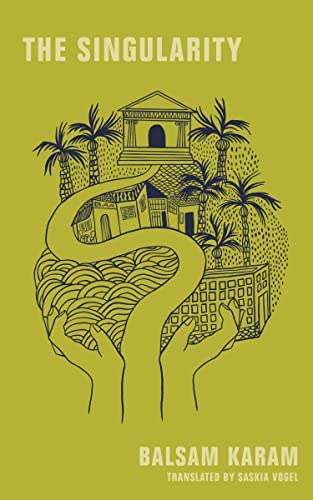

THE SINGULARITY
BALSAM KARAM
(tr. Saskia Vogel)
The Feminist Press (non-affiliate Bookshop.org link)
$16.95 all editions, available now

Rating: 4.25* of five

The Publisher Says: Lyrical and devastating, The Singularity is a breathtaking study of grief, migration, and motherhood from one of Sweden’s most exciting new novelists.

In an unnamed coastal city filled with refugees, the mother of a displaced family calls out her daughter’s name as she wanders the cliffside road where the child once worked. The mother searches and searches until, spent from grief, she throws herself into the sea, leaving her other children behind. Bearing witness to the suicide is another woman—on a business trip, with a swollen belly that later gives birth to a stillborn baby. In the wake of her pain, the second woman remembers other losses—of a language, a country, an identity—when once, her family fled a distant war.

Balsam Karam weaves between both narratives in this formally ambitious novel and offers a fresh approach to language and aesthetic as she decenters a white European gaze. Her English-language debut, The Singularity is a powerful exploration of loss, history, and memory—an experience akin to “drinking directly from a flood of tears” (Aftonbladet).

I RECEIVED A DRC FROM THE PUBLISHER VIA EDELWEISS+. THANK YOU.

My Review
: Published first but written second in Author Balsam's career.
The grandmother picked them up and held them close in sleep almost no sleep at all and then muttered that no one beyond the ruined wall wished them well and that she couldn’t bear another loss – again and again she said she couldn’t bear any more loss and even though the children didn’t understand how or why, they knew that the loss was now a part of them and that at any moment it could strike again.
It's the world of Event Horizon (review above) on Swedish soil in the camp the women live in as they have no recourse or options:
It’s your first winter in the house with the little garden, the darkness outside. Something hard hits the windows and your brother stands up, puts on his coat. After a while he comes back in, says he needs something to wipe off the dog shit from the window and the postbox. In his hand is a blue and yellow sticker that he’s torn off, like the ones you’ve seen high up on lampposts around town.

–and–
Later, your mum tells you that the first thing she was told after talking about how she had been tortured in prison was that no one would hire a person like her. One eye missing, older and not entirely fluent – it’ll be tough, the caseworker had said.
Nice people do not shout racist slogans in your face. It does not mean they are not going to behave in racist ways. The story's narrative risk-taking is more evident in its middle third:
/ do you think of her often, Marcus or Magnus asks softly / we ate bean stew with rice and yoghurt and I drank a whole pot of tea afterwards / you nod, of course you do / Gran was the happiest of us all I think / I think of her and of my grandmother you say and put the cup down / she took you in her arms and then I made sure to sleep while I had the chance / do you know anything about black holes? you later ask the counsellor / and I only got out of bed the next morning can you imagine? / inside a black hole is a place that is also a state — do you know about this? you ask, facing Patrick or Henry in his chair / a few days later Rozia's mother visited with little Rozia in her arms and a basket full of fruit /no, I'm afraid I don't know much about space, says Eric or Martin and continues to take no notes / then the two of you would meet up practically every day / you say it's called the singularity - that's what the place is called and lean over the bed / you and Rozia were like twins, we thought - the same round face and your hair as big and black / inside the singularity, the force of gravity is so strong it can't be calculated, can you imagine? you tell the counsellor / the pair of you often played in Rozia's yard and sometimes you stood by the big road even though you weren't allowed to and the soldiers could show up at any moment / that force pushes bodies together and renders the distance between them nil / because you both liked Gran's fried potatoes and her bean stew, you mostly ate at ours Mum says / you use your hands to show how no space remains between bodies in the singularity
It doesn't scan easily, but I promise you it is not flummery, a brummagem gaud of "Style" that distracts with difference without adding into meaning. In the more conventional first and last parts, the harrowing tales told do the work of impacting you in dark corners of your Safe Place, you are not safe, ever, as long as you are Other. While you are reading Author Balsam's story you are Other along with her.

It's a passionate document about grieving. It is a horrible chronicle of losing a child, losing an infant, losing losing losing without a moment of respite and never once ever giving up.

Until the final act of control is yours.

If you need a—any—content warning, do not pick this read for yourself.