Showing posts sorted by relevance for query books about books. Sort by date Show all posts

Friday, November 28, 2025

Kicking off #Booksgiving for 2025

I keep doing this in celebration of the joy that books, stories, and reading bring me all 365 days of the year. You'll see if you follow the link just how much pleasure this annual event brings me.

The Icelandic Jólabókaflóð is an annual custom of giving to, recieving from, and reading with, a book to your loved ones on Christmas Eve. I'd love to believe that custom is spreading in 2025 because books are some of the few items inexpensive enough to make sense as gifts in this recession. Even the expensive illustrated books are, comparatively, cheap when tariffs are biting budgets. Over $100 added to the average Yule shopper's 2025 expenditures just for tariffs.

It makes sense to emulate Miss Dolly Parton in giving books to children, every chance you get but particularly when their attention is so highly fractured by everything going on in their world. I've picked some of the most fun-for-me to read and look at picture books as ideas for you to gift to the niblings/grands in your life. Starter links:

Juvenile non-fiction
Juvenile books in total
middle-grade literature.

Their older sibs need reading material, too: YA across genres including our queer youth.

Need something for a guy? A stereotypical gift for a man you don't know well, or one you do and know what lind of STEM reaging he does? A few jumping-off points:
Cars.
Booze/drinking.

Always thinking of the entertainment world? A giftee on your list a music/film fan? Plenty of illustrated gift books to give, ranging from single-song treatises to film-genre studies! Or is there a petrol/gearhead among those you want to spoil? Bet they'll like the single-make studies or the industry-segment overviews on this #Booksgiving list. Celebrity culture.

I'm pretty sure we're all united by our love of The Book, the object that carries stories and information into our heads. Pretty illustrated books about books there are here. Books about books.

Pretty books about the natural world, about the cultures we don't know we don't know about, about gardens, food, drinks, about history...entering a topic in the search box will get you a ton of ideas:
Art books.
Gardens and gardening.

Of course most everyone loves them a mystery, or a thriller. Got y'all covered on those fronts, too: Mystery series.Thriller.

None of these are exhaustive...exhausting, up to you to decide, but incomplete and with the expected enshittified results that our tech masters think are good enough for the likes of us. There are a lot of reviews here, so think of a category, search for it, and very possibly it will turn up useful results. I have tried hard to do that over the past twelve and a half years of reviewing.

Tuesday, March 7, 2017

HOWARDS END IS ON THE LANDING, Susan Hill's life in the literary trenches


HOWARDS END IS ON THE LANDING: A Year of Reading from Home
SUSAN HILL

Profile Books
$15.95 trade paper, available now

Rating: 3.5* of five

The Publisher Says: Early one autumn afternoon in pursuit of an elusive book on her shelves, Susan Hill encountered dozens of others that she had never read, or forgotten she owned, or wanted to read for a second time. The discovery inspired her to embark on a year-long voyage through her books, forsaking new purchases in order to get to know her own collection again.

A book which is left on a shelf for a decade is a dead thing, but it is also a chrysalis, packed with the potential to burst into new life. Wandering through her house that day, Hill's eyes were opened to how much of that life was stored in her home, neglected for years. Howard's End is on the Landing charts the journey of one of the nation's most accomplished authors as she revisits the conversations, libraries and bookshelves of the past that have informed a lifetime of reading and writing.


My Review: Haven't all of us who possess a lot of books done this? “I will not buy a new book until I have read x from my shelves!” Uh huh. “No seriously THIS year I mean it, I'm not buying a book! Not one! No!” Mmm hmmm “Really!! I WILL NOT!” Yes dear.

I have no idea how Ms. Hill fared in her commitment not to buy any new books for a year (I suspect poorly, but I'm a suspicious old bugger, I am). I read this lovely memoir of her her reading life with pleasure, because she told me enough about the books that sparked the memories she shares for me to capture my own memories of the books, or to latch on to her sense of them, their place in her life, and the overall effect is to offer her own context as well as the book's.

I like that idea. I like to read what other readers think about when they're reading or after they've finished or even before they've decided what to read next. (Makes sense, doesn't it, here on this site?) And when that reader has written some very, very popular books, published some very good books, and talked about books on radio, television, and stage, I mean! Go fight those odds. I had to read this book. And then re-read it. I loved the experience of both, and would never ask for those eyeblinks back.

There are two passages I've come to and come back to multiple times. One is from author David Cecil's book Library Looking Glass: A Personal Anthology, a tome and a writer absolutely unknown to my poorly educated little ol' Texan self; while Ms. Hill does a wee bit of Internet bashing at the beginning of this book, I found Mother Internet most helpful in digging up a potted biography on Wikipedia of this fourth child of a marquess and father of an actor, an historian, and a literary agent. He was a very old-school gent, and deeply deeply steeped in a bygone literary tradition, author of books on Tennyson and Max Beerbohm and Dorothy Osborne...ye gods how grisly it all sounds to my ear. But then Hill quotes this from his 1975 “Personal Anthology:”

It is often said that mankind needs a faith if the world is to be improved. In fact, unless the faith is vigilantly and regularly checked by a sense of man's fallibility, it is likely to make the world worse. From Torquemada to Robespierre and Hitler the men who have made mankind suffer the most have been inspired to do so have been inspired to do so by a strong faith; so strong that it led them to think their crimes were acts of virtue necessary to help them achieve their aim, which was to build some sort of an ideal kingdom on earth.

Oh yes indeed, Lord David. Oh yes indeed, and so well said. Hardly a surprise, I suppose, this gift he shows there with the gab, given the amount and the quality of the poetry he spent his life reading, analyzing, delving into, parsing, disassembling and reassembling and explicating to generations of young scholars. But how surprising, how very satisfying to find, in a book about someone else's readerly DNA, a hitherto uncatalogued strand of my own.

Hill meditates on the subject of what forms a person, on readerly DNA, later in the book. The passage is one I found calling out to me while I was reading other books, and I marked it for easy access. It has helped me understand the reasons that I read, and the reasons that I decide not to read, certain books or genres or authors.

Books help to form us. If you cut me open, will you find volume after volume, page after page, the contents of every one I have ever read, somehow transmuted and transformed into me? … But if the books I have read have helped to form me, then probably nobody else who ever lived has read exactly the same books, all the same books and only the same books, as me. So just as my genes and the soul within me make me uniquely me, so I am the unique sum of the books I have read. I am my literary DNA.

It is the reason I am so interested in what others who, like me, crave the written story and the printed book, have to say about their reading, and their lives. We're all made of a unique set of genes, and a unique formula of books. It makes us deeply flawed, and deeply interesting.

Even as I turned the pages of the book again and sometimes two or three times, to re-read and re-savor some lovely or lively moment of memory or of sensory pleasure, even as I contemplated my own version of this book, I was aware of a sense of want, a lack of something I was expecting and not getting. It feels churlish to bring it up, but it's the reason I've given the book a half-star less than I would have otherwise. Please forgive the nosy American, Ms. Hill, but...so? And you are...? I'm asking for a wee little bit more of your CV, your activities in some...not a great deal, just some...more detail than you give. The small bits of personal information that are here are those that a very congenial acquaintance would provide, and I have the sense that is exactly and precisely what was intended to be offered.

But we're all readers here, ma'am. We're all in the club. A tell-all dishfest on le monde litteraire? No, not this book (though one of those would be lovely)...but a few more lines of whys and hows and whos would not have come amiss, nor would a sense of your place in life as the discoveries you limn for us have weighed down the narrative unduly.

A minor cavil. A delight of a book. My warmest personal thanks from England's 1644 colonial foundation on Long Island to the Long Barn.

Tuesday, September 24, 2013

Banned Books Week Post #2

It's Banned Books Week, and I blogged about a related Censorship issue on Shelf Inflicted.

Most of us who read more than one or two books a year rely on some social media or another to find our next book. We talk about books, us readers, and we shouldn't have to worry about what we say or how we say it UNLESS we threaten harm on someone's person. When a social media outlet takes it upon itself to censor what we are allowed to say, the conversation is headed to oblivion and eventually there won't be room for any opinion that isn't GLOWING.

That's a horrible thought. And it won't stop there, either. Happy-clappy fivestarland is also known as the Big Brother is Watching kind of totalitarian state that Orwell railed against. It's a truism that Ray Bradbury, author of Fahrenheit 451, expressed best: "You don't have to burn books to destroy a culture. Just get people to stop reading them." When all that's available are second-rate crappy books that get praised to the skies, how does a culture hook readers? Classics?

I don't know about your experiences with English class, but my teachers almost made a TV watcher out of me by teaching to the curriculum and compelling me to read, for example, The Scarlet Letter, and discuss it with the mouth-breathing trogs I went to school with. The curriculum was aimed at the trogs. I was asleep in my corner. Unlike most people, I was hugely lucky in that my mother was a voracious reader who liked to talk about books, and my much older sister owned a bookstore. I watched a few other natural readers who didn't have my advantages sink into indifference.

So I suspect classic books aren't likely to lead folks to reading. In fact, it's my observation that most readers of more than a book or two a year found classics after getting hooked on chick lit, or science fiction, or mysteries, and finding the literary world was chock-a-block with amazing stuff! And quite a lot of them...20 million on Goodreads, at least 2 million on LibraryThing, and the smaller sites are growing...turn to social media for help navigating the *stunning* amount of material available.

So when a big player in the field, like Goodreads, starts a ham-fisted campaign to make opinions nicey-nice, and then makes that error worse with a tin-eared social non-response to the original screw-up, well it's cause for worry. Whether or not you belong to Goodreads, it's going to affect you sooner or later. The chilling effect of censorship is insidious. It's actually not the formal, overt, clearly (or vaguely) articulated censorship that is most harmful.

It is the erosion of your internal sense of freedom. Censorship kills free thought, slowly, quietly, and indirectly. This rule today breeds that habit of avoidance that stifles that thought tomorrow. Who knows what the consequences of that stifled thought will be? A genius stifled, a mass murderer stopped, an invention unrealized...there is no way to know.

But I do know this. The risk of stifled thought depriving the world of good, important things outweighs the cost of hurt feelings and offended sensibilities. Even mine. I don't lobby for the banning of religion or the wholesale execution of gun nuts. I'd like to. I think those things should happen. But the precedent I set by advocating such draconian action EXTENDS TO ME.

Likewise censoring opinions about books, authors, publishers, etc. The precedent set extends to the censors, and those advocating the censorship.

Think about that carefully before advocating that a Rule be Established.

Wednesday, May 1, 2013

Reviewing Reflections 1 May 2013

Reviewing a book is a weird thing to do, when you think about it. Who cares what I, or anyone else, thinks about a writer's blood, sweat, and tears, her/is endless hours of toil and enormous investment of emotional energy? Shouldn't it speak for itself?

Yes. It should, and it does. Reviewing a book isn't, or shouldn't need to be, interpreting the author's work, it's appreciating the author's entire process of creation. And by appreciate, I mean "recognize the full worth of" not necessarily "be grateful for."

I recognize the full worth of books that I don't like by writing reviews of them. Even a scathing, nasty personal attack is an appreciation of the full worth of a book. All the time, all the effort that Author poured into the book has elicited from me a response that was strong enough to impel me to write it down and tell people about it. That is a giant achievement.

I read a lot. I don't review the huge majority of what I read. Some of the books are abandoned before the Pearl Rule point (Nancy Pearl's statement of the rule of 50: Before you're 50 years old, read 50 pages of a book to make a fair judgment; after age 50, subtract your age from 100 and read that many pages to be fair to the book). It seems unnecessary and unhelpful for me to review those. Most often I abandon books because they're ~meh~.

And that is a horrible thing to say about anyone's blood, sweat, and tears. Far, far better to hate something than to uncare about it, after all that work.

But back to my main idea: Why should you care what I think about a book? Well, maybe we're friends, and you know enough about me to think I might know a little about this reading fad. Maybe you're looking to pick holes in my ideas about a pet book of yours that we disagree about. Maybe you're not too sure what a particular book will offer you is worth the investment of your eyeblinks, and seek a range of opinions about it.

But more often than not, people read reviews because reading, that most solitary of pursuits, is actually very social. You're reading a book that puts you in a one-on-one contact, and a very intimate one, with an author. You're more aware of that author's thoughts about the story than you are about your mate/marital partner/child/parent's ideas about anything at all. A book is a deep, prolonged conversation between yourself and a stranger. It's legitimized cheating for those in relationships.

And then there's the wider community of readers. Other people (ideally a lot of them) are reading this book too! They're having their own illicit trysts with the author's brain! Isn't it at least a little bit intriguing to wonder what it is that they're getting from this sharing? If you're hating the experience of reading a book, and everyone else adores it, don't you at least wonder if there's another kindred soul out there feeling no love for the beloved?

And that's where reviews and reviewers come in. A lot of people don't like reviews that tell them the story of the book, some for fear of spoilers and some for sheer irritation at having to read inept synopses. (I'm the latter...spoilers make me no nevermind.) Some people want the story told them so they have a context for the response that is a review. It's that response, the personal reaction of a specific reader, that is so interesting to me, and to many who read reviews.

I write the sort of reviews I like to read: Tell me *why* you personally responded to this book, what it called up for you, what missing pieces it gave you in the puzzle of life; or tell me why it failed you, what the author set you up to expect and didn't give you.

Even when, as is so often the case, I disagree with a person's take on a book, it's very interesting to me to know what it is. I get value from hearing opinions I don't share. I've re-evaluated books I thought I didn't like because I've read ideas about them that made me question my response. I've changed my mind about a fair few, too.

That's why I care about book reviews. I can't possibly read everything I already own before I die. With the time I have, I want to be part of a community conversation about the books of our lives, listening to the responses and reactions to these uniquely intimate experiences that define reading.

That's what I hope you're getting out of reading book reviews, too. A perspective not your own on an experience uniquely your own. How cool is that, to have available to you at any time and from any imaginable point of view?

Saturday, December 14, 2024

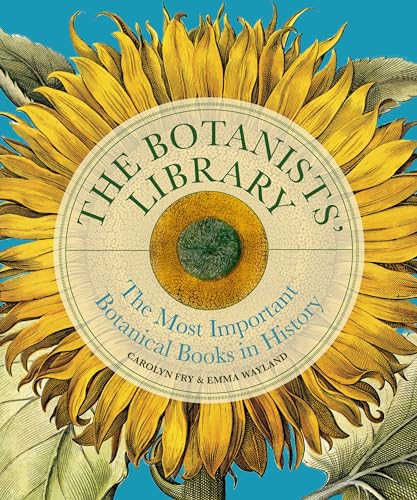
THE BOTANISTS' LIBRARY: The Most Important Botanical Books in History is one gorgeous book...even on a tablet!


THE BOTANISTS' LIBRARY: The Most Important Botanical Books in History
CAROLYN FRY & EMMA WAYLAND

Ivy Press (non-affiliate Amazon link)
$40.00 hardcover,available now

Rating: 4.5* of five

The Publisher Says: Discover a vast treasure trove of botanical knowledge in The Botanist’s Library, a superbly illustrated collection of 300+ seminal books and illustrations from throughout history.

From the earliest manuscripts penned by visionary naturalists, to the modern tomes that continue to shape our understanding of the plant kingdom, this book is a testament to the tireless dedication of the world's greatest botanists. Its compelling narrative and visual journey make it a must-have addition to the library of anyone fascinated by the beauty and complexity of the plant kingdom.

This complete guide traces the development of botanical science through era-defining publications, covering:
  • Historia Plantarum, the first history of botany, written between c. 350 BC and c. 287 BC, in which Theophrastus described plants by their uses, and attempted a biological classification, based on how plants reproduced, to the authors of the herbals of the 16th century
  • Brunfels, Fuchs, Bock and Mattioli, who regarded plants as the vehicles of medicinal virtues
  • The golden age of the 18th- and 19th-century flower hunters, who travelled to every corner of the world in search of new and exotic plants
  • Today’s most significant works of botanical reference
  • Each chapter delves into the pages of a seminal work, unveiling the insights, controversies, and stories behind the books that have shaped our understanding of the plant world. Whether you are a seasoned botanist, a budding enthusiast, or simply someone with an insatiable curiosity about the natural world, The Botanist's Library offers a comprehensive reference that will enrich your understanding of botany and its evolution.

    I RECEIVED A DRC FROM THE PUBLISHER VIA EDELWEISS+. THANK YOU.

    My Review
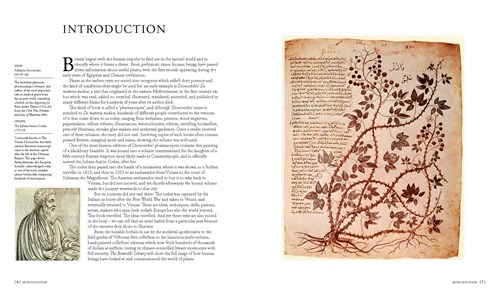
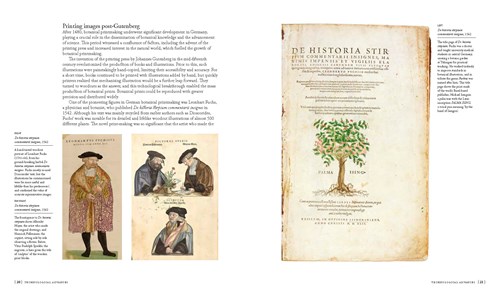
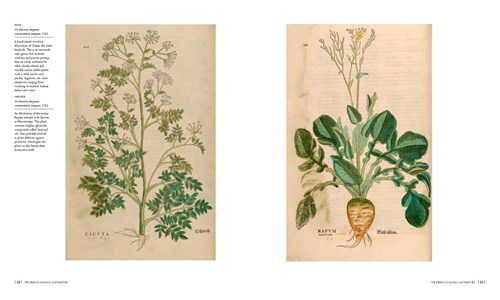
    : Looking at beautiful books is only made more satisfying when they are books about books. Here we have a book about the reasons for, the history and contributions of, and the need to preserve, ancient books of botany. The topics of botany's history, its centrality to the development of science and the scientific method, and...surprisingly to me...the art of printing get a pretty thorough overview here. Centuries of work by many talented people including women (at a time when that was not normal) are laid before what I expect will be your admiring gaze.

    These sample spreads will show you just how well the authors and the publishers understood what the assignment was:

    Why did I, after saying only laudatory things, knock a half-star off this beautifully illustrated, well-written book's score? I have a quibble with a thorough book promised and a truncated one delivered. The subject is huge, this book shouldn't be called a "comprehensive reference." An entire physical library can be, and has been more than once, dedicated to even just the scientific edges of the topic. It's not possible to do a comprehensive anything on a subject of this age and magnitude.

    That doesn't mean this utterly gorgeous object should not find its way to your coffee table for Yule. It should. I viewed it on my Galaxy tablet and it looked spectacular, so assuming you're not looking at it on an ereader, a digital version for yourself if you're gifting a hardcover to someone you love like sixty will give you value for dollar spent.

    Thursday, October 10, 2013

    A NOVEL BOOKSTORE, delightfully daffy book about books in a different kind of bookstore

    A NOVEL BOOKSTORE
    LAURENCE COSSÉ
    (tr. Alison Anderson)
    Europa Editions
    $18.00 trade paper, available now

    Rating: 4.9* of five

    The Publisher Says: A Europa classic about love, deceit, Paris, and books!

    Ivan and Francesca decide to open a bookstore devoted solely to good literature and their love of books. Frustrated by the glut of mediocre books printed every month and envisioning a true literary paradise, they offer a selection of literary masterpieces chosen by a top-secret committee of like-minded literary connoisseurs.

    To their amazement, after only a few months, their vision proves popular. Very popular. Tucked away in a corner of Paris, the bookstore quickly becomes a haven for bibliophiles. Indeed, it becomes so successful that the great majority of Parisian readers are now buying their books only at Ivan and Francesca’s store, and other stores in the city are starting to change how they order and display books too. Now big publishing’s powerful elite are desperately trying to adapt their business model to the demand for quality above all else. As the store’s success grows, venomous comments begin circulating online and the owners, and their selection committee, become the target of vicious editorials and threats.

    A Novel Bookstore blends book love and bookstore love with a brilliantly conceived and entertaining mystery and is a delight for readers of all tastes.

    My Review: Well, okay, see, this is a French novel, and it's really, really hard for a Murrikin like me to disentangle what French novels are about, like what the author set out to do, because the French don't really have the same rules we Murrikins do for novel-writing. It seems to be about two people, a rich, smart woman and a poor, smart man, who sorta kinda fall in love in a way and yet they don't because she's married to a major Philistine a-hole and he's in love, for some unfathomable reason, with this dreary little chickie half his age who seems drippy, useless, and uninteresting to *me* and, I suspect, to the rich lady too. So the rich lady does what rich people do best and unbelts with a big pile of gelt for the poor-but-smart dude to start this bookstore that will sell only novels, and only the best, the finest, the most ut of the lit'ry output of the planet, chosen by eight of the best (French) writers now writing. Hijinks ensue, which are frankly completely incredible (in its literal sense), but are lots of fun. What this book is *not* is any species of thriller or mystery; it's a French novel. That's what it is. No more, no less, no different. So, in the end, the Philistine husband and the poor-but-smart dude part ways but the store must go on, and the book's narrator is revealed, though I have to say it's not a huge surprise, though I think it's intended that way. The end, happily ever after but sadder and wiser.

    I gave the book a generous 4.9 stars because it's one of those books that, while reading, goes wildly up and down the star scale; but in the end, cover closed, glasses chewed upon, assumes a different shape than the one that the reading process creates.

    I'd recommend this book to all and sundry if only because of this passage, beautifully translated by the very talented Alison Anderson, on page 150 of the Europa edition:
    Literature is a source of pleasure...it is one of the rare inexhaustible joys in life, but it's not only that. It must not be dissociated from reality. Everything is there. That is why I never use the word fiction. Every subtlety in life is material for a book....Have you noticed...that I'm talking about novels? Novels don't contain only exceptional situations, life or death choices, or major ordeals; there are also everyday difficulties, temptations, ordinary disappointments; and, in response, every human attitude, every type of behavior, from the finest to the most wretched. There are books where, as you read, you wonder: What would I have done? It's a question you have to ask yourself. Listen carefully: it is a way to learn to live. There are grown-ups who will say no, literature is not life, that novels teach you nothing. They are wrong. Literature informs, instructs, it prepares you for life.


    If that passage rings you like the bell you wondered if you might be, then this book will speak to you and shape you a bit differently than you were before; if it seems tediously long, avoid this book like it's got herpes, because you'll hate it.

    *gooonnnggg* goes my spirit.

    Thursday, January 1, 2026

    Happy Incoming 2026


    ↟↟↟↟↟↟↟↟↟What I want to say to 2025's ghosts, ghouls, and gross old pedophiles. I've already said elsewhere that I won't be focusing attention on the number of books I've read, or any of the rest of the numbers game, because it feels like bragging. I have none of the pressures on me that normal people have. I've got my datastick of notes from reads as much as thirteen years old, never written into reviews for any number of reasons. I have a huge hoard of rage at the kakistocracy fueling a desire to do something, a disability that doesn't allow that something to be kinetic, and so I write.

    It's what I can do, so it's what I will keep doing until ICEstapo starts coming for domestic enemies of the kakistocracy. Emptying that data stick of the backlog of more-or-less coherent notes taken might last me the year, if I get even close to 2025's levels of success in writing away my emotional pain. My reviewing schedule for 2026 will begin on the second...there will be hashtag events during the year that I'll announce the weekend before they begin...I still won't post reviews on Tuesdays (traditional book-release day in the US) until publishing slows down the new-books firehose in December as #Booksgiving hots up. The most exciting books of 2025's reading were translations so I'm definitely continuing my focus on reading translated literature in 2026.

    Y'all already know about my six-stars-of-five read for 2025 (the whole list is at the bottom of this post): THE REMEMBERED SOLDIER by ANJET DAANJE, and translated from Flemish by David McKay via the estimable tastemakers at New Vessel Press (Support an excellent indie press!). My review should say it all about the layered, subtle evocation of memory's centrality to identity, about the effort love takes, about the nature of desire and its propulsive projective power. It's the kind of (long!) read that I want to put in peoples' hands to explain themselves -to- themselves.

    It is a New York Times 100 Notable Books designee, it was a finalist for the National Book Award for Translated Fiction, on lists from Publishers Weekly and LitHub and the Wall Street Journal...it deserves the patient companionship and compassion of readers seeking a window into forming...discovering...identity through its loss and rebuilding Trauma does not have to be war, you know. The world can, and does, do similar devastating things to us callously and carelessly in the course of Life. Buy one, tree book or ebook, ask your library for one so they'll know people want it, get on their wait list for it, or get one via their ILL program. It is a good, impactful story told the best way a story can be: carefully, caringly, with the cares and the needs of its characters and its readers at its heart.


    Since the entirety of 2026 is looking politically unstable, I'm making a point to review books that treat that instability as a chance to reflect on how we got here, so we can get out...and stay out. I'm not a bit sure anyone will enjoy it. It is urgent not to lose sight of the reality that our right to read and think and behave like, about, and what we think is best is very much under attack. 6870 times in the 2024-2025 school year alone. Guess whose identities were targeted most often. "Books by authors of color, by LGBTQ+ authors, by women. Books about racism, sexuality, gender, history. PEN America pushes back against censorship and the intolerance and exclusion that undergird it." I recommend joining PEN America to support a key player in the fight to oppose and reverse the school bans.
    𝗠𝗔𝗥𝗞 𝗥𝗢𝗧𝗛𝗞𝗢, Untitled, 1968 Oil on paper mounted on canvas Pace Gallery, London Photo by Chris Weekes

    I'll end on the image of a Rothko that evokes my sense of peaceful hope, optimism, and faith in humanity. I wish all of those things to every living one of us. No matter who; no matter where; no matter what.
    ALL MY 6*-OF-FIVE REVIEWS

    1994. MONTANA 1948...the original; the perfect read!
    1. THE SONG OF ACHILLES
    2. MATTERHORN
    3. EUROPE IN AUTUMN
    4. MARGARET THE FIRST
    5. MISSIONARY
    6. CIRCE
    7. BLACK LIGHT
    8. YOU EXIST TOO MUCH
    9. COVE
    10. KIBOGO
    11. THE WORDS THAT REMAIN
    12. GLORIOUS EXPLOITS
    13. THE REMEMBERED SOLDIER

    Tuesday, October 15, 2013

    My 3100 Words on the Evils Of Censorship and the Wrongness of Breaking Trust


    Goodreads, I hardly knew ye.

    I joined in 2010, and I became an active member in 2011. Less than two years later, I’m beginning the process of ratcheting my activity down to virtually zero. In those two years, I had a blast and a wonderful streak of lucky friendships and some great reviewing fortune. I’ve amassed a following of about 1600 people, become a “Forbes 25 Top Reviewers” member, been in the top-ten most popular reviewers measured, by Goodreads, every week or month for most of 2012 and 2013. That’s a wonderful, wonderful experience for anyone to have.

    Then Amazon bought Goodreads, and my “uh-oh” light went on. Otis Chandler, founder of Goodreads, announced this in April 2013. The Feedback forum on the site went bonkers. That forum consists of about 13,000 people, out of a reported 20 million members. A tiny, tiny minority...but a vocal and passionate minority committed to working on a site that allowed its members to, for free, catalog and discuss their books with a vibrant and opinionated community of likewise vocal and passionate readers of books. The price? Look at the ads. (And not even that if you, like me, have AdBlocker on your browser.) Goodreads asked us if we minded them sharing our popular reviews with third parties, as an extra revenue-generating measure. I myownself agreed readily. I wanted to help the site survive, to maintain its independence.

    The announcement of the sale chilled me to the bone. All the posts I made about the sale are gone, deleted with the thread that contained them, in May 2013. Otis Chandler decided to distill the conversation into a series of FAQs. I’m reproducing a few select questions with some responses bolded for emphasis:

    Editing of reviews - can Goodreads or Amazon edit my reviews? Delete them without asking?

    Nothing has changed when it comes to reviews. Your reviews are yours and we value the frank and honest opinions of all our members. That's what makes Goodreads different and special. (And yes, you can continue to swear if that's important to you, include images, etc.)

    Our policy has been and will continue to be that we never edit a member's review. In some cases - where the review has broken our guidelines - we will delete the review, just as we have in the past.

    There is one situation - and again this has been our policy for a long time - where we might use part of your review without showing the whole review. Sometimes, an author or publisher will ask to use a snippet of a book review in an advertisement outside of Goodreads or on a book's back cover. Rather than include the full review, they will use a line or two. This is similar to what you see in ads for movies. We always check with the members who wrote the reviews before granting permission. If an author or a publisher wants to use an excerpt of a book review in an ad on Goodreads, our team will review the ad and we permit this without checking with the reviewer as members are already sharing this content on Goodreads. These are policies that we already had in place and they have not changed.

    Will sales targets or sponsorships now influence how reviews appear on the book page and which book recommendations I see on the site?

    From the very beginning of Goodreads, we have always had a very firm policy about ensuring that editorial content on the site is never influenced by advertising. This isn't changing.

    We'll also continue to show reviews in the same order as before:

    * Reviews by your friends (people you know and trust)
    * Reviews by people whose reviews you have chosen to follow (people whose opinion and taste in books you trust)
    * Reviews from the Goodreads community, sorted by our proprietary algorithm.

    As for recommendations, our proprietary algorithms analyze 20 billion data points to come up with personalized book recommendations. Advertising is not part of this process and won't be in the future.

    Will Goodreads now be more focused on being a site for authors?

    We love having authors on Goodreads. But, we are a site that's focused on readers first. If there is a choice between what is best for readers and what is best for authors, we will always err on the side of readers. It's right there in how we describe ourselves: "the largest site for readers and book recommendations."

    On the other hand, lots of readers love to have direct interaction with their favorite authors and we're happy to provide a platform for that to happen.

    For new authors looking to establish themselves and build awareness of their books, we'll continue to educate them on the best way to interact on Goodreads. It's a learning process and our key advice will always be: first and foremost, be a reader on Goodreads.

    All that sounds very reassuring. No plans to change, no one will notice a difference. Then came Banned Books Week and, ironically on the Friday before the celebration of resisting censorship began, an announcement that Goodreads is deleting the reviews and, later on, the shelves labeled in a manner that focuses attention on the author of a book and not the book itself. Kara, the Director of Customer Care, posted this in response to massive numbers of protest posts on the “Important Note Regarding Reviews” thread where the surprise was revealed:

    We’ve been reading all the comments and wanted to give an update based on some of the concerns in the thread.

    To clarify, we haven’t deleted any book reviews in regard to this issue . (Not strictly speaking true. See below.) The key word here is "book". The reviews that have been deleted - and that we don't think have a place on Goodreads - are reviews like "the author is an a**hole and you shouldn't read this book because of that". In other words, they are reviews of the author's behavior and not relevant to the book. We believe books should stand on their own merit, and it seems to us that's the best thing for readers.

    Someone used the word censorship to describe this. This is not censorship - this is setting an appropriate tone for a community site. We encourage members to review and shelve books in a way that makes sense for them, but reviews and shelves that focus primarily on author behavior do not belong on Goodreads.

    From Wikipedia, this definition of censorship:
    Censorship is the suppression of speech or other public communication which may be considered objectionable, harmful, sensitive, politically incorrect or inconvenient as determined by a government, media outlet or other controlling body. It can be done by governments and private organizations or by individuals who engage in self-censorship. It occurs in a variety of different contexts including speech, books, music, films, and other arts, the press, radio, television, and the Internet for a variety of reasons including national security, to control obscenity, child pornography, and hate speech, to protect children, to promote or restrict political or religious views, and to prevent slander and libel. It may or may not be legal. Many countries provide strong protections against censorship by law, but none of these protections are absolute and it is frequently necessary to balance conflicting rights in order to determine what can and cannot be censored.

    So yes indeed, the act of deleting reviews and other user-created materials suddenly deemed not-community-friendly is censorship. "Enforcing community standards"...well...just a question from the peanut gallery here, but how did these "community standards" get set, by whom, and when? A long and separate chat could be had on that topic. But for now. let's note there were 21 people whose reviews were, summarily and without warning, deleted. That contradicts what Kara said above. And she posted this update to backtrack from her earlier assertion:

    Thank you for all the comments so far. One concern that has come up in this thread is that the content was deleted without those members first being told that our moderation policy had been revised.

    In retrospect, we absolutely should have given users notice that our policies were changing before taking action on the items that were flagged. To the 21 members who were impacted: we'd like to sincerely apologize for jumping the gun on this. It was a mistake on our part, and it should not have happened.

    Anyone else with reviews or shelves created prior to September 21, 2013 that will be deleted under the revised policy will be sent a notification first and given time to decide what to do.

    Again, thank you for all your comments. We'll continue to monitor this thread for your feedback.

    So we’re all hunky-dory again, right? Warning will be given to people who fall afoul of the new “community standards” which we’re now enforcing. Time to make a decision about revising content, moving content, what one wishes to do in response to the site’s desire to remove one’s content from its community’s gaze. I wasn’t given a warning, I was informed my content was removed:

    Hello Richard,

    Your review of The Hydra were recently brought to our attention. Please note that any reviews you post must contain your own original content (see our review guidelines). Any reviews that are simply copy-pasted duplicates of other reviews will be removed. Given this, the review in question has been deleted. We have attached a copy for your personal records.

    Additionally, your review of Civil Disobedience and Other Essays was recently flagged by Goodreads members as potentially off-topic. As the review is not about the book, it has been removed from the site. You can find the text of the review attached for your personal records.

    Please note that if you continue to violate our guidelines, your account may come under review for removal.

    Sincerely,
    The Goodreads Team

    Now, I've been completely and publicly pantiwadulous over the major change in Terms of Service as they affect what reviewers...the unpaid volunteers who create the value that Amazon paid for the company to get!...can and cannot say to/about authors in their own reviews, and even more troublingly, what the reviewers can and cannot name the shelves or collections they put their books into. It didn’t need to be personal to me to draw my attention to the many and various attempts to censor what kind of reading material is available to you, me, our kids, our grandkids, and the banning parties hope, posterity. Books that talk about S-E-X or the right of women to walk down all the streets of the world without fearing rape or the existence of this little thing called "science" that rejects religion's once-upon-a-time version of Creation get banned regularly...until now, Goodreads has been a place to discuss these banned books freely and openly. How long before the author-friendly censorship moves into family-friendly censorship, such as the amorphous "community standards" Kara cites above will come to demand?

    In the long run, censorship doesn't work. In the short run, it's hideously costly in human emotional terms, titanically wasteful of time, effort, and resources to police and enforce, and morally repugnant to right-thinking people.

    But the evil doesn't stop at formal banning of a book, governmental or business anathema pronounced upon a writer, a press, a review...those things, while reprehensible, are formal, out there for the public to see and hear and (theoretically) obey.

    More insidious is a behavior that's meant to fly under the radar, such as deleting people's work without warning, is almost inevitable when these "community standards" that were never hashed out, publicly debated, or even made a topic of conversation are put in place by fiat. And when the actions are discovered, they're covered up by (factually correct, morally wrong) justifications like "Oh look how few people are actually affected!" and "Most of you will never know it's even there!" and "It's my {concrete noun} and I'll do as I goddamned well please with it."

    To quote a religious figure of great renown, "Truly I tell you, whatever you did not do for one of the least of these, you did not do for me." (Matthew 31:45) You didn't speak up for the safety or the happiness of those piddling few? You didn't worry because it wasn't you?

    Next time it will be. Or the time after that. Or the one after that. Because if I've learned nothing else in 54 years of relatively constant annoyance by earthlings, I've learned that the forces of Command and Control NEVER EVER STOP WANTING MORE.

    I don't know if anyone on the Goodreads staff expected the strength and passion of delivery of the vitriol that the sheeple (irony there!) of the site unleashed on this decision. If they did not, they were not paying attention to the titanic kerfuffle when Amazon bought Goodreads. Twenty-five hundred posts (mostly) of outrage and fear didn't make an impact? The Ugly Green Button contretemps, with 2,350 posts, made no dent? Now there are over 5,800 posts on the Announcement thread linked above!

    Goodreads folk are passionate and committed readers and writers. And the reason they've...we've...invested so much emotional energy in the site is, at base, simple. It's the only one of its kind, the only place where readers connect with other readers by means of reviews, groups, and serendipity. Competitors to Goodreads are a great deal smaller, they're often focused around special interests (eg, LibraryThing, that unparalleled book cataloging site, with a sideline of social activitythat's not very much encouraged), or they just haven't got the chops to make the ease and fluidity of opinion discovery on a par with Goodreads.

    So naturally change will be resisted and feared by many, and just as naturally the Powers That Be will seek to direct the community's attention to such areas as will benefit the advertisers and/or owners who pay the bills. Some tension is inevitable, some compromise desirable on all sides. But to date, no compromise has been offered on any issue of site governance I've cited here. The policy announced Friday, 23 September 2013, that announces Goodreads can and will delete user-created information at will and without warning is in place. The mea-culpa issued the next week, with a reassurance that they won't delete stuff without warning again isn't, it appears, part of the formal policy yet.

    This is put in place, we're told, because Goodreads wants to maintain a TONE, an atmosphere, of respect and tolerance. Because nothing says respect and tolerance like unilaterally changing a community-wide policy with a dump-and-run message on Friday afternoon, in a group that much less than 1% of the user base belongs to, right?

    Still, it's their (well, Amazon's) site and they set the rules, right? Right. They do. And they offer the service to us for free, right, so they pretty much deserve to have a completely free hand, right?

    Nope. Not without a fight.

    I’m appalled by the dismissive snort many Goodreaders emit, essentially saying, "suck it up Buttercup, if you're not the paying customer you're the paid-for commodity." Point taken...you don't value the existence of a cyberspace dedicated to free discussion of the ideas and impact of books on readers. Fine, then you're not required to be upset about the absence of such a cyberspace. But you still lose when ANY voice is silenced, out of fear or obedience or...worst of all...despair. How many honest reviews, negative to the author's feelings and even insulting in language, will now not be written? How many conversations will go un-had? (I've learned a lot from arguing my point's validity on my most vitriolic reviews.)

    Talking about books freely and without censorship, whether internal or external in origin, is as important an activity as reading the damn things. If no one talks about Mein Kampf, or Man and Superman, or The Hydra, why kill the trees to print them? Why dedicate the bandwidth to delivering the files to the ereader screens? If people care enough to read even one book a year, shouldn't they be encouraged and supported in a desire to discuss it in full, even (or espeecially) if they aren’t experts in literary theory or history or ethics or copyright?

    Stifling one, twenty-one, a million and one, people's willingness to speak honestly and from the heart about the ideas, the words, the feelings expressed in a book, by an author, is stealing from the rest of us who are unaffected the very necessary challenge of understanding, if never accepting, a different point of view.

    And that's what Goodreads was. Was. I have to use the past tense. It WAS this. It is now a data farm and sales platform for a bookselling entity. (Whose customer I am, by the way, and will continue to be, because I exist on less money per month that most of you make in a week.) And sales are hurt, the conventional wisdom goes, by shouting.

    Goodreads was a unique thing, a place where opinions about books created by writers could be examined and opined upon without fear of censorship. That is an important function. No one else was doing it. And now, in fact, no one is doing it.

    And that's the most horrible thing about censorship: To avoid falling afoul of the censors, we question ourselves and censor ourselves and make a big deal out of things in our heads. We do the work of the control freaks for them, out of a desire to avoid them.

    Like Amazon, Goodreads reviews will steadily become less and less useful because, basically, how will I ever trust that the happy-clappy Kool-Aid dispensing Nicey McNiceToMe people haven't got hold of it?

    Ray Bradbury said it best: "You don't have to burn books to destroy a culture. Just get people to stop reading them." And talking about them. And now there's no safe place to do that with the size audience, with their wallets ready to spring open.

    The decline, it would seem, has accelerated, and the fall is imminent. I'm sad about that. For me, I'm going to shout from the wilderness. I'll post protests and I'll post reviews that are explicitly anti-censorship and tie them into these concerns. And most people will learn to ignore me, more than they already do, because "what's that noisy old coot hollering for?" is easier, safer, less trouble than thinking about what this explicit statement of censorship as a policy means for your own future mental freedom.

    Creative Commons License
    This work is licensed under a Creative Commons Attribution-NoDerivs 3.0 Unported License.
    Based on a work at http://expendablemudge.blogspot.com/2013/10/my-3100-words-on-evils-of-censorship.html.

    Monday, September 23, 2013

    It's Banned Books Week! Yay!

    It's that happy-clappy time again! Banned Books Week draws attention to the many and various attempts to censor what kind of reading material is available to you, me, our kids, our grandkids, and the banning parties hope, posterity. Books that talk about S-E-X or the right of women to walk down all the streets of the world without fearing rape or the existence of this little thing called "science" that rejects your religion's once-upon-a-time version of Creation.

    "Ban it! Don't talk about it! NO!! Someone must be WRONG and it can't be ME!!"

    In the long run, it doesn't work. In the short run, it's hideously costly in human emotional terms, titanically wasteful of time, effort, and resources to police and enforce, and morally repugnant to right-thinking people.

    But it doesn't stop at formal banning of a book, governmental or religious anathema pronounced upon a writer, a press, a book...those things, while reprehensible, are formal, out there for the public to see and hear and (theoretically) obey. More insidious is a behavior that's meant to fly under the radar, and when discovered, covered up by (factually correct, morally wrong) justifications like "Oh look how few people are actually affected!" and "Most of you will never know it's even there!" and "It's my {concrete noun} and I'll do as I goddamned well please with it."

    To quote a religious figure of great renown, "Truly I tell you, whatever you did not do for one of the least of these, you did not do for me." (Matthew 31:45) You didn't speak up for the safety or the happiness of those piddling few? You didn't worry because it wasn't you?

    Next time it will be. Or the time after that. Or the one after that. Because if I've learned nothing else in 54 years of relatively constant annoyance by earthlings, I've learned that Command and Control NEVER EVER STOP WANTING MORE.

    Specifically, I'm completely panitwadulous over the latest Goodreads self-inflicted PR wound. Last Friday, after the world has gone to weekend footing, Goodreads dumped the news of a major change in Terms of Service as they affect what reviewers...the unpaid volunteers who create the value that Amazon paid for the company to get!...can and cannot say to/about authors in their own reviews, and even more troublingly, what the reviewers can and cannot name the shelves or collections they put their books into.

    I don't know if anyone on their staff expected the strength and passion of delivery of the vitriol that the sheeple (irony there!) of the site unleashed on this decision. If they did not, they were not paying attention to the titanic kerfuffle when Amazon bought Goodreads. Twenty-five hundred posts (mostly) of outrage and fear didn't make an impact? Not even the Ugly Green Button contretemps, with 2350 posts, made a dent?

    Goodreads folk are passionate and committed readers and writers. And the reason they've...we've...invested so much emotional energy in the site is, at base, simple. It's the only one of its kind, the only place where readers connect with other readers by means of reviews, groups, and serendipity. Competitors to Goodreads are a great deal smaller, they're often focused around special interests (eg, LibraryThing, that unparalleled book cataloging site, with a sideline of social activity that's very much not encouraged), or they just haven't got the chops to make the ease and fluidity of opinion discovery on a par with Goodreads.

    So naturally change will be resisted and feared by many, and just as naturally the Powers That Be will seek to direct the community's attention to such areas as will benefit the advertisers and/or owners who pay the bills. Some tension is inevitable, some compromise desirable on all sides. But to date, no compromise has been offered on any issue of site governance I've cited here. The policy announced Friday that announces Goodreads can and will delete user-created information at will and without warning is in place. The mea-culpa issued today with a reassurance that they won't delete stuff without warning again isn't, it appears, part of the formal policy yet.

    This is put in place, we're told, because Goodreads wants to maintain a TONE, an atmosphere, of respect and tolerance. Because nothing says respect and tolerance like unilaterally changing a community-wide policy with a dump-and-run message on Friday afternoon, in a group that much less than 1% of the user base belongs to, right?

    Still, it's their (well, Amazon's) site and they set the rules, right? Right. They do. And they offer the service to us for free, right, so they pretty much deserve to have a completely free hand, right?

    Nope.

    I tweeted about this today, hoping to get some interest from Big Bloggers. Total response: One dismissive snort that essentially said, paraphrasing here, "suck it up Buttercup, if you're not the paying customer you're the paid-for commodity."

    In BANNED BOOKS WEEK an example of censorship gets that kind of response. Wow.

    Talking about books freely and without censorship, whether internal or external in origin, is as important an activity as reading the damn things. If no one talks about Mein Kampf, or Man and Superman, or The Nicomachaen Ethics, why kill the trees to print them? Why dedicate the bandwidth to delivering the files to the ereader screens? If people care enough to read even one book a year, shouldn't they be encouraged and supported in a desire to discuss it?

    And that's what Goodreads was. Was. I have to use the past tense. It WAS this. It is now a data farm and sales platform for a bookselling entity. (Whose customer I am, by the way, and will continue to be, because I exist on less money per month that most of you make in a week.) And sales are hurt, the conventional wisdom goes, by shouting. Yeah, Paula Deen's racist language hurt her: Sales of her books, what, tripled? It was her publishers who said "ciao" and not the customers.

    Which is its own level of icksome. But the point I'm making is simple: Stifling one, twenty-one, a million and one, people's willingness to speak honestly and from the heart about the ideas, the words, the feelings expressed in a book, by an author, is stealing from the rest of us who are unaffected the very necessary challenge of understanding, if never accepting, a different point of view. You may not ever agree, you may even like the opposition less than you did before you understood them better. (This happens to me with religious stuff all the time.)

    But you still lose when ANY voice is silenced, out of fear or obedience or...worst of all...despair. How many honest reviews, negative to the author's feelings and even insulting in language, will now not be written? How many conversations will go un-had? (I've learned a lot from arguing my point on my most vitriolic reviews.)

    Ray Bradbury said it best: "You don't have to burn books to destroy a culture. Just get people to stop reading them." And talking about them. And now there's no safe place to do that with the size audience, with their wallets ready to spring open.

    The decline, it would seem, has accelerated, and the fall is imminent. I'm sad about that.

    Friday, July 12, 2013

    This Book Is AMAZING WONDERFUL GLORIOUS! Or, well, maybe not.

    Long ago (in 1991, to be precise), I read a book called Damage:
    Damage is the gripping story of a man’s desperate obsession and scandalous love affair. He is a man who appears to have everything: wealth, a beautiful wife and children, and a prestigious political career in Parliament. But his life lacks passion, and his aching emptiness drives him to an all-consuming, and ultimately catastrophic, relationship with his son’s fiancée.

    Chilling and brilliant, Damage is a masterpiece—a daring look at the dangers of obsession and the depth of its shattering consequences.
    ...and was captivated, enthralled, hooked, over the moon! I recommended it and even bought it for folks. Someone asked me why I was so thrilled, and after I'd gushed for a while, he said, "Did you actually read this?"

    While I was offended mightily by his snark, I was inspired to go back and read it again. It was...
    ...
    ...
    ...okay.

    Lesson learned. Now I wait before I shout about books. I'm especially cynical about The Book of the Moment-type books, because they so frequently disappoint. (I'm lookin' right at you, Gillian Flynn/Karen Russell/Jonathan Franzen/Jeffrey Eugenides. Right. At. You.) But books nominated for prizes, books by unknowns and self-pubbeds, books from the Dark Ages of Cloth Bindings...I wait on 'em all, let 'em perk gently through the sieve I call a brain, and let some synapses fire and some neuronal pathways alter before I go hollerin' hallelujah. And still, despite this care and feeding, my brain gets all flippied and damzeled about (ancient book of poems I once had, wonder where it is, was titled that and I still love it). I crow over books people look at and say, "...yeah? The author doin' you or what?" about.

    I guess it's inevitable, given that everyone has different taste. But it seems to me that there are some things we should all know, like what good writing is. (It's what Chuckles the Dick and Ernie Hemmenhaw couldn't do.) Not writing that you like, that's a taste thing and it's inarguable because it's your taste. No one gets to tell you your taste is wrong. Bad, maybe, but never wrong.

    And then came the real eye-opener. So what is good writing?

    Um.

    Hell if I know what you think good writing is. Hell if I know what to tell you to read to show good writing. People have spent much of my literate life praising Dickens *shudder* to me as superbly written! Only my innate kindliness and irreproachable good manners prevent me from saying what my long-ago friend did: "Did you actually read this?"

    What makes writing good? I wonder. For me, good writing does its job of story-telling without undue fuss and bother. So why do I like Virginia Woolf and William Faulkner, but not Ernest Hemingway or the nonce-book writers from all the MFA programs?

    Woolf and Faulkner, and James Joyce (whose work I don't like as a matter of taste), all told complex stories in precise ways. There isn't another, or a better, way to tell those stories. Yes, the sentences curl around themselves, rubbing scales with their own nether bits. But how else could my doted-on Mrs. Dalloway or the superb As I Lay Dying or Ulysses be told? Hemingway's short, staccato sentences don't serve The Old Man and the Sea nearly as well as they served "The Snows of Kilimanjaro" or even For Whom the Bell Tolls (a thoroughly horrible book, dull and featureless and stupid, but the style suits it).

    Equally enjoyable to me is Colum McCann's staccato delivery of his two most recent novels, both of which I like quite a lot, TransAtlantic and Let the Great World Spin. It suits the stories. It's also not the only arrow in his quiver. Read Zoli or the stories in Fishing the Sloe-Black River...different styles indeed, in those cases the delivery matches the story being told.

    And that, to me, is what good writing does. It tells me the story the author wants me to hear in the most effective way, not showing off what the MFA program taught or bookhorning a story into a style.

    So how do we all agree on which books achieve this goal? Ideas welcomed.

    Monday, July 13, 2026

    ADA, latest fascinating idea made into a story by the eminent funny intellectual Mark Haber


    ADA
    MARK HABER

    Coffee House Press (non-affiliate Bookshop.org link)
    $18.00 paperback, available now

    Rating: 5 4.9* of five

    The Publisher Says: From “one of the most rigorous and serious—and anachronistic—novelists working today” (The Washington Post) comes a raucous new tale plumbing the depths of ego and ardor.

    In a remote country in Europe, Gerard Desacroux IX, petty tyrant and French nationalist, wants nothing more than to be reunited with Ada, the object of his desire ever since their brief fling in Paris years before. Though Ada is on her way to visit, there are the unfortunate matters of civil unrest, assassination attempts, and Ada’s affluent (and highly inconvenient) husband to contend with before bliss is attained. Despite it all, Desacroux IX is determined that nothing—neither war, nor ominous weather, nor the rising swell of indignant peasants—shall stand between him and Ada.

    Told with Mark Haber’s trademark exuberant absurdity, Ada is a comedy about the mania of power, unrequited love, and the solitude of authority.

    I RECEIVED A DRC FROM THE PUBLISHER VIA EDELWEISS+. THANK YOU.

    My Review
    : Berchtesgaden. Are you even serious right now. Berchtesgaden! And Desacroux being shoved out of Paris because of THE Revolution, being scion of a lineage of disgusting fascist scum! Readerly nose, meet authorial fist.

    And it *barely* takes him a hundred pages to whomp up this recipe for tart-tongued satire of entitlement. It's a fast-moving read, it doesn't have digressions or discursions to slow Desacroux's millrace of thoughts as he settles into Berchtesgaden (seriously, follow the link above...it makes this read exquisitely funny!) with the intent to claim what is not his for purposes malign and bland at the same time. It goes...not well, really for anyone but most definitely hastens Desacroux's comeuppance.

    At every turn, he's hemmed in, he lives in a tine, muddy place of no significance after being thrown off the world stage for utter incompetence and uselessness. Desacroux paces in circles around his "Great" Room, abusing and being abused by Hans the sole servant; when the people rise against him, he retreats into the Sword Closet, an even smaller space than the "Great" Room, one with the trappings of power all around him...and he never grasps a single one, relying on isolation to "protect" him from consequences from his real-world abuses of power. Trapped with the trappings of power, weapons he does not have the skill or the wit to wield, fearful and waspish with it, utterly determined to possess *some*thing so he chooses a woman.

    Reliably a safe choice for controlling men throughout history. It's here I got to thinking about Ada, or Ardor, Nabokov's longest work of fiction with its alternative world that so deftly, so lovingly, dissects the loss of the illusion of power by dwelling on its exterior trappings; both puissance, and intimate power are lost, misused, made into glue-traps of self-delusion and narcissism. The title, obviously, is a source of my mental leap from a short satire to a long and complicated exploration of similar themes. The sound of the word "Ada" is important in both works, but I don't think it's ever obvious they're related. Maybe they aren't, in Author Haber's purposeful use of brevity, more than coincidentally resonant and then only in my fevered head. Though I'll counsel anyone who starts this read and feels like abandoning it to read it aloud to youself for a page or two: This is performative language, meant to be performed, to be inhabited like its not-quite-our reality. Make the sounds, speak the vision into your world. It will change your experience for the better. (I do this with Nabokov's prose, too.)

    It did make my propulsive experience of this single paragraph of a read more piquant, so I hope it was really in Author Haber's mind nit solely mine. The fate of each Ada, and her illicit suitor, is oddly enough not the real point of the story. It ends not with a bang but a whimper, like most people's lives do without regard to their egocentric self-aggrandizement. It's here that I dock my tenth of a star from a perfect five. Desacroux clearly believes he is fated for the ending of a Great Man, and nothing short of that is an ending. *I* think he deserves to be beaten almost to death, then thrown into a muddy ditch to drown while dying of thirst: "...the importance of literature and books, not the books themselves, I’ve said, quite frankly books bore me, but the presence of books is vital, because the absence of books is quite disastrous, the proximity of books, the symbolic importance of owning books, cannot be overstated, and having books around, read or not, speaks to the intellectual vigor and peerless ambitions of their owner," and "...my grandfather stupidly, ridiculously, decided not only to purchase books and collect books and surround himself with books, which, as I’ve already said, is fine and good, but also to read them, the fool!"

    Off with his authorial head, I say in my Red Queen voice, for even crafting these sentences! For sinful wicked shame on you, Haber!

    Saturday, December 14, 2024

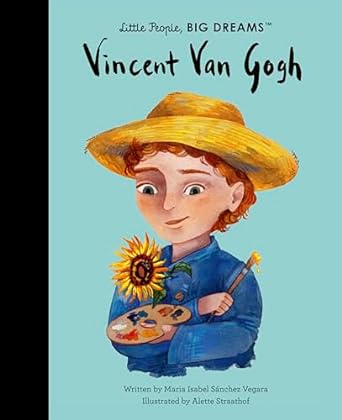
    Little People, BIG DREAMS series: VINCENT VAN GOGH, great troubled artist, & ROALD DAHL, great troubling writer


    VINCENT VAN GOGH
    MARIA ISABEL SÁNCHEZ VEGARA
    (Little People,BIG DREAMS series; illus. Alette Straathof)
    Frances Lincoln Children's Books (non-affiliate Amazon link)
    $15.99 hardcover, available now

    Rating: 5* of five

    The Publisher Says: Learn about the life of Vincent van Gogh, one of the world's most influential and best-loved artists.

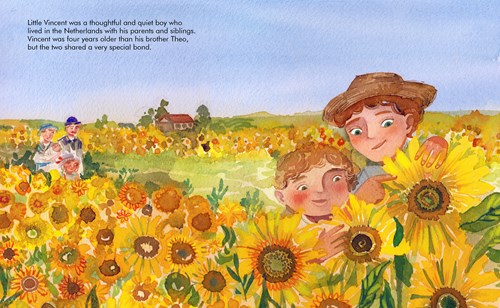
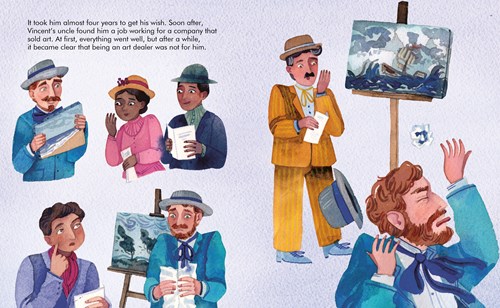
    Little Vincent was a quiet child. He loved spending time in nature and playing with his brother Theo. After leaving school, he began working as an art dealer. Vincent showed promise, but he found it more and more difficult to control his emotions and eventually had to leave. He had a go at many different jobs, including a teacher and a bookseller, but nothing felt right.

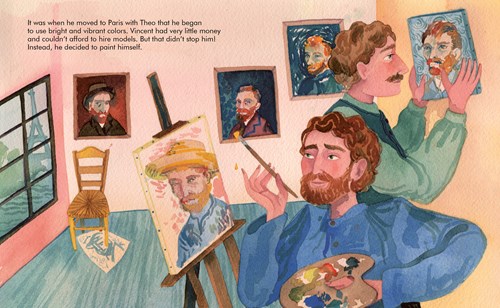
    When he wasn’t working, he wrote Theo long letters that included beautiful drawings. Theo loved his work and suggested that he try being an artist. Vincent dedicated himself to painting and never looked back! He developed his own style and expressed his emotions through his art: from sorrow to joy, and everything in between.

    During his life, Vincent had little success, but today, his paintings are admired and celebrated in galleries across the world.

    This powerful book features stylish and quirky illustrations and extra facts at the back, including a biographical timeline with historical photos and a detailed profile of the artist's life.

    Little People, BIG DREAMS is a bestselling biography series for kids that explores the lives of outstanding people, from designers and artists to scientists and activists. All of them achieved incredible things, yet each began life as a child with a dream.

    This empowering series of books offers inspiring messages to children of all ages, in a range of formats. The board books are told in simple sentences, perfect for reading aloud to babies and toddlers. The hardcover and paperback versions present expanded stories for beginning readers. With rewritten text for older children, the treasuries each bring together a multitude of dreamers in a single volume. You can also collect a selection of the books by theme in boxed gift sets. Activity books and a journal provide even more ways to make the lives of these role models accessible to children.

    Inspire the next generation of outstanding people who will change the world with Little People, BIG DREAMS!

    I RECEIVED A DRC FROM THE PUBLISHER VIA EDELWEISS+. THANK YOU.

    My Review
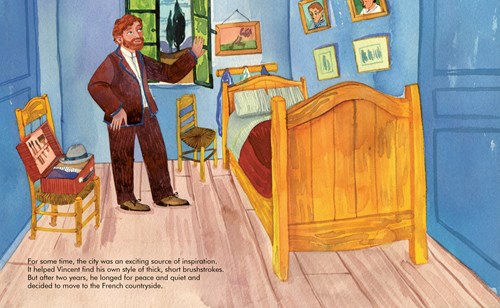
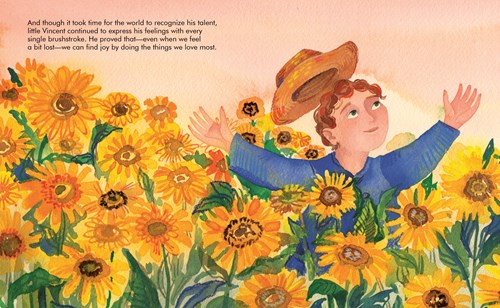
    : You don't need to be told who van Gogh is. (I hope.) A kid who's got the world to learn does, and here's a way for you to help that happen. A series like this has so many good layers: facts about the world, facts about life as others lead it, examples of what we as a culture value.

    The value here is obvious, I trust:

    Gorgeous as artworks, pitch perfect as illustrations of van Gogh's life...which is ably recounted by Sánchez Vegara's simple but effective text...this small person's excellent introduction to the life of one of the present day's most venerated artists adds luster to a terrific series.

    Worth reading yourself. An absolute must for your grand/nibling's education in art, biography, and the value of being Different in a conformist world.

    +++++++++++++++++++++++++++++++++++++++++++++++++++++++++++++++


    ROALD DAHL
    MARIA ISABEL SÁNCHEZ VEGARA
    Little People,BIG DREAMS series; illus. Francis Martin)
    Frances Lincoln Children's Books(non-affiliate Amazon link)
    $15.99 hardcover, available now

    Rating: 5* of five

    The Publisher Says: Discover the life of Roald Dahl, the groundbreaking author whose work is beloved by children all over the world.

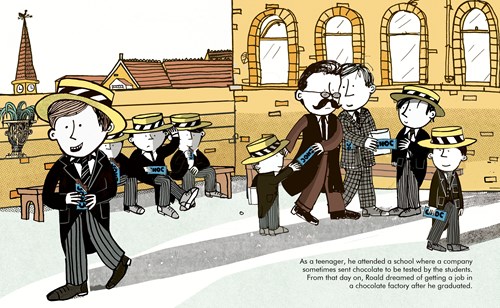
    Little Roald grew up in the city of Cardiff in Wales. He loved to spend time reading with his family and visiting the local candy store for yummy chocolatey treats. But he found school difficult. No one believed in Roald’s potential.

    When Roald finished school, he was ready to make his life an adventure! He traveled the world and saw some amazing sights. When World War II started, he was ready to serve his country and joined the air force. During his service, his plane crashed over a desert, leaving him blind for a period of time. Roald wrote about his experience of the crash, and enjoyed doing it so much that from then on, he knew he wanted to be an author.

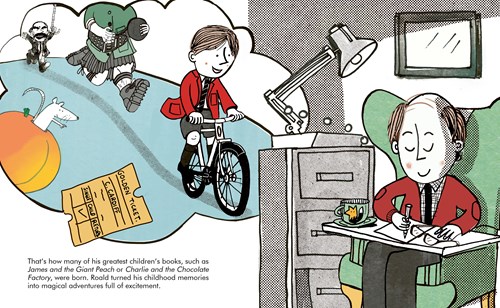
    Roald began crafting books for children, working away in the shed at the bottom of his garden. From Charlie and the Chocolate Factory to James and the Giant Peach, his wonderful stories have captivated generations of readers. The magical worlds he created have been brought to the stage and screen, with hit musicals and films, like Matilda and The Witches.

    The story also boldly addresses the antisemitic remarks that Roald Dahl made during his lifetime, highlighting the power and impact that our words can have: both to delight or cause lasting harm.

    This thoughtful book features quirky illustrations and extra facts at the back, including a biographical timeline with historical photos and a detailed profile of Roald’s life. His story shows that extraordinary talent lies within each and every one of us.

    I RECEIVED A DRC FROM THE PUBLISHER VIA EDELWEISS+. THANK YOU.

    My Review
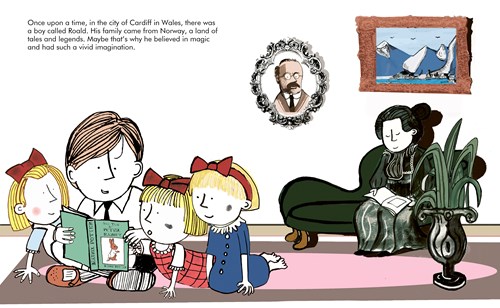
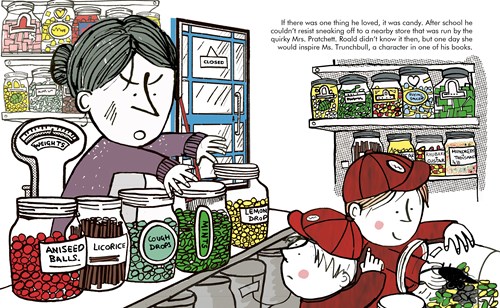
    : From the beginning, we're in possession of the facts of Dahl's troubling life. He was very much not a nice man, even by the lax standards of the day; he was hateful, and cruel to his wives, he wrote truly awful stereotypes into his books for children, and let's not discuss his adult fiction at all. Given the delight his children's books have brought on page and screen, it feels only right to introduce the children who will be in his audience to the real man.

    To do it honestly and without tendentious vilification, and in conjunction with æsthetically pleasing artwork, shows me how much thought and effort Quarto's children's imprint has put into this series of essential cultural figures' biographies.

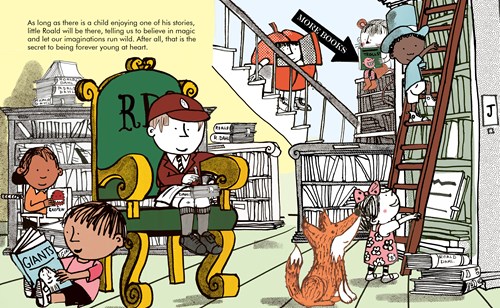
    Such a great match between illustrations and subject! Tey look like they could be from Dahl's heyday in the 1950s and 1960s. They're fresh, original, and in great keeping with the ethos Dahl worked within.

    Perfect for introducing those too young to get his work delivered directly to the ideas of it. Even better for those who have had some of his work read to them already to him as a person, as they can read it themselves. I remain troubled by Dahl and his unpleasant personality, and I'd recommend to you the giver of the book to check with the recipient's parents to be positive this body of work is acceptable for their child before committing even this minimal amount to procuring it.

    Monday, November 25, 2024

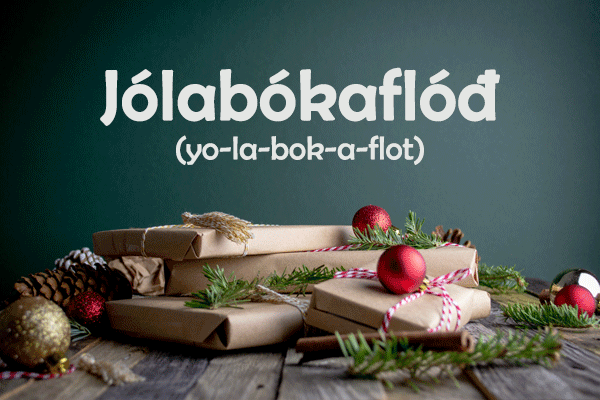
    It's #Booksgiving again...a version of the Jólabókaflóð Iceland loves!


    As we slide into another Turkey Day, I'm supposed to feel thankful for things by US custom. 2024 hasn't showered me with news or events or trends I feel at all accepting of, still less thankful for, and has taken away from me some comforting illusions about how resistant to manipulation, and how vigilant against lies and incitements of base urges, people are. Apparently all y'all gotta learn the hardest way there is to believe Them when They tell you what the plan is.


    Apparently 2024 is going to be a year where, in my struggle to find some hope if not happiness, it's going to be in pursuing a program based around #ReadingIsResistance...again. So I'm grateful for the beauty and the abundance and the variety of experience that lives in the books we have such a smorgasbord of available to us. (If we vigilantly protect our right to access it, of course.) The year had so many top-flight reads for me, in so many categories, that I didn't think I'd be able to squeeze them all into the few weeks between Turkey Day and Yule.


    Jólabókaflóðið is, this year, a more important holiday tradition to start than usual. I'm very distressed at how little books mean to modern kids. The best way I know to make books meaningful to these impressionable minds is to show them your own interest in the art of reading. Share books with kids every way you can. Buy them for your own kids and grands and niblings. Don't have the means, or the kids? Donate what you can afford to Dolly Parton's Imagination Library! In this era of crowdfunding, I really shouldn't need to explain the multiplicative effect of small donations.


    The Icelandic tradition began as a response to privation, as Lauren Oster wrote in Smithsonian Magazine:
    The Jólabókaflóð traces back to Iceland’s transformation in World War II. In 1944, Iceland was a newly independent nation with a beleaguered wartime economy and 15,000 occupying Allied troops. {Per Heiðar Ingi Svansson,the president of the Icelandic Publishers Association:} “Because of the bad economy and depression, there were quotas or very strict restrictions on many things you could import...that limited very much the selection of commodity goods that you could choose as Christmas gifts. But paper was one of the few commodities not rationed during the war—so paper was imported to produce books that were written and then printed in Iceland.” That fortuitous supply—and an infusion of occupation-related money—dovetailed beautifully with Icelanders’ literary leanings.

    Their tradition of reading together on long winter nights without any other entertainment is, of course, very much not the media landscape we in the West now inhabit. There's no denying, however, that the looming economic threats presented by the incoming administration's stated goal of raising tariffs on consumer goods bids fair to make books a vastly more appealing and affordable gift for all your giftees, of all ages.


    I'll focus #Booksgiving, as has been my habit, on books as gifts in the first part of the lead-up to Yule. I hope the books I'm excited about will excite you, too, and suggest themselves as gifts for your circle of loved ones.

    As the delivery times begin to bite, though, I'll shift to those things you can gift yourself as supplies to hoard against what my old friend Stasia contends is the imminent "Worldwide Book Famine" that looms over every librocubicularist's nightmares. My very first suggestion, and my 2024 pick for the six-stars-of-five peak reading experience, can't be anything other than the unforgettable, thrilling GLORIOUS EXPLOITS by the Irish debut novelist FERDIA LENNON. He took the absolutely grim fate of defeated Athenian soldiers in the quarries of Syracuse, infused it with hope and a kind of energy not usually found in Classical stories retold, and made it fresh thereby. I have thought about this story, in its oddly fitting Irish intonations, as the year has unfolded very, very much against my preferences and needs. I felt ever-greater kinship with these beleaguered, even doomed men as they sought respite from their hopeless circumstances. Even among the victors their belief in the power of creative storytelling to alleviate misery and offer what comfort there can be in the darkest of times found resonances.

    There is always hope for our shared humanity to come through, and come together.


    Still missing my dear, departed Dutch friend Anita.

    This #Booksgiving, then, is unusually relevant to the need we as readers should all feel to make a positive difference in our world. The best way, bar none, to do this is to model values that are crucial to the mental health of the world: tolerance, kindness, communication, and acceptance. I'll say to the inevitable complainer that tolerance does NOT include the intolerant in its circumference. This is called the paradox of tolerance, and it is a refutation in fact of "both-sides"ism. During this Holiday-rich season, you're going to face someone (quite possibly someone you love) who will trot out this long-disproven fallacy with the triumphant air of one who has struck a killer blow. This is the moment where #ReadingIsResistance shows its worth. Read up in advance; the list of books I've reviewed includes stuff from the technocratic through the popularized to the expanded listicle, all replete with rejoinders to that entrenched bunkerized ignorance.


    This #Booksgiving review blast being a standing tradition on my blog, I'll suggest that you browse your way through past reviews, looking at the books I've included under the tag since 2017. The list is self-updating, and can be accessed here.


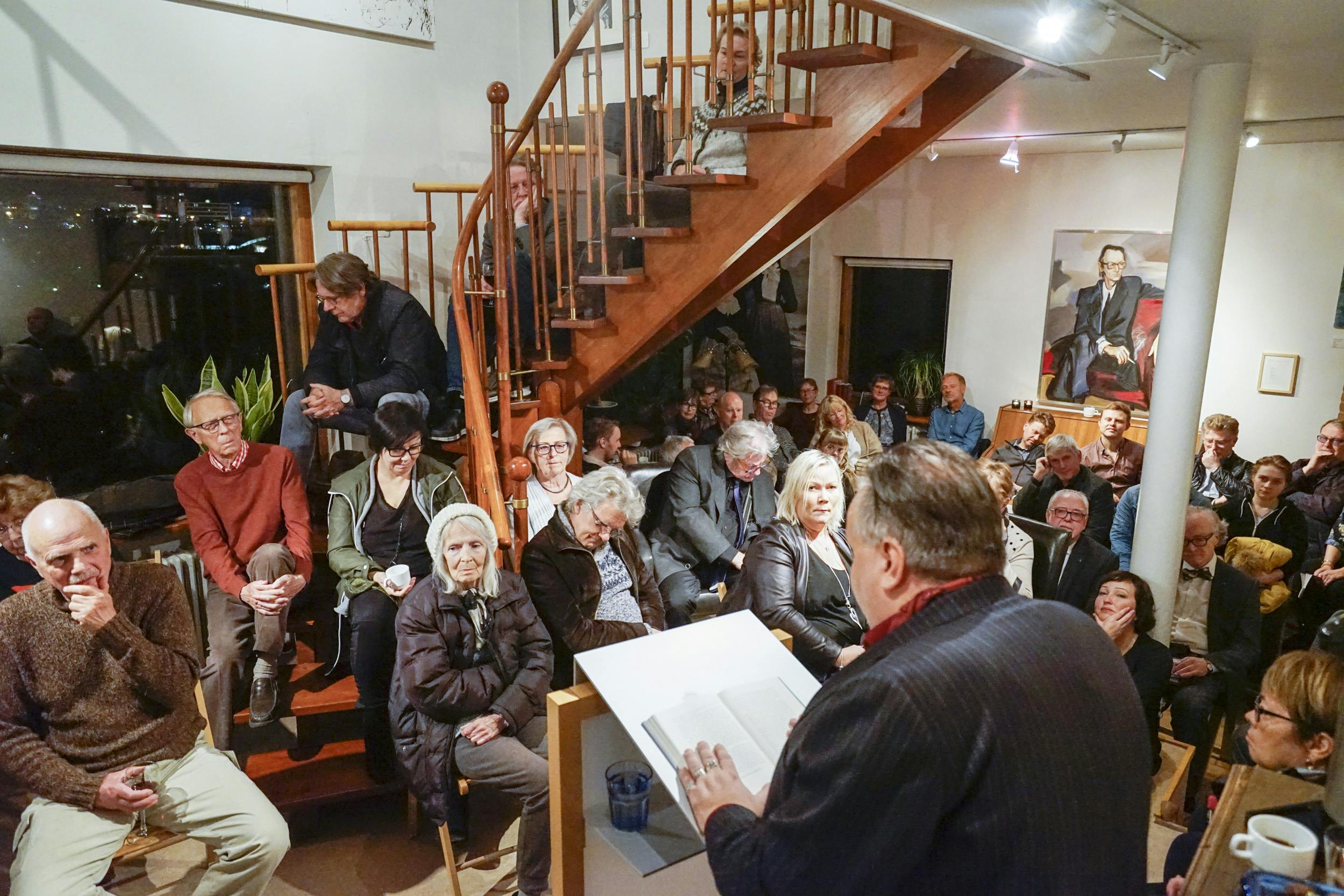
    An author book reading in December at Gunnarshús, the home of the Writers’ Union of Iceland.

    In a world of Lady Bracknells, strive instead to be Cecily Cardew.

    Thursday, August 31, 2017

    WATER FOR ELEPHANTS, a rare film adaptation that does the book justice


    WATER FOR ELEPHANTS
    SARA GRUEN

    Algonquin Books of Chapel Hill
    $14.95 trade paper, available now

    Rating: 3* of five

    The Publisher Says: Though he may not speak of them, the memories still dwell inside Jacob Jankowski’s ninety-something-year-old mind. Memories of himself as a young man, tossed by fate onto a rickety train that was home to the Benzini Brothers Most Spectacular Show on Earth. Memories of a world filled with freaks and clowns, with wonder and pain and anger and passion; a world with its own narrow, irrational rules, its own way of life, and its own way of death. The world of the circus: to Jacob it was both salvation and a living hell.

    Jacob was there because his luck had run out—orphaned and penniless, he had no direction until he landed on this locomotive “ship of fools.” It was the early part of the Great Depression, and everyone in this third-rate circus was lucky to have any job at all. Marlena, the star of the equestrian act, was there because she fell in love with the wrong man, a handsome circus boss with a wide mean streak. And Rosie the elephant was there because she was the great gray hope, the new act that was going to be the salvation of the circus; the only problem was, Rosie didn’t have an act—in fact, she couldn’t even follow instructions. The bond that grew among this unlikely trio was one of love and trust, and ultimately, it was their only hope for survival.

    Surprising, poignant, and funny, Water for Elephants is that rare novel with a story so engrossing, one is reluctant to put it down; with characters so engaging, they continue to live long after the last page has been turned; with a world built of wonder, a world so real, one starts to breathe its air.

    My Review: I don't want to give anyone the wrong impression here. I am not a sentimental old softie whose external resemblance to a conker

    is meant to scare off the timid.

    But books about old folks remembering their bittersweet pasts, books about people caring for and about the animals that they share their lives with, and books about losing your beloved far too damned soon in life do drive a teensy-tinsy little wedge into my sharp green spikes, revealing what I laughingly refer to as a "heart" for the briefest of moments.

    Without spoilering anything, the clue I will give you to my rating of this novel is that all three stars are for Rosie.

    When this book came out in 2006, it was a huge smash success. Sara Gruen touched a nerve with her evocation of the 1930s traveling-circus world. People resonated like rung bells from one end of the US to the other. I read the book then, and reacquainted myself with it recently, to remember what it was that caused the ruckus.
    Age is a terrible thief. Just when you're getting the hang of life, it knocks your legs out from under you and stoops your back. It makes you ache and muddies your head and silently spreads cancer throughout your spouse.
    ***
    Although there are times I'd give anything to have her back, I'm glad she went first. Losing her was like being cleft down the middle. It was the moment it all ended for me, and I wouldn't have wanted her to go through that.
    I think many, if not most, of the book's fans really resonate with these assessments. I know I do. It's not the most original kind of observation ever made but it's presented in a pleasantly conversational tone, one that gives the meaning precedence over the words.

    Gruen also has Jacob thinking through the problems of great age. Since the main body of the story is set quite a long time ago, Jacob gets to tell us his story unchallenged. His memories may be unreliable, how would we know?, but he gives them to us with gusto and a charming smile. That's what we all hope to do, isn't it, give the younger folks coming behind us a reason to smile as we share what we have stored in our Random Access Memory?
    My platitudes don't hold their interest and I can hardly blame them for that. My real stories are all out of date. So what if I can speak firsthand about the Spanish flu, the advent of the automobile, world wars, cold wars, guerrilla wars, and Sputnik — that's all ancient history now. What else do I have to offer? Nothing happens to me anymore. That’s the reality of getting old, and I guess that’s really the crux of the matter. I’m not ready to be old yet.
    ***
    Sometimes when you get older — and I’m not talking about you, I’m talking generally, because everyone ages differently — things you think on and wish on start to seem real. And then you believe them, and before you know it they’re part of your history, and if someone challenges you on them and says they’re not true — why, then you get offended because you can’t remember the first part. All you know is that you’ve been called a liar.
    It's an indignity perpetrated on most of us by the vast legions of those addicted to Being Right. Really, I want to say to the I'm Right And Don't You Forget It judges, give it a rest. Believe me when I tell you your own turn in the unreliable memory chair is coming soon. It's better to treat those memories other folks choose to share with you as their stories and not be ready to hop on the Being Right Soapbox. It's a theme that Gruen seems to me to be developing, though rather in the breach than the observance.

    So these quotes give you a fair sampling of the book's storytelling voice. These ideas are the ones that Gruen really bears down hard on exploring in Jacob's voice. So why am I giving all the stars to Rosie? Because this elephant, though she never utters a word, is the most vibrantly alive character in the book. Jacob is any-old-man. Rosie is not, I promise you, any old elephant! And the pleasure of Jacob and Rosie having their relationship makes this a book I didn't mind revisiting. The love affair that is the primary catalyst of all the story's action, that between Marlena and Jacob, centers on Rosie as Marlena performs her act for the circus with Rosie. Jacob, the vet, is Rosie's constant companion. Rosie is, in my mind at least, the real star of the circus and the book.

    In 2011, Reese Witherspoon and Robert Pattinson added a layer to the book's luster by embodying (damn near perfectly, in my never-humble opinion) Marlena and Jacob, the star-crossed lovers at the human heart of the tale. I'm no great fan of ~meh~ movie adaptations to popular books. I've generally got some choice invective for incompetent or poorly handled film versions of books. This adaptation is one I felt got the tone, the indefinable something that made the book such a success, right. The adaptation is also visually stunning, simply pitch-perfect in its period details and an immersive delight to watch.

    The one problem I had with both the book and the movie is a big one: I didn't buy the love story in either medium. I just do not get the sense that Jacob really had the grand passion for Marlena that's reported everywhere in the text and the script. I certainly don't think Ms. Witherspoon and Mr. Pattinson were attracted to each other. That kept cropping up in the way of my full investment in the story.

    Rotten Tomatoes, the internet movie-review aggregator, counts this as a mostly-fresh release. Its total number of professional reviews is a whopping 191, making its Fresh rating of 60% quite impressive. 68,000 regular civilians who use Rotten Tomatoes to track their film likes and dislikes give the adaptation Fresh ratings 70% of the time. 1.1 million ratings on Goodreads average 4.07 out of five for the novel. No matter the medium, the message to the audience comes through loud and clear, and the audience agrees with it. That, my friends, is called "huge success" and deserves the rewards thereof.

    The reading group guide lives here, free to download.